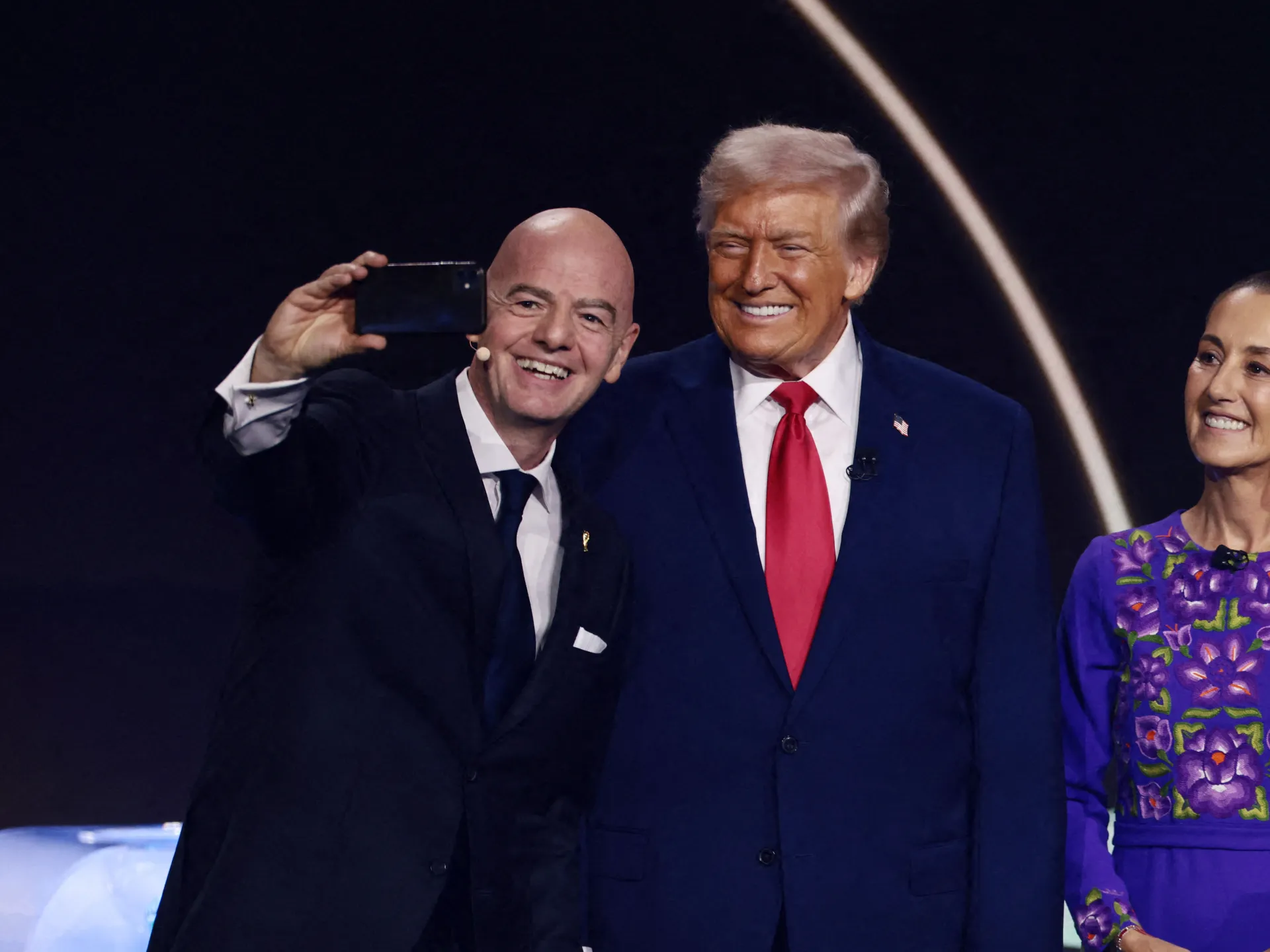
US President Donald Trump is sending senior negotiators to meet Vladimir Putin to push for a deal to end Russia’s war with Ukraine. Special envoy Steve Witkoff is expected to travel to Moscow next week, with Jared Kushner also involved in the process.
South Korean President Lee Jae Myung (L) warned of the risk of accidental clashes with North Korea during a press briefing aboard the presidential flight from Johannesburg, South Africa, to Ankara, Turkey, on Sunday. Photo by Yonhap
President Lee Jae Myung has warned risks of accidental clashes with North Korea, saying Seoul must continue to make efforts with patience to resume dialogue with Pyongyang to reduce such risks.
Lee gave the assessment on inter-Korean relations at a press conference aboard his flight from Johannesburg to Ankara on Sunday (local time), as part of his four-nation trip to Africa and the Middle East.
Inter-Korean relations have turned extremely hostile and confrontational, and North Korea is engaging in very extreme actions without even the most basic level of trust,” Lee told reporters. “We are in a very dangerous situation where accidental clashes could break out at any time.”
He renewed his call for dialogue after Seoul proposed military talks to clarify the Military Demarcation Line (MDL), aimed at preventing unintended clashes near the border. The proposal came amid repeated incidents of North Korean soldiers briefly crossing the MDL while clearing land or laying mines in the buffer zone.
Lee noted that the North has been installing triple layers of barbed wire along the MDL, raising the risk of warning-fire incidents amid differing views on the precise border line.
“With all communication channels severed, even if an accidental clash occurs, there is no way to resolve it,” he said.
To ease tensions on the Korean Peninsula, Lee underscored the need to push for dialogue with Pyongyang even if it remains unresponsive.
While reaffirming unification with North Korea is South Korea’s ultimate goal, Lee said it must be approached from a long-term perspective.
“We have no intention of pursuing unification by absorption,” he said, emphasizing that discussions on unification should come only after dialogue resumes and peaceful coexistence is established.
Asked whether South Korea could consider curtailing its joint military drills with the United States to bring Pyongyang to the negotiating table, Lee said it is premature to draw conclusions, calling the matter “the most sensitive” issue for North Korea.
He said that while a stable peace regime in which large-scale exercises are unnecessary would be desirable in the long term, decisions on drills should depend on evolving circumstances.
“If a stable peace regime is firmly established between the two Koreas, it would be desirable not to conduct the drills,” he said. “Depending on the situation, reducing or postponing the exercises could become either the result of building a peace regime or leverage to help create one. It is difficult to say at this moment which it will be.”
Pyongyang has long denounced the Seoul-Washington exercises as “war rehearsals,” while the allies claim they are defensive in nature.
On relations with China, Lee reiterated that South Korea should stably manage ties with its largest trading partner while advancing the alliance with the U.S. to a strategic comprehensive one encompassing the economy and technology.
“The basic principle of our diplomacy is the Korea-U.S. alliance, while stably managing relations with China,” he said. “The foundation of this approach is pragmatic diplomacy centered on national interests. I have clearly communicated this principle to both the U.S. and China.”
Regarding the diplomatic row between Beijing and Tokyo over Japanese Prime Minister Sanae Takaichi’s recent remarks on Taiwan, Lee called for a “cool-headed approach” guided by national interest.
He said he held separate talks with Takaichi and Chinese Premier Li Qiang on the sidelines of the Group of 20 (G20) summit in South Africa to prevent misunderstandings or conflict.
“I have explained our position in the two meetings,” he said, adding that “there are no additional risk factors” in South Korea’s relations with the neighboring nations.
South Korea, China and Japan reportedly had consultations to arrange their first trilateral summit since May 2024. But the outlook for trilateral engagement remains cloudy amid a diplomatic row between Tokyo and Beijing.
Lee said leaders he met on the sidelines of the G20 summit in South Africa and visits to the United Arab Emirates (UAE) and Egypt showed strong interest in South Korea’s defense industry.
“In particular, they were interested in joint development, production, sales and exploring new markets,” he said.
He expressed optimism in clinching a major defense deal from the UAE following his summit with President Mohamed bin Zayed Al Nahyan last week.
Lee also said Egyptian President Abdel Fattah El-Sisi outlined plans to expand Cairo International Airport under an estimated cost of around 3-4 trillion won (US$2-2.7 billion), while expressing hope that Korean companies would join the project to overhaul and operate it.
In Johannesburg, Indian Prime Minister Narendra Modi proposed establishing a cooperative framework in the shipbuilding industry involving South Korea, Japan and India, Lee added.
Ahead of his summit with Turkish President Recep Tayyip Erdogan on Monday, Lee said he wants to highlight Korea’s advanced nuclear energy capability to promote the state-run Korea Electric Power Corp. (KEPCO)’s bid to win a new nuclear plant project in Turkey.
In 2023, KEPCO submitted a preliminary bid to Turkey’s project to build its second nuclear power plant in Sinop on the Black Sea coast.
Copyright (c) Yonhap News Agency prohibits its content from being redistributed or reprinted without consent, and forbids the content from being learned and used by artificial intelligence systems.
Weekly insights and analysis on the latest developments in military technology, strategy, and foreign policy.
With the first example of Boeing’s F-47 sixth-generation stealth fighter for the U.S. Air Force now in production, a company official has highlighted how its prototyping effort allowed the program to move forward at a rapid pace. Winning the Next Generation Air Dominance (NGAD) program was “humbling,” said Steve Parker, president and CEO of Boeing Defense, Space and Security. He added that the fact that the F-47 is now in production is a testament to “the maturity of our design and pedigree coming off the prototype.”
Parker was speaking at a pre-show media roundtable ahead of the 2025 Dubai Airshow in the United Arab Emirates that TWZ attended.
Parker described the NGAD award as “transformational” for Boeing and added that it’s “tracking well.”
An official rendering of the Air Force’s sixth-generation fighter, the F-47. U.S. Air Force graphic Secretary of the Air Force Publi
While the Air Force has said that it aims to have the F-47 make its first flight sometime in 2028, Parker was unwilling to talk more about this.
“I won’t even touch the first flight day the Air Force has put the date out there; I’m just going to stay away from all of that,” Parker said. “It’s all about execution, and that’s what is getting all of my attention. We’re in a good spot.”
F-22 Raptors over Alaska. U.S. Air Force Staff Sgt. James Richardson
Parker underscored the importance of Boeing’s secretive Phantom Works, the company’s leading-edge design house that is modeled roughly on Lockheed’s legendary Skunk Works, in moving the F-47 program forward.
“I put Phantom Works together as its own division last year, and so that’s playing out really, really well,” Parker explained.
The fact that the first aircraft is in production “is really kind of remarkable when you think about this award was only provided in March of this year,” Parker said.
Especially interesting was Parker’s reference to the “maturity” of the design, pointing to extensive testing not only in the digital realm but also involving a flying prototype.
When Boeing secured the NGAD crewed fighter contract earlier this year, Air Force Chief of Staff David Allvin released a statement saying that, “For the past five years, the X-planes for this aircraft have been quietly laying the foundation for the F-47 — flying hundreds of hours, testing cutting-edge concepts, and proving that we can push the envelope of technology with confidence.”
Gen. David Allvin, who was Air Force Chief of Staff from 2023 to 2025. U.S. Air Force photo by Eric Dietrich Eric Dietrich
Back in 2023, unconfirmed reports emerged that at least three NGAD demonstrators were in existence. Certainly, there were separate examples from Boeing and Lockheed Martin. At least one demonstrator was flying as early as 2019, and another joined the NGAD program in 2022.
Details of these aircraft remain practically non-existent, but the Boeing prototype (or possibly prototypes) clearly played a key role in getting the F-47 program off to a rapid start.
The few details that we do know include those that have been provided by the Defense Advanced Research Projects Agency (DARPA), which stated that both Boeing’s and Lockheed Martin’s X-planes flew “several hundred hours each” during the NGAD evaluation.
Meanwhile, Former Secretary of the Air Force Frank Kendall went on the record to also stress that the demonstrators were entirely experimental demonstrator aircraft and not reflective of a production prototype for a “tactical design.”
Speaking in Dubai, Boeing’s Parker also put forward the case for the F-47 program being an exemplar for Secretary of War Pete Hegseth’s “arsenal of freedom,” his plan to totally overhaul the way the U.S. military buys weapons, with speed being at its core.
Secretary of War Pete Hegseth delivers recorded remarks from his office at the Pentagon in Washington, D.C., earlier this year. DoD photo by U.S. Navy Petty Officer 1st Class Alexander Kubitza Petty Officer 1st Class Alexander Kubitza
“Here you have an example with the F-47 where Boeing is building highly classified facilities in the billions of dollars of our own investment, before we actually won the contract: That is the very different definition of what the Secretary is asking for.”
Boeing previously made major investments to expand its operations in St. Louis, Missouri, to prepare for sixth-generation fighter production. This might include new fighters for the Air Force and Navy.
Parker also touched upon Boeing’s prospects for the Navy’s F/A-XX next-generation carrier-based fighter competition. A rendering that the company recently released of its F/A-XX proposal has a number of similarities with previous renderings of the F-47, as you can read more about here.
A rendering of Boeing’s F/A-XX proposal for the U.S. Navy, which shares some similarities with what has been shown of the F-47. Boeing
Of the FA-XX, Parker said: “Still no decision has been made yet, but we are ready to go if it comes.”
As for those F-47 renderings, only two official ones have been released, and Air Force officials have said they do not necessarily fully reflect what the aircraft looks like in real life, for operational security purposes.
We will have to wait for further details, as well as firm confirmation of what the F-47 actually looks like. However, that wait shouldn’t be too long, with the Air Force anticipating a first flight before the end of 2028, and with Boeing officials confident that the program is moving forward at a pace.
Oanaminthe, Haiti – It’s a Monday afternoon at the Foi et Joie school in rural northeast Haiti, and the grounds are a swirl of khaki and blue uniforms, as hundreds of children run around after lunch.
In front of the headmaster’s office, a tall man in a baseball cap stands in the shade of a mango tree.
Antoine Nelson, 43, is the father of five children in the school. He’s also one of the small-scale farmers growing the beans, plantains, okra, papaya and other produce served for lunch here, and he has arrived to help deliver food.
“I sell what the school serves,” Nelson explained. “It’s an advantage for me as a parent.”
Nelson is among the more than 32,000 farmers across Haiti whose produce goes to the World Food Programme, a United Nations agency, for distribution to local schools.
Together, the farmers feed an estimated 600,000 students each day.
Their work is part of a shift in how the World Food Programme operates in Haiti, the most impoverished country in the Western Hemisphere.
Rather than solely importing food to crisis-ravaged regions, the UN organisation has also worked to increase its collaborations with local farmers around the world.
But in Haiti, this change has been particularly swift. Over the last decade, the World Food Programme went from sourcing no school meals from within Haiti to procuring approximately 72 percent locally. It aims to reach 100 percent by 2030.
The organisation’s local procurement of emergency food aid also increased significantly during the same period.
This year, however, has brought new hurdles. In the first months of President Donald Trump’s second term, the United States has slashed funding for the World Food Programme.
The agency announced in October it faces a financial shortfall of $44m in Haiti alone over the next six months.
And the need for assistance continues to grow. Gang violence has shuttered public services, choked off roadways, and displaced more than a million people.
A record 5.7 million Haitians are facing “acute levels of hunger” as of October — more than the World Food Programme is able to reach.
“Needs continue to outpace resources,” Wanja Kaaria, the programme’s director in Haiti, said in a recent statement. “We simply don’t have the resources to meet all the growing needs.”
But for Nelson, outreach efforts like the school lunch programme have been a lifeline.
Before his involvement, he remembers days when he could not afford to feed his children breakfast or give them lunch money for school.
“They wouldn’t take in what the teacher was saying because they were hungry,” he said. “But now, when the school gives food, they retain whatever the teacher says. It helps the children advance in school.”
Now, experts warn some food assistance programmes could disappear if funding continues to dwindle — potentially turning back the clock on efforts to empower Haitian farmers.
WASHINGTON — President Trump has pardoned his former personal lawyer Rudy Giuliani, his onetime chief of staff Mark Meadows and others accused of backing the Republican’s efforts to overturn the 2020 election.
The “full, complete, and unconditional” pardon for dozens of Trump allies are largely symbolic. It applies only to federal crimes, and none of the people named in the proclamation were charged federally over the bid to subvert the election won by Democrat Joe Biden. It doesn’t affect state charges, though state prosecutions stemming from the 2020 election have hit a dead end or are just limping along.
Ed Martin, the Department of Justice’s point person on pardons and a former lawyer for the Jan. 6 defendants, linked his announcement of the pardons to a post on X that read “No MAGA left behind.”
Also named were Republicans who acted as fake electors for Trump and were charged in state cases accusing them of submitting false certificates that confirmed they were legitimate electors despite Biden’s victory in those states.
The pardon described efforts to prosecute the Trump allies as “a grave national injustice perpetrated on the American people” and said the pardons were designed to continue “the process of national reconciliation.” Giuliani and others have denied any wrongdoing, arguing they were simply challenging an election they believed was tainted by fraud.
“These great Americans were persecuted and put through hell by the Biden Administration for challenging an election, which is the cornerstone of democracy,” White House press secretary Karoline Leavitt said in an emailed statement.
Those pardoned were not prosecuted by the Biden administration, however. They were charged only by state prosecutors who operate separately from the Justice Department.
An Associated Press investigation after the 2020 election found 475 cases of potential voter fraud across the six battleground states, far too few to change the outcome.
Impact of the pardons is limited
Giuliani, a former New York City mayor, was one of the most vocal supporters of Trump’s unsubstantiated claims of large-scale voter fraud after the 2020 election. He also is an example of the limited impact of the pardons.
Giuliani has been disbarred in Washington, D.C., and New York over his advocacy of Trump’s bogus election claims and lost a $148-million defamation case brought by two former Georgia election workers whose lives were upended by conspiracy theories he pushed. Since pardons only absolve people from legal responsibility for federal crimes, they’re unlikely to ease Giuliani’s legal woes.
Ted Goodman, a spokesperson for Giuliani, said the former mayor “never sought a pardon but is deeply grateful for President Trump’s decision.”
“Mayor Rudy Giuliani stands by his work following the 2020 presidential election, when he responded to the legitimate concerns of thousands of everyday Americans,” Goodman said in an emailed statement.
While the pardons may have no immediate legal impact, experts warned they send a dangerous message for future elections.
“It is a complete abdication of the responsibility of the federal government to ensure we don’t have future attempts to overturn elections,” said Rick Hasen, a UCLA law professor. “Ultimately, the message it sends is, ‘We’ll take care of you when the time comes.’”
Some pardoned were co-conspirators in Trump’s federal case
Trump himself was indicted on federal felony charges accusing him of working to overturn his 2020 election defeat, but the case brought by Justice Department special counsel Jack Smith was abandoned in November after Trump’s victory over Democrat Kamala Harris because of the department’s policy against prosecuting sitting presidents. Giuliani, Powell, Eastman and Clark were alleged co-conspirators in the federal case brought against Trump but were never charged with federal crimes.
Giuliani, Meadows and others named in the proclamation had been charged by prosecutors in Georgia, Arizona, Michigan, Nevada and Wisconsin over the 2020 election, but the cases have repeatedly hit roadblocks or have been dismissed. A judge in September dismissed the Michigan case against 15 Republicans accused of attempting to falsely certify Trump as the winner of the election in that battleground state.
Eastman, a former dean of Chapman University Fowler School of Law in Southern California, was a close adviser to Trump in the wake of the 2020 election and wrote a memo laying out steps Vice President Mike Pence could take to stop the counting of electoral votes while presiding over Congress’ joint session on Jan. 6 to keep Trump in office.
Clark, who is now overseeing a federal regulatory office, also is facing possible disbarment in Washington over his advocacy of Trump’s claims. Clark clashed with Justice Department superiors over a letter he drafted after the 2020 election that said the department was investigating “various irregularities” and had identified “significant concerns” that may have affected the election in Georgia and other states.
Clark said in a social media post Monday that he “did nothing wrong” and “shouldn’t have had to battle this witch hunt for 4+ years.”
Richer writes for the Associated Press. AP reporter Nicholas Riccardi in Denver contributed to this report.
Former President Donald Trump is pictured in this photo provided by the Fulton County Sheriff’s Office in Atlanta on August 24, 2023. Trump surrendered on a 13-count indictment for efforts to overturn the results of the 2020 election in Georgia. Photo courtesy of Fulton County Sheriff’s Office/UPI | License Photo
Nov. 10 (UPI) — President Donald Trump is pardoning Rudy Giuliani, Sidney Powell and dozens of other allies who have been accused of trying to subvert the 2020 election, according to U.S. Pardon Attorney Ed Martin.
The list of 77 people pardoned by Trump was published late Sunday on Martin’s personal X account.
“No MAGA left behind,” he said.
The proclamation signed by Trump was dated Friday.
“This proclamation ends a grave national injustice perpetrated upon the American people following the 2020 presidential election and continues the process of national reconciliation,” the document states.
Those pardoned were tied to efforts to overturn the 2020 election, including participation in what has become known as the fake electors scheme. The strategy involved the creation of false slates of pro-Trump electors in every battleground state that he lost to Biden, including Georgia.
Among those pardoned were four of Trump’s 17 co-defendants in a case concerning the effort in Georgia, including Kenneth Chesebro, the alleged architect of the scheme. Powell, Scott Hall and Jenna Ellis were the other three.
Trump, who was among those charged in Georgia, was specifically not granted a pardon.
“This pardon does not apply to the president of the United States,” the document states.
Others granted pardons include Mark Meadows, Trump’s former chief of staff during his first term, and former Trump adviser John Eastman.
On his first day of his second term in office in January, Trump issued pardons and commutations of sentences for more than 1,500 people convicted for their participation in the January 6, 2021, insurrection at the U.S. Capitol, including those who injured police officers.
He has also issued pardons to former Illinois Gov. Rod Blagojevich, convicted on corruption charges, former Hunter Biden business partner Devon Archer and former Las Vegas City Council member Michele Fiore.
Nov. 1 (UPI) — The nation’s 42 million recipients of Supplemental Nutrition Assistance Program benefits will have to wait for them to be restored after losing them on Saturday, which might take weeks.
The ongoing federal government shutdown has shut off funding for the SNAP program that enables recipients to buy food, but two federal judges on Friday ordered the Trump administration to continue it.
President Donald Trump on Friday night announced he is seeking ways to access funds to keep the program going as the federal government shutdown continues at least through Monday.
“I do not want Americans to go hungry just because the radical Democrats refuse to do the right thing and reopen the government,” Trump said Friday in a Truth Social post.
Trump said the two federal judges issued conflicting rulingsand he does not think the federal government legally can access available funds to cover SNAP costs.
“I have instructed our lawyers to ask the court to clarify how we can legally fund SNAP as soon as possible,” he said.
“Even if we get immediate guidance, it will unfortunately be delayed while states get the money out.”
U.S. District Court of Rhode Island Judge John McConnell Jr.was one of the two judges who ordered the SNAP benefits to continue despite the shutdown.
On Saturday, he responded to the president’s post by ordering the Trump administration to access $6 billion in contingency funds for SNAP benefits.
“There is no question that the congressionally approved contingency funds must be used now because of the shutdown,” McConnell wrote Saturday in a seven-page order.
The contingency fund is too little to cover the full $9 billion monthly cost of providing SNAP benefits, but SNAP is an entitlement that the federal government must provide to all eligible households, he said.
“To ensure the quick, orderly and efficient implementation of the court’s order … and to alleviate the irreparable harm that the court found exists without timely payment of SNAP benefits, the government should … find the additional funds necessary to fully fund the November SNAP payments,” McConnell ruled.
He ordered the Trump administration to make at least a partial payment of SNAP benefits by Wednesday and to report how it intends to do so by noon EST on Monday.
The Trump administration said it will take several days and possibly longer to get funds to the respective states and cover the benefits for those who don’t receive them this month.
If the government shutdown continues into December, the problem starts over again with no contingency funds available.