edwin díaz

How Edwin Díaz regained the Dodgers’ trust in the postseason

When Edwin Díaz envisioned his first season with the Dodgers, it looked nothing like this. He was going to stay healthy all year, pitch like an All-Star. He certainly was going to throw in more than 21 regular-season appearances.

A slew of injuries, with mechanical issues layered on top, had other plans. But everything resets in the postseason. And against the odds, the right-hander is back in the closer conversation.

“It means a lot,” Díaz said in a conversation with the Times Monday. “Because I was nowhere, basically this season. They gave me the last week and a half of the season to come and pitch. And I was ready every day.”

If he can keep pitching the way he has since returning from the IL in September, it’ll strengthen the Dodgers’ chances at a three-peat. They went into the postseason with a closer-by-committee approach. But manager Dave Roberts said before the Dodgers’ workout at Truist Park on Monday that they could get to a consistent closer by the end of the postseason.

“Certainly that last outing was as good as we’ve seen him throw, and it’s hard to imagine throwing any better,” Roberts said of Díaz’s perfect inning against the Atlanta Braves Sunday, which included three fastballs over 100 mph. “We built him up, regained the confidence in himself. So, I think that it’s certainly a viable option for [Tuesday] night. I feel very confident [with] him finishing a game.”

Though his first postseason outing for the Dodgers was in the sixth inning of Game 2 of the National League Division Series, Díaz has been mainly in high leverage in his playoff career — he owns a 2.19 ERA in nine postseason appearances. The former Mets closer even recorded a four-out save at Dodger Stadium in Game 2 of the 2024 National League Championship Series.

“I don’t try to think, ‘Oh, there’s many thousands of fans here,” he said. “Just me against the hitter, and I trust myself. And like I always tell myself, ‘You are a warrior, you are you are the best, and go and compete.’”

The Dodgers’ closer situation has been in flux all year. They had signed Díaz to a three-year, $69 million contract with that role in mind. And even when he missed three months for arthroscopic surgery to remove loose bodies from his elbow, and lefty Tanner Scott took over in the ninth inning, the spot was open for Díaz when he returned.

That was not the case after his second IL stint. And it was during that month-long road back that he finally re-found himself on the mound.

“I was like this maybe in the [World Baseball Classic] and first couple games early in the year before I got hurt,” Diaz said. “But now I feel way better than everything. So I think this is the best I ever felt this year.”

The process started with treating his neck. Díaz was feeling tightness around the front side of his right trapezius muscle, which could have contributed to Díaz dropping his arm angle. He received medication and needling therapy to address the issue, he said.

Trainers used manual manipulation to find Diaz’ ideal arm slot and build muscle memory, and he was quickly cleared to resume throwing.

“I’ve been doing that for so long, I just lost it for a little,” Díaz said of his arm angle. “And we’ve got a really good group of coaches right here, and they found it right away.”

Díaz began a rehab assignment with Triple-A Oklahoma City in early September. But it wasn’t smooth sailing. In his fourth outing, Díaz issued three walks and surrendered five runs in just two-thirds of an inning.

“I got mad at myself because I knew I was better than that,” Díaz said. “I wasn’t able to control my fastball. So after that game, I talked to the pitching coaches in Triple-A to say, ‘We need to find something because I want to be back in the big-leagues, I want to help this team to win.’”

They dug into Díaz’ biomechanics and found that his hip position was different from last year. When he’s right, Díaz explained, his leg lift starts with his hip. But he’d begun to rush the move, which caused his arm to lag behind.

He threw a bullpen with the adjustment and then took it into one final rehab appearance, a one-hit outing.

“I told the team, ‘I’m ready to go,’” Díaz said.

He sure was. Díaz posted a spotless ERA in six games down the stretch, limiting opponents to one hit combined. And that success carried into his Dodgers postseason debut.

“He’s put himself in a position to be the closer,” Roberts said. “And in October, I don’t pay too much attention to the long sample of a season in a lot of cases because in October things happen quickly, and you’ve got to be willing to read and react.”

For Díaz, the season may not have gone as planned, but his vision of the next few weeks is as clear as ever. He wants to record the final out of the World Series.

“I know how to control my emotions,” he said. “I learned that during my career, and I’m pretty good at that. I just can’t wait to be in that position, and if I’m in there, I will give my 100%.”

Source link

Dodgers aren’t fretting over lack of designated playoff closer

Stop me if you’ve heard this a million times, but the Dodgers are trying to become the first team to win three consecutive World Series championships since the New York Yankees, from 1998 to 2000.

Those Yankees had a Hall of Fame closer. In 1998, Mariano Rivera got the final four outs of the clincher. In 1999, he got the final four outs. In 2000, he got the final three outs.

These Dodgers? Their closer? Your guess is as good as theirs.

“I do not know,” said Andrew Friedman, the Dodgers’ president of baseball operations.

This might be a good time to know, no? The regular season is over. The postseason is upon us.

“I feel very confident that we’re going to be going into October with arguably the deepest and best pitching staff that we’ve had,” he said. “Exactly what their roles will be and how things will be ordered, I don’t know right now.”

Perhaps the Dodgers are overthinking this. They have done that before.

Tanner Scott converted 25 of 29 save opportunities this season, including saves Friday and Saturday.

But the strongest hitters on the Dodgers’ possible division series opponents are left-handed — Matt Olson, Drake Baldwin and Michael Harris II on the Atlanta Braves; Bryce Harper and Kyle Schwarber on the Philadelphia Phillies — and the Dodgers may not hesitate to use the left-handed Scott against those guys in the seventh or eighth inning.

In theory, these Dodgers have three candidates as closer: Scott, their marquee closer signing for 2025 and actual closer for most of 2026; Edwin Díaz, their marquee closer signing for 2026; and Roki Sasaki, their accidental closer last October.

Yet Friedman said he could envision scenarios where Evan Phillips could close, or even Brock Stewart, or perhaps Alex Vesia against a run of left-handed hitters. The Dodgers hope to activate Edgardo Henriquez for the playoffs. The starters could close, too, especially a well-rested Tyler Glasnow early in the first round.

“We’ve got a number of guys that we really trust,” Friedman said. “Depending on who we’re playing, how deep our starter goes, there are a lot of factors that would go into it. But, more than who will be that pitcher on the mound, is the fact that we have so many candidates we feel really good about.”

That the Dodgers have improvised an October relief corps, transformed a rookie starter into a postseason closer and run bullpen games in elimination games might lead you to conclude Friedman does not really believe in the concept of a designated closer. In a world where “high leverage” is the trendy jargon, maybe a closer is more of an anachronism than a necessity.

That the Dodgers invested $72 million in Scott and $69 million in Díaz in consecutive winters would lead you to conclude Friedman does indeed believe in the concept of a designated closer. In fact, he does.

“I think it’s extremely helpful,” he said.

The Dodgers do not hold splashy news conferences to introduce closer candidates. When the Dodgers introduced Díaz last December, Friedman proudly introduced the three-time All-Star as the closer.

“For us, we have a high bar,” Friedman said then. “To name someone the closer, you have to be one of the best. You have to be elite and dominant at what you do.”

Díaz’s season went awry, limited to 18⅔ innings after elbow surgery and then a neck injury. But in five September appearances since his activation from the injured list, he gave up no runs and one hit in five innings, striking out nine of the 17 batters he faced. (In the same span, Scott has given up no runs and two hits in five innings, striking out nine of the 19 batters he faced.)

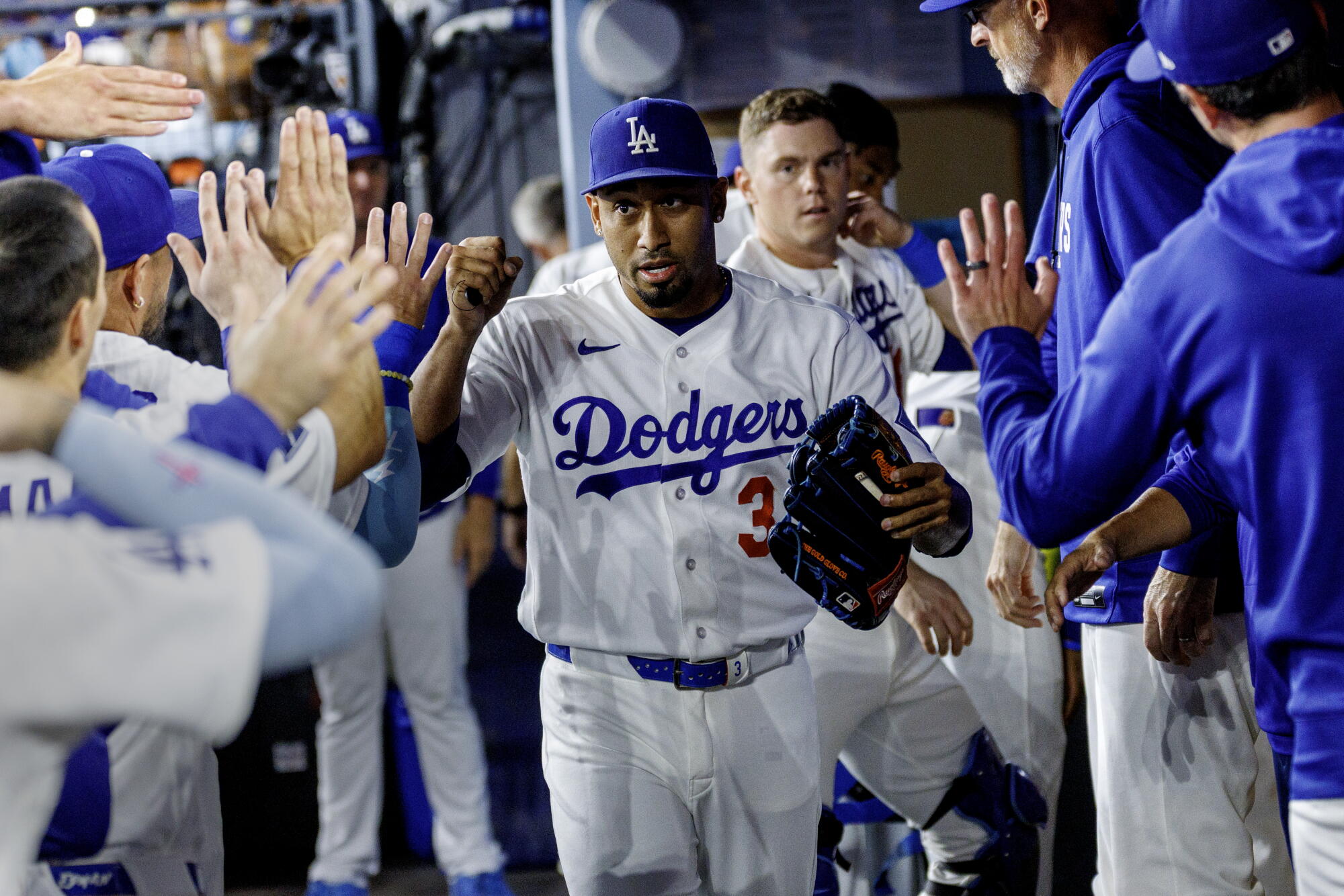
Dodgers reliever Edwin Díaz high-fives teammates in the dugout after pitching against the San Diego Padres.

Dodgers reliever Edwin Díaz high-fives teammates in the dugout after pitching against the San Diego Padres on Sept. 22.

(Gina Ferazzi / Los Angeles Times)

“What we’ve seen out of Díaz recently has been really encouraging,” Dodgers manager Dave Roberts said. “What that ultimately means, we don’t know yet.

“Of course, if you have a reliever who is really hot in October, that can be extremely valuable. It doesn’t mean you use him exclusively in the ninth. But, by and large, that’s how you would use him.”

Roberts saluted Díaz for working hard to get back to an uncertain assignment.

“I’m really proud of Edwin, given the deal he signed, to work it out, to go to the minors, to come back and pitch in whatever role we ask of him, that shows a lot of character,” Roberts said.

“He could have mailed this year in. That’s something that has not gone unnoticed. And we’ll see how October plays out.”

The Dodgers could be forgiven for believing it will all work out in the end. Their final pitcher in each of the World Series clinchers under Friedman, all starters: Julio Urías in 2020, Walker Buehler in 2024, Yoshinobu Yamamoto in 2025.

The pitchers to record a postseason save in those championship seasons: Kenley Jansen, Joe Kelly, Brusdar Graterol, Blake Treinen and Urias in 2020; Alex Vesia, Treinen and Buehler in 2024; Glasnow, Sasaki and Treinen in 2025.

The organizational flexibility can lead to some uncomfortable discussions within the clubhouse, as Roberts and coaches keep the relievers updated on the latest plan for how they might be used.

“It is tricky,” Roberts said. “These are constant conversations. They are ever-evolving. They are ongoing.”

If all goes right for the Dodgers, those conversations will be ongoing for another month.

Source link