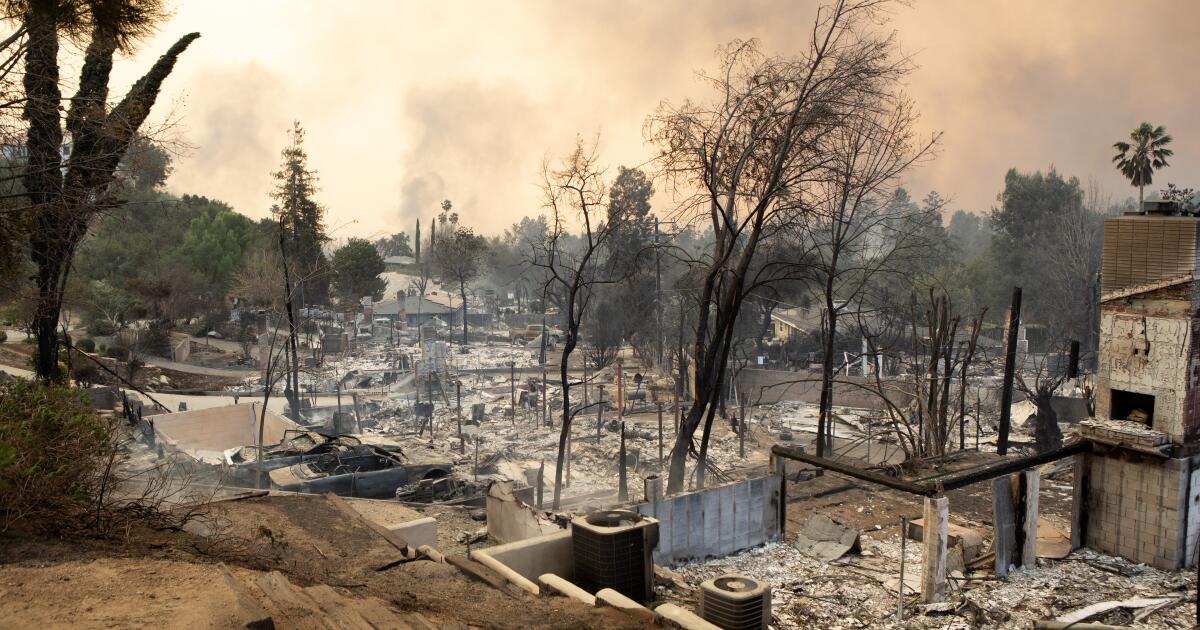
Outside a hall where Southern California Edison was celebrating Black History Month on Friday, a group of Altadena residents stood on the sidewalk, waving signs and talking of the homes and family members they lost in last year’s Eaton fire.
“They’re in there celebrating Black history and they’ve destroyed a Black town,” said Nicole Vasquez of My Tribe Rise, which helped organize the protest.
The Jan. 7, 2025 fire destroyed thousands of homes, including the majority of homes in west Altadena, a historically Black community. All but one of the 19 people who died were in west Altadena.
“If Edison’s tower did not ignite the fire, Altadena would still be there,” said Trevor Howard Kelley, who lost his 83-year-old mother, Erliene, in the fire.
Kelley, his daughter and two granddaughters had been living with his mother before her home was destroyed, he said.
The Black Altadena residents are part of a larger coalition that is asking Edison to advance each family who lost their home $200,000 in emergency housing assistance. They say that more than a year after the blaze many wildfire survivors are running out of the funds they had received from insurers.
The group protesting Friday also called for transparency from Edison. The company has said it believes it is likely its equipment caused the fire but has continued to deny it did anything wrong.
“We just want the truth,” said Felicia Ford, who lost her house in the fire. “What’s wrong with saying, ‘We got this wrong.’”
Scott Johnson, an Edison spokesperson, said Friday that the company continued to believe its voluntary compensation program was the best way to help victims of the fire. Edison has promised to quickly review each victim’s claim and pay it swiftly if approved.
Families who lost their homes can receive hundreds of thousands of dollars under the program, while those with damaged homes receive lesser amounts.
But many survivors say they don’t believe the offered amounts fully compensate their losses. And to receive the money, victims must agree not to sue — which many are not willing to do.
“We recognize the incredible struggles the community has faced,” Johnson said. “The intent of the program is to reach final settlements to allow the community to rebuild and move on.”
The investigation into the cause of the fire has not yet been released. Edison has said a leading theory is that its century-old transmission line in Eaton Canyon, which had not carried electricity for 50 years, somehow became reenergized and sparked the fire.
Company executives said they did not remove the old line because they believed it would be used in the future.
Tru Williams said he just wants to get his parents back home.
(Myung J. Chun / Los Angeles Times)
In December, state regulators ordered Edison to identify fire risks on its 355 miles of out-of service transmission lines located in areas of high fire risk and tell regulators how executives planned to use the lines in the future.
The Los Angeles County District Attorney is investigating whether Southern California Edison should be criminally prosecuted for its actions in last year’s devastating Eaton wildfire, which killed 19 people and left thousands of families homeless, the company said Wednesday.
Pedro Pizarro, chief executive of Edison International, told Wall Street analysts during an afternoon conference call that the company was cooperating with the District Attorney’s office. He said he didn’t know the magnitude of the investigation.
The company said in its annual 10-K report, which was released Wednesday, that it “could be subject to material fines, penalties, or restitution” if the investigation “determined that it failed to comply with applicable laws and regulations.”
“SCE is not aware of any basis for felony liability with regards to the Eaton Fire,” the report said. “Any fines and penalties incurred in connection with the Eaton Fire will not be recoverable from insurance, from the Wildfire Fund, or through electric rates.”
The District Attorney’s office declined to comment.
The investigation into the fire, which destroyed a wide swath of Altadena, has not yet been released. Pizarro has said that a leading theory of the fire’s cause is that a century-old transmission line in Eaton Canyon, which had not carried power for 50 years, somehow re-energized and sparked the fire.
Edison executives have said they didn’t remove the line because they believed it would be used in the future.
Company executives knew idle transmission lines could spark wildfires. In 2019, investigators traced the Kincade fire in Sonoma County, which destroyed 374 homes and other structures, to a transmission line owned by Pacific Gas & Electric that was no longer in service.
The Times reported in December how Edison fell behind in maintenance of its transmission system before the fire.
Despite the dangerous Santa Ana wind conditions on Jan. 7, 2025, Edison decided not to shut down the transmission lines running through Eaton Canyon. Pizarro has said the winds that night didn’t meet the company’s threshold at the time for turning off the lines.
Pizarro told investors on the call Wednesday that he continued to believe that the company had acted as a “reasonable utility operator” before the deadly fire.
Under state law, if a utility is determined to have acted reasonably it can be reimbursed for all or most of the damages of the fire by a state wildfire fund.
Connor Cipolla, an Eaton wildfire survivor, last year praised Southern California Edison’s plan of burying more than 60 miles of electric lines in Altadena as it rebuilds to reduce the risk of fire.
Then he learned he would have to pay $20,000 to $40,000 to connect his home, which was damaged by smoke and ash, to Edison’s new underground line. A nearby neighbor received an estimate for $30,000, he said.
“Residents are so angry,” Cipolla said. “We were completely blindsided.”
Other residents have tracked the wooden stakes Edison workers put up, showing where crews will dig. They’ve found dozens of places where deep trenches are planned under oak and pine trees that survived the fire. In addition to the added costs they face, they fear many trees will die as crews cut their roots.
“The damage is being done now and it’s irreversible,” homeowner Robert Steller said, pointing Maiden Lane to where an Edison crew was working.
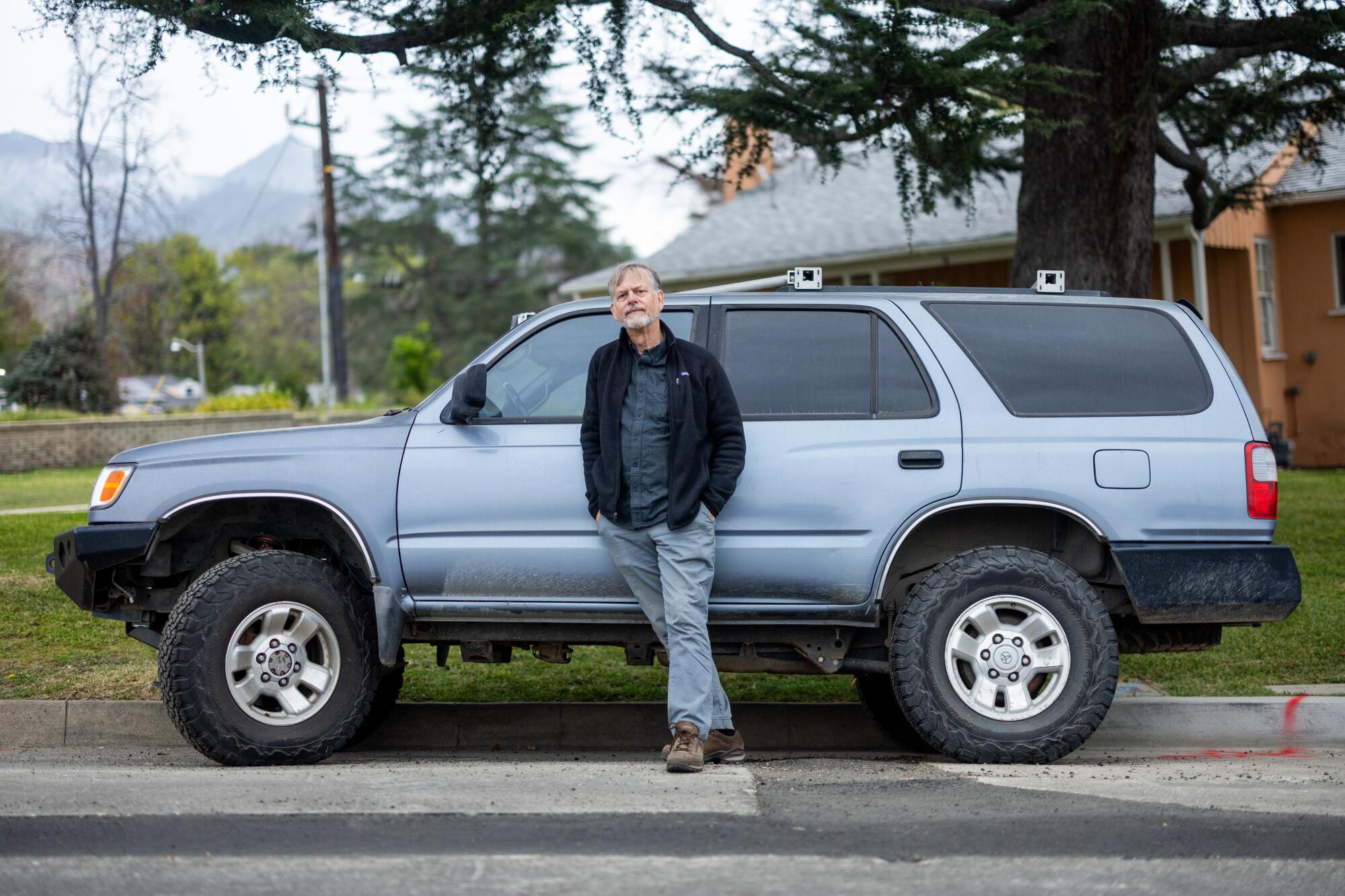
For a week, Steller, who lost his home in the fire, parked his Toyota 4Runner over a recently dug trench. He said he was trying to block Edison’s crew from burying a large transformer between two towering deodar cedar trees. The work would “be downright fatal” to the decades-old trees, he said.
Altadena resident Robert Steller stands in front of his Toyota 4Runner that he parked strategically to prevent a Southern California Edison crew from digging too close to two towering cedar trees.
(Ronaldo Bolaños / Los Angeles Times)
The buried lines are an upgrade that will make Altadena’s electrical grid safer and more reliable, Edison says, and it also will lower the risk that the company would have to black out Altadena neighborhoods during dangerous Santa Ana winds to prevent fires.
Brandon Tolentino, an Edison vice president, said the company was trying to find government or charity funding to help homeowners pay to connect to the buried lines. In the meantime, he said, Edison decided to allow owners of homes that survived the fire to keep their overhead connections until financial help was available.
Tolentino added that the company planned meetings to listen to residents’ concerns, including about the trees. He said crews were trained to stop work when they find tree roots and switch from using a backhoe to digging by hand to protect them.
“We’re minimizing the impact on the trees as we [put lines] underground or do any work in Altadena,” he said.
Although placing cables underground is a fire prevention measure, consumer advocates point out it’s not the most cost-effective step Edison can take to reduce the risk.
Undergrounding electric wires can cost more than $6 million per mile, according to the state Public Utilities Commission, far more than building overhead wires.
Because utility shareholders put up part of the money needed to pay for burying the lines, the expensive work means they will earn more profit. Last year, the commission agreed Edison investors could earn an annual return of 10.03% on that money.
Edison said in April it would spend as much as $925 million to underground and rebuild its grid in Altadena and Malibu, where the Palisades fire caused devastation. That amount of construction spending will earn Edison and its shareholders more than $70 million in profit before taxes — an amount billed to electric customers — in the first year, according to calculations by Mark Ellis, the former chief economist for Sempra, the parent company of Southern California Gas and San Diego Gas & Electric.
That annual return will continue over the decades while slowly decreasing each year as the assets are depreciated, Ellis said.
“They’re making a nice profit on this,” he said.
Tolentino said the company wasn’t doing the work to profit.
“The primary reason for undergrounding is the wildfire mitigation,” he said. “Our focus is supporting the community as they rebuild.”
It’s unclear if the Eaton fire would have been less disastrous if Altadena’s neighborhood power lines had been buried. The blaze ignited under Edison’s towering transmission lines that run down the mountainside in Eaton Canyon. Those lines carry bulk power through Edison’s territory. The power lines being put underground are the smaller distribution lines, which carry power to homes.
A power line outside the home of Altadena resident Connor Cipolla.
(Ronaldo Bolanos/Los Angeles Times)
The investigation into the fire’s cause has not yet been released. Edison says a leading theory is that one of the Eaton Canyon transmission lines, which hadn’t carried power for 50 years, might have briefly reenergized, sparking the blaze. The fire killed 19 people and destroyed more than 9,000 homes, businesses and other structures.
Edison said it has no plans to bury those transmission lines.
The high cost of undergrounding has become a contentious issue in Sacramento because, under state rules, most or all of it is billed to all customers of the utility.
Before the Eaton fire, Edison won praise from consumer advocates by installing insulated overhead wires that sharply cut the risk of the lines sparking a fire for a fraction of the cost. Since 2019, the company has installed more than 6,800 miles of the insulated wires.
“A dollar spent reconductoring with covered conductor provides … over four times as much value in wildfire risk mitigation as a dollar spent on underground conversion,” Edison said in testimony before the utilities commission in 2018.
By comparison, Pacific Gas & Electric has relied more on undergrounding its lines to reduce the risk of fire, pushing up customer utility bills. Now Edison has shifted to follow PG&E’s example.
Mark Toney, executive director of the the Utility Reform Network, a consumer group in San Francisco, said his staff estimates Edison spends $4 million per mile to underground wires compared with $800,000 per mile for installing insulated lines.
By burying more lines, customer bills and Edison’s profits could soar, Toney said.
“Five times the cost is equal to five times the profit,” he said.
Last spring, Pedro Pizarro, chief executive of Edison International, told Gov. Gavin Newsom about the company’s undergrounding plans in a letter. Pizarro wrote that rules at the utility commission would require Altadena and Malibu homeowners to pay to underground the electric wire from their property line to the panel on their house. He estimated it would cost $8,000 to $10,000 for each home.
Residents who need to dig long trenches may pay far more than that, said Cipolla, who is a member of the Altadena Town Council.
An oak tree stands tall in an area impacted by the Eaton fires. Homeowners worry such trees could be at risk in the undergrounding work.
(Ronaldo Bolanos/Los Angeles Times)
Last week, Cipolla showed a reporter the electrical panel on the back of his house, which is many yards away from where he needs to connect to Edison’s line. The company also initially wanted him to dig up the driveway he poured seven years ago, he said. Edison later agreed to a location that avoids the driveway.
Tolentino said Edison’s crews were working with homeowners concerned about the company’s planned locations for the buried lines.
“We understand it is a big cost and we’re looking at different sources to help them,” he said.
At the same time, some residents are fuming that, despite the undergrounding work, most of the town’s neighborhoods still will have overhead telecommunications lines. In other areas of the state, the telecommunications companies have worked with the electric utilities to bury all the lines, eliminating the visual clutter.
So far, the telecom companies have agreed to underground only a fraction of their lines in Altadena, Tolentino said.
Cipolla said Edison executives told him they eventually plan to chop off the top of new utility poles the company installed after the fire, leaving the lower portion that holds the telecom lines.
“There is no beautification aspect to it whatsoever,” Cipolla said.
As for the trees, Steller and other residents are asking Edison to adjust its construction map to avoid digging near those that remain after the fire. Altadena lost more than half of its tree cover in the blaze and as crews cleared lots of debris.
1
2
3
1.A pedestrian walks past Christmas Tree lane in Altadena. Christmas Tree Lane was officially listed in the National Register of Historic Places in 1990.2.A “We Love Altadena” sign hangs from a shrub on Christmas Tree Lane.3.Parts of a chopped down tree rest on a street curb in Altadena.
Wynne Wilson, a fire survivor and co-founder of Altadena Green, pointed out that the lot across the street from the giant cedar trees on Maiden Lane has no vegetation, making it a better place for Edison’s transformer.
“This is needless,” Wilson said. “People are dealing with so much. Is Edison thinking we won’t fight over this?”
Carolyn Hove, raising her voice to be heard over the crew operating a jackhammer in front of her home, asked: “How much more are we supposed to go through?”
Hove said she doesn’t blame the crews of subcontractors the utility hired, but Edison’s management.
“It’s bad enough our community was decimated by a fire Edison started,” she said. “We’re still very traumatized, and then to have this happen.”