economist

All eyes are on Fed chair Kevin Warsh’s first moves on interest rates

Ever since Kevin Warsh was nominated by President Trump in late January to lead the Federal Reserve, a question has lingered: Will he seek to raise interest rates to tame inflation or cut them as Trump has long demanded?

On Wednesday, Warsh may provide the first hints of an answer when he oversees his first Fed policy meeting as chair and holds a news conference afterward. Bond markets, which can swing sharply on a chair’s pronouncements, will be watching particularly closely for any signs of which way he leans.

“We expect the press conference to be pivotal,” Jonathan Pingle, an economist at investment bank UBS, wrote in a note. “This will be Kevin Warsh’s first public appearance as Chair. … We do not really know what his policy views are.”

Economists say Warsh will likely aim for a neutral approach, largely because he is taking over the Fed at a challenging time. Rising inflation has made it all but impossible for the Fed to cut interest rates anytime soon, which could stimulate growth and further raise prices. Hiring has improved noticeably since the beginning of the year, removing another key rationale for rate cuts. And the other 11 policymakers on the Fed’s rate-setting committee — including Warsh’s predecessor, former chair Jerome Powell — are split on whether an increase in the Fed’s key rate will be needed or if it can stay unchanged.

High inflation puts Fed in tough spot

Oil prices have fallen sharply on news that the U.S. and Iran have reached an initial deal to end their war, which could eventually cool inflation. Yet it’s unclear whether a permanent agreement can be reached.

“The right thing to do now is wait and see,” said William English, an economist at the Yale School of Management and a former top Fed economist.

Inflation has jumped to a three-year high of 4.2%, the government said last week, mostly because of higher gas prices. Even Trump has backed off a bit from his relentless demands for lower rates, and instead has argued that rate hikes — which the Fed undertakes to cool the economy and slow inflation — aren’t necessary.

In an interview earlier this month on NBC’s “Meet the Press,” Trump said, “Kevin is fantastic and I want him to do whatever he wants,” but added, “there’s no reason to raise rates.”

On Wednesday, the Fed is widely expected to keep its key rate at about 3.6%, where it has remained since last December. When the Fed reduces its rate, over time it can lower other borrowing costs for things like mortgages, auto loans, and business loans.

Changes likely to dash hopes for those seeking lower rates

Still, some changes are expected, which will disappoint those hoping for lower borrowing costs: The Fed is likely to drop language that suggests its next move will be a rate cut, and instead adopt wording that is more neutral. Several Fed policymakers in recent weeks have said that the Fed’s most likely next move is a hike, rather than a cut.

The central bank is also scheduled to release its quarterly economic projections, which include forecasts for how the Fed’s key rate will change over the next three years, on Wednesday. In March, those projections suggested the Fed would cut its rate once this year. Yet on Wednesday they will likely show no change in 2026, with maybe one or two cuts next year, economists say.

Warsh has criticized the projections for providing too much “forward guidance” to financial markets and leading Fed officials to stand by their forecasts for too long, even as the economy changes. Fed watchers will look closely to see if Warsh participates in the quarterly projections. If he doesn’t submit his own forecasts, it could be a sign he will seek to get rid of them entirely in the coming months.

Warsh to bring a new approach to Fed leadership

Outside of policy, Warsh is expected to bring a different style to the Fed than Powell, according to people who’ve worked with him. He wants Fed policymakers to give fewer speeches, have more debates behind closed doors and will likely avoid commenting on the daily ups and downs of the economy. Powell was relatively plainspoken and straightforward, while Warsh has suggested he sees the famously oracular Alan Greenspan, the Fed’s chair from 1987 to 2005, as a model.

“He’s just going to say less, because he doesn’t find that stuff very helpful,” said Robert Tetlow, a former senior policy adviser at the Fed.

Randall Kroszner, an economist at the University of Chicago who served on the Fed’s governing board from 2006 to 2009, when Warsh was also a governor, said the new chair would likely focus on bigger-picture questions, such as how AI will impact the economy. He will avoid thornier issues, such as whether tariffs raise inflation, which Powell was willing to address.

By avoiding such hot-button issues, the Fed could attract less negative attention from the White House, Kroszner said.

“He’s going to stay away from those,” Kroszner added. “If the Fed is to maintain its independence, it needs to maintain its focus.”

While seeking Trump’s nomination, Warsh called for “regime change” at the Fed and criticized the central bank for not preventing the 2021-22 inflation surge, when prices jumped 9.1% in a year, the biggest spike in four decades.

Yet Kroszner said Warsh will likely to seek to build consensus around changing things like the Fed’s communications policies, rather than imposing them. So far, former Fed officials say he hasn’t sought to fire top staff.

“He’s not there to break things,” Kroszner said.

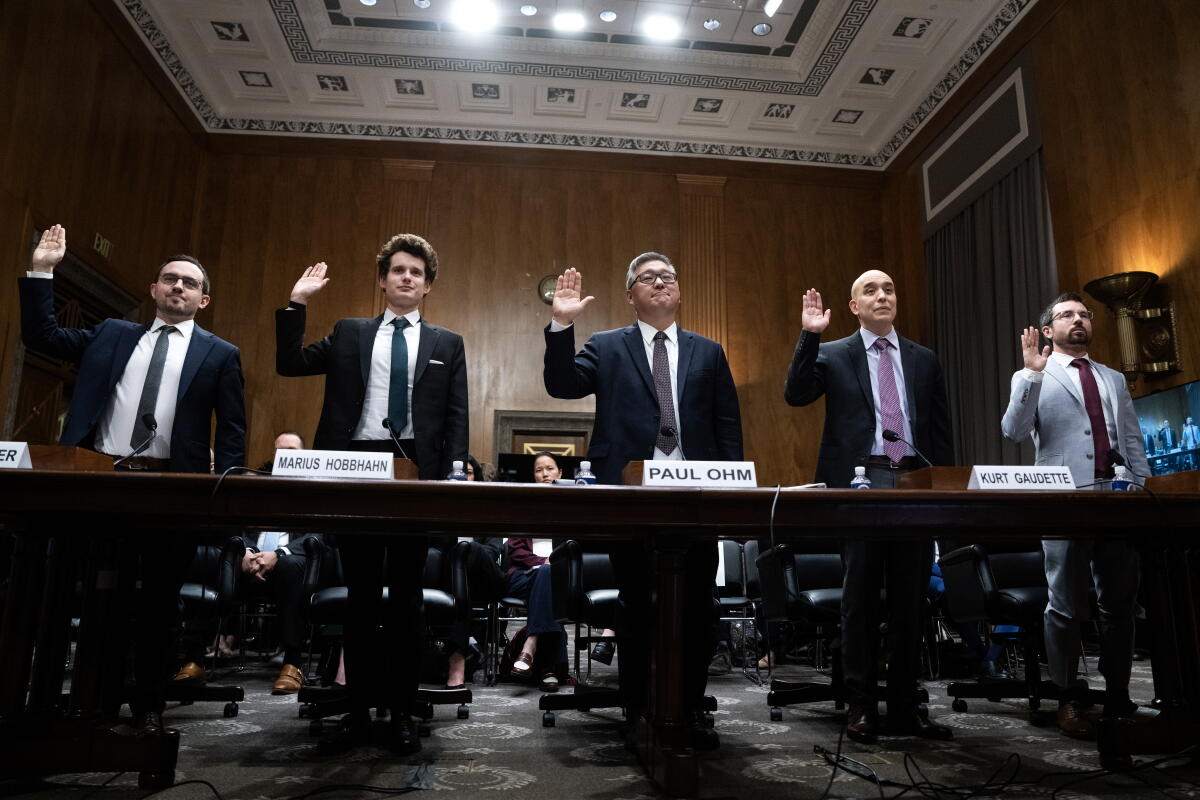
During his Senate confirmation hearing in April, Warsh said he would focus on quelling inflation.

“Inflation is a choice, and the Fed must take responsibility for it,” he said then.

If he acts on that sentiment by keeping rates unchanged — or even raising them — Trump could end up disappointed in another Fed chair. He often threatened to fire Powell, whom he also appointed, for not cutting rates deeply enough.

“There’s at least a risk here that six months down the road, Trump is fulminating about how he didn’t get what he wanted from Warsh, and he’d like to fire Warsh,” English said.

Rugaber writes for The Associated Press.

Source link

Eyeing Senate Seat : Economist Laffer: Life in Fast Lane

Arthur B. Laffer, professor, businessman and possible candidate for next year’s Republican nomination for the U.S. Senate from California, speeds down the freeway in his telephone-equipped BMW 733i, sipping a can of Diet Pepsi and reflecting on his life in the fast lane.

The impatient energizer of the nationwide tax-cut movement–a tenured professor at age 28, chief economist of the White House Office of Management and Budget at 29–has long prided himself on his ability to keep several balls in the air at once. But he acknowledges that his high-speed juggling act can sometimes get him in trouble.

“When you move very fast, you rustle the fields,” said Laffer, whose choirboy looks belie his 44 years. “You cause a commotion. Without meaning to, you create squalls.”

Controversial Figure

As a result, his life has been marked by controversy as well as achievement. Squalls spawned by Laffer’s frenetic pace have cost him a marriage and two college professorships.

Most recently, the designer of the Laffer Curve–which illustrates his disputed theory that cutting taxes can actually increase government revenues while a tax hike might reduce them–relinquished his post at USC’s School of Business Administration last September after a bitter dispute with the school’s dean. Toward the end, Laffer, who by all accounts is an excellent teacher, and the dean, Jack D. Steele, refused to even speak to each other.

USC blames Laffer’s schedule for the rupture. “With all his outside affairs, he was spreading himself too thin,” said Cornelius J. Pings, USC’s provost and senior vice president for academic affairs. “He just wasn’t meeting his obligations on campus.”

He Disputes View

Steele confirmed that Laffer’s extracurricular activities were a problem, although Laffer disputed that view.

As if to prove that he can run his $2.7-million-a-year economic consulting business and explore the possibility of seeking public office and advise President Reagan and teach, Laffer recently joined the faculty of Pepperdine University’s School of Business and Management. It was a step down in the academic world, though in many ways he and his new employer are well matched.

Pepperdine, founded in 1937 by a conservative auto-parts magnate, shares Laffer’s passion for the free enterprise system and his knack for self-promotion. Indeed, Pepperdine recently ran advertisements picturing “the renowned originator of the Laffer Curve” in the Wall Street Journal and The Times.

Although Laffer’s economic views mesh well with those of the Church of Christ-affiliated school, he is no fan of Pepperdine’s strait-laced social scene. Drinking is banned on campus and chapel attendance is mandatory.

Laffer, on the other hand, maintains an extensive cellar of German and California wines at his Rolling Hills Estates home. And, though raised as a Presbyterian, he doesn’t attend church–and says he won’t start should he decide to run for office.

About the only concession the plump professor has made to the image makers while testing the political waters has been to shed 15 pounds by substituting Very Vanilla Sego, a diet drink (“Yuk–I hate it!”), for his beloved sushi. Currently weighing in at 175, the 5-foot, 7-inch Laffer figures he has another 15 or 20 pounds to go.

Although considering a run for the Senate, Laffer is openly contemptuous of Congress. “If you look at congressmen and senators,” he tells audiences across the state, “you see a group who invariably prefer complex error over simple truth.” It is his biggest applause line. “If you ever saw what those guys actually did for a living, you’d recognize their banality and you’d throw them out of office.”

Six Children

Laffer’s personal life is as packed with activity as his professional one. Besides Traci, the 25-year-old second wife he fondly calls “my Valley girl” (she grew up in Ontario), the Laffer clan includes six children ranging in age from 6 months to 20 years, 15 rabbits, 10 parrots, 4 macaws, 3 tortoises, 2 horses, a Jack Russell terrier and a Norwegian blue fox. Laffer, an amateur biologist who once considered forsaking economics for a career in biology, manages to find time for all of them.

The menagerie used to be bigger. Fern, a pet weasel, drowned in the Laffers’ swimming pool, though her place in family folklore is secure. Laffer cackles when he remembers the time his daughter, Rachel, then 6, tossed the wriggling creature onto First Lady Nancy Reagan’s lap at a 1980 dinner party.

“I don’t think I’ve ever come so close to heart stoppage,” said Laffer, who at the time was trying to sell his supply-side theories to presidential candidate Ronald Reagan. “Everyone held their breath waiting to see how she’d react, but Mrs. Reagan was quite the lady about it.”

Unconventional Ideas

The economist revels in his new and unconventional ideas. He would reward elected officials and the head of the Federal Reserve Board with big bonuses when the economy booms and slash their salaries during recessions. He would wipe out the capital gains tax. He would amend the Constitution to provide for national referenda. And he would give $15,000, tax free, to the top 5% of scorers on the Scholastic Aptitude Test.

“Can you imagine if all of a sudden you could get out of the ghetto by studying instead of by playing basketball?” Laffer asked. “If you play basketball 16 hours a day, you become a great basketball player. If we could get these kids to study 16 hours a day, they’d become great students.”

Such schemes have won Laffer the friendship of “new ideas” Democrat Sen. Gary Hart of Colorado and the grudging admiration of some fellow economists. “Whatever you think of Laffer’s ideas, at least he thinks,” said Lester C. Thurow, a liberal professor of management and economics at Massachusetts Institute of Technology whose views often differ from Laffer’s.

Some say Laffer’s boyish looks and small stature could prove a liability should he decide to seek office. Characteristically, Laffer employs humor to disarm the size issue. In speeches, he invariably mentions flat-tax advocate Sen. Bill Bradley (D-N.J.), the former New York Knicks basketball star. Then, in his best Joan Rivers delivery, he adds: “It’s disgusting how tall he is.”

Penchant for One-Liners

Indeed, Laffer’s penchant for jokes and one-liners (sample: “The British pound is so weak that they’ve started calling it the ounce”) have led some to question his seriousness. Samuel Armacost, president and chief executive officer of BankAmerica Corp., recently quipped that a speech by Laffer “isn’t economics–it’s entertainment.” Laffer says he uses humor to make complex subjects palatable.

Although he is a polished speaker, Laffer appears to be reining in his glib, shoot-from-the-hip style. He disavows a 1981 comment embracing “the freedom to smoke pot if we want to.” Laffer acknowledged having made the remark, but said: “I think I was probably showing off at the time–trying to show you don’t have to be a conservative on all issues to favor tax cuts.”

Other Laffer views reflect his coming of age as an undergraduate at Yale and a graduate student at Stanford during the turbulent ‘60s. He staunchly opposes the draft, contending that Vietnam-era draft resisters were the spiritual ancestors of today’s anti-tax movement. “The draft is a specific tax on your body,” Laffer said.

Still, Laffer rarely wanders from economic matters in his speeches and articles. He strongly supports the concept of a flat tax, predicting that some sort of bill equalizing personal-income tax rates will emerge from Congress this year.

‘Enterprise Zones’

Another Laffer idea that has been picked up and championed by the Reagan Administration is the establishment of inner-city “enterprise zones.” Corporations locating factories in such zones would get big tax breaks and relief from minimum-wage and other regulations. The economist argues that setting up such zones would break the cycle of poverty and dependency in urban ghettos.

Despite Laffer’s emphasis on economics, mainstream economists and even conservative allies question the quality of his scholarship. “He really wasn’t interested in the life of a scholar,” said George Stigler, a professor at the University of Chicago’s Graduate School of Business, where Laffer held his first teaching job. “Doing painstaking, detailed work wasn’t his game. He went for quick and glamorous results.”

It was a trauma at Chicago, Laffer said, that turned him away from academia and pointed him toward the business and public policy arenas. In 1971, some colleagues at Chicago accused Laffer, who hadn’t yet earned his Ph.D. from Stanford, of misleading a faculty committee that had earlier promoted him to full professor.

Laffer quickly finished up his Stanford doctoral dissertation and got the degree. “It was just a question of dotting the i’s and crossing the t’s,” Laffer said, explaining that he never finished in the first place because he got swept away by his other commitments. A university committee headed by Stigler investigated the matter and found Laffer guilty of nothing worse than “carelessness,” Stigler says.

Career at a Standstill

Nonetheless, as Laffer tells it, lingering suspicion from the incident “put a stop to my career.” For the next five years, he didn’t get a raise at Chicago and academic journals shunned his articles. Suddenly, the boy wonder was a pariah. “So what do you do?” Laffer asked, “sit there and commit suicide? No, you find new avenues of expression.”

It was during this period that Laffer in 1974 sketched his now-famous curve for former journalist Jude Wanniski and an aide to President Gerald R. Ford on a cocktail napkin in a Washington restaurant. “He just scribbled it out,” Wanniski recalled, “and I thought it was a useful device for getting the message across.” The message (see chart) was a simple one: that cutting taxes could actually result in an increase in government revenues by creating incentives for people to work harder and save and invest more.

The curve didn’t gain notoriety until 1978, when Wanniski included it in his book “The Way the World Works: How Economies Fail and Succeed.” “At first,” Wanniski said, “Art was embarrassed by the name Laffer Curve–until he started to make a lot of money off it.”

Indeed, Laffer has used his high visibility to build his consulting company, A. B. Laffer Associates, into a multimillion-dollar enterprise with 20 full-time and 15 part-time employees. The firm has about 300 corporate clients who pay between $6,000 and $8,000 a year for Laffer’s economic analyses; special contracts added another $200,000 to the firm’s 1984 revenues, and about 85 speaking engagements by Laffer himself yielded $433,000.

Two Homes

Business profits and Laffer’s Pepperdine salary afford the family a comfortable life style in their antique-filled Rolling Hills Estates home and a 17-acre mountaintop retreat in Rancho Santa Fe. Such wealth is nothing new for Laffer; his late father was chairman of the board of Gould Inc., the big electronics concern, and young Arthur attended private day school in a prosperous Cleveland suburb before going on to Yale.

Despite Laffer’s commercial success, the jury is still out on his celebrated curve. Donald W. Kiefer, an economist with the Congressional Research Service, calls it “an overly simplistic approach which ignores complex economic relationships.” Critics say that the huge budget deficits that followed the Laffer-supported Kemp-Roth bill that reduced personal income taxes by 25% underscore the shortcomings of Laffer’s theory.

Laffer, on the other hand, blames delays in the tax cuts and increased government spending for the deficits. Besides, he argues, this year’s $200-billion deficit is neither “a crisis” nor “a panic situation” given the U.S. economy’s underlying vigor. Like Reagan (and unlike most economists), he believes that economic growth eventually will take care of the problem. Laffer gets to promote his economic views at periodic meetings of the President’s Economic Policy Advisory Board, of which he is a member.

Moved to California

In 1976, with his academic career going nowhere, Laffer gave up on Chicago and moved to USC. In California, he became a key supporter of 1978’s landmark real-estate tax-cutting initiative, Proposition 13. A year later, his first marriage broke up, the victim of Laffer’s four-day-a-week travel schedule. “I came home from a business trip and the kids told me my wife had been gone for three days,” Laffer recalled.

He met Traci Laffer when she was a political science major at USC moonlighting as a secretary to Dean Steele. The pair hit it off when they realized they shared a love for exotic birds. Laffer proposed to her in Paris and they were married in 1982 in an elaborate Beverly Hills wedding attended by 800 friends.

“I got a package deal,” Traci Laffer said, referring to the four children from Laffer’s previous marriage and the large collection of animals.

Laffer still travels frequently, often sleeping on “red eye” flights to the East Coast, doing his business and flying home that day. “He has this idea that you can, in effect, live two lives by cramming as much as possible into your finite number of years on Earth,” said Wanniski, who now operates his own competing economics consulting firm.

None of Laffer’s friends expect him to slow down anytime soon.

Source link