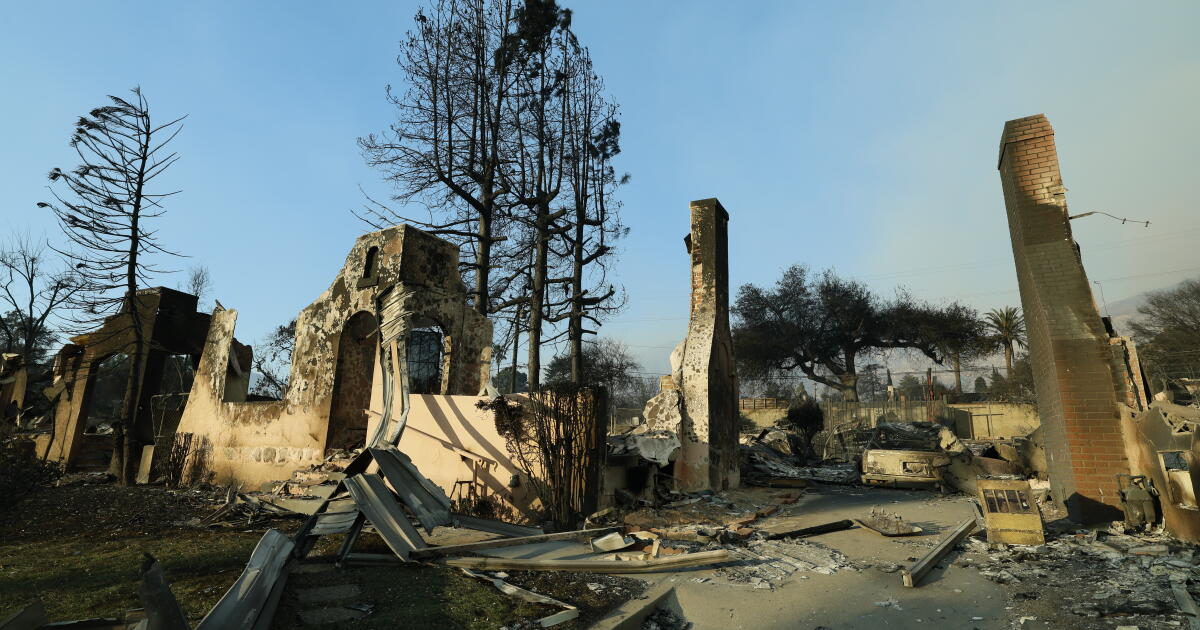
eaton fire

Newsom wildfire liability plan to hike insurance premiums, execs say

Insurance company executives warned Gov. Gavin Newsom in a letter Wednesday that his plan to shift utility wildfire liability to property insurers would raise premiums across California.

“The party whose equipment ignites a catastrophic fire should bear the economic consequence of that fire,” the 15 executives wrote. “Shifting those costs to policyholders does not reduce the cost of electricity but does make homeownership more expensive and insurance coverage harder to find.”

As the legislative session nears its end, Newsom’s staff and lawmakers have been negotiating behind closed doors on a deal to limit utilities’ wildfire liabilities.

According to a confidential document that Newsom’s staff sent to lawmakers and was obtained by Politico, the governor wants to stop property insurers from recouping their losses from homes destroyed in utility-sparked wildfires.

That could increase homeowners’ property insurance rates by as much as 50%, according to the Personal Insurance Federation of California. The highest hikes would be for those families living in severe fire risk areas.

“The proposal would shift billions of dollars in wildfire costs away from utilities and onto insurance consumers across the state, making coverage more expensive and harder to find,” said Denni Ritter at the American Property Casualty Insurance Assn.

Southern California Edison and the state’s two other big for-profit utilities have been lobbying Newsom and lawmakers to further shield them and their shareholders from wildfire liabilities ever since last year’s Eaton fire caused the price of their stock to tumble.

Government fire investigators said the fire, which killed 19 people and destroyed thousands of homes, was caused by electrical arcing on Edison’s out-of-service transmission line in Eaton Canyon. Edison kept the line in place despite not using it since 1971.

More than 11,000 households have filed suit against the utility, claiming it acted negligently, which the company denies.

Edison is offering settlements to victims of the Eaton fire. A $21-billion state wildfire fund that Newsom and lawmakers created in 2019 to protect the state’s three big utilities from bankruptcy after a fire is reimbursing Edison for its payments to victims.

At a press conference Wednesday, Newsom defended his plan, which also includes limiting the fees of attorneys in wildfire litigation and stopping hedge funds from profiting on the claims.

Newsom said that current law allows insurers to be paid before victims after a fire.

“The insurance industry is going to do everything to make sure they get paid first,” Newsom said.

No legislation has yet been filed to end what are called insurers’ subrogation claims. The legislative session ends Monday at midnight. The short time frame would allow for little public debate of a bill filed this week.

According to the document written by Newsom’s staff, the governor also proposed reducing amounts that local governments receive from utility-caused fires. The California State Assn. of Counties said that would shift costs to local taxpayers.

“Shifting wildfire costs to local governments is unjustified when utilities continue to generate significant profits and return billions to shareholders,” the association said in a brief recently sent to lawmakers.

Newsom also wants to reduce payments that fire victims can receive for non-economic damages including pain and suffering, angering victims of the Eaton fire.

More than 50 Eaton wildfire victims showed up to protest in front of the governor’s mansion on Monday night in Sacramento, where Newsom was holding an event for legislators.

They chanted, “Who should pay? Shareholders should pay!”

Source link

Key takeaways from investigation into Edison’s role in Eaton fire

Recently revealed evidence from government investigators and court filings renewed questions about Southern California Edison’s claim that it operated its electrical grid safely before last year’s deadly Eaton fire.

Most records surrounding the fire’s cause have been sealed at the request of Edison and plaintiff attorneys. Yet new details revealed in court show that critical fire prevention equipment needed repair before the blaze and that vegetation under the tower where it ignited hadn’t been trimmed for years.

Los Angeles County and state fire investigators cited eight violations, including three of California’s criminal code, in their report released on Aug. 4. The details were blacked out as the district attorney continues an investigation into the devastating fire.

“We don’t believe there is a basis for criminal liability and we will cooperate with any review,” said Kathleen Dunleavy, an Edison spokeswoman.

The investigators said in the report that the Jan. 7, 2025 inferno, which killed 19 people and destroyed more than 9,000 homes and other structures, was caused by electrical arcing on an out-of-service transmission line in Eaton Canyon, which caused hot metal fragments to fall into the dried vegetation below.

Here are key takeaways from the investigative report and recent court filings by lawyers representing fire victims:

Edison didn’t turn off power on its Eaton Canyon transmission lines, despite emergency conditions.

Before the fire, the National Weather Service predicted a “life-threatening” windstorm, investigators wrote in their report released Aug. 4. Santa Ana wind gusts were forecast to reach speeds of 60 to 80 miles per hour, with peak gusts of 90 miles per hour in the mountains.

Earlier that day, Gov. Gavin Newsom declared a state of emergency because of an out-of-control fire that was burning homes in Pacific Palisades.

Despite those conditions, Edison kept power flowing through its high-voltage transmission lines built in the mountains above Altadena. Investigators noted that wind gusts at a weather station about a half-mile from the Edison tower where the fire started recorded gusts up to 68 miles per hour just before the first flames at 6:11 p.m. By 7, gusts were up to 85 miles per hour.

Dunleavy said the conditions did not meet the company’s internal standards for shutting off the lines.

“SCE was actively monitoring the transmission lines in Eaton Canyon on Jan. 7 and none of these lines met our de-energization criteria,” Dunleavy said.

Safety equipment on the out-of-service line was damaged before the fire but not fixed.

Edison had installed safety equipment at both ends of the out-of-service, unconnected transmission line in Eaton Canyon, including at the pylon known as Tower 208 where the fire ignited. But on the night of the fire, the equipment was broken, according to a June court filing.

The equipment was designed to send any unexpected power on the out-of-service line safely into the earth. The grounding equipment was necessary because the idle Mesa-Sylmar line ran parallel to 12 energized high-voltage lines, creating the danger of induction.

Induction happens when electromagnetic fields cause power on energized lines to jump to nearby idle equipment.

At Tower 208, a component known as a compression paddle was not securely bonded to the pylon, allowing debris to form and creating a dangerous air pocket, the filing said. The paddle was meant to be secured with four bolts, but only one bolt was used.

Government fire investigators also found broken equipment at one of the Mesa-Sylmar towers during a tour of the site with Edison after the fire. According to their report, investigators observed “the center conductor dangling free from the bridge section of the tower; it appeared that the remaining two conductors were not bored down to the tower bridge.”

The investigators said they discussed the equipment “abnormalities” with an Edison lineman and lawyer on the tour. “The Lineman said that they were not new and were like this last year; he was also unsure why they were not corrected when it was inspected,” the investigators wrote.

Asked why the equipment was not fixed, Dunleavy said, “We’re looking into that.”

She said the company strives to have a strong maintenance and inspection program and still was performing post-fire examinations and testing.

Edison kept the century-old, out-of-service Mesa-Sylmar line in place for decades, despite knowing idle lines could reenergize and spark fires.

Utilities have known for decades that unused lines can become energized from nearby electrified equipment through the induction process.

To teach employees about the danger, Edison created a training video featuring a 2007 incident in which a line known as the Kramer-Coolwater circuit was de-energized to allow work by a crew. The line became reenergerized while laying on the ground and started several fires, according to a retelling of the video in a July court filing by lawyers representing victims. Later that day, the crew’s foreman was injured when he touched the line.

Eleven years later, the Kramer-Coolwater circuit was unconnected from the grid, similar to the line in Eaton Canyon. Yet the line was electrified by induction from adjacent lines again in 2018, electrocuting a lineman who touched the conductor, the court filing said.

The company has said it kept the line in place even though it hadn’t carried power since 1971 because executives believed it could be used in the future.

Dunleavy said the induction event in the training video was different from what appears to have happened on Jan. 7 with the Eaton Canyon transmission lines.

“We had never seen an idle, de-energized transmission line cause an ignition,” she said.

Edison failed to clear vegetation below the tower where the fire ignited.

The investigators’ report said the fire ignited when electrical arcing on the idle line caused hot metal particles to fall into “the receptive fuel beds consisting of dry vegetation” below the tower.

The June court filing includes details from Google Earth images showing that the vegetation under Tower 208 had not been trimmed since at least 2021. Leaving the brush to grow violated Edison’s safety standard for “structure brushing,” the filing said.

Edison explained structure brushing in an article last year, describing how it cleared all vegetation around certain equipment, creating a 10-foot barrier to reduce the fire risk.

Asked why Edison let brush grow below the idle line, Dunleavy said, “We inspect and maintain all our equipment according to existing regulations and laws.”

Edison has sued L.A. County and other public entities, saying that their failures, including not clearing brush and delayed evacuation warnings, increased the fire’s destruction.

A fight over accountability

The first jury trial looking at whether Edison acted negligently in igniting the fire is scheduled to begin Jan. 25.

Later, state regulators will evaluate whether the company acted “prudently” in its actions related to the fire’s start.

Under a 2019 law brought by Newsom to protect utilities from bankruptcy, the companies automatically are deemed to have acted prudently if regulators sign off on their wildfire prevention plan.

Newsom’s safety regulators approved Edison’s plan just before the Eaton fire. That means Edison will be fully reimbursed for the billions of dollars in Eaton fire damages by a state fund that Newsom’s legislation created unless outside parties can prove Edison acted imprudently, negligently or worse.

“We continue to believe we will make a good faith showing of prudency,” Dunleavy said.

Newsom is working behind closed doors on legislation to further protect Edison and the state’s two other big for-profit electric utilities from the cost of wildfires caused by their equipment, the Times reported this year.

The three companies’ equipment ignited at least seven of the state’s 20 most destructive wildfires, according to CalFire. The Eaton fire was the state’s second-most destructive fire after the 2018 Camp fire, which killed 85 people and destroyed most of the town of Paradise. That fire, according to investigators, was ignited by an old transmission line owned by Pacific Gas & Electric.

The survivors of Eaton and other fires are fighting Newsom’s plan, saying it would leave California more vulnerable to utility-sparked fires.

“The real danger is what will happen to Californians if we further strip away these corporations’ financial incentives to prevent catastrophic fires,” Joy Chen, executive director of Every Fire Survivor’s Network, wrote in an analysis sent to state lawmakers this week.

“These are not innocent companies overtaken by climate change, nor is this an abstract problem of ‘wildfire liability,’” she wrote. “It is a continuing pattern of catastrophic corporate failure.”

Source link

Wildfire survivors angered as utility-funded group claims to represent them

A group claiming to represent California fire survivors began sending mailers and paying for social media ads this spring, calling on lawmakers to take action to reduce the rising cost of wildfires.

“Contact your legislator and tell them we need to fix our wildfire problem to make California more affordable,” said a mailer sent this month by the group called Wildfire Victims First.

“Stand with wildfire victims,” the group’s website states, urging people to join its cause.

The group was created with money from California’s three biggest for-profit electric utilities — Southern California Edison, Pacific Gas & Electric and San Diego Gas & Electric — which government investigators found ignited at least six of the state’s 20 most destructive wildfires.

The corporate campaign has angered wildfire survivors, including some of the thousands of families in Altadena who lost their homes in last year’s Eaton fire. The blaze, which killed 19 people, remains under investigation. Edison has said its century-old transmission line is the likely cause.

The utility-funded group is lobbying in Sacramento for proposals in a study that Gov. Gavin Newsom ordered to guide lawmakers in writing wildfire-related bills. The study largely ignored utilities’ responsibility for igniting fires.

Among its dozens of proposals is limiting amounts victims can get for pain and suffering, capping fees for attorneys representing survivors and requiring property insurers to bear more of the cost of utility-sparked fires.

”Each proposal would shift more of the cost of catastrophic fires away from the corporations responsible and onto survivors, policyholders, taxpayers, and the public,” wrote Joy Chen of Every Fire Survivor’s Network in a letter to Newsom this week.

Chen wrote that the industry-funded Wildfire Victims First campaign “created the appearance that wildfire survivors supported” the findings of the study. “We do not.”

The 15-page letter was signed by other organizations including Public Citizen, Consumer Watchdog and the National Day Laborer Organizing Network.

The coalition is urging Newsom and lawmakers to do more to hold utilities accountable for the fires they ignite, so they don’t happen again.

“The Eaton fire devastated Altadena, home to one of California’s most historic Black communities,” said Brandon Lamar, president of NAACP Pasadena, who signed the letter. “Now as survivors fight to rebuild, they should not be asked to bear the cost of protecting the corporations whose failures devastated their community.”

Edison told its shareholders in its annual report that it believes it acted as a “reasonable” utility operator before the fire. If state regulators agree it acted reasonably, Edison will be reimbursed for payments it makes to victims by a $21-billion wildfire fund, which Newsom created through legislation in 2019.

And if Eaton fire damages exceed the $21-billion fund, Edison’s customers will pay the rest through their electric rates under fine print embedded in last year’s Senate Bill 254 — amendments that Newsom and lawmakers added so late that the legislative session had to be extended.

State Sen. Sasha Renee Perez, a Democrat who represents Altadena, said she opposed any bill that would limit payments to victims for pain and suffering.

“I can’t think of a more offensive thing to propose when I have friends who lost family members in the fire,” she said.

Anthony Martinez, a spokesperson for Newsom, said the governor and lawmakers were talking about new legislation because the study “concluded that the current system is unsustainable and not working for fire survivors, utility customers or insurance policyholders.”

“It’s essential that we work to address the complex and interconnected challenges Californians face from the increasing risk of catastrophic wildfire,” Martinez said.

He didn’t disclose what specific measures the governor supports.

Nathan Click, who directs the corporate Wildfire Victims First campaign, said that the group launched after the study found that “payouts to financial middlemen — like trial attorneys, hedge funds and insurance companies — are often paid out before wildfire victims receive a single dollar.”

“Shockingly, trial attorneys can take up to 40% of wildfire victims’ settlement awards,” he said.

Click said the group was advocating for legislation that reduces wildfire risk, expands access to affordable property insurance and ensures quick compensation to victims.

The utility-paid campaign has been joined by electrical worker unions, a powerful force in Sacramento, as well as the California Building Industry Assn. and dozens of other groups.

The Eaton fire was the second most destructive wildfire in state history.

Pedro Pizarro, Edison International’s chief executive, said last year that a leading theory of the fire’s cause was that an idle transmission line in Eaton Canyon was briefly reenergized through a process called induction, sparking the fire. Induction happens when the magnetic field of a nearby live wire causes power to jump to inactive equipment.

Edison kept the idle transmission line in place despite not using it for 50 years. The state’s utilities had known about the risks of leaving unused equipment in place. In 2019, the Kincade fire in Sonoma County, which destroyed hundreds of homes, was ignited by an idle transmission line owned by PG&E.

Despite the billions of dollars in damages caused by the Eaton fire, Edison’s profits soared last year by more than 200% — from $1.3 billion in 2024 to $4.5 billion.

The company also paid its top executives more. Pizarro received $16.6 million in cash, stock and other compensation, up 20% from 2024.

“If the financial rewards for repeated catastrophic failure are record profits, record executive compensation, and record shareholder dividends,” Chen wrote in the letter to Newsom, “then catastrophic failure is exactly what this system will keep producing.”

Source link

Evidence confirms Edison’s idle line ignited Eaton fire, lawyers say

New surveillance footage and other evidence from Southern California Edison confirms that a century-old, idle transmission line that the utility failed to remove ignited last year’s deadly Eaton wildfire, lawyers for insurers said in a court filing.

Video obtained from a surveillance camera at Gerrish Swim & Tennis Club in Pasadena shows two bright flashes occurring in the location of the tower holding the idle line at 6:11 p.m. on Jan. 7, 2025.

The flashes correspond to the time that Edison recorded two faults, three seconds apart, on another transmission line more than five miles away, the lawyers said in the filing, citing new data provided by the utility.

Soon after the faults, residents nearby recorded videos of a fire burning at the base of the tower, which is known as M16T1.

“Southern California Edison has spent the last sixteen months attempting to forestall the inevitable legal consequences of razing a large swath of the communities of Altadena and Pasadena to the ground,” the lawyers wrote in the filing.

“The Eaton Fire could not have occurred if SCE had simply disassembled and removed Structure M16T1,” the lawyers added.

The lawyers filing the May 18 motion represent property insurers that paid tens of millions of dollars to residents who lost their homes. Their motion asks the judge to order a judgment in the insurers’ favor that would make Edison liable for the damage under inverse condemnation, a legal doctrine in the state constitution.

Courts have ruled that the doctrine requires private utilities such as Edison to pay for property they destroy, even if they haven’t been found to have acted negligently.

Kathleen Dunleavy, a spokeswoman for Edison, said the company did not learn about the existence of the swim club video until the lawyers submitted it in court with their filing.

“It’s very disappointing and inappropriate that this video was not produced in discovery,” she said. “We hope that video has been turned over to the appropriate authorities.”

Dunleavy said the company believes the lawyers’ motion “is wrong on the facts and the law.”

“We’ll respond more fully in our own court filing,” she said.

Attorneys for the insurers did not respond to requests for comment.

In a February 2025 letter to state regulators, Edison said it had detected a single fault on a line more than five miles away from Altadena about 6:11 p.m. on the night the fire ignited. It said the fault caused a brief surge of electricity on its four live transmission lines in Eaton Canyon.

The company said in the letter that it was looking into whether the power surge could have caused electricity to jump to the idle line that runs parallel to the live wires through a process called induction.

Pedro Pizarro, chief executive of Edison International, later said that a leading theory of the fire’s ignition was that the idle line became energized briefly through induction, sparking the fire.

At the same time, the company has not accepted blame for the fire, saying repeatedly that its own confidential investigation into the cause, as well as a separate inquiry by Los Angeles County and state fire officials, is continuing.

According to the court filing, evidence obtained by the lawyers shows that the company stopped using the transmission line in 1971 and designated it as “out-of-service.”

“The declaration of Out of Service shall only be used when the line … or piece of equipment is expected to remain permanently out of service,” Edison stated in an internal document known as a system operating bulletin, according to the filing.

Edison executives told The Times last year that they left the line in place because they believed it might be needed in the future.

“We have these inactive lines still available because there is a reasonable chance we’re going to use them in the future,” Shinjini Menon, Edison’s senior vice president of system planning and engineering, said then.

Dunleavy said Friday that the idle lines are kept in place for a variety of reasons, including to preserve the right of way Edison had obtained to construct them and to support future needs for more electricity as the state aims to meet its clean energy goals.

Last year, The Times reported that state regulators, knowing old electric lines posed hazards, proposed a rule in 2001 that would have forced Edison and other utilities to remove idle lines unless they could prove they would use them in the future.

Under pressure from Edison and the other companies, the rule was weakened to allow utilities to keep the unused lines in place until executives decided they were “permanently abandoned.”

In their May 18 filing, the lawyers said Edison executives had known about the risk of induction for more than 100 years. They cited a 1923 contract between Edison and Pacific Electric Railway Co. that said that “leakage of electricity or induction from or between” conductors was an inherent risk of operating multiple electrical circuits in proximity.

“That’s why SCE grounds idle lines and inspects them,” Dunleavy said of the risk.

Copies of Edison’s fault records from that night, its operating bulletin and thousands of other documents, including depositions, are sealed from public view under a protective order that Edison and lawyers for the victims asked the judge to approve last year.

The L.A. County district attorney is investigating whether Edison should be criminally prosecuted for its actions in the fire, the company said in an investor filing this year.

The fire killed at least 19 people and left thousands of families homeless.

A hearing on the lawyers’ motion is scheduled for Aug. 11 in L.A. County Superior Court.

Edison has offered to compensate victims of the fire who give up their right to sue the utility.

The company said last week that it had so far received more than 3,500 claims from about 10,000 people. It said it had extended nearly 1,900 offers to those people, totaling more than $650 million.

Many victims have refused the offers, saying they don’t fully cover their losses from the devastating blaze.

Edison has told its investors it expects to actually pay little or nothing for the fire because of a 2019 state law. The company anticipates that it will be reimbursed for its payments to victims by a $21-billion fund created by the law known as
Assembly Bill 1054.

The law shields utilities from the damages of fires sparked by their equipment as long as they follow certain requirements, including submitting a plan to state regulators for reducing the risk that their equipment sparks fires. Regulators review the plan and track whether the utilities are making progress in reducing the fire risk.

Since 2019, Edison has spent billions of dollars on making its lines safer, including by undergrounding them and installing insulated wires. Those costs continue to raise customer electric bills.

In the last 10 years, Edison’s rates increased by 101%, according to an April report by the public advocates office at the California Public Utilities Commission.

Despite the spending, Edison’s electric lines sparked more fires in 2024 than in 2019. The company blamed the increase on erratic weather that created more dried vegetation.

Source link