easier

New California legislation would make it easier to build projects that meet climate goals. But environmentalists don’t like it

A Bay Area lawmaker wants to knock down what he believes is a key barrier to California meeting its ambitious climate change goals: one of the state’s most prominent environmental laws.

Assemblyman Tim Grayson (D-Concord) has introduced legislation that aims to make it harder for lawsuits filed under the California Environmental Quality Act, or CEQA, to stop construction of roads and public transit.

CEQA requires developers and public agencies to disclose a project’s environmental effects and take steps to reduce or eliminate them. But Grayson says the law can grind to a halt transportation projects that are needed to reduce the amount of cars on the road.

His legislation, Assembly Bill 1905, would make it easier for road or transit projects included in a state-approved regional growth plan to begin construction before any CEQA litigation is resolved.

Since state climate regulators will have already signed off on those road and transit projects when approving a region’s growth plan, the projects shouldn’t face multiple threats of environmental litigation, Grayson argues.

“What I’m looking at is how do we cut down on traffic congestion where we’re just spilling greenhouse gases, creating clouds of greenhouse gases and impacting the environment negatively,” Grayson said.

But Grayson’s approach is already attracting concerns from high-profile environmental organizations. Environmental groups often credit CEQA, which took effect in 1970, with preserving California’s natural beauty, and argue it is complementary — not contrary — to the more recent climate change laws.

A court should rule in a CEQA lawsuit before construction starts, said Kyle Jones, a policy advocate for Sierra Club California.

“It just seems prudent that you’ve gotten all your legal barriers out of the way,” Jones said.

California has many laws that force private developers and public agencies to examine the environmental impacts of their housing, commercial, industrial and transportation plans and projects.

In 2008, the state Legislature began requiring regional governments, including the Southern California Assn. of Governments, to draw up plans to accommodate population growth and reduce greenhouse gases with proposals for new housing and transportation primarily in already developed areas. The goal is to reduce sprawl and emissions from long commutes. Regional governments are now revising their plans to comply with the state’s new aggressive targets to cut carbon emissions by 40% of 1990 levels by 2030.

But actual growth doesn’t have to follow the plans, and individual projects can stall for many reasons, including environmental litigation. Under Grayson’s bill, however, any road, transit or other transportation project included in an approved regional climate plan would receive relief in potential CEQA lawsuits.

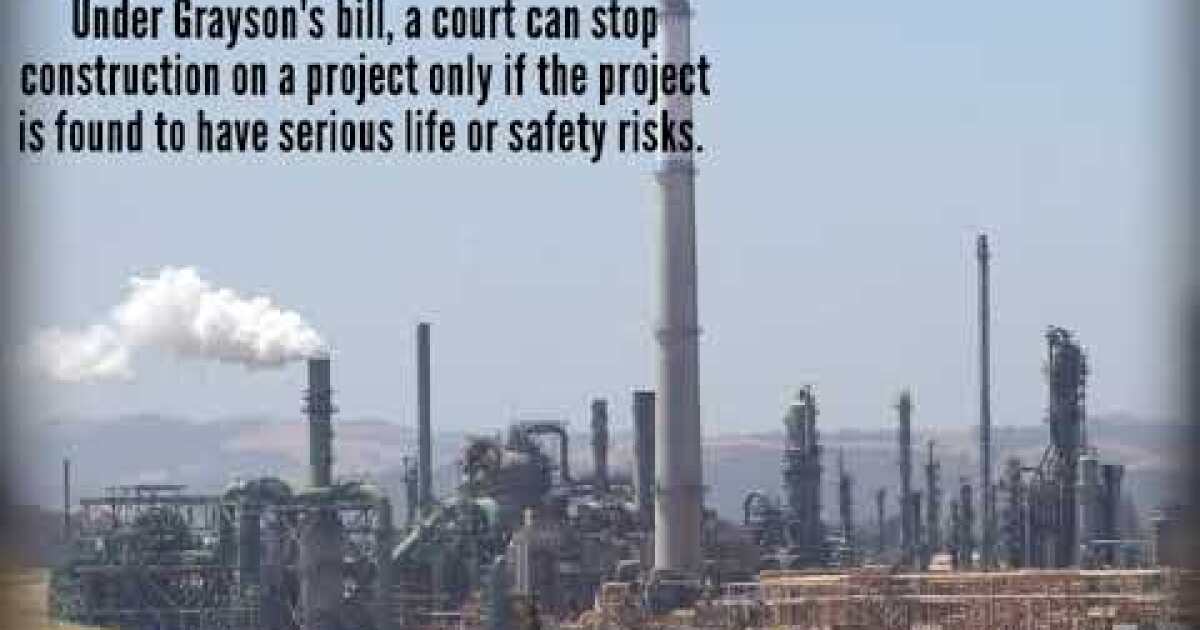
Currently, a court can stop construction on a project if the judge finds its required CEQA analysis failed to account for all effects on the environment. Under Grayson’s bill, a court could do so only if the project was found to have serious life or safety risks.

State lawmakers have approved this legal standard before to speed the development of a new Sacramento Kings basketball arena. Those rules weren’t tested in a lawsuit against the arena. But state and local officials have said the legal standard allowed construction to go forward without fear of litigation tying up the project and potentially costing the city the team.

In Los Angeles, Grayson’s bill could affect large road and transit projects including a Metro Gold Line extension into eastern Los Angeles County and tunnels through the Sepulveda Pass.

But Sierra Club California and the Natural Resources Defense Council are among the environmental organizations that believe the bill goes too far. State climate regulators don’t heavily scrutinize individual projects when approving regional growth plans, representatives of both groups said.

For instance, a judge might find that a transportation project’s environmental review didn’t account for all the effects the development could have on air quality, but under AB 1905 that judge couldn’t stop the project because of it, said David Pettit, a senior attorney with the Natural Resources Defense Council. Without the threat of halting construction, agencies won’t need to take seriously any subsequent demands to improve the air surrounding the project, he said.

AB 1905 “may look good on its face, but it’s fantastically unrealistic when you look at the effects of when concrete is already in the ground,” Pettit said.

Grayson said the inspiration for his bill came from the California Transportation Commission, a state agency that advises Gov. Jerry Brown and the Legislature on transportation policy and spending. In its most recent annual report, the commission recommended an idea similar to Grayson’s bill as a way to speed up project construction.

The recently passed gas tax and other fee increases are expected to bring in more than $5 billion annually for road repairs and mass transit upgrades. Grayson said it’s important to spend that money quickly, and making it easier to defend against CEQA lawsuits is one way to do it.

“If we’re ever going to make a huge impact it is going to be now with the amount of revenue at our disposal,” he said.

liam.dillon@latimes.com

@dillonliam

ALSO

Which California megaprojects get breaks from complying with environmental law? Sometimes, it depends on the project

Lawmakers have put a lot of energy into getting new stadiums built — without much success

California lawmakers pitch a break from a key environmental law to help L.A. Olympic bid, Clippers arena

Updates on California politics


Source link

Beautiful European hotspot relaxes rules to make travel into country easier for Brits

Major changes are set to impact British holidaymakers entering a European hotspot, and it’s good news, with the plans aimed at making travel smoother and quicker for Brits

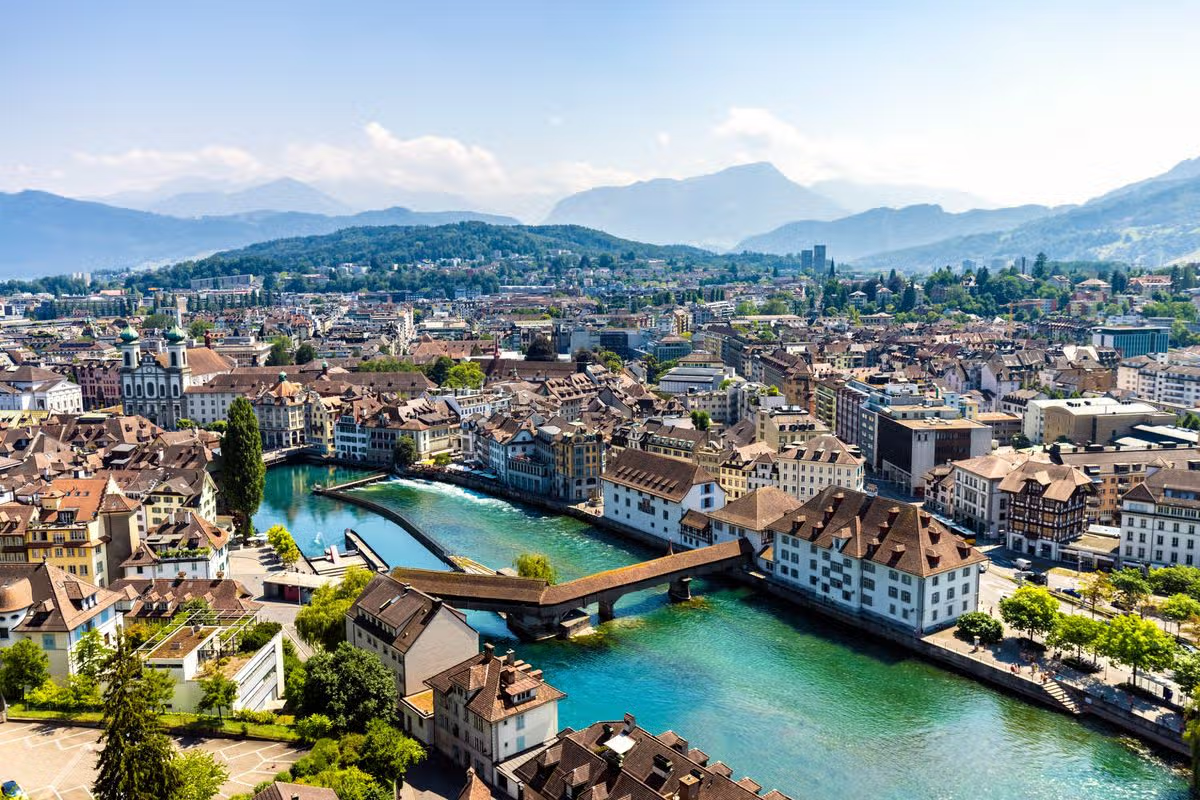
A beautiful European hotspot is set to make travel easier for Brits by relaxing its entry rules.

British holidaymakers have been facing significant disruptions when travelling to Europe, partly due to the new European Union (EU) Entry/Exit System (EES), which was rolled out on 10 April 2026, and the increased demand for short-haul getaways, particularly during peak periods. In a bid to offer a smoother journey for Brits, without relentless delays and lengthy queues, Switzerland has eased some of its restrictions.

Under a new agreement between the UK and Switzerland, Brits will be allowed to use the Swiss e-gates at airports, providing a smoother experience at passport control. British tourists and business travellers visiting the country, known for its snow-capped, dramatic peaks, will also be able to benefit from scrapped roaming charges.

Mark Tanzer, ABTA chief executive, said: “We want travel to be as easy and smooth as possible, so this announcement includes great outcomes for British holidaymakers and business travellers. Removing roaming charges would give people one less thing to think about before their trip and should make it cheaper to stay in touch, too.

“Plus, giving UK visitors access to Swiss e-gates will make going through the airport smoother and quicker for tourists and business travellers alike.

“We know it’s not something that can just happen overnight, but it is encouraging to see that Switzerland has a plan in place to make it happen. Removing travel frictions like these with major European partners is so important for UK tourism and exports.”

Initial plans, set to be in place by the end of 2026, will allow Brits to enter through the e-gates at Zurich Airport, the country’s largest international airport. There are also plans to introduce this at the airports in Zurich, Geneva, and Basel.

The significant changes were announced following a new Free Trade Agreement (FTA), which could ultimately offer an estimated £5.2 billion a year in additional UK services exports to Switzerland. Meanwhile, news that thousands of British holidaymakers and business travellers could use the Swiss e-gates was confirmed outside of the FTA.

Prime Minister Keir Starmer commented: “Whether you’re growing a business or travelling for work, this agreement is about making life easier and creating more opportunity for people across the UK. It means British firms will find it easier to sell their expertise in one of our most important markets in Europe, supporting jobs and investment here at home.

“British people will also be able to enjoy using their mobile in Switzerland without extra roaming charges, and alongside the FTA, they will soon also have quicker trips through Swiss airports.”

UK holidaymakers keen to visit Switzerland do not need a visa to enter the Schengen area, and can travel for up to 90 days in any 180-day period. Meanwhile, for UK services professionals, the changes will also introduce visa-free travel to Switzerland for up to 90 days a year.

The government website outlined: “UK businesses will be able to transfer people to work in Switzerland for up to 5 years, without being subject to stringent economic needs tests, making it easier to secure Swiss work permits for UK graduates in areas like finance, insurance and consultancy.”

Trade Secretary Peter Kyle said: “This is the most significant services trade deal the UK has ever negotiated. It will bring huge benefits to British business and consumers and comes after a slew of deals with the US, Europe, the Gulf, South Korea and India.

“This deal will mean faster journeys through the border, cheaper phone use for families and business travellers to Switzerland, and new opportunities for British firms selling their world-class services overseas.”

Do you have a travel story to share? Email webtravel@reachplc.com

Source link

European country introduces new rules for Brits and it will make holidays there easier (and cheaper)

NEW rules being introduced will make it much easier and more affordable to visit a European country.

In a new deal between the UK and Switzerland, the country is set to introduce automated passport eGates for Brits.

NINTCHDBPICT001095235525
Switzerland is making a huge change for British travellers Credit: Alamy

The scheme will allow much faster travel for Brits, and joins a number of other countries in Europe that allow the eGate passage for UK travellers.

The use of eGates is expected to start later this year at Zurich Airport, and then expand to Basel and Geneva airports next year.

UK travellers will still have to follow the new EES rules when visiting Switzerland, which require biometric checks when entering an EU country.

Another major change for Brits will be scrapping of mobile roaming charges between the UK and Switzerland.

SAVE BIG

UK theme parks and attractions offering FREE return visits and 89p kids tickets


DIVE IN

Mega waterpark hotels with EVERYTHING you ever wanted & all inclusive from £189pp

Any Brit heading to Switzerland will be able to use their mobiles without paying additional mobile fees.

This often catches holidaymakers out who assume the country follows the same rules as other countries in Europe.

A start date for this has not been announced yet.

The changes were made in a £5.2billion agreement between the Minister of the Swiss Confederation Guy Parmelin, Peter Kyle and Keir Starmer.

Around 800,000 UK citizens visit Switzerland each year whether that be for its ski resorts, or to see its incredible lake scenery in the summer.

The new deal also means that UK ‘service’ professionals’ can travel to Switzerland visa-free for up to 90 days per year for work.


Source link

Europe’s biggest indoor waterpark with 18 pools, swim up bars and very exotic spas now MUCH easier to travel to

WATER slides, themed saunas, pool bars and a spa – could somewhere be more fun?

Suntago Water Park in Poland is the biggest indoor waterpark in Europe, offering enough fun for a multi-day visit.

The waterpark has 18 pools in total Credit: Suntago: Indoor Water Park
Collage of travel items including a plane, sunscreen, passport, suitcase, and plane tickets, advertising The Sun's travel Instagram account.

And now, it is even easier for tourists to head to the park as a new bus service runs directly from Warsaw Chopin Airport to the park.

Having launched on June 1, the bus service will run until the end of the season on August 31.

The service from the airport takes around 45 minutes, runs a few times a day in each direction and costs around £13.20 return.

Visitors can also hop on a bus from Warsaw taking about 55 minutes and running each hour for £9.14 return.

Read more on travel inspo

ALL IN

I found the best value all inclusive London hotel… just £55pp with free food & booze


STAYCAY

Our travel experts’ best-kept-secret UK holiday spots for summer – from £37 a night

Or catch one from Żyrardów taking about 20 minutes and running several times a day for £4.06 return.

Inside, the park really is huge with 18 pools, 35 slides and numerous saunas.

When it comes to the pools there are several featuring different minerals or chemical elements that have different health benefits.

For example, you could take a dip in the magnesium pool (34C), which is rumoured to help skin disorders as well as relax muscles.

A number of the pools feature mineral benefits Credit: Suntago: Indoor Water Park

On the other hand, if you want to soothe dry skin then head to the calcium pool (34C).

Other mineral pools include a lithium pool to reduce stress, a potassium pool which can help with reducing blood pressure and a sulphur pool ideal for visitors who suffer with joint issues.

If you’re not into mineral pools though and would rather go for a swim, then you can head to the outdoor pool instead, with a swim-up bar for a tipple.

Another outdoor pool even has a hot tub and – instead of a lazy river – a ‘crazy river’.

Back inside, there’s a bubbling spring pool (32C) and a wave pool, both ideal for relaxing and having a splash.

Though for a bit more fun, make sure to head on the Mamba Adventure River that’s a 130-metre long pool through a cave-like area with glowing green lights.

Little ones aren’t left out either as there is a baby pool right next to a Pirates’ Playground.

And for those want it a bit of fun there are 35 different waterslides Credit: Suntago: Indoor Water Park

But there is more fun for kids than this, with 35 different waterslides across five floors.

These include three snake-themed rides where you even come out of a snake’s mouth.

On Anaconda, for example, you’ll be launched nearly 20 metres before racing through a number of twists and bends.

If you are brave enough there is another waterslide called Teleport, which features a fast and unexpected drop.

Families wanting to stick together can try out Toucan and Arara in four-person rafts or get competitive on racing waterslides.

If all those pools and slides weren’t enough, there’s also more than 13 different heated rooms, including saunas and a frigidarium.

There are more than 10 saunas at the waterpark too Credit: Suntago: Indoor Water Park

There’s a classic wooden sauna with a viking-themed twist, heated to a near-boiling 95C and an Egyptian Village where there are five saunas themed around different areas of Egypt including the Sahara Desert.

If you like the idea of a sauna but don’t want it too hot, head to the Korean Sauna, that is 38C and also plays calming music.

Or for something more exciting, head into the Aquarium Sauna with a number of fish tanks to watch.

You could also be transported to the Maldives in the Paradise Beach sauna or to Mont Blanc in the chilly frigidarium which is -7C.

One of the pools is set in a cave-like area as well Credit: Suntago: Indoor Water Park

Last but not least, there is a salt grotto which has a “seaside-like microclimate” and blocks upon blocks of salt ideal for helping your nervous system.

If you want to level up your wellness experience, there is a spa onsite too.

After all the splashing about and relaxing, if you want a bite to eat there are a number of restaurants and cafes onsite.

You can make even it a whole weekend event by staying at the Suntago Village, just five minutes from the park.

Kids can only access the Jamango zone where you’ll find pools and the slides, costing from £20.10 a day.

On the other hand adults can access the Jamango zones, as well as the Relax and Saunaria zones from £33.30 a day.


Source link