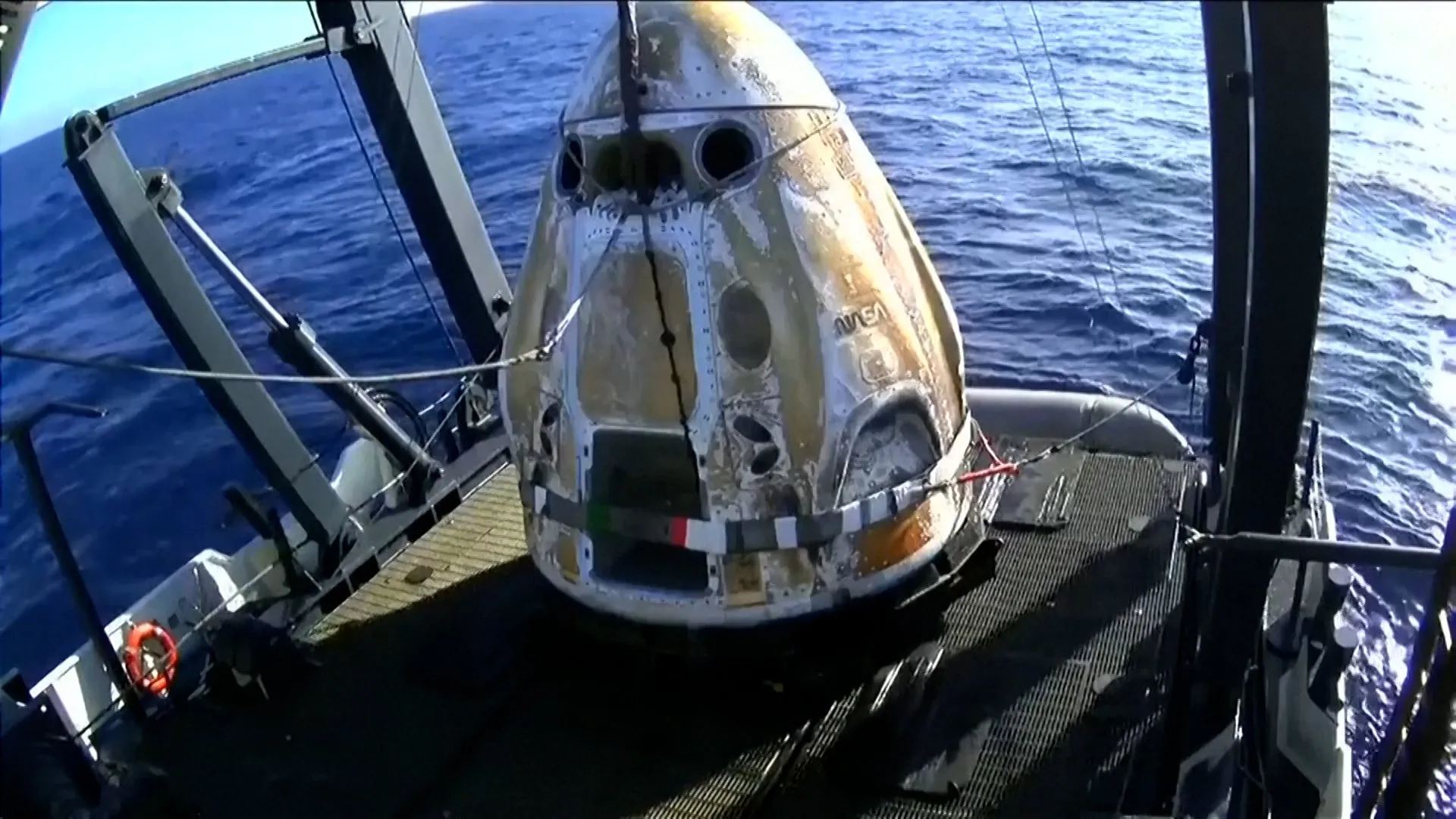
NASA’s Artemis II astronauts have returned to Earth after completing the first crewed lunar mission in more than 50 years, reaching the greatest distance ever travelled by humans. The crew successfully completed a parachute landing in the Pacific Ocean, after a high-speed re-entry through Earth’s atmosphere.
The Artemis II crew landed in the Pacific Ocean under parachutes after a high-speed re-entry that tested its heat shield.
Published On 11 Apr 202611 Apr 2026
NASA’s Artemis II astronauts have safely splashed down on Earth, completing a landmark mission that carried humans around the Moon and back for the first time in more than 50 years.
The crew successfully completed a parachute landing on Friday in the Pacific Ocean, after a high-speed re-entry through Earth’s atmosphere. Recovery teams were off the coast of California, waiting to retrieve them after their arrival at 5:07pm Pacific time (00:07 GMT).
Recommended Stories
list of 3 itemsend of list
The four astronauts will now undergo medical checks before returning to NASA’s Johnson Space Center in Houston.
NASA crew members Reid Wiseman, Victor Glover and Christina Koch, together with Canadian astronaut Jeremy Hansen, began a 10-day voyage from Florida’s Kennedy Space Center last week, travelling farther into space than any human ever has.
They looped around the far side of the moon, testing equipment in deep space, before propelling back to Earth on Friday.
Their mission was the first to the moon since the 1972 Apollo 17 mission, and their return caps a mission packed with technical milestones.
A new perspective on Earth
Artemis II is widely seen as a critical test flight for future Moon missions, particularly Artemis IV, which aims to land astronauts on the lunar surface for the first time since the Apollo era.
Engineers will now analyse key data from the mission, including the performance of the Orion capsule’s heat shield as well as navigation systems and life-support technology, all essential for safely carrying humans deeper into space.
The return also included one of the most challenging phases of the journey: a brief communication blackout during re-entry, caused by intense heat building up around the spacecraft.
But on top of its record-setting distance, the mission also marked other historic firsts. Glover became the first person of colour to travel around the moon, Koch the first woman, and Hansen the first non-American.
During their journey, the crew reported in vivid detail features of the lunar surface and later witnessed a solar eclipse as well as meteorite impacts.
Mission commander Wiseman reflected that “what we really hoped in our soul is that we could, for just a moment, have the world pause — and remember that this is a beautiful planet in a very special place in our universe”.
“We should all cherish what we have been gifted.”
Every morning since the astronauts’ departure, NASA has sent a song to Artemis II to start the day. On Friday, the astronauts awoke to the tune of Live’s song Run to the Water and the country hit Free, by Zac Brown Band.
Artemis II Commander Reid Wiseman shares a picture of Earth taken from the Orion spacecraft’s window on April 2, 2026 [EPA/NASA]
April 10 (UPI) — The Artemis II crew on Friday reached the last part of their mission to travel past the moon, farther than any human has traveled from Earth before circling back home — splashdown day.
The Orion capsule carrying the four-person crew is expected to make a water landing just after 8:07 p.m. EDT on Friday evening, capping their 10-day mission to test NASA’s new spacecraft while taking the next steps to returning humans to the surface of the moon.
Thus far, the mission has been successful in most ways, but NASA engineers have noted that the most important part is the return to Earth.
“Every system we’ve demonstrated over the past nine days — life support, navigation, propulsion, communications — all of it depends on the final minutes of flight,” Amit Kshatriya, NASA’s associate administrator, told reporters on Thursday.
“We have confidence in the system, in the heat shield, and the parachutes and the recovery system that we’ve put together,” he said.
One of the main concerns after the Artemis I uncrewed launch was unexpected charring on the heat shield of the Orion capsule, which protects astronauts from the heat created as the spacecraft reenters Earth’s atmosphere at 40 times the speed of sound.
A combination of adjustments to the heat shield and late mission burns to adjust the angle that the capsule reenters the atmosphere is expected to resolve NASA’s concerns after the first flight of the Artemis Space Launch System and Orion crew capsule.
NASA’s Space Launch System rocket carrying the Artemis II crew is launched from Complex 39B at Kennedy Space Center in Florida on April 1, 2026. Photo by Joe Marino/UPI | License Photo
‘It’s a historic day… but don’t forget to enjoy the view.’
Four astronauts from NASA’s Artemis II mission have broken the record for the farthest human travel from Earth. The record of 400,171km was set by Apollo 13 in April 1970.
Artemis II astronauts are inside the Orion capsule as they make their way to the moon. Photo courtesy NASA
April 4 (UPI) — NASA announced Saturday that the four astronauts of the Artemis II mission were closer to moon than to the Earth.
NASA shared photos from the mission on X, declaring that the astronauts were officially “moonbound.”
“Artemis II astronauts are more than halfway to their destination, and preparations for lunar flyby are underway,” NASA said. “During the trip around the far side of the moon, they will capture imagery to share with scientists (and you, too!).
The photos included two images of the moon and one of the interior of the Orion capsule as the astronauts worked and looked out at space.
Lock in, we’re Moonbound.
Artemis II astronauts are more than halfway to their destination, and preparations for lunar flyby are underway. During their trip around the far side of the Moon, they will capture imagery to share with scientists (and you, too!). pic.twitter.com/T2z4W2XLCt— NASA (@NASA) April 4, 2026
“We can see the moon out of the docking hatch right now. It’s a beautiful sight,” an earlier NASA post quoting the astronauts said.
On Sunday, Artemis II is expected to reach the lunar sphere of influence, meaning the moon’s gravity will be stronger than Earth’s on the spacecraft.
The astronauts are expected to make their flyby of the moon on Monday, coming to within 6,000 miles of the lunar surface. They’ll fly around the far side of the moon for about 6 hours, taking photos and making observations. During this time, the astronauts will lose communication with Earth for about 30 to 50 minutes.
Tuesday marks the start of Artemis II’s four-day return to Earth, and splashdown is scheduled for Friday.
NASA’s Space Launch System rocket carrying the Artemis II crew is launched from Complex 39B at Kennedy Space Center in Florida on April 1, 2026. Photo by Joe Marino/UPI | License Photo
NASA has unveiled the first images of Earth taken by Artemis II astronauts as they head towards the moon. The mission is expected to take humans farther from Earth than ever before, marking a major step in humanity’s return to lunar exploration.
April 3 (UPI) — NASA’s Artemis II crew left Earth orbit Thursday evening en route for the moon, marking a milestone not reached in more than 50 years.
The Orion spacecraft began a scheduled 5-minute, 50-second burn at 7:49 p.m. EDT, successfully propelling it and its four-person crew out of Earth orbit.
“Nominal translunar injection burn complete. The Artemis II crew is officially on the way to the moon,” NASA Administrator Jared Isaacman announced on social media.
“America is back in the business of sending astronauts to the moon. This time, farther than ever before.”
The crew of NASA astronauts Reid Wiseman, Victor Glover, Christina Koch and Canadian Space Agency astronaut Jeremy Hansen launched Wednesday evening from Florida’s Kennedy Space Center.
It is the first crewed mission to travel farther than low-Earth orbit since Apollo 17 in 1972.
The long-awaited exit from Earth orbit signaled that humankind is now on a trajectory to its closest celestial body, the moon at an average of 238,855 miles away.
“I got to tell you, there is nothing normal about this: sending four humans 250,000 miles away is a Herculean effort, and we are just realizing the gravity of that,” Reid said in a press conference after exiting orbit.
Asked what they are most excited about when they near the moon, Koch simply said it was views.
“Having just experienced incredible views of planet Earth and seeing the entire planet out the window in one pane, knowing that we’re about to have some similar views of the moon in that same way is definitely getting me more excited for it,” she said.
“I knew that that is what we would see, but there is nothing that prepares you for the breathtaking aspect of seeing your home planet both lit up bright as day and also the moon glow on it at night with the beautiful beam of the sunset and knowing we are going to get similar views of the moon, I’m just really excited for that.”
“I’m the space plumber, I’m proud to call myself the space plumber.”
Mission specialists like @Astro_Christina train for all roles so they can jump in wherever they’re needed. Sometimes that means fixing vital machinery, like the spacecraft toilet. pic.twitter.com/RGBWkwRgX7— NASA (@NASA) April 3, 2026
The Orion spacecraft is now on its way to the moon where the crew will perform a flyby, during which they will take high-resolution photographs and provide personal observations of the lunar surface, including the far side of the moon, NASA said.
After the flyby is completed, the four-person crew will begin their return to Earth, completing their 10-day deep-space journey with a splashdown in the Pacific Ocean on April 10.
The mission, in essence, is a crewed rehearsal for a future lunar landing, targeted for early 2028.
There were fireworks, there was a flyover, there was Will Ferrell screaming and Keith Williams Jr. crooning and four months of cheers unleashed by fans wearing championship belts and howling grins.
But the real stars of Thursday’s Dodger opening day show never made a sound.
They arrived silently at the end of the pregame ceremony, carefully held by two of the men who helped win them, lifted high for all those who so passionately longed for them.
They were the last two Commissioner’s Trophies, the back-to-back World Series championship trophies, the two symbols of the Dodgers domination held side by side in the afternoon sun.
Man, it was beautiful. Goodness, how they sparkled. Incredible, how they glowed.
It was almost as if they were powered by some electrical force, some sort of championship current running between them, lighting them up with a blinding power curated by the battered fingers of the two veterans who touched them.
Freddie Freeman, whose grand slam doomed the New York Yankees, held the 2024 trophy. Miguel Rojas, whose home run stunned the Toronto Blue Jays, held the 2025 trophy.
Together they brought the trophies to the dugout from center field while riding in the back of a blue convertible driven by Ferrell as part of an elaborate video skit.
It was the first time many had seen the hardware side by side, and, amid audible gasps, their power was unmistakable. The greatness of the Dodgers accomplishment came to life on a day when their new task became equally clear.
“Three-peat!” screamed one of the pregame musicians.
Welcome, Dodgers, to 2026.
While manager Dave Roberts downplayed the three-peat talk before the opening 8-2 victory over the Arizona Diamondbacks, you know it’s here, it’s there, it’s everywhere.
“At this moment, very minimal,” said Roberts when asked about the pressure. “…So yeah, hopefully we can keep that to a minimum throughout the season. But yeah, there’s obviously going to be a lot of talk about it.”
Thursday did nothing to dampen that talk. It was as if last season’s Game 7 against the Toronto Blue Jays was still being played. The Dodgers behaved like the exact same team with some of the same heroes.
The winning pitcher? Once again, it was Yoshinobu Yamamoto, who threw six solid innings with six strikeouts and no walks.
The game-changing play? Once again, it was Andy Pages, whose three-run home run in the fifth inning gave the Dodgers a lead they never lost.
The final big blow? Yep, Will Smith, whose two-run homer in the seventh inning clinched it.
Dodgers unveil the plaque for the 2025 World Series win.
(Ronaldo Bolanos / Los Angeles Times)
There was even a World Series star coming out of the bullpen, new cult hero Will Klein entering the game to the night’s loudest ovation and throwing a scoreless inning.
It’s as if the Dodgers have been on the same roll for four months…with no signs of slowing. This could be crazy. This already is crazy.
Other than the cool trophies and the Diamondbacks trampling, the most notable show Thursday was unwittingly staged by Dodger Stadium itself.
Your dutiful correspondent’s first impression of his favorite place on earth upon returning here for his 37th home opener wasn’t about the deep green or brilliant blue or enduring mountainscape.
It was, when did this place become Las Vegas?
Share via
Illuminated by the new grotesquely red Uniqlo Field billboard hanging high above center field, the stadium appears to have been transformed into something straight from NASCAR, advertisements filling every nook and cranny of the pavilion and beyond. There are giant billboards above the bullpens. There are scribbled ads on the bullpen walls. There are screaming displays for beer, soda and healthcare, the latter of which you will need if you heed too many of these ads.
The incessant sales pitches are buffeted by the usual deafening pounding music, which makes Vin Scully Avenue seem like Las Vegas Boulevard.
Was it always like this? It doesn’t seem like it. The Dodgers have always been relentless billboard salesmen, but since the arrival of Shohei Ohtani, they’ve become a global attraction with seemingly every major company on earth willing to pay for a piece of their success.
Fans will probably notice that the biggest difference this year is the $125-million sponsorship deal with Uniqlo, a Japanese apparel company that bought center field. Chavez Ravine is now officially known as Uniqlo Field at Dodger Stadium and, yeah, on Thursday it was awful hearing public address announcer Todd Leitz introduce it like that.
Not to worry, nobody in their right mind is ever going to call it that. Nonetheless, the whole atmosphere was weird and unsettling.
Still, it’s hard to blame the Dodgers. They’ve spent gobs of money building a two-time defending champion, and those bucks have got to come from somewhere.
You want Kyle Tucker? Live with the beer ad. You want a $1 billion rotation? Deal with the bank ad.
Dodgers Blake Snell, Kiké Hernandez, Roki Sasaki and Alex Call during player introductions before the game.
(Gina Ferazzi / Los Angeles Times)
Unlike many other teams that have made baseball a haven for cheapskates, the Dodgers invest much of their revenue back into the roster.
It’s not always pretty. It can be loud and distracting and obnoxious. But it works.
As night fell on a blessed blue Thursday, the Dodgers had won their eighth straight home opener. They did it with pitching, hitting, depth, and two of the prettiest pieces of jewelry you’ve ever seen.
It was a day to celebrate the completion of the most incredible two-year journey in franchise history.
It was also a day to realize that the journey has just begun.