early return

One thing was clear on election night: Angelenos want change

A huge, waning moon glimmered over Los Angeles on election night, a metaphor for a trend that emerged in early returns.

The city’s political establishment seemed to be on the retreat in favor of populist insurgents from both the left and the right.

Mayor Karen Bass held a cushy lead in her bid for a second term, and the Associated Press declared that she had made it into the November runoff election. But the underwhelming amount of support she got thus far showed that many voters in a super-blue city didn’t have enough confidence in a Democratic stalwart to return her to office. Instead, many chose self-proclaimed upstarts from opposite ends of the political spectrum: Republican reality TV star Spencer Pratt and democratic socialist City Councilmember Nithya Raman.

Raman launched her campaign at the last moment, just weeks after endorsing her longtime ally Bass, figuring that enough Angelenos were tired of the incumbent and would join her message of change from inside City Hall.

Raman’s instincts were half right. Voters did want change. But they didn’t view her as a challenge to the status quo — to many, she is the status quo.

The mayoral hopeful didn’t articulate a platform that radically departed from Bass’, and voter antipathy to her muddled messaging showed: she ended the night in third place. If the current results hold, Bass would face Pratt in the runoff.

At Raman’s election-night party at Boomtown Brewery on the outskirts of Little Tokyo, I saw why her chances of becoming L.A.’s next mayor were slim from the start. The gathering felt like happy hour at a Silver Lake bar: far whiter than the city overall, with few Latinos. Her address to a packed house was a grab bag of platitudes mixed with a broadside against MAGA, which is a political nothing in L.A. politics. It was an uninspiring cri de coeur and reflective of a campaign that wasn’t apocalyptic enough for those, such as Pratt’s people, who want radical change, while offering nothing new for Bass supporters.

Yet Raman still insisted she had unlocked something transformative.

“Together, we built something extraordinary,” she said to cheers. “And it gives me so much inspiration to be a part of it, a movement powered not by cynicism or political insiders, but by ordinary people who still believe Los Angeles is worth fighting for.”

Raman then went on the dance floor to greet well-wishers, pumping her fist while a DJ blasted Daft Punk’s “Lose Yourself to Dance.”

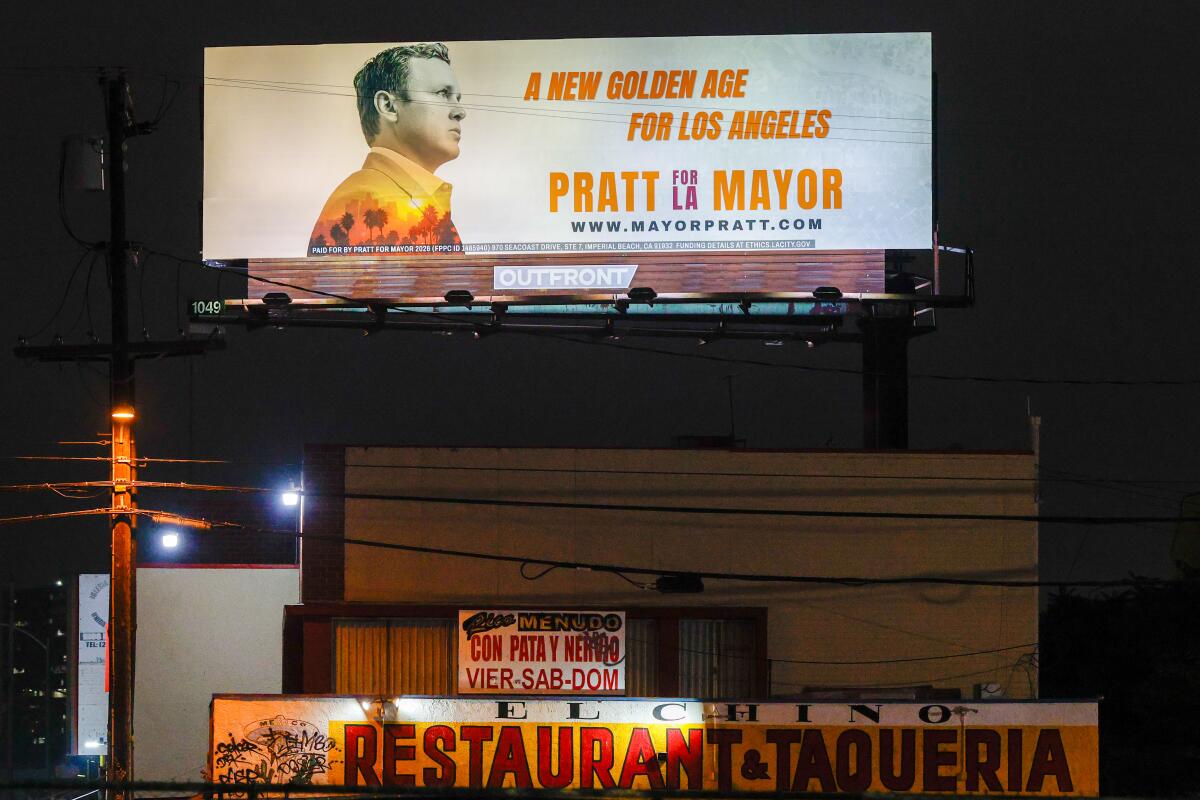
A political billboard for City of Los Angeles mayoral candidate Spencer Pratt.

A billboard for L.A. mayoral candidate Spencer Pratt near MacArthur Park on June 2, 2026.

(Ronaldo Bolanos / Los Angeles Times)

Across town in West Los Angeles, Pratt reveled in his second-place position, enjoying a Mexican dinner with friends and family. It was a peaceful conclusion to a spring of fulminations against Bass (“Karen Basura”), nonprofits, homeless people (“zombies”) and anything that reeked of Democratic pieties, even as the Republican swore he was campaigning for all ideologies in a nonpartisan race.

Long dismissed as a has-been joke, Pratt correctly judged that Angelenos are angry and don’t want to be polite about it anymore. He and his supporters will take his unlikely rise as a mandate to double down against liberal L.A.

But if Pratt, who lost his house in the Palisades fire, does move on to the general election and is serious about winning, he needs to learn from the political revolution successfully pursued by his polar opposites, the local chapter of the Democratic Socialists of America.

Six years ago this spring, L.A.’s political establishment wrote off DSA-LA as wokoso upstarts in their long-shot quest to get a political novice named Nithya Raman elected to the city council. Even as Raman and three other DSA members joined the council, skeptics dismissed them and their progressive policies as anomalies that didn’t reflect how Angelenos actually wanted the city to work.

Tuesday night, four of the six DSA-endorsed candidates in L.A. city elections were in first place by large margins and another was comfortably in second, reflecting DSA’s multicultural, citywide reach. In a telling sign of its newfound king-making status, the local chapter declined to endorse Raman or any other mayoral candidate. Without that powerful backing, their trailblazer, along with DSA member Rae Huang, withered on their L.A. revolutionary vine.

Councilmember Hugo Soto-Martínez and L.A. Unified school board member Rocío Rivas looked to be coasting to outright victories. Marissa Roy was on her way to a runoff that would exclude the incumbent city attorney, Hydee Feldstein Soto, who was a distant third in the early returns. In District 9, where Curren Price is terming out, Estuardo Mazariegos stood comfortably in second place and looked to headed to a runoff against a fellow Latino candidate in a race that will see South Los Angeles elect its first non-Black council member in 63 years.

The most surprising outcome involved Councilmember Eunisses Hernandez, who became a punching bag, along with Bass, for people who thought L.A. had transformed into a hellhole. So-called dark money groups, which don’t have to reveal where their funding comes from, poured hundreds of thousands of dollars into negative mailers. Opponents vying for her seat cast federal raids against drug dealers and gangs in the MacArthur Park area as an indictment of her leadership, berating her during debates and on social media.

Even Hernandez’s supporters were fretting about what might happen on election night. But by the time I arrived at her raucous soirée in Highland Park, early returns showed her way ahead of the field and perhaps avoiding a runoff.

“It’s reassuring to see [DSA’s success],” she said as jubilant supporters lined up beside her to get tattoos — real ink, not temporary — of hummingbirds, her campaign’s logo. “That means people see us. That means people want more.”

Hernandez pointed to her fellow DSA member, New York City Mayor Zohran Mamdani.

“What happened with DSA over there didn’t happen overnight,” she said. “In L.A., we’re getting there.”

A table filled with campaign buttons for Hugo Soto-Martinez.

A table filled with campaign buttons for Council Memer Hugo Soto-Martinez, who ran for reelection this year and is expected to win outright.

(Jason Armond/Los Angeles Times)

L.A. hasn’t suddenly become a land of Trumpers and closet commies, of course. Two incumbent council members who are centrist Democrats are also on their way to easy victories, while Councilmember Monica Rodriguez walked into a third term because no one ran against her. Centrists Timothy Gaspar and Barri Worth Girvan have a huge lead over their rivals for the San Fernando Valley council seat that Bob Blumenfield is leaving due to term limits.

But anyone who wants to win in Los Angeles needs to realize that antiestablishment sentiment is in the air.

At the same time, I would remind the victorious populists to look up in the sky and remember their Shakespeare.

“O, swear not by the moon, th’ inconstant moon / That monthly changes in her circle orb / Lest that thy love prove likewise variable,” Juliet warned Romeo.

Politics, like la luna, waxes and wanes whether we like it or not, and anyone who bets on a permanent transformation at City Hall will probably lose.

Angelenos have declared that they want dramatic change. But how will they feel in November?
Source link

LAUSD school board incumbents ahead in early returns in races devoid of pro-charter money

Los Angeles Unified School District incumbents — Rocio Rivas, Kelly Gonez and Nick Melvoin — surged strongly ahead in early returns Tuesday night for three seats on the Board of Education.

The first reported results were trending toward one-sided outcomes because the major political forces of recent years declined to do battle against each other: The teachers union supported Rivas, who represents a largely Eastside district; a charter-friendly retired businessman supported Melvoin, whose district is centered on the Westside. And the largest union representing nonteaching employees all but avoided the fray.

The third incumbent, Gonez, was the only candidate on the ballot in District 6, and faced one write-in challenger, Jose Sagredo. Thus, Gonez is poised to continue to represent a district centered in the east San Fernando Valley for a third and final term.

With no challengers boosted by high special-interest funding, the three incumbents had a virtually unobstructed campaign path.

If the early returns hold as expected, the Los Angeles Board of Education will continue to lean against charter schools and would stand in general agreement on most policies — including assertive support for immigrants and a continued holding pattern on the future of Supt. Alberto Carvalho, who remains on administrative leave as a federal investigation proceeds.

District 4, Westside

Well ahead in District 4 was two-term incumbent Melvoin. His challenger was Ankur Patel.

The funding advantage in Melvoin’s campaign was sizable through just before election day: Melvoin, $378,803; Patel: $22,662.

In addition, Melvoin benefited from an independent expenditure of $367,093 on his behalf by retired businessman Bill Bloomfield, who has been a major funder in recent campaigns, typically for candidates who also are acceptable to charter-school advocates.

Charters are privately operated public schools, most of which are nonunion. About 1 in 5 L.A. public-school students is enrolled in an independent charter operating within L.A. Unified.

District 2, downtown and Eastside

Also with a huge funding advantage was Rocio Rivas, who was headed toward a second term in District 2.

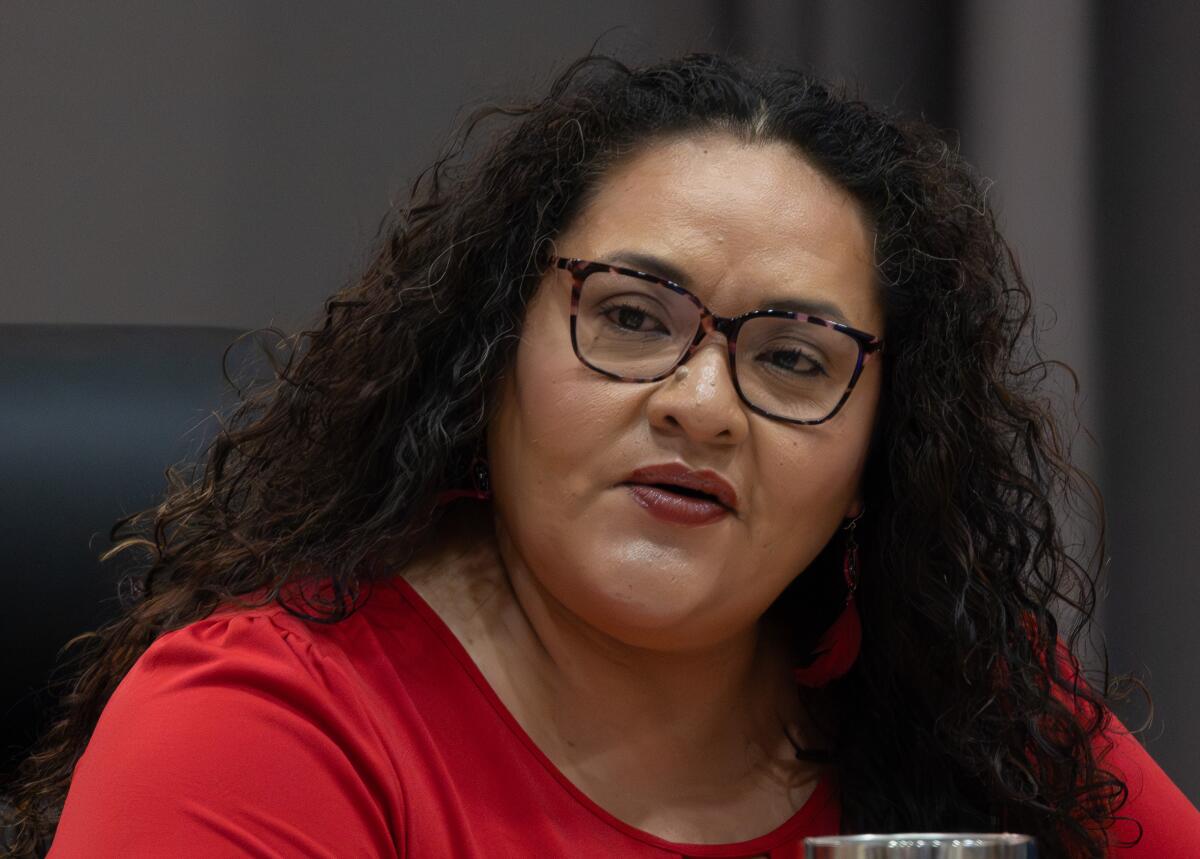
A woman in a red top wearing glasses.
LAUSD Board Vice President Rocio Rivas was headed toward a second term in District 2. Her major funding source was $889,469 in an independent-expenditure campaign on her behalf, nearly all of it from the United Teachers Los Angeles union.

(Myung J. Chun / Los Angeles Times)

Rivas’ own campaign raised $66,218. But the major funding source was $889,469 in an independent-expenditure campaign on her behalf, nearly all of it from the United Teachers Los Angeles union. The union also spent more than $4,000 in communications to its members about the election.

These figures compare with $2,525 raised by challenger Raquel Zamora, who reported spending $5,089.

In Rivas’ successful 2022 run, her main funding opponent was Local 99 of the Service Employees International Union, which backed Maria Brenes for an open seat. Historically, Local 99 has not been inclined to oppose an incumbent, which Rivas has become. And, true to history, Local 99 has endorsed Rivas, but without spending money on her behalf.

An end to charter school wars

More broadly, this election cycle marks the end to a generation of bitterly contested Los Angeles school board races that became the most expensive in the country, with the L.A. teachers union and charter school advocates slugging it out to advance their vision for public education.

Charter school supporters — who had poured tens of million of dollars into races to elect board members sympathetic to their cause — largely stepped aside, a reflection of their diminished resources and evolving strategy.

The bottom line is that, if current vote-count trends hold, the board will be unchanged for the next two years.

This situation is less than ideal for charter schools. Charters with a mixed record face a tough review when they come up for renewal — about once every five years. Charter opponents want the board majority to move more aggressively to shut down charters when possible and to force them off district campuses — where, under state law, they have a legal right to operate.

Big board decisions looming

Big decisions before the board include how to manage a projected structural deficient — with union leaders calling the dire predictions an accounting mirage.

Meanwhile, Supt. Alberto Carvalho remains in limbo after a February FBI raid of his home and office. The investigation relates at least in part to a failed district chatbot project.

Carvalho maintains his innocence and would like to return to work. The board, however, has turned the reins over temporarily to acting Supt. Andres Chait.

Words on a wall say "Los Angeles Unified School District, Administrative Offices."
This election cycle marks the end to a generation of bitterly contested Los Angeles school board races that became the most expensive in the country, with the L.A. teachers union and charter school advocates slugging it out to advance their vision for public education. Above, LAUSD headquarters in downtown Los Angeles.

(Ronaldo Bolaños / Los Angeles Times)

Source link

Early returns show L.A. County voter doubts about healthcare sales tax

Los Angeles County’s half-cent sales tax to fund healthcare services was trailing Tuesday, with early returns showing a majority of voters rejecting the measure.

The tax — a half-penny of every dollar spent in the county — is meant to prop up local hospitals and clinics that are hemorrhaging funding after recent federal cuts.

The sales tax, which needs a simple majority to pass, would take effect Oct. 1 and last five years. Officials say it would pull in $1 billion annually to help plug the budget holes hitting local hospitals and clinics.

L.A. County health officials anticipate the One Big Beautiful Bill Act, signed into law by President Trump last summer, will slash more than $2 billion from the county’s health services budget within the next three years. Due to eligibility changes, the county will no longer be able to get reimbursements for many Californians who have lost Medi-Cal.

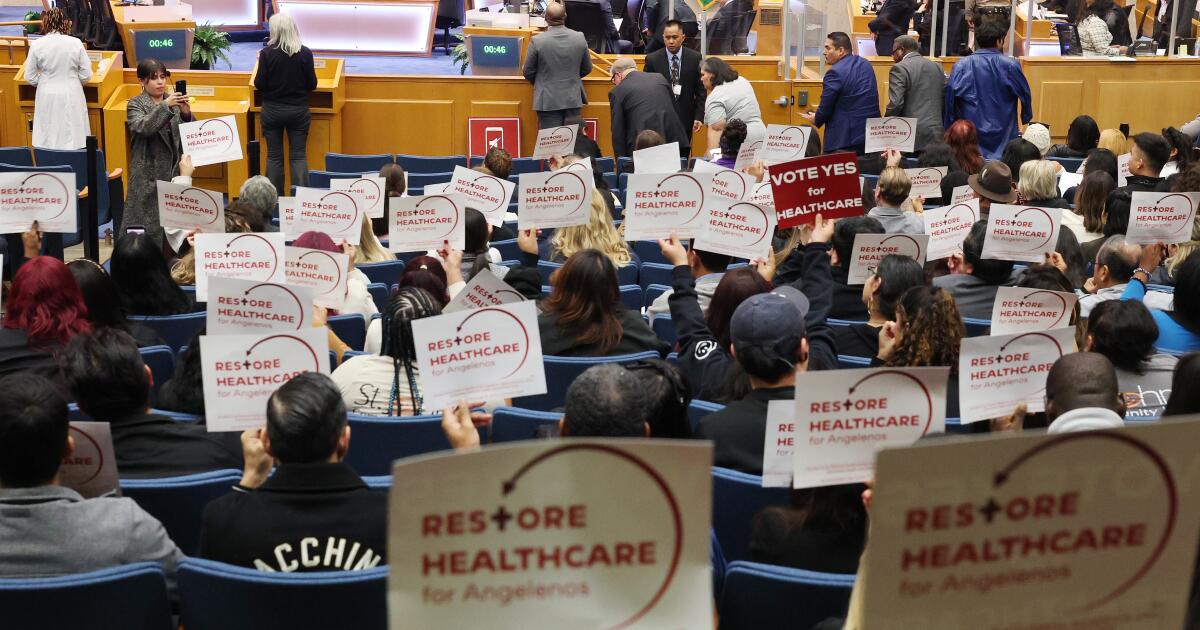
The measure was championed by a coalition of healthcare advocates called Restore Healthcare for Angelenos who warned that mass layoffs and emergency room closures could be imminent if new funding didn’t come fast. The Department of Public Health recently closed seven clinics — a grim sign, supporters said, of service cuts to come.

Voters haven’t rejected a sales tax hike since 2012, when a transportation measure fell just short with 66.1% support. It needed 66.7% to pass.

A majority of county supervisors had supported the new tax proposal, voting 4 to 1 this February to put it on the ballot. But the measure faced significant opposition from local cities, with opponents arguing the sales tax hike would unfairly burden the poorest county residents and encourage people to spend their dollars across the county line.

Supervisor Kathryn Barger, the board’s lone opponent of the tax, said she was concerned it was a “general” tax, meaning the money wouldn’t be earmarked for healthcare costs. Instead, she argued, politicians would have final say over how the money gets spent.

The supervisors have created a plan for spending the tax money, with the largest chunk of the money meant to cover the costs for patients without insurance. The measure also asked voters to sign off on a nine-member oversight committee.

The county currently has a base sales tax rate of 9.75%, and cities impose local taxes on top of that.

Source link