early may

At Riverside’s Mission Inn, former owner departs with historic art

In less than a month, Riverside’s Mission Inn has gained a new owner, lost two prized pieces of art and sparked a heated debate over the line between private property and community history.

The stage for this controversy was set in early May, when hotel owner Kelly Roberts decided to sell the Mission Inn to the Yuhaaviatam of San Manuel Nation, the tribe that owns the Yaamava’ Resort & Casino in Highland and the Palms Casino Resort in Las Vegas.

But it wasn’t the sale (for an undisclosed amount) that started arguments. It was Roberts’ removal of two beloved paintings from the hotel before the sale closed.

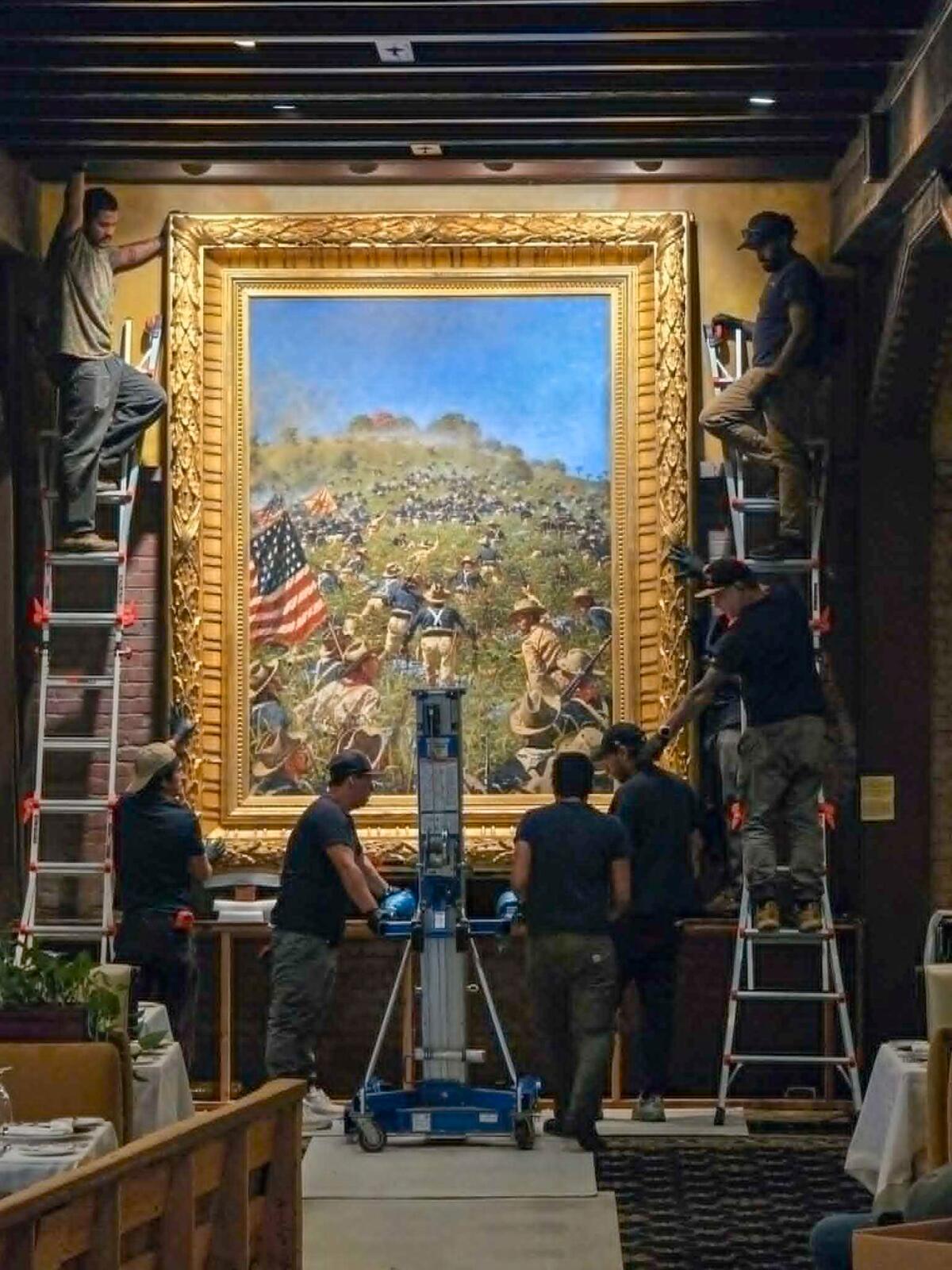
A painting at the Mission Inn in Riverside titled “The Charge Up San Juan Hill” is taken down on March 20.

A painting at the Mission Inn in Riverside titled “Charge Up San Juan Hill” is taken down on March 20, shortly before the hotel’s change in ownership.

(James Ranger)

One is an alpine landscape called “California Alps” (1874) by William Keith, which measures roughly 6 feet by 8 feet and was displayed in the lobby near the front desk. The other painting, “Charge Up San Juan Hill” (about 1900) by Vasily Vereshchagin, was displayed on a wall of the steakhouse near the lobby. Both paintings had been a part of the hotel for more than a century.

“It was like a slow-motion version of the Louvre Museum heist, pulled off on a sunny day in Riverside in view of guests, staff and visitors,” wrote David Allen of the Riverside Press-Enterprise.

“There’s an outrage among members of this community,” said Mike Marlatt, a Riverside attorney and former board member of the Mission Inn Foundation.

The issue appears to be what agreements Roberts’ late husband made when he bought the building more than 30 years ago.

Former Riverside redevelopment official Ralph Megna, who facilitated the 1992 sale to Duane Roberts’ Historic Mission Inn Corp., wrote on Facebook that “What Kelly is apparently doing at this point is just pillaging the place in violation of those agreements.” But on a phone call, he was less absolute. He said the original pact included an agreement intended to protect about 180 movable pieces of art and artifacts from removal, but that “there’s shades of gray here.” Megna added, “We trusted people. Good faith turned out to be not so good.”

Duane and Kelly Roberts, photographed in 1998 at their home in Laguna Beach.

Duane and Kelly Roberts, photographed in 1998 at their home in Laguna Beach. Duane, who reopened the Mission Inn in the early 1990s, died in 2025.

(Glenn Koenig / Los Angeles Times)

Roberts’ family attorney Alan Jackson, however, said “Kelly is not pillaging anything.” He maintained that when Duane Roberts bought the hotel, “he bought every single item. Every single item was the Roberts family’s personal property.” When Kelly Roberts sold the hotel last month, Jackson said, she was free to keep or sell any of its contents.

In that deal, Jackson said, “the buyers would not close” until the paintings and a sculpture of Duane and Kelly Roberts were removed, because “they’re expensive.” Also, Jackson said that Duane Roberts, “before his passing, made it very clear to Kelly and the family that those are two of his favorite paintings ever.”

Jackson declined to say where the artworks are but said “they are in her possession” and “she has no intention of ever getting rid of those ever.”

Flowers over the courtyard at Mission Inn.

The iconic spiral staircase in the rotunda of the historic Mission Inn.

(Gina Ferazzi / Los Angeles Times)

The hotel’s new owner, the San Manuel Investment Authority, declined to address questions about the sale agreement. But in a statement, it said it is “committed to collaborating with the Mission Inn Foundation and the City to respectfully steward and preserve this historic landmark, recognizing its deep history and significance to the Riverside community.”

Despite accolades from groups including Historic Hotels of America, tensions between the Roberts family and Riverside preservationists have risen in recent years. In late 2024, after more than 30 years renting space within the hotel, the nonprofit Mission Inn Foundation and Museum was unable to agree on a lease extension with hotel management and moved to a building on Main Street. Foundation leaders did not respond to messages seeking comment.

“The Mission Inn is so foundational to Riverside that any significant change brings real concern to me and makes me uneasy,” said City Council member Philip Falcone, 28, who has been leading tours of the inn since he was in high school.

The Keith painting is “quintessential California, a romanticized view of the Sierra Nevada range. William Keith, the painter, was friends with John Muir,” Falcone said. As for the San Juan Hill painting, it connects neatly with the history of Theodore Roosevelt, one of nine presidents who have visited the inn.

A guest takes in the view from the Spanish patio at the Mission Inn.

A guest takes in the view from the Spanish patio at the Mission Inn.

(Gina Ferazzi/Los Angeles Times)

The hotel is largely the creation of Frank Miller, who bought Glenwood Cottage, a modest boarding house, from his father in 1880. Then Miller enlisted investment help from his friend, railroad magnate Henry Huntington, transformed the boarding house into a hotel and renamed it. Over time, Miller built it into an architectural wonderland filled with art and antiques gathered in the U.S. and Europe. By 1931, the enterprise filled a city block.

“It’s a unique property,” said David Stolte, president of the Old Riverside Foundation. “It’s a National Historic Landmark. It kind of sits at the intersection of private commerce and public benefit. The original owner, Frank Miller, intended it as a public space, essentially a cultural museum, in addition to his business of running a hotel.”

After Miller’s death in 1935, the hotel’s reputation spread even further, attracting dignitaries of the day — and the future. It served as the site of Richard and Pat Nixon’s wedding in 1940 and Ronald and Nancy Reagan’s honeymoon in 1952. But by the 1960s, it was much diminished, and a later owner, Benjamin Swig, had sold close to 1,000 antiques and artworks to help pay bills.

By the mid-1980s, the hotel had passed through a period of city ownership and was closed. By 1992, more than $50 million had been spent in restoration and renovation, but the project was scuttled by a bankruptcy. That’s when Duane Roberts, who grew up in Riverside and made his fortune selling flash-frozen burritos, bought the property and reopened it.

Duane and Kelly Roberts, residents of Laguna Beach, also established the hotel’s annual Festival of Lights, an Inland Empire holiday tradition. The hotel today includes 238 guest rooms, four restaurants, two lounges, two chapels, a spa, pool and candy shop.

Besides their stewardship of the hotel, Duane and Kelly Roberts became known as major donors to the Republican party. In 2017, Politico reported that Kelly Roberts was in line to be named the Trump administration’s ambassador to Slovenia, but turned down the post.

After Duane Roberts died at 88 in November, Riverside buzzed with questions over the fate of the hotel, prompting another Roberts family lawyer to offer public assurances.

“Nobody’s buying this hotel. Mrs. Roberts is keeping this hotel,” attorney Patrick O’Brien told a TV news crew in late November. But on May 4, Kelly Roberts and the San Manuel Investment Authority announced the pending sale.

Festival of Lights, Mission Inn's popular holiday tradition.

Festival of Lights, Mission Inn’s popular holiday tradition, was created by Kelly and Duane Roberts after they reopened the hotel.

(Allen J. Schaben/Los Angeles Times)

Then on May 20, guests spotted workers removing the two paintings from the lobby area. Longtime hotel-watchers said other items had disappeared in recent years, including an 1876 Steinway piano; a statue of the goddess Pomona; William Wendt’s painting “Houses at Arch Beach”; Ilya Repin’s 1884 painting “Portrait of Madame K.”; and the hotel’s Taft Chair, a sturdy oak armchair commissioned by Frank Miller in 1909 to hold 335-pound President Taft. But the midday, presale removal of the Keith and Vereshchagin paintings prompted immediate outcry.

It was “traumatizing, seeing that stuff on display for so long and then seeing it come down,” said James Ranger, a veteran hotel tour guide and Mission Inn Foundation docent. After all the time and money the Roberts family invested in the property, “leaving on this note puts a sour taste out there,” he said.

The sale closed May 29. Though the Roberts family’s attorneys have insisted that the buyers and sellers are in accord, preservation advocates in Riverside have called for a review of documents associated with Roberts’ purchase of the property.

Meanwhile, the hotel’s new era as a tribal holding begins. Besides the two casino-hotels, the Yuhaaviatam of San Manuel Nation owns several other hotels, including the Waldorf Astoria Monarch Beach Resort & Club in Dana Point. As for the Mission Inn, the tribe has signed on Boston-based Pyramid Global Hospitality to take over management, and several changes are already evident.

Notably, the Roberts’ names have been dropped from the signage. Kelly’s Spa has become simply the spa, Duane’s Steakhouse is now just the steakhouse, and Casey’s Cupcakes, a hotel shop founded by Kelly’s daughter Casey Beau Brown, has closed. The Festival of Lights will continue, a spokesperson said.

Stolte said the Old Riverside Foundation believes the tribe will be “great stewards” for the Mission Inn.

“I wish that their welcome to Riverside was a little smoother,” he said.

Staff writer Alex Wigglesworth also contributed to this story.
Source link

Peabo Bryson dies: R&B singer known for Disney classics was 75

Peabo Bryson, a Grammy-winning R&B singer known for his duets from Disney classics “Aladdin” and “Beauty and the Beast,” has died. He was 75.

His family confirmed to The Times that he died Tuesday in Marietta, Ga. The cause was complications from a stroke he suffered over the weekend.

“We are tremendously moved by the outpouring of love, prayers and support from fans, friends, and colleagues around the world,” the family shared. “While our hearts are broken, we find comfort in knowing how deeply Peabo was loved and how many lives were touched by his voice and his generous spirit. His legacy and music will live on for generations to come.”

Bryson was a fixture on the R&B scene for decades, scoring with such hits as “Tonight I Celebrate My Love” and “If Ever You’re in My Arms Again.”

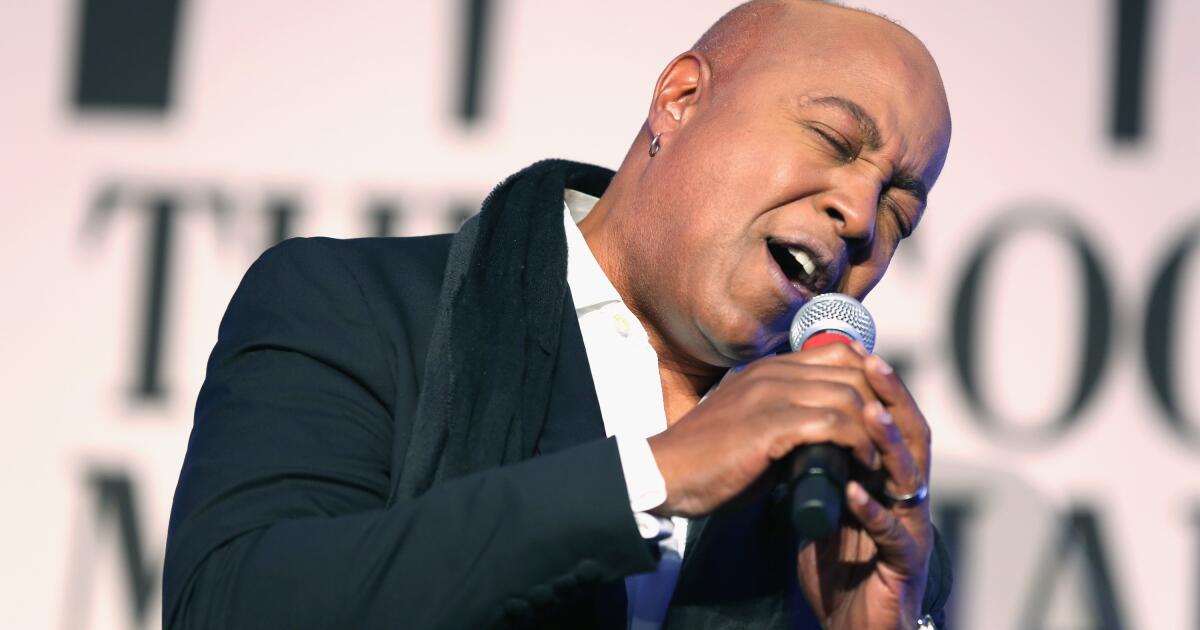
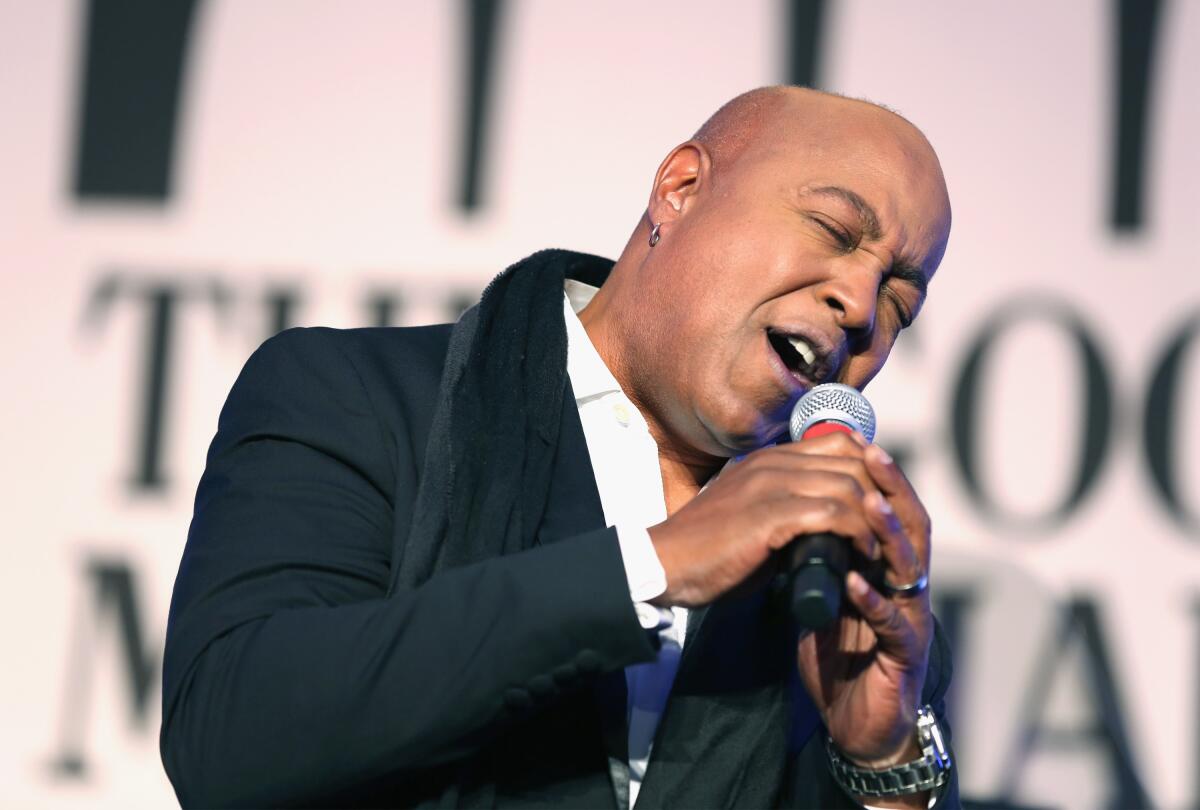
Peabo Bryson performs onstage during the Thurgood Marshall College Fund 28th Annual Awards Gala

Peabo Bryson, pictured performing in Washington, D.C., in 2016, won Grammy Awards in back-to-back years in 1993 and 1994.

(Teresa Kroeger / Getty Images)

In a career peak in 1992, the singer was featured on recordings that topped four separate charts: “A Whole New World,” a duet with Regina Belle from the Disney animated movie “Aladdin,” topped the Pop and Adult Contemporary charts; “The King and I” album, featuring Bryson, was No. 1 on the Classical Crossover charts, and Kenny G’s “Breathless” album, featuring Bryson on “By the Time the Night Is Over,” topped the Contemporary Jazz charts.

He nabbed two Grammy Awards back to back in 1993 and 1994 for his performance of “Beauty and the Beast” with Céline Dion, and his performance of “A Whole New World” with Regina Belle.

“I don’t think there’s anything I can’t do,” Bryson told The Times. “I see myself as a true Renaissance man. I don’t like one-dimensional concepts of myself.”

Robert Peapo Bryson was born on April 13, 1951, in Greenville, S.C. He grew up attending concerts his mother would bring the family to, and by the time he was in high school, he knew he wanted a career in music.

In 1978, he told David Nathan, an editor for Blues & Soul magazine, that his mother wasn’t thrilled about the prospect of him chasing his dreams in the rhythm-and-blues biz and worried he’d get into trouble.

“As far back as I can remember, I’ve always been into music,” Bryson said. “It’s all I ever wanted to really deal with. … I had to make that decision, when I was around 14, as to what I was going to get into, career-wise. Well, I’d thought about being a doctor or something like that, but I really felt that music was my thing.”

He cut his teeth as a backing vocalist in various groups, but none of his bandmates could properly pronounce “Peapo,” his French West Indian name, so he changed up the spelling to make it simpler. The stage name Peabo was born. In the late 1960s, he linked up with “My Elusive Dreams” hitmaker Moses Dillard. “I started out just singing, although I progressed into percussion, guitar and, much later, playing piano — that was basically when I started getting into songwriting,” he told Nathan.

In 1967, he signed his first record deal, with Bang Records, and in 1976, he made his solo debut with the single “Underground Music” and his eponymous album, “Peabo.” The next year, he hit it big time and signed with Capitol Records, where he put out back-to-back gold-selling albums: “Reaching for the Sky” in 1977 and “Crosswinds” in 1978.

Peabo Bryson performs during the Centennial Olympic Park's 4th of July Celebration at Centennial Olympic Park

Peabo Bryson performs at the Centennial Olympic Park’s Fourth of July Celebration in Atlanta.

(Robb D. Cohen / Invision / Associated Press)

By the ’90s, Bryson was at a career high, collected Grammy nominations and became the definitive voice of Disney duets. But the music scene was changing, and Bryson wasn’t keen on the new direction. He told The Times in 1994 that MTV had stopped considering talent as the criteria to be played on the music channel and that he thought mainstream music had taken a hostile and negative turn.

“I guess I [tick] people off because I don’t go away,” he said with a chuckle. “I’m like a tenacious forest fire — you snuff me out over here, and I’m still burning down the back 40 just when you think it’s over. I have a great faith in God, and because of my great faith in God, I have faith in the self.”

Fortunately for legions of fans of the soulful balladeer, Bryson was right and he wasn’t going anywhere for another couple of decades. The Grammy winner continued to grace stages with his flashy blazers and smooth baritone, and recently performed a concert with Jeffrey Osborne at Trilith Live in Fayetteville, Ga.

The event in early May was a standalone performance, apart from the crooner’s Golden Touch tour, which he announced last year, amid his celebration of 50 years in the music industry.

In recent years, Bryson said he had been hitting the gym and prioritizing his health after a scare seven years ago when the artist suffered a heart attack at his Georgia home. He told the Soul Train Cruise 2020 that he flat-lined for nearly 30 minutes, “long enough to make friends on the other side.”

“It turns out that dying is not that hard,” Bryson said. “Didn’t hurt that much. It’s the living afterwards that’s the really difficult part. I mean, why are you still here? You have to ask yourself those hard questions: Are you a good father? Are you a good husband? Are you a good friend? Are you a good brother? Are you a good human being?”

Bryson said he was able to answer yes.

“Then you have to ask yourself the question that makes the answer null and void — can you be better?”

Bryson is survived by his wife, Tanya Boniface Bryson; son Robert Bryson (who goes by Kit); daughter Linda Bryson; and three grandchildren.

Memorial arrangements will be announced at a later date.

Source link

Grammy-winning R&B singer Peabo Bryson has suffered a stroke

R&B singer Peabo Bryson, well known for his duets from beloved Disney classics “Aladdin” and “Beauty and the Beast,” suffered a stroke over the weekend.

A representative for the artist told The Times that the singer is undergoing treatment but provided no details about his condition.

“Two-time Grammy Award-winning singer, songwriter and balladeer, Peabo Bryson — the voice behind the Oscar-winning Disney songs ‘Beauty and the Beast’ and ‘A Whole New World’ — has suffered a stroke and is currently under medical care,” the representative said in an emailed statement. “At this time, the family requests privacy as they navigate this deeply personal moment together. The thoughts, prayers and love of friends and fans are welcomed and deeply appreciated.”

Bryson recently performed a concert with Jeffrey Osborne at Trilith Live in Fayetteville, Ga., in early May. The event was a standalone performance, apart from the crooner’s Golden Touch tour, which he announced last year, amid his celebration of 50 years in the music industry. In April, the Grammy winner turned 75 and posted photos on Instagram from a birthday bash showing him surrounded by friends and family. In early May, he posted a video of his son, Kitt, performing a Michael Jackson dance routine, writing “Super proud Dad moment from last nights Gig in Atlanta.”

Soul and funk band Maze, which was fronted by the late Frankie Beverly, shared some love for Bryson on social media.

“The entire Maze The Music Forever family sends our heartfelt prayers, love, and support to Peabo Bryson during this time of healing,” read the post. “Peabo’s extraordinary voice, timeless artistry, and unwavering contributions to music have touched millions around the world. We pray for God’s healing hand, renewed strength, comfort, and a full recovery.”


Source link

Olivia Rodrigo slams babydoll disses, says it normalizes pedophilia

Some are calling the controversy over Olivia Rodrigo’s recent outfit choices babydoll-dress-gate, Olivia Rodrigo calls it “weird.”

The dress debacle kicked up in early May when Rodrigo released the music video for “Drop Dead,” in which she runs through the Palace of Versailles wearing a pink-and-blue ruffled babydoll set while singing about the intensity of a crush. Then on May 8, she wore a cottage-core pink-and-white floral babydoll dress with knee-high Dr. Martens during a live performance in Barcelona.

Rodrigo was drawing from subversive feminist and punk fashion of yore, but internet critics were quick to slam the “deja vu” singer, saying the ensemble was sexualizing child-like imagery. In an hour-and-a-half interview with the New York Times Popcast that dropped on Thursday, Rodrigo staunchly defended the dress and called the criticism disturbing.

“I have worn outfits that are maybe revealing on stage, like I’ve been on stage in a sparkly bra and little shorts — which is my right — that’s fun,” she said. “I felt cool and comfortable in that, and that wasn’t inappropriate, but me fully covered up in a dress that people deemed to be, like, childlike was inappropriate, and I think it shows how we really normalize pedophilia in our culture.”

Rodrigo further decried the criticism as rhetoric that girls are fed from a young age, “which is ‘don’t wear that, because then a man is going to sexualize your body, and it’s your fault’ — it’s so weird.”

Rodrigo said she didn’t think she looked “sexy” in the babydoll dress; she was going for a cool look à la Kathleen Hannah or like Courtney Love, musicians whom the pop star said are her heroes. Love appeared to defend Rodrigo on social media by resharing posts defending the singer-songwriter in since-expired Instagram stories.

“I just think if we start dressing in a way that’s like, ‘Oh, I don’t want some f— freak to think that I am sexy like a baby’ or some crazy thing like that, I think it’s losing the plot a little bit,” she said. “I’m very protective of younger women and girls, and I don’t ever want them to be fed that rhetoric. You shouldn’t be responsible for some guy sexualizing you in a way that was never your intention.”

Rodrigo’s third studio album, “You Seem Pretty Sad for a Girl So in Love,” which features hit singles “Drop Dead” and “The Cure,” will be released June 12.

Source link