EA-37Bs Arrive At RAF Fairford As Iran Threatens To Attack The UK Air Base
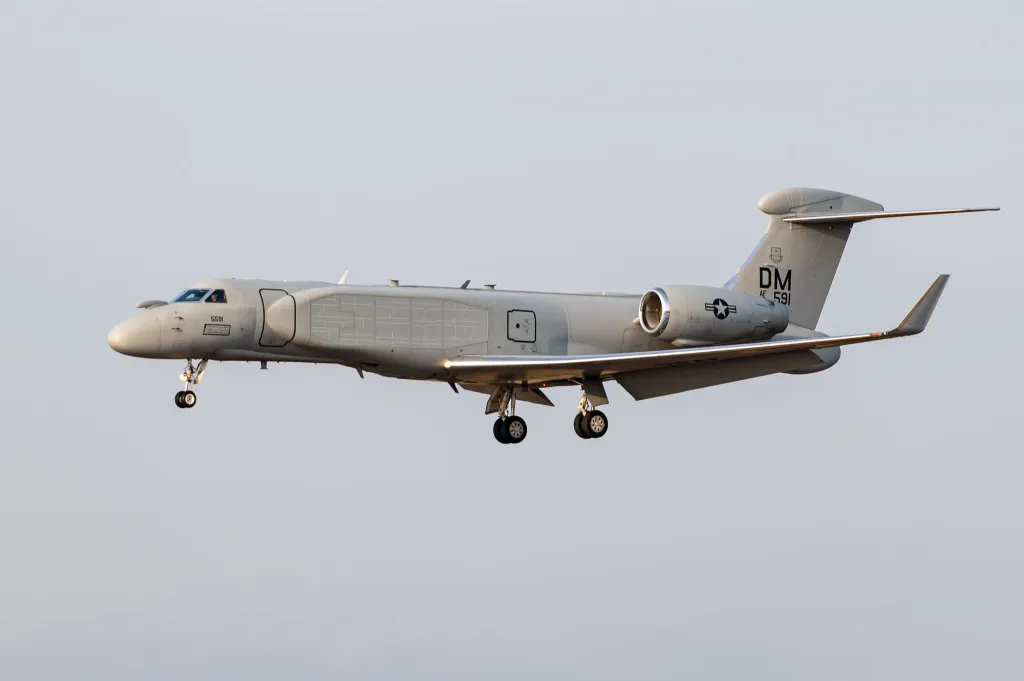
Iran on Thursday threatened RAF Fairford in the U.K. after claims emerged that U.S. Air Force B-1B Lancer bombers launched from there attacked the Islamic Republic on Tuesday. RAF Fairford is a major hub for U.S. military aircraft, with strategic assets, like the B-1s, being forward deployed to the base and tactical and other assets often using it as a pit stop during flights ‘across the pond.’ As an example, Iran’s threat came hours after two EA-37B Compass Call electronic warfare jets arrived at the base from the United States.
“The American aggressor army, which used to launch cruise missiles from its vessels in the Indian Ocean in its aggression after the official resumption of the war, with the end of the missile reserves of the aforementioned vessels, yesterday switched to using B1 planes flying from Fairford Air Base, England,” the Islamic Revolutionary Guard Corps (IRGC)-connected Tasnim news outlet claimed on Telegram. “As the officials of the Ministry of Foreign Affairs also stated, any base that is used to invade Iran’s territory is our legitimate goal.”
Asked about the threats, British officials told us that the country is prepared to defend itself.
“Our Armed Forces are ready to keep the United Kingdom safe from any kind of attacks, whether it’s on our soil or from abroad,” a government official told TWZ. “The UK stands ready 24/7 to defend itself. This includes through operating a layered approach to air and missile defense, provided by Royal Navy, British Army and Royal Air Force assets equipped with a range of advanced capabilities, working closely with our NATO allies.”
“In the Defense Investment Plan we have made air and missile defense a priority after years of underfunding, dedicating £790 million to enhance protection of the UK homeland and overseas bases from air, drone and missile threats,” the official added. “That is complemented by more than £2 billion of funding to deliver further air defense and counter-drone capabilities, and to upgrade and sustain our Typhoon fleet.”
Iranian officials did not specify how they would strike RAF Fairford, and it is unclear how they could. In March, Iran reportedly fired two missiles at Diego Garcia, a joint U.S.-U.K. base on an island in the Indian Ocean. That’s about 2,400 miles away, or about the same distance as Fairford is from Iran. However, one missile was reportedly shot down by a U.S. warship while the other failed in flight. Given that, whether Iran could actually launch a successful attack on Fairford using those weapons is questionable at the least. Far more likely, if Iran would actually even try anything at all, would be a near-field attack like Operation Spider Web launched by Ukraine in June 2025 against Russian bombers using short-range drones hidden in trucks near airfields. One-way attack drones launched from vessels at sea is another very real attack vector Iran has trained for and equipped itself to execute, a threat you can read all about here.
You can see video of one of those strikes below.
The threats came after Axios reported that B-1B bombers from the base took part in Tuesday’s strikes on Iran. TWZ cannot independently confirm that and CENTCOM declined comment. However, open-source trackers made that claim early Wednesday morning before the Axios story was published.
As we noted earlier and have discussed in the in the past, RAF Fairford has served as a major hub for aircraft heading to the region as well as long-range bomber missions on Iran.
“U.S. Air Forces in Europe operating locations, including the 501st Combat Support Wing at RAF Fairford, routinely host transient U.S. military aircraft in accordance with access, basing, and overflight agreements with Allies and partners,” an Air Force spokesperson told us in response to our questions about the Compass Calls.
The EC-37s landed shortly after 7 a.m. British Summer Time (BST), or about 2 a.m. EDT, according to local aviation photographer Matt Belcher, who was kind enough to share photos he took of the aircraft.


The Compass Calls are heavily modified Gulfstream G550 business jets. They leverage the Conformal Airborne Early Warning (CAEW) configuration developed first for the Israel Defense Forces, which has large ‘cheek’ fairings on either side of the fuselage, among other distinctive features.
The Air Force is planning to procure 10 of these jets to replace the aging and decreasing fleet of turboprop EC-130H Compass Call planes, of which only four remain. The 43rd Electronic Combat Squadron flew the first training sortie for the EA-37B on May 2, 2025, and one made the type’s maiden voyage to Europe in January.

Many of the EA-37B’s mission systems are directly ported over from the EC-130H, which is why the two very different aircraft share the same nickname. Both aircraft are designed to provide critical stand-off jamming support, including against enemy radars and communications systems. They also have a secondary intelligence, surveillance, and reconnaissance (ISR) function given their ability to spot, track, and geolocate various types of emitters.

The EA-37B also offers new capabilities that go beyond what is found on the EC-130H. The Air Force has said in the past that the aircraft’s designation reflects its ability to not only attack, but also destroy certain targets, as you can read more about here.
The Compass Calls had previously been deployed to RAF Mildenhall in the early days of Operation Epic Fury. On April 1, CENTCOM announced for the first time that they had been used in combat as part of Epic Fury. The possibility that they are returning to the region, or adding additional electronic warfare capabilities to the total force deployed there, can be considered a potential indicator of what’s to come. These are often the last assets we see move into place ahead of major combat operations.
All this comes as the U.S. is building up forces amid increasing intensity of attacks on and by Iran and President Trump’s statement to Axios today that “I am considering a massive attack. Bigger than ever before. I am close to making a decision. We are all set for it.”
In addition, Houthi attacks on Saudi ships in the Red Sea raise the specter of a U.S. military response there.
Last week, we reported that at least 12 F-16 Fighting Falcons were deployed to Muwaffaq Salti Air Base in Jordan from Spangdahlem Air Base in Germany. Other aircraft have rotated into the CENTCOM area of operations as well.
In addition, “special-operations forces have deployed to the region from their U.S. bases,” The Wall Street Journal reported, citing flight-tracking data and U.S. officials. “Squadrons of jet fighters have been staged across the Middle East, and bomber aircraft at bases in the U.S. and U.K. are on high alert to ramp up operations, according to one of the officials.”
Beyond aircraft, “more than 150 medics have arrived at the Landstuhl Regional Medical Center in Germany in recent days,” the Journal added. The hospital is the primary location for treating troops injured in combat in the Middle East.
Other assets have been rotated out, like the B-52 Stratofortress bombers that departed from Fairford earlier this month. The U.S. also returned F-22 Raptors that were flying out of Ovda Air Base in Israel back to the United States. Other aircraft, such as A-10s and F-15Es, have also returned home from or have been replaced in the CENTCOM region. So clearly there is a lot of shifting of aviation assets taking place even amid current operations.
While adding new forces to Europe and the Middle East does not necessarily mean that Trump will dramatically escalate the conflict, it gives him options to do so. In addition, the public nature of some of these movements also has a messaging effect, letting Tehran and the Houthis know that Trump is ordering more assets to the region.
Regardless, the direct threat against RAF Fairford, no matter how nebulous, is new and will certainly be taken seriously by security officials at the installations and others in region.
Contact the author: howard@twz.com