Navy E-2D Hawkeyes Appear To Be Rushing To The Middle East
A group of at least five carrier-capable U.S. Navy E-2D Advanced Hawkeye airborne early warning and control planes arrived overnight in the Azores after crossing much of the Atlantic. The Azores is a common stopover point for U.S. military aircraft heading to the Middle East. The move is somewhat rare for the E-2 community, but it’s extremely logical, and likely highly urgent, considering what is going on in the Middle East.
In many respects, the E-2D is the most sensitive airborne ‘look-down’ radar platform in U.S. military service today. As far as we know, the only E-2Ds in the Middle East right now are supporting air wing operations of the USS Gerald R. Ford and USS Abraham Lincoln. Rushing more of them to the Persian Gulf for land-based operations to help spot low-flying Iranian kamikaze drones wreaking havoc on Arab Gulf States would make total sense.
We have seen a similar request accepted by the Royal Australian Air Force, which is sending one of its highly capable E-7 Wedgetail airborne early warning and control aircraft to the region for essentially the same purpose. Australia’s commitment is separate from current U.S.-Israeli operations. Both the E-2D and the E-7 aircraft can also spot low-flying cruise missiles, short-range ballistic missiles, and even maritime threats, making them ideal for the littoral operations against everything Iran is throwing at U.S. allies in the region. The Hawkeye and Wedgetail also offer additional battle management and networking capabilities, which U.S. forces engaged in operations against Iran are currently relying heavily on a strained fleet of aging E-3 Sentry jets to provide.

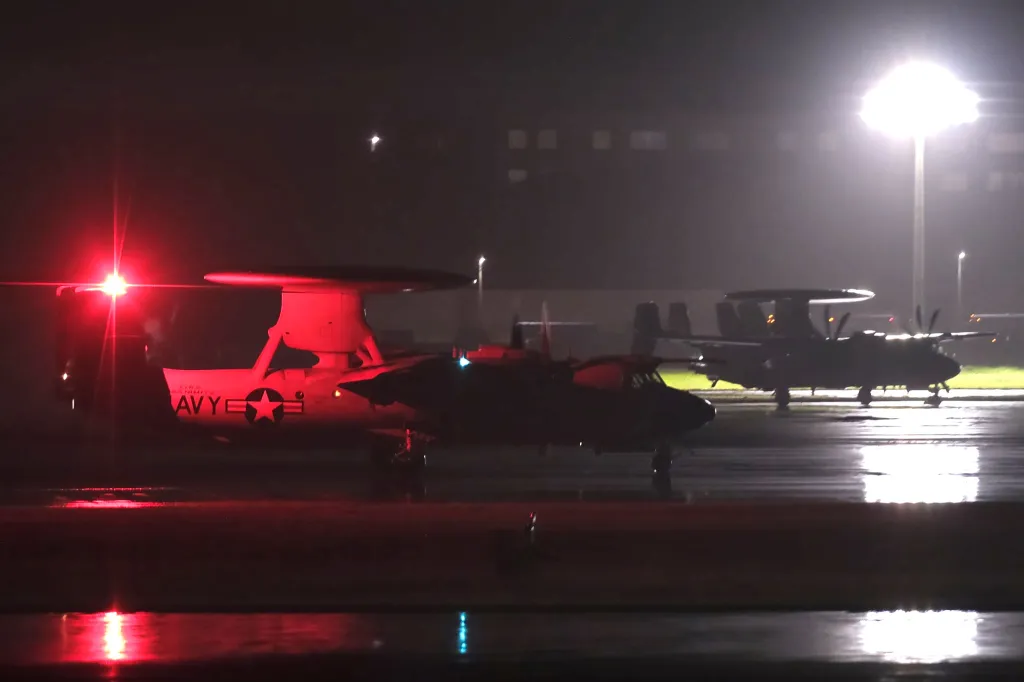
Pictures above and below show E-2Ds at Lajes on the island of Terceira in the Azores, a Portuguese archipelago, last night. Online flight tracking data had also shown the Hawkeyes heading there. We can also see that the Hawkeyes are upgraded versions capable of being refueled in flight, via a probe prominently mounted above the cockpit. In line with this, a pair of U.S. Air Force KC-46 Pegasus tankers had been tracked accompanying the Navy aircraft to Lajes, as well.

Previous tracking data shows the E-2Ds flew first from Norfolk, Virginia, to Bangor, Maine, last Friday. The Hawkeyes then departed Bangor yesterday, heading east across the Atlantic.
Markings visible in the pictures from Lajes show that at least some of the E-2Ds that touched down there are assigned to Carrier Airborne Early Warning Squadron 121 (VAW-121) based at Naval Air Station Norfolk (NAS Norfolk). There had been indications earlier that the contingent included Hawkeyes from VAW-126, also based at NAS Norfolk, but this appears to be unconfirmed at this time. VAW-121 and VAW-126 are assigned to Carrier Air Wing 17 (CVW-17) and CVW-1, respectively. CVW-17 was notably most recently attached to the supercarrier USS Nimitz, which had been scheduled to be put into mothballs in May, but is now slated to remain in service at least until March 2027.

It remains to be seen where exactly the E-2Ds head to now, but, as noted, U.S. military aircraft regularly pass through the Azores while transiting to the Middle East. Lajes was heavily utilized during the massive build-up of American airpower ahead of the start of U.S.-Israeli strikes on February 28. The American component of this campaign has been dubbed Operation Epic Fury.
The conflict has taken on a regional character, with Iranian missiles and drones having now fallen on a dozen countries across the Middle East and the Eastern Mediterranean. There is also a distinct maritime dimension to the fighting, with Iran choking off the highly strategic Strait of Hormuz with attacks on commercial vessels, and discussions now about how to reopen that critical waterway.
A deployment of E-2Ds could help provide much-needed additional eyes in the sky, as well as other capabilities, to help protect against Iranian retaliatory attacks, as well as support strikes on targets in and around Iran and/or any efforts to establish sea control in the region. In particular, the Hawkeyes are America’s best available tool for spotting low-flying, low-signature targets, such as kamikaze drones and cruise missiles, as well as small targets at sea like explosive-laden drone boats. The E-2D is also well-suited to performing these missions in littoral areas like the Persian Gulf, the Gulf of Oman, and the Strait of Hormuz in between. Hawkeyes performed similar missions in and around the Red Sea between late 2023 and early 2025.

As noted in the opening of this post, there is already an especially pronounced demand for additional assets, and more capable ones, to spot and track low-flying Iranian kamikaze drones and cruise missiles. This was already evidenced by the Australian government’s announcement last week that it was sending one of its E-7A Wedgetail airborne early warning and control aircraft to the region to help with defensive operations, something we will come back to later on.
In addition, from what is known now, U.S. forces taking part in operations over and around Iran are receiving airborne early and warning control support from U.S. Air Force E-3 Sentry AWACS (Airborne Warning and Control System) aircraft forward-deployed at Prince Sultan Air Base in Saudi Arabia. As noted, Navy Hawkeyes have also already been flying missions as part of Operation Epic Fury from the decks of carriers in the region.


Before the current conflict erupted, TWZ explored in detail the challenges and limitations that the aging E-3s face, including struggles just to keep the aircraft operational at all. On top of that, the total size of the Sentry fleet has dramatically shrunk in recent years, creating additional strain on the remaining jets, nearly 40 percent of which are now on the Arabian Peninsula. Based on available readiness data, this represents an even higher percentage of E-3s available for real-world mission tasking anywhere globally.
Just in terms of their radars, the E-2Ds with their active electronically scanned array (AESA) AN/APY-9s offer a major boost in capability over the older E-3s and their older passive electronically scanned array (PESA) types. In general, AESAs can scan faster, see farther, and produce more precise and otherwise higher fidelity tracks, even when it comes to smaller objects and/or stealthy ones with reduced radar signatures, than older types of arrays. The APY-9, specifically, also benefits from “space-time adaptive processing” functionality that “suppresses clutter, jamming, and other sources of electromagnetic interference, focusing on the target,” according to the manufacturer Lockheed Martin.
As such, with the added benefit of being able to look down from a high perch, the E-2D offers a particularly powerful tool for spotting and tracking smaller, lower, and slower-flying threats, such as Iranian kamikaze drones and cruise missiles. This capability was optimized for overwater and littoral operations to protect the carrier strike group. In addition, the APY-9 has a surface search mode that can be used for maritime surveillance, which, as already mentioned, is also very relevant in the context of the current conflict. Overall, these talents would fit in perfectly with what’s happening in the Persian Gulf and the Gulf of Oman.
Unlike older E-2s, Hawkeyes with aerial refueling capability can also fly out to operating areas further away from wherever they are based and stay on station much longer.

In Navy service, the E-2D is far more than just its radar, too. The aircraft have an extensive communications and networking suite that is tied in directly to the service’s Cooperative Engagement Capability (CEC) and Naval Integrated Fire Control-Counter-Air (NIFC-CA) architectures.

CEC – Cooperative Engagement Capability
As part of these Navy-specific networks, the Hawkeyes are deeply integrated in ‘kill webs’ that include an array of air and sea assets in the service’s inventory. For many years now, the Navy has used the example of E-2s enabling ships to fire long-range SM-6 surface-to-air interceptors at targets beyond the reach of their organic radars and other sensors to explain the benefits of these networked capabilities. CEC and NIFC-CA also just allow commanders to have a more detailed and complete picture of the battlespace around them, including friendly assets and threats, and offer a valuable boost in general situational awareness.

It should also be noted that while Navy E-2s more often operate as part of carrier air wings, the service’s Hawkeyes flying from bases on land is not new. Between 1995 and 2017, the service even had an explicitly land-based E-2 unit, VAW-77, which supported counter-drug operations in the Caribbean from bases in the United States and in Latin America. The majority of non-U.S. E-2 operators, past and present, have also operated their Hawkeyes as land-based aircraft. At the same time, since it was primarily designed around carrier operations, the Hawkeye also has the ability to fly from shorter runways and with a smaller logistics footprint compared to many other airborne early warning and control platforms.
TWZ actually already covered much of this in detail back in 2024 after U.S. Central Command (CENTCOM) released the video below, showing a Navy E-2D refueling from a U.S. Air Force HC-130J combat search and rescue aircraft somewhere in the region. At that time, we also explored how Hawkeyes could bring similar benefits to expeditionary and distributed operations elsewhere in the world, especially an island-hopping campaign in the Pacific, as you can read more about here.
It is also interesting to consider all of this now in the context of the Pentagon’s attempt last year to cancel the U.S. Air Force’s acquisition of new E-7s to replace a portion of its E-3s, and to fill interim capability gaps with additional E-2Ds instead. Questions about the Wedgetail’s survivability in a future high-end fight, such as one against China, as well as delays and cost overruns, were cited as key factors. Congress has since compelled the Air Force to proceed with the E-7A program as planned. Last Thursday, Boeing received two contract modifications, together valued at just over $2.4 billion, for an unspecified number of developmental Wedgetails, as well as materials related to the MESA sensor system.
There do continue to be some lingering questions about the future of the Air Force’s E-7 program. The service had resisted seeking any kind of direct replacement for the E-3 for years. The Air Force’s stated long-term goal remains to push most, if not all, of its airborne target warning sensor layer tasks into space, but this is still years away, at least, from becoming a reality.

As TWZ has explained in the past, while the E-2D is in many respects the most capable airborne early warning and control aircraft currently in U.S. inventory, the Wedgetail is arguably the most capable such aircraft anywhere globally at present. The jet-powered, Boeing 737-based, aerial refueling-capable Wedgetail with its large AESA Multi-role Electronically Scanned Array (MESA) sensor, can fly higher, faster, and further than the turboprop Hawkeye.

Northrop Grumman MESA Radar – Boeing E-7 AEWC
The E-7 is also just bigger and can accommodate a larger crew, making it even more adaptable to expanded mission needs, such as battle management and acting as a networking node using its own expansive communications and data-sharing suite. Any survivability concerns that apply to the E-7 would apply just as much to the E-2, as well. As noted earlier, the benefits of the E-7, including in the current context of operations against Iran, are underscored by Australia’s decision to send one of its Wedgetails to the Middle East. That aircraft is explicitly being deployed to help defend the United Arab Emirates and other countries in the region that have been subjected to Iranian drone and missile attacks.

The group of Navy E-2Ds now heading east across the Atlantic only further calls into question the Pentagon’s puzzling move to axe the E-7 program, as well as the Air Force’s previous dragging of its feet in settling on any plan to replace the aging E-3s. That additional Hawkeyes only appear to be headed to the Middle East now is also another sign that the scale and scope of Iranian retaliation on Gulf Arab States was somehow not expected, despite repeated threats from the regime in Tehran in the lead-up and supporting intelligence assessments to the current conflict. For many years, U.S. intelligence thought it was likely Iran would lash out at U.S. allies in the region, especially those housing U.S. military capabilities. It was a glaring likelihood we have discussed for years in our own reporting.
Regardless, additional Hawkeyes would provide a massive and very much-needed boost in aerial surveillance capability and capacity, as well as other benefits, to help defend against Iranian retaliatory attacks and otherwise support still-expanding U.S. operations against that country.
Special thanks to user @Azorean_Lion on X for sharing the pictures of the E-2D Hawkeyes at Lajes with us.
Contact the author: joe@twz.com