Inside Traitors star Richard E Grant’s ‘gold dust’ marriage with late wife from ‘instant attraction’ to baby heartbreak
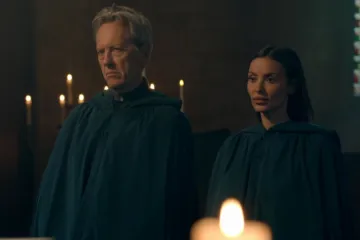
HE stole the show on last night’s opening episode of Celebrity Traitors, honestly announcing to the group that he was, in fact, a traitor.
Alongside his comical moments on the BBC show, actor Richard E Grant also gave some touching references to his late wife Joan Washington.
After host Claudia Winkleman selected the Withnail & I star as a traitor alongside presenter Maya Jama, Richard spoke about “love of his life” Joan, who passed away in 2021.
Delighted at being a traitor, he told viewers: “My wife said to me four days before she died, she said Richard try and find a pocketful of happiness in each day, and I feel like I’ve got a wheelbarrowful and then some.”
Richard’s heartfelt confession came just minutes before his now legendary Celebrity Traitors gaffe revealing his traitor status.
The relationship between Academy Award-nominee Richard, 69, and his wife of 35 years was so romantic it could have played out on the silver screen.


Richard met dialect coach Joan at a London studio, called The Actors’ Centre, in 1982, where she had been teaching an accent class.
At the time, Joan was married to someone else, and had a son called Tom, but Richard could not take his eyes off her.
In 1994, he told The Independent he was captivated, saying: “She was wearing a boiler suit and had fairly short, cropped hair and Kicker shoes, and was chain-smoking, which I thought was insane.”
But he added: “I thought she had the most wonderful voice and huge, sort of monkey eyes. She seemed fairly frenetic. I thought that she was really cute and all that.”
Joan gave Richard a lesson in developing an Irish accent and he says they “instantly” clicked.
But initially, and amusingly, Joan found him “annoying”.
She said: “I used to take a class of about 20 people and I actually used to find him quite annoying because he’d get the giggles at quite the wrong moment and I was a strict teacher.”
Giggling aside and getting to know Richard during private lessons, Joan quickly realised she was falling for him.
She previously described her then-marriage as “extremely bad at the time” and slowly found herself smitten with the handsome actor in her class.
Recalling the way she was feeling, Joan told The Independent that she soon realised she was “madly in love with him”, adding: “I do believe that there’s one person on the globe that’s meant for you.”
The pair became a couple a year later and their relationship went from strength-to-strength, even though their jobs often meant they spent great chunks of time apart.
Richard said he never believed in marriage until he met Joan.
“My parents were divorced when I was 11 and it made such a profound impression on my life that I suppose I thought that by not getting married, you could avoid your life being carved in two. But that changed,” he told The Independent.
Although they were often apart, Richard and Joan would speak on the phone regularly and write to each other daily.
Eventually, Richard decided it was time to make an honest woman of his girlfriend with a proposal that could have been straight out of a movie.
Arriving home to London for Christmas following six weeks away in Africa, he couldn’t wait any longer and popped the question at the airport.
Richard previously recalled: “So I came back and went on bended knee with my trolley at 6.30am at Heathrow Airport – and, luckily for me, she said yes.”
Richard, who was nominated for an Oscar for his role in Can You Ever Forgive Me?, and Joan married in 1986.
Richard once described their marriage as “the story of my adult life”, saying they began a conversation when they met and never really stopped.
Following their marriage, the newlyweds were keen to start a family together. Sadly, their journey was a difficult one.
Joan suffered three miscarriages. They were then left heartbroken when their first child, a daughter called Tiffany, died very soon after she was born.
Richard later told YOU magazine: “Until that time I had no idea how common it is to lose babies and what it actually meant.”
Thankfully, the couple later welcomed their rainbow baby – a second daughter, who they named Olivia, in 1989.
Richard has since described Olivia as his and Joan’s “miracle baby”.
In 2019, the devoted father looked proud as punch as he walked the red carpet with Olivia on his arm at the Oscars.
Speaking to ABC, he said at the time: “My daughter, absolutely gorgeous, she’s 30 and she works in casting so I’m guaranteed a job for life, hopefully.”
Richard and Olivia run a unisex fragrance company together, called JACK.
Speaking about her life with her dad, Olivia added: “I’m just proud. It’s been the best ride to go on together.”
Unlike dozens of other Hollywood stars, Richard and Joan’s beautiful relationship lasted the distance and their love for one another was unbreakable.
Speaking to The Guardian in 2015, he described their marriage as “gold dust”.
Tragically, in 2021, Richard confirmed on Instagram that his wonderful wife had passed away at the age of 74, following a battle with lung cancer.
Sharing an emotional video of himself dancing with Joan, Richard wrote: “Joan – Love of my Life, giver of Life to our daughter Olivia.
“Our hearts are broken with the loss of your Life last night. 35 years married and 38 together. To be truly known and seen by you, is your immeasurable gift. Do not forget us, sweet Monkee-mine.”
The actor was left devastated at the loss and said experienced further heartbreak how some friends reacted to the news, claiming a couple stopped speaking to him and even crossed the road to avoid speaking to him about his grief.
He shared: “Subsequent to her death, I have had people cross the road rather than talk. Whether they think you’re going to fall apart and you’re an emotional wreck, I don’t know. But I will never speak to them again.”
Before she passed, Richard admitted she gave him a “hilarious” list of women he must never date after she passed – although he said he does not expect to fall in love again.
Two years ago, he admitted he still writes her letters every night to stay in touch.
He told The Guardian: “I write to her every night. [I write down] everything. Stuff I know would amuse her… I have no spiritual or religious delusion that I’m ever going to get a reply.
“But after 38 years of marriage, I can hear what her response would be. It feels as close a connection as I can have. And I’ve found it very hopeful, that at the end of the day I’m having a conversation.”
In early September, Richard marked the fifth anniversary of her death with a touching tribute.
On Instagram, he wrote: “Five years ago today, my beloved wife Joan died at 7:30 in the evening. We were holding each other’s hands when she drew her last breath.”
In June 2026, Olivia and husband Florian Herbst – who wed in 2024 – welcomed their first child, a son, making Richard a grandfather for the first time.
The proud actor referred to his late wife on Instagram when he announced the news, calling the baby “our grandson.”
In an Instagram video in June 2026, an emotional Richard said: “I’m so grateful for the safe arrival of our grandson. Life truly is miraculous.”
In addition to this, in September he shared a clip of him carrying his grandkid on a walk, saying: “No better way to start my day bobbing our sleeping grandchild along Petersham meadow with Annie Lennox playing in my head.”