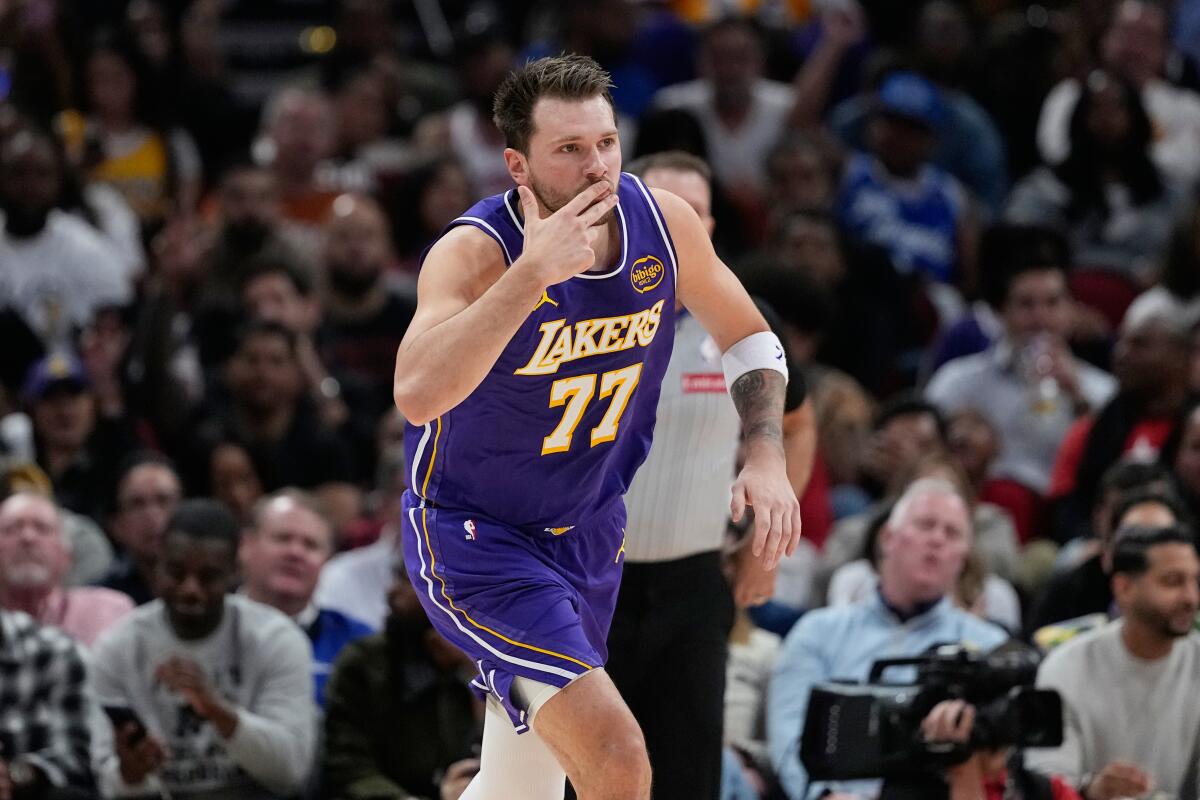
HOUSTON — The combination of Luka Doncic and LeBron James was overpowering and enthralling for all to see during the Lakers’ dynamic 124-116 win over the Houston Rockets at Toyota Center on Wednesday.
Doncic was masterful with his near triple-double of 40 points, 10 assists and nine rebounds.
“I thought he definitely put on a clinic down the stretch,” Lakers coach JJ Redick said. “Whether it was in isolation, versus fires in isolations, versus the shock with (Alperen) Segun, he just got us good offense whether for himself or for his teammates every single time down the floor….We moved the basketball, so that kind of got us going and then when Luka came back in he was just fantastic.”
James was a force with 30 points, five rebounds and two assists.
He was super efficient, missing just one of his 14 shots and making both of his three-pointers.
“Look, he was awesome tonight and I think two, part of the evolution of him on this team has been, particularly in this stretch, it’s just been his patience,” Redick said. “His patience, knowing he’s going to get the ball and he’s going to have transition opportunities and he’s going to have plays called for him and he’s going to play off-ball and get a corner three…He was great.”
The tremendous play of Doncic and James is why the Lakers extended their winning streak to seven straight games and helped them take the three-game series over the Rockets, 2-1, winning both games here, one on Monday night.
And because Doncic and James were clutch down the stretch when the Lakers leaned on them to be clutch, they are the third-place team in the rugged Western Conference, holding a 1-½ lead over the Minnesota Timberwolves.
“You know, when you win, everything is easier,” Doncic said. “Winning is fun. So, just the way we play, I think it’s a lot of fun. And that’s what we just do, we win, have a good time.”
Doncic had 10 points and three assists in the fourth quarter.
But the beauty of the night was when Doncic threw a no-look lob pass to James for a dunk and then when Doncic drilled a three-pointer with 58.4 seconds left for a 120-111 Lakers lead.
Doncic yelled at the crowd and ran down court shaking his head. When the Rockets called a time out, the Lakers bench all ran over to Doncic, hugging him, slapping him and James nudging him for a job very well done.
Doncic was asked what the fan said to set him off.
“I don’t know, some guy. Some guy was talking crazy,” Doncic said. “Showed me his… I don’t know. Nevermind.”
Doncic speaks several languages, including English and his native Slovenian.
He was asked what language he spoke when talking to the fan.
“Off the camera, it was in English,” he said. “I made sure he understand.”
Luka Doncic celebrates after making a three-pointer against the Houston Rockets in the first half.
(David J. Phillip / Associated Press)
James had a steal in the first quarter and then threw down a dunk with Alperen Segen chasing him, leading to James to stare at Segun as he ran back down court, drawing cheers from the fans in awe at witnessing the 23-year veteran still making highlight plays at 41.
Early in the second quarter, James gave the fans even more to cheer about, catching a high lob pass from Marcus Smart and throwing down a one-handed dunk to oohs and aahs.
James wasn’t done, taking a pass from Jake LaRavia and throwing down another dunk later in the second quarter that brought the crowd out of its seats. That play gave the Lakers a 13-point lead.
James was at it again with a tip dunk off a Deandre Ayton missed shot late in the second quarter.
By the end of the first half, James had made all eight of his shots and scored 18 points in carrying the Lakers to a 12-point lead after the first 24 minutes of the game.
“Right now, I feel like….” James said after the game. ‘’Right now. But in the game I felt pretty good. Before the game I didn’t feel that great. I mean, I was yawning and tired and telling myself I was literally, just like talking to myself like, ‘Come on, here we go. Let’s figure it out. Let’s get through it.’ But I felt pretty good in the game and like I said I’m happy to make a few plays to help our team win.”
In many ways, it was easy to understand why he felt that way. He had just played in his 1,610th career NBA game, leaving him one shy of the all-time record held by Robert Parish (1,611).
So, James was asked, where did he find the energy to play 34 minutes and six seconds in such a high-level and intense game.
“I mean, if I’m in uniform I got to try to see what I can give,” James said. “And that’s where it stems from.”
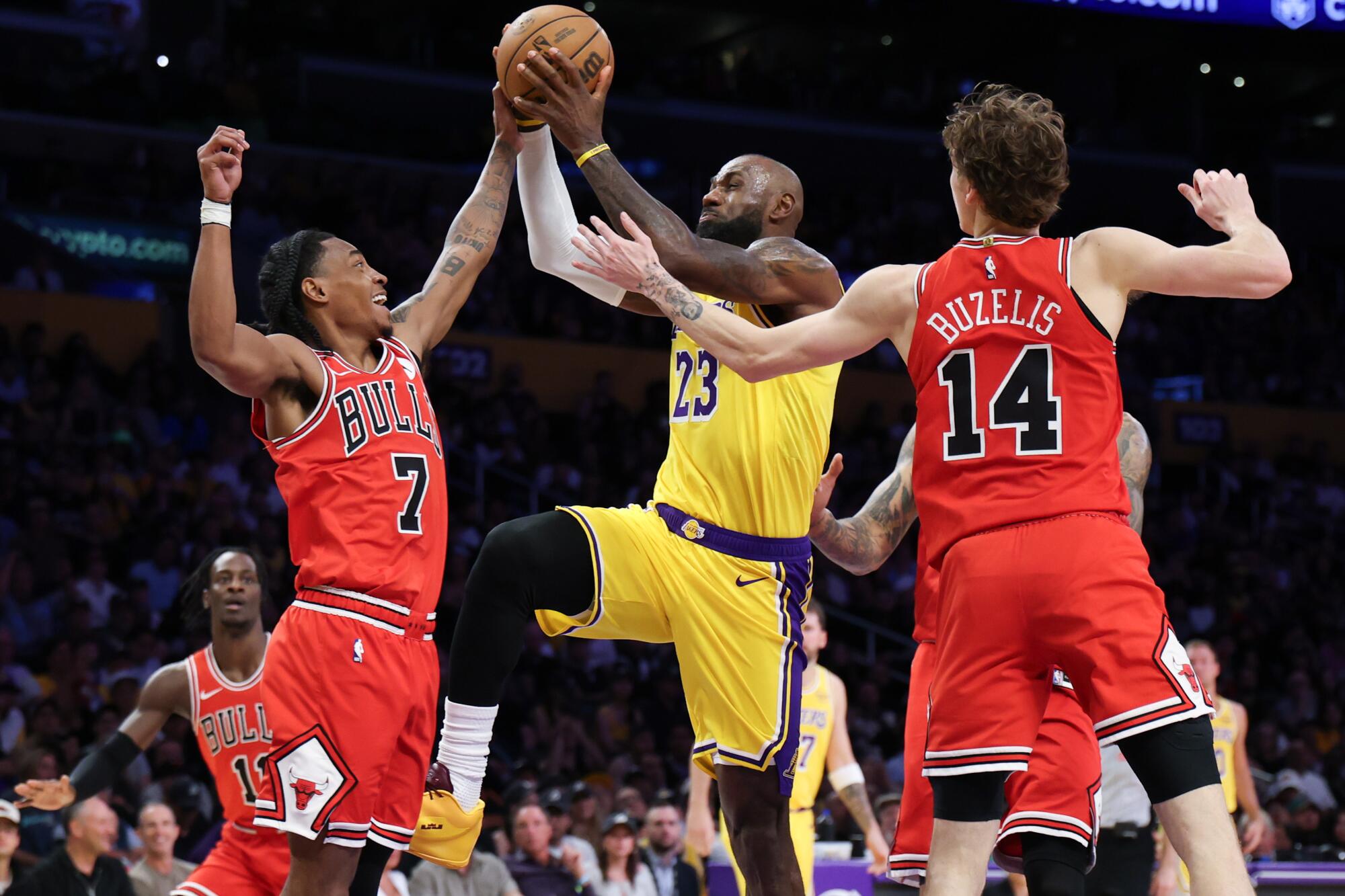
Luka Doncic recorded his first 50-point game of the season Thursday, hitting two late free throws as the crowd at Crypto.com Arena showered him with “MVP” chants in the fourth quarter. Doncic checked out with 1:41 remaining to a standing ovation with 51 points, 10 rebounds and nine assists to lead the Lakers to a 142-130 win over the Chicago Bulls.
The Lakers (41-25) jumped into third place in the Western Conference with their seventh win in their last eight games, climbing from sixth in just one week behind Doncic’s brilliance. The NBA’s leading scorer has averaged 40.2 points in the last four games, all wins. Doncic had a chance at 50 points in a game against the Minnesota Timberwolves in October, but missed a late free throw that forced him to settle for 49 points.
LeBron James returned after missing three games because of elbow and hip contusions he sustained against the Denver Nuggets on March 5. He finished with 18 points, seven rebounds and seven assists. Austin Reaves had 30 points and seven assists, surpassing 5,000 points for his career. Center Deandre Ayton held down a short-handed big man rotation with 23 points and 10 rebounds.
The Lakers were without starting guard Marcus Smart (right hip contusion) and backup centers Jaxson Hayes (back soreness) and Maxi Kleber (lumbar back strain). Smart has been playing through the injury for several games, but with a six-game road trip starting next week, “we need it to calm down,” coach JJ Redick said. The coach expected Smart to be available Saturday when the Lakers play the Nuggets at Crypto.com Arena.
The Lakers gave up a 12-3 run to end the first quarter and led the struggling Bulls (27-39) by only five at halftime. James helped give them the breathing room going into the locker room as he scored his first points of the game with 54 seconds left in the first half. His three-point play sparked a quick five-point run to end the half, which ended with a dunk from Rui Hachimura.
Lakers star LeBron James, center, drives between Chicago’s Rob Dillingham, left, and Matas Buzelis during the second half Thursday.
(Allen J. Schaben / Los Angeles Times)
James came alive in the third quarter, beginning with his dunk off a hit-ahead pass from Doncic. He returned the favor by diving out of bounds for a steal on the next possession and the save led to a three-pointer from Doncic.
Doncic made nine of 14 three-point attempts as the Lakers made 17 of 36 shots from beyond the arc, their best three-point percentage in a game since Feb. 20.
After not taking a single shot in the first quarter, James had 11 points, three rebounds and two assists in the third quarter as the Lakers’ lead grew to 22 points.
Another winnable game was slipping away, another frustrating performance by USC unraveling in painfully familiar fashion, when Jaden Brownell lifted up from the corner for a wide-open three-pointer, offering a split-second of hope in an otherwise hopeless second half.
But the shot clanked away. A collective sigh from the cardinal-and-gold faithful rippled through Galen Center, only to be swallowed up seconds later when Nebraska’s Pryce Sandfort, who finished with 32 points, knocked down a three-pointer of his own. That’s when USC’s own arena exploded with a deafening Big Red roar, loud enough to make you forget you were in Los Angeles — or that these lifeless Trojans had once looked like a real NCAA tournament team.
There were still more than nine minutes remaining after that in Saturday’s brutal 82-67 loss, though that roar from the Nebraska faithful might as well have been the exclamation point. Whether it becomes the punctuation mark on a frustrating second season for USC under coach Eric Musselman was still to be determined.
The Trojans have lost five consecutive games as of Saturday and sit in a tie for 11th in the Big Ten. They still have two regular-season games remaining to bolster their middling tournament resume, both of which they can ill afford to lose.
A midweek matchup at Washington looms especially large. A loss to the Huskies, who are 14-15, would make climbing back from the bubble brink especially harrowing. A rivalry rematch awaits after that against UCLA.
“I still think we could have a successful season,” forward Terrance Williams II said Saturday . “I had that positive mindset coming into the season. I still have that positive mindset. The season’s not over. … We can change the trajectory of the season very quickly.”
Nebraska forward Pryce Sandfort (21) drives past USC forward Terrance Williams II (5) during the first half Saturday.
(William Liang / Associated Press)
Nothing, though, about Saturday’s second half suggested USC was poised for positive change.
The Trojans positioned themselves in the first half to make a very different statement Saturday. They took advantage of foul trouble from Nebraska point guard Sam Hoiberg and led by five points at halftime. Chad Baker-Mazara had already poured in 14 points, and they barely needed freshman Alijah Arenas, who was left out of the starting lineup and played only nine minutes. “They had belief,” Musselman said.
Yet after shooting 52% from the field in the first half, the Trojans were suddenly unable to find the target in the second. For the first five minutes of the half, a dunk from Jacob Cofie was USC’s only basket. During another five-minute stretch in the second half, USC couldn’t even manage a dunk.
Its issues only got worse when Baker-Mazara fell hard trying to block a lay-in. He didn’t play the rest of the game, as Musselman said Baker-Mazara told the staff he was unable to go.
“They played great in the second half,” Musselman said, “and we did not play very good.”
The Trojans didn’t fare much better on the glass, either, as Nebraska more than doubled USC’s total rebounds (22 to 10) after halftime.
The defense followed suit, with Nebraska piling up points in the paint at will. Sixteen of the Huskers’ first 20 points in the second half came on either dunks or lay-ins as USC’s defense lacked any semblance of urgency.
“I feel like they came out with more energy to be honest,” Williams said. “The first couple possessions, you could see it. They wanted it more than we did.”
How that’s still the case, after several similarly frustrating second halves this season, is still unclear.
“Second halves, they’re hard,” Brownell said. “We have to accept that and get ready quicker in the locker room, get our mental right and then come in and be ready.”
But with the Trojans on the very brink of the tournament bubble, time is quickly running out on that possibility.
Ira Parker intended the very last scene of “A Knight of the Seven Kingdoms,” Episode 6 (titled “The Morrow”), to be just “something that was a little funny.”
Sunday’s season finale of the HBO fantasy series ends with everyone, including the royal Targaryen entourage, departing Ashford after the conclusion of the trial and tournament. Just before the credits roll, Prince Maekar, who notices his young son Aegon is once again missing, frantically shouts, “Where the f— is he?”
“To be honest, the very, very, very end was almost just meant as a joke,” the showrunner says during a recent video call. “But I think people — both in my writing camp and in the HBO camp and probably in the world — took that quite literally. So I’ve maybe had to deal with it a little bit more in Season 2 than I was planning to.”
“A Knight of the Seven Kingdoms” showrunner Ira Parker, right, with director Sarah Adina Smith on the set of the fantasy series.
(Steffan Hill / HBO)
Starring Peter Claffey as Ser Duncan the Tall and Dexter Sol Ansell as Prince Aegon Targaryen, “A Knight of the Seven Kingdoms” is an adaptation of George R.R. Martin novellas set in the same world as his “A Song of Ice and Fire” series. These “Tales of Dunk and Egg” stories take place around 100 years before the events depicted in “Game of Thrones.”
The moment in question could be a big deal for some fans of Martin’s novellas. The scene is not included in “The Hedge Knight,” the book upon which the first season of “A Knight of the Seven Kingdoms” is based. Whether Egg had Maekar’s permission to join Dunk’s travels as his squire is left more open ended in the novella itself.
While the young prince said he had his father’s blessing, “it’s not confirmed canonically” in the book, says Parker. “We haven’t done anything egregious here, I don’t think. [And] I believe it from a character perspective. I believe that Egg would do that again, because he’s already done it. We’ve seen him. He runs away. That’s sort of his thing. And he lies to people.”
Without sharing any details, Parker teases the situation will be addressed again next season.
Dunk (Peter Claffey) in the season finale of “A Knight of the Seven Kingdoms.”
(Steffan Hill / HBO)
The showrunner, who co-created the series with Martin, admits that approaching “The Morrow” was “daunting.” Set in the aftermath of Trial of Seven, Episode 6 involved “a lot of creation” to stretch out the remaining events from the source material.
“Very early on, all of us knew that we weren’t going to add any story,” says Parker, who previously worked on “Thrones” prequel “House of the Dragon.” “The story is the story. We’re going to be 100% faithful to the novellas in that respect. But where we could add, because we needed about another 50% of material in order to fill out even our six 30-minute episodes, was going to be in the characters.”
This has meant the show has spent more time with the very relatable Dunk and his precocious charge Egg. Its supporting ensemble including Lyonel Baratheon (Daniel Ings) and Raymun Fossoway (Shaun Thomas), who give Dunk a helping hand, have also been more fleshed out. This has allowed audiences to just “enjoy hanging out in this world.”
“I wasn’t always convinced that people would allow us to do it,” Parker says. “Hanging out in Westeros. It meant a little bit of a slower start. Luckily, people have come along with us on the ride. … We really just hoped that people would be charmed enough by these characters and the story and want good things for Dunk.”
Like “The Hedge Knight,” the episode concludes by teasing Dunk and Egg’s journey to Dorne, but Parker confirms Season 2 will be an adaptation of the second novella, “The Sworn Sword,” which takes place a year and a half or so after the events of “The Hedge Knight” and sees the pair in a part of the Reach.
“I love ‘The Sworn Sword’ because I think it’s very funny, and I think the sort of ‘will they / won’t they’ between Dunk and Lady Rohanne is just good territory for us,” he says. (Parker said they considered setting Season 2 in Dorne but that it would have taken too much time to flesh out the story even with Martin’s notes.)
In a conversation edited for clarity and length, Parker discussed his collaboration with Martin, every aspect of the show being a reflection of Dunk, and “A Knight of the Nine Kingdoms.”
Lyonel Baratheon (Daniel Ings), left, and Dunk (Peter Claffey) while a maester (Paul Murphy) looks over the injured hedge knight.
(Steffan Hill / HBO)
The show is called “A Knight of the Seven Kingdoms,” but in the finale, Egg points out to Dunk that there are actually nine kingdoms in Westeros. Can you explain that moment and actually showing the alternate title card?
The situation is so overwrought in this episode. With Baelor’s death and with everything that Egg has gone through, which we see him struggling with. Where Dunk’s head is at, going off alone again. The fact that they both get together is wonderful and uplifting, but we sort of had to reassure the audience — that even though Egg is now officially a prince and Dunk knows that, and this tragedy has come to pass between the two of them, the core of that relationship, what we learned to love about their relationship before all of this happened, actually still remains. So that was the importance of having a type of conversation like that. It didn’t necessarily have to be the conversation about the kingdoms, but just Egg, in his way, making sure that Dunk never feels like he knows anything. And it is a wink to the audience and to the fans [who have raised questions about the number], but we’re not changing the name of the show.
You mention Egg’s struggles and we do see just how much anger he has toward his brother Aerion in this episode. What were your thoughts on depicting that onscreen and what it says about Egg?
I talked to George a little bit about Egg and his motivations early on, and George said kids feel disappointment more acutely and that that is a huge part of it. It’s not to be discounted. I don’t want to go out there and say it’s because of Targaryen trauma and everything he’s been through. He’s a boy. Things were happening that were very nice for him that he was very happy about. Then it was all taken away and he blames people. He feels like he’s caused all these problems [for others], and when that doesn’t have a place to land, that’s what turns into anger. It just sort of brews up inside of you.
He sees Aerion as the true cause of all this. At that young age, he doesn’t know how to undirect that. He has some sort of a father there in Maekar. But the fact that he ends up with Dunk, that’s the whole story of Episode 6. Is Dunk, after all this, going to decide to save this kid who is just going to be thrown to the wolves otherwise? Who’s not going to get what he needs to direct his frustration and his disappointments to good energy targets? Kids who have that end up, generally, in better situations than kids who don’t.
It’s very important for me to show the importance of having a mentor in your life. We’re obviously very thematically about fathers and sons, knights and squires, and, to a certain extent brothers. But it is, at the core of it, what it is to have a teacher. Dunk had that in Ser Arlan. Dunk certainly has no obligation to do anything for this family at this point and he does it … because it was done for him. So he’s paying it forward, being a benefit to the person next to him.
Dunk (Peter Claffey) is ready for his next journey.
(Steffan Hill / HBO)
That’s one thing that sets Dunk apart. He’s one of the few people we see in this world who believes in doing good and that that’s what he’s supposed to be doing.
There’s an addition to that, which is that he wants so badly to do good and do right by his mentor who taught him what a knight was supposed to be. But there is this feeling that the world isn’t going to let you do that. We see somebody like Ned Stark, who’s very honorable, [but] probably suffered ultimately from his naivety — his belief in others. Dunk, I think, has one extra level. Or maybe I’m just projecting that onto him because sometimes I think about how to protect myself in this world where not everybody always has the best intentions. You so badly want to do good, but then there’s also the reality of that, and a big part of Dunk’s early journey in this world is learning those lessons.
Maybe that’s just because my head is also stuck in Book Two, where I think that is brought even more to the forefront. But he’s never going to change. He’s always going to be hopeful.
You did a Reddit AMA recently and you responded to someone who had asked about the show’s production budget that everything in this show was a reflection of the lead character. Can you explain what you meant by that?
It’s very chilling at the beginning to realize that you have one [point of view] character, but then when you realize how many facets go into making up that one person — from costumes, cinematography, music, everything — you realize you actually are telling a lot of different stories, just about one person and how they relate to the world. You have to make sure that that is one hell of an immersive experience, because it’s not like you could just have an audience member tune out if they don’t like the Dunk story this week. We had to make you feel in every single episode that you are in that situation, that you can somehow relate to Dunk and what he’s going through. This is because it’s about to get even tougher for him. Hopefully the people who come to us for the light, fun, enjoyable take on Westeros will stick with us through some of the harder, trickier, grimmer moments. Because this is George R.R. Martin’s world, and it gets dangerous.
But it was actually a very nice, natural way for us to differentiate ourselves [from the other shows]. We’re not a prequel. These are novellas that have existed for 30 years. It’s more organic. Rather than being so grand and epic in scale, it’s still small and simple and hopeful. [Dunk’s] still basically just a kid. It’s two kids setting out to have a little bit of fun. There’s got to be some some whimsy about it. That very easily allowed us to find our own voice.
Egg (Dexter Sol Ansell) has a lot of anger for his older brother.
(Steffan Hill / HBO)
How is it like to work with George R.R. Martin?
He has been wonderfully collaborative. It’s been the most fulfilling creative partnership of my whole life. A lot of people can start out in this industry reading your stuff and telling you what they think is wrong without asking you why you did something the way that you did it. Giving you the benefit of the doubt and the conversation jumping off from there, George is very good at that. Whenever he would call me about a new script, we’d talk out what’s in my head in the version of events that led me down this path. And then he talks about why he either did it another way or has issues with it. It becomes a very natural conversation. It’s an extension of a writer’s room with a living legend, one of the greatest living writers in the world today. He just likes talking about this stuff with you, and I like talking about it with him.
What were your earliest conversations with him about “Dunk and Egg” like? Did you already have an idea of how you wanted to do the show before you talked to him?
I swung pretty wildly at the beginning from the point where HBO sent it to me — where I thought “Game of Thrones” shows are 10 episodes, an hourlong each, how could we possibly do that with these three novellas — to finding out what HBO’s intentions were for it, finding out what George’s intentions were for it. Having conversations with George about what he likes, why Dunk is his sole POV character. Why, for example, he never wrote any Egg chapters. He has so many specific thoughts on all of this that that really helped inform what my approach was going to be.
I think it was very important for me to go into that first meeting, when I flew to Santa Fe to meet him, with a mile-high preparation. I knew everything possibly in and around this world and these characters, and I had a lot of pitches, if it came to that. But I didn’t go in there and lead with that. I just went and I sat down and we had conversations. I asked a lot of questions and I listened a lot. And then I went back and I re-formed and I went off and wrote a pilot. Then we were off to the races.
Raymun Fossoway (Shaun Thomas), left, was a true friend to Dunk (Peter Claffey).
(Steffan Hill / HBO)
You worked on “House of the Dragon,” which is such a different show, even though it’s in the same world. How did your time there affect how you wanted to approach this show?
That room was one of my favorite rooms that I’ve ever been in. Ryan Condal is a true writer’s writer. He has so much love for this world. It’s funny because everybody thinks comedy rooms are just so funny all the time, everybody’s cracking jokes, and drama rooms are so serious because of the material. It’s actually often the exact opposite. In drama, because comedy is not currency, everybody’s just cracking jokes all the time. And Ryan has such a sharp wit; we share a very similar sense of humor. I think it was him who put me forward for this to HBO when they were looking for a writer for “Dunk and Egg,” and I’m very grateful.
Our room for “Knight of the Seven Kingdoms” was very different. We hired all drama writers, just people that have different sensibilities. I felt like I was living my very best days. We had 11 days in that writer’s room because the writers’ strike shut us down so quickly, but we knew that that was coming up. So we got going as fast as we possibly could and we broke as much as we could. Then I assigned scripts the very last day. But those 11 days in that room, I think we broke, ultimately, 20 seasons of a show by accident.
We were having so much fun, we were creating it all for the first season. We did it all for six episodes. As soon as we got back from the strike, a few of my writers were just like, “How do you expect us to write 35-minute episodes with these beats to be broken?” We pulled it a lot, lot back from what that was, but writers rooms are the happiest place on Earth, or least lonely place on Earth. It’s not always happy — it’s hard sometimes.