drummer

David Byrne on the joy of performing and the dangers of AI

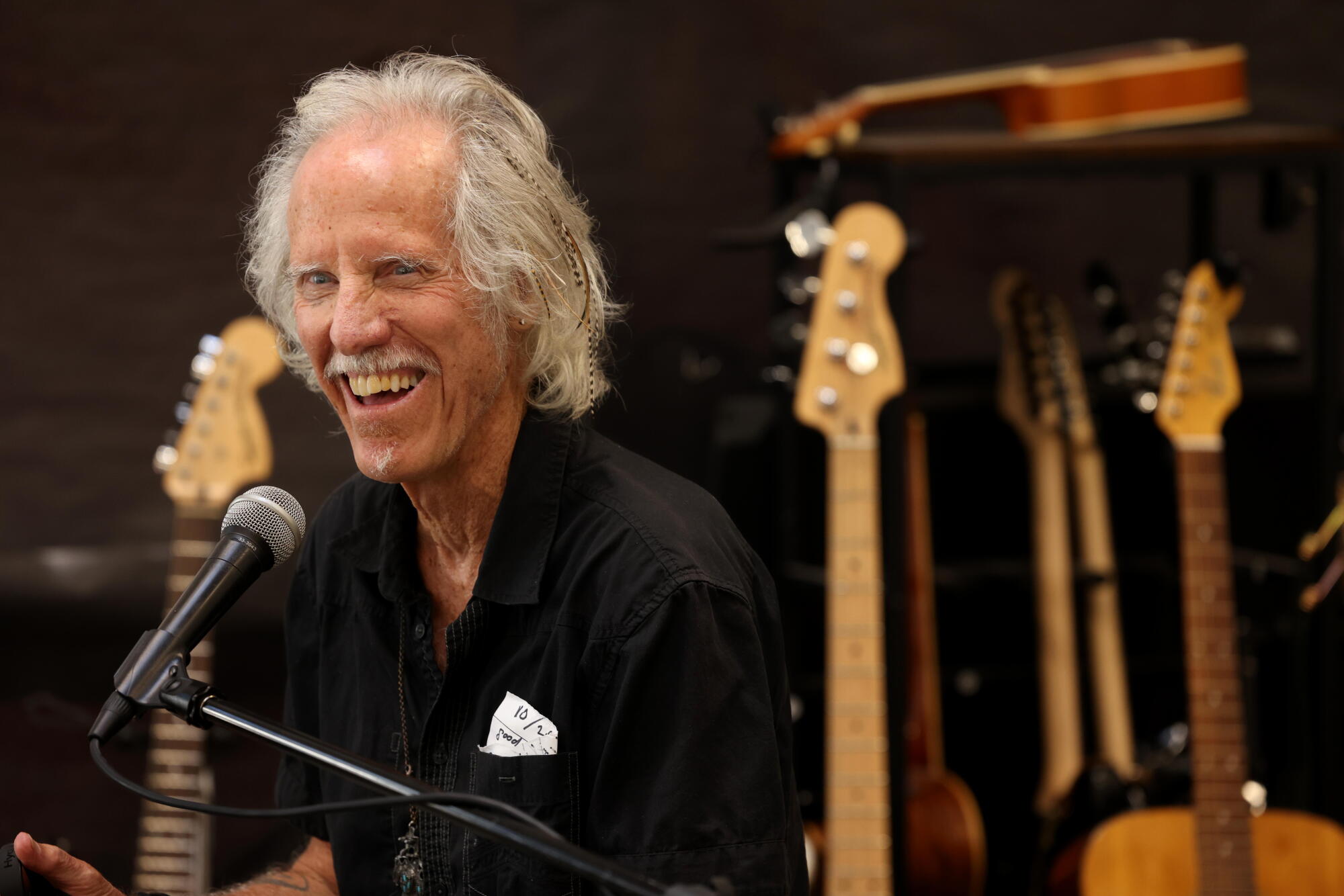
Twelve hours after walking offstage at the Greek Theatre on Tuesday night, David Byrne sits down with a cup of coffee on the patio of a tony hillside hotel and admits that he’s starting to get a little misty.

Last night’s concert on the campus of UC Berkeley was one of the remaining few on Byrne’s yearlong world tour after 2025’s “Who Is The Sky?” album. About an hour from now, a bus will pull up to ferry the 74-year-old musician and the dozen or so members of his touring company to the airport for a quick flight to Los Angeles, where they’re set to perform Friday and Saturday nights at the Hollywood Bowl.

“There’s a firepit over there,” Byrne says, pointing across the patio, “so after the show we all sat around and told stories. Everyone’s such a joy to work with — we’re all having a really good time.” He sighs. “That’s kind of rare, actually.”

“Who Is The Sky?,” which Byrne made with the producer Kid Harpoon, contrasts deep lyrics about art, home and enlightenment with bright pop arrangements filled with crisp grooves and singalong melodies. (Kid Harpoon, whose real name is Tom Hull, is known for the hits he’s created with Harry Styles and Miley Cyrus.) In the show, Byrne blends whimsical new tunes like “My Apartment Is My Friend” and “I Met the Buddha at a Downtown Party” with jittery oldies by Talking Heads, the hugely influential art-rock band he formed in 1975 with Jerry Harrison, Chris Frantz and Tina Weymouth.

Yet even when the songs get dark — as in “Life During Wartime,” which comes with images of police violence on the enormous digital screens behind the players — the mood is euphoric: Like Byrne’s previous tour behind 2018’s “American Utopia,” this one has the musicians holding their instruments as they execute choreographed moves on a bare stage; the result is more or less a nonstop dance party. (Also like “American Utopia,” which Spike Lee adapted into an acclaimed concert film, this tour will make its way to movie screens courtesy of “The Brutalist” director Brady Corbet.)

So you can see why Byrne would be sad to see it come to an end, not least because he’s been using his days off to tool around a given town and take pictures of cool local color. At the top of the gig in Berkeley, he showed photos from a hike he’d taken and of a car he’d come across with a tricked-out sound system.

“Any ideas of things to see in L.A.?” he asks me, dressed in a violet-colored chore jacket only a few shades removed from the blue one he wore onstage. “That hike was a workout. Even some of the dancers said those hills were steep.”

“Life During Wartime” was maybe 15% faster last night than the original record.
Could’ve been, yes. You’ll have to ask the drummers — they set the tempo, and they get excited and it kind of ramps up. It’s sometimes hard for me to keep up — I’ve got a lot of words to get out.

I was fortunate to be at Van Halen’s next-to-last show at the Hollywood Bowl, and I remember every song felt insanely fast.
Wonder if that was drugs?

You ever see Van Halen?
Never saw them live. David Lee Roth was a Talking Heads fan — came to visit our rehearsal loft once. I was kind of surprised: “How did you…?”

David Byrne performs at the Coachella festival in April.

David Byrne performs at the Coachella festival in April.

(Christina House / Los Angeles Times)

Would you say things turned out better or worse than the future you predicted in “Life During Wartime”?
Well, we’re not having a total civil war. There’s maybe still a chance that could happen, but it seems there’s more resistance now than there was before — a sense that we don’t have to just roll over and take all the stuff that’s going on. The footage we got kind of hits home.

You show the video of the guy on the bike pedaling away from ICE agents in Chicago.
That often gets a cheer.

I wondered if it ever doesn’t.
In the United States, no. Seeing the underdog get away — that’s a pretty timeworn story. We didn’t have that video at the beginning of the tour — it didn’t exist. I saw it on some news service, and I thought, oh, this has to lead the whole sequence. When we were first putting the show together, we had more video stuff. But screens are really seductive, so you start looking at that. We said, no, you have to connect with real live people, then you can put it up.

Have you been to the Sphere in Las Vegas?
A bunch of the band and I went to see “Wizard of Oz.” I haven’t seen a band in there. But it was really a lot of fun — quite a spectacle with the video all around you.

Don Henley compares the Eagles’ role there to the organist at a silent movie.
The pit band, yeah. That’s a thing to do — works especially well, I would imagine, for bands like the Eagles and other groups that don’t do a whole lot of song and dance.

At 74, can your body do all the dancing you want to do?
Oh, no. With more physical training, I’d probably be able to do a little more than I can now. But I’m never gonna be able to do what some of the dancers can do.

How about what you used to be able to do?
Like in “Stop Making Sense”? There’s some stuff in there where I go, nope, can’t do that. But I can do other things. I don’t have a feeling that I’m barely getting by.

Are you an exerciser?
I have a person I see in New York. It hasn’t happened so much lately because we’ve been moving around so much. But Sasha [Rivero, from the touring company] leads us through these warm-up exercises before shows — kind of a cross between strength training and yoga.

Beyond the value of staying agile, how do you think about maintaining your looks?
I’m aware it’s a thing. If I came across as old and decrepit, it might be less exciting for some of the audience. Not great for business.

When did your hair go gray?
In the ’90s, I want to say. I dyed it for a while when I started seeing a fair amount of gray coming in. Then at one point I was on holiday with my then-wife and just said, “Let’s cut it off and see what’s under there.” By that point it was pretty much all gray. I was OK with it.

Who’s a performer you admire who’s still out there doing it late in life?
Caetano Veloso — he’s served as a role model for me. He’s someone who’s reinvented himself over and over and over again — done records that are very different than the record before. Even on the same record, he can be really experimental and then do something incredibly romantic.

Can you envision a time when you’d stop performing?
I don’t think so. I can see there might be a point where I don’t do as much dancing around.

I’ve seen Willie Nelson probably half a dozen times in the last 10 years. He sits there and plays, and it’s great.
“My Apartment Is My Friend,” that was inspired by a Willie Nelson song: “Hello Walls.” There’s also a George Jones song, “The Grand Tour,” where he takes you into his place: “This is where she sat, that’s where she put out her cigarette,” all this kind of stuff. I loved that you can make an apartment into a character. So I started putting down ideas, and I realized: Should I reveal that it’s about an apartment right off the bat, or should I wait till the last line of the chorus? Before that, you don’t know — it sounds like a love song. The title gives it away. But Tom, when I said “should I change the title?” he said, “The title’s what got me to listen to the demo.”

If I say that the songs from the new album didn’t come alive for me until the show, how does that strike you?
Good and bad. I wish the record had the same impact that the songs have live. But then I also think to myself: Well, the reason you go to see a live show is because you’re getting something more than you get by just putting a record on.

David Byrne

(Josh Edelson / For The Times)

You’ve been playing for years now with this mobile handheld setup.
I wasn’t sure an audience was gonna go for it. I don’t know why, but I thought it was kind of a big step for an audience to take in.

To not have the traditional rock band stage set.
“Here’s the drummer — we know what he does.” There were people on the last tour who would say, “It’s got to be playback — you’re not really playing it.” So I added an introduction to a song where one by one we introduced the musicians at the beginning of the song, and you could hear how we put it together. An unexpected consequence is that it democratized the whole stage experience for the band members. There’s parts where the drummers come to the front and I go to the back, which you would never have in a regular kind of show where the drummer’s stuck on a riser. Everyone gets to be a star — everyone gets to be recognized as an individual.

Would you say your eagerness to share the spotlight could only have come after years of being the focal point?
I have no idea.

Most of the musicians are pretty young.
Younger than me, anyway.

Why is that important to you?
I learn from them — musically but also personally. I learn about what music they’re listening to, what their experiences have been, what their take on things is. They’re not living in the past — they don’t have nostalgia for the good old days.

In 2023, you spent a fair chunk of time looking back with the rest of Talking Heads for a rerelease of “Stop Making Sense.” Did you enjoy that or grit your teeth through it?
It was fine — it was really nice. As we said over and over, we’re very proud of that show and the music that we did and the film that Jonathan [Demme] made. And that it was going to connect with a completely new generation. Jerry came to the show last night. He lives in Marin.

You guys hang out?
Afterwards, yeah. I mean, he had to drive back. He said he enjoyed it — said it was a good show. I connected him with our keyboard player because the keyboard player came up with these interesting technical things I thought Jerry might be interested in. He has an accelerometer attached to his arm — you don’t see it because his sleeve covers it — where he raises his arm and it increases the volume like a foot pedal on a keyboard.

Tell me about Brady Corbet’s concert movie. He shot it in 70mm.
To be honest, I wasn’t sure why. But Brady made the case, and it wasn’t about bringing people into the theater. He said when you go to 70mm it’s a little bit closer to what your eye experiences.

American new wave band Talking Heads

Talking Heads in Italy in 1982: Tina Weymouth, from left, Jerry Harrison, Chris Frantz and David Byrne.

(Luciano Viti / Getty Images)

This is kind of a cutesy formulation, but I wonder if it’s pushing back on the dominance of vertical video.
Biologically and evolutionary-wise, we experience the world horizontally. We don’t go walking around looking up at the sky — the stuff that’s gonna come get us is somewhere on our eye level.

Jimmy Iovine gave an interview to the New York Times the other day where he said one of the last things he asked AI was about your set list.
He could’ve just asked me.

Iovine was extremely pro-AI in this interview. What’s your vibe?
My vibe is positive and negative. On the positive side, we’ve all heard the hype from Silicon Valley that we’re gonna have medical breakthroughs. The negatives — how could there not be massive job loss? What concerns me is the environmental stuff. The last thing the planet needs is a massive increase in energy usage. We’re talking about the survival of species — of everything that lives on Earth. To ramp up that part of what humans do just seems like the worst possible thing you could do.

The other thing that worries me is that machines aren’t really thinking — they’re probabilistic. This stuff has been designed intentionally to mimic human beings, and we are very, very easily fooled. I think that’s dangerous because we give it agency. We assume all these things about it — we trust it. I mean, people will listen to a political argument from a chatbot more than they will from another person.

Seems bad.
Right?

Any worthwhile creative application you can identify?
I used it a little bit to animate my drawings in one of the sequences from the show. They’re my drawings — I wasn’t taking from anybody else. In that case I feel like it’s a tool that’s very efficient. Might put some animators out of work, but if I had to pay the rate for animators on something like that, it would take a year to do and cost me a fortune.

What if the producer on your next record says, “Hey, here’s a little shortcut we can use”?
We already use little shortcuts — Auto-Tune is one. That’s not AI, but we’ve been using those kinds of tools, and there’s always the danger of overusing them. When people use Auto-Tune a tiny bit, it’s pretty much invisible. But on a lot of records — I’m not talking about the Cher record — it’s a little too perfect, and you start to lose the human connection. So it’s not a clear-cut choice of: Do I use this or not? It’s: Do I get seduced and use it too much?

Source link

ZZ Top drummer Frank Beard dead at 77 health issues

ZZ Top is mourning the loss of longtime drummer Frank Beard, who has died at age 77 after years of facing health-related issues.

The band announced Beard’s death on Tuesday via Instagram, with founding member and frontman Billy Gibbons writing in a statement that he and fellow member Elwood Francis “lost a great friend and collaborator, and the world lost one of the most naturally innovative drummers and a great and true son of Texas.”

The Fort Bend County Medical Examiner confirmed to The Times that Beard’s death was reported Monday. A cause of death was not revealed. He died at his ranch in Texas with family by his side after a stay in hospice, TMZ reported.

Beard died weeks after ZZ Top called off its Aug. 5 concert at the Hollywood Bowl, reportedly due to his health issues. In March 2025, the Texas trio also shared that Beard would temporarily step away from the band’s Elevation tour to address a separate health issue, later revealed to be foot and ankle problems. The veteran drummer had also missed shows because of an emergency appendectomy in 2002.

ZZ Top said in Tuesday’s announcement that its concerts in Salt Lake City and Colorado Springs have been canceled in the wake of Beard’s death. The band will continue its The Big One! tour this weekend, including two shows at Austin City Limits, which it said had become one of “Frank’s favorite venues in a city that had been something of a second home” for the drummer.

Beard joined ZZ Top in 1969, soon after the band formed, replacing founding drummer Dan Mitchell.

Times staff writer Andrea Flores contributed to this report.


Source link

Shane Hawkins becomes the driving force behind his father Taylor’s loud legacy with Chevy Metal

In the private home studio left behind by his father, Shane Hawkins is hitting the drums hard. The teenager behind the kit is locked into “Driven to Tears,” the Police’s reggae-charged protest song, channeling its sharp, syncopated beats with controlled fury.

His long blond hair swings across his face as Hawkins loses himself in the moment, tapping into a brisk echo of ’80s rock. He then shifts into the thundering blues of Black Sabbath’s “The Wizard,” driving into the heavier groove while surrounded by the instruments, gear and treasured memorabilia of his late father, Foo Fighters drummer Taylor Hawkins, who died in 2022.

Joining him in this rehearsal are bassist Wiley Hodgden and guitarist Brent Woods, who played hard-rocking cover songs in Taylor’s side project Chevy Metal for more than two decades. After Taylor’s death, the Foo Fighters carried on, but Chevy Metal were certain they could not. Shane changed that.

“Wiley and I were in agreement, like, it’s done,” says Woods. “Shane was the one that said, ‘I want to do Chevy.’”

For Taylor’s son, the band was one more thing he didn’t want to let go.

“It was a part of my childhood and it’s like, my dad was gone and these people that I’ve watched my whole childhood, they’re still there,” says Shane, 19. “Why not keep something going? And it’s just honoring my dad, you know?”

Most of the music world first saw Shane behind the drums during Foo Fighters’ performance of “My Hero” at the Taylor Hawkins tribute concert at Wembley Stadium on Sept. 3, 2022. He was 16 and already obsessed with drums, but he says it wasn’t until that moment that he knew he wanted to devote his life making music.

“It was a gnarly time,” Shane recalls. “You had to pull that off. You can’t really f— that up.

“I played for a lot of people, and there’s only one feeling like that — especially playing the drums. Once you do that, you never want to do anything else.”

With Chevy Metal, Shane is in a band committed to playing songs mostly created before he was born, with a typical setlist including songs by Van Halen, Led Zeppelin, Queen, the Rolling Stones, Talking Heads, Rush and the Doors. His presence now means leaning more often into classic punk rock. During their live sets, Shane will usually take the mic to growl through the Bad Brains’ speedy “Big Takeover,” pacing the stage and banging his head.

“We’re playing the Germs now,” says Woods. “We’re playing Black Flag, which we never did before.”

Shane Hawkins plays drums with Chevy Metal at the Viper Room.

Shane Hawkins plays drums with Chevy Metal at the Viper Room.

(Steve Appleford)

Chevy Metal shows routinely feature surprise guests. Dave Grohl and other Foos have frequently appeared. So have Mick Jagger and players from Queen, Red Hot Chili Peppers, Guns ‘N Roses and more. Even tennis star John McEnroe once joined the band on guitar at a Malibu gig, alongside his wife, singer Patty Smyth.

One regular guest is Lee Ving, singer for the pioneering L.A. punk band Fear. “Lee is like the elder statesman, and then we got Shane, who is so young,” Hodgden says of the age range. “You never see that unless it’s maybe a church band or something.”

Another regular is Anthrax guitarist Scott Ian, a family friend whose son Revel also plays music with Shane.

“He’s a great dude and he is a monster drummer,” Scott says of Shane. “I sit and I watch him and Revel play together. It’s so great to see, especially in a world where a lot of younger kids don’t pick up instruments anymore. They live, eat, sleep, breathe, bleed, rock music.”

Until this month, the resurrected Chevy Metal could only perform during Shane’s breaks from his boarding school on the East Coast, but he is newly graduated and ready to play. The trio performs Saturday at Alex’s Bar in Long Beach as part of a series of shows that will take the band to the U.K. Shane is also working with other young players on new material.

“He’s already jamming with kids his own age and friends that he’s had for years, and starting his own project,” says Woods. “But this is good for him to learn, just to play in different venues and travel around and get his feet wet playing covers.”

Chevy Metal once served a similar purpose for Taylor, a favorite pastime alongside his Foo Fighters work. Hodgden has been part of the Foo Fighters crew for 24 years, both on the road and at their studio 606, starting as Taylor’s drum tech. Before that, he was a bartender newly arrived from Oklahoma that the drummer befriended.

In 2002, Hodgden and original guitarist Achim “Dange” St. Dangerfield started the band as an acoustic duo doing cover songs. Taylor was a regular, Hodgden says, turning to Shane. “There’d be two drunks at the bar, and then your dad sitting there heckling us,” Hodgden says with a laugh. “We go into ‘Hotel California,’ and he’s like, ‘Oh, great song choice, guys.’”

The Foos drummer soon wanted in.

“Taylor was trying to come up with names and he’s like, ‘How about Chevy Metal?’ And I said, ‘Well, you can’t really name the band. You’re not in it,’” Hodgden adds. “But we jammed all the time up at his house, and then one day we’re playing and it sounded good. And Taylor stood up and said, ‘I’m gonna be your drummer and we’re gonna call it Chevy Metal.’ And I was like, that’s a rad name.”

“He got to be the boss in this band and steer the ship and do whatever he wanted,” says Hodgden. “But also it was low pressure and it was all about fun.”

Taylor filled much of his downtime making more music. Aside from Chevy Metal, he recorded new songs with the Coattail Riders (which included Woods) and, earlier, the Birds of Satan (including Hodgden).

“He never stopped,” Woods recalls. “He would call me at 7 a.m. and go, ‘What are you doin? Get up here!’ He’d go to bed probably at midnight, one o’clock, and he’s up taking the kids to school, he’s mountain biking, and he’s ready to roll. I was still sleeping, but he would be up every day wanting to create and work.”

Woods saw Chevy Metal’s first show with Taylor at Abuelitas in Topanga Canyon in 2002. After Dange moved up north to work as a teacher, Woods eventually became Chevy Metal’s new guitarist. Woods grew up in Burbank and took guitar lessons from Randy Rhoads, best known for his work on Ozzy Osbourne’s early solo albums.

“He was such a great lead player, but he was adamant that if you can’t play rhythm, it doesn’t matter how great of a lead player you are,” Woods says of Rhoads, who emphasized “rhythm and feel.”

“I wouldn’t be sitting here right now if it wasn’t for Randy teaching me.”

Growing up initially in Topanga Canyon, the first beat Shane learned to play was the thunderous drum fill from Phil Collins’ “In the Air Tonight.” Then came Deep Purple’s “Smoke on the Water” and the Rolling Stones’ “Miss You.” By 13, he was spending hours each day practicing alone in the basement at his boarding school.

“There were no other kids that really played at the school, so I’d just sit down and play,” he says.

Shane grew up watching both Foo Fighters and Chevy Metal shows. “I’d sit behind my dad and watch him play and watch people just go crazy,” says Shane. “And as a kid, you think that’s the coolest thing in the world, because it is. It’s the best feeling.”

The band Chevy Metal downstairs at the Viper Room on the Sunset Strip.

The band Chevy Metal — bassist Wiley Hodgden, left, drummer Shane Hawkins and guitarist Brent Woods — gestures downstairs at the Viper Room on the Sunset Strip.

(Steve Appleford)

Taylor’s home studio was built in a guest house behind his family’s home in Hidden Hills, a gated community on the northern edge of the San Fernando Valley. Inside, the walls are still covered with his guitars, posters, photographs and other relics from his favorite artists: Aerosmith, Rush, Bowie, Jane’s Addiction and Soundgarden.

The reborn Chevy Metal still rehearses in what Woods describes as Taylor’s “man cave.”

“He put a lot of work into making this room what it is right now,” says Shane. “I remember him precisely making sure every picture was hung up in the exact place. And every banner was hung perfectly and every speaker was placed perfectly for your ear.”

The band recorded a lot of songs here with Taylor, and they hope to release some of that material from the vault. They plan on more recording with his son.

Before Shane graduated high school, the last time Chevy Metal played a hometown show was at the Viper Room on New Year’s Eve. It was also a gathering of rock ’n’ roll families, as second-generation musicians took turns onstage with Chevy Metal, representing the offspring of Guns ‘N Roses, Jane’s Addiction and Anthrax.

During the sound check, the band ran through songs by U2 and Foreigner, and Shane hammered the drums at full volume. Afterward, he was chatting with Scott Ian, who advised him: “You never want to be great at dress rehearsal. You want to be good at dress rehearsal, and then be great at the show.”

Shane nodded, but for now, he says he can only play at one level: loud.

As Shane sat in the dressing room before Chevy Metal’s set, Jane’s Addiction drummer Stephen Perkins walked in, asking, “Where’s the drummer?” Then he spotted Shane, smiled, grabbed his hand and said, “There he is!”

Source link

ZZ Top scrubbed Hollywood Bowl concert because of Frank Beard’s health

The show will go on for ZZ Top.

Last week, the blues rock band canceled its Hollywood Bowl concert because longtime drummer Frank Beard had health issues, Rolling Stone first reported.

That Aug. 5 Los Angeles concert was supposed to be the kickoff for the band’s the Big One tour. But a spokesperson for the band says that frontman Billy Gibbons and bassist Elwood Francis will continue the tour.

Michael Monahan will substitute for Beard for the remainder of the Big One, which will conclude its U.S. run on Oct. 9 in Port Wentworth, Ga.

The band has not said that it will reschedule the L.A. show, and all tickets, including transportation and parking passes, were being automatically refunded, according to the Hollywood Bowl.

Gibbons previously posted on Instagram that there were unexplained “insurmountable obstacles” leading to the band’s sudden cancellation at the Hollywood Bowl.

The band has released no details on Beard’s condition, although this is not the first time the drummer, 77, has faced health-related issues in his long tenure with the band. Beard joined ZZ Top in 1969, soon after the band formed, replacing founding drummer Dan Mitchell.

In March 2025, the Texan trio announced via its Instagram that Beard would temporarily step away from the band’s Elevation tour to tend to a health issue, which was later revealed to be foot and ankle problems. John Douglas — a longtime tech member, percussionist and drummer — replaced Beard in the interim, having done so previously when the veteran drummer underwent an emergency appendectomy in 2002.

In ZZ Top’s early days — following the release of the 1976 album “Tejas” — Beard dealt with issues related to substance abuse that led to the band’s three-year hiatus, which he and his bandmates opened up about in the 2019 documentary “ZZ Top: That Little Ol’ Band From Texas.”

“Frank goes all out on what he does and that includes the bad things,” bandmate Dusty Hill, who died in 2021, said in the documentary. “He was sick. If you’re a very good friend, you love a guy, you don’t want to see him die. You just want to see your brother get well.”

The Grammy-nominated band, which formed in Houston, is known for its edgy blues twang in popular singles including “La Grange” and “Tush” and across 15 studio albums. In November, ZZ Top will close out the Big One tour with eight performances across Mexico and South America.


Source link