A more hawkish Federal Reserve has coincided with a sharp contraction in U.S. equity valuations, with the S&P 500’s (SP500) forward price-to-earnings multiple falling to levels last seen around early 2023, according to a chart from HSBC.
Ukraine has revealed a remarkably diverse collection of domestically developed weapons, and at least two foreign-supplied ones, used in its latest attack on the Kerch Bridge, the critical road and rail link connecting occupied Crimea with mainland Russia. You can read what we know about the operation in our separate coverage here.
The operation, coordinated by Ukraine’s Security Service (SBU) and the General Staff, unfolded over several weeks and involved seven stages, according to President Volodymyr Zelensky. The Ukrainian leader made the disclosures today, in a post on his official X account, accompanied by a video of the latest strike. As well as the bridge itself, Ukrainian forces systematically targeted Russian air defense systems, radars, electronic warfare equipment, and other installations before moving against the main target.
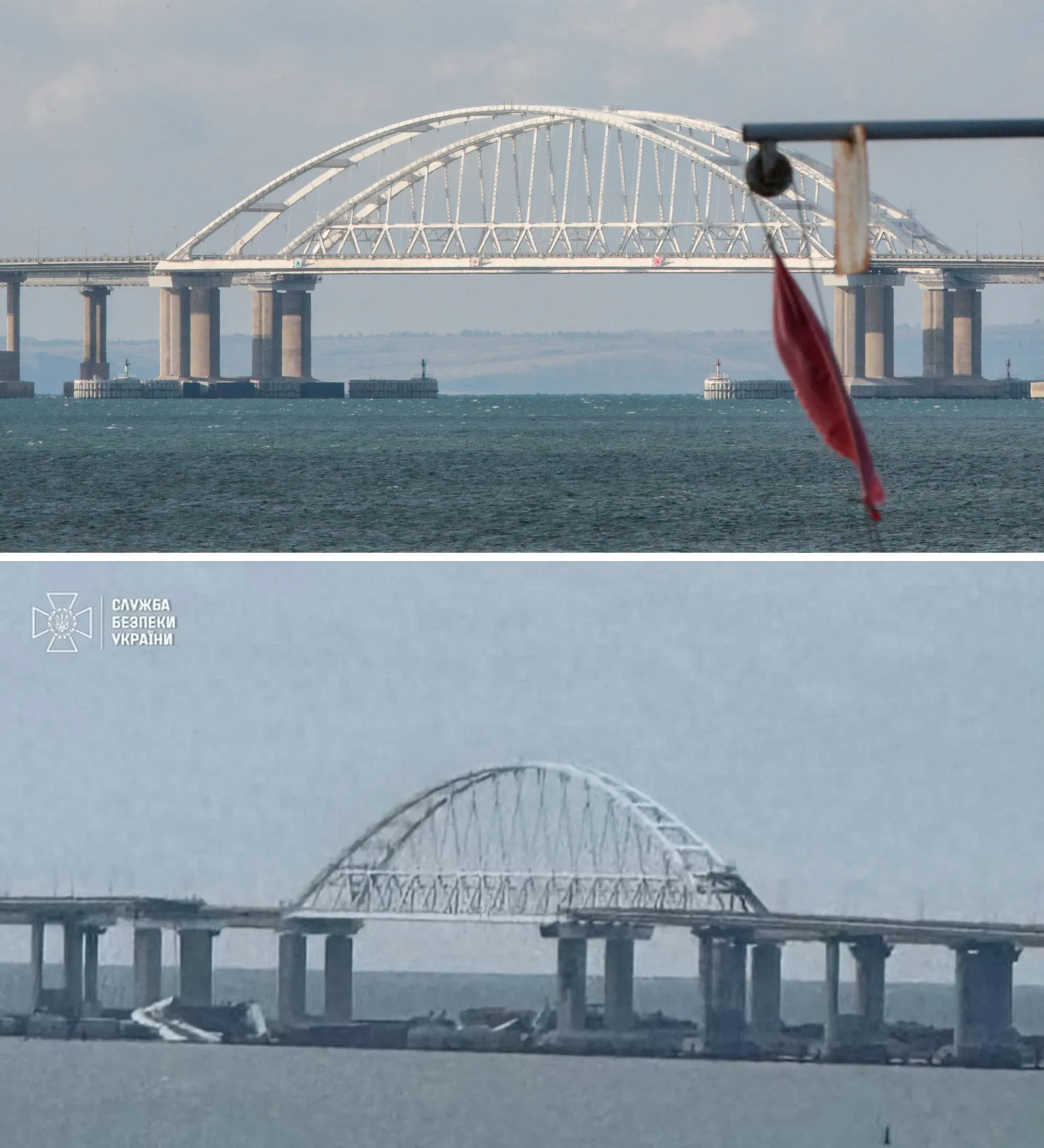
A combination of pictures created on November 17, 2026, shows (bottom) a grab taken from a video released on November 17, 2026, by the Ukrainian Security Service showing the damage after a strike on the Kerch Bridge and (top) a view of the bridge taken on October 14, 2022. Photo by Handout / various sources / AFP HANDOUT; STRINGER
The final assault, conducted overnight on November 16-17, involved a combination of long-range attack drones, cruise missiles, and shorter-range drones, according to Zelensky. He explained that Palianytsia drones struck the bridge’s road section, while FP-5 Flamingo, Neptune, and Ruta cruise missiles were used against the railway section.
In a retro-styled meme video posted on X today, the Ukrainian Ministry of Defense presented imagery of the bridge before and after the attacks, overlaid with pictures of some of the weapons used in the operation. For the FP-5 missile, however, its photo was replaced with a flock of flamingos. The result mimics the opening credits for the TV series Santa Barbara, which was popular in the immediate post-Soviet era.
Santa Barbara Opening Theme
The Ukrainian president named 11 weapons systems involved in the broader operation. Here is a closer look at what we know about them.
Dovbush
Type: Uncrewed aerial vehicle
Dovbush is a family of Ukrainian-developed uncrewed aircraft, with variants intended for reconnaissance and strike missions. Public information on the specific variant employed in the Kerch Bridge operation remains limited.
The Dovbush family includes longer-range platforms, with some versions reportedly designed to operate deep inside enemy territory. Ukrainian forces have used Dovbush aircraft in the broader campaign against Russian military infrastructure. The family also includes heavy ‘drone motherships,’ used to deliver smaller attack drones closer to their targets before launching them.
Since the specific variant or targets assigned to the system during the operation are unclear, the drone may have been used for reconnaissance or strike missions, or both.
Vendetta
Type: FPV attack drone
Vendetta is a Ukrainian attack drone associated with the country’s expanding family of domestically produced uncrewed systems. It is described in Ukrainian reporting as an FPV loitering munition, with thermal-imaging capability supporting operations at night. Previous Ukrainian reports describe it as a ‘relatively inexpensive middle-strike drone,’ in a class of drones with a range of between 12 and 43 miles.
There is little publicly available information about its precise role in the campaign. However, an attack drone with a ‘man-in-the-loop’ capability such as this could well have been used in the effort to systematically dismantle Russian electronic warfare and air defense capabilities before and during the main attack, including responding to dynamic or ‘pop-up’ threats. Bearing in mind the typical range of such drones, there is a question as to whether Vendetta was launched in the vicinity of the target, or if it was delivered via another drone, which would have required its feed to be relayed to operators via satcom. Launch of the drone from a sea-based platform of some kind, operating off the Crimean coast, would be another option.
Da Vinci
Type: Long-range one-way attack drone
Da Vinci is another uncrewed system identified by Zelensky. The propeller-driven drone is manufactured by Netherlands-based defense technology company Destinus and is reportedly intended to operate in contested electronic warfare environments.
Da Vinci is understood to be closely related to the Lord drone from Destinus, which can reportedly travel more than 621 miles, carry a warhead weighing between 88 and 220 pounds, and be prepared for launch in just 15 minutes.
European company Destinus, which developed the Ruta missile, presented two versions of its Deep Strike attack drone — Lord 1 and Lord 2.https://t.co/2cJ9F3tJRb
Although the precise configuration employed in this operation has not been disclosed, unconfirmed reports state Da Vinci was used to suppress Russian air defenses.
Sichen
Type: Long-range one-way attack drone
Sichen is a Ukrainian long-range strike drone designed to attack targets deep behind enemy lines. Based on its appearance, it clearly owes much to the Iranian-designed Shahed-136, also widely employed by Russia.
❗️In 🇺🇦Ukraine, the “Sichen” long-range strike UAV has been presented
The drone has a flight range of up to 1,400 km and an accuracy of up to 20 meters. The unmanned aerial vehicle is equipped with a 40-kilogram warhead. The maximum speed of the drone reaches 200 km/h, and the… pic.twitter.com/RfMged2Ois
Publicly reported specifications put its range at up to approximately 870 miles, with a warhead weighing as much as 88 pounds.
🇺🇦💥 A Ukrainian “Sichen” kamikaze drone breaks through heavy fire from enemy mobile air defense units and strikes a military target on Russian territory. pic.twitter.com/q8yA63GEif
— Rohoza (Дев’ятий) Mykhailo 🇺🇦🇱🇹🇨🇦 (@Oct7NeverForget) October 19, 2026
Its inclusion in the Kerch Bridge operation points to the breadth of Ukraine’s long-range drone arsenal. However, Zelensky did not specify which installations Sichen targeted.
MICH-2000
Type: Long-range attack drone
Another Shahed-lookalike, MICH-2000 is a Ukrainian long-range one-way attack drone associated with the SBU’s Alpha special operations unit.
The aircraft is reportedly based on a modified commercial Chinese UAV design and adapted for military strike missions. Ukraine’s use of readily available commercial designs as the basis for its own strike drones is by now well established, although more recently it has relied more heavily on fully domestic products.
Ukraine has released an image showing the production of its domestically developed MICH-2000 Shahed-like long-range strike drone.
The drone was previously spotted over Russia but remained unidentified. MICH-2000 drones have since been used to strike targets including the… pic.twitter.com/KgF4vVkKb1
Ukrainian MICH-2000 breaches air defenses and strikes a Moscow oil refinery: the moment of impact.
The MICH-2000 is a Ukrainian long-range attack drone with a reported range of up to 2,000 km. The unmanned aerial vehicle (UAV) is available in eight variants… pic.twitter.com/SwYieH1a1G
Some reporting puts its operational range at approximately 1,240 miles, although publicly available performance information remains limited.
Its participation in the operation is noteworthy because it demonstrates the variety of platforms Ukraine is employing for deep-strike missions, including systems developed outside its traditional aerospace industry.
Ruta
Type: Cruise missile
Ruta is a Ukrainian-operated, European-developed, low-cost cruise missile ‘strike system’ manufactured by Destinus.
According to the manufacturer, the baseline Ruta Block 1 is designed to deliver precision strikes against high-value military targets at ranges of up to 186 miles. It carries a payload of up to 331 pounds.
Destinus describes the system as being optimized for high-volume salvo attacks, with an emphasis on cost efficiency. It is designed to fly at low altitude, using terrain masking to help penetrate enemy air defenses.
An official rendering of the Block 1 version of the Ruta cruise missile. Destinus
One of its key features is a multi-sensor navigation system combining inertial navigation, satellite navigation, and visual navigation. Destinus says this architecture is intended to allow the weapon to continue operating in environments where electronic warfare systems are attempting to disrupt satellite navigation.
The company describes Ruta Block 1 as its baseline configuration, with two additional versions also identified: Block 2, offering extended range, and Block 3, designed for long-range deep-strike missions.
Zelensky specifically identified Ruta among the weapons used against the railway section of the Kerch Bridge, but not the particular version employed. In a post on LinkedIn, Destinus said that Ruta missiles struck the Kerch Bridge on two consecutive days. “Last night’s strikes damaged the bridge’s upper load-bearing structure. Today, seven Ruta missiles hit the bridge, causing one span to collapse,” it added.
Palianytsia
Type: Long-range drone
Palianytsia is one of Ukraine’s more distinctive domestically developed weapons. It is a turbojet-powered drone designed to attack targets at long distances.
Ukraine first publicly acknowledged its successful use in August 2024. The system was developed as part of the country’s effort to expand its ability to conduct deep strikes without relying exclusively on foreign-supplied missiles, which typically come with a restrictive set of employment rules.
President Zelensky showed the Palianytsia drone missile, which was first revealed yesterday.
All of its specifications are classified. What is known from the information in the video:
▪️ “Palianytsia” has a turbojet engine; ▪️ is launched from a ground platform; ▪️ the… pic.twitter.com/GyIEVFw52Q
Zelensky credited Palianytsia with striking the bridge’s road section during the final phase of the operation.
Its use against such a heavily defended and strategically important target represents a significant demonstration of Ukraine’s growing domestic strike capabilities.
An-197
Type: Uncrewed aerial system
An-197 is among the lesser-known weapons included in Zelensky’s list.
Ukrainian reporting has linked the designation with a long-range strike drone derived from the country’s existing family of deep-strike unmanned aircraft.
Publicly available technical information remains particularly sparse, and its precise relationship to other Ukrainian drone designs is not fully established.
Zelensky did not disclose which targets it was assigned during the operation.
FP-1
Type: Long-range one-way attack drone
FP-1 is a well-known long-range Ukrainian attack drone developed by Fire Point, the company also responsible for the FP-5 Flamingo cruise missile. You can read our previous wide-ranging interview with the company CEO, Iryna Terekh, here.
Footage of the production and testing of the FP-1/2 attack UAVs and the FP-5 Flamingo cruise missile
The system is designed to strike targets deep inside enemy territory and has become part of Ukraine’s expanding domestic deep-strike arsenal.
Its inclusion in the operation underscores how Ukraine employed a combination of different uncrewed platforms, with different levels of performance and payload capabilities, to attack Russian military installations before the final assault on the bridge.
FP-5 Flamingo
Type: Ground-launched cruise missile
The FP-5 Flamingo is one of Ukraine’s most ambitious domestically developed long-range weapons.
Manufactured by Fire Point, the ground-launched cruise missile is designed to attack fixed targets at considerable distances. The manufacturer has advertised a maximum range of approximately 1,864 miles and a warhead weighing up to 2,646 pounds.
Local residents filmed an FP-5 Flamingo cruise missile flying almost directly overhead at extremely low altitude. pic.twitter.com/a4akIKLTag
— Special Kherson Cat 🐈🇺🇦 (@bayraktar_1love) August 2, 2026
The Flamingo is a considerably larger weapon than most of Ukraine’s one-way attack drones and is intended to deliver a substantial explosive payload against high-value targets. When the weapon was first unveiled, TWZ noted that its combination of range and heavy warhead — as well as the absence of foreign restrictions on its use — made it a particularly suitable candidate for going after tougher targets far beyond the frontlines.
💥 Visualization of FP-5 “Flamingo” cruise missile strikes during the combined attack on the Kerch Bridge on the night of November 17.
Two missiles hit the bridge. One struck the road span arch, collapsing the structure along with the roadway. The second hit the railway section,… pic.twitter.com/rd8Amk7uWN
Zelensky specifically highlighted the system’s role in the Kerch Bridge operation, saying Ukrainian forces used it to conduct a precision-guided strike. He also noted that the communications link remained operational until the final seconds; this is supported by a purported video from one of the missiles during its final run-in to the target.
❗️🌉Clean, watermark-free footage of the historic moment a Ukrainian FP-5 Flamingo cruise missile, carrying a warhead weighing over 1,000 kg, slammed into the road arch span of the Crimean Bridge overnight. pic.twitter.com/b8BafYMeVz
The weapon’s reported involvement is especially noteworthy given the bridge’s extensive defensive arrangements, although it also needs to be considered that the Flamingo only made its way through to the target thanks to a wide-ranging effort by a wide variety of other systems.
R-360 Neptune
Type: Anti-ship and land-attack cruise missile
The R-360 Neptune is Ukraine’s domestically developed cruise missile, originally designed to attack naval vessels. It is essentially a Ukrainian version of the Soviet-era Kh-35 anti-ship missile, which has been fielded in air-launched, ground-launched, and ship-launched versions.
The original configuration of the Neptune missile. Office of the President of Ukraine Volodymyr Zelensky
The missile has since been adapted for land-attack missions, broadening its role beyond its original anti-ship purpose.
The baseline R-360 has a publicly reported range of approximately 186 miles and a warhead weighing around 331 pounds. Longer-range developments of the Neptune family have also been reported.
An official photo of the Long Neptune, an extended-range version of the Neptune missile. Government of Ukraine
Zelensky identified Neptune missiles as among the weapons used against the railway section of the Kerch Bridge, although the specific version involved was not stated.
Its participation highlights how Ukraine has expanded the utility of existing missile designs to address a much wider range of battlefield requirements.
A Multi-Layered Ukrainian Strike
The Kerch Bridge operation illustrates the increasingly diverse nature of Ukraine’s domestic weapons industry — as well as the challenges of prosecuting well-defended targets at extended ranges.
To get around this conundrum, Ukrainian forces appear to have combined reconnaissance and strike platforms, long-range one-way attack drones, jet-powered missile-drones, and conventional cruise missiles. Each of these is suited to a particular target set.
As expected, the operation involved a deliberate effort to degrade the defensive systems protecting the bridge before the final attack. Exactly how this was coordinated once the attack was underway is unclear. Undoubtedly, it was a complex operation that would have required months (at least) or careful planning.
Something new appears to have shifted technologically and/or tactically for Ukraine being able to successfully strike the Kerch Bridge. Unclear what it is, but there has been a new construct here we will probably soon learn about.
As well as putting Russian air defenses under pressure in terms of the sheer volume of targets in the sky, these Ukrainian systems have a widely varying spectrum of performance and flight profiles, making the process of hunting them down and destroying them that much harder. That being said, we don’t know exactly how many Ukrainian drones and missiles were launched, and what percentage of those made it through to their targets. In any event, a significant degree of attrition by Russian air defenses, not to mention other issues, is a given.
Rear view of an FP-5 Flamingo cruise missile. Fire Point
Importantly, Zelensky’s announcement does not provide a weapon-by-weapon account of the first six stages, which will have almost certainly involved many more different systems, nor does it identify the specific targets that every named system engaged.
Nevertheless, the announcement provides an unusually detailed look at the range of Ukrainian weapons involved in an operation against one of Russia’s most heavily defended and symbolically important infrastructure targets.
JUNEAU, Alaska — The Trump administration on Thursday moved to effectively drop its lawsuit that sought to block the certification of Democrat Mary Peltola’s victory in Alaska’s U.S. Senate race, ending a much-criticized maneuver by the president to prevent one of his political rivals from taking office.
The legal challenge centered on the presence on the ballot of a second candidate with the same name as the incumbent, Republican Sen. Dan Sullivan. The Alaska Supreme Court already ruled that the second Sullivan’s candidacy is legal and that he could be on the ballot.
Attorneys for the state, which is currently controlled by Republicans, also objected to the administration’s move, calling it legally “meritless” and filing papers to help get the initial case dismissed. The administration moved Thursday to have an appeals court declare its case moot, two days after the race was decided.
In their filing, Justice Department attorneys urged the 9th U.S. Circuit Court of Appeals to overturn the lower court’s dismissal of the case to erase the loss, but then dismiss the case anyway. They said the court “should hold that this case is moot, vacate the underlying order, and remand for dismissal on that ground.”
That decision comes after Peltola won an outright majority in the race to become Democrats’ 56th senator, the ninth Senate pickup for the party in its midterm blowout. Peltola’s margin of victory was larger than the number of votes received by challenger Dan J. Sullivan.
In a statement responding to the filing, Peltola said it was time to move on: “Now that the election is over and the voters sent a very clear message about the direction they want our state to go in, I’m eager to move forward and get to work on behalf of all Alaskans.”
Messages seeking comment also were left with Sen. Sullivan’s campaign and the Alaska Department of Law.
The Department of Justice filed the lawsuit at President Trump’s direction, saying that a Peltola win should not be certified until an investigation can determine if voters were confused by the presence of two Dan Sullivans on the ballot. The administration never explained how such an investigation could take place given the secrecy of the ballot.
The case was filed before the New York Times reported on texts and other documents that appeared to show Peltola’s campaign was involved in recruiting the retired schoolteacher from the tiny fishing community of Petersburg. He was listed as Daniel J. Sullivan Jr. on the ballot, with no party preference, to distinguish him from the senator, who was identified as a Republican and the incumbent. Dan J. Sullivan has long maintained that he ran on his own and Peltola has denied any involvement.
Trump also has demanded that Peltola be prosecuted for the scheme, and federal investigators swarmed into Alaska before election day. Tactics involving decoy candidates such as the second Sullivan have been a staple of U.S. politics for decades, and Trump’s allies have also used them, though occasionally the schemes do lead to criminal charges.
It was at least the second time since the Nov. 3 election that the Department of Justice has acted to dismiss one of its high-profile lawsuits interfering in states’ handling of their elections.
Just days after the election that saw Democrats flip control of Congress and peel off big wins in races for governor and state legislatures, the Justice Department moved to drop a lawsuit seeking to prevent California officials from counting roughly 20,000 ballots. The Trump administration alleged the ballots belonged to suspected noncitizens, but election officials questioned the validity of the data and said the government’s list contained many U.S. citizens.
Riccardi and Bohrer write for the Associated Press. Riccardi reported from Denver.
Crude oil futures finished little changed Friday but Brent crude ended with its largest weekly loss since the COVID-19 pandemic, after heavy losses suffered by Republicans in the U.S. midterm elections raised expectations that the Trump administration will pursue a diplomatic solution