Drones

General Atomics Is Turning The MQ-9 Reaper Family Of Drones Into “Cruise Missile Trucks”

The MQ-9 family of medium altitude, long endurance uncrewed air vehicles, which includes the new SkyGuradian and SeaGuardian variants, are getting the ability to reach out and hit targets at extreme ranges. In essence, the addition of long-range cruise missiles to their quivers — basically turning the drones into standoff “missile trucks” — will give these aircraft another new mission that is also relevant in high-end conflicts.

MQ-9’s long-range and extreme loitering time would offer a level of flexibility not really available in a tactical aircraft-sized package. As it sits now, Lockheed Martin’s stealthy AGM-158 JASSM and its anti-ship variant, LRASM, as well as Kongsberg-Raytheon’s Joint Strike Missile are being looked at as weapons options.

General Atomics writes in a release: “Hypothetically, a mission profile might look like this: MQ-9Bs could launch from a number of friendly bases in the Western or Southern Pacific, fly to a hold point and loiter there outside a hostile power’s weapons engagement zone. If the order came to release the weapons, the aircraft could launch them in coordination with other U.S. or allied operations.”

The goal is to start flying with at least one of the missiles this year.

Our Jamie hunter was on the show floor in Denver Colorado at the Air Force Association’s Warfare Symposium to discuss this new addition to the MQ-9’s repertoire directly with with Scott Gilloon, Sector Vice President for Strategic Programs at GA-ASI. Check out the video at the top of this story to hear what he had to say about the new standoff weapons offering for the MQ-9.

Source link

NATO allies agree to manufacture low-cost drones to counter Russia

NATO Deputy Secretary General Radmila Shekerinska, left, joined the European Group of Five in Krakow, Poland, on Friday to discuss efforts to strengthen Euro-Atlantic security and NATO’s deterrence and defense. Talks included a deal for the E5 countries — Britain, France, Germany, Italy and Poland — to produce low-cost drones to support Ukraine and proved better defense for NATO nations in Europe. Photo by NATO

Feb. 21 (UPI) — Britain announced it has made a deal with four NATO allies to launch an initiative that would see the five nations manufacture low-cost drones to protect Europe.

The European Group of Five (E5) — Britain, France, Germany, Italy and Poland — announced on Friday that they will launch the Low-Cost Effectors & Autonomous Platforms initiative, or LEAP, which is “inspired by Ukraine’s battlefield innovation,” the British government said in a press release.

The purpose of the program is to jointly develop low-cost autonomous drones that the North Atlantic Treaty Organization can use to counter Russian provocation in the airspace above NATO-allied nations, Politico reported.

The first focus of LEAP, according to British officials, will be the development of a new surface-to-air weapon that is lightweight and affordable in order to defend against Russia’s drone and missile threats.

“European security is at a pivotal moment,” Luke Pollard, Britian’s Minister for Defense Readiness and Industry, said after the E5 meeting. “The U.K. and our E5 partners are stepping up — investing together in the next generation of air defense and autonomous systems to strengthen NATO’s shield and keep our people safe.”

Over the course of the last year, Russian fighter jets have violated NATO partner’s airspace, including fighter jets over Estonia and drones over Poland, which the E5 countries said has spurred their new plans.

At a meeting Friday in Krakow, Poland, the E5 members met to with NATO Deputy Secretary General Radmila Shekerinska to discuss the plans, which she said would be beneficial for Ukraine, which she said needs its allies to step up their support, as well as for all member nations of NATO in Europe.

Britain noted Friday that the new drone initiative comes as it also works with its European allies to develop long-range precision weapons and hypersonic weapons, with plans to spend more than $500 million on those initiatives just this year.

“The stronger each ally becomes, the stronger NATO will be,” Shekerinska said.

Team USA members celebrate their first goal in the first period of the men’s hockey semifinal game against Slovakia at the Milano Santagiulia Ice Hockey Arena in Milan, Italy, on February 20, 2026. Photo by Aaron Josefczyk/UPI | License Photo

Source link

Reports say Ukraine attacked a Russian missile factory

Ukraine Defense Forces on Friday night used attack drones to strike a Russian missile factory in the Udmurt Republic that builds the hypersonic Iskander-M, pictured, and the Oreshnik missile systems. Photo by Sergei Ilnitsky/EPA

Feb. 21 (UPI) — Ukrainian Defense Forces late Friday night struck a Russian missile production facility that manufactures some of Russia’s fastest and deadliest missile systems.

Ukrainian forces used attack drones to strike the Votkinsk Machine Building Plant in Russia’s Udmurt Republic, which produces the advanced missile systems, Ukrainska Pravda reported.

The factory builds the hypersonic Iskander and Oreshnik missile systems.

Ukraine‘s general staff confirmed the strike in a statement released on Saturday.

“On the night of February 21, units of the Missile Forces and Artillery of the Armed Forces of Ukraine carried out a strike with FP-5 Flamingo cruise missiles. A defense industry enterprise — the Votkinsk Plant in the city of Votkinsk — was hit,” the statement said.

“A fire was recorded on the premises of the facility,” it added. “The results are being clarified.”

The Udmart Republic is located about 770 miles east of Moscow and about 1,300 miles northeast of Kyiv.

The Iskander missile is a mobile system that is carried and launched from atop a large military transport and is capable of carrying conventional or nuclear warheads with a range of up to 310 miles for some variants. The missile travels at hypersonic speeds of up to Mach 7.

The Oreshnik missile is a medium-range ballistic missile that can carry either conventional or nuclear warheads at distances of up to 1,000 miles and possibly more than 3,000 miles, while traveling at up to Mach 11, or 8,000 mph.

Ukrainian Defense Forces also targeted the Neftegorsk Gas Processing Plant in the Samara Region of Russia and fuel and lubricants storage facilities in Russian-occupied parts of the Donetsk region.

The extent of damage from those strikes is under assessment.

Source link

How are killer drones reshaping the conflict in Sudan | News

Sudan enters Ramadan as Civil War intensifies, famine spreads, and drone strikes hit civilian markets.

Sudan’s civil war is shifting into a drone-driven phase, erasing the lines between battlefield and civilian life. As Ramadan begins under famine conditions, how do the people of Sudan mark the holy month in the midst of war?

In this episode: 

Episode credits:

This episode was produced by Sarí el-Khalili and Melanie Marich with Maya Hamadeh, Tuleen Barakat and our guest host, Tamara Khandaker. It was edited by Ney Alvarez. 

Our sound designer is Alex Roldan. Our video editors are Hisham Abu Salah and Mohannad al-Melhemm. Alexandra Locke is The Take’s executive producer. Ney Alvarez is Al Jazeera’s head of audio. 

Connect with us:

@AJEPodcasts on TwitterInstagram, Facebook


Source link

Unification Ministry notes Kim Yo Jong’s swift response on drones

Yoon Min-ho, spokesperson for South Korea’s Unification Ministry, speaks during a briefing at the Government Complex Seoul in Seoul on Feb. 2. Photo by Asia Today

Feb. 19 (Asia Today) — South Korea’s Unification Ministry said Thursday it is taking note of a swift statement by Kim Yo Jong, a senior North Korean ruling party official, after Seoul expressed regret over recent drone incidents and announced steps to prevent a recurrence.

A ministry official told reporters the government “takes note” that North Korea quickly responded to Seoul’s expression of regret and its preventive measures. The official said the steps announced by Unification Minister Chung Dong-young are intended to protect the safety and peace of both Koreas and that the government will “responsibly” implement them.

The remarks came after Kim said earlier Thursday that North Korea “highly appreciates” Chung’s comments acknowledging what Pyongyang called a South Korean drone provocation, expressing regret again and stating an intention to prevent further incidents.

On Wednesday, Chung said Seoul expressed “deep regret” to the North over drone infiltration incidents during the previous Yoon Suk Yeol administration and additional incidents carried out at the civilian level after President Lee Jae-myung took office. Chung also announced measures aimed at preventing a recurrence, including banning drone infiltration into North Korea and strengthening penalties.

— Reported by Asia Today; translated by UPI

© Asia Today. Unauthorized reproduction or redistribution prohibited.

Original Korean report: https://www.asiatoday.co.kr/kn/view.php?key=20260219010005700

Source link

UNICEF: A third of Ukrainian children are displaced by war

A Russian drone strike on a five-story residential building in Kyiv, Ukraine, shows why a third of Ukrainian children are displaced, as reported by UNICEF on Tuesday. Photo by EPA/Stringer

Feb. 18 (UPI) — As the Ukraine war nears its fifth year, more than a third of Ukrainian children remain displaced following Russia’s invasion of its neighboring nation.

Russian forces invaded Ukraine on Feb. 24, 2022, which has led to the displacement of 2.59 million Ukrainian children, UNICEF reported on Tuesday.

The number of displaced children includes 791,000 who are still inside Ukraine and nearly 1.8 million who are refugees living outside of the country’s borders. Russian forces also have taken many Ukrainian children and relocated them to Russia.

“Millions of children and families have fled their homes in search of safety, with one in three children remaining displaced four years into this relentless war,” said UNICEF Regional Director for Europe and Central Asia Regina De Dominicis.

“For children in Ukraine, safety is increasingly hard to come by as attacks on civilian areas continue across the country,” De Dominicis said. “In many ways, the war is following these children.”

Many children and their families have been forced to flee their homes several times during the war as Russian forces targeted civilian areas.

A recently published UNICEF survey showed that a third of teen respondents between age 15 and 19 said they moved at least two times due to safety reasons so far during the war.

Bombardments by Russian artillery, attack drones and ballistic missiles have killed or injured more than 3,200 children since the war started.

Each year, the number of dead and injured has increased among Ukraine’s children, according to UNICEF.

“Obligations under international humanitarian law must be upheld, and every possible measure to protect children and the civilian infrastructure they rely on must be taken,” De Dominicis said.

“Every child has the right to grow up in safety, and without exception that right must be respected.”

Many of the support services for the country’s children also have been damaged or destroyed, including more than 1,700 schools and other education facilities, which deprives a third of Ukrainian children from attending school on a full-time basis.

Russian strikes on Ukraine’s energy infrastructure have deprived millions of Ukrainian children and their families of the power needed to heat their homes and water during the country’s extremely cold winters.

Babies and young children are especially vulnerable to harm due to a lack of electrical power, which could lead to hypothermia and respiratory illnesses.

More than 200 medical facilities also have been damaged or destroyed in Ukraine over the past year and many more before then.

The stress of the ongoing war is putting a severe mental strain on Ukraine’s children, who often experience a constant fear of attacks that force them to seek shelter in basements and remain isolated while at home.

About a fourth of Ukrainian youth between age 15 and 19 say they are losing hope for the country’s future.

UNICEF officials said they are working with local and national authorities to support Ukrainian children and provide them and their families with safe water, healthcare, food, educational support, mental health services and similar needs.

Source link

Witkoff hails ‘progress’ in peace negotiations with Russia, Ukraine

Feb. 18 (UPI) — U.S. Special Envoy Steve Witkoff early Wednesday reported “meaningful progress” in tri-lateral U.S.-Russian-Ukraine talks in Switzerland on ending the war.

Crediting U.S. President Donald Trump‘s “success in bringing both sides of this war together” to enable the progress to be made in the U.S.-moderated talks in Geneva, Witkoff provided no details of what had been achieved.

“Both parties agreed to update their respective leaders and continue working towards a deal,” he wrote X.

The accounts of Russia and Ukraine of Tuesday’s talks, which lasted six hours, were less positive with Russia’s state-run TASS news agency reporting they were “very tense” while Ukrainian President Volodymyr Zelensky said they were “difficult” and accused Moscow of playing for time.

“Yesterday’s meetings were indeed difficult, and we can state that Russia is trying to drag out the negotiations, which could already have moved to the final stage. We are grateful to the American side for their attention to detail and patience in talks with the current Russian representatives,” said Zelensky in a post on X.

A source in the Russian delegation told TASS that all sides had, however, agreed to continue the talks on Wednesday.

The negotiations are being held against the backdrop of the fourth anniversary of Russia’s full-scale invasion of Ukraine on Feb. 24, with no sign of any let up in hostilities.

At least two people were killed and 25 injured in strikes across five eastern, southern and central Ukrainian provinces overnight after Russian forces launched 126 drones and one ballistic missile, according to a Ukrainian Air Force update on social media.

Russia’s Defense Ministry said one person was injured in the city of Cheboksary, 440 miles east of Moscow, after Ukraine launched a large-scale airborne assault into Russian territory overnight using attack drones. The defense ministry said air defenses downed 43 of the drones.

Two previous rounds of talks, in Abu Dhabi in January and earlier this month, were unable to gain traction in overcoming the main stumbling blocks of Russia’s demand that Ukraine cede territory and Ukraine’s insistence on cast-iron Western security guarantees.

The negotiations are based on a heavily revised version of a 28-point plan, first drawn up by Witkoff’s team and Russian officials in November, under which Ukraine would give up Luhansk and Donetsk, including areas its forces still control, in exchange for security guarantees.

Kyiv has ruled out giving up territory it still occupies but the Americans are pushing a compromise solution that would see those areas become a demilitarized “special economic” buffer zone.

However, the security guarantees remain the potentially most intractable issue with Moscow adamant they cannot involve Western boots on the ground — something Ukraine believes must be permissable for any guarantee to be credible.

Former South African president Nelson Mandela speaks to reporters outside of the White House in Washington on October 21, 1999. Mandela was famously released from prison in South Africa on February 11, 1990. Photo by Joel Rennich/UPI | License Photo

Source link

Iran partially closes oil route for military drills, prices rise

A container ship sails on the Strait of Hormuz, as seen from Ras Al Khaimah, United Arab Emirates, on June 23, 2025. Iran partially closed the Strait of Hormuz, a critical shipping path, to conduct military drills on Monday. File Photo by Ali Haider/EPA-EFE

Feb. 17 (UPI) — Oil prices climbed on Tuesday as Iran partially closed the Strait of Hormuz, a critical shipping path, to conduct military drills.

Fars, an Iranian news agency, cited “security precautions” as the reason for the closure, with no indication of when the Strait of Hormuz will fully open again.

About 13 million barrels of crude oil were transported through the strait each day in 2025, making up about 31% of oil shipments by sea. It is the main seaborne export route for Middle Eastern oil shipping to Asia.

Iranian naval forces began the drill “Smart Control of the Strait of Hormuz,” on Monday.

The drill involves deploying drones capable of striking aerial and maritime targets and is “focused on enhancing operational readiness, strengthening deterrence, and reinforcing multilayered defense,” Fars reported.

Tuesday is the first time that Tehran has closed any part of the Strait of Hormuz since President Donald Trump threatened military action against Iran in response to the killings of protesters.

The United States has posted warships on the Indian Ocean as Trump attempts to negotiate with Iran to scale back its nuclear program.

The United States and Iran held a second round of negotiations in Geneva on Tuesday. Trump was not present for those negotiations but said he would participate “indirectly.”

Source link

AH-64 Apache Is Getting Proximity Fuzed 30mm Cannon Ammo For Swatting Down Drones

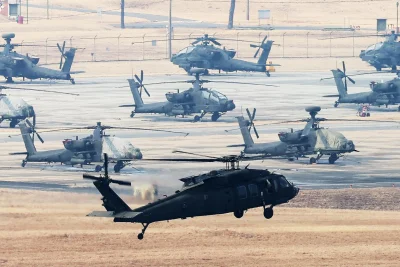
The AH-64 Apache attack helicopter has evolved into a counter-drone platform in recent years — something we have been following closely. While the Israeli Air Force had pioneered this role for the AH-64 for years, the U.S. Army has now formally codified it and added new capabilities in the process. Now, as we had suggested some time ago, the Apache is getting proximity-fuzed 30mm cannon shells for its chin-mounted M230 cannon that will add to its drone-killing arsenal, giving it a cheaper and more plentiful engagement option than some of the alternatives.

CRAZY footage of an IAF Apache helicopter chasing down a Hezbollah drone over northern Israel and downing it with cannon fire from its chaingun👇 pic.twitter.com/8vdks0PYL4

— Raylan Givens (@JewishWarrior13) November 2, 2024

Apaches live-fire tested the 30x113mm XM1225 Aviation Proximity Explosive (APEX) ammo last December, according to a recent Army release. The trials occurred at the service’s sprawling Yuma Proving Ground (YPG) in southern Arizona. Multiple test engagements occurred against various types of drone targets.

A U.S. Army AH-64 Apache helicopter assigned to the 5-17 Air Cavalry Squadron, 2nd Infantry Division, fires the M230 Bushmaster chain gun during live-fire aerial gunnery training at Rodriguez Live Fire Complex, Republic of Korea, on March 6, 2025. The exercise certified aircrews, sharpened weapons proficiency, and enhanced overall force readiness. (U.S. Army photo by Staff Sgt. Neil McLean)
A U.S. Army AH-64 Apache helicopter assigned to the 5-17 Air Cavalry Squadron, 2nd Infantry Division, fires the M230 Bushmaster chain gun during live-fire aerial gunnery training at Rodriguez Live Fire Complex, Republic of Korea, on March 6, 2025. The exercise certified aircrews, sharpened weapons proficiency, and enhanced overall force readiness. (U.S. Army photo by Staff Sgt. Neil McLean) Staff Sgt. Cornelius McLean

The specialized APEX ammunition works by detonating only when it is close to an object, then it explodes in a spray of shrapnel. This is critical to shooting down drones as they are small, independently moving targets, and the Apache’s monocle-targeted chin gun isn’t exactly a sniper rifle in terms of precision. At the same time, the rounds could also be used against targets on the surface — including personnel, soft-skinned vehicles, and small boats, for instance — offering unique area effects compared to the Apache’s standard impact-detonating, high-explosive ammunition.

(Short video) M230 chain gun follows the head movement of AH-64 Apache gunner


AH-64 Apache attack helicopter taking out Iraqi trucks and artillery with its 30mm cannon


Variants of the M230 cannon, the prime contractor for which is now Northrop Grumman, have already become an increasingly popular choice for dealing with lower-end drone threats from the ground. The light-weight M230LF version, designated the M914 in Army service, has found its way onto counter-drone vehicles. This includes the Sgt. Stout Maneuver Short-Range Air Defense (M-SHORAD) system based on the 8×8 Stryker light armored vehicle. The Army has been separately pursuing self-destructing and other kinds of proximity-fuzed 30mm ammunition for use with the M914. The new APEX ammo offers improved performance that can plug-and-play with the Apache/M230 combo. The other rounds for use in ground-based systems have never been cleared for use on the Apache to our knowledge.

M-SHORAD with its M230 derivative at the center of its multi-munition turret. (US Army)

The M230LF Bushmaster Chain Gun | XM914


An official Army release on the XM1225’s successful testing reads, in part:

“Developed and managed by Product Manager Medium Caliber Ammunition (PdM MCA) from Picatinny Arsenal, NJ, the XM1225 APEX cartridge is designed to counter modern threats, including UAS, exposed personnel, and small boats, without requiring modifications to the Apache’s M230 Area Weapon System or fire control system. The XM1225 has undergone extensive safety testing to ensure reliable performance, making it a safe and effective addition to the Apache’s arsenal. This innovative design ensures seamless integration into existing platforms while delivering enhanced lethality and operational flexibility.

…The primary objective was to evaluate the XM1225 cartridge’s accuracy and compare its performance to the legacy M789 High Explosive Dual Purpose (HEDP) cartridge under identical conditions. A secondary objective was to collect data on mixed loads of XM1225 and M789 rounds against both ground and UAS targets.

Initial results were highly successful, with the XM1225 meeting all accuracy requirements and demonstrating exceptional effectiveness against both ground and UAS targets. The proximity-fuzed capability of the XM1225 allows it to detonate near the target, creating a larger lethal radius and significantly improving its ability to neutralize airborne and dispersed threats. This capability positions the Apache to dominate the battlefield in both air-to-ground and air-to-air engagements, providing warfighters with a critical edge in modern combat scenarios.”

U.S. Soldiers with the 1-151st Attack Reconnaissance Battalion, 59th Aviation Troop Command, South Carolina National Guard, conduct their annual aerial-gunnery qualification table at the Poinsett Range, Sumter, South Carolina, May 22, 2024. Aircrews fired both 30mm rounds and rockets, the training allowed Soldiers to sharpen their armory skills, communication and team work with their assigned AH-64 Apache helicopters. (U.S. Army National Guard photo by Sgt. Tim Andrews)
U.S. Soldiers with the 1-151st Attack Reconnaissance Battalion, 59th Aviation Troop Command, South Carolina National Guard, conduct their annual aerial-gunnery qualification table at the Poinsett Range, Sumter, South Carolina, May 22, 2024. (U.S. Army National Guard photo by Sgt. Tim Andrews) Staff Sgt. Tim Andrews

A key feature of the APEX ammunition is that it requires little additional training for Apache crews to successfully employ it as it acts very similarly, ballistically, to the M789 high-explosive dual-purpose (HEDP) rounds already fielded. Those shells use an impact/grazing fuze to command detonation.

A major issue with using any gun for counter-drone work from the air is that standard high-explosive or incendiary cannon rounds simply keep traveling until they hit something, then they explode. This makes any horizontal or upward aspect shots very problematic, as the rounds can fly many miles before hitting the ground. Anyone or anything in that unpredictable zone would not fare well. Even high-deflection shots are risky, especially considering the size of the drones. Not only will most rounds miss and still hit somewhere below, but the aircraft can easily fly into the drone itself, as judging its distance and keeping track of it in the air is problematic. So, having self-destructing rounds, and even better, proximity fuzed ones that do the same, is key.

U.S Soldiers reload the 30mm rounds in an Apache


As it sits now, the AH-64 has modified AGM-114 missiles that use the Longbow Radar to prosecute aerial targets. Laser-guided Hellfires are potentially another option. Regardless, any Hellfire costs well into the six-digit realm. Advanced Precision Kill Weapon System II (APKWS II) laser-guided rockets are a lower-cost option, having a low-to-mid five-digit price tag. It isn’t clear if the AH-64 has been cleared to use air-to-air optimized Fixed Wing, Air Launched, Counter-Unmanned Aircraft Systems Ordnance (FALCO) versions of the APKWS II, which also use a proximity fuze for going after aerial targets, yet.

So, giving AH-64s the gun option, and in a far more reliable and safer manner via a proximity fuzed round, would be a huge boon for crews tasked with the counter-drone mission. Apaches can carry a whopping 1,200 rounds of 30mm ammunition, and they can be reloaded with more very quickly at forward austere locales on the ground.

So as it sits now, it likely won’t be too long before the AH-64 has a new arrow in its anti-drone quiver.

Contact the author: Tyler@twz.com

Tyler’s passion is the study of military technology, strategy, and foreign policy and he has fostered a dominant voice on those topics in the defense media space. He was the creator of the hugely popular defense site Foxtrot Alpha before developing The War Zone.


Source link