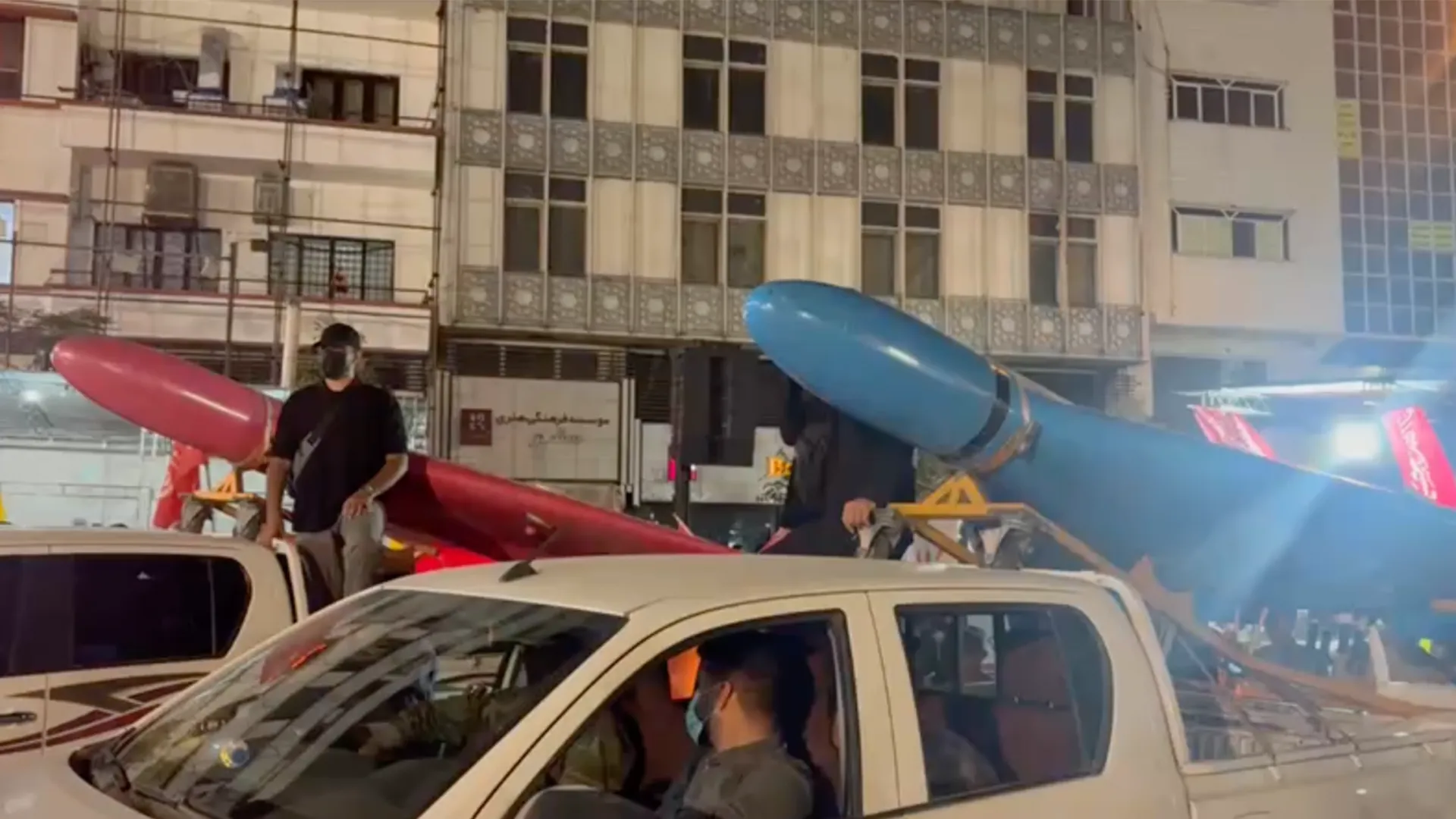
Crowds cheered and waved national flags as two Shahed drones were paraded through Tehran. Iranian-made, low-cost Shahed drones have become a major feature of modern warfare, used in attacks across the Gulf and extensively by Russia in its war in Ukraine.
Cape Canaveral Space Force Station is getting lasers that can zap drones intruding into its airspace. When installed, the new directed energy defense system will be part of a much larger effort to protect the spaceport against drone incursions, a spokesperson for Space Launch Delta 45 (SLD 45) told us.
The idea is to ensure the safety of launches and to keep prying eyes away from an installation full of secrets about America’s military and commercial space efforts. Companies like SpaceX, United Launch Alliance, Blue Origin and Relativity Space use the installation for space launches. The base defense modernization effort comes as the Cape Canaveral region is inundated with drone incursions. There were hundreds last year.
A SpaceX Falcon 9 rocket launches from Space Launch Complex 40 at Cape Canaveral Space Force Station, Florida, on May 29, 2026. (U.S. Space Force photo by Gwen Kurzen) Gwendolyn Kurzen
“As the world’s premier spaceport continues to support an unprecedented launch tempo for national security and commercial missions, securing critical launch infrastructure from low-altitude aerial threats remains a top operational priority,” the spokesperson explained. “The ongoing security modernization integrates detection, tracking, and defensive capabilities to include directed energy systems. These will provide security forces with real-time situational awareness and the necessary tools to safeguard personnel, launch complexes, and national security payloads.”
The spokesperson did not have a timeline for when the directed energy system will be operational. Florida Today was the first to report that lasers will make up this defensive system.
Col. Brian Chatman, who commands Space Launch Delta 45, told the publication that the facility is “bringing on a directed-energy system that can do a kinetic kill against UASs (Unmanned Aircraft Systems) that are coming into the area that are having nefarious intent.”
“The Air Force Research Laboratory [AFRL]-tested system has been proven to be able to safely bring down a drone,” Florida Today noted. “This directed-energy system uses lasers to shoot down any drone that flies into restricted areas.”
Chatman didn’t name the specific system to Florida Today and the SLD 45 spokesperson declined to say.
The following video shows one such AFRL-tested system that has been used in combat before.
Raytheon laser weapon demo: Drones don’t stand a chance
For the spaceport, being able to use lasers is even more important than it is for other locations needing protection from drones. That’s because the traditional method of jamming radio frequencies to interfere with drone connections to controllers could damage spacecraft.
“If you start blasting a bunch of RF energy you run into potential challenges,” Chatman explained. “You don’t want that.”
There is good reason for Chatman to be concerned about drones. The spaceport has been subjected to many unauthorized incursions, the spokesperson told us. However, there were no statistics immediately available on how many or whether they occurred during launches. There were 500 unauthorized drone flights over the adjacent Port Canaveral in 2025, Port Canaveral CEO Capt. John Murray said.
In addition, on Sept. 18, a Chinese tourist pleaded guilty to a federal misdemeanor charge after flying a drone in restricted airspace above NASA’s Kennedy Space Center (KSC) in late July. KSC is located across the Banana River from the space station.
It is unclear if the new laser system will also protect the skies over KSC. The spokesperson did not immediately know and is checking into it.
Cape Canaveral. (Google Earth)
That tourist, Xiaodong He, flew a drone that videotaped the installation, according to federal documents. The drone got within 1.56 miles of pad 39B, from where the next crewed lunar flight is expected to launch in 2028.
NASA’s Kennedy Space Center pad 39B. (NASA)
Encompassing about 25 square miles, Cape Canaveral Space Force Station is a large, unpopulated, open area with a long Atlantic Ocean shoreline. The station’s physical layout allows many vectors for drone incursions, and what’s housed there makes it a logical target for a nefarious actor.
The systems being prepared for launch and launched at the sprawling facility are extremely valuable and can take many years to build, costing billions. When they are out on the pad or being transported around, the rockets are massive tubes packed with high explosives that would cause a devastating secondary explosion if struck.
Even disrupting launches there due to a successful or even attempted attack could have major national security impacts.
The move to bring directed energy systems to protect the spaceport comes as the military is investing heavily in these systems to counter drones. Late last month, for instance, troops from the Joint Task Force-Southern Border (JTF-SB) employed an Army Multipurpose High Energy Laser (AMP-HEL) system during an operation dubbed Ardent Vanguard. The AMP-HEL was used “to engage and defeat three hostile UAS, determined to be such based on their use in direct support of activities posing a physical threat to U.S. military personnel and CBP [Customs and Border Protection] partners,” according to a media release at the time.
The shootdown was part of the U.S. government’s ongoing effort to counter drones being flown by Mexican drug cartels.
Joint Task Force – Southern Border personnel used the Army Multipurpose High Energy Laser system to engage and defeat a hostile drone. (U.S. Army Photo by Sgt. Daniel Huerta) Operation Ardent Vanguard
The military is seeking to expand its ability to counter drones with directed-energy weapons. In May, the Defense Department and Joint Interagency Task Force 401 selected five installations to participate in a directed-energy counter-unmanned aircraft systems pilot program required by the Fiscal Year 2026 National Defense Authorization Act.
“This initiative will accelerate the fielding and evaluation of advanced directed energy capabilities to protect critical infrastructure, military installations and homeland missions,” the Pentagon explained. “The locations were deliberately selected to support rigorous testing and operational assessments across diverse environments and mission sets.”
The Pentagon selected two “key southern border installations” for this program: Fort Huachuca, Arizona; and Fort Bliss, Texas. It also tabbed Naval Base Kitsap, Washington; Grand Forks Air Force Base, North Dakota; and Whiteman Air Force Base, Missouri.
Though the Pentagon is pressing forward with making directed energy a key part of counter-drone efforts, laser weapons have limitations. These include their short-term magazine depth being limited to how many successive shots they can fire before thermal loads require the system to cool down. Energy supply can also be a limiting factor. Additionally, laser systems don’t function as well in heavy cloud cover and other inclement weather.
You can see the Iron Beam’s first claimed kills in the following video.
A World First — Combat-Proven Laser Defense, Powered by Rafael
For the first time in history, high-power laser systems have been used to intercept aerial threats in combat. This unprecedented breakthrough took place during the Swords of Iron War — with Rafael’s advanced… pic.twitter.com/B3D6UdCJvE
— Rafael Advanced Defense Systems (@RAFAELdefense) May 28, 2025
At the same time, a laser weapon of this kind is very much a point-defense weapon, with its short range meaning that multiple systems will be needed to provide coverage of a significant area. In some situations, even a single, large military base like Cape Canaveral Space Force Station might require more than one to provide full defensive coverage.
In addition, there have been concerns about the safety of the systems and the authorities required to use them in the homeland.
Safety concerns about using directed energy weapons, and especially kinetic ones, to take down drones in the U.S. have been a major factor in why they haven’t been previously used in this role. Almost two years ago, officials at U.S. Northern Command (NORTHCOM), which has coordinating authority for counter-drone efforts in the U.S., said the use of such weapons was not yet on the table. The reason is that they can create dangerous or otherwise serious collateral effects that are less of a concern in a war zone.
That the U.S. Space Force is bringing in a laser system to protect some of the nation’s most important and secret military assets is a strong indication that these concerns are being overcome.
It’s stunning to comprehend how much has changed since Russia began its invasion of Ukraine. The conflict quickly turned into one dominated by artillery, with both sides scrambling to source shells wherever possible. Drones have since replaced tubed artillery as the ‘king of battle’ along the front, but cannons still have an important place on the battlefield. The commander of a new combined drone-artillery brigade offered some fresh insights into how his guns are now being deployed to achieve effects that drones still can’t provide.
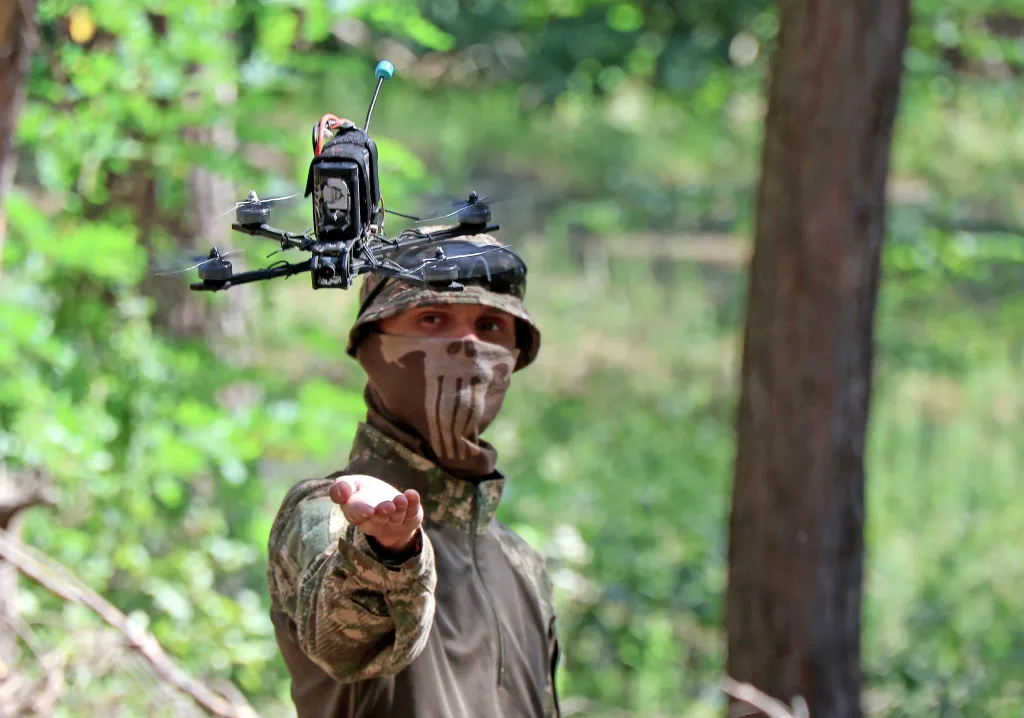
As we have frequently documented, the ubiquity of drones has changed the nature of combat, especially when it comes to artillery. Not only can drones hold artillery positions at risk, many are cheaper than shells and easier to produce at scale. Most types are also precision guided munitions capable of hitting moving targets with pinpoint accuracy and can also provide battlefield surveillance. However, they are not a panacea, especially amid the cat-and-mouse game of electronic warfare countermeasures and improving kinetic and passive defenses.
In a recent interview with the Ukrainian Oboronka news outlet, Lt. Col. Vitalii Korniienko, commander of the 7th Artillery Brigade, talked about the changing nature of artillery warfare. Korniienko, whose unit is part of the Ukrainian National Guard, explained what is being done to keep his array of domestically produced Bogdana 155mm systems, donated weapons like M777 howitzers, remaining Soviet-era 2S7 Pion 203mm self-propelled howitzers and other guns, relevant. Here are some takeaways from that discussion.
How The Game Changed
“Guns used to be massed at positions to create an ‘artillery wall’ and a barrage of fire,” the lieutenant colonel said. “That practice is gone now. So, how effective is artillery today? We can create an artillery barrage, but what is the point of mindlessly churning up the earth? I’d rather send 20 FPV drones to destroy the target. The cost of that mission is $20,000.”
A soldier from the 13th Khartiia Brigade of Ukraine’s National Guard hones his FPV drone piloting skills during a training flight in the Kharkiv region, Ukraine. (Photo by Viacheslav Madiievskyi/Ukrinform/Future Publishing via Getty Images) Future Publishing
“Alternatively, I could fire 200 shells, but the cost would be astronomical,” he pointed out. “Plus, if we fired 100 shells from a gun in a single day, it likely wouldn’t survive until evening. The sky is full of drones; every shot gives away the position, leading to detection and an attempt to dismantle it using every available means. Nowadays, a typical mission involves a series of up to 10 shots. First, 3–5 shells for ranging, followed by fire on the target. That’s a minimum of five shells, with each costing at least $2,000.”
What Does The Drone-Artillery Brigade Do Differently?
“It is a concept of ours that was approved: combining artillery and drones within a single brigade,” Korniienko said. “Drones take out enemy artillery and logistics, while our guns provide cover for the infantry, destroy targets, and pin the enemy down in their dugouts. This way, we mitigate the limitations of both systems and boost overall effectiveness.”
Ukrainian troops firing a domestically produced 2S22 “Bogdana” self-propelled howitzer against Russian forces near the front line in the Zaporizhia direction. (Photo by Maksym Kishka/Frontliner/Getty Images) Frontliner#VIDEO
“Our primary operations are focused within the corps’ area of responsibility—targeting positions 10 kilometers deep or farther behind enemy lines. Of course, we will also engage closer targets if requested by the brigade holding the defense. In addition, we are shifting logistics tasks from pickup trucks to ground-based robotic systems. They are already transporting ammunition to drone and artillery positions, as well as food and fuel for generators.”
What Artillery Can Do That Drones Can’t
“Let’s be honest: 95% of strikes right now are carried out by drones,” Korniienko explained. “Yet, we cannot simply abandon artillery. The focus of our operations has shifted from merely striking the enemy to destroying, suppressing, and halting the actions of assault groups and armored columns—and the need for that remains as critical as ever. There are tasks that only artillery can handle.”
“For instance, we currently have several enemy targets in the Kupyansk sector that drones cannot reach due to electronic warfare (EW) interference, while slow fiber-optic drones are simply shot down,” the officer noted. “What do we do? We call in artillery. Nothing affects its shells. Fog, strong winds, snow, or headwinds—it makes no difference to artillery; it will operate regardless.”
Preparing Artillery For The Modern Battlefield
“At the beginning, both we and the Russians might have had two or three guns at a single position,” Korniienko proffered. “The enemy was doing this as late as 2023. Then it tapered off, because if you deployed six guns, an hour later they’d be gone. No one drives out into an open field anymore. Today, a gun wouldn’t even make it to the position without being spotted.”
Ukrainian National Guard troops prepare a ‘Bogdana-BG’ artillery installation from a dugout position. (Photo by Sofiia Bobok/Anadolu via Getty Images) Anadolu
As a result, the artillery crew’s deployment “is prepared in advance,” the officer stated. “First, anti-aircraft drone teams ‘clear’ the sky above the site of enemy reconnaissance assets. The position itself is a fully underground-dugout caponier with well-camouflaged access routes. We put a lot of effort into ensuring the artillery doesn’t get destroyed. Losing a gun is a huge blow to us.”
Short Range Versus Long Range Shells
“There is currently an ongoing debate about phasing out ‘short’ shells and switching entirely to long-range variants,” the officer stated. “This is intended to protect artillery from drone strikes.”
“What exactly is a ‘short’ shell, and should we stop using it?” he asked rhetorically. “The M107 155mm round is what is known as a ‘short’ shell. It is inexpensive and mass-produced; all our allies—and even our own country—manufacture it. We have sufficient stocks of them for combat operations. While accurate, its range is limited to 14–18 km, depending on the propellant used.”
Army
Long-range options “include the M795 and its foreign equivalents,” Korniienko explained. “These are longer, heavier, and significantly more expensive. With high-quality propellant, they can reach 30 km, or even further if equipped with a base-bleed unit. However, both these shells and the necessary propellants are in short supply.”
Army
“I do not believe abandoning the M107 is the right move,” the officer suggested. “Long-range shells cause faster barrel wear and compromise position concealment; firing a long-range charge produces a massive burst of flame from the muzzle—visible for kilometers at dusk or dawn.” “Besides,” he added, “18 km is a respectable range. If the gun is positioned 15 km back, it still has a 3-km margin to spare. That is sufficient for engaging frontline infantry. In my view, the ideal mix for most brigades would be 60% long-range shells and 40% standard M107 rounds.”
Big Versus Small Guns
“I operated 105mm guns in the Serebryanka area, on the Kharkiv axis,” Korniienko noted. “Based on intercepted communications, the enemy thought it was a mortar and searched for it within a five-to-six-kilometer range. But the howitzer was positioned eight or nine kilometers away and fired out to 10–12 kilometers.”
“There is almost no muzzle flash, just a bit of dust,” he added. “The shell arrives, and the enemy doesn’t even hear the sound of the shot. It’s compact and lightweight—you can transport it on a pickup truck. So yes, it would be useful.”
An L119 lightweight towed howitzer. (Via X)
“I’d also like to see the development of 203mm artillery; why move away from that caliber?” the officer wondered aloud. “Our ‘Pion’ systems fire a massive 100-kilogram shell capable of punching through at least two floors of a building or a bunker. And it’s reasonably accurate, too. You wouldn’t want to be on the receiving end when guns like that are firing at you. Overall, I believe we need competition. Right now, the ‘Bogdana’ is evolving under wartime conditions, which is good. But in a few years, momentum could stall. They might just keep producing the same system without significant upgrades because there’s no incentive to innovate. Yet, the nature of war doesn’t stand still.”
Wary Of Asian Shells
“We have a wide range of shells from different countries, and the ones coming from the West are fine,” Korniienko said. “However, their counterparts produced in certain Asian countries… the quality is frankly poor.”
“What is wrong with them?” queried Korniienko, who did not name the country in question. “On paper, the shell weight is listed as 46 kilograms, but when we weigh them, we find 46.9 or 45.4 kg. And that half-kilogram difference—give or take—has a huge impact on where the shell lands.”
As a result, “we no longer trust the standard firing tables provided with the shells; instead, we compile our own for each manufacturer. We weigh every batch and sort them by weight so that the difference between the ‘piles’ is minimal, ensuring a reasonably tight grouping. I can’t afford to make a mistake that causes a shell to land 2 kilometers off-target—right where our infantry guys are positioned. I should add that our artillerymen are actually wary of shells from one specific country. There have been instances where they tore off the muzzle brake or even caused the barrel to burst. A barrel burst is a disaster.”
Homegrown Is The Best
Korniienko said his unit was one of the first to test the Bogdana system, adding that he prefers it to other guns.
“We tested them and provided feedback to the manufacturer, which was then used to refine the design,” he explained. “It is a solid gun now, and it is my preferred choice. It might not be the absolute best, but I am very satisfied with the support and service.”
“If there’s a breakdown, the gun is back in position within a day or two,” he pointed out. “For instance, a gun broke down today, and we needed a repair team from the manufacturer. I know I’ll have it fixed by the day after tomorrow. They arrive in the morning, and by midday, the gun is ready. Then it takes another day or two to get it back to the position. That is very fast.”
That’s a very different experience than what he sees with donated weapons like the U.S.-made M777.
Ukrainian soldiers prepare to fire an M777 howitzer at Russian forces. (Photo by Diego Herrera Carcedo/Anadolu Agency via Getty Images) Anadolu
“As for the Western partners helping us—we are deeply grateful,” the officer avowed. “However, by the time you actually receive a part—say, a sensor—the gun might have been sitting idle for six months. And you can’t try to fix it yourself, because that would void the warranty.”
While artillery may no longer be the reigning weapon of war, as far as Ukraine is concerned, it has not been relegated to the dustbin of history yet either.
Transfer windows, team budget caps and drones replacing convoy vehicles at races are three of the ideas to boost cycling in a new report from the sport’s global governing body.
The Union Cycliste Internationale’s (UCI) report, entitled “Future of Cycling”, examined road cycling and heard from 55 stakeholders including professional teams, national federations, race organisers and some riders.
It aims to turn a “large but passive audience into active, loyal fandom”, admitting cycling’s under-35 audience was “under-represented” and there was a need to “strengthen its appeal”.
“While the sport today enjoys strong and growing popularity across five continents, its media exposure and the revenue it generates for its stakeholders do not yet fully reflect its potential,” it said.
Among the most frequently referenced recommendations were:
A more coherent race calendar based on geography with fewer overlaps
More predictable rider participation in races alongside transfer windows and fees
Simplifying the ranking and category system
A stronger second division with clearer pathways
Continued growth of women’s cycling
A financial fairness mechanism, such as a budget cap on teams
The combined total budget of professional UCI tour teams in 2025 was £731m (850m euros), but individual team budgets vary.
Long-discussed budget caps, aimed at evening out the peloton and increasing “financial fairness”, would improve the attractiveness of the sport for investors according to the UCI.
But it admitted any such mechanism remains the biggest point of difference for stakeholders and would be at the heart of upcoming discussions.
Meanwhile work on a new transfer system and rider-agent regulation was already under way, it said.
Critics say Serbia’s military ties with Israel are rising significantly.
Published On 17 Sep 202617 Sep 2026
Serbia has opened a factory to assemble advanced Israeli-made drones, which will supply the Serbian military and armed forces in other countries.
Serbian President Aleksandar Vucic inaugurated the facility jointly operated with an unnamed Israeli company on Thursday.
“Our plans are huge,” Vucic said in a social media post showing a video of him touring the facility with Israeli Ambassador Avivit Bar-Ilan, adding that at least three more factories will be opened across Serbia with Israeli partners.
Vucic said the facility “will employ around 100 workers and produce state-of-the-art equipment both for the Serbian Armed Forces and the armies of some other countries”.
Vucic did not disclose the factory’s location or the Israeli firm involved, saying journalists were excluded from the opening because of “the confidentiality of the production process”.
Previous reporting by investigative outlet BIRN and Israeli newspaper Haaretz has identified Israeli defence firm Elbit Systems as Serbia’s partner in the drone-manufacturing process.
Elbit has previously been criticised over its role in operations in Gaza and the West Bank.
Last month, Vucic told Serbian news outlet Nezavisne Dnevne Novine that the goal of the factory was to “preserve peace and stability, and to be strong enough to deter all potential aggressors”.
Serbia is one of the few countries in the Western Balkans that is not a NATO member, and it has invested heavily in its military to “preserve neutrality”.
It has faced scrutiny over arms exports to Israel, which BIRN and Haaretz said rose from 1.4 million euros ($1.6 million) in 2023 to 42.3 million euros ($48.5 million) in 2024.
During a visit to Serbia earlier this year, United Nations Special Rapporteur on the occupied Palestinian territories Francesca Albanese said Belgrade remained one of Israel’s “most steadfast and determined allies” despite calls for more countries to restrict weapons exports due to the war in Gaza.
U.S. Air Force Collaborative Combat Aircraft (CCA) are set to take part in a large-force employment (LFE) exercise for the first time later this year. Sending CCAs to the next iteration of the Emerald Flag test exercise is another important new stepping stone toward fielding the drones operationally.
“We have not yet done a LFE with these [CCAs], for real. The first one is going to be Emerald Flag. That’s in December,” Lt. Col. Lyndon “OTTO” Bartlett, Director of Operations for the Experimental Operations Unit (EOU) at Nellis Air Force Base in Nevada, said earlier today. “That’ll be our first tip dip of the toe in an actual force integration.”
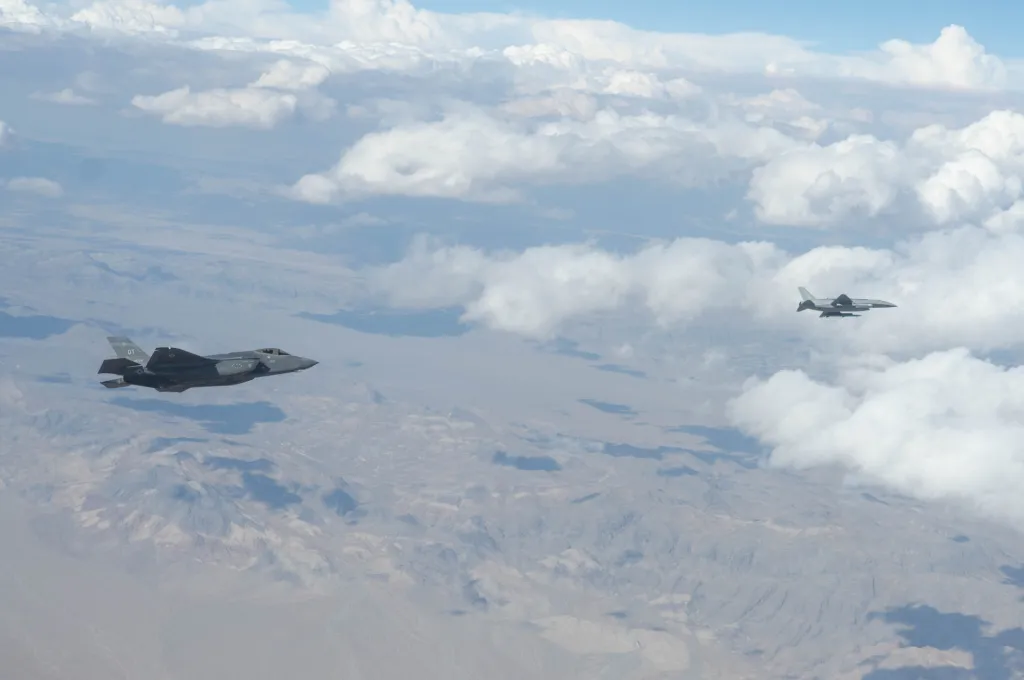
One of the Air Force’s YFQ-44A Fury CCA drones flies together with an F-35 Joint Strike Fighter. Anduril
It is worth noting here that Boeing’s MQ-28 Ghost Bat, a CCA-type design, did take part in Valiant Shield 26, another LFE exercise, earlier this year. The EOU was also involved. However, the MQ-28, originally developed for the Royal Australian Air Force, is not officially part of the Air Force’s CCA program at present.
Emerald Flag in December “will, in OTTO’s mind, be the first time that we will ever do some CCA end-to-end chain [demonstration] live. That’s the first time we’ll ever be integrated in a fourth- and fifth-gen combined OCA [offensive counter air] push,” Lt. Col. Bartlett added. “It’ll be small, but those type [sic] of building blocks are where I think you get the intangibles like trust in the CCA.”
“Those learnings are going to be just as valuable as the technical, [like] does the radio work properly? Does the button I push to say ‘target’ work properly?” he continued.
A General Atomics YFQ-42A CCA drone during an earlier test flight. General Atomics
“If it’s in a simulated environment, it’s immediate,” Lt. Col. Bartlett said during the panel when asked about the “feedback loop” in testing the EOU is already taking part in. In that environment, “when the mission autonomy iterations are happening, our guys are literally with the programmers … They give the feedback, and if it’s possible to do immediately, they take that feedback. If not, then they work on it on the next turn of the software.”
Real-world testing, of course, offers opportunities to explore additional aspects of future CCA operations, including when it comes to loading weapons and maintenance. A key component of the Air Force’s vision for CCA employment is being able to forward deploy the drones to far-flung locations, including airstrips with limited infrastructure and access to logistics chains. Rapid, distributed deployments like this are central to still-evolving concepts of operations currently referred to collectively as Agile Combat Employment (ACE). The EOU has been involved in at least two rounds of ACE-focused testing this year, one at Edwards Air Force Base in California in April and another at Creech Air Force Base in Nevada in July. TWZ was the first to report on the latter event.
Visualizing ACE
During the panel today, Lt. Col. Bartlett also talked more generally about work EOU has done to date. This has included exploring “sortie generation, how easy they are to maintain, [and] how small a footprint could be.”
“We’ve been pleasantly surprised. The jets are extremely easy to maintain,” he continued. “We’re at a one-to-one maintainer-to-airplane ratio, which is crazy small.”
With “CCAs, [it] seems like because they’re a little bit simpler, because their role is so focused, what we found is that just about any – not just about, but we found that any AFSC [Air Force Specialty Code; alphanumeric codes used to identify specific jobs within this service] can be trained to generate sorties to load weapons, and we’ve done some of those things already,” he further explained. “It’s our job to bring them [CCAs] out and make sure that, beyond the technical specifications of it, that we’re kind of experimenting with the more complex things like logistics, and C2 [command and control], and how do we battle manage these things.”
Airmen prepare to load an inert AIM-120 Advanced Medium Range Air-to-Air Missile onto a YFQ-44A CCA drone. USAF/Senior Airman Renee Blundon
The head of the EOU did acknowledge challenges that still have to be surmounted. This notably includes hurdles currently imposed by Federal Aviation Administration (FAA) regulations on the operation of fully uncrewed aircraft, even by the U.S. military, within U.S. airspace. This is further compounded by the explicit intention to operate CCAs with far more minimal human engagement compared to most existing drones.
“Mission autonomy is going to be the secret sauce that lets these things become decisive or not, and we’ll know that over the next couple years as that develops,” according to Bartlett. “If I were to identify the two biggest problems from the trenches of the EOU, [one] is FAA integration or policy implications to an autonomous airplane.”
“So these things don’t have pilots. They’re not RPAs [remotely-piloted aircraft]. They’re not manned fighters. They have no pilots,” he continued. “Our system is not set up for that, and that is a challenge that we are finding extremely hard to navigate through, and to not go around, but to make a policy.”
“We need to make sure the Air Force is ready for these things, to set policies that make sure the enterprise and the country is [sic] ready to receive these, and internalize an autonomous fighter that does not have a pilot that is running on a mission autonomy agent that doesn’t listen to ATC [air traffic control],” he added.
Another look at a YFQ-44A prototype during at test in 2026. USAF
The second problem, per Bartlett, is making sure the Air Force develops new internal policies and doctrine that are not “copy and pastes from old regulations” that do not take into account the specific nuances that CCAs will bring. What the service needs is “something that enables us to move quickly with these things, to weigh what we need, and to experiment with novel types of air superiority.”
All of this circles back to the discussion of trust in autonomous capabilities. It also speaks to the potential for future operations where CCAs could operate far more independently.
“It’s in the name that they’re collaborative,” Bartlett said. “Taking them out of that could technically be effective, but would not enhance the joint force the way that we see a collaborative, integrated force package to be.”
“What we need autonomously to do is written down. I won’t discuss the particulars in this forum, but we know what we need it to do, or we know what we think it really needs to do,” he noted. “We’ve structured our experimentation game plan to analyze ‘can it do those things?,’ and if not, then how do they need to be different? And then as they iterate on it, which we’ve already seen a couple times, we get that at the EOU, we get the new version down, we fly it again. Is it fixed? Yes or no.”
A General Atomics YFQ-42A seen from another angle during earlier testing. General Atomics
Some members of industry are clearly envisioning futures with different definitions of ‘collaborative’ that could lean more toward independent operations involving highly autonomous drones.
What “the whole entire program is trying to do is [figure out] what is the requirement to put out into the field to get to the warfighter and to start operating this thing this [sic; in] real time?” Robert “Otis” Winkler, Vice President of Corporate Development & National Security Programs at dronemaker Kratos, another one of the panelists, said. “The collaborative part of this makes it a much easier, I think, technical problem to be able to limit and grow the autonomy as you field this.”
“I think eventually we may see these aircraft utilized as collaborative aircraft, but not in conjunction with your traditional pulsed operation, but in support of that pulsed operation when the pulse isn’t there yet. But I do think that that is a bit of a stretch goal that’s going to be down the road.”
CCAs “have been designed really around increasing both survivability and lethality of current force packages. So there are many manned platforms that you would describe in the exact same fashion,” Jason Levin, Senior Vice President for Air Dominance and Strike at Anduril, who was also on the panel, said. He was responding here to a specific question about whether his use of the term “fighter” to describe these drones implied more emphasis on independent operations.
All of this underscores the importance of bringing CCAs to Emerald Flag in December, as well as other events in the future offering opportunities to see how the drones really fit in with other crewed platforms. The Air Force is hoping to start seeing CCAs enter operational service around the end of the decade, and have 500 of them, at least, in inventory by 2032.
During the panel today, the EOU’s Lt. Col. Bartlett made clear that “we’re going to learn a lot over the next couple years.”
The first naval battle between two Unmanned Surface Vessels (USVs) has taken place in the Black Sea. The Ukrainian Navy said on Saturday that one of its naval drones sank a Russian vessel.
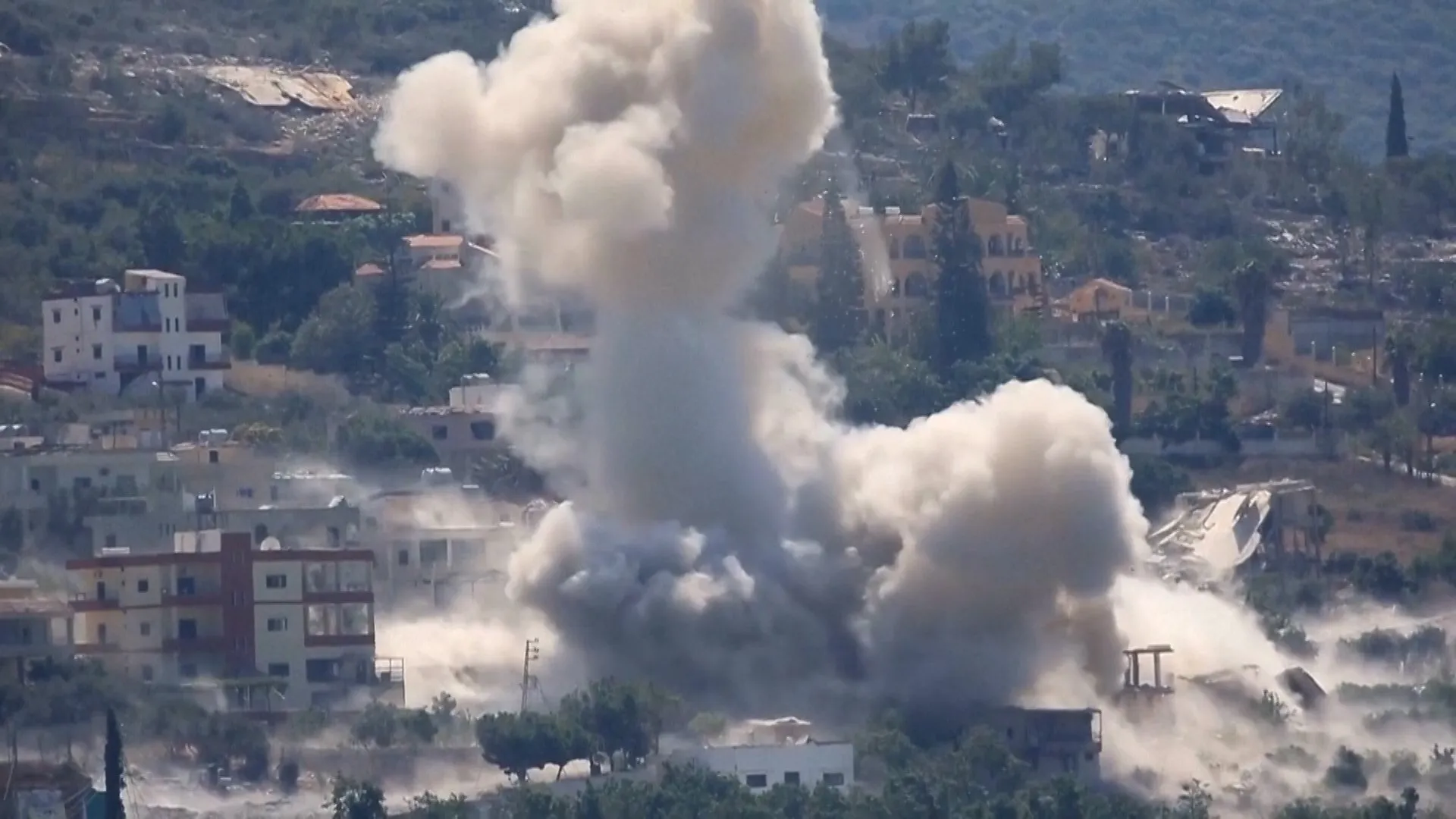
ARAB SALIM: Lebanese President Joseph Aoun urged Washington and the international community to help stop Israeli attacks, which killed at least seven people on Sunday despite a truce and a framework deal aimed at halting the violence.
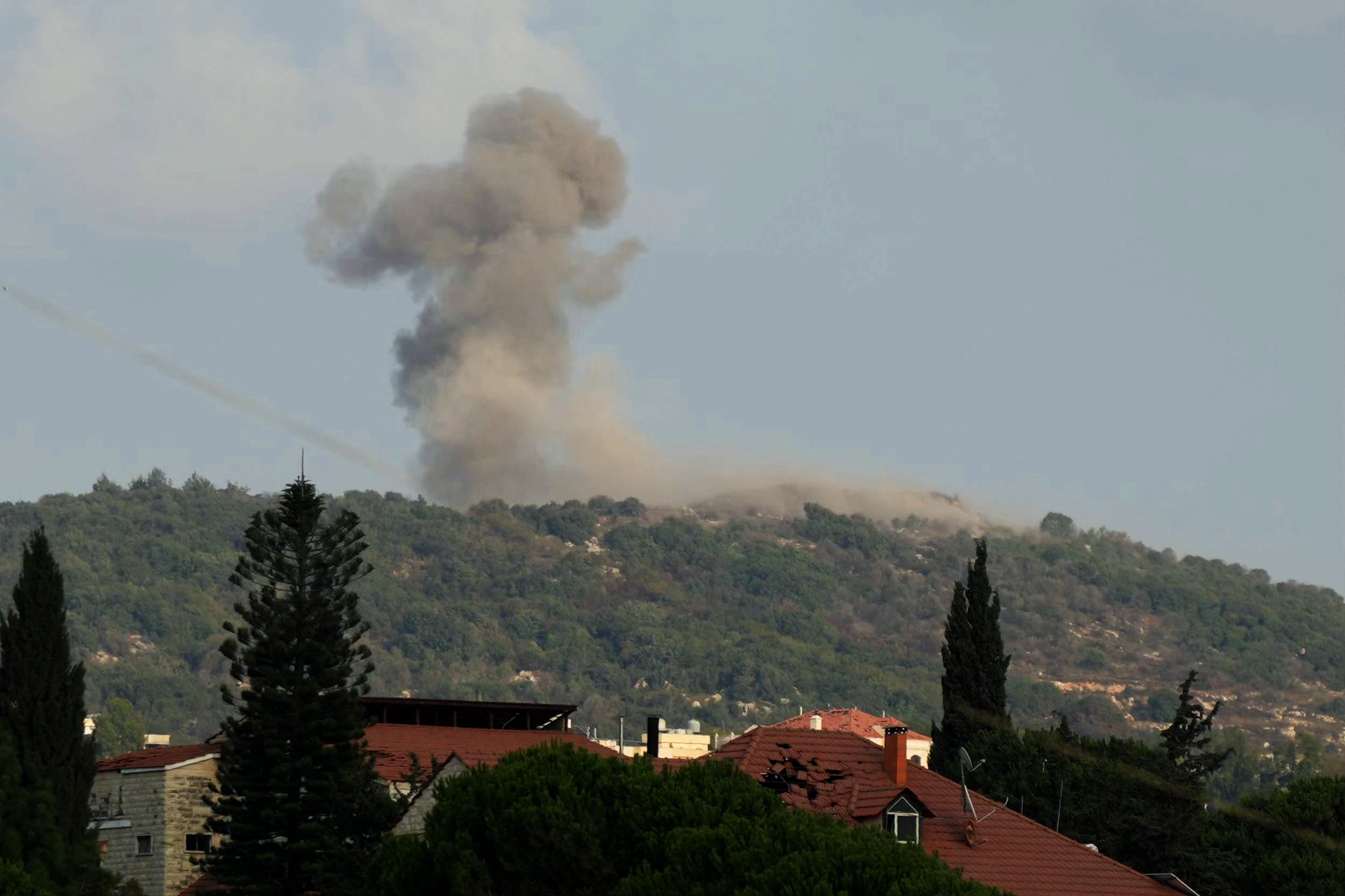
Israel said it had targeted Hezbollah operatives and sites in response to a drone attack a day earlier by the Iran-backed group on its troops in the vicinity of a strategic south Lebanon ridge.
It reported no casualties but accused Hezbollah of a “blatant violation.”
Israel this week said it had captured the Nabatieh-area Ali Al-Taher ridge, which it considers part of its self-declared “security zone” in south Lebanon.
Hezbollah, which has not claimed any attacks for weeks, has not commented on Israel’s declaration of control over the site.
Aoun said Sunday’s strikes, which damaged government premises and destroyed an out-of-service hospital, were “a dangerous escalation… reaching Lebanese state institutions” and health facilities.
He called on the international community — particularly the United States, which has sponsored direct Israel-Lebanon talks and a framework agreement between the sides in June — “to urgently act to stop these violations.”
Lebanon’s health ministry said two people were killed in strikes on south Lebanon’s Nabatieh Al-Fawqa, with two women also killed in nearby Arab Salim.
It said 20 other people including several women and three children were wounded there, as well as in the city of Nabatieh and town of Kfar Rumman.
The ministry later reported that a strike on a parking lot near Nabatieh killed three more people.
Hospital hit
The ministry said one of the strikes in Nabatieh Al-Fawqa “totally destroyed” the out-of-service Ghandour hospital, decrying “another grave violation of international humanitarian law.”
Israel’s army said it targeted Hezbollah operatives and infrastructure, including “weapons storage facilities and terrorist structures,” as well as “a Hezbollah command center that had been established inside a building previously used as a hospital.”
It had earlier issued its first evacuation notice in Lebanon in a month, warning residents near a building it called a Hezbollah facility in Arab Salim to leave ahead of an attack on the site.
It did not issue warnings for other areas where strikes were reported.
Lebanon’s state-run National News Agency (NNA) said that after the Israeli warning for Arab Salim, “enemy warplanes launched a strike on another house, destroying it” and killing the two women.
It said the Israeli military subsequently carried out a strike on the building threatened in the evacuation warning.
At the scene of the second strike, an AFP correspondent saw the ruins of a devastated villa, with large decorative columns laying on their side next to stairs littered with rubble.
Haidar Haidar, the brother of the building’s owner, told AFP that nobody had been living inside.
At the other site in Arab Salim where the two women were killed, a mattress, furniture and other items including a Hezbollah flag were strewn among the rubble, while neighboring buildings were also damaged.
‘Take action’
The NNA also reported a strike on a motorcycle in the Nabatieh area, and said that another in the city itself targeted a historical building and damaged offices belonging to finance and agriculture authorities.
An AFP correspondent there saw rubble and extensive damage to adjacent buildings, shops and vehicles, as heavy machinery cleared the road. Dust and debris covered chairs and desks in the regional ministry offices.
Nabatieh Mayor Abbas Fakhreddine said “the Lebanese government must take action… and at the least defend its institutions,” adding that it was the second time the official buildings had been damaged by strikes.
Lebanon was drawn into the wider Middle East war in March after Hezbollah attacked Israel in support of its backer Iran.
Israel responded with airstrikes and a ground invasion of Lebanon that Beirut says have killed more than 4,300 people.
Violence has decreased since a US-Iran memorandum of understanding on the broader regional conflict in June and the Israel-Lebanon framework agreement later that month.
Israeli forces are operating inside a self-declared “security zone” around 10 kilometers (six miles) deep inside Lebanon along the border.
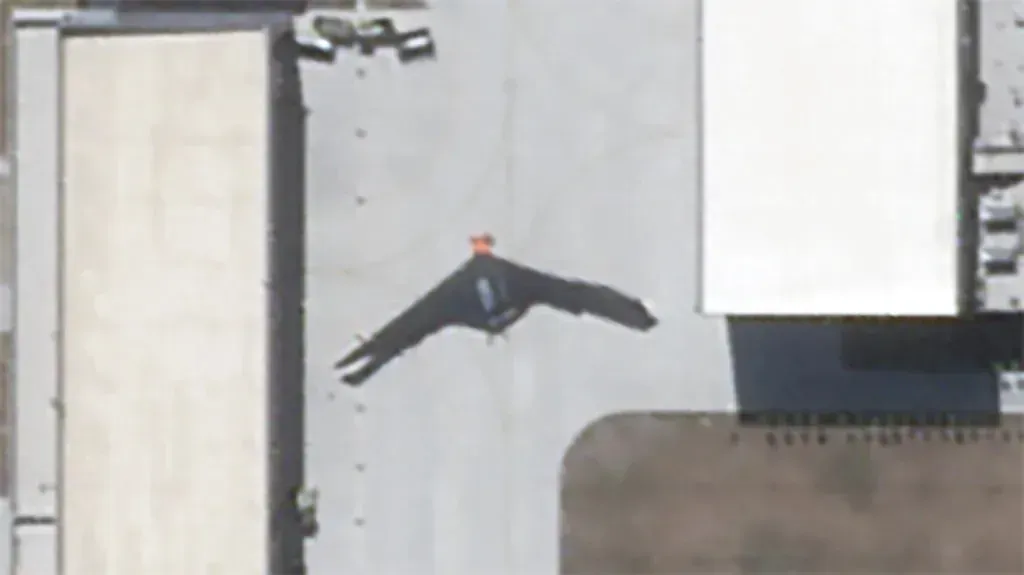
New imagery appearing out of China provides the best look yet at one of the country’s most enigmatic aircraft: the very large, low-observable, flying-wing drone widely referred to as the WZ-X. Seen previously primarily in satellite imagery, TWZ broke the story of the existence of this monster high-altitude, long-endurance drone. The new views that emerged today help clear up one of the most puzzling aspects of the aircraft’s appearance, namely the unusual shape of its enormous wings.
The aircraft was first identified in satellite imagery collected in May 2025 showing the People’s Liberation Army Air Force’s (PLAAF) sprawling test facility at Malan in Xinjiang. At the time, it was difficult to determine whether some of the apparent discontinuities in the wing planform were genuine features, visual countermeasures, or artifacts of the imagery.
The new photograph, seen at the top of the article and below, as well as a new satellite image, shows that the aircraft has a broader-chord inner wing section that transitions into a substantially narrower outer section. Rather than tapering continuously from the center section toward the tips, the wing effectively becomes much more slender over its outer portion in a ‘step down’-like fashion. The resulting planform gives the aircraft an exceptionally long, narrow outer wing. The wing arrangement differs from the B-2 and other stealthy flying wing designs because it has two outer wing sections, in addition to its diamond-like central fuselage, instead of just one.
We still can’t say for sure if this feature is just the way the aircraft’s wing was designed or if it also is due to some other exotic feature, such as wing folding or removable outboard sections. While a more novel explanation is possible, it is somewhat improbable at this point.
Seen from behind, the aircraft has a relatively shallow central fuselage section, with extremely long wings extending outward from it. The landing gear is extended, revealing large main undercarriage doors and substantial landing gear consistent with an aircraft of this size. Split rudders are visible toward the outer wing areas, broadly reminiscent of those used on the B-2.
An earlier view of the WZ-X. via Chinese internet
As in previous imagery, the rear of the center section of the aircraft may also reveal slot-like exhaust openings, supporting the assessment that it is twin-engined.
For an aircraft intended to spend long periods operating at high altitude, a very long overall span combined with a relatively narrow outer wing could be advantageous. Such an arrangement would increase effective aspect ratio and reduce induced drag during efficient cruise, potentially improving endurance and high-altitude performance.
It may also allow the designers to concentrate structural mass and internal volume closer to the center of the aircraft while still achieving a very large span.
There is a potential low-observable tradeoff, however. A significant change in chord introduces additional planform geometry and potential edge-alignment discontinuities that must be reconciled with the requirements of a stealth aircraft. The transition will influence radar reflections depending on its precise shape, orientation, and relationship to the aircraft’s other edges and surfaces. This will also be highly dependent on the aspect the radar is viewing the aircraft from. Modern very low observable designs try to minimize these exact types of features, with large continuous structures being the most advantageous to radar signature. This philosophy can be seen in the design of the B-21’s planform, which was also how the B-2 was supposed to look originally. You can read all about this here.
Regardless, the WZ-X does indeed have a semi-sawtooth trailing edge due to this intriguing feature.
New images of the so-called WZ-X stealthy flying-wing drone. via Chinese internet
The overall scale of the aircraft is also becoming increasingly apparent. Our initial analysis of satellite imagery put its wingspan at approximately 170 feet, roughly comparable to the 172-foot span of the B-2. That would make it considerably larger than other Chinese flying-wing drones identified to date.
Andreas Rupprecht, an analyst specializing in Chinese military aviation and TWZ contributor, assesses that the WZ-X is likely a twin-engined design similar in configuration to the supposed U.S. RQ-180, but considerably larger.
Rupprecht estimates a length of approximately 46 feet. He also assesses the aircraft as having a relatively spacious central fuselage and a dorsal satellite communications antenna. His estimates of a range exceeding 12,000 miles and a normal cruising altitude of somewhere between 59,000 and 66,000 feet remain unconfirmed.
The WZ-X is notably different from China’s smaller flying-wing designs. The CH-7, for example, has a deeper and more curved center section and is substantially smaller. The WZ-X’s broad, relatively flattened center body and enormous span instead appear particularly compatible with high-altitude endurance.
CH-7 stealthy flying-wing drone. via Chinese internet
Its apparent configuration also makes a long-duration surveillance mission plausible. The central body and inner wing section would provide substantial space for fuel, sensors, and communications systems, while the outer wing, combined with its lifting central body, could support highly efficient flight at high altitude.
A low-observable platform of this size could potentially conduct many types of wide-area surveillance and networking assistance while operating in or very near contested airspace where conventional high-altitude UAVs would face greater risks. A strike capability cannot be ruled out, particularly given China’s broader development of combat-capable flying-wing UCAVs, but the aircraft’s proportions appear especially well suited to persistence and reconnaissance.
While the location of the latest imagery is unconfirmed, Malan has developed into a massive center for Chinese drone testing, with satellite imagery showing extensive expansion of its infrastructure in recent years. The facility has been associated with multiple flying-wing designs, including the WZ-X and the similarly mysterious and also very large GJ-X. This substantially different flying-wing aircraft with a cranked-kite planform is also undergoing flight testing. That aircraft is estimated to have a wingspan of around 137 feet, underscoring the breadth of China’s experimentation with large low-observable uncrewed aircraft.
China is pursuing tailless/flying-wing designs across an increasingly wide range of sizes and missions, alongside larger crewed aircraft programs including the J-36 and J-XDS and, eventually, the H-20 stealth bomber.
The WZ-X appears to be part of a much broader effort to develop highly integrated, low-observable aircraft optimized for different combinations of range, endurance, payload, and survivability.
For now, its official designation, manufacturer, propulsion system, performance, and intended mission remain unknown.
However, its configuration appears well suited to the requirements of a very large high-altitude endurance aircraft, although the trade-off between its performance and its stealth characteristics remains equally mysterious.
Since receiving these tanks last year, the crews, serving with Ukraine’s 425th Separate Assault Regiment “Skala,” have used the Abrams in two combat operations in the fight for Pokrovsk, a key Ukrainian logistics hub and part of a defensive belt of towns in Ukraine’s eastern Donetsk region. They recounted their experiences to Hromadske, an independent media channel in Ukraine.
Чому «Скеля» їхала на Abrams у Покровськ / hromadske
Fighting around Pokrovsk
The first major deployment described by the crews took place in December of last year, when Abrams tanks were used to support assault groups entering Pokrovsk.
The crewmember with the callsign Kent described moving into the city behind a mine-clearing tank and ahead of two infantry fighting vehicles (IFVs) carrying assault troops, during a mission that was deliberately aggressive.
“Since a tank is a priority target — my task was to draw their attention, while our infantry dismounted and moved in successfully.”
The Abrams was also assigned three target points to engage along the route.
“We went right in there, poured it on, and drove back out,” he recalled.
A video showing the 425th Separate Assault Regiment in action in August 2025, soon after receiving the Abrams:
Танки Abrams в 425 ОШП “Скала” [Серпень 2025]
The second operation, on March 31, involved an attempt to enter and hold an industrial area near Pokrovsk to help block Russian movement toward Hryshyne, a contested village in the district.
The operation was prepared for more than two weeks. Ukrainian forces conducted reconnaissance flights, examined difficult sections of the planned routes, and provided crews with extensive video and imagery.
“They knew every meter of the route,” another of the unit’s commanders, with the callsign Kubik, said.
Weather was considered essential. The Ukrainians waited for fog and rain, hoping to limit the effectiveness of Russian drones.
“Without the right weather we wouldn’t have been able to pull off operations like that,” Kubik said.
The operation nevertheless resulted in the destruction of four out of five armored vehicles, some of which are seen in the video embedded below.
Russia’s Rubicon Drone Center FPV drones destroyed a Ukrainian assault group near Pokrovsk, hitting an M1A1 Abrams tank, M1117 APC and BMP-2 as the unit tried to advance near Hryshyne under fog cover. #Ukrainepic.twitter.com/ZzE52qAYxp
The commander acknowledged that the Russian side may have had advance knowledge of the operation.
“I can’t rule out the possibility that the enemy knew our plan,” he said.
His Abrams was not immediately destroyed. According to the crew, it completed its task and the assault troops dismounted before the weather changed.
“Once the fog lifted, they started working on it with an FPV drone,” the commander said.
Why use tanks at all?
The losses prompted criticism from Ukrainian military commentators, particularly after footage of the destroyed vehicles was published.
However, the crews defend the decision to use armored vehicles for the missions. According to the men of the Skala interviewed, the alternative was often to send infantry over several miles on foot while carrying weapons, ammunition, water, and other supplies.
“That takes more time,” Kubik explained. “And the enemy isn’t standing still — the enemy is moving toward them.”
🇦🇺🇺🇦 Australia-supplied M1A1 Abrams AIM main battle tank in service of the Ukrainian 425th Separate Assault Regiment “Skala.”
The argument that infantry could simply move more stealthily on foot also has limitations.
“Every day the Mavic drones are flying, the fixed-wing drones are flying,” he said. “No fog, guys are visible.”
Combined witu IFVs, the Abrams can provide the ability to rapidly move troops while simultaneously delivering heavy direct fire against enemy positions and offering substantial protection to its crew.
The crews argue that this capability remains worthwhile even when the tank itself may eventually be lost.
One commander was asked whether deploying a roughly $5-million tank makes sense if a single sortie can result in its destruction.
“Yes, of course it makes sense to deploy it,” he replied.
“First and foremost — it saves the lives of the crew inside it.”
Russian forces captured a relatively lightly damaged M1A1SA Abrams main battle tank operated by the 47th Separate Mechanized Brigade in the Pokrovsk direction.
— Status-6 (War & Military News) (@Archer83Able) October 27, 2024
A tank under attack by drones
The Ukrainian crews repeatedly highlighted the Abrams’ accuracy and survivability.
“What are the biggest advantages of the Abrams?”, Kent was asked.
“Accuracy.”
Its biggest disadvantage, he said, is equally obvious on a modern battlefield: “It’s very tall — and very large — so it’s hard to conceal.”
A video showing a U.S.-supplied Abrams under attack from Russian FPV drones:
🇺🇸🇺🇦 An Abrams tank withstands 9 FPV drones hits. Eventually, the tank was destroyed, but the tank crew successfully survived. pic.twitter.com/4NBKdg2zmW
He pointed to fairly basic modifications including rubber strips and a foldable wire cage mounted on the turret, as additional layers of protection against drone attacks.
“A drone doesn’t hit the actual penetrating element directly — it just can’t reach it,” he explained. “It hits the rubber, and then the blast wave travels from there.”
Even with their tanks festooned with explosive reactive armor (ERA) bricks, the crews acknowledge that such protection has limits.
A head-on view of an M1A1 of the 425th Separate Assault Regiment shows the ERA bricks installed around the turret and in front of the hull. Ukrainian Armed Forces
US-supplied M1A1 Abrams tank in service of the Armed Forces of Ukraine with added Kontakt-1 ERA on the frontal hull and standard ARAT ERA on the sides. pic.twitter.com/PC2kDfxefO
— Status-6 (War & Military News) (@Archer83Able) May 21, 2024
“They also protect very well. An effective thing,” he said.
A Russian tank with the ‘hedgehog’-type protective covering. Russian state media
For now, the drone threat has led the regiment to keep its Abrams out of combat, as we will return to later.
The Abrams as a machine
The crews’ assessment of the Abrams included praise for its mobility, roomy interior, gun, and fire-control system.
Kubik said he had personally driven an Abrams to 50 miles per hour cross-country.
“The engine is an absolute beast,” he added.
The tank can also rapidly perform a pivot turn, which the crews consider particularly useful when maneuvering in confined spaces. Despite its prodiguous weight, it only rarely becomes bogged down after the kind of very heavy snow-melt that effects all vehicles on the battlefield.
Loading a 120mm M1028 canister cartridge into an M1A1 AIM Abrams main battle tank of the tank battalion of the 425th Assault Regiment. pic.twitter.com/tMd8QcROQe
— 𝔗𝔥𝔢 𝕯𝔢𝔞𝔡 𝕯𝔦𝔰𝔱𝔯𝔦𝔠𝔱 🦩🇬🇪🇺🇦🇺🇲🇬🇷 (@TheDeadDistrict) June 21, 2026
Its disadvantages include its demanding maintenance requirements. The running gear was described as particularly sensitive, with crews inspecting, lubricating, and replacing components after every sortie.
Fuel consumption is another major burden. The crew cited roughly 400 to 700 liters (106 to 185 gallons) per 100 kilometers (62 miles) depending on terrain and operating conditions.
“On asphalt it burns about 400 liters,” one said. In boggy terrain, consumption can reach “700 liters or more.”
The Abrams thirsty gas turbine engine and extreme logistical demands have always been a criticism of the platform.
An M1A1 of the 425th Separate Assault Regiment fording a river. Ukrainian Armed Forces
The crews said the vehicle’s ability to operate on different fuels is useful, although diesel provides the best engine-hour performance in their experience. Prior to delivery, the gas turbine engines of the tanks were reconfigured to use diesel fuel instead of the standard JP-8 aviation kerosene, according to earlier reports.
They also praised the Abrams’ protected ammunition storage and crew space compared with Soviet-designed tanks.
The version operated by the Ukrainians is an M1A1 rather than the latest Abrams configuration, with less sophisticated electronics than newer variants. It also lacks the classified armor found on its U.S. Army counterpart.
“For me — as a tanker — this configuration, what we have right now, is more than enough,” Kubik said. “The sight is absolutely excellent. The gun is also great.”
Waiting for a solution to the drone problem
The interview ultimately presents a more complicated picture than either the declaration that tanks are obsolete on the Ukrainian battlefield.
At the time of writing, at least 25 Abrams have been confirmed visually to have been destroyed, damaged, or abandoned in Ukrainian service. This is from a total of 31 provided by the United States and 49 from Australia.
“For now, we’re not using them further — there’s no way to,” Kubik said. “The enemy has developed their drone component very heavily, and for now we don’t have the means to counter that.”
While tanks remain exceptionally powerful direct-fire and protected mobility platforms, the proliferation of inexpensive uncrewed aircraft has made operating them increasingly difficult.
M1A1 AIM Abrams tanks of the 425th Assault Regiment 🇺🇦. The reinforced upper glacis and turret roofs are clearly visible. pic.twitter.com/Sn9h8OWZ9P
— 𝔗𝔥𝔢 𝕯𝔢𝔞𝔡 𝕯𝔦𝔰𝔱𝔯𝔦𝔠𝔱 🦩🇬🇪🇺🇦🇺🇲🇬🇷 (@TheDeadDistrict) June 21, 2026
“If someone had told me, as a tanker, back in 2022: ‘Take this — we’re giving you an Abrams, we’ll give you time to train and you’ll fight in it,’” Kubik said, “I would never have climbed out of it.”
“I’d only be saying: ‘Bring me shells. I’ll drive non-stop wherever needed, arrive and work.’”
An M1A1 of the 425th Separate Assault Regiment firing its main gun. Ukrainian Armed Forces
As it stands, reconnaissance drones can find the Abrams, FPV drones can attack it, and persistent surveillance makes concealment difficult. Experience has shown that without more effective counter-drone capabilities, even a heavily protected tank can eventually be overwhelmed.
But Kubik believes that will change.
“The day will come when one of our bright minds figures out some excellent solution against drones — and we’ll start using them again.”
Asked whether the era of tanks is over, his answer was unequivocal.
“It’s not over … They’re just waiting it out for now, biding their time. Writing off tanks — in my opinion — is still too early.”
As the war drags on in Ukraine, its civilians are again suffering.
Thirty-eight people were killed in the village of Myla on August 29, when a Russian drone attack struck an ammunition depot. Another 12 were killed in attacks across the country on September 1.
Recommended Stories
list of 4 itemsend of list
Civilian deaths have sharply increased this summer as Russia is using jet-powered drones, which fly at about half the speed of a passenger jet and are more difficult to intercept than propeller-powered drones.
Jet-powered drones numbered about 2,800 in August, said Ukraine Air Force spokesman Yurii Ihnat, compared with about 1,500 in July, several times the number launched in June. Ukraine has an interception rate of more than 90 percent against propeller-powered drones, but only 60 percent against the jet-powered variant, Ihnat said.
(Al Jazeera)
Ukraine said Russian forces suffered 42,020 casualties last month, as Moscow’s territorial gains dropped to a fraction of last year’s rate of advance.
Ukrainian armed forces figures showed Russia’s monthly casualties were only slightly below July’s 42,860 and well above the 39,290 in June.
Al Jazeera cannot independently verify casualty estimates by either side, but if accurate, those summer figures – 25.8 percent higher than the casualties Ukraine inflicted in the spring – suggest the high Russian casualty rate is not a passing event.
Russian recruitment rates are thought to be well below those totals, estimated by Ukraine at about 32,500 a month this year.
An area in Kyiv hit by numerous missile attacks, September 1, 2026 [Gleb Garanich/Reuters]
Ukrainian President Volodymyr Zelenskyy has publicly shared intelligence suggesting that Russian leader Vladimir Putin will conscript 300,000 or more troops next month.
Zelenskyy has said that up to 80 percent of Russian casualties were inflicted in Kostiantynivka, the southernmost of Ukraine’s “fortress belt” of cities in the eastern Donetsk region, whose capture Putin has repeatedly prioritised.
Russian forces are thought to control only a portion of the city, but have infiltrated more than 70 percent of it with scattered individual troops sent to drop supplies and await reinforcements. Ukrainian drone operators have been targeting the troops as Russia replenishes them.
This week it was revealed that Ukrainian commander-in-chief, Mykhailo Drapatyi, reinforced the Donetsk front around Sloviansk and Dobropillia, north and south of Kostiantynivka, respectively, but kept the Kostiantynivka front largely unchanged. That suggests Ukraine may be adopting the tactic of fighting a prolonged rearguard in the urban landscape to inflict attritional losses, as it did in the battles of Bakhmut, Pokrovsk and Chasiv Yar.
Police inspect parts of a Russian drone at an apartment building in Kyiv, September 1, 2026 [Gleb Garanich/Reuters]
The fight for Kostiantynivka has sapped troop strength elsewhere on the front line, where Ukraine liberated 130sq km (50 square miles) of its land in August, limiting Russia’s overall advance.
Russia seized just over 90sq km (35 square miles) in August, estimated the Institute for the Study of War, a Washington-based think tank that assesses territorial gains using open-source geolocated sources.
While still a net gain, that is less than a fifth of the land Russia seized in August last year.
During June, July and August this year, the ISW assessed that Russia gained firm control of 160sq km (60 square miles), compared with 1,440sq km in the summer months of 2025 (560 square miles) – a 90 percent decrease.
Family members attended the funeral on Monday of village leader Taras Didych, who was among 38 people killed in a Russian drone attack in Myla last week, August 31, 2026 [Alina Smutko/Reuters]
Ukraine’s response
Ukraine has turned its focus from Russian refineries to strikes against Russian air defences, radar systems and drone launch sites.
Ukraine’s Unmanned Systems Forces (SBS) destroyed 33 air defence elements in August, increasing the annual total to 263.
Ukraine also kept up some strikes on refineries, hitting 12 in August, along with two gas-processing plants and three oil transshipment terminals, according to its defence ministry.
During the past week, Ukraine struck the Yanos refinery in Yaroslavl and the Kirishi and Ust-Luga refineries near Leningrad, all 800km (500 miles) from its border.
Petro Ionov mourns his son Yevhenii in the town of Bilohorodka, August 25, 2026 [Anatolii Stepanov/Reuters]
Those strikes have caused petrol shortages, further hurting Russia’s economy.
Ukraine’s military intelligence reported that certain Russian exports had fallen by 80 percent compared with pre-war levels. Oil has been among the hardest hit, as Ukraine has struck terminals and hundreds of tankers carrying Russian oil in the Black Sea and Sea of Azov.
Russian oil exports from the Black Sea port of Novorossiysk fell from 800,000 barrels a day in July to 350,000 barrels per day in August, said Ukraine’s Foreign Intelligence Service.
“The Russian side acknowledges that its Black Sea Fleet ships are effectively blockaded in Novorossiysk due to our drone strikes and are unable to operate at sea,” said Zelenskyy.
“Since the Russian fleet is unable to provide escorts for the commercial and shadow fleet … one of the solutions being considered is to equip civilian ships with small arms, electronic warfare (EW) equipment and military personnel,” he said. “We will prepare appropriate countermeasures.”
The strikes on the oil industry have not only reduced exports. They have reverberated across the Russian economy, creating queues at petrol stations and raising prices for motorists.
This week, Russia extended its ban on diesel exports to the end of September to keep its army and transport industry supplied and sought to import petrol.
Occupied Crimea, where petrol distribution has been restricted to government-owned vehicles, has been hard hit.
The Russian-appointed governor of the region, Sergei Aksyonov, said on September 2: “Fuel supplies to the region are currently not fully meeting the needs of the residents. Unfortunately, some residents of Crimea will, at this stage, face limited access to gasoline”.
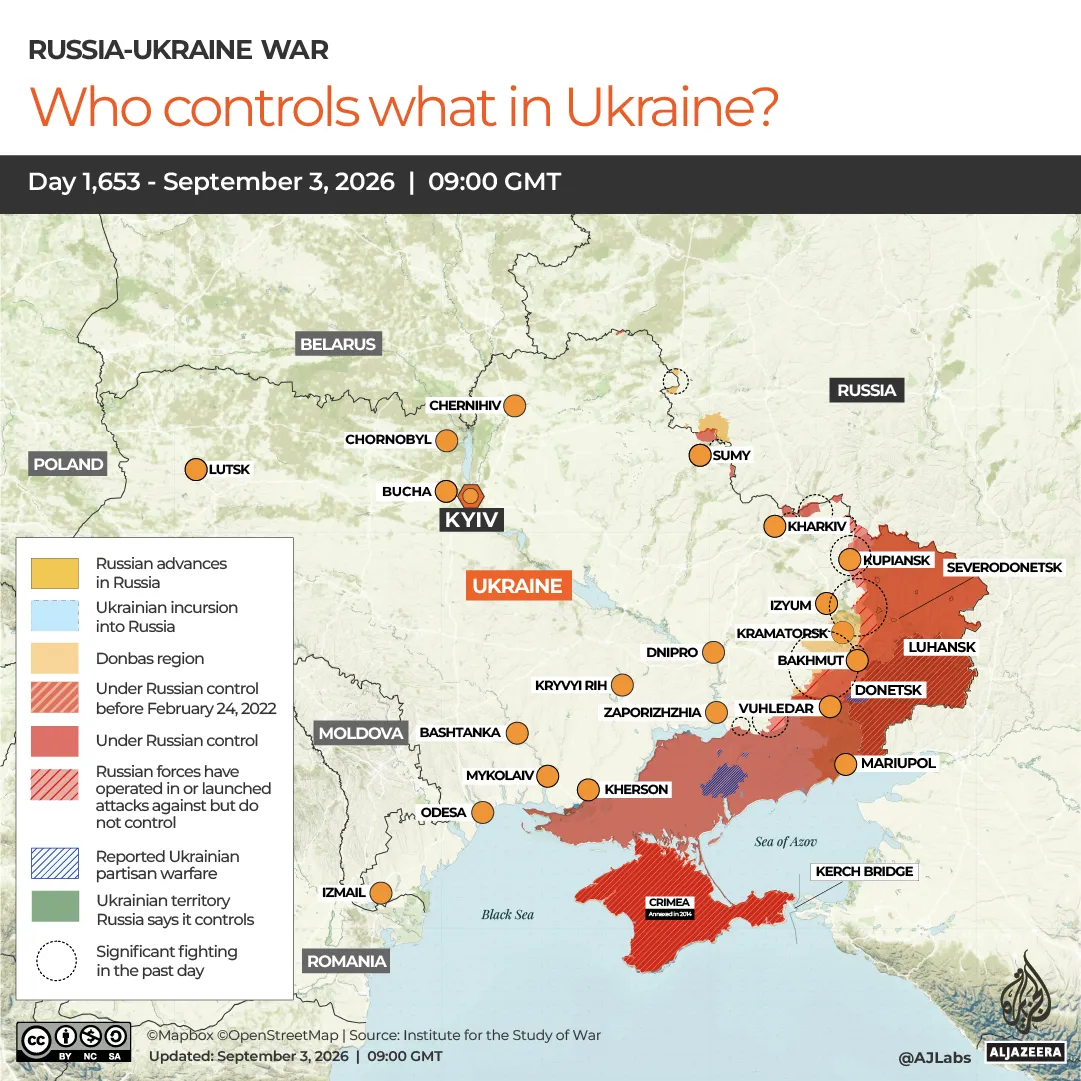
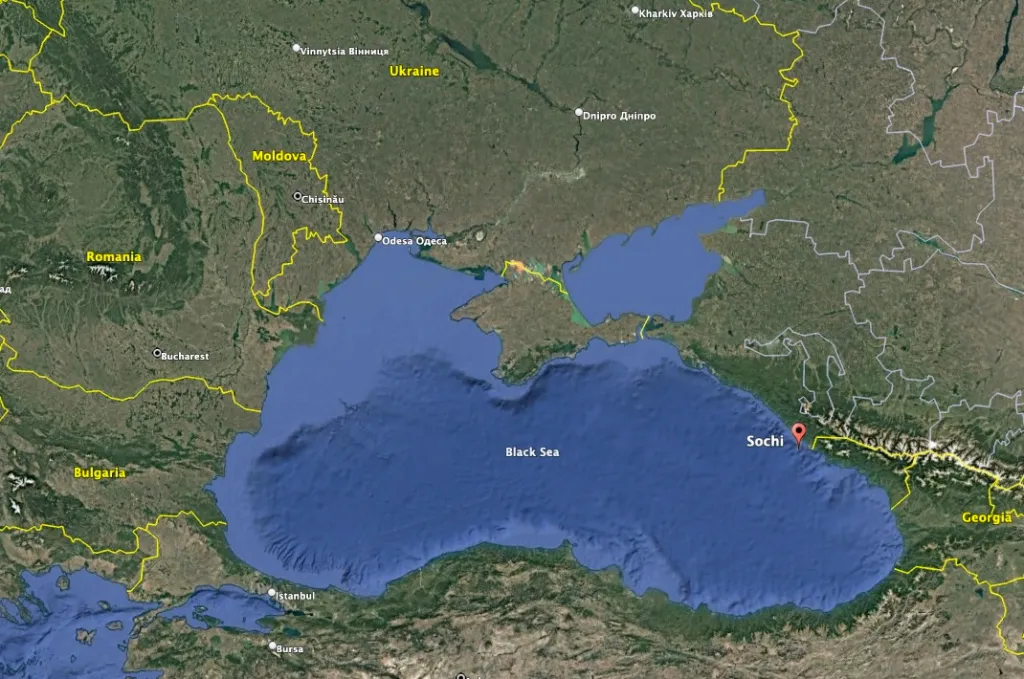
Ukraine carried out one of its farthest uncrewed surface vessel (USV) attacks from Ukrainian shores, striking the Nefrit, a multipurpose offshore vessel, in the Russian Black Sea resort city of Sochi. The seaside getaway is located about 350 miles on a direct line from the nearest Ukrainian-held territory, but the trip is a lot longer if originating from Ukrainian-held shores.
This marks the first known USV attack on this city that Russian President Vladimir Putin often visits. As we have reported in the past, it has been attacked several times by Ukrainian aerial drones.
The Russian Black Sea port of Sochi came under attack on Thursday. (Google Earth)
“The multipurpose support vessel, flying the Russian flag, was hit by an unmanned naval vessel of the Ukrainian Navy,” the service said on Telegram. “A powerful explosion and smoke were observed in the area of the vessel.”
“The NEFRIT is part of Russia’s maritime and energy infrastructure, providing support for oil and gas operations, servicing offshore facilities, transporting cargo and personnel, and carrying out underwater technical work,” the Ukrainian Navy explained. “Its activities directly supported the enemy’s war economy and financed the criminal aggression against Ukraine.”
“The damage to the NEFRIT is a blow to the enemy’s logistics, special capabilities, and military-economic infrastructure,” the Ukrainian Navy added. “The Ukrainian Navy continues to deprive the enemy of resources and capabilities for waging war, and once again demonstrates that even Russian territory is not a safe haven.”
🇺🇦⚓ВМС України уразили судно забезпечення рф NEFRIT у порту Сочі Багатоцільове судно забезпечення під прапором рф було уражене морським безекіпажним катером Військово-Морських Сил. У районі судна зафіксовано потужний вибух та задимлення.
There is also video of one of the USVs being destroyed before it could reach its target.
Starting at about 6 a.m. local time, Sochi Mayor Andrey Proshunin declared an emergency.
“ATTENTION! THREAT OF A USV ATTACK IN SOCHI,” he warned on Telegram. “All forces and resources are working to defend the city. Take shelter in a safe place, remain calm.”
Sochi Mayor Andrey Proshunin declared an emergency about an impending sea drone attack on Thursday. (Sochi Mayor Andrey Proshunin’s Telegram)
About a half hour later, Proshunin issued an all-clear notice, but did not provide any details about what happened.
Sochi Mayor Andrey Proshunin lifted the emergency about a half hour after it started. (Sochi Mayor Andrey Proshunin’s Telegram)
There was no immediate response from the Kremlin.
Ukraine has carried out long-distance USV attacks on Russian Black Sea targets in the past, including one in 2023 on theRopucha class vesselOlenegorsky Gornyak, located in Russia’s Black Sea port of Novorossiysk. A major Russian port on the eastern coast of the Black Sea, it sits roughly 420 miles from Ukrainian-held shores. Sochi is about 110 miles southeast of Novorossiysk, meaning the USVs in today’s attack would have had to travel an even longer distance if launched from Ukrainian-held shores. However, the launch point of the Sochi USV strike is not publicly known and there is always the possibility that a mothership could have been used.
The attack occurring during broad daylight is also interesting, as Ukraine has often taken advantage of the cover of darkness for USV strike operations on port facilities.
You can see a video of that strike below:
The strike on the Nefrit is the latest in Ukraine’s long-running drone boat campaign in the Black Sea. This onslaught has already kept Russia’s Black Sea Fleet (BSF) at bay, forcing it to retreat from Crimea to Novorossiysk. Ukrainian USVs have also damaged enemy military facilities in occupied Crimea and the Kerch Bridge.
In July, the U.S. military used USVs as combat weapons for the first time, striking Iranian targets in Bandar Abbas. The following video shows that attack.
Yesterday, using multiple one-way attack surface drones, CENTCOM forces successfully struck a submarine and ship maintenance facility in Iran. Three Corsair unmanned surface vessels hit the port at Bandar Abbas Naval Base, marking the first time American forces have employed sea… pic.twitter.com/bOM2kmgRxz
It may be a day or so before we get a better picture of the extent of the damage to the Nefrit. Regardless, the attack itself is another sign that Ukraine can reach targets with sea drones far from its own shores.
The Latest
All across the battlefield, Ukrainian forces are largely holding off continued Russian attacks or are making small advances. Overall, in August, “Russian forces advanced or infiltrated into about 123.53 square kilometers — an average pace of 3.98 square kilometers per day,” according to the Institute for the Study of War (ISW). “Russian forces’ main territorial gains in August 2026 have been in the Fortress Belt area, Donetsk Oblast. Even there, Russian forces managed to achieve only marginal tactical gains and have thus far failed to complete the seizure of Kostyantynivka.”
Kharkiv: Russian forces continued offensive operations in northern Kharkiv Oblast and the Velykyi Burluk direction on September 1 and 2 but did not advance. Russian forces also continued offensive operations in the Borova and Kupyansk directions on September 2 but did not advance. However, Moscow’s troops continued attempts to secure and expand the bridgehead on the left bank of the Oskil River to enable further infiltrations into Kupyansk.
Donetsk: Ukrainian forces recently defeated a Russian infiltration mission in the Slovyansk direction. They also recently maintained positions or advanced in the Dobropillya tactical area. Russian forces continued offensive operations in the Novopavlivka direction on September 1 and 2 but did not advance. Neither Ukrainian nor Russian forces reported ground activity in the Oleksandrivka direction on September 2.
Zaporizhia: Russian forces continued offensive operations in the Hulyaipole direction on September 1 and 2 but did not advance. Russian forces continued offensive operations in western Zaporizhia Oblast on September 1 and 2 but did not advance as Ukrainian forces counterattacked west of Orikhiv.
Kherson: Neither Russian nor Ukrainian forces reported ground activity in the Kherson direction on September 2.
MORE 🧵(1/3): ISW has observed evidence to assess that Russian forces consolidated positions in or seized about 90.35 square kilometers of territory in Ukraine in August 2026, averaging 2.91 square kilometers seized per day. Including Russian infiltrations, Russian forces… https://t.co/0RlwRfBdhspic.twitter.com/Cp2Knry2Du
Air traffic around Moscow continued to be disrupted on Thursday as Russian authorities responded to another large-scale Ukrainian drone operation, according to EU Today. The disruptions came two days after President Volodymyr Zelensky warned international airlines and insurers that Russian airspace was becoming increasingly unsafe for civilian aviation due to Ukrainian drone attacks.
Moscow Mayor Sergei Sobyanin said that 548 drones had flown towards the wider Moscow region between 8 a.m. on Wednesday and midday Thursday local time. However, Russian authorities claimed that most were intercepted before they could reach the Moscow area while 143 were destroyed on approaches to the Russian capital.
“Temporary restrictions were again imposed at Moscow’s principal airports,” EU Today noted. “Vnukovo and Domodedovo stopped arrivals and departures for periods during the operation, while Sheremetyevo handled flights under additional restrictions. The measures produced cancellations, delays and diversions extending beyond the periods in which individual airports were formally closed.”
The disruption “had already become extensive on Wednesday,” the publication added. “Flight-tracking data showed 21 cancellations and 235 delayed services at Sheremetyevo, Russia’s largest airport, while Vnukovo recorded 22 cancellations and 94 delays.”
⚡️ Moscow airports cancel flights after Zelensky’s ‘closed skies’ warning
“Temporary restrictions on the arrival and departure of aircraft have been introduced,” Russia’s Federal Air Transport Agency (Rosaviatsia) said.https://t.co/BAlAASaDv5
Putin on Thursday said there is a chance of resolving the “Ukrainian conflict” but Kyiv’s campaign to shut down Russian airspace is “complicating the negotiation process.”
Russia and Ukraine themselves must reach an agreement, while other countries can only support and assist, the Russian leader added, according to a translation from former Ukrainian government official Anton Gerashchenko.
Russia is in contact with the White House and President Donald Trump “is committed to positive and constructive engagement,” Putin proclaimed. “Russia has many friends in the United States. One of them is Steven Seagal, the ‘best envoy of peace.’”
Putin said there is a chance of resolving the “Ukrainian conflict” but Ukraine’s threats to shut down Russian airspace are “complicating the negotiation process.”
A Russian drone strike on an Odesa apartment building injured at least 17 people, including three children, Zelensky stated on X.
In Odesa, emergency services continue working at the site of a drone strike on an apartment building. Damage to apartments from the 10th through the 17th floors left 17 people injured, including three children. Efforts are also ongoing to deal with the aftermath of the strikes in… pic.twitter.com/FWAmFNJSYp
— Volodymyr Zelenskyy / Володимир Зеленський (@ZelenskyyUa) September 3, 2026
Overall, Ukraine says its air defenses downed or suppressed 135 of 163 Russian drones launched overnight, including Shahed-type UAVs, about half of which were jet-powered. Russia also used S-8000 Banderol, Gerbera and decoy drones. Hits were recorded at 15 locations and debris fell at four.
Ukraine says air defenses downed or suppressed 135 of 163 Russian drones launched overnight, including Shahed-type UAVs, about half of them jet-powered. Russia also used S-8000 Banderol, Gerbera and decoy drones. Hits were recorded at 15 locations and debris fell at four.… pic.twitter.com/JyxTS6QBzL
Russia has been increasingly using jet-powered drones to attack Ukraine. The Ukrainian Defense Ministry released video it says shows troops from the 208th Anti-Aircraft Missile Brigade downing one of those drones. The jet powered Shahed-like one-way attack drones fly higher and faster than their propeller-driven cousins, making them harder to intercept by more cost effective and plentiful means, such as Ukraine’s many drone interceptors. Instead, much more expensive and increasingly scare missile must be used in some circumstances.
What appears to be the first video of Ukrainian troops using Cold War-era Leopard 1 tanks with turrets swapped out for the Rheinmetall Skyranger 35 short-range air defense system has emerged on social media. The @deaidua X account that tracks German war materiel donations to Ukraine said the 1020th Anti-Aircraft Missile Regiment recently took delivery of this system, designed to be a highly mobile counter to a range of aerial threats.
The Skyranger 35 “is equipped with a KDG 35/1000 revolver cannon in 35 mm x 228 caliber with a firing rate of 1,000 rounds per minute,” according to Rheinmetall, which began delivering these to Ukraine in January. “It has an effective range of up to 4,000 meters and a high degree of commonality with the Oerlikon Revolver Gun Mk 3. Thanks to AHEAD technology, the Skyranger 35 is airburst-capable. In the future, it will also be possible to equip it with modern guided missiles.”
It seems that Ukraine’s 1020th Anti-Aircraft Missile Regiment which belongs to the Ground Forces has taken delivery of the first Skyranger 35 SPAAGs mounted on a Leopard 1 chassis made by @RheinmetallAG.
A new documentary about Ukraine’s use of the combat-proven National Advanced Surface-to-Air Missile System (NASAMS) air defense system debuts tomorrow.
“Sky Defenders is a new documentary taking audiences inside the increasingly critical battle to protect the skies of Europe and Ukraine,” according to the film’s producers. “Launching globally on Apple TV and Amazon Prime on Sept. 4, the 50-minute film explores the people, technology and strategy behind modern air defense and the race to stop missiles and drones before they reach their targets.”
SKY DEFENDERS | Official Trailer
A new video shows a Russian soldier being attacked by three Ukrainian kamikaze drones simultaneously, underscoring just how dense the drone threat has become to troops near the front.
That kind of attrition is also visible around Pokrovsk, where Ukrainian kamikaze drones are increasingly coordinating strikes against individual Russian infantrymen and small assault groups.https://t.co/HfKBCW7ZOm
It’s been more than three years since the Russians captured the town of Bakhmut in the eastern Donetsk region after a long battle that incurred a tremendous toll on personnel and equipment on both sides of the fight. New drone video has emerged showing the city remains in ruins, with blocks and blocks of vacant and destroyed buildings.
A harrowing new video from Bakhmut, filmed in the summer of 2026. The Ukrainian city was captured by the Russians three years ago and has lain in ruins ever since.
In this once-vibrant city of 72,000 inhabitants, there are no longer any shops, schools, kindergartens, cafés,… pic.twitter.com/clFfLu5jkq
Sept. 2 (UPI) — Ukrainian President Volodymyr Zelensky issued a warning to airlines to stay clear of Russian airspace and airports due to a large-scale escalation in drone strikes on Russian targets by the Ukrainian military.
Zelensky said Tuesday that he wanted to notify every airline flying in Russian airspace, every insurance company and anyone that still used airport hubs such as St. Petersburg and Moscow, which have six airports between them, that the skies above Russia were “becoming completely dangerous.”
“There will simply be drones in Russia’s skies on a scale that has to be taken into account,” he said.
“The Ministry of Foreign Affairs of Ukraine and our other institutions will provide international organizations with full information about the dangers in Russian airspace. Drone-infested skies are no place for civilian aviation,” added Zelensky.
Zelensky stressed that the warning was not intended to “threaten civilian aviation as such — not a single civilian aircraft” and Ukraine did not want the loss of any innocent lives.
The majority of Western airlines stopped over-flying Russia after the start of the war in 2022 but Chinese, Turkish and Middle East carriers and some others continue to do so, particularly on long-haul Asia to Europe flights where the Russia route can slash up to 2,250 miles from the journey, equivalent to four hours’ flight time and as much as 30 tons of extra fuel.
Russian aviation authorities automatically suspend flights if a drone sighting is confirmed within a certain radius of a specified zone with civil aviation disrupted on numerous occasions over the past year after Ukrainian drone assaults, often involving hundreds of drones at a time.
Russian President Vladimir Putin said Zelensky’s warning was a “declaration of state terrorism,” vowing that Russia would not let up in its attacks on Ukraine.
On Sunday, the Russian Defense Ministry stoked Ukrainain fears they were facing another very tough coming winter by saying the Russian military was gearing up for “massive strikes” against Ukraine’s energy infrastructure as a “response to the continuing attacks of the Kyiv regime against the Russian civil infrastructure and fuel and energy facilities.”
The defense ministry was referencing a sustained military campaign by Ukraine targeting Russia’s oil processing capabilities and logistics faclilities with long-range drones.
Retired Deputy Police Chief Sam Pulia places American flags at the 9/11 memorial south pool before the start of the 9/11 Commemoration Ceremony at the National September 11th Memorial and Museum in New York City on September 11, 2025. Nearly 3,000 died in the September 11 attacks. Photo by Peter Foley/UPI | License Photo















![Танки Abrams в 425 ОШП "Скала" [Серпень 2025] thumbnail](https://i0.wp.com/i.ytimg.com/vi/tAsBO3BCMn0/hqdefault.jpg?w=640&ssl=1)