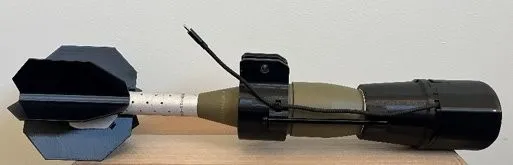
This Is The Army’s New MALET Kit That Turns Mortars Into Drone-Dropped Weapons
The Army on Wednesday unveiled its new system allowing front-line troops to rapidly convert 60mm and 81mm mortar rounds into drone-droppable munitions. Dubbed the Munitions Air-dropped Lethal Effects Tool (MALET), it is part of the service’s Picatinny Common Lethality Integration Kit (CLIK), which enables lethal payloads to be placed on unmanned systems, including small drones.
The development of these systems is taking place as the Army races to catch up to a mode of delivering munitions on enemy targets that began to show up a decade ago, when ISIS fighters started using this capability during the Battle of Mosul in Iraq in 2016 and 2017.
Work on the MALET system began in 2024, the Army explained in its announcement Wednesday morning. Experts at the Armaments Center’s Fuze and Mortar Divisions “recognized a critical opportunity,” according to the service. “Rather than introducing new munitions to the battlefield, soldiers could benefit from a capability to safely drop existing munitions without having to perform field modifications or manually remove safety mechanisms.”
What they came up with was a clip-on kit that adds a fuze function to the round that allows it to be detonated after being dropped and includes fins to ensure “the aerodynamic stability required for a drone drop of the cartridge,” the Army stated.

Once the rounds are converted, the goal is to drastically extend the range of mortars. Fired from a tube, they have a range of about between two to 3.5 miles. While the Army did not specify which drones were used in recent MALET tests, a solicitation earlier this year said the service is seeking to place these systems on drones with a desired operational range of between 20 and 40 km (about 12.5 to 25 miles).
The MALET system doesn’t damage the mortar, nor does removing it. That way, if the mortar is not expended, or mission requirements shift, soldiers can return the munition back to its original state, allowing it to be fired as a conventional mortar if needed.
Another advantage of the MALET system, according to the Army, is that it has a large supply of mortars.
“Instead of having to procure purpose-built munitions on drones, soldiers will be able to use rounds which they have in abundance already, such as 60mm and 81mm mortar rounds,” the Army noted.

Recent test drops at multiple facilities “have already shown the MALET’s effectiveness, successfully maturing both the system’s fuze function and its critical safety elements,” the Army claimed. “The team just recently had a successful test where they demonstrated the performance of MALET with live 60mm mortars. The items were dropped from a UAS on the move; they oriented correctly and detonated within the desired target area.”
The Army only provided still images showing the round after it was released and then hitting a target, so we can’t independently confirm how well the system worked or how easy it is for soldiers to use it.

As it conducts these tests, the Army says the MALET architecture can be applied to munitions other than these two mortar types. Mortars were the first to be demonstrated due to their maturity and alignment with large UAS requirements.
“The MALET Integrated Product Team (IPT) is exploring even more concepts” which are “mostly close-hold for now,” said the Army. Senior Scientific Technical Manager for Indirect Fire Munitions Ryan Gorman would say only that these new concepts are “unique.”
“The MALET program is a great example of how the DEVCOM Armaments Center can leverage core competencies like fuze design, safety, and ammunition development and apply them to a dynamic, emerging space like lethal UAS to provide a unique and viable option for the warfighter,” Gorman added.
For the Army, the next step is to distribute the kit to major military exercises this fall “to allow for soldier touchpoints and receive feedback,” the service stated. “Conversations with industry partners, the User and Acquisition communities have already proven fruitful.”
As we noted at the top of this story, MALET is part of the Picatinny CLIK modular system. It includes the Armament UAS Delivered Immediate Battlefield Effects (AUDIBLE) Weapons Release System and the Gunslinger fire control software.

AUDIBLE enables “quick change adapters to safely drop existing munitions, like the M67 grenade, providing a proven concept that is scalable to service a larger array of munition options,” the Army said in a 2025 release.
Gunslinger was originally designed by the Armaments Center for the Future Vertical Lift – Future Attack Reconnaissance Aircraft XM915 20mm Cannon, the Army explained in a separate release.
Fire control software helps users point the weapon where it will most likely result in a strike while taking into account variables like target or weapons platform motion.
While the Army is touting the MALET system, it should be noted that last year, the service came under fire for lauding its ability to drop a grenade from a drone. This practice had been in widespread use by even the lowliest of actors for years by then.
“Have you ever seen a drone drop a GRENADE?” a now-deleted post from the official U.S. Army account on X read. “Watch Soldiers from @7thATC [7th Army Training Command], the Joint Multinational Training Group-Ukraine [JMTG-U] and @173rdAbnBde [the 173rd Airborne Brigade] execute the Army’s first live-grenade drop from an unmanned aircraft system in Grafenwoehr Training Area, Germany.”
The accompanying video, also since deleted, showed Army personnel loading standard M67 fragmentation hand grenades, as well as inert M69 practice types, onto small quadcopter-type drones fitted with purpose-built mechanisms for dropping them. The system was designed to pull out the safety pin on the unmodified grenade as it is released.
The following image is a screen capture of the now deleted video.

As we pointed out last year, the answer to the “have you ever seen a drone drop a GRENADE?” is a resounding ‘yes’ for anyone who has watched this area of development over the past decade. We had predicted exactly this kind of application for commercially available drones even years before ISIS began using them in Iraq in 2016.
There was a deep disconnect between the tone of the social media post, what is seen in the video and the comments therein, as well as the global reality when it comes to small armed drones.
The Army suggested this was a technological advancement. However, as we noted earlier in this piece, this mode of attack has been used for quite some time.
After the initial use by ISIS in Iraq a decade ago, ISIS and other militant organizations also used drones to drop small munitions, including on American forces in Syria. The threat of weaponized commercial drones, including types carrying improvised explosive payloads designed to just smash into their target and detonate, migrated to Afghanistan, as well. They have been a big part of the Ukraine war, used widely by both sides.
You can see a video of Ukrainian forces dropping munitions from drones early in the war below.
In addition, various nation-state armed forces and non-state actors around the world, including drug cartels in Mexico, now regularly employ small armed drones.

Difunden video de bombardeo desde drones en Tepalcatepec
The concept of adapting surplus munitions to be dropped from drones is not new by any means either, though it has been largely done in more of an improvised manner than the MALET system.
Ukrainians in particular became masters of this, including breaking down some of the U.S.-made cluster munition artillery shells they received to repurpose the submunition bomblets inside as improvised weapons to be air-dropped from small drones. Now there are munitions built just for this, as well.
The following video shows one example of how that worked.
Given that the Army is still testing the MALET system, it will be some time before it is actually fielded. While the service remains behind the curve, if MALET works as advertised, it will be a welcome addition for soldiers who want to extend the reach of a plentiful munition.
Contact the author: howard@twz.com