Drone Attacks On U.S. From The Sea Are A Known Possibility
The disclosure of an FBI alert warning about the possibility of an Iranian drone attack on targets in California in retaliation for U.S. and Israeli strikes on its territory got a lot of attention earlier this week. The notice described a scenario involving drones launched from a ship off the coast. It has since been confirmed that the alert was based on raw, unverified intelligence, and was sent out of an abundance of caution rather than any fears of an imminent threat. However, this episode has served to highlight what is still a highly plausible mode of attack that TWZ has been drawing direct attention to for years now. The U.S. authorities themselves now regularly highlight growing threats posed by drones, in general, despite continuing to play catch-up in establishing domestic defenses against them.
ABC News first reported on the alert on March 11. The FBI had sent out the notice to members of a Joint Terrorism Task Force last month, ahead of the current conflict in the Middle East. The United States and Israel began launching strikes on Iran on February 28.
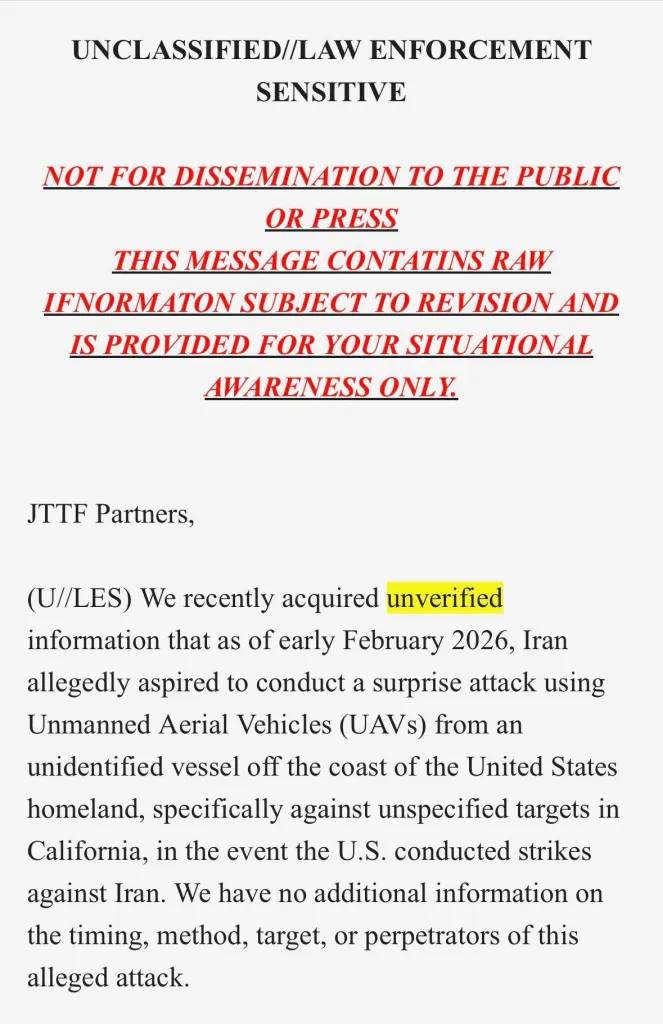
The main body of the alert, which the FBI has now released, reads:
“We recently acquired unverified information that as of early February 2026, Iran allegedly aspired to conduct a surprise attack using Unmanned Aerial Vehicles (UAVs) from an unidentified vessel off the coast of the United States homeland, specifically against unspecified targets in California, in the event the U.S. conducted strikes against Iran. We have no additional information on the timing, method, target, or perpetrators of this alleged attack.”

The alert is marked as unclassified, but also as “law enforcement sensitive.” It declares up front that “NOT FOR DISSEMINATION TO THE PUBLIC OR PRESS” and that “THIS MESSAGE CONTATINS [sic] RAW INFORMATON [sic] SUBJECT TO REVISION AND IS PROVIDED FOR YOUR SITUATIONAL AWARENESS ONLY.”
Subsequent reporting from the Los Angeles Times, citing anonymous California law enforcement sources, said that the alert was based on intelligence the U.S. Coast Guard had received.
Additional context
Overall, much still remains unknown about the underlying intelligence behind the FBI’s drone attack alert. For unclear reasons, ABC‘s original report, which has since been updated, also did not note that the warning was the product of unverified intelligence or that it had been sent out as a precautionary measure.
For its part, the FBI had initially declined to comment in response to queries for more information from multiple outlets, including ABC and TWZ. We also reached out to U.S. Northern Command (NORTHCOM), the principal U.S. military command for defense of the homeland, which directed us to contact the FBI. We contacted the Department of Homeland Security (DHS) and the White House, as well.
“No such threat from Iran to our homeland exists, and it never did,” White House Press Secretary Karoline Leavitt wrote in a post on X on Wednesday, which also called for a full retraction of ABC‘s piece.
“I am in constant coordination with security and intelligence officials, including at @Cal_OES [California Governor’s Office of Emergency Services], to monitor potential threats to California – including those tied to the conflict in the Middle East,” California Gov. Gavin Newsom wrote in his own post on X on March 11. “While we are not aware of any imminent threats at this time, we remain prepared for any emergency in our state.”
“It’s all-around intelligence collecting, and it’s all about a posture of preparedness for the worst-case scenario,” Gov. Newsom said in response to ABC’s initial reporting, as well, according to The Sacramento Bee. “We have been gaming those out for some time as it relates to, again, what the FBI has been warning of. Again, it’s not a surprise, and it’s sort of a large part of the larger spectrum of considerations that we have as it relates to doing what we can to support our federal partners and local partners at the state level, in terms of what could happen next.”
“Law enforcement sources experienced in intelligence said such alerts are cautionary in nature,” the Los Angeles Times had also reported. “The source is experienced in counter-terrorism and said ‘that it’s not been deemed credible at this time.’ The sources stressed the warning was cautionary and there was no indication Iran was planning an attack or that it could successfully launch one.”
“This is not actionable,” a “California-based federal law enforcement official” separately told CBS News.
“All this means is we got this information and we want to get it out to law enforcement executives to make sure they’re up to speed on it,” a second law enforcement official from California also said, per that outlet. “There is absolutely nothing more to it.”
Generally speaking, there are long-standing concerns that Iran and/or other actors operating on its behalf could seek to launch asymmetric attacks on targets in the United States, as well as elsewhere outside of the Middle East, in retaliation for large-scale strikes. The risks of Iranians deciding to take such action have historically been seen as especially high in any scenario where they might be an existential threat to the regime in Tehran.
Earlier this week, ABC News also reported that U.S. federal authorities had issued another alert to law enforcement agencies after they “intercepted encrypted communications believed to have originated in Iran that may serve as ‘an operational trigger’ for ‘sleeper assets’ outside the country.”
“Although a large-scale physical attack is unlikely, Iran and its proxies probably pose a persistent threat of targeted attacks in the Homeland, and will almost certainly escalate retaliatory actions — or calls to action – if reports of the Ayatollah’s death are confirmed,” the DHS’s Office of Intelligence and Analysis also warned in a threat assessment published on February 28 also said, according to a story last week from Reuters.
On Wednesday, U.S. President Donald Trump had said “no, I’m not,” when asked about whether he was worried that Iran might attempt to attack targets in the United States in response to ongoing U.S.-Israeli operations, per Reuters.
“It’s being investigated, but you have a lot of things happening, and all we can do is take them as they come,” Trump also said later in the day.
“I have been,” the President added at the time when asked if he had been briefed about Iranian “sleeper cells” in the United States. “We know where most of them are. We’ve got our eye on all them, I think.”
Trump had previously downplayed concerns about attacks on the U.S. homeland in retaliation for the ongoing conflict against Iran in an interview with Time, which was published last week.
“I think they’re worried about that all the time. We think about it all the time. We plan for it,” he said. “But yeah, you know, we expect some things. Like I said, some people will die. When you go to war, some people will die.”
A real threat vector
Regardless, the prospect of a drone attack, launched by the Iranians or other actors, on targets in coastal areas of the United States is very plausible. The threat here is not new, and is something TWZ has been sounding this alarm for years now, especially when it comes to the clear dangers this reality poses to the U.S. homeland.
Long-range one-way attack drones with endurance measured in many hundreds of miles, if not more than a thousand miles, are increasingly a staple in military arsenals globally, and have also been proliferating to larger non-state actors.

Firms in Israel have been and continue to be pioneers in this space. However, Iran and its regional proxies have also emerged as leaders in this domain. Iranian designs have also now become a fixture in Russian attacks on Ukraine and have been cloned in the United States. U.S. Low-Cost Uncrewed Combat Attack System (LUCAS) kamikaze drones, reverse-engineered from the Iranian Shahed-136, have been launched at Iran in the current conflict.
The Shahed-136 has become a particularly dominant example of this broad category of weapons, due in large part to Russia’s heavy use of variants and derivatives of the design in the ongoing war in Ukraine. However, it represents just one class of one-way attack drone, and there are many other types being produced globally with different capabilities.

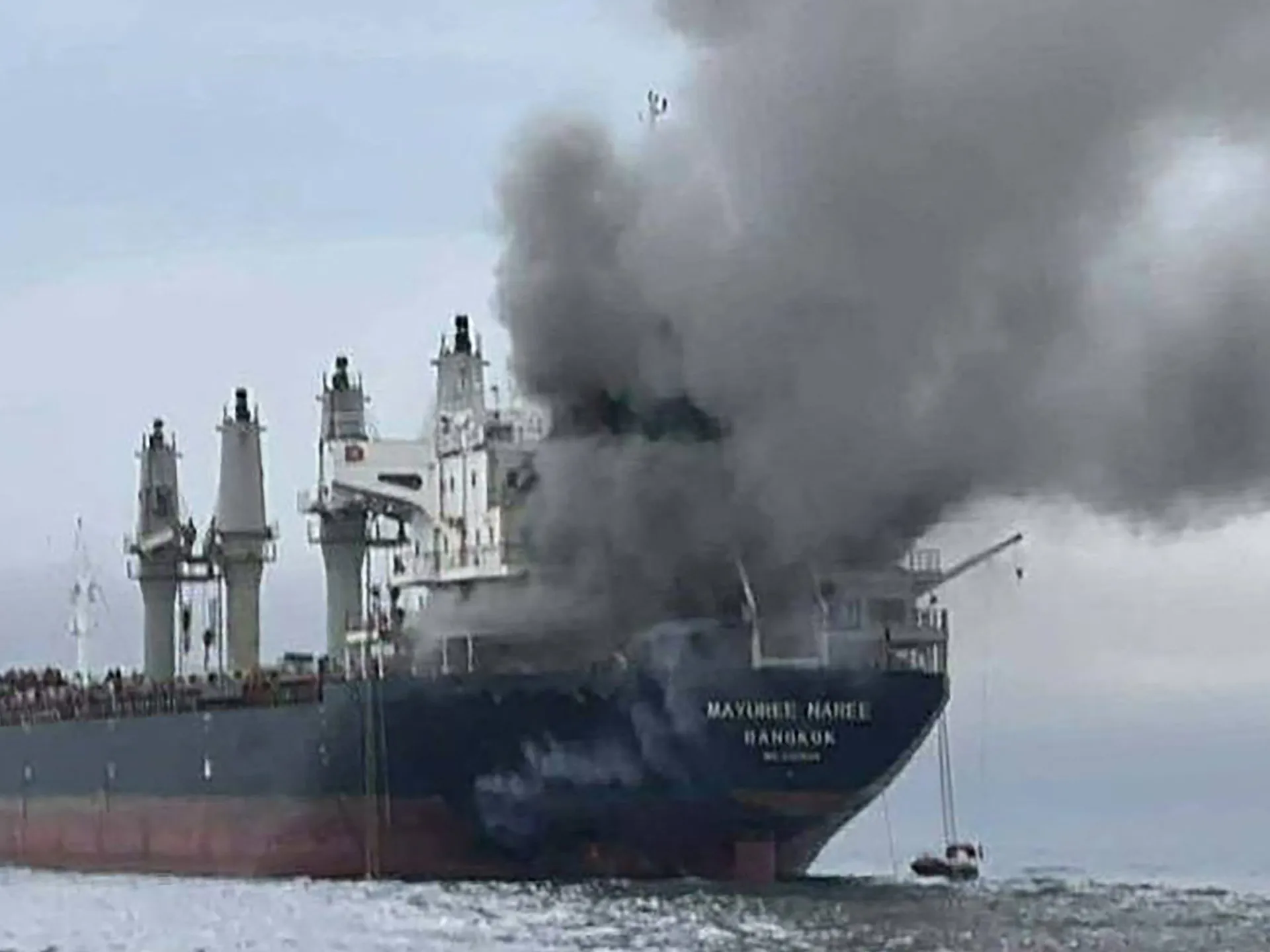
In addition to being relatively low-cost, many of these kamikaze drones are very flexible in terms of where and how they can be launched. Iran and the U.S. military have notably demonstrated how Shahed-136-type and other kamikaze drone designs can be readily fired from ships, even smaller ones, and do not require significant deck space to be employed in this way. This also makes it easier to conceal the drones and their launchers before use. A warship with a purpose-built launch system is definitely not required. Even smaller commercial vessels could fire off multiple long-range one-way attack drones.

Iran Navy unveils its first drone division in the Indian Ocean
Once launched, the drones fly relatively low and slow, under the long-range radar horizon, creating complications for defenders. They are also relatively small and can be difficult to spot on radar, as well as by their infrared and acoustic signatures, making them even harder to spot and track. These complexities would be further amplified by a surprise attack launched from anywhere in the massive swaths of ocean ranging out many hundreds of miles from America’s shores.
For years, the U.S. military itself has been highlighting the danger of standoff cruise missile attacks on the homeland launched from ships offshore, potentially including cargo ships and other unassuming civilian vessels. Russia, China, Iran, and the United States have all developed launchers that can fit inside standard shipping containers. Cruise missiles proliferating to non-state actors has also been a major factor dating back two decades.
Cruise missile threats to the homeland from rogue states and actors were a major factor in the U.S. Air Force deciding to install new active electronically-scanned array radars on F-15C Eagles primarily belonging to the Air National Guard. Up until recently, Guard F-15C units were tasked with guarding America’s ocean borders. Today, F-35As share that responsibility. Over a decade later, F-16 Viper fighters charged with the homeland defense mission also began getting AESAs, in part due to the need to better defend against drones and cruise missiles. The F-16 radar upgrade effort has since expanded to hundreds of other jets. This was also the key driver behind the abortive Joint Land Attack Cruise Missile Defense Elevated Netted Sensor System (JLENS) radar blimp program.

So, yes, for many years the military has been very concerned with surprise standoff attacks coming from far off its shores from non-traditional platforms, enough for that threat to drive critical procurement initiatives. And all this was before the long-range one-way attack munition became a primary threat.
“Our potential adversaries have created significant capacity to reach us asymmetrically. Our forward layers, our allies, our partners, our forward combatant commands and geographic commands, have largely kept those threats away from the United States,” U.S. Air Force Col. Kristopher Struve, then Vice Director of Operations for the North American Aerospace Defense Command (NORAD), said during a virtual roundtable the Missile Defense Advocacy Association (MDAA) hosted back in 2021. “As we look into threats from cyber actors, space threats, as well as kinetic conventional cruise missiles, which have [seen] significant improvement on the part of China and Russia in recent years, those create avenues that can create havoc in the homeland while we are trying to project our power forward to potentially a regional conflict.”
Struve also said at that time that the U.S. homeland was “not a sanctuary any longer” and called for expanded defenses, including new surface-to-air missile batteries, to protect domestic critical infrastructure.

TWZ has noted in the past that the line between traditional cruise missiles and long-range kamikaze drones, as well as decoys, is increasingly blurry. Long-range one-way attack drones are definitely more accessible, and often have greater reach, than most traditional cruise missiles.
“We’re behind. I’ll just be candid. I think we know we’re behind,” Lt. Gen. Charles Costanza, commander of the U.S. Army’s V Corps, said at a panel discussion at the Association of the U.S. Army’s (AUSA) main annual symposium last year. “We’ve been talking about counter-UAS [uncrewed aerial systems] and UAS capability for a better part of a decade, since, really, we watched the war in Armenia and Azerbaijan [in 2020] go on, and saw very much the beginning of the drone UAS capabilities.”
“We aren’t moving fast enough,” Costanza continued. “And it really took Russia’s invasion of Ukraine [in 2022], and the way they’re innovating, and Ukrainians are innovating, to realize, hey, we need to move fast.”
Vessels sitting off the coast could also be vectors for near-field drone attacks using shorter-ranged types. The barrier to entry is already especially low when it comes to employing weaponized commercial designs, even by non-state actors and lone wolf terrorists, and it only continues to drop. It has been well established at this point that smaller armed uncrewed aerial systems, whether they are purpose-built or improvised in nature, also inherently lend themselves to covert and clandestine employment. Ukraine’s Operation Spiderweb’s unprecedented attacks on multiple airbases across Russia last year, as well as Israel’s near-field drone and missile attacks to destroy Iranian air defenses in the opening phases of the 12 Day War last June, are prime examples.
TWZ just highlighted the overall drone threat ecosystem and the dangers it presents this past weekend in the context of Iranian attacks on prized missile defense radars in the Middle East. As we wrote:
“Now, long-range one-way-attack drones, as well as increasingly capable cruise and ballistic missiles, continue to proliferate steadily, including to smaller nation-state armed forces and even non-state actors. An attack could even come from a small drone with a C4 charge launched from a fishing trawler 10 miles away from one of these critical radar installations. The threat of these kinds of near-field attacks has largely been overlooked for years, even as the low-end drone threat has exploded and ‘democratized’ precision-guided weaponry, as they did not fit the established aerial threat matrix and the countermeasures used to repel those threats.“
The potential for shorter-range drone attacks to come from vessels offshore, specifically, is also not simply an academic assessment of the available technology and its accessibility. U.S. authorities at least explored the possibility that a Hong Kong-flagged bulk carrier, the M/V Bass Strait, might have been tied to still mysterious drone swarms that harassed U.S. Navy ships off the coast of southern California back in 2019, which TWZ was first to report. Whether the Bass Strait or another nearby ship was the source of the harassment, or when it came from somewhere else, potentially further away, remains unknown, at least publicly.

More recently, authorities in Europe have raised the possibility that Russia has been launching drones for harassment purposes from a ‘shadow fleet’ of oil tankers it otherwise uses to skirt international sanctions.
It’s also worth noting that Representative Jeff Van Drew, a New Jersey Republican, alleged that there was an “Iranian mothership off the coast of the United States launching … drone incursions” at the height of a rash of reported sightings of uncrewed aerial systems over various parts of the United States in late 2024. The U.S. military categorically denied this assertion at the time, and Van Drew subsequently retracted his claims. That wave of drone sightings blurred the line between hysteria and real national security concerns.
The FBI’s alert about the possibility of an Iranian drone attack also comes at a time when the U.S. government continues to lag behind in establishing counter-drone defenses domestically, despite how long the threat has been apparent. Significant progress has been made under the Trump administration in addressing this threat, including the fielding of new counter-drone capabilities and the reworking of legal and other frameworks to enable their use in a more effective manner. At the same time, much work is still clearly to be done, as was evidenced by a sudden airspace closure over El Paso, Texas, last month and the chaos that ensued. That incident was prompted by the use of a counter-drone system featuring a laser-directed energy weapon, as you can read more about here.
From what is known now, the FBI’s warning about a potential Iranian drone attack on California does not appear to have reflected an imminent cause for concern, and it remains unclear exactly what triggered it. Still, even if this specific threat has not turned out to be credible, the danger of such an attack is certainly well within the realm of possibility.
Contact the author: joe@twz.com