Gaza’s health toll mounts, with 1,439 dead and 5,052 injured since the ceasefire began in October 2025.
Published On 1 Oct 20261 Oct 2026
An Israeli drone strike has killed a Palestinian man and wounded several others in southern Gaza while settlers shot dead another Palestinian man near Ramallah in the occupied West Bank.
The body of Tamer al-Hamayda, 42, and three wounded people were brought to Nasser Medical Complex on Thursday after the strike hit a tent sheltering displaced Palestinians in the al-Mawasi area, west of Khan Younis on the southern coast of the Gaza Strip.
Recommended Stories
list of 3 itemsend of list
Another Palestinian succumbed to wounds sustained in an earlier Israeli drone strike on Tuesday that targeted a gathering of Palestinians in Jabalia refugee camp in northern Gaza, according to medical personnel in Nasser Medical Complex.
Israeli forces also carried out a large-scale demolition operation targeting buildings east of Gaza City’s al-Tuffah neighbourhood.
The Gaza Health Ministry reported eight new deaths and 26 wounded over the past 24 hours, putting the toll since the “ceasefire” took effect in October 2025 at 1,439 killed and 5,052 wounded, with 834 bodies recovered from the rubble.
Israel’s war on Gaza has killed at least 74,040 Palestinians and wounded 175,168 since October 2023, the ministry said.
Occupied West Bank pogroms
In the occupied West Bank, Israeli settlers shot dead a Palestinian man and wounded another during a raid on the village of Yasuf, north of Ramallah, on Thursday.
51-year-old Mashhour Yassin was shot dead by settler gunfire, the Palestinian Health Ministry said.
Describing the attack, the Palestinian Ministry of Foreign Affairs said Israeli forces had detained an ambulance, seizing its key and throwing it aside, “in a crime that reflects clear coordination between the settlers and occupation forces.”
It said the killing “falls within the framework of a serious and continuous escalation in organised settler crimes,” saying Israel gives free rein to settler “terrorism against our people in the service of settlement, annexation, forced displacement and ethnic cleansing plans.”
Yasuf Mayor Jumaa Abdel Fattah told the AFP news agency that dozens of Israeli settlers armed with sticks and firearms had attacked the village, which lies between four Israeli settlements.
“Yassin was at his doorstep when the settlers attacked the village homes. He went out to defend his house,” Abdel Fattah said, adding that Yassin’s nephew was also wounded in the attack.
Abdel Fattah said the settlers had come from Havat Anton, an illegal Israeli settlement established in July that has previously attacked the village’s residents.
Palestinians in the occupied West Bank have reported a surge in settler pogrom attacks in recent months.
More than 500,000 Israelis live in West Bank settlements considered illegal under international law.
According to the UN, at least 1,112 Palestinians in the occupied West Bank have been killed by Israeli forces or settlers in the territory since October 2023, including at least 37 killed by settlers.
Ukraine has targeted an industrial plant in Russia’s Perm region with a massive drone swarm. Russian authorities say they also repelled strikes headed towards Moscow.
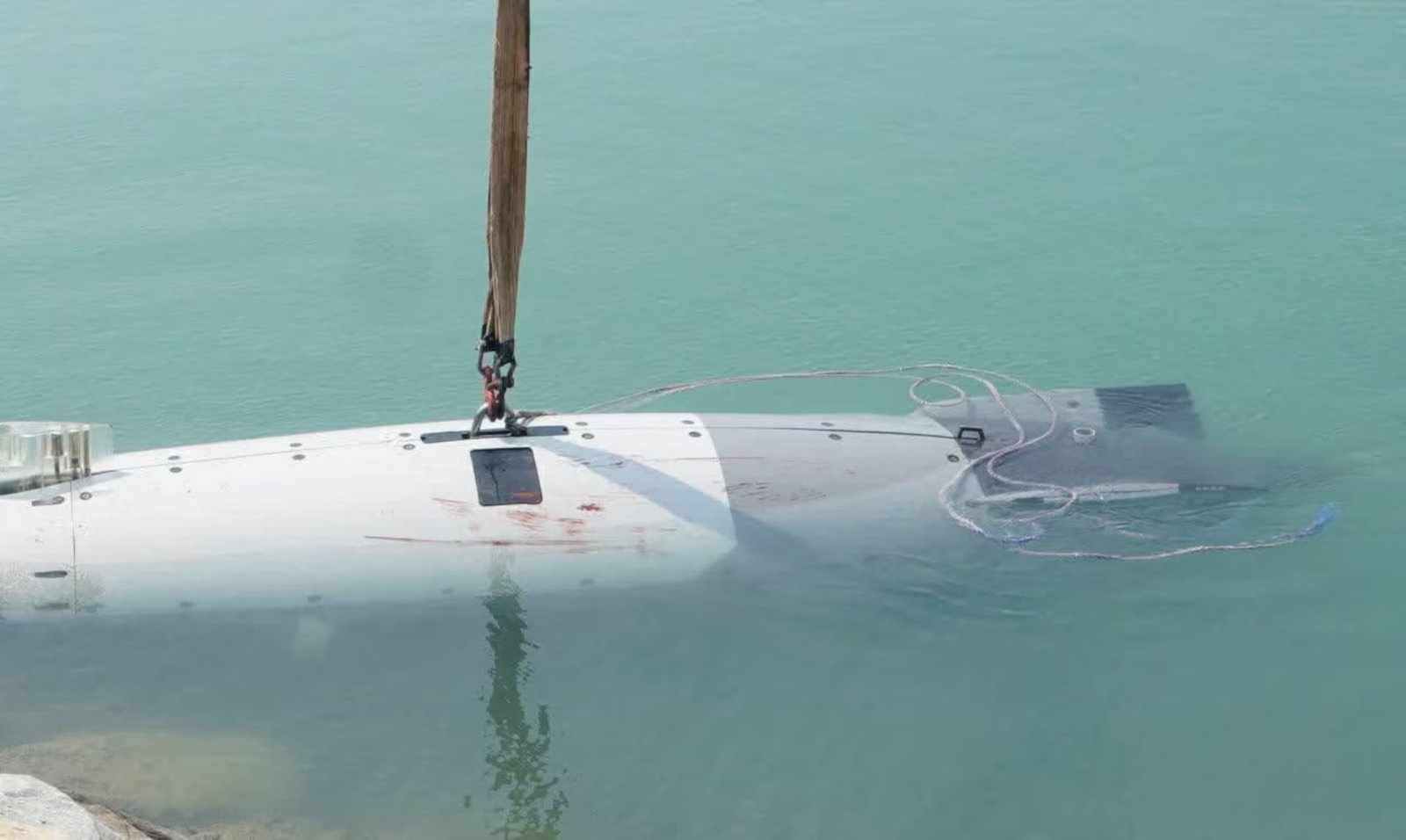
For the past six months or so, a curious-looking vessel with a very boxy superstructure has been taking shape at a shipyard in the Chinese city of Shanghai. A new satellite image lends credence to an earlier assessment that this is a mothership to support China’s growing fleets of ever-larger submersible drones, though it could also have other roles.
TWZ obtained the image of the ship in question, which was taken on September 10, from Vantor. Since then, it has also received an overall coat of gray paint, pointing to future service with the People’s Liberation Army Navy (PLAN). It is some 669 feet (204 meters) long and around 98 feet (30 meters) at its widest. In terms of basic length and width, the vessel being built now is very roughly comparable to China’s Type 071 amphibious warfare ship. However, it appears to be much taller overall than the Type 071.
The new ship has been under construction at the Hudong-Zhonghua Shipyard on Changxing Island in Shanghai since at least April. This yard produces a variety of naval vessels, including surface combatants and amphibious assault ships, as well as commercial designs.
The September 10 image, which shows the ship from the stern, is interesting for a number of reasons. It notably confirms that the design not only has a well deck, but that it is sized around what looks to be a large cradle-like platform visible in the shot. The very roughly 164-feet (50-meter) long rectangular platform has an arch-shaped structure at one end and two teardrop-shaped ones at the other, as well as six pillars, three on each side, in between. The teardrop-shaped structures, in particular, point to the platform being at least a semi-submersible, as they would help with stability and otherwise guide the flow of water while being pulled along.
The satellite image also clearly shows six large struts extending from the top of the stern end of the superstructure, each one which is paired with a shorter strut, for a total of 12. Earlier this month, independent naval analyst H.I. Sutton, who tracks undersea warfare developments in particular, posited that these struts could be used to lower a platform or some other similar structure below the hull of the ship. He also assessed that they could be used as part of a larger system capable of moving payloads between decks internally. This would help account for the configuration of the core superstructure, especially how high it is all the way from the front to the back. Overall, signs point to the inside of the superstructure being largely hangars and other open work spaces, allowing for multiple large UUVs to be carried and supported. Individual UUVs would be launched and recovered, one at a time, via the cradle.
In making his assessment, Sutton drew specific attention to a previously shown rendering of a proposed Chinese scientific research vessel with a roughly similar strut-based system at the stern for deploying submersibles and other large payloads. However, on that design, the system was entirely exposed rather than contained with an extended superstructure.
The rendering of the proposed scientific research vessel with a system for deploying payloads at the stern that features four struts. Chinese internet via H.I. Sutton
The platform seen immediately behind the ship being built at the Hudong-Zhonghua Shipyard aligns with Sutton’s assessment about the purpose of the struts. At the same time, launches and recoveries could also be conducted in a more traditional manner via the well deck. The design of the cradle-like platform would seem to suggest the latter option is at least part of the plan.
The image from September 10, as well as other recent views of the ship, highlight other features that are now taking shape. This includes a large opening on the starboard side, which could be for launching and/or recovering lifeboats or other watercraft, or moving payloads to and from the pier while docked, as well as a multi-pronged mast on top of the bridge. An additional part of the ship’s superstructure extends behind the bridge area, and there is what looks to be a hangar inside. There is no attached helipad present now, but one could well be added later on somewhere on top of the superstructure. Many naval auxiliaries, as well as commercial ships designed for offshore support and other specialized tasks, have open helipads on raised frames attached to different parts of the superstructures.
Though there is growing clarity about the ship’s design, many questions do remain about the full breadth of its intended purpose. In Sutton’s view, the PLAN has a need, just in general, for a dedicated mothership to support its growing uncrewed underwater vehicle (UUV) fleets. The PLAN is pursuing various tiers of UUVs to perform a host of different missions, including intelligence, surveillance, and reconnaissance (ISR), as well as mine-laying, special operations support, and even launching direct attacks on enemy vessels. Larger and larger UUV designs have been steadily emerging in China, which could require more specialized launch and recovery options to be feasibly employed operationally, especially from other vessels at sea. Deployment and retrieval at sea could, in turn, support very long duration missions far from China’s own shores.
“With smaller UUVs, even up to 20 meters like the AJX-002 and HSU-100 paraded in Beijing last year, they are road mobile. Truck mounted cranes should be sufficient for getting them in and out of the water making operations much simpler. With these latest, much larger XXLUUVs [extra-extra large uncrewed underwater vehicles] however, China will start to need dedicated port facilities,” Sutton wrote previously on his website. “Until now China has been using floating docks to house the two XXLUUV prototypes being tested on Hainan. One of these docks was purpose built while the other may have been taken up from general use.”
A Chinese AJX-002 UUV, or a mockup thereof, seen ahead of a major military parade in Beijing in 2025. Chinese internet via X
China’s naval unmanned systems.
Consisting of (in order), AI enabled unmanned submersible (HSU-100), used for detection and attack.
Unmanned patrol boat.
Unmanned mine-laying/attack submersible (AJX-002), this was previously mistaken for a nuclear powered torpedo. Because the… pic.twitter.com/Mlj55XLNBH
“This arrangement also has a significant drawback: each floating dock can only carry a single XXLUUV,” Sutton added. “Or if more than one, then they both need to be placed in the water at the same time. Because the whole dock floods, there cannot be one undergoing maintenance while another is being launched or recovered.”
A mothership vessel able to discreetly deploy and recover large uncrewed and crewed submersibles and other large payloads underwater could be tasked with more specialized missions, including cutting cables, retrieving objects from the seabed, and other kinds of undersea espionage. There is overlap here with more benign roles, such as submarine rescue, salvage, and even deep-sea scientific research. There is also the matter of servicing an expanding array of Chinese underwater infrastructure, including sensor and communications networks. As something of a corollary, Russia’s spy ship Yantar is officially described as an oceanic research vessel. In China, the line between military and non-military assets and capabilities, including ships, is often very blurry, to begin with, as TWZ regularly highlights. This dichotomy was observed right at the Hudong-Zhonghua Shipyard around the end of last year after pictures of a commercial cargo ship being used to showcase a new family of containerized weapons, sensors, and other systems went viral online.
It is also worth pointing out that the boxy and largely enclosed design of the ship now being built at Hudong-Zhonghua Shipyard will inherently make it difficult to observe any activities onboard. This will have the additional knock-on effect of helping keep any payloads, as well as the crew, shielded from the elements. This could be valuable for operations in harsher locales, including waters in and around the Arctic, an ever-more strategic part of the world where China is working to be more engaged.
We also do not know if the apparent mothership vessel is intended to be a one-off or part of a larger class. It could be a stepping stone to broader plans or be part of an already extensive fleet of bespoke naval auxiliaries, as well as unique ostensibly commercial vessels, in service in China today. The PLAN’s aforementioned UUV ambitions will bring along significant test and evaluation requirements, as well as the need to support actual future operations.
If nothing else, evidence is only growing that the new ship under construction at the Hudong-Zhonghua Shipyard is intended to serve, at least in part, as a mothership for large submersible drones.
Strikes carried out in southeastern province of Khost cause no casualties, governor’s office says.
Published On 24 Sep 202624 Sep 2026
Pakistan says it has carried out air strikes on 10 locations in Afghanistan used to store and launch drones, some of which were used in cross-border attacks.
The air strikes on Thursday were carried out as tensions grow between the former allies over attacks by armed groups in Pakistan, which triggered their worst fighting in years in February.
Recommended Stories
list of 3 itemsend of list
Islamabad accuses Kabul of harbouring fighters who stage cross-border attacks, but Afghanistan’s Taliban government denies harbouring anti-Pakistani armed groups and says the attacks are Pakistan’s internal problem.
The air strikes were “deliberate, precise, calibrated, and proportionate, and strictly limited to identified military objectives directly linked to the attempted attacks against Pakistan”, Pakistani Information Minister Attaullah Tarar wrote on X.
He condemned a “deliberate and unlawful incursion into Pakistan by drones” on Wednesday.
“This constitutes a blatant violation of Pakistan’s sovereignty and territorial integrity and is a grave and unacceptable act of aggression,” he said.
The Pakistani air strikes were conducted in several areas of Khost province in southeastern Afghanistan, Mustaghfir Gurbaz, spokesperson for the Khost governor, said.
There were no casualties, he said.
An attack on a police facility in northwestern Pakistan last week that killed at least 21 people has reignited fighting between the countries after nearly three months of relative calm. A Pakistan Taliban faction claimed responsibility for the blast and subsequent gun battle.
On Monday, air strikes targeting three locations in northeastern Afghanistan killed three civilians in the Nurgal district of Kunar province, Afghan officials said. Islamabad said it killed 28 “terrorists”.
The escalation threatens mediation efforts by China, Turkiye, Qatar and Saudi Arabia to broker a lasting peace between the two neighbours.
Relations between the former allies have been strained since the fighting in February, the worst for years.
WASHINGTON — President Trump’s AI-fueled vision for a drone port he intends to install atop the new White House ballroom includes missile-bearing unmanned aerial vehicles and gun-toting troops, ostensibly to protect the 18-acre complex and the nation’s capital.
A few hundred feet away, a drone port, run by the U.S. Secret Service and not the military, is already quietly operational. Equipped with cameras and sensors to scope out potential threats from a bird’s-eye view, the small UAVs stand on alert in four gray weatherproof boxes until deployed at officers’ commands.
The agency is using a model known as “drone as first responder,” deploying speedy unarmed drones from outdoor stations to serve as flying cameras. That model has been adopted by hundreds of police agencies across the U.S., often powered by AI software to help dodge obstacles or track targets.
The existence of the surveillance drones on a Treasury Department building adjacent to the White House complex has not been previously reported, and could undercut Trump’s legal claims that the ballroom construction is necessary “to protect the White House and surrounding region from aerial attacks.” The need for the drone port underpinned Trump’s national security defense for the construction project — a justification he is now citing for the construction of a massive arch outside the gates of Arlington National Cemetery.
The installation is thus far markedly less imposing than the vision outlined by Trump, with its rows of futuristic attack drones, apparently modeled after those used in U.S. military strikes, that drone experts describe as outlandish.
“To be honest, if a drone was so close to the White House that it needed interdiction, it’s already gotten too far,” said Matt Sloane, co-founder of SkyfireAI, which makes software for drones used by public safety agencies.
It would be more realistic for the White House to build something akin to what the Secret Service is using next door, Sloane said: “The drone takes off and does some type of perimeter sweep or whatever, and then puts itself back in the box.”
The White House did not comment for the story. The Secret Service declined to comment on the specifics of its drone operations but said the new docks are separate from Trump’s ballroom drone port.
The details of Trump’s ballroom drone port remain murky
Security of the president and the White House complex is generally the domain of the Secret Service, which works in close concert with the White House Military Office and other military elements when needed.
Trump has said the drone port came at the request of U.S. military officials. Speaking to reporters in May, he said the building’s plans were expanded to meet the request: “They wanted more drone capacity,” he said. On social media, he boasted that the drone port might end up being the “most sophisticated” in the world.
What Trump is ultimately aiming to build, and how far it goes beyond what has already been installed, remains unclear. Beyond Trump’s AI images, some of which he filed in his appeal to the U.S. Supreme Court to lift lower courts’ blocks on the construction, the White House has not disclosed what kinds of drones will be used or for what tactical purpose.
The Secret Service is using smaller surveillance drones that are a fraction of the size of the attack drones depicted in Trump’s AI images. The U.S. Air Force bought similar drones from Skydio in April to protect bases across the Middle East. The company also supplied drones to help protect World Cup matches this year.
The Secret Service has been building out its drone- and counter-drone programs for years. But work has accelerated since the 2024 attempted assassination of Trump at a campaign rally in Butler, Pa., when the agency failed both to take action against a drone used by the shooter to scout out the attack and to fly one of its own to provide overwatch of the event.
In the weeks that followed, tethered and untethered surveillance drones became commonplace at campaign rallies and large events at the White House complex.
In an online video released by the agency highlighting their deployment, the Secret Service said the Skydio drones are used to provide “real-time situational awareness” and “aerial overwatch.”
“It allows you to see the threat before it becomes an issue, and to task assets accordingly,” Dustin Talbott, of the Secret Service’s Aviation and Airspace Security Division, said in the video. “We no longer wait for the threat to reveal itself. We find it first.”
Skydio did not provide comment for this story.
Trump’s drone port vision would face logistical hurdles
Trump has made it a priority to build a stronger drone presence around the White House, responding to an increase in political violence and the evolution of drone warfare.
Paul Eckloff, a former supervisor of the Secret Service’s presidential protection division, said the Russia-Ukraine war has highlighted the risks posed by drones, even off-the-shelf models that can cause massive damage. Drones now represent one of the largest emerging threats the White House must defend against, he said.
During Trump’s first term, conversations about drones often centered on their use in places like Iraq and Syria, said Javed Ali, who served on the National Security Council during at that time and now teaches national security at the University of Michigan. Since then, it has become a matter of domestic security, he said.
Yet there would be major logistical hurdles involved in putting a busy drone port on top of the White House, he said. “There’s a whole host of questions, like who is responsible for overseeing it, and how would there be any de-confliction with commercial airspace?” he said.
Complexities around federal oversight were laid bare this year when the U.S. military used a laser to shoot down a drone near El Paso, Texas, only to find it belonged to Customs and Border Protection. The mishap briefly led the FAA to close nearby airspace.
A drone hub at the White House would navigate crowded and complex airspace around Washington, not far from Reagan Washington National Airport and flight paths shared by other military aircraft.
Opponents say the White House is becoming a fortress
Trump started talking about the drone port in May, weeks after a federal judge halted ballroom construction but allowed work on security components to continue. Trump later went on to refer to the ballroom as a “military complex,” leaning on that security role as a legal justification.
The Supreme Court in August cleared Trump to continue construction as the legal challenge moves ahead.
Opponents say the president is going too far in his hardening of the White House, turning it into something closer to a fortress. Edward Lengel, a former chief historian for the White House Historical Assn., said Trump has militarized the White House at a scale that’s at odds with its legacy as “the people’s house.”
“It turns it into a big giant porcupine that has its spines pointing out against the people and against the world,” Lengel said.
Trump has argued that the White House was in “very bad condition” when he returned to office, saying it had become vulnerable to modern threats.
At times, he has expressed concerns about his own safety and the risks posed by drones and other air threats. Speaking at a Rose Garden dinner for law enforcement officials in May, Trump quickly glanced up from the lectern as a low bird flew overhead.
“I thought that was a drone,” Trump said, bringing laughs from the crowd. “They make them in all different sizes nowadays — they can be very destructive, as you’ve probably heard.”
Islamabad, Pakistan – On September 16, a delegation from Powerus, a year-old United States drone company backed by two sons of President Donald Trump, was received by Pakistan’s military chief, Field Marshal Asim Munir, at military headquarters in Rawalpindi.
A day later, the company announced it had received a “limited procurement order” from Pakistan’s Ministry of Defence for unmanned aerial systems. It also said it had signed a separate memorandum of understanding (MoU) with senior Pakistani defence officials.
Recommended Stories
list of 4 itemsend of list
Neither the value of the order nor the systems involved have been disclosed. But for analysts studying Pakistan’s venture in drone technology, even bigger concerns have arisen from information that has since emerged.
Less than three months earlier, the same company had given an Indian defence manufacturer the exclusive right to make and sell its drone interceptor technology in India. And one of the cofounders of Powerus is an Israeli military veteran. Pakistan does not recognise Israel and accuses it of carrying out a genocide in Gaza.
Analysts are questioning why a country that already builds its own drones and buys others from China and Turkiye would turn to a company that was founded only last year – and has links to Israel and sells drones to India too.
“Pakistan technically already makes or is capable of making each of the drones shown by Powerus,” Bilal Khan, founder of the Quwa Group, a Toronto-based defence news and market intelligence platform, told Al Jazeera. “It’s unclear where Powerus fits in the long term [from Pakistan’s perspective].”
What did Pakistan sign?
In its statement on the meeting, Inter-Services Public Relations (ISPR), the Pakistani military’s media wing, said the two sides discussed cooperation in defence procurement, production and capacity building.
The statement did not mention the MoU.
But Powerus told Al Jazeera which institutions were involved. “The MoU was signed with the Pakistan army. The related procurement order was placed by Pakistan’s Ministry of Defence,” a company spokesperson said.
In its own statement, Powerus said the memorandum was not a definitive agreement, created no purchase obligation and would be subject to US laws and government approvals.
“We are proud to support Pakistan’s Ministry of Defence, and the memorandum gives both sides a strategic framework to build upon,” Brett Velicovich, the company’s cofounder, said in the statement.
According to media reports, Velicovich has also said the company is exploring ways to build technology in Pakistan.
The ISPR, the Ministry of Foreign Affairs and the Ministry of Information and Broadcasting did not respond to Al Jazeera’s requests for comment.
Founded in 2025 and based in Florida, Powerus is set to merge with Aureus Greenway Holdings, a Nasdaq-listed company that owns golf courses in the US state, in a deal expected to close in the final quarter of this year.
Powerus’s Guardian Interceptor is a drone interceptor [Handout/Powerus]
Donald Trump Jr and Eric Trump, President Trump’s oldest sons, are investors in Powerus through a vehicle called American Ventures, which is expected to hold a 9.9 percent beneficial stake in the combined company, according to US regulatory filings.
A spokesperson for Donald Trump Jr has told media outlets that he is a passive investor with no role in the company’s operations or contracts and had no prior knowledge of the Pakistan deals.
The White House has said there are no conflicts of interest.
The company makes about 3,000 interceptor drones a month, according to media reports, and last month won a US Air Force contract with a ceiling of up to $90m.
Asked how it addresses conflict of interest questions while pursuing government defence work in the US and abroad, Powerus said the Trump brothers played no part in its operations.
“Trump’s sons are not advisers to Powerus and have no involvement in how the company runs its business or structures its defence relationships, domestically or internationally. They hold no corporate-governance role. Our government relationships are pursued on their own merits,” the company told Al Jazeera.
The India question
Powerus’s first deal in South Asia, however, was not in Pakistan.
It was in India, Pakistan’s archrival, with which Pakistan fought a brief but intense conflict in May last year, one in which drones were used by both sides.
In a June 30 filing to India’s stock exchanges, Paras Defence and Space Technologies said Powerus had granted it an exclusive licence to manufacture and sell its Guardian-1 interceptor technology in India.
Mansoor Ahmed, an honorary lecturer at the Australian National University’s Strategic and Defence Studies Centre, said Washington has long armed rival states.
“The US has previously sold F-16s to Greece and Turkiye and Egypt and Israel and is now selling F-35s to Saudi Arabia, which Israel already operates,” he told Al Jazeera.
A former Pakistani government defence analyst who spoke on condition of anonymity said Pakistani planners had probably known about the Indian deal.
“Pakistan’s defence planners were likely aware of Powerus’s engagement with India,” he told Al Jazeera.
This isn’t the first time that Pakistan and India have ended up buying military equipment from the same company, the defence analyst pointed out. He cited the build-up to the conflict over the Siachen Glacier, where India launched Operation Meghdoot in April 1984 to take control of the heights.
“In 1983, Pakistan ordered high-altitude warfare gear from a London supplier, unaware that the same firm also provided gear to the Indian army, and subsequently, India learnt of it and planned Operation Meghdoot in 1984,” he said.
The analyst said the burden now lies with the company.
“In the present case, the challenge is more for Powerus than Pakistan or India as Powerus’s management must ensure it can manage and meet the requirements of two adversaries without jeopardising either side’s operational security.”
A retired Pakistan air force air marshal who spoke on condition of anonymity because he was not authorised to speak publicly said the arrangement carries risks for Pakistan.
“Two adversary countries procuring from the same source has its pitfalls, especially when one of the adversaries has taken the lead as well as has a larger financial capacity,” he told Al Jazeera.
An Israeli link
The company’s leadership also has links to Israel, a country Pakistan does not recognise.
Powerus’s website described one of its cofounders, Ziv Marom, as a veteran of the Israeli military and said he founded Kaizen Aerospace, now a Powerus subsidiary.
Another senior executive, Justin Gans, the company’s vice president for mergers and acquisitions and a former member of the US Navy SEAL special forces, served as a vice president at Elbit Systems of America, the US arm of the Israeli defence company Elbit Systems, from 2018 to 2019.
A retired three-star army Pakistani general who served in senior roles before retiring in 2019 and requested anonymity because of the sensitivity of the subject said such a background would normally draw attention during vetting.
“So under normal circumstances, a cofounder’s service in the Israeli military would be flagged as a sensitivity marker, even if the company itself is American,” he told Al Jazeera.
“In other words, for a serious acquisition, this background would be scrutinised carefully. For a political MoU, it may not have been a decisive factor.”
Quwa’s Khan, however, said Pakistan has long accepted Israeli components inside US or European systems.
“We can see that, generally, as long as there’s a country in the middle, Pakistan does not have qualms being in close proximity to Israel,” he said. “However, the two sides very, very rarely talk to each other.”
What drone technology does Pakistan already have?
Beyond questions over who else Powerus works with, analysts said the more fundamental issue is what Pakistan actually needs from the company.
Pakistan’s air force has publicly displayed Turkish-made Bayraktar TB2 and Akinci drones, Chinese-made Wing Loong II drones and the domestically developed Shahpar-II.
Shahpar drones, made by the Pakistani state-owned defence company Global Industrial & Defence Solutions, are displayed at the 2024 International Defence Exhibition and Seminar in Karachi, Pakistan [File Akhtar Soomro/Reuters]
China supplied 80 percent of Pakistan’s arms imports from 2021 to 2025, according to the Stockholm International Peace Research Institute.
This month, the Pakistan air force revealed in a video that it had incorporated into its forces China’s HQ-17AE air defence missile system and Turkiye’s Korkut anti-aircraft gun and Sahin counterdrone system, all built to take on drones and other low-flying threats.
Khan said the state-owned Heavy Industries Taxila was also working with private firms to develop interceptor drones.
“So as it stands, Pakistan is following all the right best practices to build its C-UAS posture,” he said, referring to counterdrone systems.
“For Pakistan, the challenge isn’t whether it can get the designs but whether it can produce or induct these in large enough numbers fast enough.”
An official at a private drone manufacturer in Rawalpindi who requested anonymity because he is not authorised to speak to the media said Pakistan’s drone market has grown well beyond state-run firms.
Dozens of private companies and more than half a dozen state-owned enterprises now make drones besides the army’s own production facilities, he said. According to him, Powerus would have to compete with all of them on the quality of its products.
The retired general offered a different reading of why Pakistan might be interested in a tie-up with a US firm.
“The gap is not drone manufacturing. It is electronics, integration and systems-level capability, which is where American firms traditionally dominate,” he said. “How far this particular company can help in this regard is a million-dollar question.”
Powerus’s Guardian interceptors are small, low-cost drones designed to knock down incoming drones. They are a weapon widely used by both sides in the war in Ukraine.
Hammad Waleed, a research associate at the Islamabad-based Strategic Vision Institute, said such systems fill a cost gap that conventional air defences cannot.
“Traditional air defences use costly missiles against incoming cheaper drones,” he told Al Jazeera. “Interceptor drones are way cheaper and easier to operate than traditional air defences.”
Capability or signalling?
The retired Pakistani general, who has experience with defence production, said a supplier of this kind would normally face financial, technical and security checks as well as a review of its track record.
“A company less than a year old, not yet listed and without a delivery record would not usually clear these checks for a strategic defence partnership,” he said.
“Such firms are typically considered too immature unless the MoU is political signalling rather than a procurement decision.”
Khan agreed that the process has been unusual.
“Yes, the way this deal came about is not generally in line with how the procurement heads of the tri-services typically operate,” he said, referring to the three branches of Pakistan’s military.
The Powerus agreements were made as Munir has built close ties with President Trump, who has called him “my favourite field marshal” and praised him on several occasions during the past 15 months.
In September last year, weeks after Pakistan signed a $500m critical minerals agreement with a US company, Munir and Prime Minister Shehbaz Sharif met President Trump at the White House, where the Pakistani leaders presented him with samples of Pakistani minerals.
In January, Pakistan also signed an MoU with an affiliate of World Liberty Financial, the Trump family’s main cryptocurrency business.
From left, US President Donald Trump examines a box of rare earth minerals and gemstones presented by Pakistani Prime Minister Shehbaz Sharif and Field Marshal Asim Munir in September last year at the White House [File: Handout/White House]
Khan said Pakistan’s security establishment needs to ask what it is getting in return for that closeness.
“There was a time when such gains were measured in F-16s and the billions in US financial assistance, yet today, we are seeing more photo ops and supposed pacts that obligate the armed forces, but are they helping the armed forces as a fighting force?”
He also offered what he called a “less cynical take”.
Pakistan has a growing number of drone start-ups that lack the capital to build production facilities, he said, and ties with Powerus could draw US investment into them.
“So there is an argument that building rapport with Powerus and its backers can lead to that capital,” Khan said.
Ahmed said Pakistan is looking beyond a single purchase.
“Pakistan’s primary interest appears to be the acquisition of state-of-the-art drone technologies that also allow for local production and indigenisation,” he said.
What about China and Turkiye?
The retired Pakistani general said bringing in a foreign private company could overlap with Pakistan’s existing Chinese and Turkish partnerships.
“It has the potential of being seen by Turkiye and China as Pakistan hedging politically,” he said.
Khan, however, disagreed.
“There’d be no issue with the Turks as they work with US companies all the time and the drones on offer by Powerus don’t overlap with the ones NASTP is designing with Turkiye,” he said, referring to Pakistan’s National Aerospace Science and Technology Park.
He added that any Powerus designs built cheaply in Pakistan would still rely on Chinese parts.
“With the Chinese, it’d be less of an issue because, ultimately, the only way to make these Powerus designs at a low enough cost for the Pakistani armed forces to induct is to literally import the upstream subassemblies from China.”
Drones are displayed during the International Defence Exhibition and Seminar in Karachi on November 21, 2024 [Akhtar Soomro/Reuters]
Waleed said the deal would not dent Pakistan’s defence ties with Beijing and Ankara.
“Pakistan is prioritising China and Turkiye for the sophisticated and modern combat systems in the drone and counterdrone domain. That relationship is not only unaffected and is going upwards in trajectory,” he said.
For now, Khan said, the real test of the Powerus deal would be what follows it.
“I would not pass judgement on the Powerus deal yet, but we can track whether it’s serious by seeing if the MoD [Ministry of Defence] signs similar deals with other foreign and local vendors in the coming months,” he said.
“Basically, will we see a consistent pattern moving forward, or will this be a one-off?”
Overnight missile and drone attacks hit several Ukrainian regions as world leaders gather in New York for the UN General Assembly.
Published On 22 Sep 202622 Sep 2026
Russian forces have launched widespread attacks targeting industrial sites and critical energy infrastructure across several regions of Ukraine, killing at least three people and knocking out power to nearly 100,000 residents, Ukrainian officials said.
The strikes overnight hit industrial facilities simultaneously in the Dnipropetrovsk region, including Dnipro, Pavlohrad and Kryvyi Rih, the hometown of President Volodymyr Zelenskyy, regional Governor Oleksandr Hanzha said on Telegram on Tuesday.
Recommended Stories
list of 3 itemsend of list
Three people were killed and six others were wounded in Dnipro, where missiles, drones and artillery heavily damaged business and warehouse premises, Hanzha said.
Ukraine’s air force said Moscow’s overnight barrage involved 212 drones, four cruise missiles, and an unspecified number of Oniks antiship and ballistic missiles.
The strikes also damaged energy infrastructure. An attack on a power facility left nearly 100,000 consumers without electricity in the northern region of Chernihiv, while in the Poltava region, Governor Vitalii Diakivnych said a “massive” Russian attack hit an industrial enterprise and a critical infrastructure facility.
The Russian Ministry of Defence confirmed its forces carried out major strikes, stating it hit industrial and military facilities, the fuel and energy sector, port infrastructure and sea vessels operating for the Ukrainian military.
Meanwhile, Ukrainian drones targeted Russia’s Samara region along the Volga River, killing one person and injuring four, according to the local governor. The region hosts critically important facilities, including oil refineries.
The Russian Defence Ministry said its air defence units intercepted and destroyed 297 Ukrainian drones across various regions overnight.
Diplomatic push in New York
The attacks come as Zelenskyy arrived in New York for the United Nations General Assembly (UNGA), where talks on ending the war are set to be high on the agenda as nearly 130 heads of state gather.
The Ukrainian president wrote on X that a “drone deal” was ready to be signed to bolster air defence and secure funding for the war effort.
“Of course, Ukraine’s number one priority is bringing peace closer and protecting the lives of our people,” Zelenskyy posted. “There are concrete security proposals and de-escalation measures that could bring the end of the war closer. We are working to strengthen air defence and ensure sufficient financing for Ukraine.”
He said, “Around 20 meetings are planned, including with the US president, European leaders, US senators and members of the House of Representatives, heads of international organisations, leading American companies and think tanks.”
Zelenskyy met French President Emmanuel Macron on Monday and is likely to meet US President Donald Trump on Tuesday.
Earlier, Macron also met Trump, after which he said the two countries agreed to work together to secure a moratorium on strikes targeting energy networks and civilian infrastructure in Ukraine. Both Zelenskyy and Russian Foreign Minister Sergey Lavrov are set to address the UNGA later this week.
French President Emmanuel Macron, left, with his Ukrainian counterpart, Volodymyr Zelenskyy, on the sidelines of the UNGA in New York, US, September 21, 2026 [Ludovic Marin/AFP]
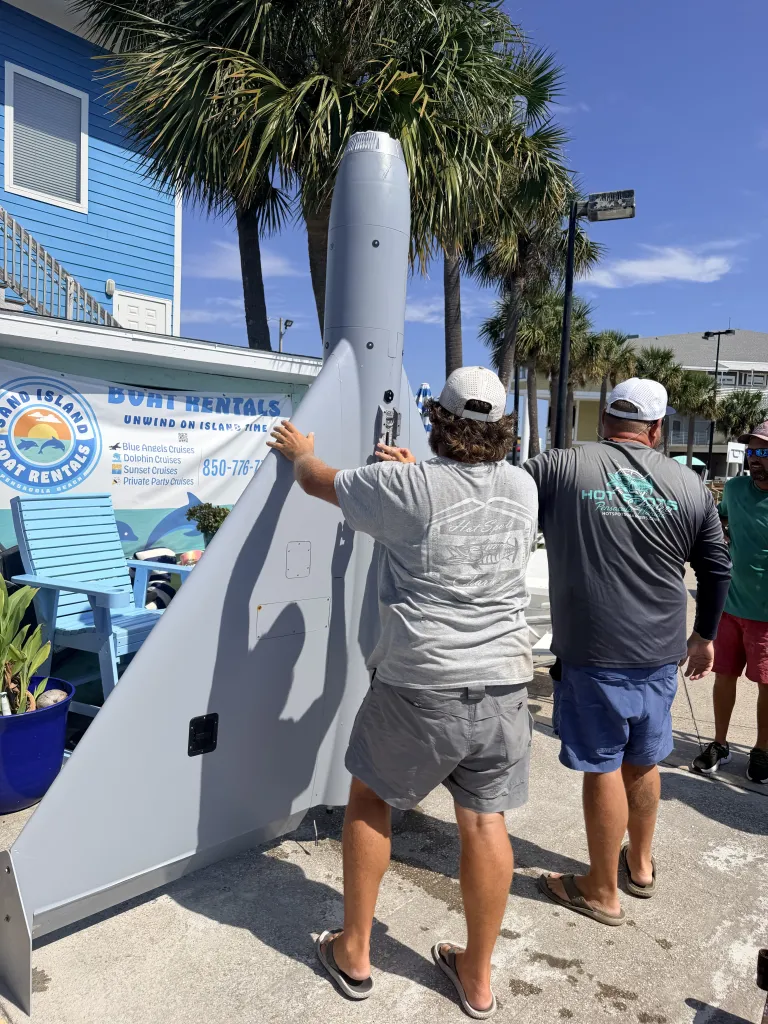
A Florida fishing charter boat made a very unusual catch Saturday while operating near Eglin Air Force Base. Located in the western end of the Florida Panhandle, Eglin is home of the U.S. Air Force weapons test wing. Hot Spots Charters pulled a delta-wing aerial drone out of the water during an excursion, according local charter captain Charlie Green. The recovered drone closely resembles a clone of the Iranian Shahed-136 one-way attack weapon, specifically the U.S. military’s Low-Cost Uncrewed Combat Attack System (LUCAS) that took center stage during its first combat use in Operation Epic Fury. The target version of that drone is built by SpecktreWorks and is designated the FLM-136. It was originally designed for mimicking one-way attack munitions, specifically the Shahed-136, which it was reverse engineered from, for testing and training before it was weaponized into LUCAS.
An Eglin AFB spokesperson told us the installation recently lost a drone, but would not confirm it was the same one found by Hot Spots Charters.
“I can confirm that we were doing a test and the test article went down,” the spokesperson told us, declining to provide further details about what kind of drone, when it was lost or the location it went down. They referred us to the Pentagon, which could not immediately provide any additional details.
“The drone was found by local charter Capt. Daniel Arsenault with Hot Spots Charters,” said Green, who is also an aviation photographer whose work can be found at Aquatic Charlie on social media. “He saw the object at a distance and went over to check it out. When he did, he pulled a good size mahi-mahi out from underneath it, complementing his already stocked cooler full of fish from that morning charter. His passengers helped him haul it aboard.”
The drone found by Hot Spots Charters. (Charlie Green)
“Arsenault and his charter company did all the due diligence possible to notify local agencies of the recovery- and was eventually collected by one of them,” Green added. He did not know which agency.
Images taken of the drone shared with us by Green show that it did not have the engine, propeller or the nose cone/seeker intact. Losing these kind of components is common for impacts into water.
(Charlie Green)
While the Eglin spokesperson offered scant details, the host unit at the installation is the 96th Test Wing, which is the “test and evaluation center for Air Force air-delivered weapons, navigation and guidance systems, command and control systems, and Air Force Special Operations Command systems,” according to the wing’s homepage. It oversees the massive Eglin Gulf Test Range, which “provides approximately 120,000 square miles of overwater airspace, covering the eastern third of the Gulf of Mexico from the Florida panhandle to the Florida Keys. The land range covers 724 square miles and contains 70 specific test and training areas, including an approved depleted uranium test range and the only qualified air-to-ground supersonic range east of the Mississippi River.”
Eglin Test Range. (Eglin Air Force Base)
As noted in the opening of this article, the LUCAS drone was used for the first time in combat during the opening day of the Operation Epic Fury war on Iran on Feb. 28.
“Costing approximately $35,000 per platform, LUCAS is a low-cost, scalable system that provides cutting-edge capabilities at a fraction of the cost of traditional long-range U.S. systems that can deliver similar effects,” Navy Capt. Tim Hawkins, a CENTCOM spokesperson, told TWZ when the command stood up Task Force Scorpion Strike (TFSS), the military’s first one-way attack drone unit, back in December. “The drone system has an extensive range and the ability to operate beyond line of sight, providing significant capability across CENTCOM’s vast operating area.”
“LUCAS drones deployed by CENTCOM have an extensive range and are designed to operate autonomously,” CENTCOM added in a press release. “They can be launched with different mechanisms to include catapults, rocket-assisted takeoff, and mobile ground and vehicle systems.”
TFSS falls under the auspices of U.S. Special Operations Command Central (SOCCENT), which oversees U.S. special operations activities across the Middle East.
A LUCAS drone. (NAVCENT/C5F/U.S. Army Spc. Kayla McGuire) NAVCENT/C5F/U.S. Army Spc. Kayla Mc Guire A LUCAS drone. (Courtesy photo/Naval Air Warfare Center Weapons Division)
While we aren’t sure if the drone found by Hot Spots Charters is the one lost by Eglin, it wouldn’t be the first time something like this has happened in Florida. For example, in 2021, beachcombers in Florida’s Palm Beach County found a U.S. Air Force BQM-167A high-performance target drone that washed ashore.
Indeed, the Air Force has a handful of 120-foot boats, the only vessels in its service, to help recover drones after they are shot down during live-fire exercises, or otherwise need to be recovered from these waters. The boats are operated by a contracted crew from Florida Offshore and retrieve around 100 of the drones each year.
The FLM-136’s origins as a target drone are highly relevant here. Counter-unmanned aerial system (C-UAS) capabilities are being hotly pursued on all fronts across the U.S. military as the threat from them has ballooned. During the war in Ukraine and multiple engagements with Iran, including Operation Epic Fury, one-way attack drones have proven to be a massive threat that is heavily influencing how wars are fought. As far as Eglin AFB goes, maybe the most high-profile C-UAS development as of late that has emerged from there has been arming USAF fighters with FALCO APKWS laser-guided rockets to shoot down exactly the same kind of threat that the FLM-136 is meant to emulate. This program began in 2019, which TWZ was first to report on, but was finally rushed into service years later as the standoff with Iran went hot. Now there are many other programs aimed at dealing with these same threats, including a more capable “fire and forget” air-to-air APKWS.
A 2019 test of air-to-air APKWS laser-guided rockets occurred off Eglin AFB. (USAF)
LUCAS development is continuing at a high-pace, with its ability to swarm cooperatively with other LUCAS drones — a feature we reported as central to the LUCAS vision when the existence of the program was disclosed — being worked on now. You can read more about this here. These systems need sanitized airspace for development activities, and the vast ranges over the gulf are some of the best in the country for it.
So, it’s not surprising to see an FLM-136 floating in the waters off Eglin AFB. Even in the war with Iran, there were multiple losses of LUCAS drones where they were found intact. These weapons are produced to be risked in large numbers, and some failing, for whatever reason, is just part of the calculus.
Locals in Iraq appear to have recovered a crashed and almost entirely intact Low-Cost Unmanned Combat Attack System (LUCAS), an American copy of the Iranian Shahed-136 Attack Drone, which is confirmed to have been used recently by Task Force Scorpion Strike during U.S. attacks on… pic.twitter.com/SEqO6627en
We will update this story with any additional details we can find about this drone. Though we don’t yet know for sure where it came from, one thing is for certain, the folks on the Hot Spots Charters boat that found it will always have a good tale about the one that didn’t get away.
WASHINGTON — President Trump said Sunday that the massive arch he wants to build between the Lincoln Memorial and Arlington National Cemetery would become a “top grade military complex” able to host drones and snipers while storing ammunition.
It is one more example of how Trump is insisting that his initiatives to remake the White House and its environs are also serving a defensive purpose. Trump has been calling the new White House ballroom a “military complex” and arguing it is necessary for national security purposes, at least in part to help it pass legal muster.
The Pentagon said it had no information beyond the president’s statement.
Trump’s announcement comes as the arch, like his other projects, faces legal challenges. Though the arch has received early approval from the U.S. Commission of Fine Arts, whose members were all appointed by Trump, a group of three veterans and an architectural historian sued, saying the project needs to be approved by Congress.
“The president’s belated efforts to manufacture a national security justification for this project do nothing to cure its fundamental illegality,” Nicolas Sansone, one of the attorneys representing the litigants, said Sunday. “Congress has not authorized the arch, and unless and until Congress does so, the project should not be permitted to move forward.”
The president said in a social media post that he had agreed, at the “strong request” of the military, to convert the planned 250-foot-tall memorial arch “into a top grade Military Complex/Triumphal Arch, to house, store, and have the rapid ability to use large numbers of drones, plus Snipers, on both the roof and plaza areas, and additionally have and hold large quantities of sniper ammunition in storage.”
The arch is proposed for a circle adjacent to the Memorial Bridge, which is a heavy traffic area as one of several connecting bridges between the nation’s capital and northern Virginia.
Among the other projects Trump is pursuing to refashion Washington’s cityscape are renaming and renovating the Kennedy Center, refurbishing the Lincoln Memorial Reflecting Pool and rebuilding a golf course in East Potomac Park that could significantly reduce the public’s access to running and biking paths. Some of the projects have run into trouble: The Kennedy Center now faces closure and perhaps demolition, and the botched Reflecting Pool renovation, originally set for completion by July 4, remains incomplete.
The groundbreaking for the arch was to have happened sometime this month. The project has not yet received final approval from the National Capital Area Planning Commission, which greenlighted the site and preliminary plans at its July meeting. The commission is expected to take up the matter again this fall.
Moscow mayor reports intercepting 1,600 drones during ‘unprecedented’ attack, accusing Ukraine of election interference.
Published On 20 Sep 202620 Sep 2026
At least two people have been killed and a major refinery has been damaged as hundreds of drones targeted the Russian capital, Moscow, and its surrounding region on the final day of the country’s parliamentary elections.
Moscow’s Mayor Sergei Sobyanin said on Sunday that more than 1,600 drones had been intercepted and shot down, 450 of which were heading for Moscow.
Recommended Stories
list of 3 itemsend of list
He also accused Ukraine of attempting to interfere with a tightly controlled three-day election that is set to tighten President Vladimir Putin’s 26-year grip on power.
“The unprecedented attack was clearly planned with the aim of disrupting the elections. The enemy did not succeed,” he said on Telegram.
Moscow regional Governor Andrey Vorobyov said on social media that a 44-year-old woman and an elderly man were killed in two separate locations.
A fire triggered by a drone crashing into a 21-storey building forced the evacuation of 400 people, Vorobyov said.
The strikes come as Kyiv has intensified its long-range drone campaign against Russia, particularly targeting energy infrastructure to cut off a vital source of Kremlin revenue used to fund its war effort, now in its fifth year.
“A facility on the territory of the Moscow Oil Refinery has been damaged,” Sobyanin added, saying that no casualties were reported so far and emergency services were on the scene.
The major refinery has already been hit by Ukrainian strikes in recent months.
The latest strike follows claims by US President Donald Trump on Monday that Ukraine and Russia had agreed not to target each other’s energy facilities.
It also comes as Russians vote in the country’s first parliamentary elections since Moscow sent troops into Ukraine in February 2022, igniting a war that has killed hundreds of thousands of people. Moscow has also organised voting in parts of Ukraine that it has seized in the four-and-a-half-year war.
Meanwhile, Ukraine’s Air Force Command reported that Russia launched 138 drones of various types across the country overnight, according to the Interfax-Ukraine news agency.
It added that air defences managed to shoot down or neutralise 101 of them.
An annual award has gone to one of the U.S. Air Force’s most secretive drone squadrons, offering a very rare window into its activities. The 30th Reconnaissance Squadron is one of two units known to operate the stealthy RQ-170 Sentinel, and it is unusual to hear anything about its operational exploits. Much about the RQ-170 itself remains highly classified 17 years after its existence was first officially acknowledged.
The General Atomics Remotely Piloted Aircraft (RPA) Squadron of the Year award for 2025 was presented to the 30th Reconnaissance Squadron at the Air & Space Forces Association’s (AFA) 2026 Air, Space & Cyber Conference on Tuesday, at which TWZ was in attendance. The AFA’s Mitchell Institute for Aerospace Studies works together with General Atomics’ Aeronautical Systems, Inc. division (GA-ASI) to recognize an Air Force drone unit in this way each year.
“The RPA Trophy is awarded annually at the USAF level for outstanding performance of active duty, Air Force Reserve, and Air National Guard … squadrons in achieving persistent attack and/or reconnaissance over the preceding calendar year,” the Mitchell Institute told TWZ in a statement. “Squadrons are judged on performance across their specified mission sets, exercise participation, and squadron and individual achievements.”
The RPA Squadron of the Year trophy seen at the 2026 Air, Space & Cyber Conference this week. The name and unit insignia of the 30th Reconnaissance Squadron are seen on a plaque on the front of the base. Air & Space Forces Association
The institute sent an additional statement regarding this year’s particular award to the 30th Reconnaissance Squadron, which is as follows:
“Through relentless combat support, operational agility, and enterprise leadership, the 30th Reconnaissance Squadron – known as the Blackbirds – has set the standard for the remotely piloted aircraft community and strengthened the Joint Force’s intelligence advantage. In 2025, the 30th Reconnaissance Squadron conducted intrusive intelligence, surveillance, and reconnaissance missions across three areas of responsibility, filling critical intelligence gaps and disrupting enemy networks. In the face of urgent deployment requirements, the squadron demonstrated exceptional agility, rapidly pivoting resources to establish forward operating locations and execute critical missions under severely compressed timelines. The Blackbirds’ accomplishments paved the way for future remotely piloted aircraft capability, distinctly identifying them as the Air Force’s most outstanding RPA squadron.“
Larry Stutzriem, the AFA’s Executive Vice President, while presenting the award to representatives of the 30th Reconnaissance Squadron ahead of a panel at the Air, Space & Cyber Conference.
“In 2025, the 30th Reconnaissance Squadron conducted 87 ISR [intelligence, surveillance, and reconnaissance] missions across three different AORs [areas of responsibility], filled critical intelligence gaps, and disrupted enemy networks,” Stutzriem said. “On the unit mobility side, the Blackbirds executed 7.2 million dollars worth of airlift in six movements across four combatant commands, moving 250 tons of personnel, top secret material, and equipment to provide low-observable RPA support for a critical Secretary of War-directed mission.”
“With their deployments, the Blackbirds demonstrated exceptional agility under extremely compressed timelines,” he added.
The official unit insignia of the 30th Reconnaissance Squadron, with its prominent blackbird motif. USAF
Furthermore, during 2025, the squadron “also executed six large force exercises to develop tactics, techniques, and procedures; validated joint force tactical objectives in land and maritime environments; and provided combat-relevant training,” according to Stutzriem. “Instructors and evaluators graduated the largest ever combat mission-ready class, 30 percent ahead of schedule, and accelerated mission-ready status 33 percent, while increasing total unit aircrew by 26 percent.”
Though Stutzriem noted that the 30th Reconnaissance Squadron provided “low-observable RPA support,” no explicit mention was made of the RQ-170. Whether or not the squadron may now operate other kinds of low-observable (stealthy) drones is unknown. As mentioned, to date, the Air Force has only confirmed that Sentinels are assigned to two units, the other being the 44th Reconnaissance Squadron. Both the 30th and 44th are assigned to the 432nd Wing at Creech Air Force Base in Nevada. Between 20 and 30 RQ-170s, in total, are understood to be in the Air Force’s inventory.
What three specific AORs the 30th Reconnaissance Squadron operated in during 2025 is also not known.
However, at least one, and possibly two, RQ-170s took part in the mission to capture Venezuelan dictator Nicolas Maduro in January of this year, as you can read more about here. It’s very likely that the Sentinels were tracking Maduro ahead of the operation. In December 2025, Air Forces Southern (AFSOUTH) had also made a post on X that included a picture of an individual wearing a name patch with the silhouette of Sentinel and the sleeve insignia of the 432nd Wing, prompting questions about whether the drones were operating in the region. The post was subsequently deleted.
Further in the past, RQ-170s are also known to have been deployed to the Middle East, Central Asia, and the Pacific. The Sentinel first emerged publicly in Afghanistan in the late 2000s, prompting the U.S. military to confirm its existence in 2009. Sentinels are notably understood to have surveilled Al Qaeda founder Osama Bin Laden’s compound in Pakistan in the lead-up to the raid that led to his death in May 2011.
Later in 2011, one of the drones infamously went down in Iran while presumed to be on a mission to monitor aspects of that country’s nuclear program. With that in mind, it is possible, if not extremely probable, that RQ-170s likely played a role in relation to the Operation Midnight Hammer strikes on Iranian nuclear sites last year. Sentinels could have provided direct surveillance over the sites in question, as well as collecting post-mission bomb damage assessments and other intelligence. These are exactly the kinds of missions the drones were designed for and that operators have trained for.
A satellite image available through Apple Maps, seen below, also shows an RQ-170 at Naval Air Station Sigonella in Italy, likely in the 2023-2024 timeframe, based on the state of construction visible elsewhere at the base. It is not known how many Sentinels were deployed to Sigonella and for how long. The Apple Maps image does lend some credence to earlier reports that these drones may have flown missions in the Black Sea region, gathering intelligence on Russian forces on the heavily defended, occupied Crimean Peninsula, between 2022 and 2023.
Apple Maps
Overall, the RQ-170 does still appear to be a go-to for performing penetrating tactical reconnaissance missions, especially when there is a need to provide persistent surveillance in denied areas, resulting in extremely important intelligence collection.
Again, it is important to reiterate here that we do not know if the 30th Reconnaissance Squadron operates any other stealthy drones beyond the RQ-170, or has in the past. A very stealthy high-altitude, long-endurance (HALE) surveillance and reconnaissance drone commonly and unofficially referred to as the RQ-180, or an evolution thereof, burst into the public eye in March after it was spotted landing in broad daylight at a base in Greece. Much about the drone, including what units are involved in its operation and where the home base of the fleet is, as well as the reasons for its deployment to the region, has yet to emerge. It does seem unlikely that the 30th would have taken on operation of the RQ-180, which is a larger strategic reconnaissance-focused platform compared to the smaller, tactically-minded, and less exquisite RQ-170. This is also just one example of what could still be lurking in the classified realm.
Whether or not the awarding of the 2025 RPA Squadron of the Year trophy to the 30th Reconnaissance Squadron might now point to a new willingness to talk about that unit’s activities and/or the RQ-170 remains to be seen. Regardless, the award and its description are yet more reminders of just how important the Sentinel remains nearly two decades after it first appeared.
The officer who led the 31st Marine Expeditionary Unit (MEU) on its recent combat deployment to the Middle East told us he needs his own uncrewed surface vessels (USVs) on future deployments. Operationalizing USVs is an area where the Marines are lagging behind. In particular, he wants the ability to send USVs forward to reconnoiter potential highly-contested beach landing areas, a mission largely assumed by the Navy.
As we have frequently reported, the military use of USVs is now proliferating around the globe at an increasing rate. Ukraine has employed sea drones to devastating effect against Russia’s Black Sea Fleet vessels and facilities, forcing the general evacuation of Russian naval assets from occupied Crimea to bases in Russia proper. During Operation Epic Fury, the U.S. used them for the first time in combat, as one-way attack weapons against Iranian targets, to hunt for mins, and for a search and rescue operation to locate the crew of an AH-64 Apache helicopter downed by Iran, as well as general broad-area surveillance and awareness. China is investing heavily in the space, as well, along with many other navies around the globe, both friend and foe.
The following video shows the first U.S. use of a USV as a kamikaze weapon.
Yesterday, using multiple one-way attack surface drones, CENTCOM forces successfully struck a submarine and ship maintenance facility in Iran. Three Corsair unmanned surface vessels hit the port at Bandar Abbas Naval Base, marking the first time American forces have employed sea… pic.twitter.com/bOM2kmgRxz
“There was a lot in theater that were being used, but it wasn’t something that we went out with,” Col. Chris P. Niedziocha told us when we asked if the 31st MEU deployed with USVs. He answered in the affirmative when we asked him if MEUs need sea drones on future deployments. He said it is part of the “explosion in robotics and autonomy” being used in combat.
“These systems are incredibly useful and capable,” explained Niedziocha, now director of the USMC Expeditionary Warfare School. “And you say, ‘Hey, you know, [in] the next war, if the first thing you’re putting through the breach isn’t a robot, something’s wrong. You say never send a Marine someplace you haven’t sent a bullet. I think the new way is [you] never want to send a Marine someplace you haven’t already sent a robot. So yeah, we’re embracing [the technology] and we’re not leaders. We’re fast followers in that regime.”
Asked for specific use cases he sees for USVs, the colonel talked about using them before putting Marines ashore.
“I can tell you if you’re doing an amphibious operation, you want to understand what’s waiting beneath the surface in the water column,” Niedziocha noted. “So something can go either with a side-looking sonar array or even forward-looking to demonstrate that there’s nothing there, and the hydrography and bathymetry is what you… need for the operation to be successful.”
Hydrography measures “the shape and features of the shoreline; the characteristics of tides, currents, and waves; and the physical and chemical properties of the water itself,” according to NOAA. Bathymetry, which is part of that, focuses on mapping the depths and shapes of underwater terrain.
NOAA
These functions are critical for mine detection and determining whether there are man-made or natural obstacles that would impede landing operations. While these missions are largely being performed by the Navy, including with USVs, the Marines are moving toward making that an organic capability. Recently, the Marines announced they were testing a counter-mine USV system. The evaluation was conducted late last month at Camp Pendleton by the Program Manager Combat Support Systems (PM CSS) Explosive Hazard Defeat Team.
The test of the USV was “in response to a littoral capability gap,” according to the media release. “The solution: seek a commercial USV solution that is equipped with integrated autonomous driving and payloads that consist of Sonar, Forward-Looking Infrared (FLIR) cameras, Line of Sight (LOS) Communications and Acoustic Communications (AComms).”
This was part of the overall effort to develop “solutions that enable increased standoff for Marines to detect, investigate and neutralize threats,” the release added. “The innovation of Explosive Ordnance Disposal (EOD) and Littoral Explosive Ordnance Neutralization (LEON) systems will provide Marine EOD Technicians with the confidence to operate in contested environments while preserving combat power, increasing operational reach, and minimizing exposure to explosive threats.”
LEON is a so-called system of systems, using a remotely operated vehicle, diver equipment, an unmanned underwater vehicle (UUV), a USV, and an Amphibious Unmanned Ground Vehicle to enable “EOD to confirm and mark hazards and obstacles from very shallow water to the beach zone,” the media release added.
While unmanned systems have long been part of EOD operations, “we’re expanding that into maritime systems that allow more endurance and less risk for operators,” said Chief Warrant Officer 2 Alfredo Andrade, officer in charge, Explosive Ordnance Disposal Company, 7th Engineer Support Battalion (ESB). “Some of the conflicts that we are engaged in take a toll on the force, and surging in new forces is costly. It turns into a logistical problem. To preserve the safety and the health of the forces… the USV and the [LEON] program exist to ensure that we have readily available combat power.”
In late August at Camp Pendleton, the PM CSS Explosive Hazard Defeat Team tested an unmanned surface vessel in response to a littoral capability gap. (PAE Marine Corps photo by Kristiana Gehly) Kristiana Gehly
While Niedziocha didn’t address USVs for offensive combat roles, the Marines have evaluated them for that use as well as for logistics, among other functions.
Our Autonomous Low-Profile Vessel (ALPV) solicitation is now accepting submissions.
The @DeptofWar and the @USMC need to resupply units spread over wide distances in contested littoral environments. Increased all-domain threats targeting logistics capabilities, locations, and… pic.twitter.com/Af8v0DTRHS
— Department of War Innovation Unit (@DIU_x) March 3, 2026
There have been many other tests, as well. Including one just this summer at RIMPAC. These trials saw the launch and recovery of one of Splash Industries’ Typhoon USVs aboard the USS Essex. The ‘Gator Navy’ of amphibious assault vessels that haul Marines and their kit around the oceans is uniquely suited to act as USV motherships. Their well decks allow for easy deployment and recovery of USVs of many sizes and capabilities near seamlessly. So it won’t be surprising if these vessels and the Marines aboard them quickly become staples in the Pentagon’s USV playbook.
Watch us land one of our drone-boats inside a moving US Navy warship during RIMPAC. This world-first resupply mission was performed completely autonomously using a Splash Industries Typhoon USV. pic.twitter.com/AEzNzZjsL1
You can see that engagement in the following video.
Ukraine’s Navy says a Sargan unmanned surface vessel destroyed a Russian unmanned boat with machine-gun fire in the Black Sea, the first-ever battle between unmanned surface vessels. Ukrainian Navy personnel operated in coordination with HUR. #Ukrainepic.twitter.com/Avg4ecz8m6
Having recently returned from a six-month deployment that saw the Marine Corps’ first use of its Expeditionary Advanced Base Operations (EABO) concept in a combat setting during the fight against Iran, Niedziocha has a good sense of the realities of modern warfare. His Marines operated forward arming and refueling points (FARPs) for various aircraft in combat for the first time and set up remote sensing locations.
That a commander like him who sees value in USVs is a good sign for progress in the development of these systems.
KYIV: A Russian drone struck a passenger bus in southern Ukraine early Wednesday, killing five people and wounding at least seven in the latest in a series of Russian strikes on civilian transportation.
Ukrainian President Volodymyr Zelensky called the attack an atrocity with no military purpose.
The strike occurred in the Nikopol district of Ukraine’s Dnipropetrovsk region, near the war’s southern front line. Oleksandr Hanzha, head of the regional military administration, said that all five were killed at the scene while the seven wounded were receiving medical care.
Zelensky described the vehicle as a minibus and said in an X post that the strike had “no military rationale” and that it was “just another atrocity.” He said the strike was connected to Russia’s targeting of logistics and critical infrastructure that has continued “unabated.”
Zelensky said that a passenger train was also struck in the Mykolaiv region on Wednesday, damaging a railway station and a diesel locomotive. Nearly 170 passengers on board the train were evacuated before the strike. An electric locomotive in the northwestern city of Kovel was also struck, Zelensky said.
Ukraine requests locomotives from partners
Russian strikes on Ukraine’s rail network have resulted in more than 500 locomotives being damaged or completely destroyed since the beginning of the all-out war on Feb. 24, 2022, with more than half those strikes occurring this year, Ukrainian Foreign Minister Andrii Sybiha wrote on X on Tuesday.
Sybiha described such attacks as “systematic” and aimed at disrupting logistics across Ukraine. He said that Ukraine urgently needs replacements for damaged locomotives, and called on the country’s partners to assist in finding locomotives compatible with its 1,520-millimeter rail gauge and to assist in financing.
In another post on X on Wednesday, Sybiha said that Russian forces were striking passenger trains, locomotives, stations and railway routes “knowing exactly how essential they are for civilians, evacuations and Ukraine’s economy.”
“This is not collateral damage. It is a systematic hunt for people and an attempt to (paralyze) civilian life,” he wrote.
Zelensky says there is no truce on halting energy strikes
In an interview with CBS News on Tuesday, Zelensky pushed back against an earlier claim by US President Donald Trump that Ukraine and Russia had agreed to mutually cease attacks on each other’s energy infrastructure. Zelensky said that Ukraine was ready to enter such an agreement, if Russia stops striking Ukrainian energy facilities.
Trump said in a social media post Monday that such a truce had been reached, but didn’t offer details on the purported agreement. Previous efforts to broker even a partial ceasefire have repeatedly fallen apart within hours, with both sides accusing the other of violations.
In the CBS interview, Zelensky said that the possibility of an energy truce was discussed during a recent meeting in Kyiv with Trump’s representatives, Steve Witkoff and Jared Kushner, but that he had told them: “If the Russians are ready for an energy truce, that means there will be no attacks on energy facilities at all.”
This morning, the Russians struck a regular intercity minibus near Nikopol with an FPV drone. As of now, five people have been reported killed, and seven others are receiving medical care. No military rationale, just another atrocity. My condolences to the families and loved… pic.twitter.com/QFetF4Ww0s
— Volodymyr Zelenskyy / Володимир Зеленський (@ZelenskyyUa) September 16, 2026
Russia decorates ship captain who fired flares at Danish helicopter
Russia’s Defense Ministry said Wednesday that the captain of a Russian warship that fired two signal flares toward a Danish military helicopter on Monday, drawing ire from Denmark, has been awarded a medal for his “competent and resolute action.”
The ministry said in a statement that the Soobrazitelny corvette was on a mission in neutral waters in the Baltic Sea when its crew spotted the approaching helicopter, which failed to respond to calls made via the international communication channel.
“To prevent a provocation by the Danish helicopter, the corvette commander decided to fire two red signal flares, after which the helicopter left the area where the Russian warship was located,” the ministry said.
Russian Foreign Minister Sergey Lavrov said Wednesday that Moscow has no aggressive intentions toward Europe, but that if countries on the continent were to launch an attack on Russia, “it would be a completely different kind of war, and a very short one.”
Russian general killed in Ukrainian drone strike
The deputy head of the Russian armed forces’ military-political department, Lt. Gen. Apti Alaudinov, confirmed Wednesday that a decorated Russian general had been killed in the occupied Donetsk region.
Alaudinov, who didn’t provide details on the circumstances of Maj. Gen. Anton Grunis’ death, hailed the officer as “a hero” and “one of the most respected generals … a real man and officer and a great patriot.”
The confirmation of Grunis’ death came after Robert “Magyar” Brovdi, commander of Ukraine’s Unmanned Systems Forces, alleged on Wednesday that Grunis had been killed in occupied Donetsk by a Ukrainian drone while at a command post in the village of Kindrativka.
In July, Grunis reported to Russian President Vladimir Putin that his troops had captured the town of Kostiantynivka and he was later awarded the Hero of Russia medal. Ukraine has disputed that Kostiantynivka was fully taken by Russian forces.
Grunis had previously fought in Chechnya, a mainly Muslim republic whose bid for independence after the Soviet Union’s collapse led to years of war with Russian government forces. He also took part in Russia’s campaign in Syria.
In Ukraine, he commanded the 4th Guards Motorized Infantry Brigade.
Meanwhile, 17 other sites were damaged in Ukraine’s Kyiv region between Tuesday and Wednesday morning, according to the head of the Kyiv regional military administration, Tymur Tkachenko. Eight private homes, five vehicles, a municipal building, a hangar and a production facility were among the sites damaged, Tkachenko said on Telegram.
Zelensky said on X that the Kherson, Donetsk and Poltava regions had also come under attack.
In the northern city of Sumy, six people were injured in a Russian guided aerial bomb attack, including a 14-year-old girl, according to the head of the Sumy regional military administration Oleh Hryhorov. Two homes were destroyed and 10 others damaged in the strikes, along with damage to an educational facility, Hryhorov said, adding that two other men were hospitalized after a separate strike hit an industrial zone.
In the port city of Odesa, one person was killed in a Russian attack that sparked a fire at garages and damaged vehicles and private homes, Serhii Lysak, head of the city’s military administration, wrote on Telegram Wednesday.
Russia’s Defense Ministry said that its air defenses downed 71 Ukrainian drones overnight. In the Belgorod region, one person was killed and four others were wounded by Ukrainian strikes over the last 24 hours, according to acting governor Alexander Shuvayev.
It is stunning to see the impact the USAF’s Collaborative Combat Aircraft (CCA) program has made on discourse surrounding the future of the Air Force since it was officially announced. There is still much to prove regarding the concept, but testing is accelerating and the USAF now plans on buying 500 CCAs by 2032. At the same time, the USAF is now hunting for a successor to the MQ-9 Reaper, with plans on procuring hundreds of those drones, as well, by early in the next decade.
With all this in mind, TWZ’s Jamie Hunter talked to Mike Shortsleeve from General Atomics on the show floor at Air, Space & Cyber 2026. The two discussed the latest progress for the company’s newly-named FQ-42 Vengeance Collaborative Combat Aircraft, as well as General Atomics’ new Wildfire platform designed to address the lower-cost Massed Modular Aircraft program that could replace the company’s iconic MQ-9 Reaper.
Check out the interview below or at the top of this post.
FQ-42 Vengeance fighter drone update from General Atomics
Nato fighter pilots have shot down a drone that entered Lithuania’s airspace overnight, the Lithuaninan president said.
Authorities said the drone likely entered southern Lithuania, near the second-largest city of Kaunas, from Belarus shortly after midnight on Tuesday.
Lithuanian President Gitanas Nausėda wrote in a statement on X: “A drone that just entered Lithuanian airspace was destroyed by NATO fighter jets.”
The origins of the drone are yet to be determined, a spokesperson for the Lithuanian national crisis management centre said.
Drone alerts sounded across the capital Vilnius and surrounding region earlier on Tuesday.
Nausėda’s post on social media added: “With Russia intensifying its aggression against Ukraine, such readiness is vital for our region. Together with our NATO Allies, Lithuania will defend its airspace.”
Lithuania shares a large part of its southern and eastern border with Belarus, a key Russian ally.
Military drone incursions have become increasingly common across Europe since the beginning of Russia’s full-scale of invasion of Ukraine.
CAIRO/NEW YORK: The UN secretary-general’s personal envoy for Sudan, Pekka Haavisto, held talks in Cairo on Sunday and Monday with the Arab League’s secretary-general, Nabil Fahmy, and the Egyptian foreign minister, Badr Abdelatty, as preparations continued for UN meetings in New York this month.
The diplomatic efforts came as drone strikes and other hostilities continued to endanger civilians and drive displacement across Sudan’s Darfur and Kordofan regions, and Blue Nile State.
During his meeting with Haavisto on Sunday, Fahmy stressed the importance of launching a comprehensive, Sudanese-led political process that involves all sections of Sudanese society.
He also reaffirmed the Arab League’s support for Sudan’s sovereignty and territorial integrity, and called for the prevention of external interference in the country’s affairs.
In a separate meeting on Monday, Abdelatty stressed the need to support stability, end the conflict and reach a comprehensive political settlement that preserves Sudan’s sovereignty and meets the aspirations of its people. His talks with Haavisto encompassed the latest developments in the conflict, as well as regional and international efforts to halt the escalation and advance de-escalation measures.
Abdelatty reiterated Egypt’s support for Sudan’s unity, sovereignty, territorial integrity and national institutions. He also emphasized the need to respect Sudanese ownership of any political solution.
Both sides stressed, in an official statement, the important need to respect Sudan’s sovereignty, support de-escalation efforts, facilitate the delivery of humanitarian aid and alleviate the suffering of the Sudanese people.
Meanwhile, UN spokesperson Farhan Haq said drone strikes and other hostilities in Sudan continued to threaten civilians and force people from their homes.
In Blue Nile State, several drone strikes hit fuel stations and other critical infrastructure in the state capital on Sunday, with civilian casualties reported. The UN estimates that nearly 100,000 people were displaced by insecurity across the state between January and August, about 66 percent more than the figure since the start of the year that was reported in late May.
In North Darfur, drone strikes hit several locations in Tina, near the border with Chad.
The UN said nearly 1,200 people were displaced from two villages in El-Fasher between Sept. 10 and 13. More than 1,200 others fled villages in Um Baru over the past week, with most of them crossing into Chad.
Drone attacks were also reported at several locations in West Darfur on Saturday, including a fuel market west of the state capital. Casualties were reported.
Insecurity in Kordofan continues to drive displacement and disrupt humanitarian operations. More than 7,000 people have reportedly arrived in Abassiya, South Kordofan, in recent weeks. In North Kordofan, Al-Mina Al-Bari camp in the state capital, El-Obeid, is hosting about 9,000 families, placing further strain on overcrowded sites and basic services.
Haq reiterated the UN’s call for all parties involved in the conflict to protect civilians and civilian infrastructure, and ensure rapid, safe, unhindered and sustained humanitarian access to those in need.
Sudan descended into civil war in April 2023 after tensions between the Sudanese Armed Forces and the rival paramilitary Rapid Support Forces erupted into fighting. The conflict has killed tens of thousands of people and driven a severe hunger crisis.
A report published in May said nearly 19.5 million people, about 41 percent of Sudan’s population, faced high levels of acute food insecurity.
The UN Food and Agriculture Organization, the World Food Programme and UNICEF called for an immediate cessation of hostilities. They also urged the international community to increase funding for food assistance, emergency food production, efforts to rebuild livelihoods, and nutrition, health, water and sanitation services.
Amani El-Taweel, a researcher at Al-Ahram Center, told Arab News that the meetings in Cairo reflected continuing diplomatic efforts to find a solution to the Sudanese crisis.
She said the situation remained extremely complex, particularly amid the wider escalation in the Middle East, and that the emergence of new fronts had further complicated conditions in eastern Sudan.
Ezzat Saad, director of the Egyptian Council for Foreign Affairs, told Arab News the only path out of the crisis was to unify Sudanese institutions and secure a ceasefire.
He said any solution must come from within Sudan, without interference from external parties. Haavisto’s meetings in Cairo were part of the preparations for upcoming UN General Assembly sessions in New York at which heads of state would have an opportunity to discuss regional crises, Saad added. Sudanese institutions themselves must also demonstrate a commitment to preserving the country’s unity, he said.
On Saturday, the Egyptian president, Abdel Fattah El-Sisi, met the UN secretary-general, Antonio Guterres, on the sidelines of the BRICS summit in India. El-Sisi said any threat to Sudan’s security, unity or sovereignty constituted a “red line,” according to a statement from the Egyptian presidency.
In January, Egypt hosted the fifth meeting of the Consultative Mechanism to Enhance Coordination of Peace Efforts in Sudan, which was chaired by Abdelatty.
The foreign minister said Egypt remained committed to achieving peace and stability in Sudan. He highlighted the launch of the Sudan Neighboring Countries Initiative in July 2023, which emphasized the need for a ceasefire, inclusive political consultations and the guaranteed delivery of humanitarian aid.
The Ukrainian Navy is claiming one of its uncrewed surface vessels (USV) sank a Russian USV, marking the first time one of these weapons, also known as drone boats, destroyed another. The engagement is the latest iteration in the use of combat drone boats, which Ukraine has employed to devastating effect against Russia’s Black Sea Fleet vessels and facilities, forcing the general evacuation of Russian naval assets from occupied Crimea to bases in Russia proper. The use of weaponized USVs is now proliferating around the globe at an increasing rate.
The incident took place somewhere in the Black Sea, said the Ukrainian Navy, which provided no details about when it happened or exactly where. TWZ cannot independently verify this claim; however, we cannot find any evidence of a drone boat killing another drone boat in the past.
“Units of the Main Intelligence Directorate (GUR) detected the target,” the Ukrainian Navy stated on Telegram. “The Ukrainian Navy’s ‘Sargan 3000’ unmanned boat, equipped with a remotely operated weapon station (RWS) Protector 12.7 mm, successfully destroyed it. This is the first naval battle in history between unmanned boats.”
An 81-second video released by the Ukrainian Navy opens with a view from the Sargan 3000’s onboard camera. It shows the Ukrainian USV acquiring, then engaging the Russian USV with its machine gun. It then cuts to a closer view of the Protector gun system firing at the Russian drone boat. At about the 30-second mark, the view switches to a feed from an aerial platform, though it is unclear if it is piloted or a drone. The video continues with the Sargan 3000 raking the Russian USV with its heavy machine gun until pieces start flying off and it eventually sinks, stern first.
Ukraine’s Navy says a Sargan unmanned surface vessel destroyed a Russian unmanned boat with machine-gun fire in the Black Sea, the first-ever battle between unmanned surface vessels. Ukrainian Navy personnel operated in coordination with HUR. #Ukrainepic.twitter.com/Avg4ecz8m6
The Sargan 3000 (the name means needlefish in Ukrainian) was first introduced by Ukrainian President Volodymyr Zelensky in April as a “multi-purpose platform that has undergone testing and entered service with the Ukrainian Navy. These uncrewed vessels are highly maneuverable and capable of carrying out strike missions.”
“The maritime drone features a specialized low-profile hull with distinctive hydrodynamic lines and is constructed from materials that reduce its radar signature,” the publication explained. “The Sargan-3000 USV is equipped with a waterjet propulsion system (presumably powered by a diesel or hybrid engine to ensure a long operational range).”
AmalNews states that the Sargan 3000 is 6.9 meters (about 22.6 feet) long, 2.2 meters (about 7.2 feet) wide, with an operational radius of up to 1,600 km (about 994 miles) and can carry a payload of 450 kg (about 992 pounds). It travels at an estimated speed range of 40-55 knots.
During operations, the Sargan 3000 connects to Ukraine’s Delta situational awareness system, “enabling the real-time transmission of target data, video feeds, and telemetry to operators,” AmalNews noted. “It features multi-channel control capabilities, including redundant satellite communication terminals (utilizing secure Western commercial networks and NATO military networks).”
It is also equipped with “an autonomous inertial and optical navigation system to ensure operation in the event of GPS jamming, and it incorporates electronic countermeasures (ECM) modules.”
There are several variants of this USV. They include those equipped with machine guns; rockets; FPV drones; an electronic warfare version and one that lays mines, the publication added.
Ukraine’s Sargan-3000 naval drone was presented in an FPV drone carrier variant, additionally fitted with a remote weapon station. The type first appeared in combat conditions in early June, when one washed ashore and detonated in the waters of Romania’s Constanța port. #Ukrainepic.twitter.com/QyKnyJFqUq
The drone boat’s first publicly known combat engagement took place in July, when one “destroyed the Russian Federation’s FSB border guard ship Izumrud,” the Ukrainian Navy stated at the time.
“Ukrainian naval sailors sank the border guard ship of the 2nd rank with the Sargan-3000 maritime unmanned complex near Novorossiysk,” the Ukrainian Navy claimed on Facebook. “Among the crew of the ship are dead and wounded.”
It is unclear whether the USV acted as a kamikaze vessel or a weapons platform, although the former is most likely.
“It was Izumrud that on November 25, 2018, participated in the attack on the ships of the Ukrainian Navy in the Kerch Strait,” the service added. “Revenge is inevitable.”
Ukraine’s Navy has sunk the Russian FSB Border Guard patrol ship Izumrud near Novorossiysk using the Sargan-3000 unmanned maritime system.
The vessel, a Rank 2 patrol ship, reportedly sustained catastrophic damage, with casualties and injuries among its crew.
— SPRAVDI — Stratcom Centre (@StratcomCentre) July 14, 2026
One sea drone killing another is a notable development given the damage these systems can inflict and the challenge of locating and destroying them on open waters. Being able to operate on the water over long distances and timeframes, they can be used to hunt down other drone boats, as what appears to have taken place in this engagement, or serve as a picket line of sorts to protect harbors, vessels and other targets that have been attacked by USVs in the past.
The Russian drone boat, which is not identified, did not appear to be armed.
Ukraine has carried out the world’s first known combat mission in which a sea drone transported and deployed an armed ground robot behind Russian lines on the occupied Kinburn Spit. pic.twitter.com/zyJdFXWxVb
The U.S. used drone boats as kamikaze weapons for the first time in July, during an attack “on a submarine and ship maintenance facility in Iran,” U.S. Central Command (CENTCOM) announced on X at the time.
Yesterday, using multiple one-way attack surface drones, CENTCOM forces successfully struck a submarine and ship maintenance facility in Iran. Three Corsair unmanned surface vessels hit the port at Bandar Abbas Naval Base, marking the first time American forces have employed sea… pic.twitter.com/bOM2kmgRxz
Regardless, it looks like history was made with this incident in the Black Sea. But this involved a sea drone hunting down and destroying another that couldn’t fight back. Given the rapid pace of weapons development by both sides in the Ukraine war, it seems inevitable that a duel between two armed drones boats could soon follow.
Saudi Arabia has closed a critical oil pipeline after it was attacked by drones launched from Iraq, as conflict in the Middle East widens.
Iraq said it had fired a military commander and launched an investigation after admitting the drone attack on its neighbour’s East-West pipeline had originated in one of its provinces bordering Iran.
The 1,200km (745 mile) pipeline has helped Saudi Arabia – the world’s largest crude oil exporter – bypass the Strait of Hormuz.
The incident comes amid a major advance by the Iranian-backed Houthi rebels in Yemen, putting more pressure on global oil shipping routes as the US-Iran war stretches into its seventh month.
Riyadh on Friday said it had shut the pipeline as a precaution, as satellite images of scorched ground and smoke near the site emerged.
The foreign ministry said the attack resulted in some injuries and damage, which was still being assessed.
The pipeline has been moving 4% to 5% of global oil supply, news agency Reuters has reported, citing ship tracking companies and analysts.
Saudi Arabia has chosen not to retaliate at this stage, its foreign ministry says, following a call from Iraq’s prime minister.
It said the kingdom would “support the efforts of the Iraqi government” to “prevent attacks” launched from the country against neighbouring states.
“The Kingdom of Saudi Arabia affirms that it reserves its right to take all necessary measures to safeguard its sovereignty and security, protect its facilities, and ensure the safety of its citizens and residents,” the statement added.
The Iraqi prime minister’s office in its own statementsaid the operations commander in the Maysan governorate – a province which borders Iran – had been removed from his post following confirmation the drone attack had been launched from that region.
CAIRO: An Iraqi military commander was dismissed early on Saturday after investigations confirmed the latest drone attacks targeting Saudi Arabia originated from Iraq, according to a statement by Iraq’s prime minister’s office.
The commander led operations in Maysan province in southern Iraq, according to the statement.
OASIS have launched a countdown to a major announcement with a drone display above their beloved Manchester City’s home ground.
Over the past few weeks, Liam, 53 and Noel Gallagher, 59, have dropped a string of cryptic clues about their next world tour, and last night they continued to hype up the buzz.
Rockers Noel and Liam Gallagher have teased a major Oasis announcementCredit: GettyThe band put on a drone light show over the Man City stadiumCredit: PA
Oasis reformed two years ago, after the long-feuding brothers caused the band to split-up in 2009.
WASHINGTON: Iran’s capture of a US military underwater drone gives Tehran an opportunity to study and potentially reverse engineer the vessel, delivering a setback for the Pentagon and drone maker Anduril.
The US military and Anduril have downplayed the significance of the drone falling into Iranian hands. The vessel, a Dive-LD autonomous underwater vehicle designed for long-range surveillance and other undersea missions, is among a new generation of military drones intended to operate for days with little human intervention. Washington has previously treated the loss of advanced drones to Iran as a serious matter.
After Iran captured an RQ-170 Sentinel stealth reconnaissance drone in 2011, then-President Barack Obama publicly asked Tehran to return the aircraft. Iran later claimed it had reverse-engineered the drone and subsequently unveiled domestically produced models that appeared to draw heavily on its design.
More recently, the US military moved swiftly to prevent Iranian forces from taking possession of uncrewed maritime technology. In 2022, a US Navy patrol ship and MH-60S Seahawk helicopter were deployed after an Iranian naval vessel attempted to tow away a Saildrone surface vessel in the Gulf, according to the Navy.
Analysts say Iran is unlikely to gain a decisive military advantage from the captured drone, but the episode nonetheless represents a propaganda victory for Tehran and an awkward setback for Washington’s efforts to project technological superiority.
IRANIAN EMBASSIES MOCK US
Iranian embassies around the world have mocked the US for losing its drone. Iran’s embassy in Ghana, in a post on X, boasted about picking the submersible up in “a strait controlled by people who can hear a shrimp sneeze,” adding that, “Our guys picked it up like a plastic bottle in a fishing net. Fully intact. Still blinking like an idiot. Condolences to whoever was holding the joystick.”
Anduril and the Pentagon did not immediately respond to requests for comment.
“Of course Iran will take every opportunity as a propaganda win,” said Farzin Nadimi, a senior fellow at the Washington Institute for Near East Policy. “It can help the (Islamic Revolutionary Guard Corps) make better versions of their own designs.”
Iran will almost certainly try to pry open the drone’s hardware, but the drone’s software carries built-in defenses, said Bryan Clark, a senior fellow and director of the Center for Defense Concepts and Technology at the Hudson Institute. Iranian engineers “could definitely reverse-engineer the mechanical systems,” he said, pointing to Tehran’s track record with captured American aircraft.
“Unboxing ceremony by our reverse engineers, tomorrow morning!” Iran’s embassy in Hyderabad wrote on X.
The incident has also highlighted a disconnect between the messaging of Anduril and its customer, the US Navy.
Navy officials said the Dive-LD was an older-model vehicle that suffered a malfunction and was recovered by Iranian forces after being left “dead in the water.”
Anduril has promoted the Dive-LD as “the most reliable and flexible” large autonomous underwater vehicle available, saying it is capable of operating for up to 10 days in demanding conditions.
“This is something that Iran has proven very adept at exploiting for its own benefit in terms of seeking to frame the narrative as one of US, in this case, ineptitude and their ability to sort of retain control over the Strait of Hormuz,” said Mona Yacoubian, director of the Middle East program at the Center for Strategic and International Studies.
“Today, an attack by a drone was repelled against one of the industrial facilities in Noyabrsk,” Dmitry Artyukhov, governor of the Yamalo-Nenets Autonomous Okrug, stated on Telegram. “As a result of the drone’s debris falling, a fire broke out. Emergency services specialists are working at the scene. Most importantly: there are no casualties or injuries. The extent and nature of the damage are being determined.”
“I urge residents of Yamal to remain calm and to rely only on information from official sources,” Artyukhov added. “The situation is under control.”
(Dmitry Artyukhov Telegram)
“The criminal Kyiv regime has, for the first time, attacked the Arctic region of the Ural Federal District,” Artem Zhoga, the Presidential Envoy of the Russian Federation to the Ural Federal District, confirmed on Telegram. “As a result of debris from a drone falling on the territory, a fire broke out at a fuel and energy complex facility in the Yamalo-Nenets Autonomous District… The enemy is trying to damage economic facilities in order to sow panic.”
New range record: Ukrainian drones attack Novy Urengoy – nearly 3,000 km from Ukraine.
The facility in Novy Urengoy that processes gas condensate for transport was hit—one of the most important installations in Russia’s gas condensate infrastructure.
The target of the attack was the Novourengoysky Condensate Stabilization Plant (CSP), according to Ukraine’s Armed Forces General Staff, which took credit for the attack.
“On 9th September 2026, units of the Defense Forces of Ukraine struck the Novy Urengoy Gas Condensate Processing Plant in Novy Urengoy, Yamalo-Nenets Autonomous Okrug,” the general staff claimed on X. “The extent of the damage is being assessed.”
The plant has an annual processing capacity of approximately 19.5 million tons, the general staff added.
“It produces stabilized gas condensate, petroleum fractions, diesel fuel and other petroleum products,” the Ukrainian military pointed out. “Its products are used, among other purposes, to meet the needs of the Russian armed forces. Operations against key enemy military targets are ongoing.”
Ukrainian officials did not provide any details about how the strike was carried out.
⚡️⚡️ More than 3,000 km away. Novy Urengoy gas condensate processing plant hit
On 9th September 2026, units of the Defence Forces of Ukraine struck the Novy Urengoy Gas Condensate Processing Plant in Novy Urengoy, Yamalo-Nenets Autonomous Okrug, russian federation.
One video that emerged from the scene showed a column of flames rising in the distance but does not offer much in the way of detail about where the attack took place or the extent of the damage.
Ukrainian drones have for the first time attacked Russia’s largest gas-production hub, almost 3,000 km from the Ukrainian border.
Ukraine struck the Arctic part of the Urals Federal District. A fire started at a fuel-and-energy site.
Another video showed smoke rising in the distance, but again offered little in the way of detail about what happened.
❗️Ukrainian drones attacked Novy Urengoy in Russia for the first time. That’s about 3,200 km from Ukraine!
The Novy Urengoy plant for preparing condensate for transport, located in the Yamalo-Nenets Autonomous Okrug, was the target. It is one of the region’s key gas condensate… pic.twitter.com/KDwOFWicd6
“Novy Urengoy is Russia’s unofficial gas capital, located in the Yamal-Nenets autonomous district in northwestern Siberia,” according to the Moscow Times. Gazprom “estimated the region’s gas resources at 26.5 trillion cubic meters as of 2020, enough to cover global demand for more than six years.”
In Novy Urengoy, Khanty Mansi AD, west Siberia, Russia, long-range Ukrainian drones hit an industrial facility in the city located some 3,000 kilometers (1,800 miles) from the Ukrainian border.https://t.co/bruXXjLYR4
In addition to being the first attack in this region of Russia, this was “the furthest strike since the start of the war,” the Russian Mediazona Telegram channel stated. “Previously, the record for distance was the attack on the Omsk Oil Refinery in July 2026. It is located approximately 2,500 km (about 1,550 miles) from the border in a straight line.”
While the Ukrainian Armed Forces General Staff offered scant details about the strike, officials from the Fire Point weapons company hinted online that one of their drones carried out the attack.
“Guess who traveled over 3300 km (about 2,050 miles) and successfully achieved their goal,” the company stated on a Telegram post that included video of the gas plant attack.
“3200)),” Fire Point’s founder, Denys Shtilierman, teased in an X post with an image of the burning gas plant.
Neither Shtilierman nor the company provided any other details; however Fire Point claims its FP-1 drones can now travel about 2,100 miles (3,400 km) with a 60 kg payload.
Despite Fire Point’s hints, there is no confirmation that the company’s weapons had anything to do with this attack. There is also the chance that it could have been carried out by another system or even from inside Russia. Ukraine has, in the past, relied on proxies to stage attacks deep in Russia. In addition, Ukraine last summer carried out a series of remotely launched drone attacks on Russian strategic aviation. Dubbed Operation Spider Web, it included strikes on the Belaya Air Base, about 3,000 miles from the border.
However, a strike from inside Russia is much less likely than one launched from Ukraine given Fire Point chiming in and the increasing reach of Ukraine’s weapons. We have reached out to Fire Point and Ukrainian officials for comment.
You can see video of the Operation Spider Web attack on Belaya below:
The Novy Urengoy Gas Condensate Processing Plant wasn’t the only site in Russia affected by drone incursions far from the Ukrainian border today.
“A state of emergency has been declared in the Khanty-Mansi Autonomous Okrug due to unmanned aerial vehicle (UAV) activity,” the Russian RIA Novosti news outlet reported on Wednesday. This is located about 1,500 miles from Ukraine.
“Temporary restrictions have been implemented at the airports of Igra, Nyagan, Uray, ‘Sovetsky,’ Surgut, and Khanty-Mansiysk,” the outlet added.
The publication did not report any attacks and Ukraine did not claim any, but video emerged of what appears to be a Fire Point FP-1 drone flying over the area.
While the extent of the damage to the Novourengoysky Condensate Stabilization Plant is unclear at the moment, the attack extends the range of Ukraine’s campaign against Russia’s oil infrastructure.
This summer, Ukraine struck nearly all Russian refineries within range, the Kyiv Post noted.
Russian President Vladimir Putin signed a decree allowing the government to temporarily take control of critical infrastructure if private owners fail to protect it from Ukrainian drone attacks or rebuild it after strikes.
Though Russia is continuing its grinding offensive, the energy infrastructure attacksare clearly taking a major toll. The ability to do so seems to have taken on additional significance in the wake of another round of attempts to end the fighting.
U.S. President Donald Trump’s top envoys, Steve Witkoff and Jared Kushner, recently traveled to both Russia and Ukraine seeking to rekindle peace talks. However, there does not appear to be any immediate resolution in sight.
The expanding range and quantity of Kyiv’s long-range strike arsenal gives Zelensky perhaps his most powerful card to play against Russia’s interest in continuing the war. Ukraine has been improving these weapons by the month and the pace of development of its drones and cruise missiles is rapidly accelerating. The country also has several ballistic missile projects in the works, which will only add to the pressure put on Moscow once operational.
Regardless, earlier this week, Ukrainian President Volodymyr Zelensky said he expects the war with Russia to continue into the winter at the very least. Given that, Kyiv’s campaign against Russia’s energy infrastructure does not seem like it will end anytime soon, either.
Case in point, Ukraine’s long-range drone strikes continued on Wednesday with another attack on Sochi, a Black Sea resort town often frequented by Russian President Vladimir Putin. And, for the second day, drones were visible over Russia’s remote central high-north energy production hub.





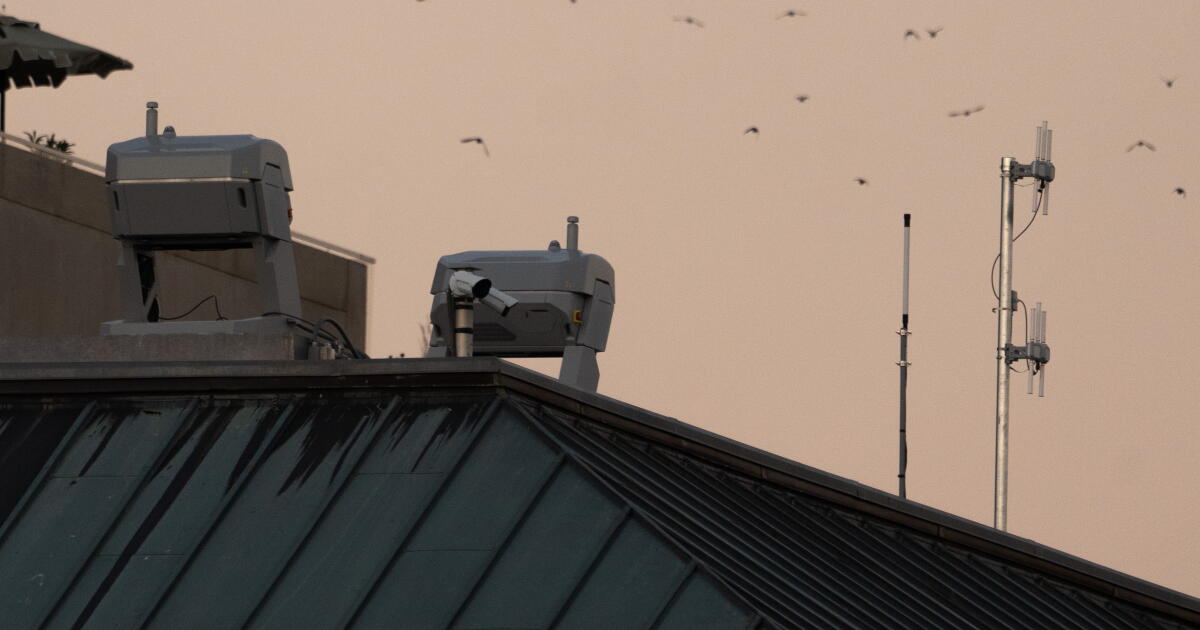
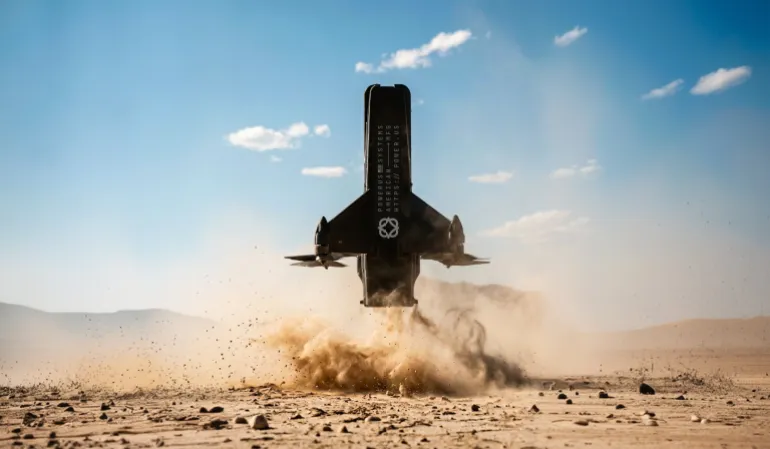
![Powerus' Guardian Interceptor is a counter-drone interceptor. [Courtesy Powerus]](https://i0.wp.com/occasionaldigest.com/wp-content/uploads/2026/09/guardian-fieldhero-1790078758.jpg?w=640&ssl=1)

![US President Donald Trump examines a box of rare-earth mineral and gemstone samples presented by Pakistan's Chief of Army Staff Field Marshal Asim Munir (center), alongside Pakistani Prime Minister Shehbaz Sharif (left) last year in September at the White House. [Courtesy White House]](https://i0.wp.com/occasionaldigest.com/wp-content/uploads/2026/09/Pakisatn-Minerals-WH-1790079007.jpg?w=640&ssl=1)

![France's President Emmanuel Macron meets with Ukraine's President Volodymyr Zelenskyy on the sidelines of the United Nations General Assembly in New York City on September 21, 2026 [Ludovic Marin/AFP]](https://i0.wp.com/www.aljazeera.com/wp-content/uploads/2026/09/AFP__20260922__C8XY4MU__v1__HighRes__UsFranceUkrainePoliticsDiplomacy-1790058813.jpg?w=640&ssl=1)