Every so often, an aspiring screenwriter wanders into the dim red glow of Jumbo’s Clown Room hoping to interview one of the dancers. “They’re like: ‘I’m writing a screenplay. Can I interview you?” says Cecilia Fairchild, one of the longtime dancers at the renowned East Hollywood bikini bar.
Her response is usually some version of this: “I’m like, ‘Why are you writing about that? Don’t you know we are all writing that too? Leave us alone,’” Fairchild says with a mischievous laugh. What bothers Fairchild is the assumption behind it — that the dancers are voiceless and helpless. Worst of all, they’re presumed to have stories worth mining but not the ability to produce literature themselves.
Jumbo’s has a longstanding reputation of being part of L.A.’s literary lore.
In the 1970s and 1980s, Charles Bukowski — L.A. nightlife’s debaucherous poet laureate — was rumored to haunt the bikini bar in its early days. David Lynch wrote his classic screenplay “Blue Velvet” at the bar. (According to local legends, the iconic opening shot of “Blue Velvet” came to Lynch when he spotted a dancer with only one ear.) Writer and director Quentin Tarantino reputedly wrote at the bar. But while Jumbo’s has garnered a mythology as a magnet for filmmakers, writers and musicians who collect impressions, the dive’s dancers have shifted from being the subject to the artists.
Many of Jumbo’s dancers write fiction and memoir, host literary salons across Los Angeles and find ways to tell their own stories rather than serve as muses. “It’s funny because I wish that male auteurs would tell the story of customers. I want a sniffer’s memoir. I think that’s a real point of view,” Fairchild says. (Speaking of alienation and horniness, the dancer has been meaning to crack the Marcel Proust canon.)
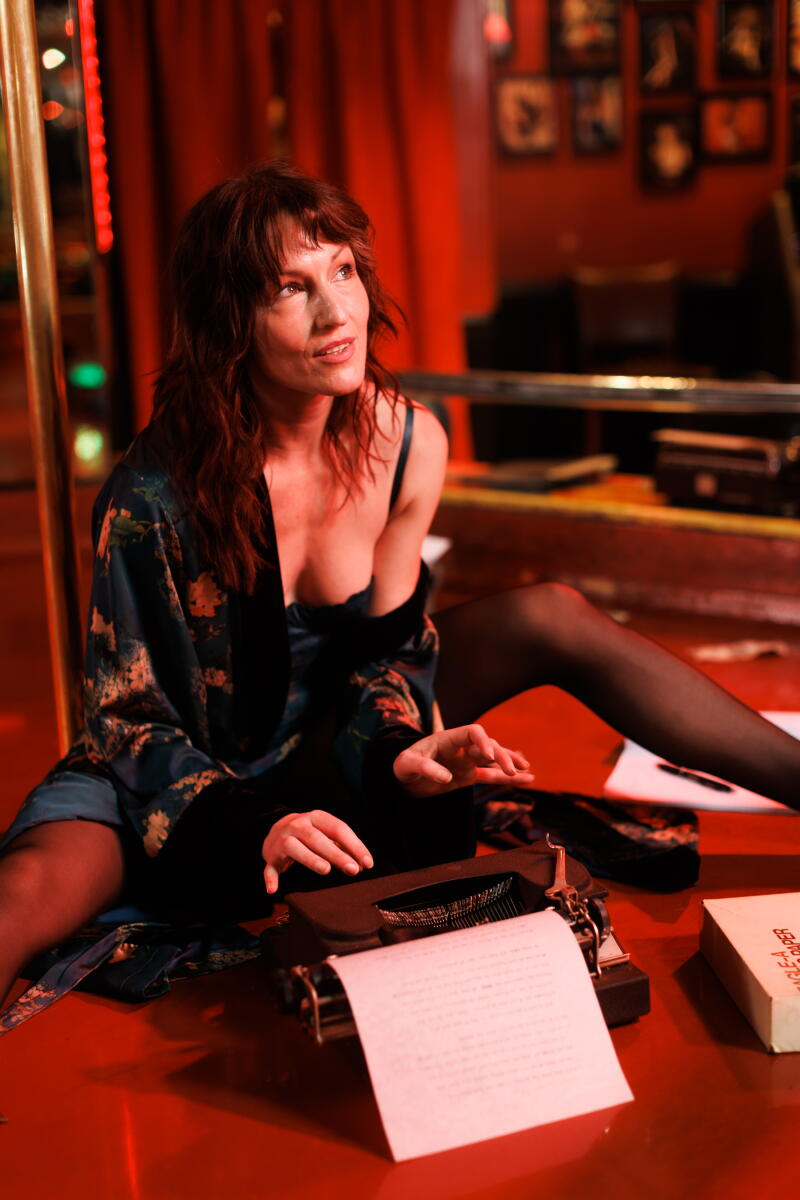
Honey Ryder (Claudia Musikul) types on the bar inside Jumbo’s Clown Room.(Carlin Stiehl / For The Times)
Fairchild is a playwright, poet and memoirist. Her recently completed memoir, “The Poison + The Spit,” traces a life of tumultuous love affairs and a stint dancing in New Orleans, rendered in prose that is whimsical, surreal and deeply emotional. The dancer also hosts the Downpour, a popular monthly literary salon at Bar Covell, and recently directed “Fool in the Pool,” a play that premiered at El Condor in Silver Lake this summer.
Her writing style mirrors her dancing: kinetic, wild and unpredictable. She sometimes takes the stage in roller skates, dancing to David Bowie. Her memoir achieves that same sense of hypnotic motion. “The memoir is so heavy,” she says. “Everything was so sad that I needed some lens to look at it that was fun, zippy and crazy.”
For Fairchild, dancing and writing possess the same need to expose oneself. “Vulnerability is one of the most interesting things about dancing,” she says. “There really is the potential to look into people, and they look into you, and you wordlessly share something with them that is half sexual and half this other thing.”
Meanwhile, Danielle Henderson — another dancer and aspiring novelist at Jumbo’s who writes under the pen name D.M. Faulk — has been working on a science-fiction novel titled “Meridian.” The book imagines a dystopian American wasteland where pregnant women are surveilled and controlled. She has been a longtime science-fiction fan since she and her father watched “Jurassic Park” and “Planet of the Apes” when she was a child.
Long treated as passive muses by visiting writers, Jumbo’s dancers — from left, Caroline Blaike (Caroline Moyer), Honey Ryder (Claudia Musikul), and Cecilia Fairchild — are reclaiming the narrative as active poets, memoirists and screenwriters.
(Carlin Stiehl / For The Times)
Unexpectedly, the Jumbo’s comically tiny dressing room became the inspiration for her novel. In 2022, when Roe v. Wade was overturned, conversations between dancers about reproductive rights ignited in the dressing room, which in turn informed her novel.
“A lot of those conversations happen in the dressing room. I’m incredibly inspired by the women I’m with who are incredibly sex positive and strong.” That ethos informed Henderson’s protagonist, Zayla.
In recent years, the bar has become a local author hangout. Allie Rowbottom, the author of the recent buzzy adult film novel “Lovers XXX,” discovered the bar in 2011 on the occasion of writer Elizabeth Hall’s birthday party. “I recall sitting front row on novelist Jon Lindsey’s lap, raining dollar bills on dancers performing intricate, beautiful athletic feats,” Rowbottom says. “I spent more than I could afford that night and have been back often since.”
Increasingly, Jumbo’s has cemented itself as a watering hole to the local writing scene. “Two years ago, I rented out a few tables for Jon Lindsey’s birthday, attended by Los Angeles literati like Tea Hacic-Vlahovic, Sammy Loren, Morgan Krantz, Tex Gresham and Nada Alic,” she adds.
According to Rowbottom, Jumbo’s is rife for literary inspiration. “To me, Jumbo’s feels uniquely dedicated, as a venue, to intersecting sex and art, despite the obvious dissonance of selling either,” she says. “I suspect such is what has historically made it a rich spot for writers, dissonance and tension being of utmost importance to good literary work.”
From left, Caroline Blaike (Caroline Moyer), Honey Ryder (Claudia Musikul), Cecilia Fairchild and Stephen (Aaron Laughton) inside Jumbo’s Clown Room.
(Carlin Stiehl / For The Times)
A charged scene in L.A. writer Aiden Arata’s critically-acclaimed 2025 essay collection, “You Have a New Memory,” features a night out at Jumbo’s Clown Room. “The dancers are starlets, athletes, artists; the theme is clown, and also longing — longing is a high form of physical comedy,” says Arata. “It possesses that heady mix of scuzz and glamour that can trick you into thinking your life is about to change.”
Jumbo’s burgeoning literary interest revives a hotly debated question: Who gets to tell the stories of sex work? For decades, the club has inspired celebrated writers and filmmakers, but Claudia Musikul — a dancer at Jumbo’s and a screenwriter herself — hopes its literary legacy will increasingly belong to the people at its core: the dancers.
“I hope that everybody can actually get their work out there because I feel it’s much deserved,” says Musikul. “You’ve probably heard about Bukowski, David Lynch doing ‘Blue Velvet’, or Anthony Bourdain. That’s all really cool, but in a way, it’s the actual dancers’ turn to have that kind of recognition.”
Musikul primarily writes screenplays about strippers, a subject she believes is seldom represented authentically. She has been in writing partnerships and workshops while developing scripts centered on dancers. In a sea of films depicting sex work, she cites Paul Verhoeven’s “Showgirls” as a film that resonates with her experience.
“‘Showgirls’ is my very favorite movie,” she says. “It’s my very special place in my heart movie.”
For Caroline Blaike, a poet and dancer at Jumbo’s, the connection between dancing and writing lies in observation. Years of performing have made her acutely attentive to the people who pass through the club, a voyeuristic habit that carries over into her poetry.
“When you’re a dancer, you’re very observant. You watch every person that walks in,” she says. “I feel like the way dancing makes you observe people helps you write from a perspective that other people can then relate to.”
Blaike has been working on a poetry collection that explores love, queerness, desire and personhood. “It’s gotten a little sexier over time, which is kind of fun,” she says. “I also just write about love, being gay, just existing. It can be a little aggressive, but people seem to like it, so that’s good.” She writes these poems from her prized typewriter — a “1951 Olympia typewriter that is my child.”
Among Blaike’s earliest literary touchstones was Maya Angelou. She still remembers encountering Angelou’s line in her poem “Still I Rise,” “I dance like I have diamonds at the meeting of my thighs,” and being stunned by it.
“I was like, ‘Oh, you can write that? That’s amazing,’” she says.
The literary ambitions at Jumbo’s extend well beyond the stage. Stephen Laughton, one of the club’s security guards, jokes that he leads a double life. By night, he keeps watch at the door; by day, he is an award-winning playwright. He’s recently been named the new associate artistic director of the Echo Theater in Atwater Village, and Laughton’s served as the writer-in-residence in the astrophysics department at the Natural History Museum in New York. Last November, his latest play became the first in the world to be staged in a planetarium.
“It’s this crazy, beautiful science play about two guys who meet in a club that explores mental health in the LGBT community, human interaction, time and astrophysics,” Laughton says.
Like many of his co-workers, Laughton has found himself turning Jumbo’s into copy. The club, he suggests, has a way of compelling everyone who works there to write about it.
“I think that probably what we’re all going to realize is that we’re all writing a version of the exact same story,” Laughton jokes.
Blaike argues that the dancers’ diverse talents are a key reason why Jumbo’s Clown Room has become such a beloved institution in the city. “It attracts confident, creative women who work there,” says Blaike. “Our community of women is supportive of each other and each other’s endeavors. … It really does facilitate that.”
Bernina Express train on Landwasser Viaduct, Filisur, Graubunden, Switzerland
Flight chaos and cost driving people to trains and cruises, report says Holiday experts say the rising cost and uncertainity of air travel is sparking a rising interest in rail and cruise breaks in the UK. Bookings for rail and cruise itineraries have jumped 31% year-on-year, according to a report from The Luxury Holiday Company – with 87% saying they are interested in a rail or cruise holiday in 2026.
Nearly half say these types of holidays now offer better value for money and 27% say they want to avoid ‘airport hassle’
The report also found a growing shift towards multi-generational holidays whike people want to prioritise ease, comfort and ‘together time’. The data shows that European-specific rail holidays are alsogetting longer, with average stays increasing by 14%, while European and Scandinavian cruises have surged by 433% year-on-year.
Scenic journeys also play a major role, with more than a third saying scenery and views are a core part of the holiday experience.
Alison Nicolle, rail and cruise travel specialist at The Luxury Holiday Company, said: “Our research shows Brits’ travel priorities this year include a strong desire for experience-driven or bucket-list-style holidays. We’re seeing a rise in rail and cruise holidays year on year, and there’s no sign of this slowing down.
“In 2026 travellers want to see more, and enjoy the journey itself, all while reducing the stress of constant planning. We’ve seen demand rise for groups booking a cruise or rail holiday, as group bookings have skyrocketed 55% in the past year.
“This isn’t just a niche trend. Groups want holidays where everyone, from grandparents to grandchildren, can experience beautiful destinations, relax and enjoy the journey itself. Slowing down, seeing nature and prioritising relaxation over adventure are the most important factor to more than a third of travellers this year.
“Clients are booking longer rail journeys as well as choosing itineraries that combine scenery, culture and indulgence. It’s no longer about getting there quickly, it’s about travelling well.”
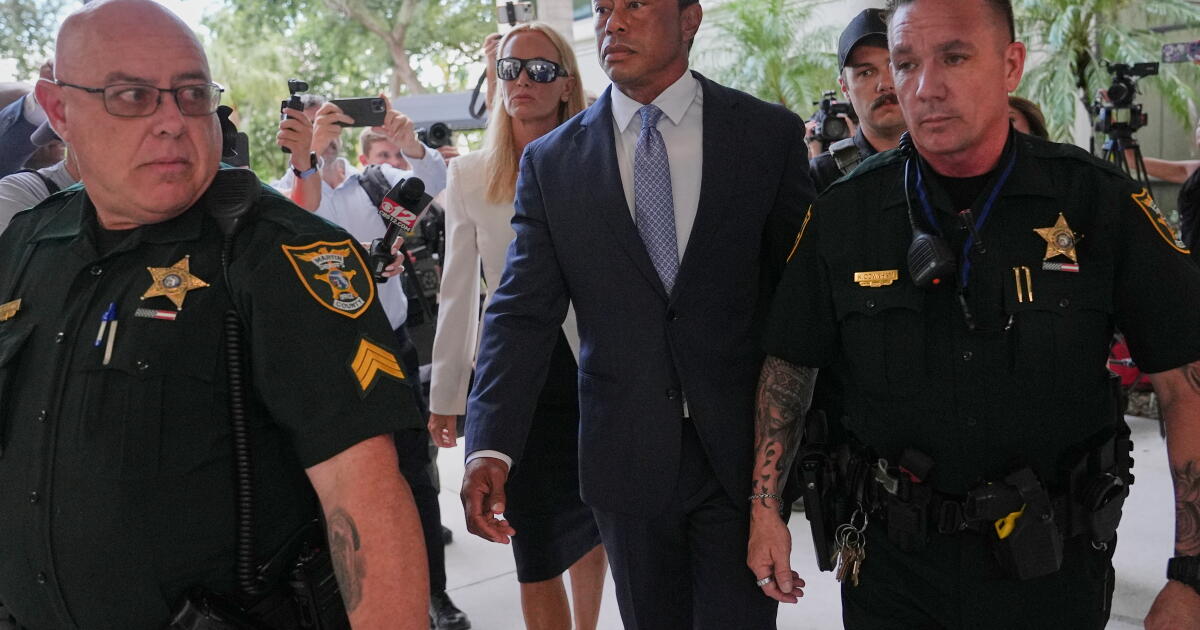
Tiger Woods was suspended from driving for five years and fined after reaching a plea deal at a Florida court Wednesday in connection with a rollover crash in March.
The golf legend pleaded guilty to reckless driving and refusal to submit to a lawful urinalysis test. The agreement also includes a $1,000 fine.
Woods, 50, initially pleaded not guilty after being charged with driving under the influence on March 27. His Land Rover clipped a truck, rolled onto its side and he was arrested by police officers who responded to the incident after he failed a sobriety test.
An arrest affidavit indicated Woods said he was looking at his cellphone and changing the radio station when the crash occurred. The breathalyzer test showed no traces of alcohol, but Woods refused to take a urine test, had two hydrocodone pills in his pocket and admitted to taking “a few pills,” the report said.
Woods’ attorney, Douglas Duncan, pleaded not guilty to both charges March 31 and requested a jury trial. The judge allowed Woods to leave the country for inpatient treatment at a rehab facility in Switzerland.
Woods’ pivot to recovery came after a barrage of headlines about his rollover crash and unfocused, hiccups-laden aftermath captured on police officers’ body cameras that included a phone call to President Trump, the failed field sobriety tests, handcuffs and a drive to jail in the back seat of a squad car.
At a hearing in May, Steele granted prosecutors’ request for access to “any and all prescription medication on file” for Woods, including type of prescription, number of pills and dosage amount. Those details presumably would have been submitted as evidence at a trial, which now will not take place.
“I know and understand the seriousness of the situation I find myself in today,” Woods said in a statement in March. “I am stepping away for a period of time to seek treatment and focus on my health. This is necessary in order for me to prioritize my well-being and work toward lasting recovery. I’m committed to taking the time needed to return to a healthier, stronger, and more focused place, both personally and professionally.”
Woods’ struggles with prescription drugs became public in 2017 when police found him asleep at the wheel of his car with the engine running near his Jupiter, Fla., home. Painkillers, sleep aids and THC were detected in his system. Woods checked into rehab shortly after that incident, saying his efforts to manage insomnia and pain from his staggering number of back surgeries on his own was a mistake.
The latest crash is the fourth major incident involving Woods behind the wheel since 2009.
“I feel bad for Tiger,” fellow golf great Jack Nicklaus told the Palm Beach Post in April. “He’s been taking painkillers for a long time and I don’t know how much pain he’s in. But I don’t think he’d be taking them if he didn’t need them.”
Woods first hurt his back as a high school sophomore in 1992 when he became the youngest golfer to play in a PGA Tour event, shooting a one-over-par 72 at Riviera Country Club in Los Angeles. That began a career-threatening battle with back injuries that includes seven surgeries since 2014 — several microdiscectomies, a 2017 lumbar fusion and most recently a lumbar disc replacement performed in October 2025.
“Tiger Woods’ experience with spinal disease highlights a real and under-recognized issue among modern-era golfers,” said Dr. Corey Walker of the Barrow Neurological Institute. “Tiger’s use of the mechanics of the modern-day swing places a tremendous strain on the back.”
Woods last played in an official PGA Tour event at The Open Championship on July 19, 2024, at Royal Troon, missing the cut.
Syria has suffered its worst bloodshed since Bashar Al-Assad was ousted in December, with more than 1,000 people reported killed in violence that has swept the coastal region of the country since Thursday. The violence has pitted the Islamist-led government’s security forces against fighters from Assad’s Alawite minority.
The dead include hundreds of Alawite civilians, whom the a British-based organisation that reports on the conflict, the Syrian Observatory for Human Rights, reported were killed in reprisals after attacks on security forces.
What has driven the violence; how has interim President Ahmed Al-Sharaa reacted; and what have world powers said?
The violence began to spiral on Thursday, when the authorities said that their forces in the coastal region came under attack from fighters aligned with the ousted Assad regime. The interim government poured reinforcements into the area, which is heavily populated by Alawites, to crush what it described as a deadly, well-planned and premeditated assault by remnants of the previous regime.
As government reinforcements deployed, mosques in regions loyal to the new administration began calling on people to wage jihad, or holy struggle, in support of security forces.
By Friday afternoon, reports began emerging of scores of civilians being killed in sectarian reprisals in Alawite towns and villages. As of Sunday evening, the Syrian Observatory for Human Rights said that 973 civilians were killed in reprisal attacks carried out by government forces or fighters aligned with them. More than 250 Alawite fighters were killed and more than 230 members of government security forces were also killed, it added. Reuters has not been able to independently verify the tolls.
The Alawites are the second-largest religious group in Syria after Sunni Muslims. Their faith is an offshoot of Shia Islam. The Assad regime recruited heavily from the Alawite community for its army and security apparatus, which was notorious for its brutality during more than five decades of the family’s rule.
This put many Alawites on the front lines of the civil war that erupted out of protests against Assad’s rule in 2011. The conflict took on a sectarian dimension as Sunni Muslim rebel groups sought to topple the Assad government which was backed by Shia Iran, Lebanon’s Shia Hezbollah movement and others.
Al-Sharaa led the most powerful Sunni group fighting Assad. Known as the Nusra Front, the group was part of Al-Qaeda until he severed ties with the jihadist network in 2016 and renamed his organisation. In a 2015 interview with Al Jazeera, Al-Sharaa described the Alawites as part of a sect that “moved outside the religion of God and of Islam” and urged them to renounce Assad and change their beliefs to remain safe.
Since Assad was ousted, the interim president has pledged to run Syria in an inclusive way. But while he has publicly engaged Kurds, Christians and Druze, there have been no declared meetings between him and senior Alawite figures. Many Alawites say that they suffered like other Syrians under the rule of Assad and his father, both of whom came from the sect.
Prior to Thursday’s escalation, Alawite activists had reported violence and attacks on their community following Assad’s ouster, particularly in rural Homs and Latakia.
In a speech on Sunday, Al-Sharaa said that remnants of the Assad government, supported by external parties, were seeking to create strife and drag Syria back into civil war with the aim of dividing it. He promised to form a fact-finding committee and said its findings would be made public, vowing to bring to account anyone involved “in the bloodshed of civilians” or mistreating them.
He has also announced the formation of a committee aimed at preserving civil peace, which would be tasked with communicating with the people on the coast and providing them with the support they needed to guarantee their protection.
The violence has prompted international alarm.
The United States, which imposes sanctions on Damascus, urged the Syrian authorities to hold accountable the “radical Islamist terrorists” [sic] that had killed people in Syria and said it stood with Syria’s religious and ethnic minorities.
Israeli Defence Minister Israel Katz said on social media that atrocities committed against the Alawites showed that Al-Sharaa had revealed his “true face” as a jihadist.
However, Saudi Arabia and Turkey, allies of Damascus, both signalled their backing for the interim administration as violence was escalating last week. Riyadh condemned “crimes being undertaken by outlaw groups” in Syria and their targeting of security forces.
Turkish Foreign Minister Hakan Fidan, whose country has forces on the ground in north-west Syria, has urged calm and said unnamed foreign elements were partly to blame.
Iran, which backed Assad through the war, has warned that the violence in Syria could cause regional instability.
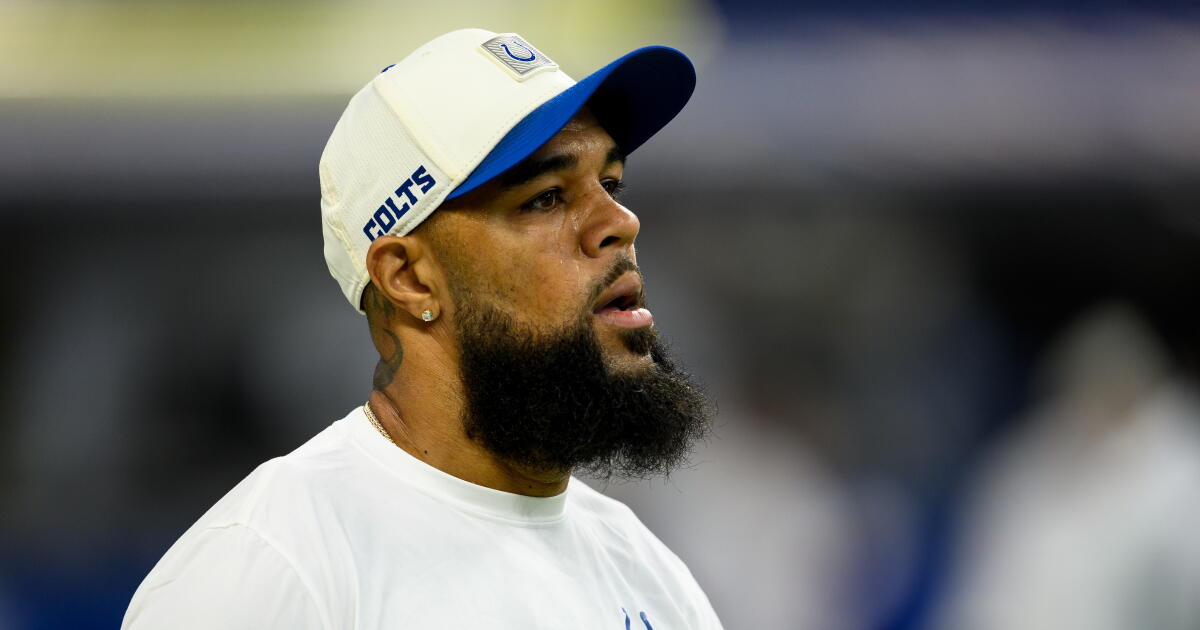
Six-time Pro Bowl receiver Keenan Allen was arrested Sunday in downtown Indianapolis on suspicion of drunken driving.
According to the Indianapolis Metropolitan Police Department, officers observed a vehicle parked in a no-parking zone on the 100 block of South Meridian Street shortly after 1 a.m. and conducted a traffic investigation. While speaking to the driver, who was later identified as Allen, officers noticed signs of intoxication.
Following further investigation, the longtime Chargers player and current Indianapolis Colts receiver was arrested on preliminary misdemeanor charges of operating a motor vehicle while intoxicated (blood-alcohol level of .08 or higher) and OVWI (operating a vehicle while intoxicated) endangering a person.
Jail records show that Allen was released Sunday afternoon and has a court date scheduled for Sept. 16.
“An arrest and a charge are merely accusations, and Allen should be considered innocent unless and until found guilty in court,” the police department said in a statement. “The Marion County Prosecutor’s Office will make the final charging decision.”
Allen was selected by the Chargers in the third round of the 2013 draft and made the Pro Bowl each year from 2017 to 2021 and again in 2023. After playing with the Chicago Bears in 2024 and returning to the Chargers last season, Allen signed with the Colts earlier this month and was included on their initial 53-man roster when it was released Sunday evening.
“We are aware of the incident involving Keenan Allen last night,” the Colts said in a statement earlier on Sunday. “We are in the process of gathering more information and have no further comment at this time.”
Allen has 1,055 career receptions (13th all time) for 12,051 yards (33rd all time) with 70 touchdown catches (52nd all time).
JESY Nelson has shared a loved up snap with her new boyfriend Ben Davies after they were caught up in a bar row last week.
The former Little Mix star, 35, took to her Instagram stories on Wednesday evening to post the sweet picture.
Jesy Nelson has shared a loved-up snap with her new boyfriendCredit: InstagramShe shared a snap of her man Ben Davies while drivingCredit: jesynelson/ Instagram
In the photo, Ben could be seen driving as he had one hand on the steering wheel and the other interlocked into Jesy’s hand.
He was sporting an all-black look with a Givenchy t-shirt and a matching cap.
Sign up for the Showbiz newsletter
Thank you!
The pair appeared to be loved-up as she posted the picture during their outing together.
The two were spotted together at the London venue Jin Bo Law after appearing to grow close, with the singer later sharing a picture of a tattooed arm as she enjoyed drinks on a rooftop.
An eyewitness who saw them together at the time said Jesy “looked like she was having a great time”, adding that it was “massively deserved after everything she’s been through”.
She’s been through an incredibly tough time over the past year and a half after her twin daughters Ocean Jade and Story Monroe were diagnosed with the muscle-wasting condition Spinal Muscular Atrophy Type 1.
The rare and severe condition causes muscle weakness and can affect movement, breathing and swallowing.
Jesy was first linked to landscape gardener Ben earlier this monthCredit: SuppliedShe’s been through a tough time over the past year after her twins’ diagnosisCredit: Instagram
Jesy has been documenting her daughters’ health battle and has spoken openly about the emotional toll of watching them undergo treatment.
Jesy has previously described the girls’ health journey as one of the hardest experiences of her life.