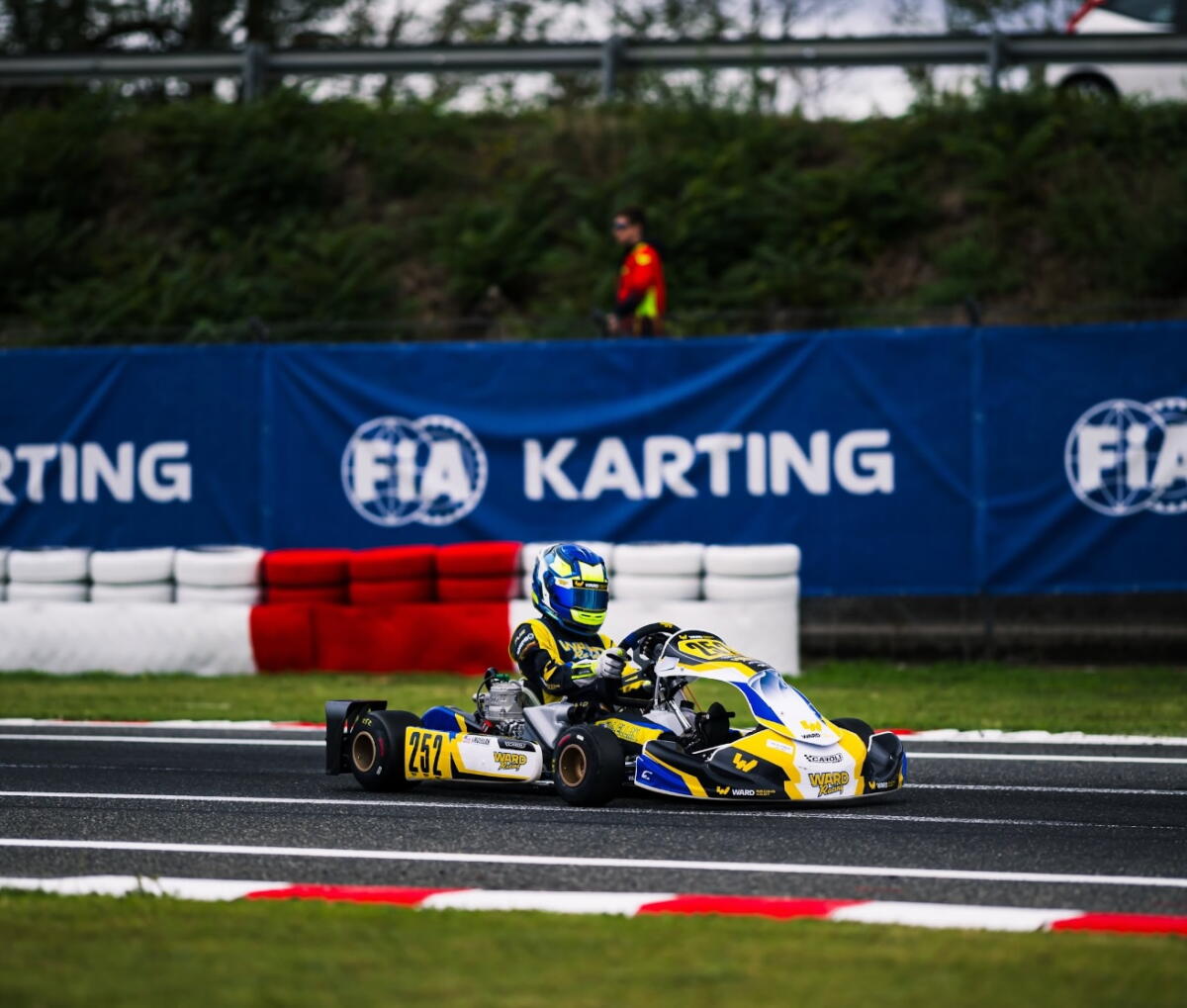
John McLellan is not old enough to have a driver’s license at 13 years old, but the Redondo Beach teenager has been racing kart cars at speeds nearing 80 mph in Italy this month.
Last week, he had a breakthrough performance, finishing third among 117 drivers representing 33 countries at the FIA Karting World Cup OK-N Junior Final at Leopard Circuit Viterbo, Italy.
His father, John Sr., sent him to Italy for four weeks to compete for Sweden-based Ward Racing.
“Dad is on him all the time,” his father said. “Do your homework, brush your teeth.”
“Yes and yes,” John Jr. said this week after returning home.
John Jr. is enrolled in a Texas-based online middle school to help with his unpredictable traveling schedule. He had been a club soccer player until deciding racing is what he wants to do.
First he was into motocross at age 6. After an accident resulting in a broken hand and broken collarbone, kart racing became his specialty, with a dream of racing Formula 1 cars.
John McLellan, 13, in his Kart car.
(Matteo Segago)
His mother is from Australia and his father is a Torrance native who chose racing motorcycles over playing high school soccer. Like father, like son.
“He loves it,” John Sr. said. “What kid wouldn’t want to race cars?”
John said of the strangeness driving high speeds at 13: “Whenever you have a kid going 80 mph without a driver’s license and going to middle school, you would think that’s absolute carnage and crazy. Karting is just a very competitive sport.”
The average lap speeds are 56 mph. John wants to attend a regular high school when he enters ninth grade next year, so whether it’s Rolling Hills Prep or Redondo Union, new friends need to know they’re hanging out with a teenager who, as Tom Cruise said in “Top Gun,” “I feel the need … the need for speed.”
This is a daily look at the positive happenings in high school sports. To submit any news, please email eric.sondheimer@latimes.com.
Missing Q2 was disappointing but he responded with a strong recovery on Sunday. Climbed from 15th on the grid to finish just outside the points and comfortably ahead of Audi team-mate Bortoleto after the Brazilian’s penalty.
Lance Stroll – 6.5/10
A much more competitive weekend for Aston Martin generally. Stroll joined Alonso in Q2 and kept himself out of trouble through a chaotic race to finish 12th, even if his team-mate ultimately extracted more from the opportunity.
Franco Colapinto – 7/10
Started 21st due to grid penalties, so 13th represented a very respectable recovery. Kept things clean after his costly mistake last time out and made up plenty of ground in difficult conditions.
Oliver Bearman – 5/10
Another fairly anonymous weekend for Haas. Knocked out in Q1 and although he gained a couple of places during the race, 14th was about all there was to show for it.
Esteban Ocon – 5/10
Frustrated with Haas’ qualifying run plan after going out in Q1 and never really recovered from there. Great start and was fighting well inside the top 10. Ultimately finished behind Bearman and was unable to make the changing conditions work sufficiently to threaten the points.
Pierre Gasly – 5.5/10
Qualifying ninth was an excellent start but Sunday unravelled almost immediately. Nearly lost the car on slicks during the formation procedure and ultimately fell all the way to 16th as Alpine’s gamble failed to pay off.
Carlos Sainz – 6/10
Williams struggled for pace throughout the weekend but 13th represented a good qualifying. His race was then further compromised by contact with Bortoleto, for which the Audi driver was penalised, so 17th doesn’t tell the whole story.
Gabriel Bortoleto – 4.5/10
There was plenty to like about reaching Q3 in the Audi, but the race undid that good work. Contact with Sainz earned him a penalty and left him 18th after starting inside the top 10.
Sergio Perez – 4/10
Qualified last and never looked likely to make meaningful progress even amid all the chaos. Reaching the chequered flag was at least something for Cadillac, but 19th completed another difficult weekend.
George Russell – 8/10
A far better race than his eighth place in qualifying suggested. Made an excellent start, ran inside the top three for virtually the entire afternoon and, even if he couldn’t match Mercedes team-mate Antonelli, was heading for another podium before a power-unit failure stopped him with five laps remaining.
Alex Albon – 4.5/10
Williams lacked pace from the outset and qualifying 20th left him with an enormous amount of work to do. His eventual retirement was caused by a gearbox problem rather than a driving error, but there had been little sign of any kind of meaningful challenge before then.
Valtteri Bottas – 3.5/10
A weekend to forget. Qualified ahead of Cadillac team-mate Perez but admitted his decision to run slicks was a risk before spinning into the gravel on lap nine and triggering the first safety car.
U.S. Immigration and Customs Enforcement officers have been ordered not to engage in high-speed car chases and to make vehicle stops only if they have completed specific training, under new internal guidance issued after several drivers were shot in encounters with ICE.
A memo sent to officers in ICE’s Enforcement and Removal Operations division and obtained by the Associated Press warned they are not any under circumstances authorized to chase vehicles that fail to pull over. Instead, officers should take down the vehicles’ information for further investigation, according to the memo signed by ICE’s executive associate director, Marcos D. Charles, and dated Wednesday.
The new guidance comes after ICE-initiated vehicle stops have repeatedly escalated when drivers have refused to cooperate or tried to flee. ICE agents have opened fire during more than a dozen such encounters since last year, killing at least four people and wounding several others.
President Trump’s administration has faced internal tension over how to handle traffic stops, which are seen as particularly high-risk encounters.
After fatal shootings of drivers in Maine and Texas in July, ICE officers were directed to temporarily pause most vehicle stops. But the next day, Trump went on social media to direct the agency to continue traffic stops, calling them “one of ICE’s most important and effective Crime Fighting tools.”
ICE has faced intense pressure from the White House to deport more people who are in the country illegally, and its arrests have reached record numbers. At the same time, the agency’s rapid hiring spree last year resulted in some poorly vetted and trained officers hitting the streets.
In a statement, ICE downplayed the significance of the memo, which said the new guidance was intended to replace and amend previous directives issued earlier this year, last year and in 2018.
“Occasionally, ICE leadership issues guidance reminders to law enforcement officers,” the statement said. “Vehicle stops and arrests of illegal aliens continue.”
The new memo outlines steps intended to improve the safety of vehicle stops for ICE officers, drivers they are targeting, their passengers and the public.
The memo told ICE’s field office directors that they must ensure vehicles used for traffic stops have lights and sirens that let the public know they are law enforcement vehicles when activated. Underthe guidance, all officers on the scenes of vehicle stops must wear and activate their body cameras.
In addition, only officers who have completed one of five specific agency training courses can conduct vehicle stops. Officers who have not completed the courses can participate in vehicle stops only “in a support capacity” as passengers and cannot be the drivers of any of the vehicles involved.
The guidance says ICE officers can continue to use a controversial technique known as pinning, which is defined as “using a vehicle or physical barrier to trap or stop a car,” but only if they have received special training. Similarly, only trained officers can use spike strips that deflate tires to prevent drivers from fleeing.
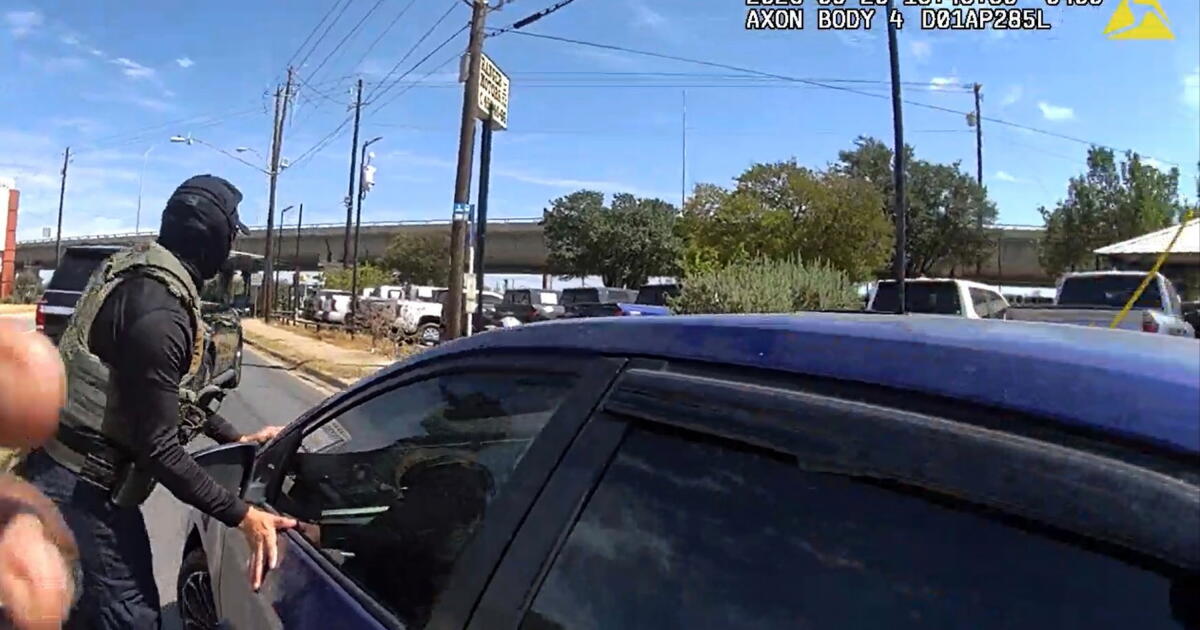
The memo came the day that courtroom testimony highlighted ways in which two ICE officers involved in a vehicle stop, pursuit and shooting that wounded a delivery driver in Austin last month would not have complied with the new guidance.
During a bond hearing for Wilber Rafael Garces Perez, testimony showed that the officer who shot him wasn’t wearing a body-worn camera. The ICE officer who did have a camera was driving in a separate car and turned it off during the pursuit.
Prosecutors presented surveillance video that showed an ICE agent chasing Garces Perez at high speeds through residential streets after he fled an initial traffic stop.
Garces Perez faces federal assault charges after investigators say he struck an ICE officer with his driver’s side mirror. That officer then shot into Perez’s vehicle, lodging a bullet in his back, officials say.
Attorneys for Garces Perez have called the charges against him “retaliation” and have argued that the camera footage was inconclusive because it didn’t fully capture the moment when he allegedly tried to flee.
Foley writes for the Associated Press. AP reporter Anna Wilder contributed to this report from Austin, Texas.
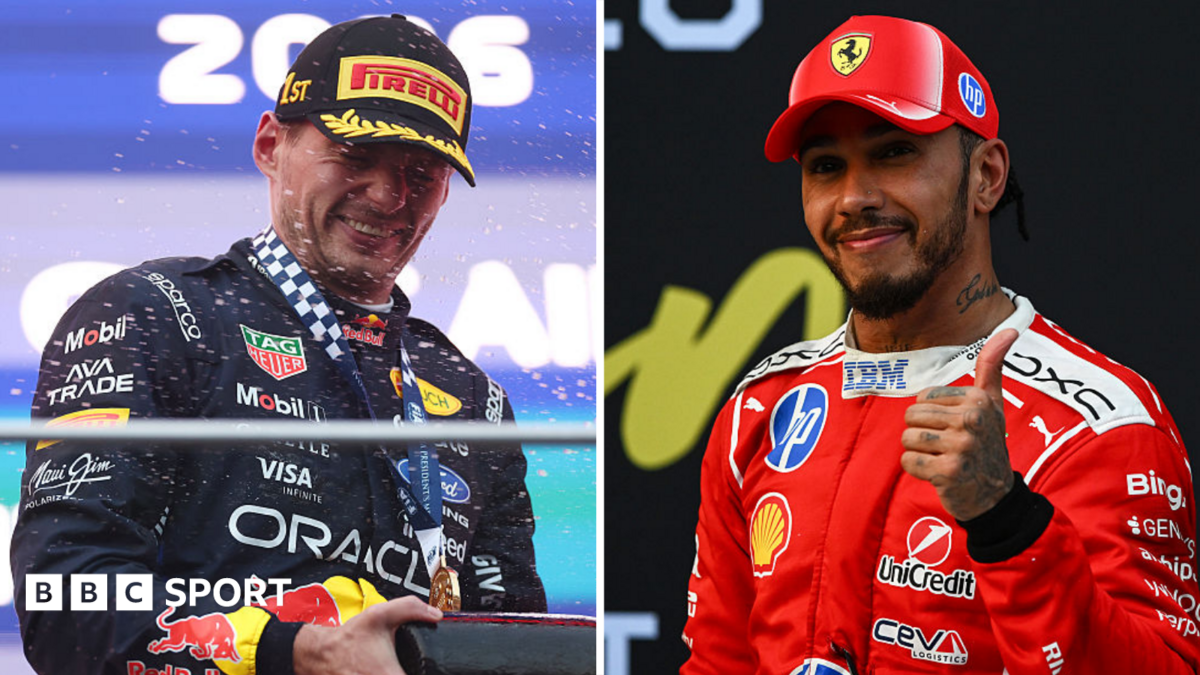
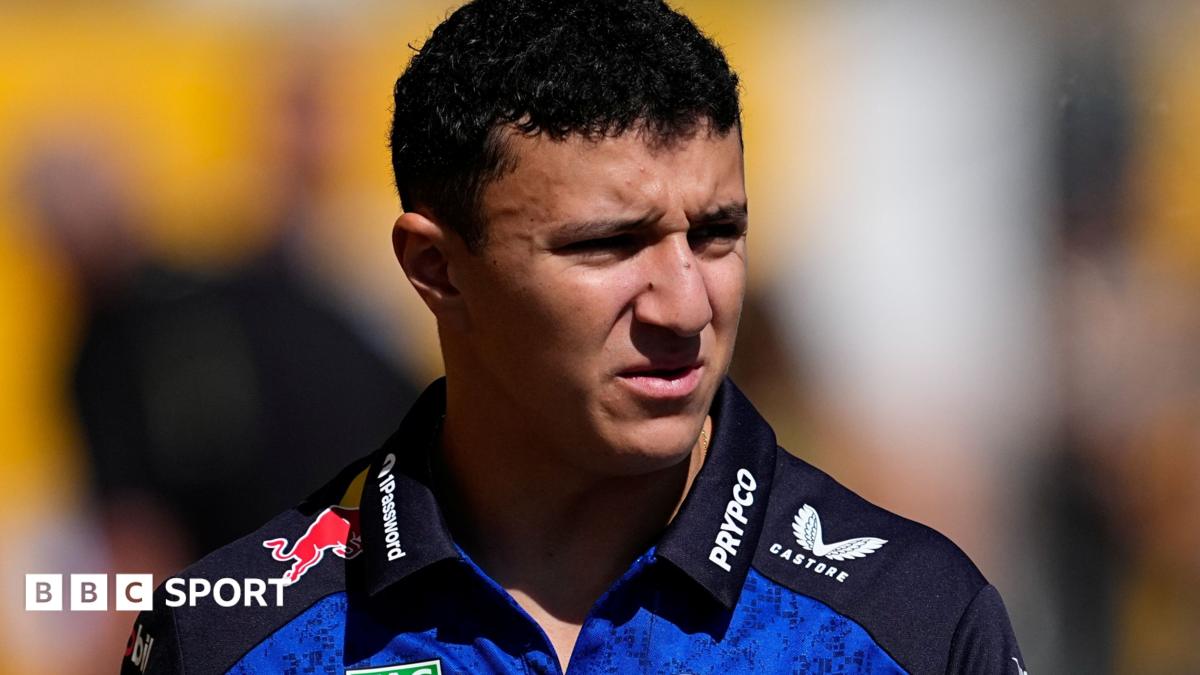
Frenchman Isack Hadjar is to stay at Red Bull as Max Verstappen’s team-mate for the 2027 season.
The 21-year-old was promoted to the senior team this season after a rookie year with Racing Bulls and has managed to be closer to Verstappen on pace than any team-mate since Daniel Ricciardo in 2018.
His best result this season came with a third place at the Monaco Grand Prix.
Red Bull team principal Laurent Mekies described the move as “an easy decision”.
Mekies said: “Since joining us at the start of the year, Isack has been superb on and off track, especially considering this is only his second F1 season.”
Hadjar returns to Red Bull for this weekend’s Azerbaijan Grand Prix after missing the past three races with a broken wrist, an injury sustained while boxing as part of his training programme.
Mekies added: “You could see from his first weekend in Melbourne that he handled the step up with remarkable composure and had earned his place in this seat.
“The period since his injury has been a difficult one for Isack, but this extension shows how much we believe in him.”
Hadjar said: “I came to this team eight months ago and immediately understood the scale and ambition of this organisation.
“There are so many talented people at the factory, and you’re aware of the privilege of driving for such an incredible team alongside a four-time world champion like Max.
“I’m constantly looking to listen, learn and push myself further every single day, which only makes me more excited about what lies ahead.”
Over the first half of the season, Hadjar was 0.239 seconds slower than Verstappen on average in qualifying and has managed to out-qualify the Dutchman three times, in Australia, Japan and Britain.
In Silverstone Verstappen had a down-on-power engine and in Australia the Dutchman crashed at the start of qualifying.
Verstappen signed a two-year extension to his contract, that now runs to the end of 2030, in August.
Marvin Reid can’t say how many pedestrians he’s seen get hit while trying to brave the North Hollywood intersection of Magnolia Boulevard and Tujunga Avenue. He gave up keeping count long ago.
One afternoon last spring, he watched a man get run over while walking toward a 7-Eleven on the corner. Fortunately, the man popped to his feet “like nothing ever happened” and hustled into the store, Reid said. A week or two prior, he said, an out-of-control motorist nearly plowed into the statue of Amelia Earhart that sits next to a library bearing the famous aviator’s name.
“This is really a bad spot,” said Reid, who has helped run a Jamaican food pop-up at the busy street corner for the past five years. “It doesn’t matter if it’s an old lady crossing the street with a walker.”
The number of Angelenos who die in traffic crashes now regularly outpaces those killed by homicide. From 2016 to 2023, the annual traffic death toll rose nearly 29% overall, and pedestrian deaths jumped roughly 54%. Fatal crashes fell slightly last year, but deaths still exceeded 300 in each of the last three years.
The city is rolling out 125 speed cameras in school zones, known street-racing corridors and places where speeding has contributed to a high rate of collisions — including Reid’s intersection.
But for him, the cameras aren’t a replacement for police traffic enforcement, which he said seems virtually nonexistent.
Even though LAPD squad cars are posted up outside the library “everyday,” he says, they rarely do anything about the drivers who come careening off the exit ramps from the nearby 170 Freeway.
Similar complaints are being echoed around the city. Historically, Los Angeles — like other places across the U.S. — has relied on police stops to produce road safety. But in recent years, public pressure has compelled city leaders to think more critically about whether enforcement can continue without the historical harms that has come along with it.
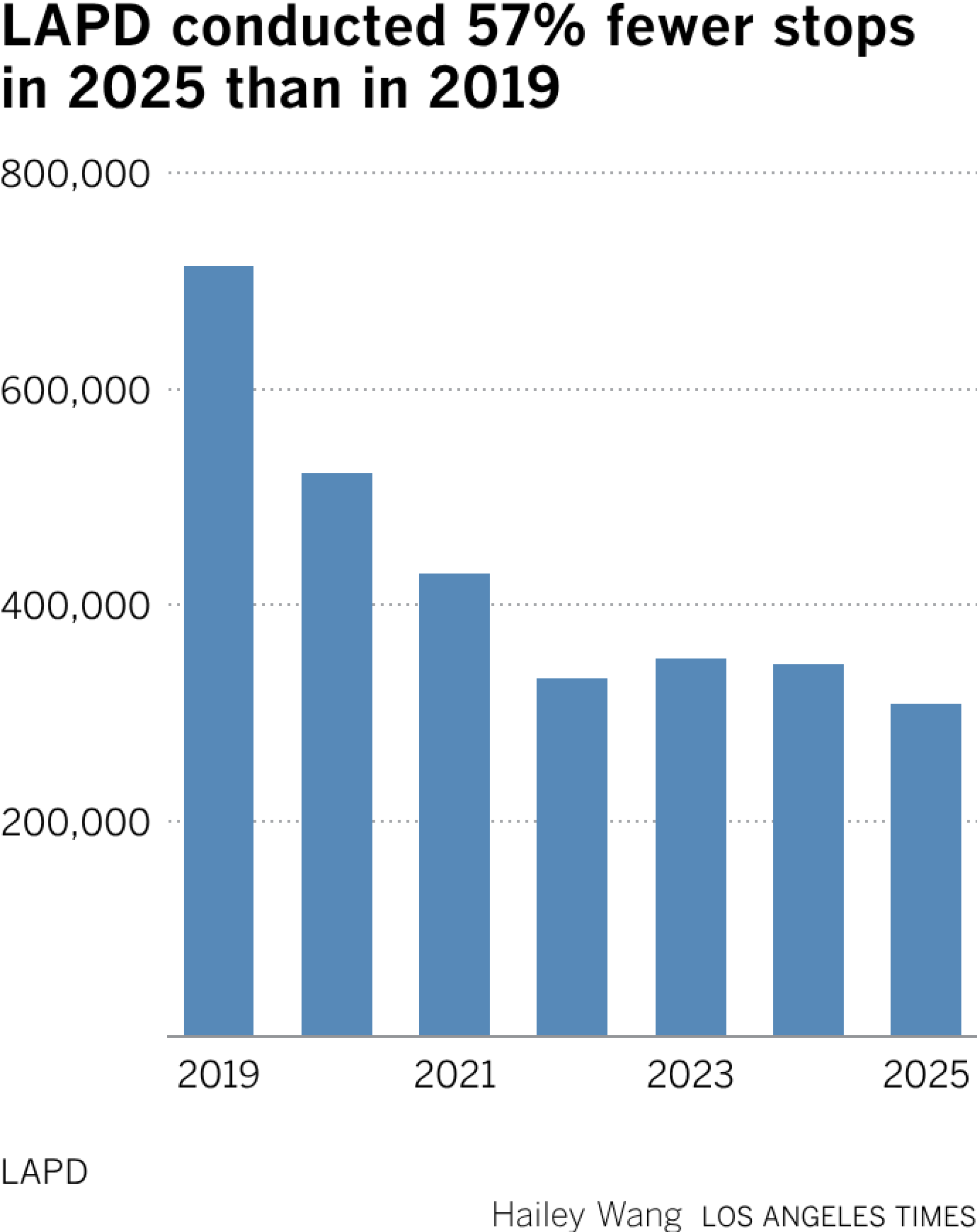
LAPD data show the department is far less proactive than it used to be.
In 2019, LAPD officers made about 713,000 stops across the city; by 2025, that number had decreased to roughly 308,000 — a roughly 57% decline. A Times analysis of police stop data found that the drop-off was especially pronounced in the Central, West Valley, 77th Street and Southeast police divisions.
In some ways, the decline in stops is unsurprising. Other large U.S. cities have seen similar changes in enforcement strategies by police since the pandemic. As the department continues to shrink, LAPD commanders say they have fewer resources to devote to traffic duty. Officials have been under pressure to curb the use of so-called “pretext stops,” in which officers use a minor violation — a broken turn signal, say, or a cracked windshield — as justification to stop someone in order to investigate whether a more serious crime has occurred.
The largest declines were in the Central and 77th Street areas
Change in police stops, 2019 to 2025
LAPD
Hailey Wang LOS ANGELES TIMES
Reform activists and some city leaders argue the stops are fishing expeditions that lead to police abuses — while failing to deliver safer streets.
The practice of pulling over random vehicles, often based on little more than a hunch, has been a cornerstone of the city’s crime-fighting strategy for decades. The tactic is especially prevalent among the department’s elite Metropolitan Division and anti-gang units, several of which have come under investigation in recent years for failing to document the stops and improper searches.
Since 2019, when a Times investigation found significant racial disparities in LAPD crime suppression tactics, officials have slowed — but never abandoned — the practice of flooding neighborhoods with tactical officers to pull people over and search their vehicles.
Four years later, stops for minor violations began dropping again after LAPD overhauled its policies to limit the circumstances under which officers can make pretext stops, joining law enforcement agencies in cities like Philadelphia, Seattle and Berkeley, Calif.
Yet a report published last year found that officers are still disproportionately targeting Black and Latino drivers.
LAPD Chief Jim McDonnell and other department leaders have fought against more restrictions, arguing they risk losing an essential weapon against serious crime.
But in May, the Los Angeles City Council passed a measure urging the Police Commission, the LAPD’s policy-making body, to further limit arbitrary pull-overs for non-moving traffic violations.
While LAPD officials had acknowledged issues in a handful of police divisions, the latest audit found that gang units citywide routinely flouted the department’s rules on pretext stops, including by often failing to obtain proper consent to search the vehicles they stopped. The inspector general’s office also found that gang officers didn’t always turn on their body-worn or dashboard cameras as required during these encounters and at times failed to properly log who they were stopping — resulting in an undercount of “both the number of detentions and the enforcement actions taken,” the report said.
The review, based on a sample of 300 stops as well as interviews with current and former gang officers, also highlighted ongoing confusion about what the department expects its officers to do when pulling someone over.
The findings of the second report — which reviewed pretext stops by officers from other units in January — are expected to be presented at an upcoming commission meeting.
The Los Angeles Police Protective League, the union for rank-and-file officers, and other proponents of pretext stops argue that elected leaders don’t grasp the consequences of doing away with the tactic, which the U.S. Supreme Court has deemed lawful.
Reform advocates have fought to deploy unarmed civilians instead of LAPD officers for traffic enforcement — as the city has already started doing for certain mental health-related calls — but the union has warned that the work is too dangerous. A state bill that would have allowed trained civilian workers to make traffic stops failed to make it through the state assembly.
With the death toll from speeding on the rise, more enforcement is needed, not less, department leaders say. The city, they argue, can’t afford to wait on alternative programs that require study, money and public buy-in that could take years.
Amid the debate over how to proceed, LAPD enforcement hasn’t vanished completely.
Even though the department no longer dispatches officers to the scenes of minor accidents, LAPD statistics show that enforcement the department’s 308-member traffic bureau has gone up. As of July, the number of traffic tickets issued had climbed 44% from the same time last year — increasing to more than 14,600 from around 10,100. Citations for impaired driving have also risen, and the department continues to crack down on street takeovers.
Still, progress toward new, non-police approaches to traffic enforcement has been frustratingly slow in Los Angeles, advocates say.
Advocates have pointed to mounting research in other cities that showed road improvements along high-injury street corridors were more effective than police at changing driver behaviors, ultimately reducing the number of traffic-related deaths and serious injuries more than the threat of being ticketed.
Supporters of so-called “self-enforcing” roads say narrowing lanes can lead to a considerable decline in crashes as drivers reduce their speed and move more cautiously than when the road is less wide. Such changes also reclaim space for protected bike lanes, public transit lines, or safer walkways — after long prioritizing convenience for cars, advocates say.
Car accidents are dangerous for everyone involved, but they have become even more hazardous for pedestrians and cyclists.
Experts cite speeding and cellphone distractions as two of the biggest problems.
Another factor is the proliferation of larger vehicles — a phenomenon known as “autobesity” — which have bigger blind spots and more likely to seriously injure a pedestrian or bicyclist.
Andres Ramirez, executive director for the transportation advocacy nonprofit People for Mobility Justice, said he’s cautiously optimism that the mayor’s promise of a “No Car” 2028 Olympic Games will help fast-track some of the most pressing road safety projects.
“The streets needs to be a lot safer for pedestrians, for bicyclists, different modes,” Ramirez said. “The most obvious way is ensuring that infrastructure projects are prioritized in communities that have long been ignored.”