After spending her first two seasons with the Chicago Sky, the two-time All Star has been traded to the Atlanta Dream in exchange for first-round picks in 2027 and 2028, the teams announced Monday morning. Atlanta also receives the option to swap second-round picks with Chicago in 2028.
“An Angel’s DREAM,” Reese posted on X. “ATL WHAT UP?!”
Reese was already a star before coming to the WNBA after helping Louisiana State win the national championship over Caitlin Clark and Iowa in 2023 and leading the Tigers back to the Elite Eight the following year.
Selected by Chicago with the seventh overall pick in the 2024 draft, Reese finished as runner-up to Clark in rookie-of-the-year voting and led the league in rebounds per game in each of her first two seasons. Overall, she has averaged 14.1 points and 12.9 rebounds a game.
The Sky have gone 23-61 and missed the playoffs both seasons since drafting Reese. On Sept. 3, the Chicago Tribune published quotes from the star player that indicated her frustration with the team’s inability to build a winning roster and an inclination to leave if the organization isn’t able to get it right.
“I’d like to be here for my career, but if things don’t pan out, obviously I might have to move in a different direction and do what’s best for me,” Reese told the Tribune.
After the Sky’s 88-64 victory over the Connecticut Sun that night, Reese told reporters she had apologized to her teammates about the article.
“I think the language is taken out of context,” she said, “and I really didn’t intentionally mean to put down my teammates, because they’ve been through this with me throughout the whole year. They’ve busted their ass, just how I bust my ass, they showed up for me through thick and thin, and in the locker room when nobody could see anything.”
Reese did not play for Chicago again. She was suspended half a game for her comments, which were deemed “detrimental to the team,” served a separate mandatory one-game suspension by the WNBA for receiving eight technical fouls during the season and missed the final three games of the season with what was listed as a back injury.
The Sky said in a statement Monday that the “trade is designed to achieve roster balance and represents a great opportunity for all parties.”
“Angel has achieved many record-breaking milestones in her first two years in the WNBA and has been a competitive force for the Sky,” the team wrote. “We are thankful for her many important contributions to this league and this game, and we know she will continue to have a big impact on the court and beyond.”
Reese joins an Atlanta team that went 30-14 and finished first in the Eastern Conference before losing to the Indiana Fever in the first round of the playoffs. The roster includes Allisha Gray, who finished fourth in the MVP voting last season, as well as sixth player of the year Naz Hillmon and All-Star Brionna Jones.
“Angel is a dynamic talent and a perfect fit for what we are building in Atlanta,” Dream general manager Dan Padover said in a statement. “She has already proven herself as one of the most impactful players in the league, and her competitiveness, production and drive to win align seamlessly with our vision. This is an exciting moment for our organization and our fans.”
If kids were in charge on holiday they would eat dessert before mains, go treasure hunting – and have a giant water fight. A poll of 1,000 children aged 6-12 revealed their ideal getaway, which would include eating three ice creams a day, using bikes or scooters as their go-to form of transport and playing board games every night.
One in five would play hide and seek with their family, 14% would indulge in a pyjama day and 40% would spend all day in the pool. When it comes to locations, 93% of youngsters want to stay at a holiday park, with 72% of them saying they are fun places with lots of activities to keep them entertained.
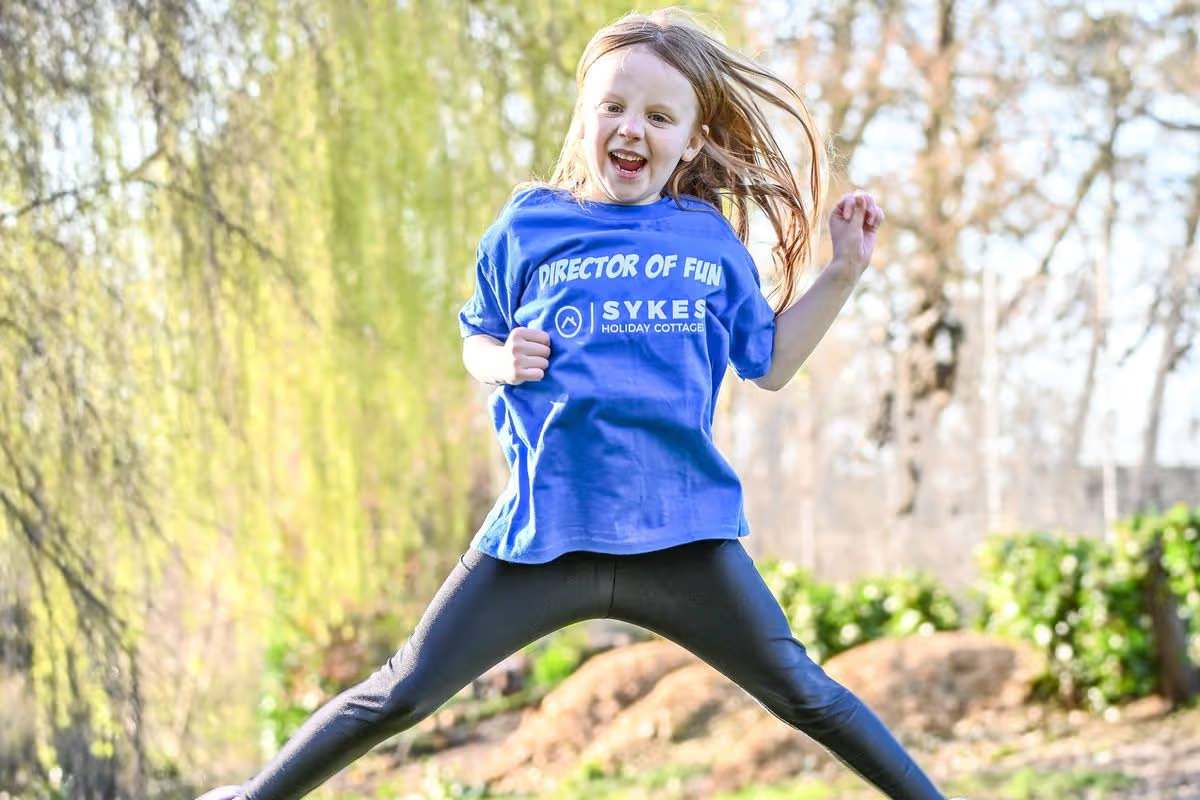
The study was commissioned by Sykes Holiday Cottages, which has unveiled a competition to appoint two youngsters as its resident Directors of Fun, created to place kids at the centre of holiday planning.
The playful job ad specifies entrants must be spontaneous, have a big imagination and bring enthusiasm to every day, and applicants can share their perfect holiday itineraries until 30th April 2026 to win the chance to make them come true.
James Shaw, spokesperson for the staycation specialist said: “It’s always interesting to see what kids would do if they were in charge of the whole holiday – and it turns out it would be pretty fun for everyone else too.
“While there’s plenty of excitement around things like unlimited ice cream and activities, what really stands out is how much they value simply spending time together.
“That’s why we wanted to bring children back into the heart of holiday planning with this competition, recognising that their ideas of a great break are often less about packed schedules and more about being with the people around them.”
Over half (51%) of the youngsters surveyed said their favourite aspect of being on holiday was spending time with family and for over a third (35%) it’s meeting other kids their age.
Eight out of ten confessed they’d like to take control of a family holiday, with leading the way in order to do the activities they want (63%), instructing their relatives what to do (41%) and feeling like an adult (40%) the top three reasons.
The research via OnePoll.com also discovered 19% feel like holiday parks are a home away from home, with popular forms of entertainment such as swimming, adventure playgrounds and arcade games making it ideal accommodation.
James Shaw added: “Holidays should give families the chance to properly switch off, reconnect and enjoy shared experiences all in one place.
“What’s striking is how much children value the freedom to shape their own days – whether that’s choosing activities, exploring, or just having unstructured time to play.
“That’s where settings like holiday parks come into their own, offering a mix of flexibility and variety that lets every family member make the most of their time away.”
THE TOP 10 THINGS KIDS WOULD DO ON HOLIDAY IF THEY WERE IN CHARGE:
Skinner’s counter to the idea his side may have been better advised to drop slightly deeper to prevent Harder making those runs was sound.
“There are two mistakes in there from us,” he said.
“If you get pressure on the ball, you can’t play the long ball. They tried it a few times and played the ball out of play.
“It worked for them tonight but if I stop those two chances, they don’t score.”
It sounds simple. But execution is key at the highest level. If you don’t do that properly, you will get punished.
There are a number of minor details to explain why United came out on the wrong side of a tight result.
One of them is unquestionably squad depth.
Take the case of Japan midfielder Hinata Miyazawa, who played in the final of the Asian Cup in Sydney on Sunday, then travelled back to start for United.
By contrast, Tanikawa, who did not get on the pitch against Australia, started on the bench for Bayern, who were mindful of the effects of jetlag and wanted the midfielder to make an impact, which she did, by setting up Harder, then scoring the winner.
Skinner simply does not have enough players to rotate like that.
It makes the next few days, which feature another Old Trafford outing against Women’s Super League leaders Manchester City on Saturday before the trip to Germany for the second leg with Bayern next Wednesday (17:45 BST), particularly tough.
“We’ve played the most football in Europe this year, and we’ve got a really small squad right now, so it will challenge us,” said Skinner.
“It will take us to the depths. But the carrot is there for us.
“We expect it to be difficult. You can kind of trench your mind into what you must do.
“That’s why my players are at Manchester United. If they didn’t want to do it, they wouldn’t be at this club. They’re going to give it absolutely everything.”
DESPITE winning dream roles, Anya Taylor-Joy admits her real wish is to retreat from Hollywood and live on a farm.
The 29-year-old is one of the world’s best-known actresses but has spent years feeling nervous on the red carpet, struggled to watch her award-winning performances and now wants calm.
Sign up for the Showbiz newsletter
Thank you!
Anya Taylor-Joy in jewels at the Vanity Fair Oscar Party earlier this monthCredit: SplashAnya and her musician husband Malcolm McRaeCredit: Getty
She voices love interest Princess Peach in the new Super Mario Galaxy movie, which is released on April 1.
Princess Peach is the main female character and head of state of the Mushroom Kingdom.
Anya said: “I was so touched by how strong she is and how cool. The fact that’s going to be a role model kids can have nowadays is unbelievable. I left feeling very inspired by her.”
Anya knows all too well that life can be difficult as a child.
She was born in Florida, then lived in Argentina for five years where she rode horses in the idyllic countryside.
Her African-Spanish mum, a psychologist, and Scottish-Argentine dad, who raced powerboats, then moved the family to London when she was six — and things became dramatically different.
Anya was bullied, “locked in lockers, barred from classrooms, not invited to things” and did not speak English.
Watching films helped her navigate through the traumas.
She told the Happy Sad Confused podcast: “I’ve never been good at being cool, this is why I didn’t get along well with people in school.
“If I like something, I love it and it just pours out of me.
“But if I was sad, like if my hamster died, my parents could put me in front of a movie and I would feel better at the end of it.
“I could get lost in something like that.”
It was her love of movies that eventually helped her learn English.
Anya voices Mario’s love interest Princess Peach in the Super Mario GalaxyCredit: AP
She says: “I learned English when I was eight. I stuck it out for two years in London, refusing to speak English because I wanted to go home. Then eventually I was like, ‘I have no friends, this is going to be a needed skill’.”
Anya told her parents she was going to be an actress.
But first, after being “picked up” outside Harrods, she became a model at 16.
She was recruited by Sarah Doukas, boss of Storm model agency, who had discovered Kate Moss.
But at first Anya thought she was a stalker.
She said: “It was absurd. A black car comes up, starts chasing me. I pick up my dog, start running and a head comes out of the window and they say, ‘If you stop, you won’t regret it,’ and I stop.
“It was the head of a modelling agency. I don’t encourage other people to do this.
“I had no idea what I was doing, but luckily it worked out and my parents came with me the next day to the modelling agency.”
Her parents always supported her. Anya said: “They’d had six kids, so were like, ‘Oh, just do whatever you’re going to do’.
“I’m so grateful for the approach my parents have had because I did some pretty ballsy things in my teenage years and luckily they paid off, but they were always supportive.”
She did many auditions before getting her breakthrough role at 19 in film The Witch.
Anya said: “I thought that audition went so badly. I truly thought I had messed that up massively because I had a huge panic attack before I went into it, and luckily that really worked for the scene.”
It was then that Anya found where she truly belonged.
She said: “Going into work every single day felt like such a joy.
“I could breathe because I’d found a place where I was doing something I loved, with people who didn’t think I was a psychopath. And I could have fun with it. I loved every second of making that movie.”
She found it “mind blowing” that The Witch was a hit and forced herself to watch the performance.
Anya said: “It’s like getting hit by a bus. I personally don’t agree with not watching your films, it’s not all about you. It’s a whole bunch of other people who have done a lot of work and different departments that you have to go and support, because they deserve it and you love them. So I have to watch it.
“But the first time, I always feel I’ve let people down and I’m always like, ‘Oh, I messed it up’.
“Then I process it and the second time I watch it, it’s slightly more palatable and I’m able to lose myself a bit more.
“By the third time I’m just like, ‘OK, whatever’. You just have to get over yourself and applaud the people you care about that worked with you.”
She went on to roles in horror film Last Night In Soho, black comedy The Menu and the apocalyptic film Furiosa: A Mad Max Saga. Anya said she works “very hard, very gratefully hard” because she feels lucky to do a job she feels passionate about.
But it is not always easy. Despite her modelling background, Anya struggles with the limelight.
She said: “When I first started doing red carpets, I couldn’t handle the notion of being pretty.
Anya as chess champ Beth Harmon in The Queen’s GambitCredit: AlamyAnya loved films from a young ageCredit: Instagram/@anyataylorjoy
“I was like, ‘I don’t do that’. I am a scummy, mud-caked ferret and striving for anything different felt disingenuous and scary.”
She has even been known to dress up “like an East Berlin spy” at times so nobody recognises her.
Now she is trying to make time for some balance in her life.
She said: “I’ve been living on film sets for five years and, occasionally, I think it would be nice to find out what Anya would do with three months if she wasn’t playing another person.
“So I’m trying to be more careful with my time there.
“You spend 18 hours a day thinking, behaving and breathing as another human being. That doesn’t leave a lot of time to figure out what it is that you like.”
And the person she wants to spend it with is her husband, US musician Malcolm McRae, who she married in 2021.
The couple split their time between homes in the Hollywood Hills and London.
She said: “I’ve finally found someone who will happily sit in silence with me, reading. We’re basically 80 years old and seven at the same time, and it works really well.
“When you are together, you are really valuing the time you have. Everyday, mundane activities are so full of joy.
“I love going to the petrol station with him and filling up the car and going to get breakfast.”
But right now, her focus is all on Princess Peach.
Anya told US Today: “She wants to find out where she comes from and is on a quest for adventure and prioritising herself a little bit more.”
Princess Peach sounds very much like the actress playing her.
Michael Conlan began his professional boxing career with great fanfare and an ambition to become a multi-weight champion, but despite going close, he was unable to replicate his success as an amateur.
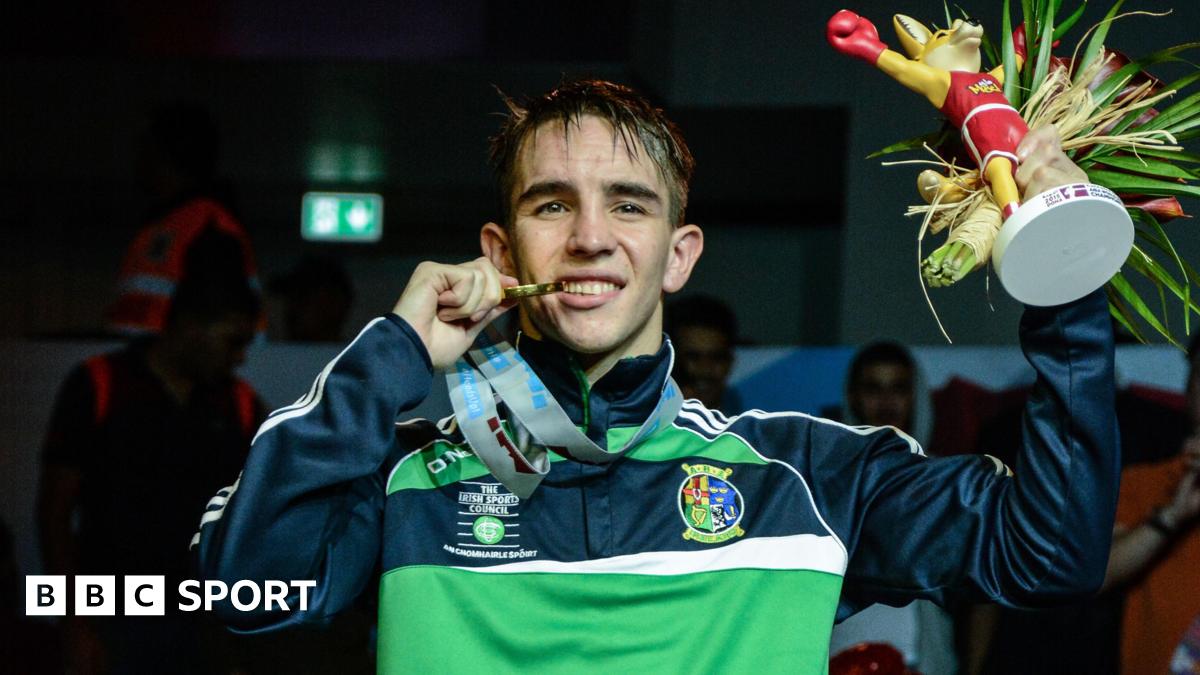
The 34-year-old called time on his career following Friday’s defeat to Kevin Walsh in Belfast when his last roll of the dice to get back into title contention unravelled.
A polarising figure, Conlan could sell out arenas and outdoor venues to the tune of 12,000, while eliciting the ire of others in his home town.
What could not be disputed was he talent inside the ring, with his silky switch-hitting skills bringing his from the streets of west Belfast to the top of the amateur game and within a whisker as a pro.
“I didn’t think I lost tonight but it was too close for my liking and no matter how I would lose, no matter if it’s a robbery, I said that would be my time,” Conlan told reporters in his dressing room after his defeat to Walsh.
“It’s all very raw at the minute and how I’m answering questions is all emotion.
“How light I feel at the minute is probably relief. I’ve had so much pressure on my, so many expectations, even my own.
“I’ve not achieved what I wanted to but I said when I came back into it [in 2025] it would be if I achieve it, then great but if I don’t then so be it. This is the so be it situation and now I can spend time with my family.”
Having followed his brothers into the boxing gym as a seven year old, Conlan would blossom into one of, if not the best Irish male amateurs.
Collecting Antrim, Ulster and Irish titles as a junior, his first major international senior competition came at 2010 Commonwealth Games in Delhi, where, as a 17-year-old, he came unstuck against Australia’s Jason Moloney.
It was just the beginning as the following year, he won the first of five Irish Elite titles which earned him a place on the team for the World Championships in Baku, reaching the quarter-finals which earned a place at the 2012 Olympic Games in London.
There, he made the big breakthrough, reaching the semi-finals where he lost to Cuba’s Robeisy Ramirez but returned with a bronze medal to great acclaim.
Gemma let the cameras follow her as she and partner Rami had IVF and planned their wedding but she says the results show ‘a real nightmare’ of a year
23:13, 19 Mar 2026Updated 23:15, 19 Mar 2026
Gemma’s mother Joan has now moved in with her and Rami as she continues to suffer poor health(Image: PA)
Gemma Collins’ new series Four Weddings and a Baby will see her breaking down in agony after fearing that her mother Joan was at death’s door last year.
Launching the new show Gemma, 45, said it would give a warts and all look at her life over a year. Speaking to Dermot O’Leary at a Sky event in London, she explained: “During making the show my mum nearly died, my relationship was obviously taking a bit of a hit, I was trying to have a baby – my whole world just fell apart.
“Because I was going through so much trauma and struggles, there was no performative person there. Everyone gets to see the real me – you’re in my home. It’s what people don’t see. I was broken.”
She explained that the reality series would be very different to TOWIE and other programmes she has appeared on. “I’m used to being very performative. The camera goes on, The GC comes out, boomshackalack, that’s really how it is. Hold on to your seats because you never know what’s going to happen!
“But this is a show where I’m trying to have a baby, I’m trying to get married and none of it goes smooth. It’s a nightmare. But it’s not a comical nightmare it’s a real nightmare.”
The series is due to launch on Sky Max later this year. In one clip, Gemma is seen weeping while driving as she explains to the camera how Joan is in hospital and in a very bad way, having caught pneumonia and suffering from a “build up of fluid”.
She explains: “My mum has suffered with chronic illness for 10 years. This is not my first rodeo with her. However, this one has to be the worst. It’s making me realise that mum might not have a lot of time left.”
Viewers will also be able to follow Gemma’s attempt to conceive using IVF, with fiancé Rami Hawash, and also their attempt to organise a wedding. But in another clip she sobs: “Having a baby is not easy. You don’t want to be making the wrong decisions in your life. Then I think f*** it – if mum hasn’t got long left – do I just spend my life with my mum, you know? And then just not have a baby, not get married.”
She told Dermot that the aim of the series was to be “a bit more vulnerable and honest”, adding: “It’s me not having any control over my life, any control over the cameras. It’s very raw.
“Family have always been everything to me, which people haven’t seen, but I think it’s OK to show people you are human? Nothing’s perfect, life’s not perfect and maybe that will resonate.”
Asked how Joan, 70, is doing now, Gemma said that she has moved in to her house and has carers who come regularly. “I’m just so grateful for every day I get to spend with her,” Gemma said. Another clip from the upcoming series shows how the Essex favourite tried to prepare for her second stint in I’m a Celebrity, Get Me Out of Here.
In a bid to become less fearful, she invites a snake-handler round to her house and admits the thing she is most afraid of is “a snake wrapping itself around my neck” The woman gives assurance that Gemma won’t be given “anything that’s going to hurt you”. But when the snake is placed around her shoulders it flicks its tail into her face, leaving her sweating and saying: “F***, f***, f***.”
This year marks a veritable museum-palooza as Los Angeles debuts four new major arts complexes, with three in the wings likely to open in advance of the 2028 Summer Olympics.
Immerse yourself in a psychedelic explosion at Meow Wolf, plan an afternoon liaison with Van Gogh at LACMA’s new David Geffen Galleries, inhale the scent of nature inside Refik Anadol’s AI arts museum, Dataland, or simply geek out over George Lucas’ jaw-dropping collection of “Star Wars” memorabilia.
Whatever your arts craving may be, this astoundingly rich new lineup of new local museums has you covered.
LACMA’s David Geffen Galleries
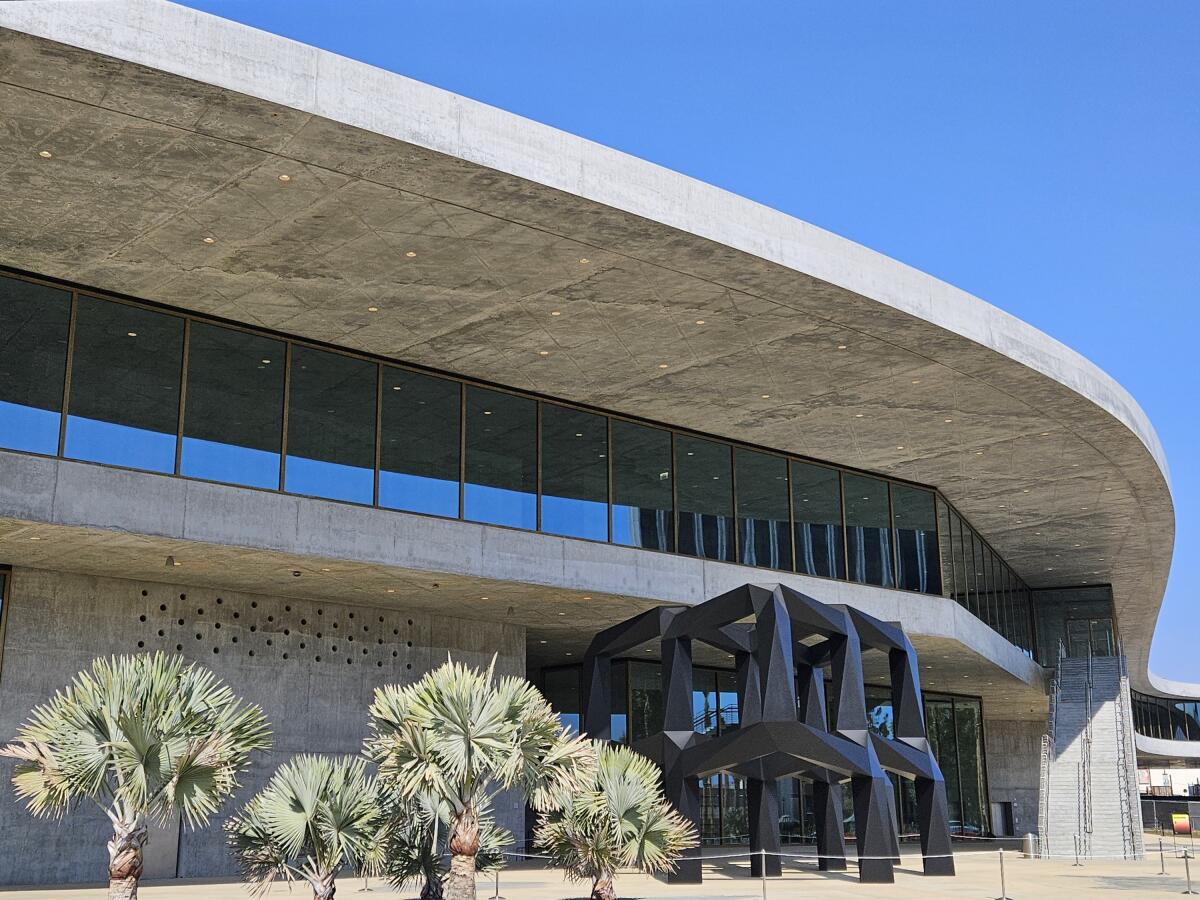
The new David Geffen Galleries, opening in 2026, are composed entirely of Brutalist concrete.
(Christopher Knight / Los Angeles Times)
The Los Angeles County Museum of Art’s David Geffen Galleries are set to debut this April to members, before opening for general admission at the beginning of May. The $720-million Geffen Galleries will display 2,500-3,000 objects from LACMA’s collection.
The building, designed by Pritzker Prize-winning architect Peter Zumthor, is described by supporters as a “concrete sculpture” and will host 90 exhibition galleries across 110,000 square feet. The Wilshire Boulevard museum’s inaugural exhibition will organize artwork by the Pacific, Indian and Atlantic Oceans and the Mediterranean Sea instead of by medium or period.
“The idea is for you to make your own path — not to speak at you, but to let you wander like you would through a park or a place,” LACMA Director and Chief Executive Michael Govan said in an interview with The Times. “That change in attitude, and how the building is built, is really exciting.”
Some of the most-anticipated works on display include Georges de La Tour’s “The Magdalen With the Smoking Flame” (1640), Henri Matisse’s “La Gerbe” (1953) and Vincent Van Gogh’s “Tarascon Stagecoach” (1888).
Lucas Museum of Narrative Art
The gardens at the Lucas Museum, designed by Studio-MLA, on Monday, May 19, 2025.
(Jason Armond / Los Angeles Times)
After more than 10 years of anticipation, George Lucas and Mellody Hobson’s museum will open in Exposition Park this September. With over 10,000 square feet of galleries, the museum will feature a wide array of artwork and pop culture ephemera, including Lucas’ personal trove of “Star Wars” film franchise treasures, “Peanuts” comic strips, “Alice’s Adventures in Wonderland” illustrations, a Richard Sargent painting and covers of the Saturday Evening Post.
Lucas donated his collection to curate the Lucas Archives, which, in addition to “Star Wars,” will encompass props and production art from Lucasfilm projects, such as the “Indiana Jones” franchise.
One of the museum’s defining features is its massive green-roof garden designed by Mia Lehrer and her landscape architecture firm Studio-MLA.
“This brings everything together,” Lehrer said in an interview with The Times. “Design, ecology, storytelling, infrastructure, community. It’s the fullest expression of what landscape can be.”
Meow Wolf
A work-in-progress piece set to be featured in Meow Wolf L.A. as seen during a walk through at the group’s warehouse in Santa Fe on Oct. 15, 2025.
(Gabriela Campos/For The Times)
Meow Wolf’s L.A. location will reimagine a ’90s movie theater with its takeover of the Cinemark at West L.A.’s Howard Hughes entertainment complex outside Culver City. Meow Wolf’s sixth permanent exhibition comes on the heels of the immersive art creator’s 52,000-square-foot psychedelic art installation in Las Vegas, which was disguised as a dystopian grocery store called Omega Mart and promptly went viral on TikTok.
Complete with sci-fi elements, a meditative space and a 30-foot-tall mushroom tower, Meow Wolf’s new location will open at the end of 2026. Although organizers have kept much of the exhibition under wraps, visitors can expect to be transfixed by a thoroughly Los Angeles tale.
“It’s cool that we’re creating a story about a pilgrimage, because L.A. is that for so many artists, especially people involved in storytelling,” Shakti Howeth, Meow Wolf‘s creative director, told The Times. “It’s one of those places that’s built on layers and layers of dreams, and we’re really exploring that here. Not only dreams but broken dreams — the compost that can happen when you digest broken dreams.”
Refik Anadol’s Dataland
Refik Anadol’s Infinity Room is meant to be a multisensory experience.
(Dataland)
Opening this spring at the Frank Gehry-designed Grand L.A., Dataland dubs itself the world’s first museum of AI arts. Turkish American artist Refik Anadol designed his own AI model, named the Large Nature Model, which only sources material with permission from original creators, making it what Anadol calls “ethical” AI. Partners include the Smithsonian and the Cornell Lab of Ornithology.
“I’m calling this new art form not AR, not VR, not XR — so we are still finding a name for it. The best name so far, and people love it, is generative reality,” Anadol told The Times.
Dataland will feature five galleries, including the Infinity Room, which Anadol first created in 2014 as a student at UCLA. In another exhibit, he trained an AI model on half a million scents and built a machine to push those scents into the gallery to create a totally immersive viewing experience.
Opening Later
The Armenian American Museum and Cultural Center of California
Slated to complete construction in downtown Glendale in late 2026, the 51,000-square-foot Armenian American Museum has been in the works for more than a decade. With a $67-million budget, the museum will include permanent and temporary exhibitions, as well as an auditorium, learning center, archives collection and a demonstration kitchen.
The museum is an initiative of the Armenian Genocide Centennial Committee Western US, and planning began as the group prepared to mark the the 100th anniversary of the Armenian Genocide in 2015. The museum is adorned with the 36 letters of the Armenian alphabet and a glass hazarashen skylight, inspired by traditional roofs in homes across the Armenian Highlands.
“The Armenian American Museum was once an idea, then a vision, and today is rising before our eyes,” museum Executive Chairman Berdj Karapetian said in a statement. “This progress is the result of an extraordinary collective effort by Armenians and non-Armenians here in California, across the United States and around the world.”
The Samuel Oschin Air and Space Center
The Samuel Oschin Air and Space Center in Los Angeles is a major expansion of the California Science Center.
(Myung J. Chun / Los Angeles Times)
A solid opening date has not yet been announced, but the $400-million Samuel Oschin Air and Space Center at the California Science Center in Exposition Park is busily preparing for liftoff. Construction on the building began in 2022. The shiny new building will be home to the Korean Air Aviation Gallery, Kent Kresa Space Gallery and the Samuel Oschin Shuttle Gallery, which will host the Space Shuttle Endeavour.
Endeavour will be displayed in launch position, making it the tallest authentic spacecraft displayed vertically in the world, with a height of 20 stories. One of three surviving space shuttles, Endeavour made 25 successful missions into space.
The center is also expected to have 20 planes and jets, including a Boeing 747, a mock flight deck and a pair of introductory films produced by J.J. Abrams’ company Bad Robot, one of which will end with a simulated launch.
“It is an amazing experience, and we want to really build it up,” Jeffrey N. Rudolph, president and chief executive of the California Science Center, told The Times. “It’s not just about the hardware but about the people and the educational aspects.”
The Broad Expansion
Exterior rendering of the future Broad expansion from Hope Street.
Opening in 2028, the Broad expansion will contain 70% more gallery space, two outdoor courtyards, a live programming space and views of the museum’s art storage vault. First announced in 2024, the $100-million addition is slated for completion before the 2028 Summer Olympics.
Located in downtown L.A., the expansion was deemed necessary after the museum significantly exceeded visitor projections. The new building will invert the existing Broad museum’s architectural design, with a smooth, gray structure attached to the original construction.
“The idea is that it adds new facets to the visitor’s journey through the expanded Broad,” said Joanne Heyler, founding director and president of the Broad, in an interview with The Times. “In a way, the existing building is always sort of talking to you. And there will be a similar thing happening with the expansion, but just a slightly different conversation, like you’re listening to its sibling.”
MILAN — Milan’s two first-division soccer teams share a stadium, the majestic San Siro, and the top two spots in the Serie A standings. They each have American owners and fanatically loyal supporters. And both are among the most iconic and successful teams in history.
But that’s where the similarities wane. Because while Inter Milan believes it has a story to tell, AC Milan has locked the doors, drawn the drapes and taken the phone off the hook.
I know this because ahead of last month’s Milan-Cortina Winter Games I reached out to both clubs and asked if they might have some time to visit. AC Milan proved too busy to chat, but Inter Milan invited me to its training center, hidden among farm fields and quiet pastures 45 minutes from the city. Those humble surroundings proved to be at odds with the lofty global reach the team is trying to build.
“I would say it’s leveraging more around Italian history and then the history of the club,” Giorgio Ricci, Inter Milan’s chief revenue officer, said of the image the club is trying to market. “A city like Milano is now a real ambassador of that Italian culture, from lifestyle to design to food and whatever. But we [also] have the authentic history around the foundation of this club. It’s a story not of globalization but of internationalization.
“So there is always this dualism between being very strong[ly] rooted in the city of Milan, in the real core, and having this international attitude. It’s quite a unique and winning combination.”
The Inter in Inter Milan, after all, is short for Internazionale, Italian for international.
“It shall be called Internazionale, because we are brothers of the world,” said Giorgio Muggiani when he helped start the team in 1908. He later lent his talents as an artist and illustrator to the fascist movement of Benito Mussolini.
Inter Milan is in the fifth year of its latest and boldest transition, one that is taking it from being just a soccer club into being a lifestyle and fashion-focused brand, a transition that, as Ricci said, will trade on its history as an international club and its location in one of the fashion capitals of the world.
It’s a model that was pioneered by French club Paris Saint-Germain, which nine years ago began partnering with Dior, Jordan Brand, Levi Strauss and others. Inter has teamed with Italian menswear brand Canali, created a new digital ecosystem that has won it a significant increase in video views and user engagement and has launched non-sporting merchandise such as streetwear accessories to accompany the rebrand.
“We are a football club,” Ricci said. “But in order to grow, we need to become a global football brand.”
And it has begun to do that. Deloitte, the British professional services company which does an annual ranking of soccer club revenues, says Inter brought in more than $620 million in 2024-25, the most recent season for which figures are available. That’s 11th best in the world and a jump of about 70% and eight places from where the club was a decade ago, when it was just the fourth-most-profitable club in Italy.
Inter Milan’s Hakan Calhanoglu celebrates after scoring on a penalty shot against Genoa on Feb. 28.
(Marco Luzzani / Getty Images)
In an effort to tell that story and continue that growth, Inter collaborated with Spike Lee on a short film titled “My Name Is My Story,” in which Lee narrated the club’s history and identity, introducing it to a U.S. audience during last summer’s Club World Cup.
Inter isn’t going it alone though. All of Italian football is in the midst of a long-needed overhaul.
A generation ago, Serie A was the best soccer league in the world. It had players like Roberto Baggio, Jurgen Klinsmann, Alessandro Del Piero, Ronaldo, George Weah and Diego Maradona and its wealthy, deep-pocketed owners sent Italian teams to nine Champions League finals between 1989-99.
Since then the league has struggled to market its product globally, lost many of its top players to better pay in other European leagues, found potential revenue streams closed off by aging, crumbling infrastructure, and saw its reputation and credibility damaged by the 2006 Calciopoli scandal, which centered on the manipulation of referee appointments to favor certain clubs.
An influx of U.S.-based owners is helping turn that around. Eight of Serie A’s 20 teams have American owners and Ricci says they have not only brought much-needed investment to the league but they’ve brought ideas on how to market Italian soccer.
“Some are only bringing money, yeah. Others are bringing also a vision and an ambition,” Ricci said. “Our ownership is exactly bringing that. Bringing the North American culture of not seeing only constraints and barriers in the development of a project [but] having the ambition, far-sighted[ness] and working on building a dream.
“That is exactly what Serie A needs: a bit of a dream and a bit of a vision to dare a bit more and not be too conservative. We need a few leading and having vision and bringing that dream.”
A big part of that dream and vision in Milan is a new stadium, one that will replace the century-old San Siro with a 71,500-seat arena at the center of a $1.4-billion urban-regeneration plan funded primarily by RedBird Capital, AC Milan’s New York-based owner, and Oaktree Capital Management, the Los Angeles-based company that owns Inter Milan.
For Inter Milan that investment, the club hopes, will transform the game-day experience not just for well-heeled corporate types but for the team’s diehard fans. I’m still waiting to hear what AC Milan’s plans are.
“I’m not only talking about corporate clients and things like that,” Ricci said. “That, of course, will benefit from a new state-of-the-art venue with the facilities, restaurants, whatever. But also for general [admission]. As soon as they step into a new venue with better seats, in terms of sound, in terms of video, audio and all the entertainment, we are going to increase the perception of each kind of spectator you have in the venue.”
Is it a gamble? Sure, but then very few things in sports are a sure bet. Yet for Inter Milan, at least, that vision and the story behind it are worth telling.
⚽ You have read the latest installment of On Soccer with Kevin Baxter. The weekly column takes you behind the scenes and shines a spotlight on unique stories. Listen to Baxter on this week’s episode of the “Corner of the Galaxy” podcast.
TRAVELLERS are rushing to Amazon to bag a large-sized Samsonite suitcase that’s now almost half-price in the retailer’s Spring Sale.
This soft-shell, big-brand luggage usually costs £209, but has since dropped to £112.
Sign up for the Travel newsletter
Thank you!
Samsonite’s soft-shell Base Boost case has a 112.5-litre capacity
Samsonite Base Boost Soft Luggage, £112.19 (was £209)
The retail giant’s Spring Deal Days sale is now in its penultimate day, with thousands of prices plummeted across the site.
With the holiday season fast approaching, small wonder the online giant has decided to drop prices across a wide range of suitcases.
And yes, you’ll find all sorts of third-party options for much less – but if you’re looking for assured levels of quality on your hols, then go for a well-known maker like Samsonite.
Originally £209, the Base Boost Soft Luggage Suitcase has been dropped to just £112.19.
This, by contrast, is a 112.5-litre beast that’s best for families and those long trips away.
Despite its size, it remains incredibly lightweight at just 3.1kg, which gives you more of an opportunity to fill up the case while steering clear of those dreaded overweight baggage fees.
It comes in black and navy blue, with the black being a little cheaper.
For security, it’s got a fixed TSA combination lock built-in for stress-free travel, and inside, it’s got a buckle system to keep your clothes in place and a zipped mesh divider for easy organisation.
Better yet, Samsonite also includes a 10-year warranty with this case.
The stand-off between Ten Hag and Sancho lasted four months, before Sancho joined Dortmund on loan for the remainder of the season and helped them reach the Champions League final.
But they could not afford to keep him and, although United sporting director Dan Ashworth was credited with brokering the truce that allowed Sancho to join up with United in the pre-season of 2024, it was a temporary situation, which Chelsea seemed to solve by agreeing a loan that committed them to a permanent transfer at the end of the season.
Yet, after five goals in 41 appearances, Chelsea preferred to pay a £5m penalty to send Sancho back to Old Trafford.
This time, there was no olive branch. Sancho was placed in Ruben Amorim’s ‘bomb squad’ and had to train away from the first team until he joined Villa on 1 September.
United have an option to trigger an additional year on Sancho’s contract, which otherwise expires in the summer. In public, they are reserving their position on that. No-one expects it to happen.
At 25, Sancho still has a lot to offer. There have been glimpses of quality during his time at Villa, but it is by no means certain he will stay there beyond the end of the season.
“Seeing Jadon close up, technically, he’s got an awful lot of ability,” said current United interim head coach Michael Carrick, who worked with Sancho as part of Solskjaer’s backroom team and managed him for three games during his short stint in charge after the Norwegian’s dismissal.
“In and around the box; his ball carrying; his little plays; the connections; his creativity; the way he handles the ball – he’s got natural ability.
“He’s always had it all the way coming through. That’s one part of football.
“But – and I’m not talking about Jadon individually on this – it is just how it is and how it should be.
“You can’t just assume it’s all going to be smooth. It’s proven that it’s not always like that.
“You’ve got to find a way through it. If you are playing in a good team with good players and a good squad and depth, that’s part of the challenge to stay at the top.”
Arvid Lindblad said he “showed people a bit of what I am here to do” after finishing eighth on his Formula 1 debut at the Australian Grand Prix.
The 18-year-old Racing Bulls driver, who become the youngest Briton to race in F1 on Sunday, qualified in ninth and briefly rose to third place on the first lap after a dramatic start to the season opener in Melbourne.
Lindblad’s top-10 finish means he enters the record books as the third youngest F1 points scorer at 18 years and seven months – behind Mercedes’ Kimi Antonelli and Red Bull’s four-time world champion Max Verstappen.
“When I was five years old, I had a dream and my dream was to be in Formula 1 and I am living my dream today,” he told Sky Sports.