dozen

Two dozen Democrat-led states sue Trump over mail-in ballot limits | Donald Trump News

Rights groups have raised concerns about Trump’s efforts to change election administration before November’s midterms.

About two dozen Democrat-led states have filed a lawsuit against the administration of United States President Donald Trump to block an executive order setting new limits on mail-in ballots.

Friday’s lawsuit comes as voting rights groups charge that Trump is seeking to make it more difficult to vote before the consequential midterm elections in November.

Recommended Stories

list of 3 itemsend of list

Trump, meanwhile, has argued that his efforts are meant to counter rampant voter fraud in US elections.

That opinion runs counter to the findings of independent election monitors, including the conservative Heritage Foundation, whose decades-spanning database has found an exceedingly low rate of election fraud.

New ‌York Attorney General Letitia James was among the attorneys general in 23 states and the District of Columbia who filed Friday’s suit, alongside the governor of Pennsylvania.

In a statement, she argued that Trump’s executive order exceeded his presidential power.

“Free and fair elections are the cornerstone of our democracy, and no president has the power to rewrite the rules on his own,” James said.

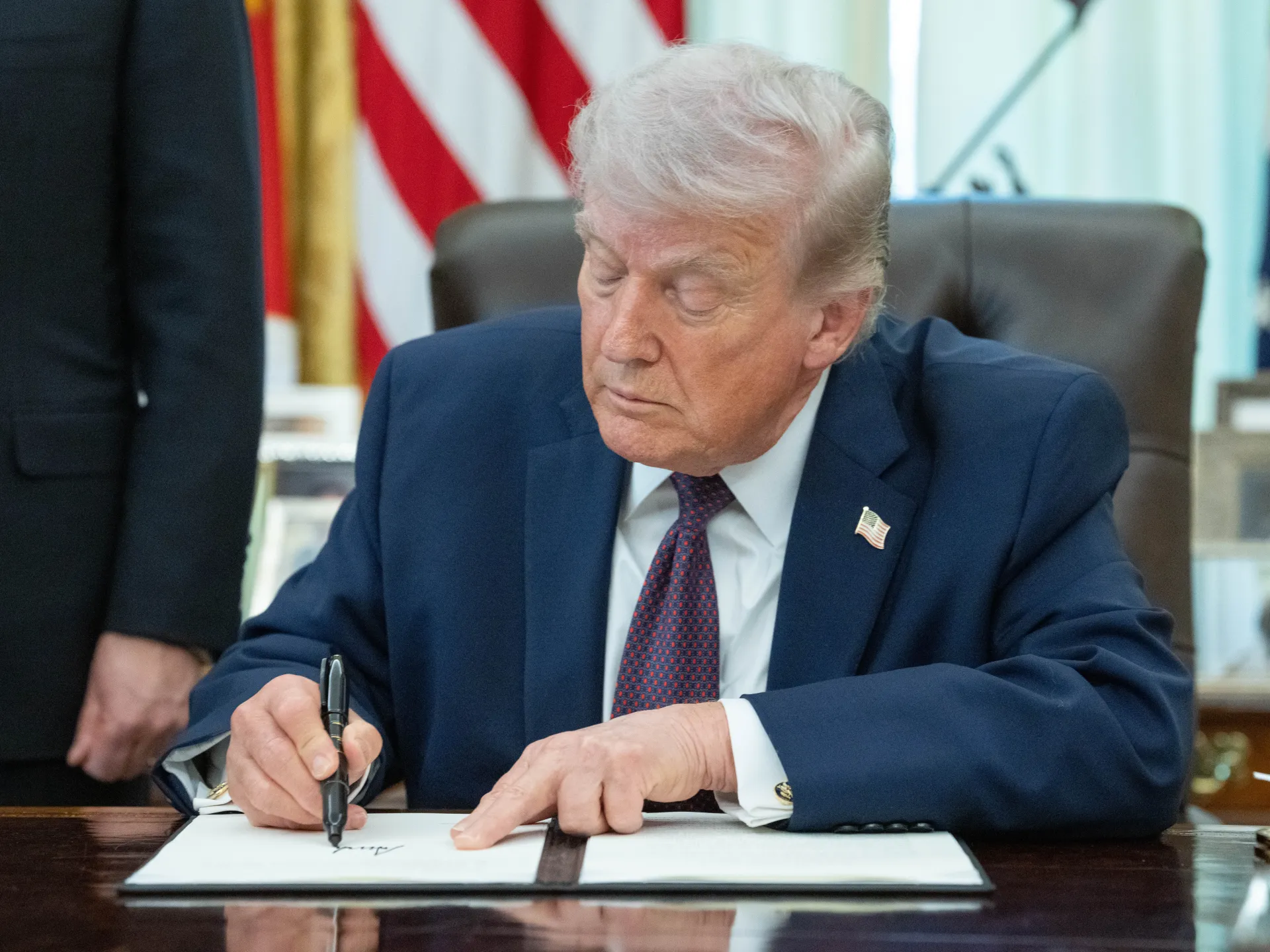
Trump’s latest executive order, signed on Tuesday, calls on the Department of Homeland Security to “compile and transmit” a list of United States citizens who are eligible to vote in each state.

It then requires the United States Postal Service (USPS) to “transmit ballots only to individuals enrolled on a State-specific Mail-in and Absentee Participation List, ensuring that only eligible absentee or mail-in voters receive absentee or mail-in ballots”.

Voting rights groups have said the measures would likely rely on an incomplete federal list of US citizens and would heap too much responsibility on USPS.

Mail-in voting has increased across the US, in states that lean both Republican and Democratic, particularly after the COVID-19 pandemic. In the 2024 elections, a third of all ballots were cast by mail.

In Friday’s lawsuit, the states argue that Trump’s order violates the US Constitution, which says that state officials decide the “times, places and manner” of elections.

The states further maintain that only Congress can pass new restrictions related to how elections are conducted. Forcing a change to election administration so close to the November elections will also create chaos, according to the lawsuit.

The midterm elections will determine which party controls the US House of Representatives and Senate.

Trump has previously voiced concern that he may face impeachment proceedings, should the Republican Party see its majorities in both chambers disappear.

For years, Trump has maintained, without evidence, that his 2020 election loss was the result of widespread fraud, and he has pledged reforms to the voting system.

He previously signed executive orders seeking to overhaul US election administration, although they have been mostly blocked by the court system.

The Department of Justice has also sued several states in an attempt to gain access to voter information, and the FBI seized ballots from the 2020 election during a raid last January in Fulton County, Georgia, further stoking concerns.

Trump, meanwhile, has been pushing lawmakers to pass the “SAVE America Act”, which would require increased proof of US citizenship when registering to vote, including a birth certificate or a passport, as well as a photo ID to cast a ballot.

Rights groups have warned the measures could disenfranchise many voters, including women who changed their last name upon marrying.

Source link

Legal groups condemn arrival of a dozen deportees from US to Uganda | Donald Trump News

Legal groups in Uganda have announced that a dozen deportees from the United States are expected to land in the country, following a deal with President Donald Trump.

On Thursday, the Uganda Law Society and the East Africa Law Society announced they had gone to court to challenge the deportation, which they called “an undignified, harrowing and dehumanising process”.

Recommended Stories

list of 3 itemsend of list

“We have approached the Courts of Law in Uganda and the region, seeking bespoke reliefs designed to arrest this patent international illegality,” Asiimwe Anthony, the vice president of the Uganda Law Society, wrote in a statement.

“Our perspective of the matter is broader than a single act of deportation. We view it as but one gust from the ill winds of transnational repression that are blowing across our world.”

Thursday’s deportation marks the first confirmed instance of deportees being transferred from the US to Uganda.

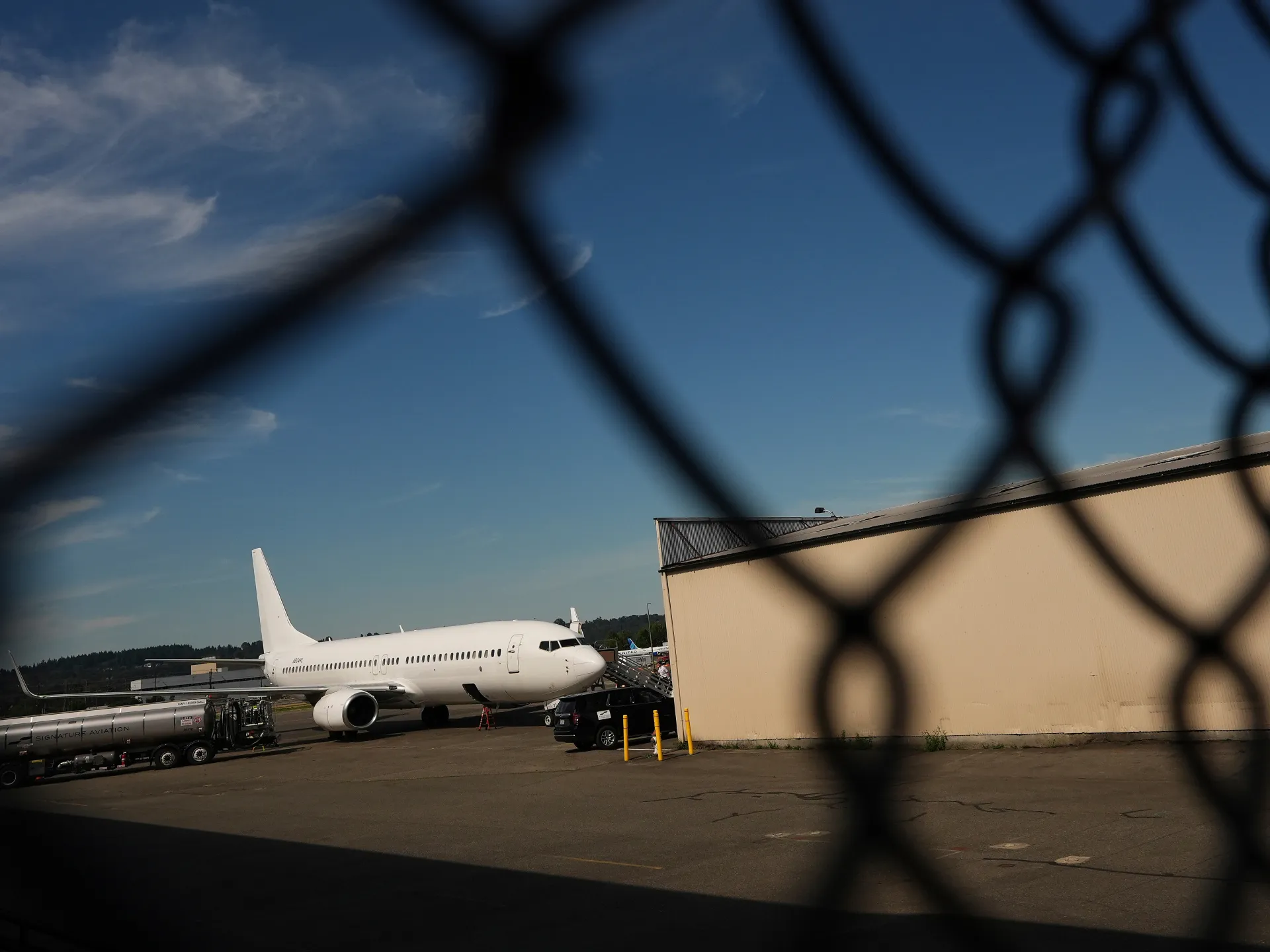
The 12 people reportedly landed at the Entebbe International Airport, some 40 kilometres (25 miles) from Kampala, by private aircraft. No identifying information was provided about the deportees.

But the deportation is the latest example of Trump’s far-reaching efforts to offload immigrants to “third countries”, where they have no personal connections — and may not even know the language.

Scrutiny of third country deportations

So far, Trump has struck deals with a number of countries to accept deported foreigners. They include at least six African countries, among them Equatorial Guinea, Ghana, Rwanda, Eswatini and South Sudan.

The deal with Uganda came to light last August. The country’s Ministry of Foreign Affairs confirmed that the agreement was a “temporary arrangement” and that priority would be given to deportees from other African countries.

Unaccompanied children and people with criminal records would not be allowed under the deal, according to the ministry’s statement at the time.

It is unclear whether Uganda received payment for its decision to accept third-country deportations.

Other countries, though, have signed multimillion-dollar deals. El Salvador was given nearly $6m to imprison deportees from the US, Equatorial Guinea got $7.5m, and Eswatini nabbed $5.1m.

There is no official estimate about the total cost of these third-country deals, but Senate Democrats in the US have estimated that at least $40m in funding has been given as incentives for countries to accept deportations.

Most of those funds, the Democrats added, were disbursed in lump sums before any deportees arrived. They also note that those funds are separate from the additional costs of the deportation flights: US military aircraft can cost $32,000 per hour to operate.

“Through its third country deportation deals, the Trump Administration is putting millions of taxpayer dollars into the hands of foreign governments, while turning a blind eye to the human costs,” Democratic Senator Jeanne Shaheen said in a February statement.

“For an Administration that claims to be reigning in fraud, waste and abuse, this policy is the epitome of all three.”

Critics have also questioned whether the countries receiving US deportees are adequately safe.

In the past, the US has criticised Uganda for “significant human rights abuses”, citing reports of extrajudicial killings, life-threatening prison conditions, and torture and other degrading treatment from government agencies.

It also noted that Uganda had government restrictions against human rights and civil society organisations, and that consensual same-sex conduct was outlawed.

According to the United Nations, Uganda already plays host to nearly 1.7 million refugees and asylum seekers, as people flee violence in neighbouring countries like the Democratic Republic of Congo (DRC) and South Sudan.

An ‘authoritarian project’?

In his letter on Thursday, Anthony, the vice president of the Uganda Law Society, called the US deportations part of a “broader authoritarian project” that his group felt compelled to oppose.

“This development and the attendant illegalities that accompany it are reminiscent of a dark past that the global family of humanity supposedly put behind itself in the pursuit of the ideal that every human being is born equal,” Anthony wrote.

He added that US actions under Trump were paving the way for similar policies elsewhere.

“In the United States, the militarisation of society has given carte blanche to captured democracies in Africa to carry on with despotism unchecked,” he said.

Still, the Trump administration has defended the deportations as legal under the US Immigration and Nationality Act, which has loopholes for removals to “safe third countries”.

The Trump administration has also pointed to diplomatic assurances from the “third countries” in question that US deportees would not face persecution.

The “third-country” policy has, however, faced numerous legal challenges. While the US Supreme Court has largely let such removals proceed, a lower court once again ruled in February that the policy could infringe upon immigrants’ due process rights.

In the case of Salvadoran immigrant Kilmar Abrego Garcia, lawyers have even argued that his deportation to a country far from home was evidence of “vindictiveness” on the part of the Trump administration.

Uganda has been floated as one of the destinations for Garcia, who was wrongfully deported in March 2025 and then returned to the US in June, only to face deportation proceedings once more.

Trump has pushed an aggressive programme of mass deportation since returning to the White House for a second term in 2025.

At least 675,000 people have been removed under his administration as of January, according to US government statistics.

Source link

A dozen arrests as hundreds attend Al-Quds Day rally in London | Israel-Palestine conflict News

Police make 12 arrests as demonstrators defy government restrictions to gather on Thames embankment.

Hundreds gathered in central London for the annual Al-Quds Day demonstration, an international show of solidarity with Palestinians that this year took place under sweeping new restrictions and a heavy police presence.

Crowds assembled on Sunday along the Albert Embankment of the River Thames, where demonstrators waved Palestinian flags, held banners, and chanted slogans – some carrying images of Iran’s late Supreme Leader Ayatollah Ali Khamenei, who was killed earlier this month during US-Israeli attacks on Iran.

Recommended Stories

list of 2 itemsend of list

Police made 12 arrests during the event, including for showing support for a proscribed organisation and threatening or abusive behaviour.

Chants of “from the river to the sea” and “Israel is a terror state” were heard. Al-Quds Day is named after the Arabic name for Jerusalem.

More than 1,000 officers were deployed across the area ahead of what police Assistant Commissioner Ade Adelekan warned would still be “a difficult public order weekend”. Earlier estimates suggested 12,000 people could attend, but only hundreds showed up.

The demonstration marked the first time in more than a decade that authorities banned the march through the capital.

Home Secretary Shabana Mahmood approved Scotland Yard’s request for a month-long prohibition on marches, with the government citing public disorder risks linked to the “volatile situation in the Middle East”, and potential clashes between different groups of demonstrators.

Organisers from the Islamic Human Rights Commission proceeded with a “static” rally in defiance, telling supporters the event would go ahead regardless.

The group accused London police of having “capitulated to the pressure of the Zionist lobby”.

‘Words have consequences’

Al-Quds Day takes place annually on the final Friday of Ramadan, with rallies held worldwide in solidarity with Palestinians and in opposition to Israel’s occupation of Palestinian territory. It was held on Sunday in London as Friday was a regular workday.

Police put demonstrators on notice that “intifada” chants and displays of support for proscribed groups would result in arrest, with Adelekan stating “these words have consequences”.

On the opposite bank, a smaller counterprotest organised by Stop The Hate and the Lion Guard of Iran drew Iranian dissidents and others opposed to the Islamic Republic, some waving Israeli flags.

Scotland Yard used the River Thames as a physical barrier, with police boats patrolling the water and Lambeth Bridge closed to separate the two sides.

Both demonstrations were confined to the stretch between Vauxhall and Lambeth bridges and permitted only between 1pm and 3pm.

Both demonstrations wrapped up at 3pm, with police saying the security plan had worked and neither side attempted to breach conditions by marching.

LONDON, ENGLAND - MARCH 15: People take part in an Al Quds Day rally on March 15, 2026 in London, England. Britain's Home Secretary, Shabana Mahmood, has formally banned the Al Quds Day London march organised by the Islamic Human Rights Commission after a request from the Metropolitan Police citing a high risk of "serious public disorder" due to ongoing tensions in the Middle East. While the moving march is prohibited, a static rally is proceeding because UK law does not currently grant the power to ban stationary assemblies. This marks the first time a protest march has been banned in the UK since 2012. (Photo by Carl Court/Getty Images)
The rally was the first protest march to be banned in the United Kingdom since 2012 [Carl Court/Getty Images]

Source link