

downs

‘I hiked in UK national park like a tropical paradise – not Lake District or South Downs’

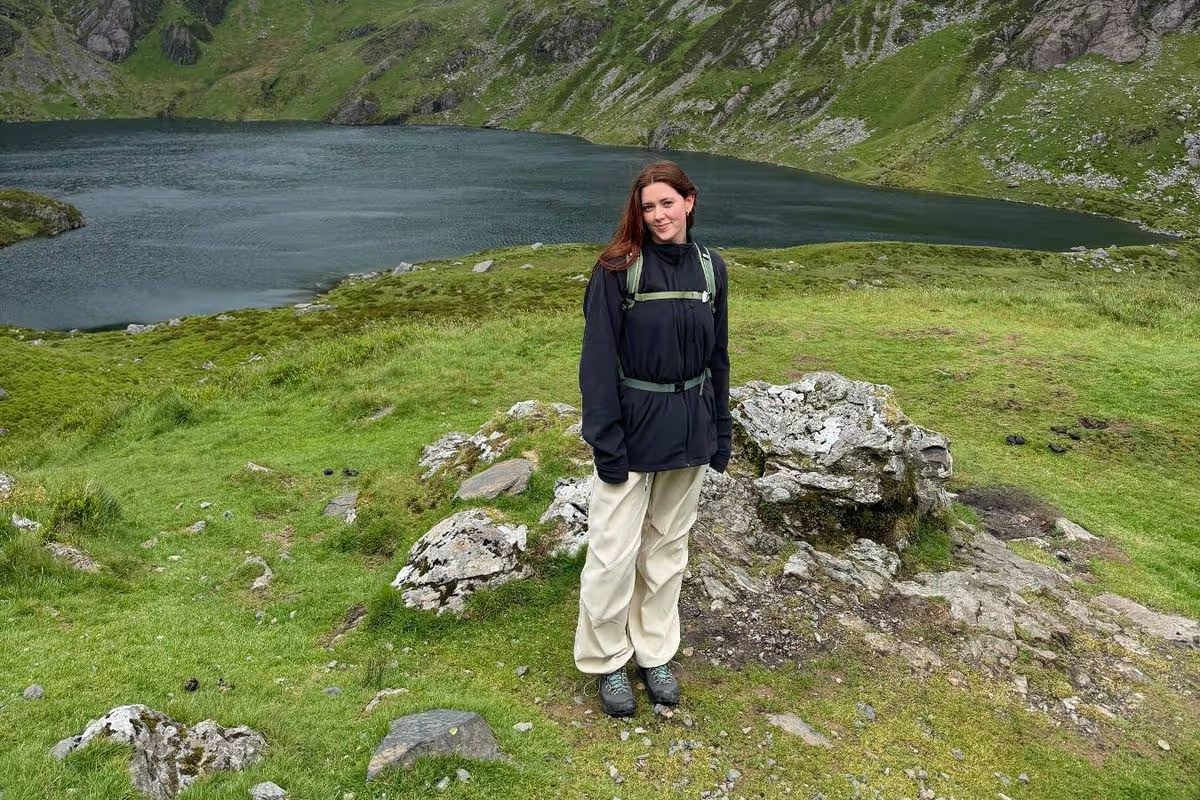
The national park’s a hotspot for tourism, but this particular walk felt like, at points, I could have been hiking in a tropical destination, with its bright green rugged cliffs

The more I travel around the UK, the more I am in awe of its natural beauty which seems to be overlooked by a lot of keen travellers, and this particular spot feels like a real slice of paradise.

You don’t need to hop on a plane to experience a sense of the tropics; it turns out you can immerse yourself in the brightest hues of green and walk along waterfalls in the north of Wales. While, of course, Snowdonia National Park is no secret, especially to avid hikers, cyclists and explorers, it was my first time visiting, and this specific route is one that blew me away.

It’s often cited as one of the best hikes in Snowdonia (Eryri). Cadair Idris is an 893-metre mountain in the southern part of the park and is renowned for its wild and rugged scenery. To me, it looked like its surroundings could belong in the likes of Peru or Southeast Asia, with its tropical plants, waterfalls and vibrancy of its green grass.

But of course, like any beautiful place in Wales, it reminded me exactly where I was when I spotted sheep dotted around its cliffs, even on the steepest parts. It looked as though the sheep could fall off the edge of the world, taking me with them, as I fought for hours against the growing pain in my shins, with each step up and up to the peak.

The route

I was taken up the Minffordd Path route, which is described as the shortest yet steepest route to the mountain’s summit, tackling a demanding 10 km walk. Overall it’s set to take up to four to five hours to complete, and in turn you are rewarded with dramatic and captivating views of the national park’s landscape.

The route begins at Dôl Idris car park and takes you past the Cadair Idris visitor centre, which quickly fills up. We were recommended to get there early in the morning to beat the pile-up and were thankful that we did; setting off on our walk at around 8am meant we got to experience the quietness of the route in all of its natural wonder. Albeit, the lie-in would have also been appreciated.

Running parallel along the stream which runs parallel to the stream which leads to Llyn Cau, the lake at the heart of the base of the mountain. It was immediately, when taking on these steep steps along the river, that I felt like I could be abroad.

Not only was the sun shining down on us, but the water was trickling down, with tropical plants growing around us, and it felt as wild and wonderful as the experiences I had in Thailand or the pictures I’ve seen of hikes in Vietnam or Peru.

This continued as we made our way out of the forest area and into the open air, with nothing but pure greenery around us, and the mountain stood proudly ahead. The second phase levels lightly as you enter a rocky amphitheatre, with up-close and personal views of the lake.

Pushing past slate and rocks, many of which are loose and therefore can be difficult to navigate, this section and throughout the walk, requires concentration and care with each step. A quick trip or fall could have you stumbling, and that’s why lots of hikers opt to go armed with sticks to help gain their balance and push them through.

By the time I made it to the top of the mountain, the weather dramatically changed, from sunny to high winds which were extremely cold. It’s this that can catch a lot of amateur hikers out, and I think it’s always best to go armed with windproof and waterproof layers, as they say ‘don’t dress for the car park’.

The real treat after that consistently steep hike upwards is this – the flat walk along the edge of the entire mountain before reaching its penultimate peak. Seeing it all from a circular angle gave you a real treat at each point whenever I decided to stop and take a breath.

Wales is the gift that keeps on giving when it comes to my explorations, and Cadair Idris was no exception to that. If you’re willing to take on the circular route and the real challenge of its steep and unsteady ground, then you will be rewarded with a touch of paradise and views you’ll continue to daydream about.

Source link

Gateway to the South Downs: take the train to a picture-perfect village with a cracking pub | Sussex holidays

Wisteria and clematis hang from weathered cottage walls. Tulips and pink apple blossom spill out of several gardens. Thatched animals decorate the rooftops. There’s a Norman church, a medieval castle and an 80-hectare (200-acre) nature reserve. Amberley is the kind of place people assume you can only reach by car, but the village has its own railway station with regular direct trains, along the scenic Arun Valley line, from Bognor, Horsham and London Victoria.

This spring, the Black Horse pub reopened in Amberley. The new owners are the gourmet Gladwin brothers, Oliver and Richard, returning to their Sussex roots near Nutbourne Vineyards. Having founded five Local & Wild restaurants in London, the Black Horse is their first country pub and first place with rooms.

I’ve walked through Amberley numerous times, but never stopped to explore. It’s the midpoint of the South Downs Way, a 100-mile route from Winchester to Eastbourne, with views for much of its length in both directions: north across the Weald and south towards the sea.

Black Horse pub in Amberley. Photograph: Dave Watts

Trains leave London every half an hour and take about 1hr 20mins to get to Amberley. The scenery outside gets steadily lovelier, passing blackthorn-bordered fields and bluebell woods. Beyond Pulborough, the railway enters the South Downs national park. There are herds of deer, chalk-hill views and the winding River Arun.

My first stop is Amberley Museum (two for the price of one with a voucher if you travel by train). Sprawling across more than 14 hectares (36 acres) of former chalk pits, it has impressive disused lime kilns and demonstrations of everything from broom-making to printing.

It’s right opposite the railway station and I’m planning a 45-minute whiz round before strolling into the village. Three hours later, I’m still there, riding the narrow-gauge railway and chatting to volunteers with encyclopedic enthusiasms for various traditional crafts. Visitors can hear the rattle of old machines and smell the printers’ ink, pine shavings, brick dust and engine oil. There’s a whole building about communications through time, from horse-drawn post carts to fibre-optic cables. The Tools & Trades History Society has intricate displays involving bee-smokers, hoop drivers, moulding planes, straw splitters and spindle grinders.

Above the museum’s main site, a nature trail leads up, through banks of bluebells and primroses, to a hilltop bench. Across the chalk cliffs of the old quarry and tall sycamores with their nesting rooks are views of the fortified walls of Amberley Castle, a bishops’ residence dating mainly from the 14th century.

I pass the castle on my 20-minute amble into the village and stop off at neighbouring St Michael’s church to admire the zigzagged Norman arch, oak leaf-carved doorway and graveyard cowslips. I check into the Black Horse, then head out again to explore Amberley Wildbrooks nature reserve, an area of boggy woods and tussock-sedged wetland, which starts two minutes’ walk away from the pub.

A pair of birders with a proper scope show me their photo of the resident white-tailed eagle, then I stroll through golden evening shadows serenaded by linnets and skylarks. No sign of the eagle, but I’m happy to hear warblers in the reedbeds and a woodpecker drumming for bugs. (Next day, I learn one of the area’s best eagle-spotting sites is The Sportsman, Amberley’s community pub, with binoculars on its terrace). I walk for miles along the single boggy track, following the Wey-South Path, a 34-mile (55km) route to Guildford mostly along canal towpaths, before finally heading back.

With bedrooms offering real milk and coffee, Amberley pottery and homemade biscuits, the Black Horse is hospitable. There are wooden beams, hilly views and fresh flowers. Plenty of pubs claim to be haunted by a “grey lady”; the Black Horse reports sightings of a spectral “woman in lavender … fleeting as the mist that settles over the Downs”.

Arundel Castle and the River Arun. Photograph: Adam Burton/Alamy

The renovated pub’s wood-panelled restaurant has an emphasis on local, foraged and sustainable food. Wild garlic season is ending and local asparagus has arrived. Grilled green spears in lemon with purple onion flowers look beautiful and taste better. Salad is dressed with gingery magnolia. There’s squid from Worthing, free-range lamb from the third Gladwin brother and farmer, Gregory, and wines from the family vineyards five miles north.

Many of the diners live locally (some on their second or third visit), while the early breakfasters next morning are mostly hiking the South Downs Way. The chalky hills look tempting in the spring sunshine, but I have other plans. In Arundel, four minutes’ journey south by rail, the nearly 1,000-year-old fortress (£17, gardens only) is hosting its huge annual tulip festival when I visit, having planted more than 1.4m bulbs over the past decade and won Historic Houses’ garden of the year in 2025, among other awards.

From pretty Arundel station, a bee-friendly path leads cyclists and walkers under the railway and beside a field to a safer stretch of pavement. Local community group Greening Arundel has won awards for this path, which is lined with celandines, murals and bug hotels.

Arundel Castle’s gardens. Photograph: Jesus Maria Erdozain Gomez/Alamy

There’s a queue to get into the castle gardens, but it’s easy to see why people come here. With fountains, thatched gazebos and historic walls as a backdrop, there are sweeping beds of multicoloured blooms, banks of scarlet by the moat, lush tubs of peony-style doubles, elegant lily-flowered cultivars and striped Rembrandts among a soft haze of forget-me-nots and the last of the narcissi.

Included in garden entry is the monument-filled 14th-century Fitzalan chapel, where pairs of marble knights and ladies lie side by side. On one of my teenage South Downs’ hikes, I spent hours with a friend searching every church in town for the stone effigies featured in Philip Larkin’s 1956 poem An Arundel Tomb, only to find them later in Chichester Cathedral.

After walking around the gardens, I climb the narrow-stepped Norman keep for views that stretch to the sea. There’s plenty to look at inside the castle, too: paintings by Van Dyck and Canaletto, rooms full of crossbows and rapiers, lion pelts in the Great Hall, antlers in the corridors.

From Arundel station, I can see the hilltop church and castle, framed by woods and marshes. The scene is up there with England’s other great views from railway stations, such as Durham Cathedral or St Michael’s Mount. Rich in history and wildlife, the trip feels longer and more rewarding than a simple overnight break. Outside the train windows, herons guard the waterways and swans are nesting in the reeds.

Accommodation was provided by the Black Horse pub, doubles from £110 room-only. Train travel was provided by Southern

Source link

Letters: The ups, downs and in-betweens of Dodgers baseball

p]:text-cms-story-body-color-text clearfix”>

Was it more fun to watch the Dodger offense return to form or to watch spoiled kid Pete Crow-Armstrong strike out four times on Saturday?

Certainly in the long run, Dodger success is much more important to this engaged fan than the serial failure of a young player still playing like a rookie after two years. Can you just imagine the screaming and cursing those Cubs fans watching on TV over PCA’s performance? I hope Pete appreciates that attention.

David Gene Echt
Torrance


Please explain to Dave Roberts that you don’t try a sacrifice bunt when you know the Marlins then automatically walk Shohei Ohtani. Nonsensical.

Fred Wallin
Westlake Village


Ah, yes, it’s that time of the baseball season, when the L.A. faithful panic over early losses, while other fanbases talk trash and pile on — despite knowing they’ll once again be playing late into October. Call it the Dodger Blue-print.

Steve Ross
Carmel

Source link