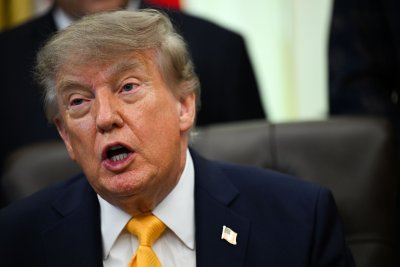
Donald Trump gives conflicting messages on prominence of Iran war in upcoming talks, with his administration emphasising trade.
United States President Donald Trump has departed the White House en route to Beijing, where he will meet with his Chinese counterpart Xi Jinping.
Trump spoke briefly with reporters on Tuesday as he boarded the Marine One helicopter. He was then set to arrive in China aboard Air Force One on Wednesday, ahead of the planned meetings on Thursday and Friday.
Recommended Stories
list of 3 itemsend of list
United States officials have taken pains in recent days to downplay how big a topic the US-Israel war on Iran will be during Trump’s visit.
Beijing has made its opposition to the war clear, at times asserting behind-the-scenes pressure on its trading partner Iran. However, it has largely avoided being pulled into the fray.
In recent days, US Secretary of State Marco Rubio and Treasury Secretary Scott Bessent have stepped up their calls for China to use its influence to help reopen the Strait of Hormuz, through which about 20 percent of the world’s oil supply flowed before the war began.
But Trump again gave conflicting messages on Tuesday about how much the war would feature in his meetings in China.
“We’re going to have a long talk about it. I think he’s been relatively good, to be honest with you,” Trump said of his plans to discuss the conflict – and how it has roiled global oil markets – with Xi.
Minutes later, he added, “We have a lot of things to discuss. I wouldn’t say Iran is one of them, to be honest with you, because we have Iran very much under control.”
“I don’t think we need any help with Iran. We’ll win it one way or the other, peacefully or otherwise,” he said.
Trade to loom large
The upcoming meetings will be the first face-to-face exchanges since the leaders of the world’s two largest economies met on the sidelines of the Asia-Pacific Economic Cooperation (APEC) summit in Busan, South Korea, in October 2025.
It is the second time Trump will travel to China as president, and the first time since his second term began on January 20, 2025. Xi is expected to travel to the US later this year.
Beyond the war, the US administration has stressed that trade will be a top subject discussed, with Trump seeking a series of business deals and agreements.
Underscoring that initiative, Trump invited an array of US business leaders to accompany him on the trip, including Tesla CEO Elon Musk, who had previously chaired Trump’s so-called Department of Government Efficiency (DOGE), and Apple CEO Tim Cook.
Both sides are expected to seek to avoid a return to the tariff war that defined Trump’s early days in office, which saw Trump set tariffs on Chinese goods at 145 percent, while China announced a further tightening of rare-earth export controls that would have hurt US industry.
The two sides reached a fragile truce in October of last year.
China’s continued support for Iran’s ballistic programme and its defence of Tehran’s nuclear programme has also risked again derailing relations.
Last month, Trump threatened to impose a 50 percent tariff on China after reports that Beijing was preparing to deliver a shipment of new air defence systems to Iran. He later backed away from the threat, claiming that he had received written assurance from Xi that he would not provide Tehran with weaponry.
Days later, Trump said that the US Navy had intercepted a Chinese vessel carrying a “gift” for Iran. Neither side offered further details of the incident.
Xi was also expected to push Trump on US arms sales to Taiwan, the self-governing island that China claims as its own.
All this comes as Trump has been telling media outlets that he believes the war could soon end. We’ll talk more about that later in this story.
“China is very happy that I am permanently opening the Strait of Hormuz,” the American leader proclaimed on Truth Social, even as the flow of oil from the Middle East has been drastically reduced by the war. “I am doing it for them, also – And the World. This situation will never happen again. They have agreed not to send weapons to Iran.”
“President Xi will give me a big, fat, hug when I get there in a few weeks,” he added. “We are working together smartly, and very well! Doesn’t that beat fighting??? BUT REMEMBER, we are very good at fighting, if we have to – far better than anyone else!!!”
In a pre-taped interview that aired Wednesday morning, Trump told Fox News that the war hasn’t soured his relationship with Xi, who has expressed frustration with American actions in the Middle East.
“I don’t think it does,” Trump told Fox News host Maria Bartiromo. “He’s somebody that needs oil. We don’t. He’s somebody I get along with very well. He just wrote me a beautiful letter…He responded to a letter that I wrote because I had heard that China is giving weapons to – I mean, you’re seeing it all over the place – to Iran…I wrote him a letter asking him not to do that, and he wrote me a letter saying that essentially he’s not doing that.”
Trump:
I wrote a letter to Xi. I asked him not to give Iran weapons. He wrote me a letter, and he is saying that he is essentially not doing that. pic.twitter.com/yrTT9Dwi2V
Before his Truth Social Post and the Fox interview aired, Financial Times reported that Iran “secretly acquired a Chinese spy satellite that gave the Islamic republic a powerful new capability to target US military bases across the Middle East during the recent war.”
“Leaked Iranian military documents show the satellite, known as TEE-01B, was acquired by the Islamic Revolutionary Guard Corps’ Aerospace Force in late 2024 after it was launched into space from China,” according to the outlet. “Time-stamped coordinate lists, satellite imagery and orbital analysis show that Iranian military commanders later tasked the satellite to monitor key US military sites. The images were taken in March before and after drone and missile strikes on those locations.”
Meanwhile, China continues to push back against accusations that it is helping Iran and repeated previous assertions that it will respond should Trump go through with his threat to impose a 50% tariff.
“Media reports accusing China of providing military support to Iran are purely fabricated,” Chinese Foreign Ministry spokesman Lin Jian stated on X. “If the U.S. goes ahead with tariff hikes on China on the basis of these accusations, China will respond with countermeasures.”
Lin did not offer details about those countermeasures.
Media reports accusing China of providing military support to Iran are purely fabricated.
If the U.S. goes ahead with tariff hikes on China on the basis of these accusations, China will respond with countermeasures. pic.twitter.com/QwETjpJEyY
Regardless, Iran’s use of commercial space imagery to strike U.S. and allied targets “will force the Pentagon to adjust, the head of U.S. Space Command said,” according to Defense One.
“We have to recognize that the rest of the world can now see the entire planet transparently and almost 24/7 and so we have to be able to operate in that environment successfully,” Gen. Stephen Whiting, the head of U.S. Space Command told reporters Tuesday during the Space Symposium conference.
UPDATES
UPDATE: 2:24 PM EDT –
White House Press Secretary Karoline Leavitt denied the U.S. requested an extention to the ceasefire.
‘I saw some reporting that we had formally requested an extension of this ceasefire. That is not true. We remain engaged in these negotiations.’
She also thanked Pakistan for its help in the negotiations.
PRESS SEC on U.S.-Iran negotiations: The Pakistanis have been incredible mediators and we really appreciate their friendship and efforts to bring this deal to a close.
The President feels it’s important to continue to streamline this communication through the Pakistanis. pic.twitter.com/3iIeF0oUpn
Trump, as we noted earlier, is saying that he believes the war could soon be concluded.
“I think it’s close to over,” Trump posited. “I mean, I view it as very close to over. You know what? If I pulled up stakes right now, it would take them 20 years to rebuild that country. And we’re not finished. We’ll see what happens. I think they want to make a deal very badly.”
When asked by Sky whether a deal could happen before King Charles visits the U.S. at the end of the month, Trump said: “It’s possible. Very possible. They’re beaten up pretty bad.”
U.S. and Iranian negotiators made progress in talks on Tuesday, moving closer to a framework agreement to end the war, two U.S. officials said, Axios reported on Wednesday.
“U.S. officials and sources familiar with the mediation cautioned that a deal is not guaranteed, given the substantial differences between the two sides,” the news outlet noted.
“Let’s wait and see if we can get a deal. We are hopeful and accordingly trying to push with both sides,” a Pakistani official told Axios.
“U.S. officials and sources familiar with the mediation cautioned that a deal is not guaranteed, given the substantial differences between the two sides.”
“We want to make a deal. And parts of their government want to make a deal. Now the trick is to get the whole of government…
In another step toward potential future negotiations, Pakistan’s Army Chief of Staff Asim Munir arrived in Tehran today for talks.
Iran’s Foreign Minister Spokesman, Esmail Baghaei, said that during the visit, “the views of both sides are likely to be discussed in detail.”
Iran’s Foreign Minister Spokesman, Esmail Baghaei, confirms that a high-ranking Pakistani delegation will visit Tehran today to follow up on talks with the U.S. in Islamabad. “During this visit, the views of both sides are likely to be discussed in detail,” Baghaei said. pic.twitter.com/bdMnyCKUA5
— Ariel Oseran أريئل أوسيران (@ariel_oseran) April 15, 2026
Baghaei, however, said Iran would not capitulate.
“If a negotiation is based on one side imposing conditions on the other, that is not negotiation; it is dictation and imposition, and you know that the Islamic Republic of Iran and the Iranian nation will never accept such imposition,” he stated.
Iranian Foreign Ministry spokesperson:
If a negotiation is based on one side imposing conditions on the other, that is not negotiation; it is dictation and imposition, and you know that the Islamic Republic of Iran and the Iranian nation will never accept such imposition. pic.twitter.com/lnKeJT9Pow
In an X post, CENTCOM on Wednesday said that during “the first 48 hours of the U.S. blockade on ships entering and exiting Iranian ports, no vessels have made it past U.S. forces. Additionally, 9 vessels have complied with direction from U.S. forces to turn around and return toward an Iranian port or coastal area.”
During the first 48 hours of the U.S. blockade on ships entering and exiting Iranian ports, no vessels have made it past U.S. forces. Additionally, 9 vessels have complied with direction from U.S. forces to turn around and return toward an Iranian port or coastal area. pic.twitter.com/h4msgvaPTl
Late Tuesday night, Adm. Brad Cooper, commander of CENTCOM, took to X to announce that the “blockade of Iranian ports has been fully implemented as U.S. forces maintain maritime superiority in the Middle East.”
“An estimated 90% of Iran’s economy is fueled by international trade by sea,” Cooper noted. “In less than 36 hours since the blockade was implemented, U.S. forces have completely halted economic trade going into and out of Iran by sea.”
Senior IRGC commander Maj. Gen. Ali Abdollahi claimed the Islamic Republic would consider it a prelude to the breach of the ceasefire if “the aggressive and terrorist America” continues the blockade.
Abdollahi “threatened that the powerful Iranian armed forces would not allow any export and import to keep going in the Persian Gulf, the Sea of Oman, and the Red Sea region, in the face of the US maritime aggression,” the official Iranian IRNA news agency stated on Wednesday.
Meanwhile, the Malta-flagged VLCC Agios Fanourios I became the first crude carrier to head west through the Strait of Hormuz since the US blockade on Iran’s ports came into force, according to MarineTraffic.
First crude carrier heads west through Strait of Hormuz since the US blockade
The Malta-flagged VLCC Agios Fanourios I has become the first crude carrier to head west through the Strait of Hormuz since the US blockade on Iran’s ports came into force. According to #MarineTraffic… pic.twitter.com/K8syfSZtFL
Though another round of peace talks between the U.S. and Iran is being discussed, the Pentagon continues to pour resources into the Middle East, something we have been reporting about for weeks.
“The forces moving into the region include about 6,000 troops aboard the aircraft carrier USS George H.W. Bush and several warships escorting it, said current and former officials,” according to The Washington Post, citing anonymous officials. “About 4,200 others with the Boxer Amphibious Ready Group and its embarked Marine Corps task force, the 11th Marine Expeditionary Unit, are expected to arrive near the end of the month.”
The Nimitz class aircraft carrier USS George H.W. Bush. (U.S. Navy photo by Mass Communication Specialist 2nd Class Mitchell Mason) Petty Officer 2nd Class Mitchell MasonA stock picture of the Wasp class amphibious assault ship USS Boxer. USN
During the pause in fighting, Iran appears to be using the time to reopen entrances to underground missile cities damaged during the war, according to CNN. The network published footage showing engineering equipment at the Tabriz South missile base and the Khomein missile bases.
The network also noted that, according to U.S. intelligence estimates, about half of the Iranian missile launchers remained intact after a month of fighting, and that many of these launchers could have been buried in underground storage facilities as a result of strikes on the entrances.
CNN published footage showing engineering equipment making use of the ceasefire to reopen the entrances to underground facilities at missile bases that were damaged during the war.
The sites documented include the Tabriz South missile base and the Khomein missile base.
A day after negotiations took place in Washington between the U.S., Israel and Lebanon, Hezbollah issued a veiled threat to Beirut. Considered a terrorist organization by the U.S. and Israel, Hezbollah was not a party to the talks.
“The Lebanese authorities must reconsider their actions and return to the embrace of the people,” said Hezbollah MP Hassan Fadlallah in a statement. “The authorities withdrew the army from the south, leaving it vulnerable to occupation and giving the enemy [Israel] free rein.”
Meanwhile, Israel is continuing to bombard Hezbollah.
“In the past 24 hours, the IDF struck over 200 Hezbollah terror infrastructure sites in southern Lebanon,” it claimed. “Among the targets struck: terrorists, military structures, approximately 20 launchers, including those recently used to fire towards the State of Israel.”
ביממה האחרונה הותקפו יותר מ-200 מטרות של ארגון הטרור חיזבאללה בדרום לבנון. בין התשתיות שהותקפו: מחבלים, מבנים צבאיים וכ-20 משגרים, בהם משגרים ששיגרו לעבר שטח הארץ והושמדו בסגירות מעגל מהירות. pic.twitter.com/LeR2mr37Vv