Downed

What Was The “Jellyfish-Like” Drone Swarm The Downed F-15E Pilot Reportedly Saw Over Iran?

Many questions remain about the complex mission to rescue the crew of the U.S. Air Force F-15E Strike Eagle that came down over Iran in April of this year and what led to it. Now, the reported testimony of the Strike Eagle pilot involved describes a ‘jellyfish-like’ swarm of drones in the sky, moments before they ejected from the stricken jet.

According to a report from CNN, the pilot recounted seeing “multiple Iranian drones hovering in the air, moving as one, in a formation that resembled a jellyfish.” The report is based on statements from four unnamed sources said to be familiar with the matter.

Needless to say, the veracity of the report should be treated with caution, especially bearing in mind the highly dynamic and confused nature of the situation. However, CNN claims that the account was taken seriously enough to prompt debate within the U.S. intelligence community. It should also be noted that the testimony relates only to the pilot and not the Weapon Systems Officer (WSO).

The report suggests that, during a post-incident debriefing, the F-15E pilot told intelligence officials that they saw:

“Multiple drones interconnected and moving as one with smaller drones below the bigger drones like legs. Real alien shit.”

Those words are not from the pilot themselves, but are said to be from one of the sources familiar with the witness account.

Another source told CNN that the same pilot described seeing a “minefield of drones” in the air.

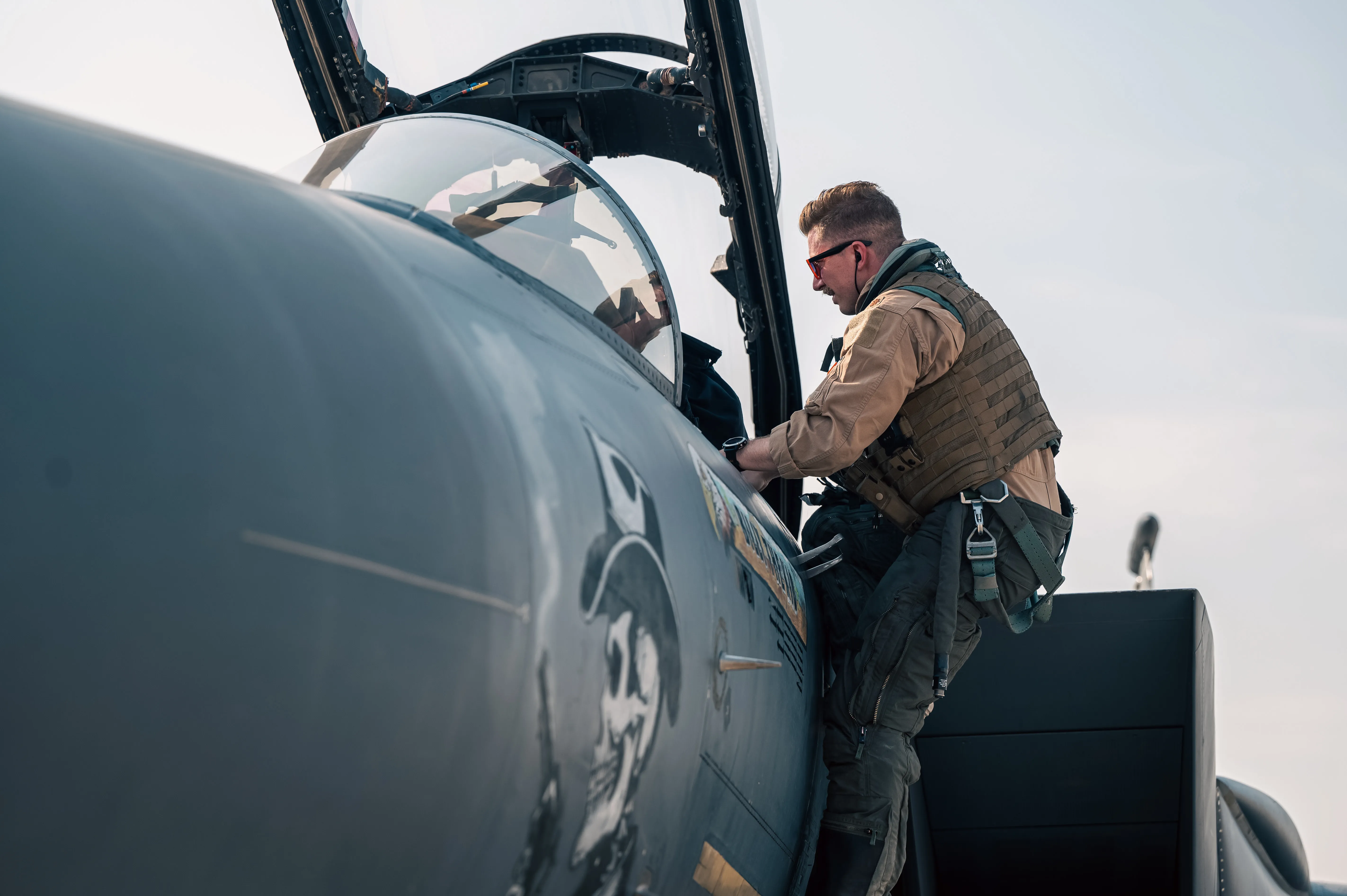
U.S. Air Force Capt. Johnson, a pilot assigned to the 391st Expeditionary Fighter Squadron, climbs into the cockpit of an F-15E Strike Eagle during exercise Agile Spartan 25.2 in the U.S. Central Command area of responsibility Aug. 26, 2025. U.S. Air Forces Central's ability to rotate a combat-capable fighter presence throughout the theater complicates the adversary’s decision-making and targeting processes against the U.S. forces in the region. (U.S. Air Force photo by Senior Airman Grace Turpin)
In a library photo, a pilot assigned to the 391st Expeditionary Fighter Squadron climbs into the cockpit of an F-15E Strike Eagle in the U.S. Central Command area of responsibility. U.S. Air Force photo by Senior Airman Grace Turpin

Again, provided these accounts are correct, we cannot say for sure that the pilot actually saw what they described. After all, this was during an extremely high-stress period, and the pilot also ended up with a concussion. Even the U.S. intelligence officials involved in the debrief reportedly disagreed on how to interpret what the F-15 pilot described, and whether the pilot could recount the incident clearly, according to CNN.

The same report also repeats the assertion that the pilot had previously been shot down in the same conflict, during a friendly-fire incident that left three Strike Eagles downed over Kuwait in March. The High Side, a publication on Substack, first reported this detail, citing unnamed current and former Air Force officials. CBS News also subsequently reported this, citing anonymous individuals familiar with the events.

As for the F-15E incident over Iran, you can read our analysis of what was previously revealed about what happened here.

While the exact cause of the loss of the F-15E hasn’t been revealed, NBC News previously quoted three unidentified officials who said the jet “was probably struck by a Chinese-made shoulder-launched missile” and that the engagement may have been supported by a “long-range early-warning radar that spots stealth aircraft,” which Iran received in the “early days” of the war. U.S. President Donald Trump also reportedly said that the Iranians used a shoulder-fired missile, and that “they got lucky.”

Furthermore, while the pilot was rescued within hours, the WSO hid out in a crevice as both rescuers and Iranians frantically searched for him. They were picked up around 50 hours after ejection, aided by a rescue mission involving hundreds of troops, scores of aircraft, and diversion operations over more than a half dozen different parts of Iran. The effort also saw the loss of a second aircraft, an A-10 attack jet in the air, as well as two MC-130J Commando II special operations cargo planes and several H-6 Little Bird special operations helicopters that were destroyed on the ground.

The wreckage of an MC-130J Commando II and an H-6 Little Bird after it reportedly got stuck during the operation to rescue the downed F-15E WSO and later was blown up by U.S. forces so it would not fall into Iranian hands. Iranian state media

The most dramatic interpretation, that a drone swarm directly participated, even if by happenstance, in the shootdown of the Strike Eagle, cannot be entirely ruled out, but there is no publicly available evidence supporting it. There is the description of this formation being a “minefield,” as in something the F-15 could stumble into. This is an interesting note and it may just be how it was mentioned figuratively. At the same time, putting up some sort of a drone screen formation along a known route, especially if it is being used for low-level transits, or near a high-risk facility, could make some sense. Basically, the aircraft would fly into it and be destroyed if it hits a drone, the drones are detonated in close proximity to the aircraft or even if they are connected physically somehow and the aircraft hits the cables. This would match with the description, to a degree, and it would not require any sort of real swarming capability. This would be something of a new ‘barrage balloon’ concept that is more flexible and easier to deploy on demand. China is using balloons in a similar manner to protect key installations today. In addition, Iran certainly has employed its fair share of bizarre tactics and weapons concepts to that point that this doesn’t seem that implausible, but still, it is just a guess.

Returning to the new report, if the pilot really did see a ‘jellyfish-like’ group of Iranian drones that were truly swarming, that would point to previously unknown capabilities within that country, but this is technology that is certainly within the realm of credibility.

Swarms, in this context, are groups of vehicles or guided munitions that are interconnected via datalink and work cooperatively to maximize their combined abilities to accomplish an objective or set of objectives. It is important to note that a major role is played by the nature of a swarm’s computing and autonomy capabilities, and the supporting communications architecture. Swarms can range from ones offering basic cooperative capabilities to far more advanced and dynamic, advanced AI-driven ones. Swarms are not to be confused with a group of drones that are simply sent on a mission together, but have no true cooperative capabilities. These can be best viewed, at least in the aerial sense, as formations of drones or ‘flocks’ of drones that are basically preprogrammed, with tactical planning and large numbers providing an advantage, not the ability to react to external stimuli and make decisions as a team in real-time.

Regardless, based on two of its sources, CNN asserts that “initial reports indicated that it was possible the drone formation had in some way enabled Iran to shoot down the American jet.”

This would raise questions about what type of performance and configuration these drones had, including what altitude the drones were at when they were supposedly sighted, as well as the flight level of the Strike Eagle.

Previously, U.S. officials disclosed that Iran had made use of smaller drones in the hunt for the missing F-15E WSO, but there was no mention of any kind of drone swarms.

A U.S. Air Force F-15E Strike Eagle pilot and weapons systems officer assigned to the 335th Expeditionary Fighter Squadron, Seymour Johnson Air Force Base, North Carolina, prepares to receive fuel from a KC-135 Stratotanker assigned to the 92nd Expeditionary Air Refueling Squadron, Fairchild Air Force Base, Washington, over the U.S. Central Command (USCENTCOM) area of responsibility (AOR), Sept 16, 2024. The F-15E is a two-seat, dual-role, fighter with a rear cockpit allowing for a weapons system officer to manage weapons and aircraft systems while conducting operations that provide safety and security for the U.S. regional partners and coalition allies within the USCENTCOM AOR. (U.S. Air Force photo)
An F-15E Strike Eagle pilot and weapon systems officer assigned to the 335th Expeditionary Fighter Squadron prepare to receive fuel from a KC-135 over the CENTCOM area of responsibility. U.S. Air Force photo

For China and Russia, to name just two nations, both of which have provided military assistance to Iran, drone swarming is very much an area of focus. Swarms have many uses, not just to overwhelm the enemy, but also to sense broad areas cooperatively and to work as a highly efficient group offering mixed capabilities that equate to a sum greater than their parts.

In the case of China, as we have been reporting on for years, the country has moved especially fast on drone swarming, working to evolve these capabilities on different scales for many years. China has repeatedly demonstrated swarms of loitering munitions, deployed from container launchers that can be mounted on light vehicles or helicopters, for example. The country also has worked to develop higher-end swarming capabilities using larger drones, as well as advanced unmanned combat air vehicles. This is on top of the country’s place as an absolute leader in low-end unmanned technologies, including massive coordinated drone swarms for commercial purposes.

中国电科陆空协同固定翼无人机“蜂群”系统 thumbnail

中国电科陆空协同固定翼无人机“蜂群”系统


The potential of this kind of warfare has not been lost on the U.S. military either, which has been working on it for decades. These efforts date back many years, with the public disclosure of the Perdix having come nearly a decade ago now, and cooperative swarming trials have been carried out repeatedly in the open since then. These efforts have since become ‘mainstream’ as the drone revolution has taken hold of the defense industry. Some of these technologies are now being operationalized in a publicized manner. All this is on top of what is likely an extreme level of development in the classified realm.

Only last month, TWZ reported on how the Defense Advanced Research Projects Agency (DARPA) was looking into drones with a high degree of autonomous operation, as well as remotely-operated containerized systems to launch, recover, and otherwise support them. The end result would be a largely self-sustaining “autonomous constellation” capable of supporting networked swarms consisting of as many as 500 drones at once.

By now, swarming capabilities are a key emerging tenet of modern military drone development and are beginning to be demonstrated on the battlefield in Ukraine.

At this point, it is worth noting that Iran has already demonstrated “loitering” surface-to-air missiles, an unusual category of weapon that blurs the distinction between a kamikaze drone and a more traditional surface-to-air missile. As far as we know, Iran has not attempted to use these weapons in swarms, although having them operate in larger groups would clearly boost the probability of success.

Russia’s Defense Minister Sergei Shoigu, in the front row, second from the right, is shown a 358 “loitering” surface-to-air missile at an Islamic Revolutionary Guard Corps (IRGC) exhibition in Iran. Russian Ministry of Defense

There is also the possibility that what the F-15E pilot saw was some kind of previously unknown drone technology fielded by the U.S. or Israeli military, before the Strike Eagle came down. Clearly, Israel and the United States deployed certain systems in the conflict that had not been seen before, and both countries have the ability to field platforms with swarming capabilities. Releasing a group of drones that can hunt and even kill over the Iranian countryside, looking for targets of opportunity over large areas, like air defenses and standoff weapons launchers, is exactly the kind of concept that swarms were envisioned as being so capable at realizing.

Subsequently, while the rescue effort was underway, the U.S. military certainly was making use of drones in the vicinity. Air Force Gen. Dan Caine, chairman of the Joint Chiefs of Staff, previously described how “A-10s and […] drones and other tactical aircraft were violently suppressing and engaging the enemy in a close-in gunfight to keep them away from the front-seater and allow the pickup force to get into the objective area.” 

The use of drones for suppression and destruction of enemy air defenses, as well as stand-in jamming of those systems, is a very real component of modern air warfare dating back decades. Israel was a pioneer in it, which you can read all about here. Those capabilities are far more advanced today, especially for long-range systems dedicated to those missions and for the emerging ‘launched effects’ segment of drone warfare. It’s hard to imagine that these proven capabilities were not put to some use over Iran during the war. The U.S. military even employed its own one-way attack munition, the LUCAS drone, with similar capabilities.

LUCAS drone launching off a ship in the Middle East. (CENTCOM)

With all that being said, there is the possibility that the pilot experienced something else entirely, perhaps related to their concussion or another kind of phenomenon. Even a flock of birds or a group of balloons, the latter of which can be used as decoys to confuse enemy radar and bait fighter aircraft and other air defenses, could appear as a drone swarm, for example. Iran had every reason to use such cheap, but potentially effective tactics. While an experienced fighter pilot would normally be able to tell the difference between drones or birds, these were very much abnormal circumstances. Then there is the matter of Unidentified Aerial Phenomena (UAP), which this could fall into, just for the reason that what was seen may be hard to identify. We don’t know what the description of the configurations of the drones was, or if any was provided, which could help narrow down the possibilities. Also, did the aircraft’s sensors detect these craft? We just don’t know.

A U.S. Air Force F-15E Strike Eagle performs a flare check over the U.S. Central Command area of responsibility, March 9, 2025. The F-15E is deployed within the CENTCOM AOR to help defend U.S. interests, promote regional security, and deter aggression in the region. (U.S. Air Force photo by Senior Airman Zachary Willis)
A U.S. Air Force F-15E Strike Eagle performs a flare check over the U.S. Central Command area of responsibility. U.S. Air Force photo by Senior Airman Zachary Willis

For now, the reported drone sighting remains an intriguing but unverified element of a much larger story, many important details of which are still to emerge.

Contact the author: thomas@thewarzone.com

Thomas Newdick is a staff writer at TWZ, where he covers military aviation, defense technology, weapons systems, and international security. Based in Berlin, Germany, he reports on conflicts, military modernization efforts, and emerging aerospace technologies around the world, with a particular interest in airpower and its role in contemporary warfare. His reporting is informed by deep expertise in modern and historical airpower, particularly in Europe, with a focus on military aviation, air campaigns, and aerospace developments across the continent and beyond.


Tyler’s passion is the study of military technology, strategy, as well as foreign policy, and he has fostered a dominant voice on those topics in the defense and national security space. Tyler was the creator of the hugely popular defense site Foxtrot Alpha before developing TWZ, which he continues to lead as the Editor-In-Chief to this day.


Source link

This Is The Corsair Drone Boat That Plucked The Downed Apache Crew Out Of The Gulf Of Oman

U.S. Central Command (CENTCOM) has confirmed a Saronic Corsair was the uncrewed surface vessel (USV) that rescued the crew of a U.S. Army AH-64 Apache out of the Gulf of Oman overnight. President Donald Trump has also now said Iranian forces downed the attack helicopter, and promised a response. This is the first known instance of a drone boat being used to recover personnel as part of a search and rescue mission, and has major implications for these operations going forward. Readers can otherwise get up to speed on what is already known about this incident in our initial reporting here.

“The surface drone that assisted in last night’s rescue of the Apache crew off the coast of Oman was a U.S. Navy Corsair unmanned surface vessel operated by U.S. 5th Fleet’s Task Force 59,” U.S. Navy Capt. Tim Hawkins, a CENTCOM spokesman, told TWZ. “The task force began fielding these drones in theater in late March.”

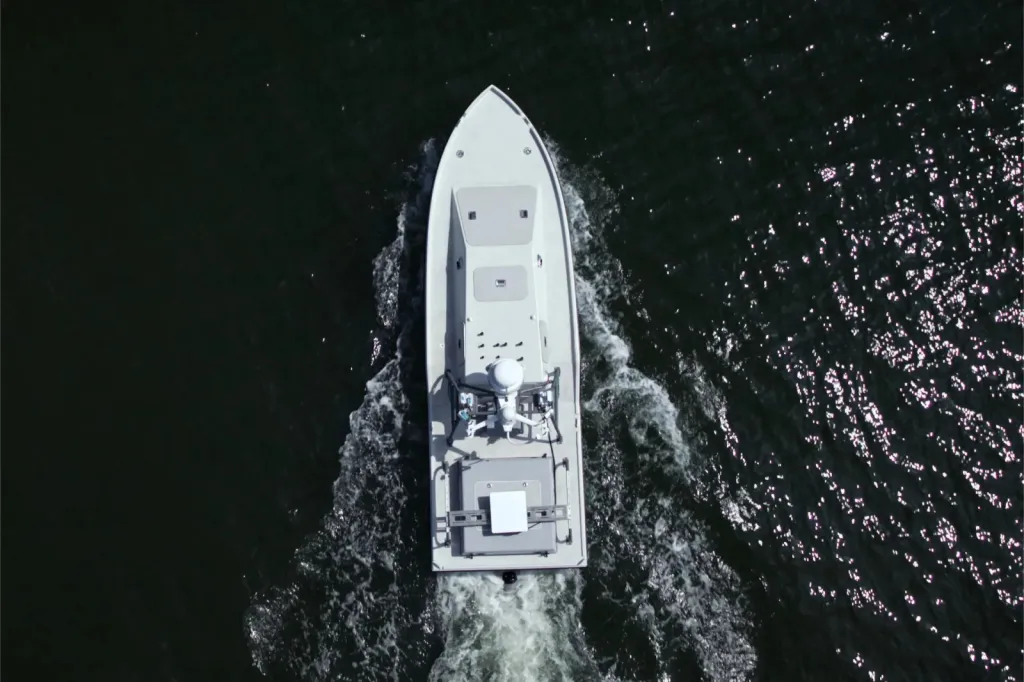
A top-down look at a Saronic Corsair USV. Saronic

The Navy confirmed last December that it had signed an Other Transaction Authority (OTA) deal with Saronic, valued at $392 million, for the production of Corsair USVs. The Corsair, which the manufacturer also calls an autonomous surface vessel (ASV), is a 24-foot-long drone boat with a speedboat-like design that was first unveiled in 2024. The manufacturer says it has a maximum range of 1,000 nautical miles, a top speed of 35 knots, and a 1,000-pound payload capacity.

The Corsair “picked them [the Apache crew] up and transported them to another location on the water where they were then hoisted up to a helicopter for further transport,” Capt. Hawkins, the CENTCOM spokesperson, added.

CENTCOM had already confirmed to TWZ and others that an unspecified USV found and rescued the two aircrew from the downed Apache. The Wall Street Journal was first to report the specific type of drone boat employed.

The Army aviators spent approximately two hours in the water before being recovered safely, according to a previous CENTCOM statement. As mentioned, President Donald Trump has also now separately said that Iranian forces were responsible for bringing down the Apache, and that a U.S. response will be forthcoming.

Since its establishment in 2021, the Navy’s Task Force 59 has been charged with helping expand the service’s operational use of uncrewed platforms, as well as artificial intelligence (AI) and machine learning-driven capabilities, across the Middle East. It has operated an array of different types of USVs, as well as uncrewed aerial systems, over the years.

How many Corsairs Task Force 59 has currently, as well as their exact configuration, is unclear. Pictures and videos that Saronic has released to date have shown Corsairs fitted out primarily for surveillance and reconnaissance missions, with a camera turret on top of a central mast-like frame. A commercial navigation radar, additional cameras to help provide extra situational awareness, and various other antennas have also been seen fitted to that frame. Saronic has talked about integrating other capabilities to enable additional mission sets, including launchers for loitering munitions, in the past.

A picture showing the most typical configuration of the Corsair USV that has been seen to date. Saronic

Saronic also says Corsair has a high degree of autonomy, with the type having logged more than 100,000 nautical miles of total travel to date, including multi-day missions. The SUV is designed to be employed independently or in networked swarms, according to the company. Human operators are in the loop during these operations via datalink.

“Corsair can be given a mission, alone or as part of a collaborative swarm, and execute with minimal human interaction to deter or counter adversarial threats at a range of 1,000 nautical miles,” Saronic said in a press release back in 2024. “Employing redundant communications and passive perception capabilities, Corsair can autonomously identify, track, follow, and intercept targets in contested and communications denied environments.”

These are all capabilities well suited to the U.S. Navy’s immediate needs in the Middle East, especially in support of the current blockade of Iranian ports. Corsair would notably offer a lower-risk way to closely shadow vessels that might be attempting a run into or out of the area. Corsair’s ability to automatically spot and track objects of interest would have helped in finding and rescuing the downed Apache crew, too. It is worth noting here that automated target detection is also a key part of Corsair’s ability to safely navigate autonomously, day or night, especially in congested waterways, as seen in the video below.

Corsair’s overall performance in the Middle East could easily translate to further operational use of this USV by the Navy globally. The service has particularly significant demands for persistent maritime surveillance and reconnaissance capacity, as well as just general presence, across the broad expanses of the Pacific. One of the key benefits that USVs offer is the ability to provide additional distributed ‘mass’ at relatively low cost. This can help bolster the capabilities of crewed platforms they are networked together with or just ease the operational strain on those assets.

The Navy has now also clearly demonstrated how valuable USVs could be in future maritime search-and-rescue operations worldwide. This, in turn, underscores the benefits uncrewed platforms bring to these missions, especially in the face of growing anti-air and other threats.

As we already wrote today:

“As TWZ regularly highlights, search and rescue operations present inherent complexities and risks, especially when conducted in or near hostile territory. The F-15E rescue effort in Iran put a particular spotlight on the immense risks that combat search and rescue (CSAR) forces take, with helicopters and C-130 variants sent into areas where even a high-end fighter aircraft didn’t survive.”

“Open-water recoveries can present distinct additional challenges. There is always the possibility of the loss of additional assets and personnel in the process, no matter where a CSAR mission occurs.”

US Air Force HH-60W Jolly Green II search-and-rescue helicopters refuel from an HC-130J Combat King II aircraft. USAF

The use of a Navy drone boat in the rescue overnight highlights a new dimension for maritime CSAR going forward. These uncrewed assets can be more readily pre-positioned in a distributed manner. For example, in the broad expanse of the Pacific, USVs could be forward-deployed at multiple points along certain flight paths for this exact purpose. USVs could offer other distinct advantages in certain scenarios where they might be able to get into areas where traditional assets cannot and without risking additional personnel. These realities extend well beyond the maritime domain, and we are only likely to see uncrewed platforms of all kinds increasingly taking part in rescue efforts, especially in denied areas. The U.S. military is coming to terms with just how vulnerable their CSAR assets are and the ranges that would be needed to access highly defended areas, especially during a peer fight. Using drones to execute personnel recovery is being viewed as one part of a larger set of solutions to this pressing problem.

The additional detail we have now that the Corsair USV brought the downed aircraft to a territorial location, where they were then hoisted into a helicopter, is notable, too. This further shows how uncrewed platforms could be used as part of a distributed hub-and-spoke-style concept of operations for future rescue missions, which could increase flexibility and total area covered. USVs could be used to penetrate into especially high-threat areas, recover personnel, and then bring them to crewed assets at safer locations to the rear, as well.

“When it comes to search and rescue, you utilize the best asset that is the closest and the quickest, and that was the case in this instance,” CENTCOM’s Hawkins also told The Wall Street Journal today. “We’ve practiced this scenario in exercises, but not quite necessarily like this.”

Corsair’s now very public use in the Middle East could be a boon for Saronic when it comes to future sales opportunities with the U.S. military and foreign customers, as well. Corsair, by itself, has already been at least evaluated by the Pentagon’s Defense Innovation Unit (DIU) under its Production-Ready, Inexpensive, Maritime Expeditionary (PRIME) effort. It was also a finalist in the Army’s xTechPacific 2025 innovation challenge.

Saronic has multiple larger USV offerings beyond Corsair, and the company just recently launched the first example of the largest type it has in development now, the Marauder. This drone boat is 180 feet long and is designed to be able to travel up to 4,100 nautical miles while carrying 150 metric tons of containerized payloads, or even further with a lighter load.

The first Marauder prototype seen being launched earlier this year. Saronic

The Navy is already set to evaluate Marauder, as well as designs from six other companies, as part of the first round of prototyping under its latest Medium Unmanned Surface Vessel (MUSV) effort. This is part of a larger strategy the service rolled out in March to try to field more USVs and do so faster, as you can read more about here.

In the meantime, Saronic’s Corsair is already being employed operationally in the Middle East and demonstrating its ability to perform complex missions.

Contact the author: joe@twz.com

Joseph has been a member of The War Zone team since early 2017. Prior to that, he was an Associate Editor at War Is Boring, and his byline has appeared in other publications, including Small Arms Review, Small Arms Defense Journal, Reuters, We Are the Mighty, and Task & Purpose.


Source link