doubts

Iran war day 98: Tehran raises doubts on deal as Lebanon fighting continues | US-Israel war on Iran News

Israel strikes Lebanon despite ceasefire, while Hezbollah rejects deal as death toll tops 3,500.

Israel has continued to carry out deadly strikes across Lebanon despite the announcement of a new US-brokered ceasefire agreement reached by Lebanese and Israeli officials in Washington, DC.

The violence has pushed the number of casualties higher, with Lebanon’s Ministry of Public Health reporting that at least 3,526 people have been killed and 10,733 wounded in Israeli attacks since March 2.

Meanwhile, Hezbollah leader Naim Qassem has dismissed the ceasefire as a “farce”, warning that northern Israel will remain a target as long as Israeli forces continue bombing Lebanon, raising more doubts about the prospects for a lasting truce.

Here is what we know:

In Iran

  • Iran adviser flags concerns over draft deal: Mohsen Rezaei, an adviser to Iran’s Supreme Leader Mojtaba Khamenei, said the draft memorandum of understanding being negotiated to end the war still contains “ambiguities” that need to be clarified. Speaking to Iranian state television, Rezaei also accused US President Donald Trump of trying to pressure Tehran into accepting Washington’s terms while keeping Iran’s own conditions “in a vague state”.

War diplomacy

  • Questions over US strategy: Reporting from Washington, DC, Al Jazeera’s Kimberly Halkett said the White House is facing growing questions over why a negotiated agreement with Iran is still needed after President Donald Trump repeatedly claimed US military action had “obliterated” Iran’s nuclear programme. Halkett said critics are asking: “If these military objectives have been achieved, then is there still a need for talks?” She added that “with each passing week that this war drags on” and negotiations remaining stalled, it is becoming increasingly difficult for the administration to reconcile its claims of success with the continued push for diplomacy.
  • Hezbollah rejects conditional ceasefire: Hezbollah leader Naim Qassem rejected the limited truce agreed to by Lebanese and Israeli representatives in the US, demanding a complete ceasefire and a full Israeli pullout from the country. Qassem also warned of more attacks on northern Israel, highlighting the difficulties in reaching a lasting peace. Both sides have blamed each other for breaking a previous ceasefire announced in April.

The Gulf

  • Oman oil terminal disruption: Reuters reported that Oman has suspended crude oil loading operations at its key Mina al-Fahal terminal after an explosion near its single-buoy mooring (SBM) berths. Citing unnamed sources, the agency said the blast occurred between SBM 1 and SBM 2 and was allegedly caused by a drone attack.

In the US

  • Trump says US does not need a deal to access Iran’s uranium: The US president said Washington could access Iran’s enriched uranium without reaching an agreement with Tehran, arguing the material is effectively “entombed”. Trump also said he does not plan to meet Iran’s Supreme Leader Mojtaba Khamenei, but he suggested a meeting could be possible if a deal is eventually reached, adding that “if it happened … I’d be respectful”.

In Israel

  • Ultra-Orthodox protest blocks major highway: Hundreds of ultra-Orthodox Israelis blocked Highway 1 in protest against the government’s enforcement of military conscription for religious students, according to Israel’s Channel 10. The demonstrations began after police stopped two ultra-Orthodox students and transferred one to military authorities. Large numbers of police and border guards were deployed to clear the highway and disperse protesters.

In Lebanon

  • Hezbollah rejection raises fears of escalation: Reporting from Beirut, Al Jazeera’s Ali Hashem said Hezbollah remains the key actor on the Lebanese side when it comes to decisions about fighting and any potential halt to hostilities with Israel, “regardless of what the Lebanese government says”. Given Hezbollah’s rejection of the US-brokered ceasefire, Hashem warned that further escalation is likely from both Hezbollah and Israel. He noted that southern Lebanon and the western Bekaa Valley experienced significant Israeli air and ground attacks on Thursday, adding that Hezbollah’s position suggests “it is going to be a very difficult situation” in the days ahead.

Source link

Early returns show L.A. County voter doubts about healthcare sales tax

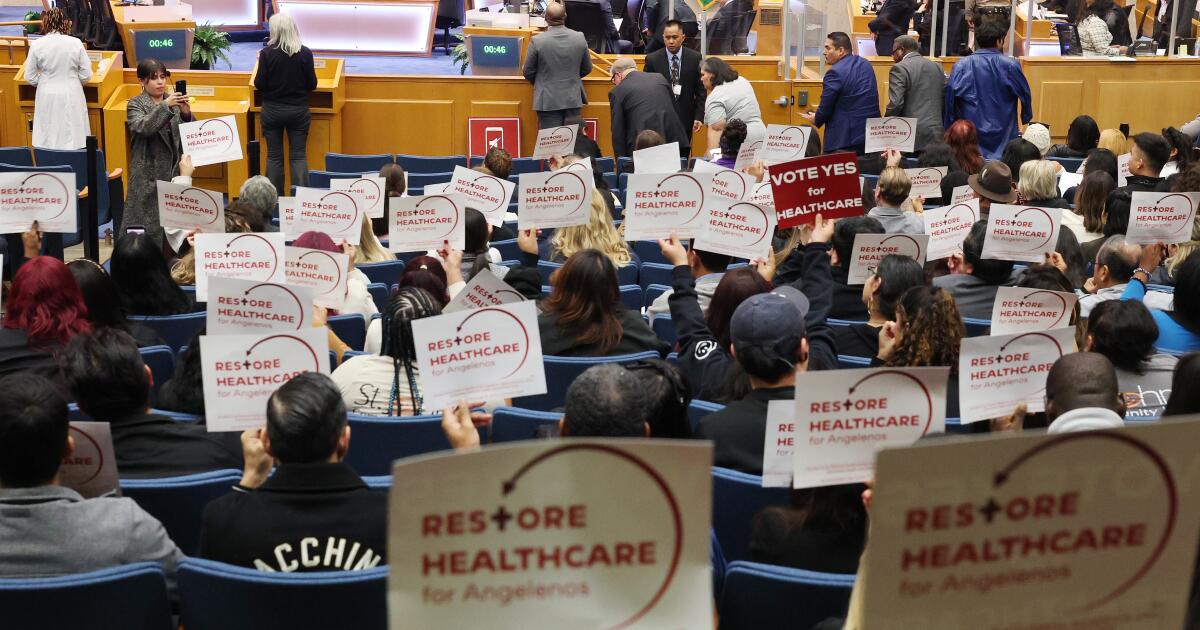
Los Angeles County’s half-cent sales tax to fund healthcare services was trailing Tuesday, with early returns showing a majority of voters rejecting the measure.

The tax — a half-penny of every dollar spent in the county — is meant to prop up local hospitals and clinics that are hemorrhaging funding after recent federal cuts.

The sales tax, which needs a simple majority to pass, would take effect Oct. 1 and last five years. Officials say it would pull in $1 billion annually to help plug the budget holes hitting local hospitals and clinics.

L.A. County health officials anticipate the One Big Beautiful Bill Act, signed into law by President Trump last summer, will slash more than $2 billion from the county’s health services budget within the next three years. Due to eligibility changes, the county will no longer be able to get reimbursements for many Californians who have lost Medi-Cal.

The measure was championed by a coalition of healthcare advocates called Restore Healthcare for Angelenos who warned that mass layoffs and emergency room closures could be imminent if new funding didn’t come fast. The Department of Public Health recently closed seven clinics — a grim sign, supporters said, of service cuts to come.

Voters haven’t rejected a sales tax hike since 2012, when a transportation measure fell just short with 66.1% support. It needed 66.7% to pass.

A majority of county supervisors had supported the new tax proposal, voting 4 to 1 this February to put it on the ballot. But the measure faced significant opposition from local cities, with opponents arguing the sales tax hike would unfairly burden the poorest county residents and encourage people to spend their dollars across the county line.

Supervisor Kathryn Barger, the board’s lone opponent of the tax, said she was concerned it was a “general” tax, meaning the money wouldn’t be earmarked for healthcare costs. Instead, she argued, politicians would have final say over how the money gets spent.

The supervisors have created a plan for spending the tax money, with the largest chunk of the money meant to cover the costs for patients without insurance. The measure also asked voters to sign off on a nine-member oversight committee.

The county currently has a base sales tax rate of 9.75%, and cities impose local taxes on top of that.

Source link

Doubts Cast on Girl’s Account of Iraqi Atrocities in Kuwait

A teen-ager who shocked a congressional committee with her accounts of Iraqi atrocities in Kuwait was revealed Monday to be the daughter of the Kuwaiti ambassador to the United States–a fact concealed when she appeared at the late 1990 hearing, conducted as a vote loomed on America’s use of force in the Gulf.

Confirming an opinion article in Monday’s New York Times, California Rep. Tom Lantos (D-Burlingame) said Monday he knew that the 15-year-old girl, publicly identified only as Nayirah, was, in fact, the daughter of Kuwaiti envoy Sheik Saud al Nasir al Sabah.

Her identity was kept secret at her father’s request, Lantos said, because Saud feared that other family members still in Kuwait could become victims of Iraqi reprisals.

The girl’s testimony before the Congressional Human Rights Caucus, which Lantos chairs, had a major impact on lawmakers sharply divided over authorizing President Bush to use force to liberate Kuwait.

Appearing before Lantos’ panel Oct. 10, 1990, the girl testified that she had recently escaped from Kuwait, where she had seen Iraqi soldiers storm into Al Adnan hospital and remove 15 babies from their incubators, leaving them “on the cold floor to die.”

Her account, which was similar to atrocity reports provided by a Kuwaiti doctor and other medical personnel, was later cited by several lawmakers in the speeches they gave in support of their decision to authorize the use of force against Iraq.

The testimony was later called into question, however, by Amnesty International and other human rights groups. After an Amnesty International investigation in Kuwait in April of the following year, an Amnesty spokesman said: “We became convinced . . . that the story about babies dying in this way did not happen on the scale that was initially reported, if, indeed, it happened at all.”

While Lantos knew the girl’s identity at the time of her testimony before his panel, other Congress members, including the Republican co-chairman of the caucus, Rep. John E. Porter of Illinois, said they did not.

Both congressmen defended the decision to have her testify and heatedly denied the suggestion, implicit in the New York Times opinion page piece by Harper’s magazine publisher John R. MacArthur, that lawmakers may have been duped into voting to go to war against Iraq by artful propaganda.

Times staff writers William Eaton and Don Shannon contributed to this report.

Source link