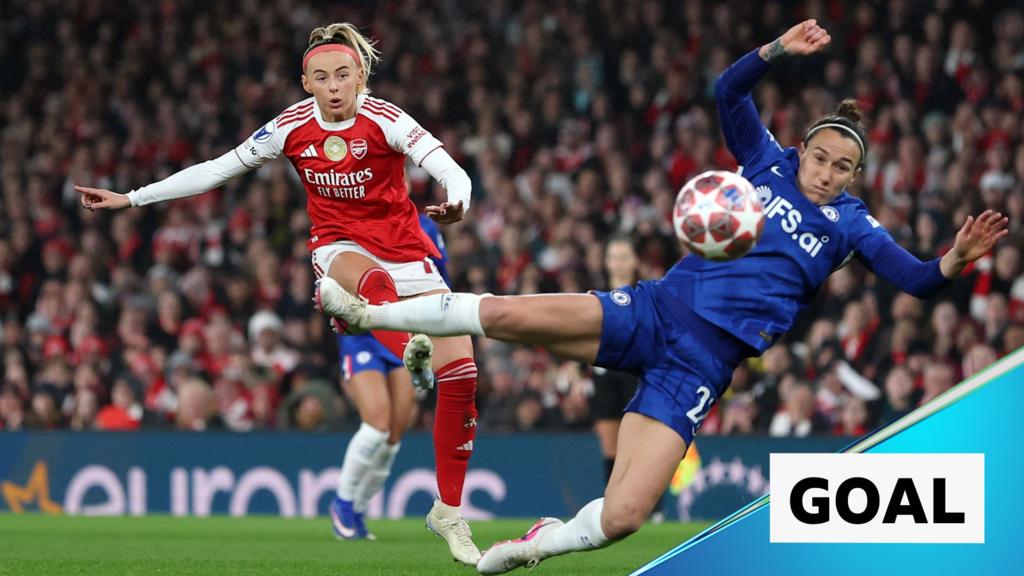
'What a stunner!' – Kelly doubles Arsenal's lead against Chelsea
Chloe Kelly’s curling long-range strike puts Arsenal 2-0 up in the first leg of their Women’s Champions League quarter-final against Chelsea.
Source link
Chloe Kelly’s curling long-range strike puts Arsenal 2-0 up in the first leg of their Women’s Champions League quarter-final against Chelsea.
Source link
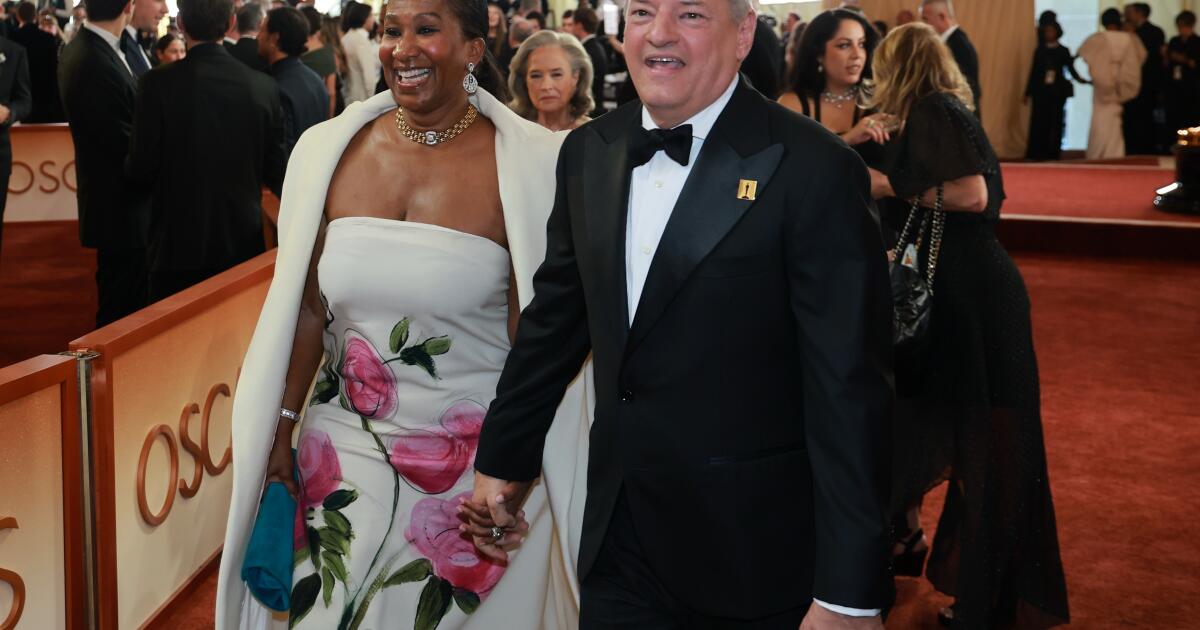
Rather than chasing sequels and reboots, Netflix is betting its 2026 film strategy on a massive investment in original storytelling and a renewed focus on the theatrical comedy.
The streaming giant’s need for original content is one of the main reasons Netflix fought fiercely to acquire Warner Bros. But even after losing the bid to Paramount earlier this month, the priority remains.
“We’re zigging where legacy studios are zagging,” Dan Lin, Netflix’s film chairman, said Wednesday at Netflix’s slate event in Hollywood.
Last year, 18 of the top 20 theatrical films were based on already established intellectual property, like with sequels and remakes. The only two original ideas to break through were Ryan Coogler’s “Sinners” and Zach Cregger’s “Weapons.” Both of these films were received well by audiences and earned golden statues at this year’s Oscars.
Lin said that at Netflix, 2025’s slate was the “exact opposite,” where half of the films it released last year were based on original storytelling.
“We have a very healthy content budget. So if there’s a great movie out there, we’ll go out and either build it or acquire it,” Lin said.
Bela Bajaria, the company’s chief content officer, said the company isn’t too concerned with the theatrical element that other studios can offer when hunting for these original stories, as Netflix is a streaming-first company.
“We’ve always had competition. This isn’t really any different,” said Bajaria. “It’s to understand what the competition is, not head in the sand at all. [We have] to understand what the market is and continue to look ahead.”
It’s not just original ideas that Netflix is scouting; the streamer’s also looking to fill gaps in genres. In recent years, comedies have fallen out of favor with major studios — leaving room for streamers like Netflix to expand. This year, Netflix is looking to break through with upcoming comedy productions like Kevin Hart’s bachelor party-driven “72 Hours,” John Cena and Eric André’s buddy comedy “Little Brother” and Eva Longoria’s “Fifth Wheel,” which Lin describes as “our version of ‘Bridesmaids.’”
“We’re taking the chance, and we’re making the movies,” Lin said. “It’s what we’re delivering, I hope, [it’s] what audiences want and what they’re craving. There are a lot of genres that you just can’t find in theaters anymore. So, we’re making those kinds of movies.”
In addition to emphasizing comedies, there’s a lot of opportunity to develop young adult films, Lin said. Netflix has upcoming titles such as “Voicemails for Isabelle,” starring Zoey Deutch and Nick Robinson, and “Roommates,” with Sadie Sandler, to draw in younger movie watchers.
One genre in which Netflix doesn’t see much success is live musical adaptations, so it’s “not an area that I’m leaning into,” Lin said. He first joined the company in 2024 and has since green-lighted 88 films.
Netflix subscribers watch about seven movies a month, according to the streamer’s data. So, with the push for original stories, the streamer is hoping to meet its consumers’ demands.
The current strategy is to release up to four “event films” a year. For 2026, Netflix is looking at Greta Gerwig’s “Narnia” adaptation and David Fincher’s follow-up to “Once Upon a Time … in Hollywood” as its big hitters.
“It’s all very under wraps right now, but it’s something that I’m just so thrilled about because it was the book of my childhood. It was the book series that I loved, and I lived through, and I spent so much time imagining myself inside of Narnia,” Gerwig said in a video message during the Netflix event. “It’s been a joy and an honor to be the person who gets to imagine this universe.”
Gerwig’s “Narnia” is set to hit Imax this Thanksgiving and start streaming on Netflix come Christmas.
THE list of the richest celebs in the world has been revealed — and it’s good news for Taylor Swift.
The US superstar’s net worth has soared since she was named a billionaire in 2023, and she is now worth twice that.
She has risen from No9 last year to No7 in Forbes magazine’s annual rundown, which revealed there are now 22 celebrity billionaires — up from 18 last year.
Fellow singer Beyonce, tennis ace Roger Federer, rapper Dr Dre and filmmaker James Cameron are the new additions who have crossed the $1billion threshold.
Taylor, 36, boosted her earnings massively with profits from her record-breaking Eras Tour and the value of her music catalogue, all of which she now owns, having bought back the rights to her first six albums last year.
She is said to have amassed $1billion from royalties and touring, while her catalogue of hits has been valued at $900million.
READ MORE ON CELEB RICHES
The Eras 149 gigs across 21 countries from March 2023 to December 2024, made it the highest-grossing tour of all time at $2.077billion, with 10MILLION attendees.
Thanks to the money-spinning shows, she was able to buy the rights to her first six albums.
In 2019 Taylor’s former label, Big Machine, had sold the masters to talent manager Scooter Braun, prompting Taylor to vow to re-record them.
Braun sold them on to LA investment fund Shamrock Holdings in 2020.
But last May she announced she finally controls all her music.
Taylor said last year: “That’s how I spent that Eras Tour money. My fans are why I was able to get my music back.”
The rights to the records had been sold for more than $300million, although it is not known how much she spent to reclaim them.
But she is believed to have made an eight-figure sum in profits from the “Taylor’s Version” remakes of Fearless, Red, Speak Now, and 1989 — which all topped the charts.
She also owns $100million of real estate, including pads in New York, Beverly Hills, Rhode Island and Nashville.
The news coincides with new figures from the British Phonographic Industry, which reveal CD sales in the UK returned to growth in 2025, up 3.1 per cent, largely thanks to 226,000 copies of Taylor’s latest album The Life Of A Showgirl being sold here.
She also contributed to the 19.9 per cent year-on-year rise in vinyl purchases, thanks to 147,000 sales of the record on the format.
It meant The Life Of A Showgirl sold the most vinyl of any new album in a calendar year this century. Her 2023 collection Lover (Live From Paris), which was reissued last year, was also the fourth biggest vinyl of 2025.
Taylor has now scored six No1 singles and 14 No1 albums, beating Madonna’s record of 12 chart toppers for a female artist.
Taylor’s huge net worth dwarfs that of her American football star fiancé Travis Kelce, 36, whose riches total $90million.
The two are expected to marry this summer in a glittering, star-studded ceremony in the US.
Yesterday Travis hinted Taylor has started working on new music for a potential 13th studio album.
He said: “It’s amazing to see her keep going to the table, keep finding new things to write about, keep finding new melodies and things like that.
“On top of that, still seeing her have that love and joy in what she does.
“Of course that’s motivating. That’s motivating for anybody to see, let alone in my fiancée, and knowing that I’m going through something as I try to figure out what the future holds for me.
“Something like that motivates me.”
$7.1bn
THE highest-grossing director of all time, 79-year-old Spielberg earns an estimated $100million annually from gross ticket sales thanks to a 1987 deal.
$5.2bn
THE Star Wars creator, 81, kept the merchandising rights and ownership of the hit sci-fi franchise and in 2012 sold his firm LucasFilm to Disney for $2.2billion plus shares.
$4.3bn
BASLETBALL legend, 63, made $2billion from corporate deals.
In 2023 he sold majority stake in NBA team Charlotte Hornets, valued at $3bn.
$3.6bn
BUSINESSMAN, 80, made sports promotion firm World Wrestling Entertainment – WWE – a global brand before a $21billion wrestling mega-merger in 2023.
$3.2bn
TALK show host made TV and films through her production firm Harpo.
Oprah, 72, has also earned millions partnering with Weight Watchers and through real estate.
$2.8bn
Rapper, 56, made over $1billion from his alcohol brands D’Usse cognac and Armand de Brignac.
In 2008 he founded the lucrative entertainment firm Roc Nation.
$2bn
$1.9bn
Reality star owns a third of her $5billion shapewear brand Skims.
Kim, 45, also earns through her skincare firm, endorsements, real estate, acting and TV shows.
$1.9bn
MOVIE director, 64, made Lord Of The Rings films and sold the tech division of his visual effects company Weta Digital for $1.63billion in 2021.
$1.6bn
FORMER basketball player, 66, has a majority stake in a life insurance company as well as part-ownership of four US professional sports teams.
$1.5bn
GOLFING legend made $1.9billion during his sporting career and through endorsements.
Woods, 50, is estimated to have earned $121million in prize money.
$1.5bn
THE producer behind hit US TV dramas Law & Order, Chicago and FBI, 79-year-old Wolf signed a five-year, $1billion deal with NBCUniversal in 2020.
$1.4bn
THE actor and filmmaker has 100 per cent ownership of his 22 films and over 1,200 TV episodes.
Perry, 56, now owns the largest film production studio in the US.
$1.4bn
SPORTS contracts have earned $500million for the 41-year-old basketball player – and he has a lifetime $1billion endorsement deal with Nike.
$1.2bn
ROCKER, 76, has toured for five decades, released 21 studio albums and received $500million when he sold his entire music catalogue to Sony in 2021.
$1.2bn
HAVING earned $500million from films, the 78-year-old actor has also made savvy investments, including in an investment firm which manages $1 trillion in assets.
$1.1bn
THE comedian has earned almost $500million from syndicating his self-titled sitcom.
Seinfeld, 71, still does stand-up and has a Porsche collection valued at $100million.
$1.1bn
Retired tennis player, 44, won 20 Grand Slams but also had lucrative deals with Rolex and Mercedes.
He also has a stake in athletic
$1.1bn
FILMMAKER behind three of the four highest-grossing films of all time.
Cameron, 71, directed Titanic, Avatar and Avatar: The Way of Water, which made over $7.5bn.
$1bn
THE Umbrella singer, 38, has a $200million music catalogue but made her main fortune through cosmetics firm Fenty Beauty and lingerie brand Savage X Fenty.
$1bn
AS well as grossing more than $1billion in back-to-back tours, the singer, 44, has a $300million music catalogue and a haircare line, Cecred, valued at $100million.
$1bn
RAPPER, 61, co-founded Beats Electronics and Beats Music, and launched the careers of Kendrick Lamar and Eminem through his label Death Row Records.

Back in the early 2010s, the music industry was at a low point.
Piracy was rampant. Compact disc sales were on a steady decline. And the then-new audio streaming services, like Spotify, were taking hits from creators for paying low royalty rates.
Today, Spotify has grown into the world’s most popular audio streaming subscription service and the highest-paying retailer globally — paying the music industry over $11 billion last year. The Swedish company said in a recent post that the payouts aren’t strictly going to ultra-popular artists, but that “roughly half of royalties were generated by independent artists and labels.”
“A decade ago, a lot of the questions were really fair. Spotify had to be able to prove out if it could scale as an economic engine. People didn’t know if streaming would scale as a model,” said Sam Duboff, Spotify’s global head of marketing and policy of music business.
Duboff said Spotify’s payouts aren’t “plateauing — we’re still growing that royalty pool on Spotify more than 10% per year.” He credits the streaming platform’s growth to “incentivizing people to be willing to pay for music again” by providing personalized experiences and global accessibility.
The company, founded in 2006, serves more than 751 million users, including 290 million subscribers, in 184 markets.
“The average Spotify premium subscriber listens to 200 artists every month, and nearly half of those artists are discovered for the first time,” Duboff said. “When you build an experience where people can explore and fall in love with music, it inspires them to upgrade to premium and keep paying.”
The platform offers a wide variety of playlists, curated by editors like the up-and-comer-driven Fresh Finds or rap’s latest, RapCaviar. There are also personal playlists generated for users, such as the weekly round-up Discover Weekly and the daily mix of tunes called the “daylist.”
The streamer considers itself the first step toward “an enduring career” for today’s indie artists. Last year, more than a third of artists making $10,000 on the platform in royalties started by self-releasing their music through independent distributors.
“Streaming, fundamentally, is about opportunity and access. It’s artists from all over the world releasing music the way they want to and reaching a global audience from Day One,” Duboff said. He adds that when fans have a choice, they will discover new genres and music cultures that may have otherwise languished in obscurity.
In 2025, nearly 14,000 artists earned $100,000 from Spotify alone. The streamer’s data also show that last year the 100,000th highest-earning artist made $7,300 in Spotify royalties, whereas in 2015, an artist in that same spot earned around $350.
The company, with a large presence in L.A.’s Arts District, emphasizes that the roster of artists on its platform who earn significantly more money — well into the millions — is no longer limited to the few. A decade ago, Spotify’s top artist made around $10 million in royalties. Today, the platform’s top 80 artists generate over $10 million annually. Some of 2025’s top artists globally were Bad Bunny, Taylor Swift and the Weeknd.
Spotify claims those who aren’t household names can earn six figures, with more than 1,500 artists earning $1 million last year.
Damon Krukowski, a musician and the legislative director for United Musicians & Allied Workers, argues that Spotify’s money isn’t necessarily going to artists — it’s going to their labels.
Those without labels usually upload music through distributors such as DistroKid and CD Baby. These platforms charge a small fee or commission. For example, DistroKid’s lowest-level subscription is $24.99 a year, and the site states users “keep 100% of all your earnings.”
”There are zero payments going directly to recording artists from Spotify,” Krukowski asserts. “Recording artists deserve direct payment from the streaming platforms for use of our work.”
The advocacy group, which has mobilized more than 70,000 musicians and music workers, recently helped draft the Living Wage for Musicians Act to address the streaming industry. The bill, introduced to the U.S. House of Representatives last fall, calls for a new streaming royalty that would directly pay artists a minimum of one penny per stream.
In the Q&A section of Spotify’s Loud and Clear website, the streamer confirms that it “doesn’t pay artists or songwriters directly. We pay rights holders selected by the artist or songwriter, whether that’s a record label, publisher, independent distributor, performance rights organization, or collecting society.”
Instead of following a penny-per-stream model, Spotify pays based on the artist’s share of total streams, called a “streamshare.”
“Streaming doesn’t work like buying songs. Fans pay for unlimited access, not per track they listen to,” wrote the company online. “So a ‘per stream’ rate isn’t actually how anyone gets paid — not on Spotify, or on any major streaming service.”
The United States-Israeli war with Iran continues to rage, as Washington pledges to send more troops and military assets to the Middle East and Tehran widens its retaliatory strikes across the region.
But on Thursday, top officials under US President Donald Trump shifted focus to another military front: Latin America.
list of 3 itemsend of list
Since taking office for a second term, Trump has indicated he plans to exert US dominance over the entire Western Hemisphere. His push for control has coincided with military operations against alleged criminal networks across the region.
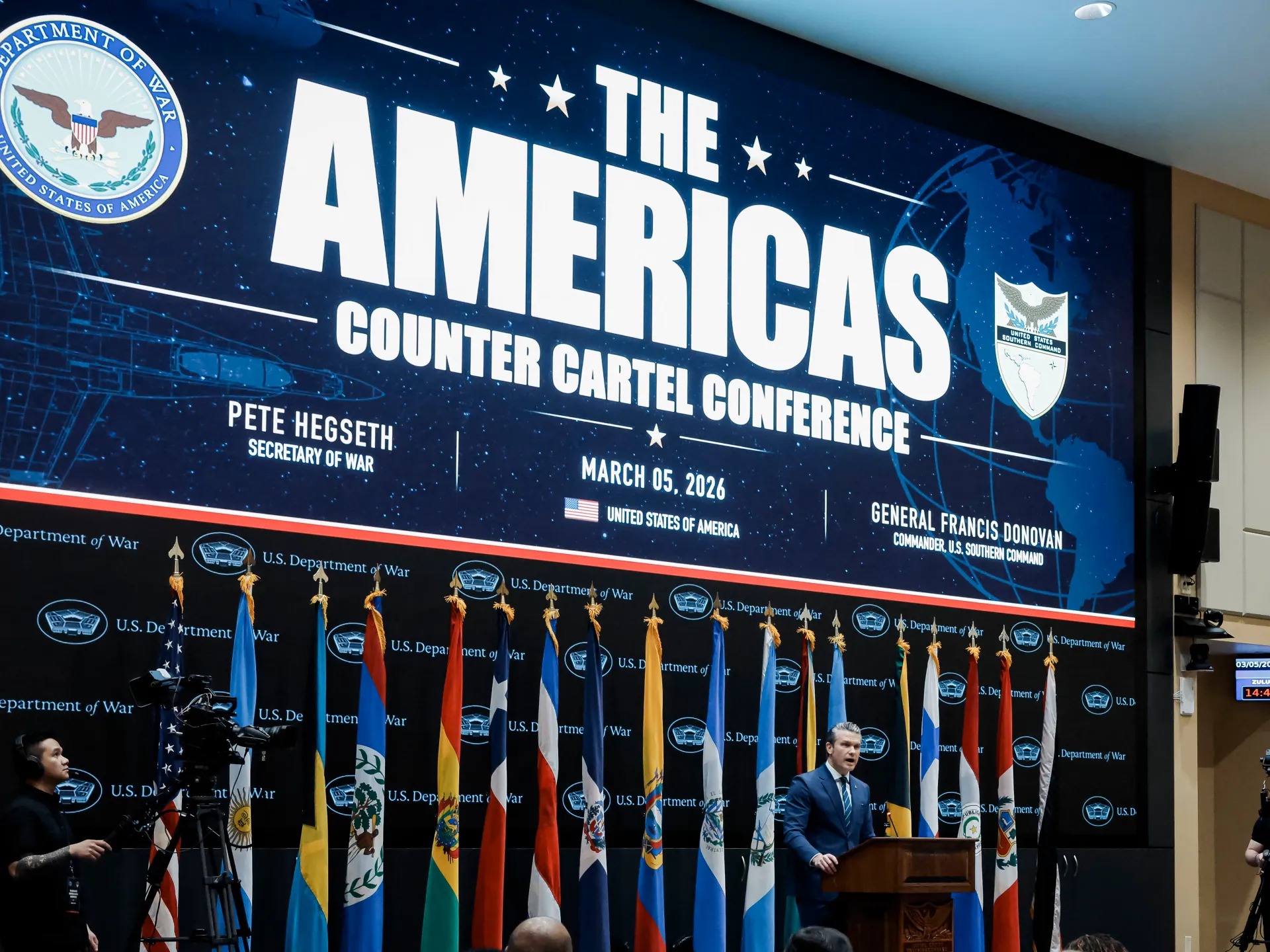
At Thursday’s inaugural “Americas Counter Cartel Conference”, speakers such as White House security adviser Stephen Miller assured reporters that Latin America would remain a top military priority for the US, regardless of events in the Middle East.
“We are not going to cede an inch of territory in this hemisphere to our enemies or adversaries,” Miller said, adding the US was “using hard power, military power, lethal force, to protect and defend the American homeland”.
Miller further maintained there is no “criminal justice solution” to drug cartels, which he likened to armed groups like al-Qaeda and ISIL (ISIS).
Organised crime, he concluded, “can only be defeated with military power”.
Since Trump took office last year, his administration has applied what experts describe as a “global war on terror” approach to Latin America, including by labelling drug cartels “foreign terrorist organisations”.
Figures like Miller, a key architect behind Trump’s hardline immigration policies, have championed the president’s militaristic approach, even as critics warn it raises human rights and legal concerns.
Last September, for instance, the administration began striking alleged drug-smuggling boats in the Caribbean and eastern Pacific Ocean, in what rights groups have decried as extrajudicial killings.
And in early January, the US launched an extraordinary operation to abduct Venezuelan leader Nicolas Maduro. It has since pursued a pressure campaign against Cuba designed to weaken its communist government.
Just this week, on Wednesday, the Pentagon announced it had launched joint operations with Ecuador’s military “against Designated Terrorist Organizations” in the South American country.
The announcement indicated a new front for US military actions in the region, which officials have said could include land operations.
But the broadening scope of Trump’s military involvement in Latin America, combined with the nascent war with Iran, has raised questions about the US’s ability to sustain such intense military activity.
The “Americas Counter Cartel Conference” came as Latin American leaders arrived in South Florida to attend a regional summit hosted by Trump at his Mar-a-Lago estate.
Attendees included officials from the Trump-allied conservative governments in Argentina, Honduras and the Dominican Republic.
But despite support from several regional governments, Secretary of Defence Pete Hegseth nevertheless told the audience that the US was “prepared to take on” Latin America’s cartels and “go on the offence alone, if necessary”.
“However, it is our preference — and it is the goal of this conference — that, in the interest of this neighbourhood, we all do it together,” Hegseth added.
The secretary also praised Trump’s take on the 1823 Monroe Doctrine, which sought to establish a US sphere of influence, separate from Europe, in the Western Hemisphere. Administration officials have dubbed Trump’s parallel approach the “Donroe doctrine”.
Hegseth framed the administration’s attacks on alleged drug-smuggling boats as a keystone of Trump’s effort to maintain regional influence.
The US military has carried out at least 44 aerial strikes on vessels in the Caribbean Sea and eastern Pacific Ocean, resulting in an estimated 150 known deaths.
The identities of the victims have not been released, with several family members saying fishermen and informal workers were among those targeted.
The Pentagon chief said the approach was meant to “establish deterrence”.
“If the consequence was simply to be arrested and then released, well, that’s a consequence they’d already priced in a long time ago,” Hegseth said.
He then pointed to a “few weeks” in February in which there were no strikes on alleged drug boats.
The pause in attacks, he said, was evidence of the strategy’s success. But that break notably came as the US surged assets to the Middle East.
Neither Hegseth nor Miller specifically referred to the war with Iran, but the pair touched on themes that have been present in the administration’s messaging on the war.
Trump, for example, said Iran’s government “waged war against civilisation itself”. There have been reports, meanwhile, that US military officials have referenced the biblical “end times” as a religious underpinning for the war.
Those remarks have reflected what critics consider Trump’s embrace of Christian nationalism and his view of the Americas as a European-derived “civilisation” threatened by outside forces.
At Thursday’s conference, Miller himself referenced violence in European history as justification for the modern-day military actions in Latin America.
There were periods in European history throughout the 18th and 19th centuries during which “ruthless means were used to get rid of the people who were raping and murdering and defying established systems of order and justice,” Miller said.
He also echoed Trump’s allegation that Europe was facing “civilisational erasure” as a result of left-wing leadership and immigration.
“The reason why many Western countries are struggling today is they’ve forgotten the eternal truth and wisdoms they once followed,” Miller said.
Hegseth, meanwhile, described all the countries at Thursday’s meeting as “offsprings of Western civilisation”.
Representatives in attendance, he said, faced a test “whether our nations will be and remain Western nations with distinct characteristics, Christian nations under God, proud of our shared heritage with strong borders and prosperous people ruled not by violence and chaos but by law”.
He added that foreign “incursions” represent “existential questions” for the region, seemingly referencing the growing influence of China as an economic and political partner in the Americas.

