domingo

U.S. seeks to sell ‘woke’ painting removed from Santo Domingo embassy

Aug. 28 (UPI) — The U.S. State Department removed a Kehinde Wiley painting from its embassy in the Dominican Republic and wants to sell it after Trump administration officials called it “woke.”

The department is talking with legal representatives to determine whether it can sell Young Artists After Siamesas 1960, which was commissioned with taxpayer funds in 2013 for the Art in Embassies cultural diplomacy program.

U.S. Ambassador Leah Campos posted a video Aug. 11 showing the painting being removed after it was initially covered with a tarp featuring a U.S. flag design.

“Under the Trump administration and my leadership, we are leaving behind globalist and ‘woke’ ideologies to embrace American patriotism and the beauty of our great country,” Campos wrote.

Erin Scavino, director of Art in Embassies, said in a recent interview with former Trump White House press secretary Sean Spicer that her team had worked to remove the painting. She described it as “very woke” and “aesthetically terrifying.”

The State Department cited comments Wiley made about another of his works and sexual misconduct allegations that the artist has denied, according to The Art Newspaper.

Dominican law would allow physical ownership of the painting to be transferred, but Wiley would retain his intellectual property rights, according to an analysis published by the Dominican news outlet Acento.

Attorney Edwin Espinal Hernández said the Dominican Republic’s copyright law distinguishes between ownership of the physical object and intellectual property rights over the work, Acento reported.

A buyer could own and display the canvas, but could not reproduce it, print it or sell copies without Wiley’s authorization unless the parties expressly agree otherwise.

Dominican law also recognizes an artist’s resale right. If the transaction takes place through a public auction, an exhibition or a professional dealer, Wiley would be entitled to receive at least 2% of the sale price from the seller.

In addition, if the transaction exceeds approximately $12,000, Dominican anti-money laundering law would prohibit a cash payment and require verifiable proof of the transaction.

Wiley created the painting in 2015 in collaboration with Dominican students from the School of Arts and the Altos de Chavón School of Design in La Romana, according to the official documentation from Art in Embassies.

According to the expanded Art in Embassies description, the 107-by-150-inch oil-on-linen painting depicts four local art students in poses inspired by Female Nude (1940) by Celeste Woss y Gil and Siamese Twins (1960) by Gilberto Hernández Ortega.

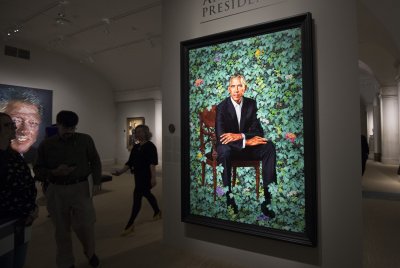
Wiley gained international recognition after painting President Barack Obama‘s official portrait, which was unveiled at the National Portrait Gallery in 2018.

The State Department had awarded Wiley a Medal of Arts in 2015 for his contributions to U.S. cultural diplomacy.

Source link

‘That’s the same guy?’ Colman Domingo is in his chameleonic era

Earlier this year, Colman Domingo devoted a portion of his monologue on “Saturday Night Live” to a few things he is famous for. One example? “When you come to my house, the vibes are spectacular.”

Those vibes must have transitive properties: On a recent morning in a borrowed backyard in Santa Monica, the vibes were as impeccable as one of the actor’s famously natty red-carpet looks. Posing for photos poolside, Domingo was the picture of laid-back charm, chatting with the crew in that commanding leather-and-gravel voice and flashing a toothsome smile.

With four projects in 2026 alone and more than 100 credits across film, television and the stage dating back to 1994, you definitely know Domingo from something. Increasingly, people recognize him from several things. Or, as the case may be with a performer of his caliber, they don’t — and that has been the highest compliment of all for the 56-year-old Philly native.

“It is the wildest thing,” says Domingo, stretched out on a sectional in the shade. He recounts how people have approached him about his role as Danny, the elegantly snarky architect on the Netflix comedy “The Four Seasons, and were flummoxed to discover that he also plays the tightly wound Ali, he of shaken faith and sawed-off shotgun, on the recently concluded HBO drama “Euphoria. “I’ve had so many people who saw me as one character, but they didn’t know I played the other character, even if they watched both. They’re like, ‘Wait a minute, that’s the same guy?’”

Domingo in "Euphoria."

Domingo in “Euphoria.”

(Patrick Wymore / HBO)

That’s the same guy. Familiarity has bred respect as Domingo nabbed Emmy nominations for both roles for the second time — supporting actor in a comedy for “The Four Seasons” and guest actor in a drama for “Euphoria,” a trophy he took home in 2022.

“I get the yin and yang,” he says of the pleasure and challenge of inhabiting men from such different worlds.

Domingo credits “Euphoria” creator Sam Levinson with the complexities of Ali’s journey, which were showcased in the finale in breathtaking extremes of violence and grace and included a poignant monologue about the limits of empathy as he grieved the loss of his sponsee Rue (Zendaya). “It was so beautiful,” says Domingo of the conclusion of his arc. “Sam gave me words that are not just for Rue. They’re like a prayer for the world, sitting down at tables and having the hard conversations and trying to get people to come to their personal truths. To have a breakthrough in their lives. That’s how he’s been utilizing me for the series.”

Colman Domingo.

(Evan Mulling / For The Times)

Conversely, Tina Fey and the writing staff of “The Four Seasons” have been using Domingo’s Danny as, among other things, a brutally effective vehicle to deploy acidic one-liners. (A favorite: “This the town Tracy Chapman sped away from.”)

“He is fictitious, but in many ways there’s a lot more of me in him than I personally have seen [in my previous characters],” he says of the man whose bravado masks an unsettled energy as he encounters the challenges of midlife. “Even in my notes to Tina and the showrunners, I started to craft a character that was closer to myself. I’m like, ‘I don’t see the mes in the world, queer men who are mostly in heteronormative worlds and how we activate and how we love and our friendships that are not just based on the fact that we are queer.’”

Domingo’s own midlife — conversations about fiber and the proliferation of readers in every room aside — is enviable. In addition to the two series, he appeared in two of the most talked-about films of the year, the blockbuster Michael Jackson biopic “Michael” and Steven Spielberg’s sci-fi thriller “Disclosure Day.” In another instance of playing a set of disparate characters, he was the imperious patriarch Joe Jackson in the former and the rebellious, empathetic whistleblower Hugo Wakefield in the latter.

“I wanted to challenge myself in different spaces,” says Domingo with gratitude for those roles as well as other 2026 opportunities, like his “SNL” appearance — which brought him back to his “Big Gay Sketch Show” days — and his recent guest-hosting stint on “Jimmy Kimmel Live!” “I never want to get caught up just doing the same thing.” He recalls a time when he played a couple of villains in a row and similar offers poured in. “I thought, ‘Oh no, I’ve done that.’ I knew it was time to move on to something else. And even ‘The Four Seasons,’ when that came along, I had been going back to back with dramatic roles — ‘Sing Sing,’ ‘The Color Purple,’ ‘Rustin.’ It takes a little toll on you.”

Marco Calvani as Claude and Colman Domingo as Danny in Episode 201 of The Four Seasons, Season 2.

Domingo with Marco Calvani in “The Four Seasons.”

(Emily V. Aragones / Netflix)

Fortunately, all of that work has helped Domingo amass a very comfy set of laurels (upon which he refuses to rest). While his success has been a slow burn, including years of work on Broadway as an actor and playwright — Domingo co-wrote the book for “Summer: The Donna Summer Musical” as well as several straight plays — and his stint as a series regular on “Fear the Walking Dead” the last five years lighted the fuse on the rocket.

In that time, Domingo has won four NAACP Image Awards, been nominated for back-to-back lead actor Oscars, Golden Globes and BAFTA awards, and received a second Tony Award nomination, this one for best play as a co-producer of the “Hamlet” adaptation “Fat Ham.” (His previous Tony nod came in 2011 for featured actor in a musical for “The Scottsboro Boys.”)

Colman Domingo.

Colman Domingo.

(Evan Mulling / For The Times)

“I’m very happy that this has happened the way it has,” he says of this golden period of work and creativity in his 50s. It’s not that he wouldn’t have appreciated or been ready for it in his youth, he says, but he has seen the pitfalls of success that happens too young. “At this age, I know myself. I know what I need. I have boundaries. I know how to still be a person in the world. And that’s the part that’s important to me, which is not being so isolated.”

There’s little danger of that given how often he is now stopped on the street. But he is cheered by the interactions because, whether fans love him as a good guy, a bad guy or a character in between, they all want the same thing. “Whatever I’ve done, people always ask, ‘Can I have a hug?’” Maybe the vibes are not about the house, but Domingo himself.

Source link

Mexico wins back fans, still faces familiar World Cup wall

After what may have been the most important game in the Mexican national team’s World Cup history, coach Javier Aguirre hugged each of his 26 players.

The embraces weren’t to celebrate a victory. They were hugs of gratitude, encouragement and, above all, resignation.

Minutes earlier, the players paraded around Azteca Stadium — traditionally an impenetrable fortress — to applaud El Tri fans with tears in their eyes. Mexico had just lost 3-2 to England, extinguishing the hope that it could parlay its World Cup co-host role into the deepest tournament run in the country’s history.

The goal was to advance to the quarterfinals for the first time since 1986 and, above all, to show the world that Mexican soccer finally had taken the leap that had been demanded for so long — defeating a past world champion, England, that hadn’t looked particularly dominant. But reality, once again, hit hard as the loss became Mexico’s eighth defeat in the round of 16 since 1994.

This time, Mexico had the support of its fans, playing on home soil. And it wasn’t enough.

“I’m satisfied with the work we’ve done, but when you lose — and I’ve lost a lot in my career — you never quite get over it,” Aguirre said. “It’s very painful because dreaming gives us hope; losing this way hurts a lot.”

Mexico fans wave flags and show their support before their team faced England in a World Cup match at Azteca Stadium.

Mexico fans show their support before their team faced England in a Round of 16 World Cup match at Azteca Stadium on July 5.

(Richard Pelham / Getty Images)

After weeks of celebrations following wins over South Africa, South Korea, Czechia and Ecuador, Mexico failed the test against England, ranked fourth in the world. El Tri dominated possession but could not convert it into goals, while the English were clinical, led by Jude Bellingham, Harry Kane, Anthony Gordon, Bukayo Saka and goalkeeper Jordan Pickford.

For Aguirre, the loss reopened a familiar wound. In the 2002, Mexico lost 2-0 to a U.S. squad led by Landon Donovan in what many consider the most painful defeat in the country’s World Cup history. This defeat to England very well could rival it.

“I would have liked to win five games, to leave home with five victories. That hurts — it hurts a lot,” Aguirre said. “A loss is a loss. Our opponent didn’t make the same mistakes we did.”

Judging Aguirre solely on the end of this World Cup run would be simplistic given what he inherited. Two years ago, he was asked to lead the struggling team for the third time. When he arrived, Mexico was ranked 17th in the world and had not won the Nations League. He leaves with Mexico ranked in the top 10 and as Nations League champion and two-time defending Gold Cup champion.

This World Cup wasn’t the disaster that Qatar was four years ago, when Mexico was eliminated in the group stage. This summer, Mexico secured its first knockout-round victory since 1986, advanced to a fifth World Cup match for the second time and swept three games during the group stage without conceding a goal — something no other Mexican team achieved.

In 22 months at the helm — having taken over in 2024 following Jaime Lozano’s failure at the Copa América, where Mexico failed to advance past the group stage — Aguirre achieved something that went beyond the scoreboard by uniting players previously accused of having too much ego and preferring not to sacrifice to help the team.

At this World Cup, that squad gave its all — body and soul — and rebuilt a relationship with the fans that had seemed broken since the 2024 Copa América. Thousands of fans filled the Ángel de la Independencia, the Zócalo and other squares across the country, as well as watch parties in cities like Los Angeles.

“We managed to restore the pride of being part of the national team — for the national anthem and for its people. It’s a privilege to be here, and they know it,” Aguirre said of his players. “I think we’ve returned to a Mexican identity.”

Green jerseys were seen all over Mexico as people set aside their differences to cheer on El Tri.

“Mexico was the best host of the three. It had the best atmosphere — it’s a country that truly loves soccer,” Mexico City native Santiago Mondragón said before the England match.

Mexico had standout and inspired performances from Erik Lira, Gilberto Mora and Roberto Alvarado, but its lineup struggled to keep pace with English players trained at elite European clubs.

Mora, just 17 years old and with tremendous potential, made a mistake on the play leading to England’s second goal. Alvarado, who provided strong passes to Raúl Jiménez and was solid in defense throughout the tournament, lost track of Bellingham on the first goal. Raúl Rangel, who was outstanding against South Korea and who three years ago was playing for Tapatío in the Mexican expansion league, stepped too far forward on the penalty kick that sealed the match, minutes after an English player was sent off in the second half. Edson Álvarez, who did not have a good season with Turkey’s Fenerbahce because of an injury, received little playing time and made a serious mistake marking Kane, which led to Gordon’s breakaway on the play that resulted in the penalty kick.

Mexico's Raúl Jiménez gets tangled with England's Ezri Konsa while going for the ball during a World Cup match.

Mexico’s Raúl Jiménez gets tangled with England’s Ezri Konsa while going for the ball during a World Cup Round of 16 match at Azteca Stadium on July 5.

(Francois Nel / Getty Images)

Following the loss, many in Mexico still are wondering why, despite having a one-man advantage for 36 minutes —plus 11 minutes of stoppage time — the team was unable to tie England. Aguirre replaced Mora and goal-scorer Julián Quiñones, bringing on an attacking lineup that focused on sending in crosses, which the English defense easily cleared.

While it’s possible a few changes could have shifted the match in Mexico’s favor, there were limits to how much the technical staff could get out of the roster.

El Tri lacks sufficient depth to assemble a truly competitive 26-man roster, as players such as Álvarez and Santiago Giménez didn’t arrive at their best form, and players such as Brian Gutiérrez weren’t ready for the pressure of a tournament of this magnitude, in need of more time to develop.

Mexico lacked game-changing players capable of breaking down tight defenses — the role Hirving Lozano played in 2018 or Giovani Dos Santos in 2014. The lack of creativity that showed against Saudi Arabia in 2022 flared up late against England.

Thanks to Jiménez and Quiñones, the team did show firepower, scoring 10 goals in five matches, but it lacked depth to break down a well-organized English defense.

The talent pool has been hindered by the Mexico club system.

Mexico's Julián Quiñones is tossed in the air by teammates as they celebrate a Round of 32 World Cup win over Ecuador.

Mexico’s Julián Quiñones is tossed in the air by teammates as they celebrate a Round of 32 World Cup win over Ecuador at Azteca Stadium on June 30.

(Kevin C. Cox / Getty Images)

Liga MX owners maintain a narrow view of domestic soccer, prioritizing foreign signings over the development of local players and promotion and relegation remain abolished — removing competitive pressure that is the backbone of English leagues.

Top Mexican players continue to be overvalued by their home clubs, which makes it difficult for European clubs to sign them when there are cheaper options with more impressive résumés.

“This was the opportunity; that’s why it’s frustrating, that’s why it’s sad,” Mexican journalist Javier Alarcón said of El Tri’s World Cup exit. “With the Mexican federation and its owners, there isn’t much hope.”

Rafael Márquez, a former FC Barcelona star and one of the greatest players in Mexican national team history, is succeeding Aguirre after serving as one of his assistant coaches. Márquez has formed a close bond with players, who tossed the 47-year-old former defender in the air after one of their World Cup wins, and is familiar with all the reasons Mexico continues to hit the same World Cup wall.

“Rafa is a great guy, a great coach,” said Aguirre, who noted that the team’s average age has dropped and that more and more players are playing in Europe. “Hopefully he can do better than we were able to.”

Source link