dominate

China’s EVs dominate the world — why not in the US and Canada? | Explainer News

One month before he opened this year’s United Nations climate summit, Brazilian President Luiz Inacio Lula da Silva helped open a new mega-factory at the site of a former Ford car manufacturing plant.

The new plant, in Brazil’s Camacari, Bahia, is one of many being built around the world by China’s BYD, the world’s largest manufacturer of electric cars.

Recommended Stories

list of 4 itemsend of list

BYD’s presence is also being felt at the ongoing COP30 climate summit in Brazil’s Belem, where it is a cosponsor alongside GWM, another Chinese electric carmaker.

The sponsorship is just one of many ways that China’s investments in green technology are being felt at the UN’s top climate meeting, where the Chinese official delegation of 789 people is second only to Brazil’s 3,805.

It is a stark contrast to the United States, whose federal government has not sent an official delegation. California’s Governor Gavin Newsom has accused US President Donald Trump of “handing the future to China” and leaving states like California to pick up the slack, in a speech at the summit.

“ China is here. Only one country’s not here: United States of America,” Newsom said. Trump has called concerns over climate change a “hoax” and a “con job”.

But the UN Climate Change Conference COP30 is not the only event where the diverging paths that China and the US are taking on addressing the climate crisis are being felt.

Back in the US, and in neighbouring Canada, trade barriers aimed at punishing Chinese electric vehicles have made them far costlier than what the manufacturers want to sell them for.

These tariffs are a legacy of former US President Joe Biden’s administration, and place North America as an outlier at a time when Chinese EVs otherwise dominate the global market.

How dominant is China in EVs?

Joel Jaeger, a senior research associate with the World Resources Institute, told Al Jazeera that Chinese EVs have “really upended the car market” in recent years.

China has gone “from basically not a major player five years ago” to becoming “the number one exporter of cars globally in terms of the units”, says Jaeger.

According to the International Energy Agency (IEA), China manufactured 12.4 million electric cars in 2024, more than 70 percent of the 17.3 million electric cars manufactured globally last year.

Of these, China exported about 1.25 million cars, representing 40 percent of global exports, while the remaining Chinese-made cars — the vast majority — were sold domestically.

This dominance has been built on the back of “subsidies that China’s put in place to develop its industry, which I think is a very strategic thing that China has done, both for its own economic growth as well as decarbonisation”, Jaeger said.

But on the streets of the US or Canada, Chinese EVs are still relatively rare.

Why are Chinese EVs less affordable in the US and Canada?

According to Jaeger, “prohibitive” tariffs mean that Chinese EVs are almost impossible to buy in the US and Canada.

“In the last year, the US and Canada both put on basically completely prohibitive tariffs on EVs [of] over 100 percent in both places,” he added.

Notably, the steep import taxes on Chinese EVs in the US were introduced under Biden, a Democrat, who championed renewable energy, in contrast to Trump, who has pledged to fight it and “drill, baby, drill” for oil.

A month after the US introduced 100 percent tariffs on Chinese EVs in September 2024, Canada brought in identical tariffs of its own.

It means that a car that a Chinese EV manufacturer might be selling at $30,000 actually costs at least $60,000 in the US or Canada. This makes it hard for even cheaper Chinese models to compete with the higher-end US electric models, which on average retail for approximately $55,000.

These tariffs, along with other US policies, have meant that Chinese manufacturers have yet to set up shop in the US.

In Canada, Addisu Lashitew, an associate professor of business at McMaster University, told Al Jazeera that the steep tariffs conflict with targets set to transition fully to electric cars by 2035, but are also complicated due to Canada’s close trading ties with the US.

“The problem is that one, we are going through a very complex trade talk with the US now,” said Lashitew. “And two, our supply chain has also [been] very much integrated. Many of the American manufacturers are here, and Canadian firms are mainly suppliers.”

But while it is almost impossible to buy a cheap Chinese electric car in the US, Jaeger says this does not mean that North America is completely missing out on importing new Chinese technology.

“The US, for example, imports a lot of batteries from China. It’s actually the second-biggest importer of lithium-ion batteries behind Germany in the world, from China. So, they’re using them in US-made EVs,” he said.

A selection of 2025 GMC Sierra EV Denali pick-up trucks, which are fully electric vehicles, are displayed at a GMC/Hummer truck dealership, Friday, July 18, 2025, in Manchester, N.H. (AP Photo/Charles Krupa)
US manufacturers are also making bigger cars, including fully electric pick-up trucks [File: Charles Krupa/AP Photo]

Where can you buy cheap Chinese electric cars?

In contrast with the US and Canada, said Jaeger, many other countries have been more open to China’s EV market.

“You see different reactions from different countries, depending on their relationship with China, but mostly depending upon their domestic auto manufacturing presence,” he said.

Lashitew told Al Jazeera that Chinese exporters, including BYD as well as some smaller firms, are “targeting many emerging and developing countries”.

“Ironically, we’re in a situation where in the transportation sector, the energy transition is happening much faster in the Global South than in North America, at least.”

Chinese electric cars have also continued to sell well in many European countries, says Jaeger, despite those countries also imposing some tariffs, though lower than the US and Canada, “for what they see as unfair competitive practices in China”.

Still, while BYD has built factories in Japan, Hungary and India, as well as Brazil, its biggest presence remains in China, where the company was founded in Shenzhen in 1995. A majority of the 4.27 million electric cars that BYD sold in 2024 were bought by Chinese consumers. BYD also has a manufacturing presence in Lancaster, California, where it builds electric buses and batteries, but not cars.

In China, the local market has grown in part due to incentives from the government, which also saw electric cars as part of its strategy to bring down air pollution in big cities like Beijing and Shanghai.

Customers in China have benefitted from the government’s approach, including through access to new technology. For example, a new battery, which BYD announced in March with the promise of charging for 400km (about 250 miles) of travel in just five minutes, is first being made available for preorder to customers in China only.

How expensive are EVs?

They used to be costlier than cars that run on petrol or diesel. But according to the IEA, the cost of owning an electric car over the vehicle’s entire lifetime is now less than fossil fuel-powered cars, due to the reduced costs of fuel and maintenance.

Buying an electric car is still often more expensive, though.

That is where China’s subsidies to manufacturers help. The IEA has found that prices for electric cars in China are similar to petrol and diesel cars, with half of all electric cars being sold for less than $30,000 and a wide range of lower-priced models available.

By contrast, in the US and Europe, “the range [of available EVs] was skewed towards higher-end models with higher prices”, according to the IEA.

Under Biden, the US tried to boost its domestic electric vehicle industry, while also trying to get the sector to reduce dependence on China.

Biden’s Inflation Reduction Act (IRA) introduced incentives for US manufacturers that did not use any Chinese parts. The IRA also introduced subsidies for consumers who bought EVs, though these have largely been overturned by Trump’s Big Beautiful Bill, which became law in July.

Nevertheless, even with the Biden-era incentives, only one in 10 cars sold in the US in 2024 was electric, while more than half of all new cars sold last year in China were electric.

Cape Town’s Arrowgate Depot, equipped with Autel Energy’s MaxiCharger DC Fast units, powering the city’s growing fleet of electric buses — the largest public EV bus charging hub in South Africa.
Electric buses charge in Cape Town, South Africa [File: AP Photo]

Not just cars

While electric cars grab most headlines on sustainable transport, people are also increasingly turning to electric bicycles, scooters, motorcycles, buses and even trains in many parts of the world.

Even in the US, says Jaeger, there has been a significant growth in the number of electric scooters and two-wheelers imported from China.

According to data from the Observatory of Economic Complexity (OEC), the US imported $1.5bn worth of electric two-wheelers from China in the 12 months up to September 2025, an increase of $275m — or more than 20 percent — from the previous year. Experts say that is because scooters are cheaper than cars, and because US tariffs on Chinese electric scooters are also lower than on electric cars.

Meanwhile, in Vietnam, the government has said it will ban petrol-powered motorbikes in the centre of its capital, Hanoi, from July next year, as part of a plan to tackle local air pollution.

According to the IEA, some 40 percent of bus sales are now electric in European countries, including Denmark, Finland, the Netherlands and Norway.

There have also been increases in electric bus sales in Central and South America. In Mexico, for example, “close to 18 percent of all bus sales were electric in 2024, up from just above 1 percent in 2023”, according to the IEA.

Still, the US continues to struggle here, too. Electric bus sales declined in 2024, according to the IEA, after the leading electric bus manufacturer went bankrupt and a second company stopped manufacturing in the US market after suffering sustained financial losses.

HO CHI MINH CITY, VIETNAM - NOVEMBER 6: People ride motorbikes on a street as water levels reach the annual peak on November 6, 2025 in Ho Chi Minh City, Vietnam. Ho Chi Minh City is one of the world’s fastest-sinking coastal cities and has seen worsening flooding due to climate change, rising sea levels, and rapid urbanization. According to the World Bank, a 40 cm rise in sea level could cause yearly losses of 1–5% of the city’s GDP. (Photo by Thanh Hue/Getty Images)
Vietnam is planning to phase out petrol motorcycles [File: Thanh Hue/Getty Images]

Source link

Gabriela Jaquez and No. 3 UCLA dominate in win over South Florida

Gabriela Jaquez scored 17 points to lead six UCLA players in double figures, and the No. 3 Bruins dominated from the beginning to beat South Florida 94-61 on Saturday night in the WBCA Challenge.

Charlisse Leger-Walker added 16 points for the Bruins, including 12 in the first quarter.

Katie Davidson led South Florida (2-2) with 16 points, and Stefanie Ingram scored 13.

UCLA controlled the entire game and was especially effective inside in outscoring the Bulls 56-18 in the lane. The Bruins also made 61% of their shots.

They scored the game’s first 14 points and led 29-8 after the first quarter. Underscoring the total team dominance, usual standouts Kiki Rice and Lauren Betts combined for just two points. They later made their presence felt with Betts scoring 14 points and Rice 12.

UCLA is showing all signs of a team that looks primed to return to the Final Four for the second year a row. In addition to this victory, the Bruins beat two ranked teams this past week — No. 6 Oklahoma 73-59 and No. 11 North Carolina 78-60 — by double digits.

They will have a chance to build on their resume when the Bruins return to Las Vegas in two weeks to play in the Players Era in which three of the four teams are ranked in the top four.

South Florida is playing under interim coach Michele Woods-Baxter, though she is in her 18th season in the program. She stepped into that role when the WNBA’s Dallas Wings hired Jose Fernandez, the Bulls’ coach for 25 seasons, before South Florida’s season opened.

Up next for UCLA: hosts Southern on Nov. 23.

Source link

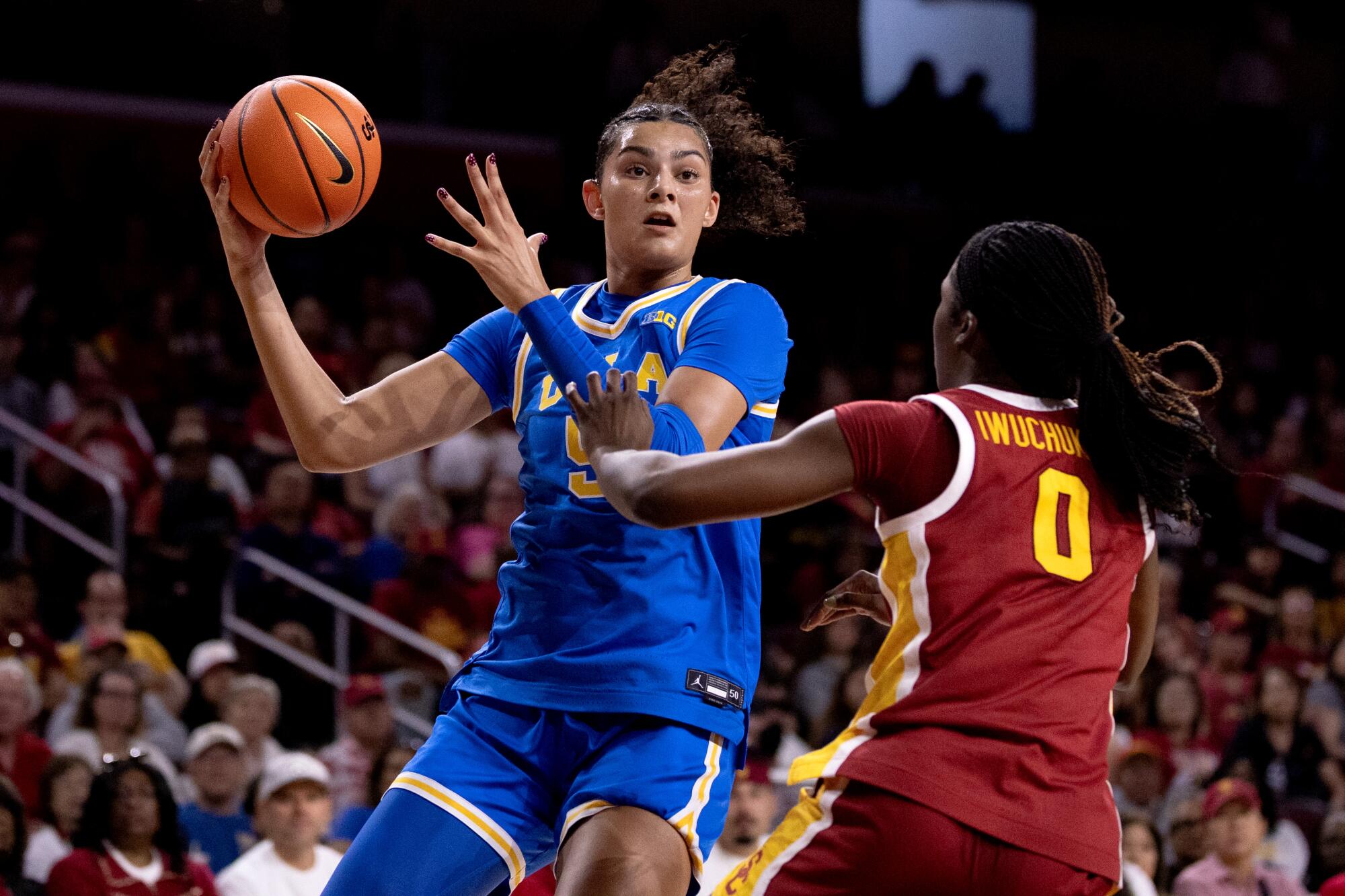
Gabriela Jaquez and UCLA dominate in win over UC Santa Barbara

At her players’ request, Cori Close showed up inside Pauley Pavilion five hours before tipoff. The UCLA women’s basketball coach was joined by her assistants and managers for pregame shooting at 6:30 a.m., so many players filling the court that the sessions had to be staggered.

Three days after a lackluster showing in their season opener, the Bruins felt they had something to prove in their first game at home. The additional work before facing UC Santa Barbara on Thursday reflected their commitment.

“I mean, I never have to coach this team’s work ethic,” Close said. “That is never in question. And so that’s a really fun place to be in.”

The day’s biggest gratification would come later, the third-ranked Bruins resembling an All-Star team at times during an 87-50 rout of the Gauchos that showed glimpses of the firepower they hope to fully unleash by season’s end.

Forward Gabriela Jaquez revealed one of the best long-range shooting displays of her career, making four of seven three-pointers on the way to 21 points. Point guard Kiki Rice was a constant playmaker in her return to the starting lineup while scoring 20 points, grabbing eight rebounds and distributing three assists. Shooting guard Gianna Kneepkens added another dimension to the offense with four more three-pointers and 20 points.

It was the first time the Bruins had three players score 20 or more points since four of them did it against Bellarmine in November 2023.

“There’s so many weapons that I feel like it’s hard for the defense to choose what to take away,” Kneepkens said, “so I think really what makes this team special is that on any night it could be someone’s night, so that’s a really hard thing to scout.”

The challenge for the Bruins (2-0) could be to maximize all that talent.

Close said Rice had sent her an Oklahoma City Thunder news conference in which the team talked about building rhythm with its offense by best utilizing the players who were hot on any given night.

“We’re not quite there yet,” Close said. “We’re not playing with great rhythm. … I think we just haven’t totally found that flow yet.”

UCLA guard Kiki Rice drives to the basket past UC Santa Barbara guard Zoe Shaw during the second half Thursday.

UCLA guard Kiki Rice drives to the basket past UC Santa Barbara guard Zoe Shaw during the second half Thursday.

(Kyusung Gong / Associated Press)

Part of that could be pinned on Rice still rounding into form from a shoulder injury and fellow point guard Charlisse Leger-Walker (eight points, seven assists, three steals) playing in only her second game since returning from a lengthy injury layoff.

The Bruins were also without Sienna Betts (lower leg) and Timea Gardiner (knee) for a second consecutive game. Close said there remained no timetable for Betts’ return even as she continued to progress.

But Close said she liked the way her players responded after describing them as “flat all the way around” in their opener, a 24-point victory over San Diego State.

“The film session after that was not fun. Practice was not fun,” Close said. “And their willingness to say, ‘This is what we need. We need to be challenged. We didn’t meet the standard’ — I’m really impressed with their willingness to do that.”

After some lackadaisical UCLA defense in the first quarter, there was a stretch in the second quarter in which the Bruins made it difficult just to get the ball past halfcourt.

Jaquez stuck out a hand, tipping an outlet pass to herself before going in for a driving layup in which she was fouled. On the Gauchos’ next possession, Leger-Walker came up with another steal, leading to a Rice layup.

It wasn’t long before Jaquez and teammate Lauren Betts (12 points, seven rebounds, six assists) used a double team along the sideline to force another turnover.

Closing the half on a 19-2 run, the Bruins surged into a 51-26 lead. UCLA also benefited from an oddity midway through the second quarter when the Gauchos (1-1) were assessed a technical foul for having a player wearing a jersey number that didn’t correspond with the scorebook.

For UCLA, the biggest challenge might have been scheduling the game.

Close said she’s struggled to get teams to agree to play the Bruins after their Final Four run, calling every school in the state from San Luis Obispo to San Diego. Most of UCLA’s marquee nonconference games, starting with a showdown against Oklahoma on Monday in Sacramento, will be at neutral sites.

“They kept saying it’s the Lauren Betts factor and I was like, ‘No, it’s the you’re scared factor. Come on,’ ” Close said. “I actually really lose respect for people who aren’t willing to step up and play hard people.”

The Gauchos eagerly complied in part because they were Close’s alma mater and the spot where she coached for nine years.

“Thank you to them for stepping up and coming into Pauley,” Close said, “and wanting to get better at their craft and growing the game.”

For the Gauchos, given the way things went, they might be owed a Christmas card as well.

Early to rise, the Bruins also put an early end to any upset hopes.

Source link