DOJ issues subpoenas in Paramount-Warner's $110B deal – Reuters
DOJ issues subpoenas in Paramount-Warner's $110B deal – Reuters
Source link
DOJ issues subpoenas in Paramount-Warner's $110B deal – Reuters
Source link
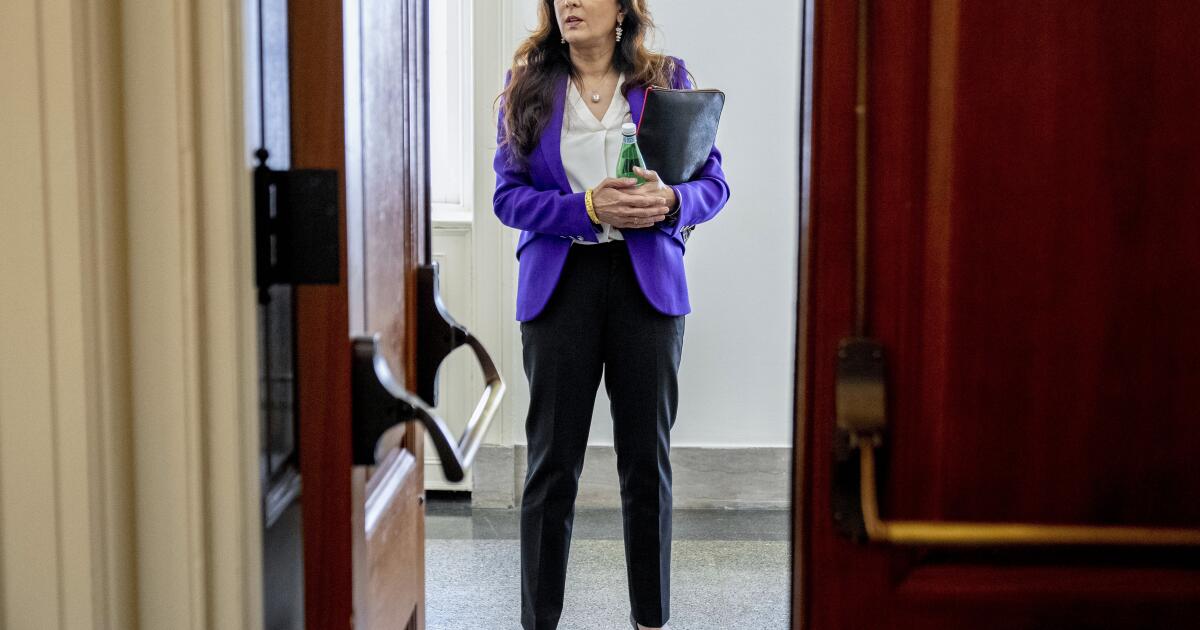
The U.S. Department of Justice announced Thursday that it has launched an investigation into two California women’s prisons to determine if they unconstitutionally provided housing and preferential treatment to “biological male prisoners.”
In a letter to Gov. Gavin Newsom, Assistant Atty. Gen. Harmeet Dhillon — who heads the Justice Department’s Civil Rights Division — said investigators will look into “widely reported allegations of deprivation of female prisoners’ rights” at the Central California Women’s Facility in Madera County and the California Institution for Women in San Bernardino County.
The Justice Department said in a news release that there have been allegations “of sexual assaults, rape, voyeurism and a pervasive climate of sexual intimidation due to the presence of males in the women’s prison.”
Newsom’s office referred The Times to the California Department of Corrections and Rehabilitation. A spokesperson for the agency said it is “committed to providing a safe, humane, respectful and rehabilitative environment for all incarcerated people.”
The Department of Justice also notified Maine Gov. Janet Mills of an investigation into allegations that the state “has allowed a biological male inmate to remain housed with women despite complaints that the male inmate has assaulted or harassed several female inmates.”
Dhillon said in a video posted on X that the investigations are part of a new project called the “single-sex prisons initiative” to look for potential civil rights violations in which female inmates are forced “to be in the same rooms with men who are posing as women to get access to the female prisons.”
“In California there are reports of many dozen such men housed in women’s prisons which of course is exposing these women to sexual assault and other forms of violence and harassment that, if true, are extremely troubling and could violate the civil rights of these women,” Dhillon said.
In 2020, Newsom signed into law Senate Bill 132, which gives transgender, nonbinary and intersex inmates at state prisons the right to be housed at either men’s or women’s facilities. Opponents of the law sued the following year, alleging that it was unconstitutional and created an unsafe environment for women in female facilities, with some plaintiffs claiming they were assaulted.
At the time, LGBTQ+ advocates slammed the suit as baseless and damaging.
“The way they wrote [the complaint] is saying that trans women are men and they are putting men in women’s prisons, which is completely false,” Bamby Salcedo, president and chief executive of the TransLatin@ Coalition, which cosponsored SB 132, previously told The Times. “They’re making a claim that is not accurate and not respectful towards trans women specifically.”
In an interview with the Times Thursday, Salcedo said that while there may be instances in which people have abused the law, she stressed “it is the responsibility of the CDCR to protect people who are incarcerated.”
“They should be able to not just follow the law, but also to be able to screen people appropriately,” Salcedo said.
Salcedo said she was not surprised to hear about the new Justice Department investigation, calling it “an effort for this administration to continue to deny opportunities and access to trans people in our society.”
The Women’s Liberation Front, which brought the lawsuit, announced this week that a federal court had dismissed the case but that they planned to appeal. In an emailed statement, Elspeth Cypher, Women’s Liberation Front board president, called the Justice Department investigation “welcome and long overdue.”
“I hope that this investigation provides the women in prison with some hope that finally someone is listening,” Cypher said.
Under the bill enacted in 2021, 1,028 inmates housed at male prisons have requested to be moved to female facilities, according to data as of March 4. The department had granted 47 requests and denied 132. Another 140 applicants “changed their minds,” according to the department.
State officials said that 84 inmates sought to be transferred into men’s facilities from women’s prisons. Of those, seven were approved.
According to the corrections department, 2,405 inmates identify as nonbinary, intersex or transgender. Those populations are said to experience excessive violence in prison. A 2007 UC Irvine study that included interviews with 39 transgender inmates found that the rate of sexual assault is 13 times higher for transgender people, with 59% of those surveyed reporting experiencing such encounters.
The Justice Department said Thursday that its investigation was just getting underway and that it “has not reached any conclusions regarding allegations in these matters.”
“I’m very determined to ensure that no woman who’s incarcerated in the United States is subject to potential rape, sexual assault or other violations of her civil rights as a condition of incarceration to satisfy some woke ideology by the state,” Dhillon said. “If these states are violating these rights and they don’t stop, we will make them through litigation.”
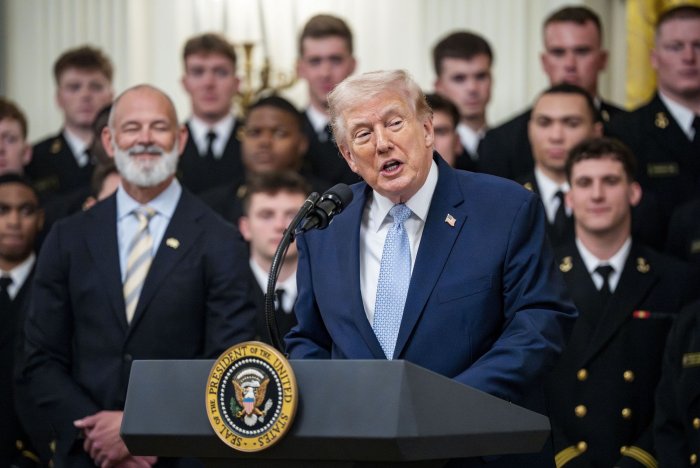
The President Donald Trump administration has filed suit against Harvard University, claiming it didn’t protect Jewish Students during protests against Israel starving Palestinians. File Photo CJ Gunther/EPA
March 20 (UPI) — The U.S. Justice Department sued Harvard University on Friday, accusing the Ivy League school of failing to protect Jewish students in the wake of the war in Israel and Gaza.
Filed in Boston, the lawsuit said Harvard allowed a “hostile education environment” for Jewish students who were physically assaulted and harassed. Protests sparked at Harvard and other U.S. college campuses after the start of the Oct. 7, 2023, war.
“The United States cannot and will not tolerate these failures and brings this action to compel Harvard to comply with Title VI, and to recover billions of dollars of taxpayer subsidies to a discriminatory institution,” the lawsuit read, referencing a federal law banning discrimination based on race, color or national origin in programs receiving federal funds.
Harvard denied the allegations laid out in the lawsuit, saying it has taken steps to embrace and respect Jewish and Israeli students on campus.
“Harvard has taken substantive, proactive steps to address the root causes of anti-Semitism and actively enforces anti-harassment and anti-discrimination rules and policies on campus,” a statement from the school said.
“We also have enhanced training and education on anti-Semitism for students, faculty and staff, and launched programs to promote civil dialogue and respectful disagreement inside and outside the classroom.
“Harvard’s efforts demonstrate the very opposite of deliberate indifference.”
The administration has actively targeted Harvard since President Donald Trump took office in 2025. Trump’s official grievance against the university is that he claims the school failed to protect Jewish students during protests against Israel during the war that began in 2023.
In February, the Justice Department sued Harvard for failing to hand over admissions documents for an investigation about whether the admission process discriminates against white people. Earlier in February, Secretary of Defense Pete Hegseth announced that the Pentagon would end its academic partnership with Harvard over what he called a “woke” institution that is not welcoming to the U.S. military.
On Feb. 3, Trump said he was now seeking $1 billion in damages from Harvard but didn’t explain why.
“We are now seeking One Billion Dollars in damages, and want nothing further to do, into the future, with Harvard University,” Trump said on Truth Social.
On Dec. 19, the administration filed an appeal against a judge who blocked his order to cut funding by $2 billion.

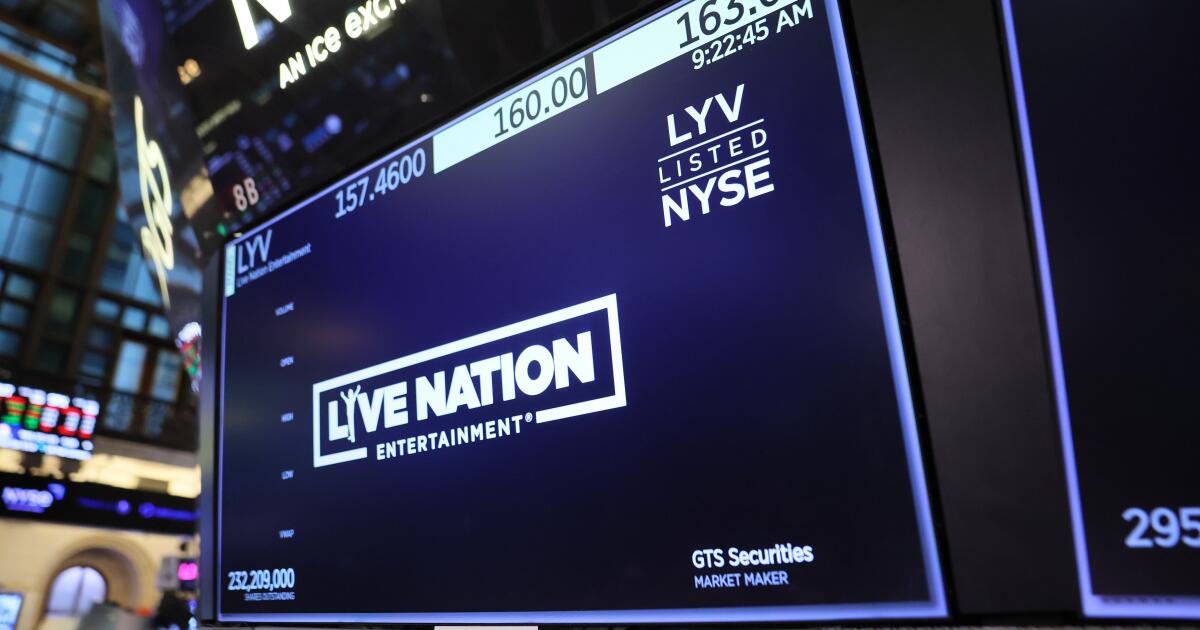
Live Nation has reached a settlement with the Justice Department in an antitrust case that put the entertainment giant at risk of being separated from Ticketmaster.
The ticket vendor’s settlement offer was announced, in a court hearing on Monday, less than a week after the long-awaited trial began. With pending approval from the judge, Live Nation will have to pay damages to the suing states and allow competitors to sell tickets on its platform. Media reports have said the company agreed to pay more than $200 million as part of the settlement.
The settlement caught Judge Arun Subramanian off guard. He said no one informed him of the tentative deal until late Sunday, even though a term sheet for a possible settlement was signed on Thursday, according to the Associated Press.
A 12-person jury was seated last Tuesday in a Manhattan federal courthouse and the trial had reached witness testimony by the end of last week. The complaint was filed in 2024, when the federal government, 39 states including California and the District of Columbia, alleged that Live Nation and Ticketmaster have monopolies in various aspects of the live music industry, such as concert promotion, venue operations, artist management and ticketing services.
Live Nation could not immediately be reached for a comment.
Many of the large monopoly claims were thrown out during a pretrial hearing last month, including an allegation that Live Nation’s industry power raises ticket prices and harms consumers. But the new settlement offers major structural changes to the company’s ticketing services.
If the trial judge approves the settlement, the Beverly Hills-based company will have to open parts of its platform to rival ticketing operators. This means third-party sellers like SeatGeek could list tickets and have access to Ticketmaster’s technology.
Another key claim in the lawsuit concerned Ticketmaster’s alleged exclusivity contracts, which required artists who booked Live Nation-owned venues to also use its ticketing services. The settlement now limits these contracts to four years and allows venues to place a number of its tickets on competing platforms.
The original lawsuit also argued that Live Nation manages more than 400 artists and controls more than 265 venues in North America — all while Ticketmaster simultaneously controls around 80% of the primary ticket marketplace and is increasing its involvement in the resale market. Under the pending legal agreement, Live Nation would have to divest more than 10 of its venues and Ticketmaster would also have to cap service fees at 15%.
Serona Elton, attorney and interim vice dean at the University of Miami’s Frost School of Music, said this outcome can be understood in two ways — it’s either a win that addresses anti-competitive behaviors or a deal that does not go far enough.
“It is important to understand that it is not illegal to be a monopoly and control a large portion of the market,” said Elton in a statement. “What is illegal is the use of anti-competitive tactics. In analyzing the settlement, the question to ask is if it does enough to address the alleged tactics and the harm they may have caused.”
Elton added that venues could benefit from these adjustments, but “music fans should not think this is going to bring ticket prices down to an affordable level as there are other causes behind the sky-high ticket prices.”
Stephen Parker, the executive director of the National Independent Venue Association, similarly expressed some skepticism about the potential settlement.
“The reported settlement does not appear to include any specific and explicit protections for fans, artists, or independent venues and festivals,” he said in a statement.
“Reported details also indicate that ticket resale platforms could be further empowered through new requirements for Ticketmaster to host their listings, which would likely exacerbate the price gouging potential for predatory resellers and the platforms that serve them,” Parker added . “If these facts are true, NIVA views this as a failure of the justice system.”
A settlement could mark the potential end to one of the major legal battles Live Nation is facing. The company is also being sued by the Federal Trade Commission and is dealing with a handful of class-action lawsuits from groups of concertgoers.
After the news of the settlement broke, Live Nation’s stock jumped over 5% to $164.03.
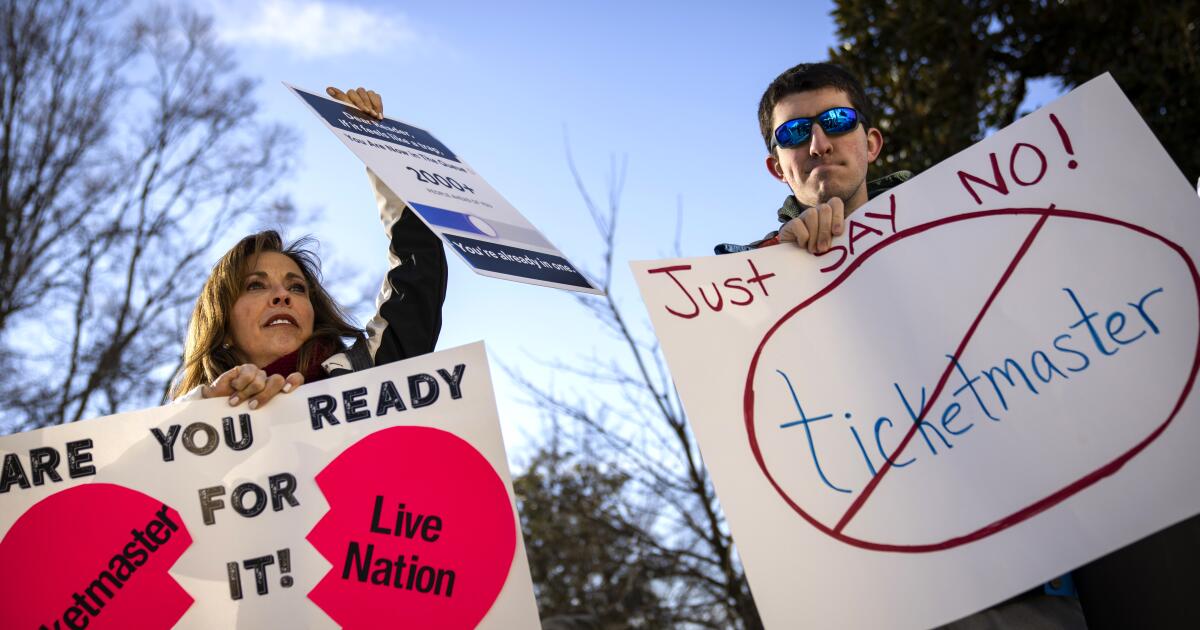
After years of ticketing complaints and frustrations, the trial for the Department of Justice’s antitrust lawsuit against Live Nation is officially underway.
As part of its case, the DOJ has accused Live Nation of requiring artists to use its promotional services when they play a Live Nation-owned venue. Because so many venues are owned by the company, the government claims Live Nation’s alleged practices are anti-competitive.
Jury selection began Monday in a New York federal court and opening statements are expected Tuesday for the complaint first filed in 2024. Since then, the antitrust case against the Beverly Hills-based company has been streamlined — examining whether Live Nation uses illegal anti-competitive practices and whether the company and Ticketmaster should be broken up.
The legal proceeding is expected to last around a month, with Judge Arun Subramanian, who also presided over Sean Combs’ sentencing last year, at the helm.
Live Nation’s presidents Michael Rapino and Joe Berchtold, executives from competing companies like Anschutz Entertainment Group and Irving Azoff, the former Ticketmaster CEO, are expected to testify. Musicians like Ben Lovett of Mumford & Sons and entertainer Kid Rock could also take the stand.
The original lawsuit led by a cadre of interested parties including the federal government, 39 states and the District of Columbia alleged that Live Nation and its subsidiary Ticketmaster have monopolies in various aspects of the live music industry, such as concert promotion, venue operations, artist management and ticketing services.
The lawsuit states that Live Nation manages over 400 artists and controls more than 265 venues in North America. Ticketmaster simultaneously controls around 80% of the primary ticket marketplace and is also increasing its involvement in the resale market.
Many of the large monopoly claims were thrown out during a pretrial hearing with Judge Subramanian last month, including an allegation that Live Nation’s industry power raises ticket prices and harms consumers.
The claim with arguably the greatest potential impact centers on whether Live Nation should own Ticketmaster. The two companies merged in 2010, a move that has frequently been considered controversial. Beyond the ownership of Ticketmaster, the DOJ claims Live Nation forces venues to sign exclusive contracts with Ticketmaster, barring the inclusion of other ticket vendors.
“For over a decade, Ticketmaster and Live Nation have promised reform, but meaningful competition has remained out of reach. The industry now stands at an inflection point: restore a competitive marketplace that supports innovation, or allow the status quo to continue narrowing options for American consumers,” Dustin Brighton of the Coalition for Ticket Fairness said in a statement.
“Yet the very competitors that could check this monopoly and restore balance are routinely boxed out by restrictive practices that limit innovation and reduce consumer options,” Brighton added.
Live Nation did not respond to a request for comment. When the complaint was first filed, the company called the claims “baseless.”
“Calling Ticketmaster a monopoly may be a PR win for the DOJ in the short term, but it will lose in court because it ignores the basic economics of live entertainment,” wrote Live Nation in a previous statement.
If Live Nation loses the trial, the judge will decide how the company should be restructured, which could mean selling Ticketmaster to a competitor. Live Nation maintains the right to appeal such a decision, if it materializes, and take the matter to a higher court.
“If the court finds Live Nation violated the law, monetary penalties and behavioral commitments alone will not be sufficient,” Stephen Parker, executive director of the Independent Venue Association, said in a statement.
“The relief must be proportionate to the harm,” Parker added, “and that means structural separation of primary ticketing, resale ticketing, venue operation, national tours, advertising/sponsorship, and artist management must be seriously considered.”
Beyond the current DOJ trial, Live Nation is also facing a lawsuit from the Federal Trade Commission and a handful of class action lawsuits from groups of concertgoers.

Feb. 27 (UPI) — The Justice Department has sued another five states, including three led by Republicans, for their unredacted voter registration lists, amid the Trump administration’s the information ahead of November’s midterms.
The Trump administration has now sued 29 states and the District of Columbia for voter information, heightening Democrats’ concerns that it is seeking to meddle in the elections.
The five states sued Thursday were Utah, Oklahoma, Kentucky, West Virginia and New Jersey. The litigation effort has so far disproportionately targeted Democratic-led states, with Utah, Oklahoma and West Virginia among the few GOP-led states sued for their voter registration lists.
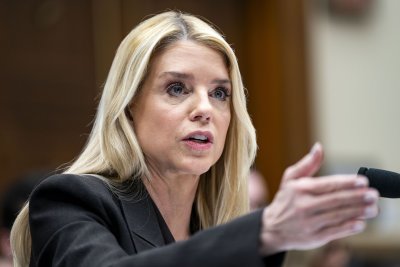
Attorney General Pam Bondi argues she is charged by Congress with authority to request the sensitive election data under the Civil Rights Act of 1960, though courts have ruled against the government in the three cases that have reached decisions: California in mid-January and Michigan and Oregon earlier this month.
Courts that have so far rejected Bondi’s argument found either that she lacks the authority to compel disclosure of the unredacted voter lists, as in Oregon, or the laws she cites do not permit the government to obtain them, as in Michigan. The judge in the California case also ruled her demand “stands to have a chilling effect on American citizens like political minority groups and working-class immigrants” worried about how their information will be used.
“As several courts have already held, the Department of Justice’s request for voters’ personal information, including their driver’s license numbers and Social Security numbers, is baseless,” New Jersey Attorney General Jennifer Davenport said in a statement Thursday rejecting the Trump administration’s lawsuit.
“We are committed to protecting the privacy of our state’s residents, and we will defend against this lawsuit in court.”
Lt. Gov. Deidre Henderson of Utah said the Justice Department sued her state after federal prosecutors declined Utah’s previous offer to share publicly available lists with them. The Trump administration’s lawsuit was expected, she said.
“Neither state nor federal law entitles the Department of Justice to collect private information on law-abiding American citizens,” she said in a statement. “Utahns can be assured that my office will always follow the Constitution and the law, protect voters’ rights and administer free and fair elections.”
Attorney General Gentner Drummond of GOP-led Oklahoma even responded to the lawsuit by stating that they are willing to “fully cooperate with any lawful requests related to voter fraud.”
“Oklahomans should have confidence that their state remains firmly committed to both election integrity and the protection of personal information,” he said in a statement.
The Trump administration has argued it requires the lists for election integrity purposes, raising concerns from Democrats already concerned about Trump attempting to interfere in the midterm elections as he has repeatedly expressed worries that he will be impeached if his Republican Party loses control of Congress.
Democrats and civil rights organizations, including the American Civil Liberties Union, Common Cause and the NAACP, have each echoed warnings that the Trump administration wants to use voter registration lists to undermine the upcoming election.
Assistant Attorney General Harmeet Dhillon of the Justice Department’s Civil Rights Division acknowledged Thursday that many states are choosing to fight them in court, but they will not be dissuaded.
“We will not be deterred, regardless of party affiliation, from carrying out critical election integrity legal duties,” Dhillon said in a statement.