documents

ICE whistleblower documents reveal deep cuts to training program

New whistleblower documents detail substantial cuts by the Trump administration to the training requirements for new immigration officers.

Among the cuts are the elimination of practical exams, use of force and legal training courses, and an overall reduction in training time, contrary to an official’s testimony to Congress earlier this month.

The documents, provided to Sen. Richard Blumenthal (D-Conn.) by whistleblowers from the Department of Homeland Security, were publicly revealed ahead of a forum Monday afternoon with congressional Democrats — the third in recent weeks probing what the members view as abusive and illegal tactics used by federal agents.

Lauren Bis, deputy assistant public affairs secretary at DHS, said no training hours have been cut.

“Our officers receive extensive firearm training, are taught de-escalation tactics, and receive 4th and 5th Amendment comprehensive instruction,” she said. “The training does not stop after graduation from the academy. Recruits are put on a rigorous on-the-job training program that is tracked and monitored.”

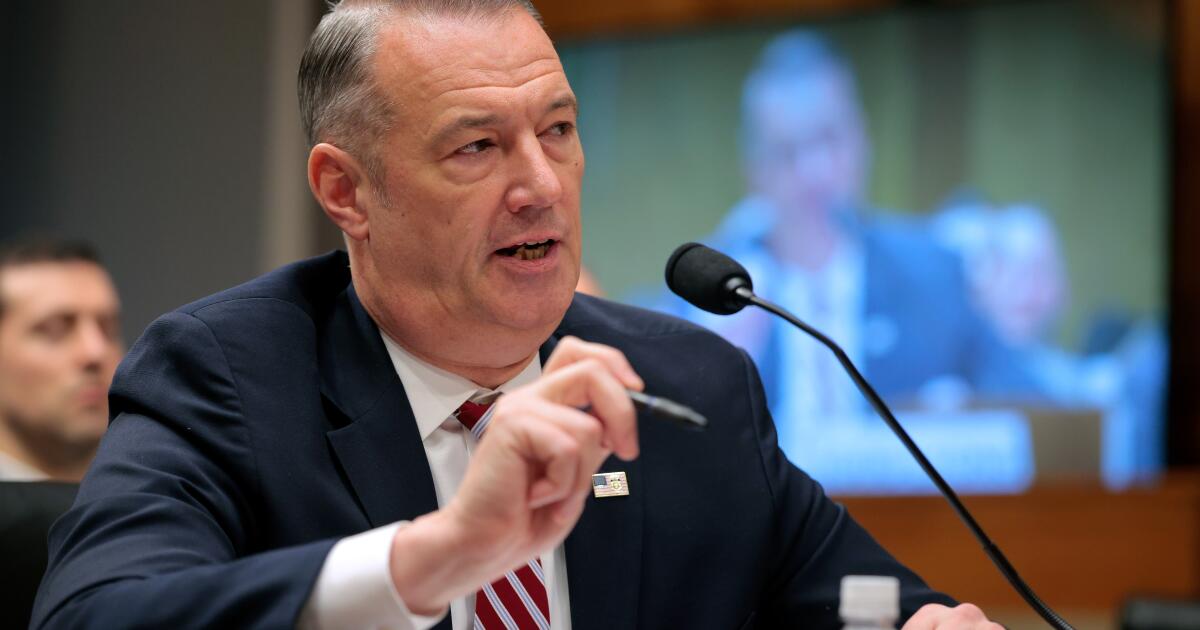
Blumenthal’s office also disclosed the identity of one whistleblower: Ryan Schwank, an attorney who most recently served as an instructor for new Immigration and Customs Enforcement recruits at the ICE Academy within the Federal Law Enforcement Training Center in Georgia. Schwank, who resigned Feb. 13, is scheduled to testify at the forum.

Schwank is one of two whistleblowers who made a confidential disclosure to Blumenthal’s office last month regarding an ICE policy allowing agents to enter people’s homes without a judicial warrant.

In excerpted quotes from Schwank’s prepared testimony shared with The Times, he calls the training program “deficient, defective and broken.”

“Deficient training can and will get people killed,” he wrote. “It can and will lead to unlawful arrests, violations of constitutional rights, and a fundamental loss of public trust in law enforcement. ICE is lying to Congress and the American people about the steps it is taking to ensure its 10,000 new officers faithfully uphold the Constitution and can perform their jobs.”

Blumenthal’s office did not confirm whether Schwank or the other, still anonymous whistleblower provided the documents released Monday in a 90-page memorandum from minority staff of the Senate Permanent Subcommittee on Investigations.

The documents show ICE has eliminated more than a dozen practical exams that ICE officers previously needed to graduate. In July 2021, a cadet needed to pass 25 practical exams to graduate. Now, nine are required.

Eliminated exams include “Judgment pistol shooting,” “Criminal encounters,” and “Determine removability.”

“All of these are now instead evaluated, if at all, mainly by open-book, multiple-choice written exams and without any graded practical examinations,” the memo states.

Comparisons between the program’s syllabus table of contents and general information sections from July 2025 — before the surge in hiring — and this month show that ICE appears to have cut whole courses, such as use of force simulation training, U.S. government structure, criminal vs. removal proceedings, and use of force.

Earlier this month, acting ICE Director Todd Lyons testified to Congress that while the agency had reduced the number of training days to 42 from 75, “We went from five days a week to six days a week. Five days a week was five eight-hour days. We’ve gone to six 12-hour days.”

But the documents appear to contradict Lyons’ testimony.

“The schedules reflected on these documents indicate that current ICE recruits receive nearly 250 fewer hours of training than previous cohorts of recruits,” the memo states.

The training reductions come as ICE plans to bring up more than 4,000 new Enforcement and Removal Operations officers this fiscal year, which ends in September. One of the documents notes that ICE had graduated 803 new officers in 2026 as of Jan. 29 and projected 3,204 more graduates by the end of the fiscal year.

In a written statement, Blumenthal encouraged more whistleblowers to come forward.

“We know about the Trump Administration’s decimation of training for immigration officers and its secret policy to shred your Constitutional rights because of the brave Americans who are speaking out today,” he wrote. “They are coming to Congress because we have the responsibility to not only bear witness to these crimes, but to do something to make sure they don’t happen again.”
Source link

Federal judge blocks release of Jack Smith’s classified documents report

1 of 5 | Former Justice Department special counsel Jack Smith testifies at a House Judiciary Committee oversight hearing on Capitol Hill in Washington, D.C., on January 22. A federal judge on Monday blocked Smith’s report on his investigation into President Donald Trump’s handling of classified documents held at Mar-a-Lago. File Photo by Bonnie Cash/UPI | License Photo

Feb. 23 (UPI) — A federal judge in Florida on Monday blocked the public release of former special counsel Jack Smith’s report on his investigation into classified documents held at President Donald Trump‘s Mar-a-Lago estate.

In the order, U.S. District Judge Aileen M. Cannon of the Southern District of Florida said Smith’s report should not be made public after she previously ruled that he was illegally appointed to spearhead the case.

In July 2024, she said Smith’s appointment as special counsel by President Joe Biden violated the Appointments Clause of the Constitution. She took issue with what she described as the “broad power” given to Smith, the “indefinite” appropriate given to the task and his lack of supervision.

Biden appointed Smith to investigate whether Trump — then the former president — mishandled classified documents by storing them at his Mar-a-Lago estate in Palm Beach, Fla. Smith’s probe resulted in 41 criminal counts against Trump, but Cannon dismissed the case in 2024.

In her order Monday, she accused Smith of accelerating efforts to prepare the report after her ruling so it could be completed before he left his position in January 2025 upon Trump’s inauguration to a second term. She said Smith used “discover materials generated in this case,” and there was a 2023 protective order preventing the public release of such materials unless approved by a court.

Cannon said she’s also blocking the release of the report because doing so “would cause irreparable damage to former defendants” involved in the case. Also named in the indictment against Trump were his aide, Walton Nauta, and Carlos De Oliveira, a maintenance worker accused of helping Nauta move 30 boxes of classified documents at Mar-a-Lago into a storage room under Trump’s direction.

Smith defended his investigation into the handling of classified documents — and another into Trump’s alleged attempts to interfere with the 2020 election — to Congress in December. He said if given the same evidence, he would charge Trump with crimes again.

“Our investigation developed proof beyond a reasonable doubt that President Trump engaged in a criminal scheme to overturn the results of the 2020 presidential election and to prevent the lawful transfer of power,” Smith said.

“Our investigation also developed powerful evidence that showed President Trump willfully retained highly classified documents after he left office in January 2021, storing them at his social club, including in a bathroom and a ballroom where events and gatherings took place.”

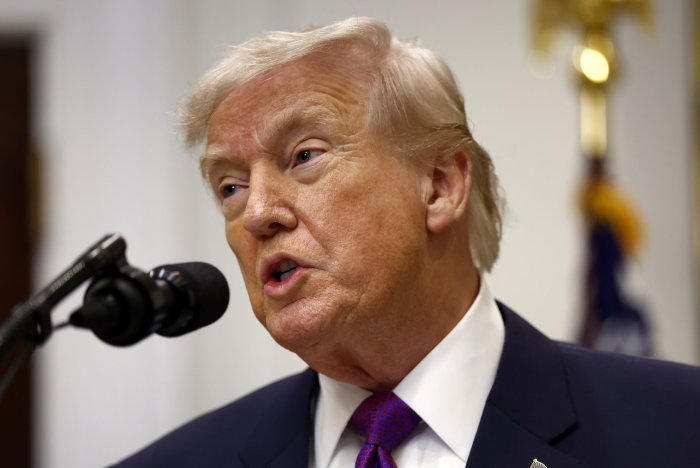
President Donald Trump speaks alongside Administrator of the Environmental Protection Agency Lee Zeldin in the Roosevelt Room of the White House on Thursday. The Trump administration has announced the finalization of rules that revoke the EPA’s ability to regulate climate pollution by ending the endangerment finding that determined six greenhouse gases could be categorized as dangerous to human health. Photo by Will Oliver/UPI | License Photo

Source link

New law puts Kansas at vanguard of denying trans identities on official documents

Kansas is set to invalidate about 1,700 driver’s licenses held by transgender residents and roughly as many birth certificates under a new law that goes beyond Republican-imposed restrictions in other states on listing gender identities in government documents.

The new law takes effect Thursday. Democratic Gov. Laura Kelly vetoed the measure, but the Legislature’s GOP supermajorities overrode it last week as Republican state lawmakers across the U.S. have pursued another round of measures to roll back transgender rights.

The bill prohibits documents from listing any sex other than the one assigned birth and invalidates any that reflect a conflicting gender identity. Florida, Tennessee and Texas also don’t allow driver’s licenses to reflect a trans person’s gender identity, and at least eight states besides Kansas have policies that bar trans residents from changing their birth certificates.

But only Kansas’ law requires reversing changes previously made for trans residents. Kansas officials expect to cancel about 1,700 driver’s licenses and issue new birth certificates for up to 1,800 people.

“It tells me that Kansas Republicans are interested in being on the vanguard of the culture war and in a race to the bottom,” said Democratic state Rep. Abi Boatman, a transgender Air Force veteran appointed in January to fill a vacant Wichita seat.

Kansas’ new law enjoyed nearly unanimous GOP support. It is the latest development in what has become an annual effort to further roll back transgender rights by Republicans in statehouses across the U.S., bolstered by policies and rhetoric from President Trump’s administration.

Trump and other Republicans attack research-backed conclusions that gender can change or be fluid, which they frame as radical “gender ideology.” GOP lawmakers in Kansas regularly describe transgender girls and women as male, and say that in doing so they are protecting women.

Like other Republicans, Kansas Senate Majority Leader Chase Blasi said Trump’s reelection and other GOP victories in 2024 show that voters want “to return to common sense” on gender.

“When I go home, people believe there are just two sexes, male and female,” Blasi said. “It’s basic biology I learned in high school.”

Kelly supports transgender rights, but GOP lawmakers have overridden her vetoes three of the last four years. Kansas bans gender-affirming care for minors and bars transgender women and girls from female sports teams, kindergarten through college.

Transgender people can’t use public restrooms, locker rooms or other single-sex facilities associated with their gender identities, though there was no enforcement mechanism until this year’s law added tough new provisions.

Transgender people have said carrying IDs that misgender them opens them to intrusive questions, harassment and even violence when they show it to police, merchants and others.

In 2023, Republicans halted changes in Kansas birth certificates and driver’s licenses by enacting a measure ending the state’s legal recognition of trans residents’ gender identities. Though the law didn’t mention either document, it legally defined male and female by a person’s “biological reproductive system” at birth.

However, a lawsuit led to state court decisions that permitted driver’s license changes to resume last year.

Legislators in at least seven other states are considering bills to prevent transgender people from changing one or both documents, according to a search using the bill-tracking software Plural.

But none would reverse past changes.

The extra step by Kansas legislators reinforces a message “that trans people aren’t welcome,” said Anthony Alvarez, a transgender University of Kansas student who works for an LGBTQ+ rights group.

Kansas is likely to notify transgender residents by mail that their driver’s licenses are no longer valid and they need to go to a local licensing office to get a new one, said Zachary Denney, spokesperson for the agency that issues them.

The Legislature hasn’t earmarked funds to cover the cost, so each person will be charged for it — $26 for a standard license.

Alvarez already has had four IDs in four years as he’s changed his name, changed his gender marker and turned 21.

He’s always planned to stay in his native Kansas after receiving his history degree this spring.

But, he said, “they’re just making it harder and harder for me to live in the state that I love.”

Hanna writes for the Associated Press.

Source link