101 East investigates rampant alleged corruption in flood-control projects in one of Asia’s most typhoon-prone countries.
In the Philippines, a massive corruption scandal is triggering street protests and putting pressure on the government of Ferdinand Marcos Jr.
The population’s increasing exposure to typhoons, floods and rising sea-levels has seen the government allocate $9.5bn of taxpayer funds to more than 9,800 flood-control projects in the last three years.
But recent audits reveal widespread cases of structures being grossly incomplete or non-existent.
Multiple government officials are accused of pocketing huge kickbacks, funding lavish lifestyles.
101 East investigates how the most vulnerable are being flooded by corruption in the Philippines.
It’s awards season crunch time, in the sense that I’m crunching in as much work as I can before a Thanksgiving respite — including a guide to some of the highlights from this week’s issue of The Envelope, covered by my profile of Renate Reinsve.
Whether it’s while you smell turkey legs being turned into gravy (i.e., if you’re me as I write this) or as you’re lounging around over the holiday weekend, I hope you’ll dive into the great stories below. And be sure to take a breather from the mayhem in the process. It’s a marathon, not a sprint!
Digital Cover: Ethan Hawke
(Victoria Will / For The Times)
In the years since the Golden Age of TV, it’s not been uncommon for actors to vie for major awards on both the big and small screens at once. But few in recent memory have done so in such distinct projects as Ethan Hawke in “Blue Moon” and “The Lowdown”: One is a chamber drama about the last days of legendary songwriter Lorenz Hart, the other a noirish tale of a hangdog journalist.
It’s a reflection of the actor’s voracious appetite for the unexpected (see also: “Black Phone 2”), which he reveals that some in Hollywood once found “irritating.”
“Generally, people are more comfortable when they know exactly what you are and what your thing is, and if you keep changing your thing it’s confusing,” he tells writer Emily Zemler. “But it’s always been interesting to me to do different things. It makes acting really exciting to me to keep shaking it up. Each thing has its own geometry and math, and that keeps you really engaged.”
Eva Victor on ‘Sorry, Baby’
(Jason Armond / Los Angeles Times)
One of my favorite films of the year, “Sorry, Baby” works on many levels — as a campus satire, a portrait of a friendship, a slice of small-town life. And as writer-director-star Eva Victor writes in a new essay on the film, it took all of those other levels to make the film’s deepest, darkest level possible.
“There was a time in my life when I was looking for a film about going through a trauma that held my hand while I was watching it,” Victor notes, contrasting “Sorry, Baby” with films that depict similar subjects with violent imagery. “I needed the film to care for me, the person who’d been through the difficult thing. I didn’t need a film that existed to teach people how bad it is to go through a bad thing, I needed a film that existed to make me feel less alone.”
How ‘F1’ became a part of F1
As an avowed fan of Formula One, from docuseries “Drive to Survive” to scripted miniseries “Senna,” what fascinated me most watching Apple TV’s summer blockbuster “F1” was the delicate logistical dance it must’ve required to shoot a major theatrical film at actual races on the actual F1 circuit. Maybe that’s my stressed-out editor brain at work, but I asked Nate Rogers to dig into the question.
He reports back that even with legendary racer Lewis Hamilton and Apple on board, the film had to prove “that they could set up at an event like the fabled British Grand Prix at Silverstone and not cause a pileup.”
“We had to rehearse the blocking and staging for about two weeks with a stopwatch … to prove to them that we could actually shoot a scene and get off the track before the race started,” director Joseph Kosinski tells Rogers.
Curtis “50 Cent” Jackson’s documentary about Sean Combs finally has a release date.
Netflix announced Tuesday that it would release “Sean Combs: The Reckoning,” a four-part docuseries about the disgraced mogul directed by Alexandria Stapleton, on Dec. 2. Jackson, who serves as an executive producer, first revealed he was working on a documentary about Combs and his alleged abuses nearly two years ago.
The synopsis describes the series as a “staggering examination of the media mogul, music legend, and convicted offender” and touts that it will feature “explosive, never-before-seen materials, including exclusive interviews with those formerly in [Combs’] orbit,” such as “his former associates, childhood friends, artists, and employees.”
“Born with an insatiable drive for stardom and a knack for spotting talent, Combs made a quick ascent through the ranks of the music industry with Bad Boy Entertainment and was crucial in bringing hip-hop to the pop masses and launching the careers of dozens of generation-defining artists like The Notorious B.I.G., Mary J. Blige, Jodeci, and Danity Kane,” reads the synopsis. “But along the way … something darker began to color his ambitions.”
In July, Combs was found guilty on two counts of transportation to engage in prostitution after a seven-week federal criminal trial in New York. He was cleared of the more serious charges related to racketeering and sex trafficking. The former rapper is serving a four-year sentence.
Jackson, who had long feuded with Combs, often took to social media to troll the Bad Boy Entertainment founder as the various allegations against him mounted and even through the criminal trial’s aftermath.
But the “In Da Club” rapper, whose work in TV also includes serving as executive producer on Starz’s crime thriller “Power,” told Netflix’s Tudum that he’s “been committed to real storytelling for years through G-Unit Film and Television.”
“I’m grateful to everyone who came forward and trusted us with their stories, and proud to have Alexandria Stapleton as the director on the project to bring this important story to the screen,” he said.
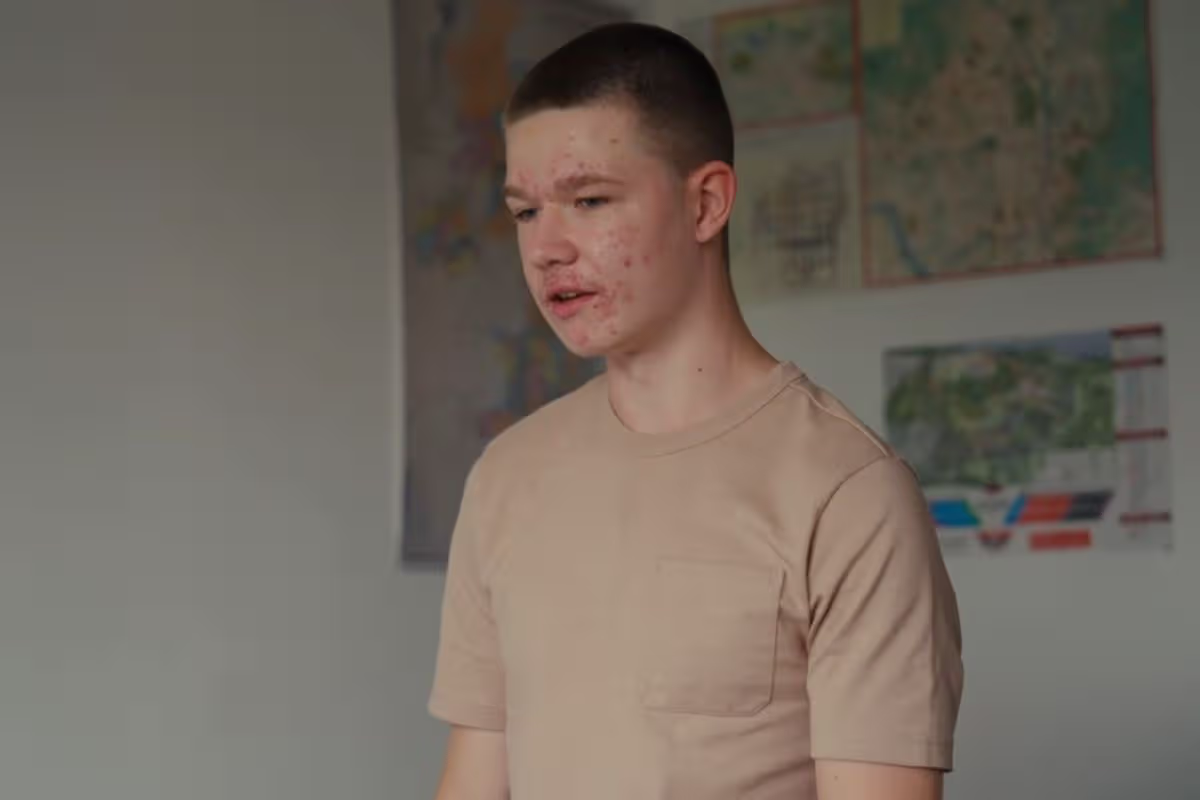
A boy who grew up during Syria’s war reveals the untold origins of the conflict and the fight for his nation’s freedom.
In 2017, Al Jazeera broadcast a documentary by Clover Films that sought to highlight the true origins of the Syrian civil war. By that year, international sympathy for the rebel cause had diminished dramatically as Western media adopted the accepted mainstream position that groups such as al-Qaeda-linked al-Nusra Front and even ISIL (ISIS) had been behind the revolution. (ISIL didn’t even exist at the time of the uprising.) The Boy Who Started the Syrian War would change the narrative.
Now, with the collapse of Bashar al-Assad’s regime along with its army and militia, the Shabiha, it’s time to meet once again with the surviving characters from the original film. One of those is Mouawiya Syasneh, who had laid down his school satchel and picked up a gun to fight with the Free Syrian Army.
Liam Payne’s family is set for more heartbreak as his ex-fiancée Maya Henry is making a documentary about their relationship and break-upCredit: GettyMaya is working with HBO and an independent production company to make a film about her time with himCredit: GettyMaya was in a relationship with Liam from 2018 to 2022Credit: Getty
American model Maya, who was in a relationship with Liam from 2018 to 2022, is working with HBO and an independent production company to make a film about her time with him.
I am told that contributors are being invited to film in Texas, where Maya was born and raised, with those from overseas being flown over.
A source said: “This documentary is going to be hugely upsetting for Liam’s family, who are struggling with unimaginable loss.
“There is also concern within the industry that it is going to be one-sided.
“Of course, Liam is not here to give his side of the story or his version of events. It all just feels terribly sad.”
It comes after disgruntled Maya has already penned a fictional book, Looking Forward, rumoured to be based on her tumultuous romance with the star.
Meanwhile, another mole revealed that Maya will also touch upon trolling she received from 1D fans.
An insider said: “The social media comments were vicious and Maya wants to open up about what she went through and the dark side of dating a world-famous pop star.
“‘It wasn’t just the strain of the relationship itself. She also faced relentless trolling from the band’s fanbase, receiving hateful messages almost daily, which made moving on even harder.
“She hopes the documentary will finally give her the chance to share her experiences and tell her side of the story.”
Last month details of Liam’s emotional second album — which he had finished before he died and features a poignant track called Safe In Heaven — were released.
One industry insider explained that the follow-up to his 2019 debut LP1 was the most self-reflective piece of work he had ever done.
On the few occasions I met Liam he was genuinely a lovely bloke, I think his legacy should be treated with respect . . .
LOOK ON THE BRIGHT SIDE, ZARA
ZARA LARSSON lit up Norway in this bright yellow skirt on Friday night.
The Swedish pop star flaunted her incredible figure on stage as part of her Midnight Sun Tour.
Zara Larsson lit up Norway in this bright yellow skirt on Friday nightCredit: Getty
Aside from the tracks on her new album, Zara played her hits Lush Life and Never Forget You.
Next week sees her head to Finland for a couple of gigs before a homecoming night in Sweden.
RONNIE ’N’ ZACH LOVING IT
LOVE Island: All Stars is upon us and I hear two former lotharios are busy pressing their trunks for a villa comeback.
Semi-professional footballer Ronnie Vint is hoping it’s third time lucky as he finds himself single again.
Semi-professional footballer Ronnie Vint is hoping it’s third time lucky as he finds himself single againCredit: ITVZach Noble is giving love another chance after his relationship with Molly Marsh broke down earlier this yearCredit: Rex
The hunk, who originally appeared in the 2024 summer series and then in this year’s All Stars show, is single again after splitting from Harriett Blackmore.
I’m also told that 2023 contestant Zach Noble is giving love another chance after his relationship with Molly Marsh broke down earlier this year.
A source said: “Love Island: All Stars 2026 is shaping up to be a sizzling cast and bosses have scouted these two rebound hunks keen to find love.
“Both lads were fan favourites, with bags of personality and a decent following on social media.”
Female contestants rumoured to be taking part include Millie Court and Andrada Pop.
I can’t wait to watch the chemistry crackle . . .
PARTY of the WEEK
THE ZYN Rolling Stone UK Awards at The Roundhouse, North London, on Thursday.
Who was there: Sir Bob Geldof, Danny Dyer, FKA Twigs, Lewis Capaldi and Louise Redknapp.
Sir Bob Geldof at the Rolling Stone UK AwardsCredit: Supplied
What we ate: Smoked salmon, lamb and chocolate pears.
What we drank: M&S beer and Rockferne English sparkling wine.
Goodie bag: Percy Pigs.
PIPING HOT, BILLIE
BILLIE PIPER looked a sheer delight as she belatedly celebrated her 43rd birthday in this lacy black dress.
The actress, who turned 43 in September, was partying with pals including Dominic Cooper and Richard Madden at Upstairs At Langan’s in central London.
Billie Piper looked a sheer delight as she belatedly celebrated her 43rd birthday in this lacy black dressCredit: GettyRichard Madden and Dominic Cooper at the partyCredit: Getty
Billie recently starred as music teacher Isadora Capri in season two of Netflix show Wednesday.
She said: “I’ve always wanted to play a sort of floaty, liberal musician or art teacher.”
And now the British actor has given the biggest clue yet that he will be taking over the reins from actor Daniel Craig to be the next 007.
Aaron Taylor-Johnson has been announced as an ambassador for Swiss luxury watchmaker OmegaCredit: Getty
Aaron has been announced as an ambassador for Swiss luxury watchmaker Omega, which is Bond’s favourite timepiece.
Since 1995, the secret agent has worn an Omega Seamaster in every film – with special tribute watches made to honour the character.
Aaron said: “My interest in watches first began with my dad, who introduced me to Omega, if you can believe it.
“He was working class and saved his earnings to purchase an Omega watch.”
In 2022 I revealed that Aaron had completed a top-secret screen test at Pinewood Studios, the home of James Bond movies.
Aaron is currently filming in Dartmoor alongside Lily-Rose Depp for upcoming horror film Werwulf, which is scheduled for release next year.
Sounds like the time is ticking for the next Bond to be formally announced.
OLLY: I WOULD GIVE A BOXING BOUT A SHOT
HIS new album Knees Up is about having a good time with your mates – but Olly Murs has revealed that instead of sinking pints down the pub, he prefers throwing punches in the boxing ring.
Olly has struck up a friendship with super-welterweight champ Sam Gilley and now has a “burning desire” to get fighting fit.
Olly Murs has revealed that instead of sinking pints down the pub, he prefers throwing punches in the boxing ringCredit: Supplied
Chatting to Bizarre’s Emily at his album launch in East London on Friday, left, Olly said: “I train twice a week without fail. I love it.
“I wanted to learn how to punch properly and move, and I wanted to learn the fundamentals of boxing. Am I open to a fight? Yes. Whether or not my wife lets me is another question. I just know there is definitely a burning desire for me to get into the ring and give it a shot.”
Olly added: “I think it is something in my blood. I did Who Do You Think You Are? on the BBC and I learned so much about my grandad.
“He was Latvian and came here in the Second World War. He was an amateur boxing champion.”
I’m Matt Brennan, editor in chief of The Envelope, and each Wednesday from now until Jan. 7, I’ll be sending you a (digital) editor’s letter with some highlights from our Phase I issues.
Our first issue of the 2025-2026 campaign features stories on documentaries, films about the Palestinian experience and “Marty Supreme’s” Odessa A’zion.
A Deeper Dive: Documentaries
(Illustration by Daniel Stolle / For The Times)
I won’t pretend to be Nostradamus when it comes to Hollywood’s top awards — my Gold Derby Emmys ballot didn’t even crack the top 1,000 — but most anyone who ran into me at this year’s Sundance Film Festival heard at least one bold prediction that turned out to be correct: 2025 has been a sterling year for documentaries.
With journalists under attack in the U.S., Ukraine, Gaza and beyond, the form’s close connection to reportage has never felt more urgent, at least not to me. In the contraband prison images of “The Alabama Solution,” the body camera footage of “The Perfect Neighbor,” the conflict coverage of “2000 Meters to Andriivka” and “Love + War,” the portraiture of “Cover-Up” and much more besides, the year’s finest documentaries — no, the year’s finest films — manage to unearth new ways of seeing our society’s most pressing issues, often with more precision and subtlety than scripted films much longer (and costlier) in the making.
I can confirm Tim Grierson’s reporting that Odessa A’zion is a hugger: I received several myself from the “Marty Supreme” and “I Love L.A.” performer when she stopped by The Times newsroom recently for an Envelope digital cover shoot, her own 16mm still camera in hand.
As Grierson notes of the actor, A’zion “doesn’t behave like a rising star” — and she’s not particularly comfortable with the label, either.
“A’zion has heard those predictions before, so she’s wary about being anointed the next big thing,” he writes. “After all, she remembers all the auditions that went nowhere. She remembers being behind on her rent. She remembers almost being evicted. She remembers getting fired from gigs. Simply being cast in a Josh Safdie film doesn’t make those old wounds disappear. ‘To all of a sudden be like, “OK, I’m done [worrying about my career]!” — I don’t see that feeling coming anytime soon.’”
A trio of Palestinian films in the international feature race
A scene from “All That’s Left of You.”
(Watermelon Pictures)
Palestinian stories are no stranger to awards season. But this year, as Gregory Ellwood writes, a trio of films from female directors — each submitted by a different country and each set in a different time period — make for a particularly remarkable confluence.
“In a way, the movie lived what most Palestinians live: war, exile, fleeing,” “All That’s Left of You” filmmaker Cherien Dabis told Ellwood of her film having to shift production after the outbreak of the Israel-Gaza war. “All of the uncertainty, the financial and logistical crisis of it all. I think that what really grounded me during that time was just knowing that the movie was more relevant than ever, and that it had to get done.”
Stories will long be told about what Gazans have endured these last couple of years, and movies will be part of that unburdening. This spring, Iranian filmmaker Sepideh Farsi believed she would be unveiling a uniquely dignified portrait of one Palestinian woman’s experience when the Cannes Film Festival accepted her documentary “Put Your Soul on Your Hand and Walk,” which comprised her year of spirited video chats with positive-minded 25-year-old photojournalist and poet Fatma Hassona. The day after the Cannes news, Hassona and her family were killed by an Israeli missile.
It’s not unheard of for a completed movie to become something entirely different overnight. But what’s quietly miraculous about “Put Your Soul on Your Hand and Walk,” considering its added tragic weight, is what the force of Hassona’s personality and Farsi’s filmmaking choices still manage to do: speak to what’s ineffably beautiful about our human capacity for hope and connection.
In her opening narration, Farsi explains how she’d been looking for a way into Gaza to understand it beyond the media reports. Physically, that proved impossible, but through a refugee friend, she was connected to Hassona in April 2024. In their first video call, which Farsi, then in Cairo, recorded with a separate smartphone, Hassona’s beaming face immediately dispels any notion that all Palestinians must exist in a defeated state amid relentless bombing. Asked how she feels, Hassona — who had just witnessed a huge explosion the day prior — says, “I feel proud.” With unforced lightness, she assures Farsi that they will continue to live their lives and laugh, that they are “special people.” She knows every day is about actively not letting themselves get used to it. The documentary’s title is Hassona’s description of what she does when she leaves her house.
You believe her. That high-wattage smile registers as whatever the opposite of a bomb is. But it’s also easy to notice Farsi’s ingrained cynicism about the state of things, having once been imprisoned as a teenage dissident during the years following her country’s Islamic Revolution, now in exile. In her voice-over, Farsi describes meeting Hassona as if encountering a mirror, realizing “how much both our lives are conditioned by walls and wars.”
Farsi threads in many of Hassona’s photographs. The images of daily life amid destruction and rubble — children, bicyclists, workers, laundry drying from high floors in a half-destroyed building — hint at an inextinguishable flame carrying on through a campaign of death.
Though Farsi knows how to ask for details about her life in Gaza, the vibe isn’t one of interviews conducted to make a film, but a genuine curiosity and warmth, the ebb and flow of real interaction captured whenever possible. Meanwhile, war, politics and failed leadership can be glimpsed in brief interludes of news reports on Farsi’s television. But they’re always cut short, as if to say: I’d rather hear from my friend who’s living it.
Hassona’s face becomes so familiar to us, we can tell when her cheery disposition is hard to maintain. But her energy and hope never feel like depletable resources. “I want to be in a normal place!” she blurts out in one of their last conversations, almost as if she were a musical protagonist about to break into song. But Hassona never got more than a first act.
Farsi doesn’t draw the ending out: just sparsely worded text after witnessing their final chat, followed by a video Hassona had taken rolling through her devastated city, somehow grounded in a palpable, undying everydayness. You’ll feel loss, but the afterimage of this singular woman’s belief in finding light is what will burn.
‘Put Your Soul on Your Hand and Walk’
In Arabic and English, with subtitles
Not rated
Running time: 1 hour, 53 minutes
Playing: Opens Friday, Nov. 14 at Laemmle Monica Film Center, Laemmle Glendale
LONDON — The BBC apologized Thursday to President Trump over a misleading edit of his speech on Jan. 6, 2021 but said it had not defamed him, rejecting the basis for his $1 billion lawsuit threat.
The BBC said Chair Samir Shah sent a personal letter to the White House saying that he and the corporation were sorry for the edit of the speech Trump gave before some of his supporters stormed the U.S. Capitol as Congress was poised to certify the results of President-elect Biden’s victory in the 2020 election.
The BBC said there are no plans to rebroadcast the documentary, which had spliced together parts of his speech that came almost an hour apart.
“We accept that our edit unintentionally created the impression that we were showing a single continuous section of the speech, rather than excerpts from different points in the speech, and that this gave the mistaken impression that President Trump had made a direct call for violent action,” the BBC wrote in a retraction.
Trump’s lawyer had sent the BBC a letter demanding an apology and threatened to file a $1 billion lawsuit for the harm the documentary caused him. It had set a Friday deadline for the BBC to respond.
The dispute was sparked by an edition of the BBC’s flagship current affairs series “Panorama,” titled “Trump: A Second Chance?” broadcast days before the 2024 U.S. presidential election.
The third-party production company that made the film spliced together three quotes from two sections of the 2021 speech, delivered almost an hour apart, into what appeared to be one quote in which Trump urged supporters to march with him and “fight like hell.”
Among the parts cut out was a section where Trump said he wanted supporters to demonstrate peacefully.
Director-General Tim Davie, along with news chief Deborah Turness, quit Sunday, saying the scandal was damaging the BBC and “as the CEO of BBC News and Current Affairs, the buck stops with me.”
The apology and retraction came as BBC acknowledged that its Newsnight program in 2022 had also misleadingly spliced together parts of Trump’s speech.
LONDON — British Prime Minister Keir Starmer refused to say Wednesday whether he would urge President Trump to drop his threat to sue the BBC for a billion dollars over the broadcaster’s edit of a speech he made after losing the 2020 presidential election.
During his weekly questioning in the House of Commons, Starmer was asked by Ed Davey, the leader of the Liberal Democrats, whether he would intervene in the row between Trump and the British public broadcaster, and to rule out the idea that the British people would hand over money to the U.S. president.
Instead of responding directly, Starmer reiterated the government’s line since the BBC’s director-general, Tim Davie, announced his resignation on Sunday because of the scandal.
“I believe in a strong and independent BBC,” he said. “Some would rather BBC didn’t exist, I’m not one of them.”
However, he added that “where mistakes are made, they do need to get their house in order.”
In an interview that aired Tuesday on Fox News, Trump said he intended to go through with his threat to sue the BBC, a century-old institution under growing pressure in an era of polarized politics and changing media viewing habits.
“I guess I have to,” he said. “Because I think they defrauded the public and they’ve admitted it.”
The president’s lawyer, Alejandro Brito, sent the threat to the BBC over the way a documentary edited his Jan. 6, 2021, speech before a mob of his followers stormed the U.S. Capitol. The letter demanded an apology to the president and a “full and fair” retraction of the documentary along with other “false, defamatory, disparaging, misleading or inflammatory statements” about Trump.
If the BBC does not comply with the demands by 5 p.m. EST Friday, then Trump will enforce his legal rights, the letter said.
The row centers on an edition of the BBC’s flagship current affairs series “Panorama,” titled “Trump: A Second Chance?” days before the 2024 U.S. presidential election.
The third-party production company that made the film spliced together three quotes from two sections of the 2021 speech, delivered almost an hour apart, into what appeared to be one quote in which Trump urged supporters to march with him and “fight like hell.”
Among the parts cut out was a section where Trump said he wanted supporters to demonstrate peacefully.
BBC Chairman Samir Shah apologized Monday for the misleading edit that he said gave “the impression of a direct call for violent action.”
In addition to Davie’s resignation, the news chief Deborah Turness quit Sunday over accusations of bias and misleading editing.
Eddie Murphy has solidly been established as Hollywood royalty after a decades-long career stretching from “Saturday Night Live” to “The Nutty Professor” to “Dreamgirls” and beyond.
A key hallmark of Murphy’s status is his voluminous gallery of offbeat characters — an impeccably attired prison convict, a clumsy professor, a wisecracking donkey, an elderly Jewish man and even an obese, abusive wife.
In Netflix’s “Being Eddie,” now streaming, Murphy lifts the veil on the persona he feels the closest to — Eddie Murphy.
Directed by Angus Wall (an executive producer of “The Greatest Night in Pop”), the documentary traces the meteoric rise and triumphs of Murphy, who seldom grants interviews and is fiercely private about his creative process and personal life.
With his trademark humor and probing insight, the entertainer offers candid perspective of his trajectory from a kid in New Jersey performing stand-up to joining “Saturday Night Live” right out of high school, his string of hit films (“48 Hrs.,” “Trading Places,” “Eddie Murphy Raw”) and his transition from foul-mouthed provocateur to family-friendly films.
Eddie Murphy, left, with his brothers Vernon Lynch and Charlie Murphy.
(Photo from Eddie Murphy / Netflix)
He also addresses some of his misfires (“Vampire in Brooklyn”), and throws more than a little shade at “Saturday Night Live” and the Academy Awards (“I haven’t gotten an Oscar, and I’ve done everything”).
The film is largely set at Murphy’s castle-like estate, where he’s seen hanging out with his 10 children and second wife, Paige Butcher. (“My legacy is my children, not what I did at work,” he says. “My kids are the center of my life. It’s all about them… If you put your family first, you will never make a bad decision.”) Jerry Seinfeld, Dave Chappelle, Chris Rock, Kevin Hart and Pete Davidson are among the numerous entertainers who comment on Murphy’s influence on popular culture.
The following are some of the more fascinating takeaways from “Being Eddie.”
LONDON — President Trump’s threat to bring a billion-dollar lawsuit against the BBC has cast a shadow over the British broadcaster’s future, but it could also be a bluff with little legal merit.
The president’s lawyer sent the threat to the BBC over the way a documentary edited his Jan. 6, 2021, speech before a mob of his followers stormed the U.S. Capitol.
Trump’s history of suing news media companies — sometimes winning multimillion-dollar settlements — is part of a long-running grievance against the industry he describes as “fake news” that has often focused a critical eye on his actions.
But Trump faces fundamental challenges to getting a case to court, never mind taking it to trial. He would also have to deal with the harsh glare of publicity around his provocative pep talk the day Congress was voting to certify President-elect Joe Biden’s victory in the 2020 election that Trump falsely alleged was stolen from him.
“If he sues, he opens a Pandora’s box and inside is every damning quote he’s ever uttered about the ‘steal,’” said attorney Mark Stephens, an international media lawyer who practices in the U.S. and U.K.
The BBC documentary
The BBC’s “Panorama” series aired the hourlong documentary titled “Trump: A Second Chance?” days before the 2024 U.S. presidential election.
The third-party production company that made the film spliced together three quotes from two sections of the 2021 speech, delivered almost an hour apart, into what appeared to be one quote in which Trump urged supporters to march with him and “fight like hell.” Among the parts cut out was a section where Trump said he wanted supporters to demonstrate peacefully.
BBC Chairman Samir Shah apologized Monday for the misleading edit that he said gave “the impression of a direct call for violent action.”
Director-General Tim Davie and news chief Deborah Turness quit Sunday over accusations of bias and misleading editing.
From letter to lawsuit
A lawsuit in England is unlikely because the one-year deadline to bring one expired two weeks ago, experts said. If successful in overcoming that barrier, libel awards in the High Court rarely exceed 100,000 pounds ($132,000), experts said.
Trump could still bring a defamation claim in several U.S. states, and his lawyer cited Florida law in a letter to the BBC.
Filing a lawsuit and demanding money is one thing, but prevailing in court is much different. To succeed, Trump would have to clear many hurdles to get a case before a jury.
Before any of that could happen, Trump faces a more fundamental challenge: The BBC program was not aired in the U.S., and the BBC’s streaming service is also not available there. Americans could not have thought less of him because of a program they could not watch, Stephens said.
“The other ticklish problem for Trump’s lawyer was that Trump’s reputation was already pretty battered after Jan. 6,” he said. “Alleging ‘Panorama’ caused additional harm when your reputation is already in tatters … is a tough sell.”
Trump was impeached on a charge of inciting insurrection over the Jan. 6, 2021, attack on the Capitol by some of his supporters, though he was acquitted by the Senate.
The demands
Trump’s lawyer Alejandro Brito threatened the BBC with a defamation lawsuit for “no less than” $1 billion. The letter spelled out the figure and used all nine zeros in numeric form.
The letter demanded an apology to the president and a “full and fair” retraction of the documentary along with other “false, defamatory, disparaging, misleading or inflammatory statements” about Trump.
It also said the president should be “appropriately” compensated for “overwhelming financial and reputational harm.”
The letter cites Florida’s defamation statute that requires a letter be sent to news organizations five days before any lawsuit can be filed.
If the BBC does not comply with the demands by 5 p.m. EST Friday, then Trump will enforce his legal rights, the letter said.
“The BBC is on notice,” it said.
While many legal experts have dismissed the president’s claims against the media as having little chance of success, he has won some lucrative settlements against U.S. media companies.
In July, Paramount, which owns CBS, agreed to pay $16 million to settle a lawsuit filed by Trump over a “ 60 Minutes” interview with former Vice President Kamala Harris. Trump alleged that the interview was edited to enhance how Harris, the Democratic nominee for president in 2024, sounded.
That settlement came as the Trump-appointed head of the Federal Communications Commission launched an investigation that threatened to complicate Paramount’s need for administration approval to merge with Skydance Media.
Last year, ABC News said it would pay $15 million to settle a defamation lawsuit over anchor George Stephanopoulos ’ inaccurate on-air assertion that the president-elect had been found civilly liable for raping writer E. Jean Carroll. A jury found that he was liable for sexually abusing her. Trump asked the Supreme Court on Monday to throw out that jury’s finding.
Litigation threat could leverage payout
London lawyer David Allen Green dismissed the litigation letter for failing to spell out any actual harm Trump suffered. But he said Trump’s willingness to use lawsuits as a form of deal making could leverage a payout because the edit was indefensible.
“Putting aside the theatrics of a bombastic letter with its senseless $1 billion claim, there is a power play here which Trump has done many times before,” Green said on the Law and Policy Blog. “The real mistake of the BBC (and the production company) was opening itself up to such a play of power.”
Stephens said if Trump were somehow to win billions from the BBC, it could crush the news organization that is mostly funded through a fee charged to all television owners in the U.K.
But he said that outcome was unlikely and the broadcaster should stand its ground. He recommended Trump take the public relations win and avoid the damage from revisiting the Jan. 6 events that would be dredged up at trial.
He said Trump was due an apology, which Shah offered, for the BBC not upholding high journalistic standards.
“The question is, ‘Did it cause harm in people’s minds?’” he said. “Because he was elected afterwards, it doesn’t appear it did.”
LONDON — The BBC reported Monday that President Trump sent a letter threatening legal action over the way a speech he made was edited in a documentary aired by the British broadcaster.
The BBC’s top executive and its head of news both quit Sunday over accusations of bias and misleading editing of a speech Trump delivered on Jan. 6, 2021, before a crowd of his supporters stormed the Capitol in Washington.
Asked about a letter from Trump threatening legal action over the incident, the BBC said in a statement on Monday that “we will review the letter and respond directly in due course.” It did not provide further details.
Earlier, Trump welcomed the resignations of BBC Director-General Tim Davie and news chief Deborah Turness, saying the way his speech was edited was an attempt to “step on the scales of a Presidential Election.”
The hourlong documentary — titled “Trump: A Second Chance?” — was broadcast as part of the BBC’s “Panorama” series days before the 2024 U.S. presidential election. It spliced together three quotes from two sections of the 2021 speech, delivered almost an hour apart, into what appeared to be one quote in which Trump urged supporters to march with him and “fight like hell.” Among the parts cut out was a section where Trump said he wanted supporters to demonstrate peacefully.
In a resignation letter to staff, Davie said: “There have been some mistakes made and as director-general I have to take ultimate responsibility.”
Turness said the controversy was damaging the BBC, and she quit “because the buck stops with me.”
Turness defended the organization’s journalists against allegations of bias.
“Our journalists are hardworking people who strive for impartiality, and I will stand by their journalism,” she said Monday. “There is no institutional bias. Mistakes are made, but there’s no institutional bias.”
BBC chairman Samir Shah apologized Monday for the broadcaster’s “error of judgment,” saying the broadcaster “accept[s] that the way the speech was edited did give the impression of a direct call for violent action.”
Trump posted a link to a Daily Telegraph story about the speech-editing on his Truth Social network, thanking the newspaper “for exposing these Corrupt ‘Journalists.’ These are very dishonest people who tried to step on the scales of a Presidential Election.” He called that “a terrible thing for Democracy!”
White House Press Secretary Karoline Leavitt reacted on X, posting a screen grab of an article headlined “Trump goes to war with ‘fake news’ BBC” beside another about Davie’s resignation, with the words “shot” and “chaser.”
Trump speech edited
Pressure on the broadcaster’s top executives has been growing since the right-leaning Daily Telegraph published parts of a dossier compiled by Michael Prescott, who had been hired to advise the BBC on standards and guidelines.
As well as the Trump edit, it criticized the BBC’s coverage of transgender issues and raised concerns of anti-Israel bias in the BBC’s Arabic service.
The “Panorama” episode showed an edited clip from the January 2021 speech in which Trump claimed the 2020 presidential election had been rigged. Trump is shown saying: “We’re going to walk down to the Capitol and I’ll be there with you. And we fight. We fight like hell.”
According to video and a transcript from Trump’s comments that day, he said: “I’ll be there with you, we’re going to walk down, we’re going to walk down. Anyone you want, but I think right here, we’re going to walk down to the Capitol, and we’re going to cheer on our brave senators and congressmen and women, and we’re probably not going to be cheering so much for some of them.
“Because you’ll never take back our country with weakness. You have to show strength and you have to be strong. We have come to demand that Congress do the right thing and only count the electors who have been lawfully slated, lawfully slated.
“I know that everyone here will soon be marching over to the Capitol building to peacefully and patriotically make your voices heard.”
Trump used the “fight like hell” phrase toward the end of the speech, but without referencing the Capitol.
“We fight like hell. And if you don’t fight like hell, you’re not going to have a country anymore,” Trump said.
In a letter to Parliament’s Culture, Media and Sport Committee, Shah said the purpose of editing Trump’s words had been “to convey the message of the speech” so that viewers could understand how it had been received by Trump’s supporters and what was happening on the ground.
He said the program had not attracted “significant audience feedback” when it first aired but had drawn more than 500 complaints since Prescott’s dossier was made public.
Shah acknowledged in a BBC interview that “it would have been better to have acted earlier. But we didn’t.”
A national institution
The 103-year-old BBC faces greater scrutiny than other broadcasters — and criticism from its commercial rivals — because of its status as a national institution funded through an annual license fee of 174.50 pounds ($230) paid by all households who watch live TV or any BBC content.
The broadcaster is bound by the terms of its charter to be impartial, and critics are quick to point out when they think it has failed. It’s frequently a political football, with conservatives seeing a leftist slant in its news output and some liberals accusing it of having a conservative bias.
It has also been criticized from all angles over its coverage of the Israel-Hamas war in Gaza. In February, the BBC removed a documentary about Gaza from its streaming service after it emerged that the child narrator was the son of an official in the Hamas-led government.
Governments of both left and right have long been accused of meddling with the broadcaster, which is overseen by a board that includes both BBC nominees and government appointees.
Some defenders of the BBC allege that members of the board appointed under previous Conservative governments have been undermining the corporation from within.
Prime Minister Keir Starmer’s spokesman, Tom Wells, said the center-left Labor Party government supports “a strong, independent BBC” and doesn’t think the broadcaster is biased.
“But it is important that the BBC acts to maintain trust and corrects mistakes quickly when they occur,” he said.
NEW YORK — No one could possibly be working harder right now on Broadway than Kristin Chenoweth, who is bearing the weight of a McMansion musical on her diminutive frame and making it seem like she’s hoisting nothing heavier than a few overstuffed Hermes, Prada and Chanel shopping bags.
A trouper’s trouper, Chenoweth has reunited with her “Wicked” compatriot Stephen Schwartz, who has written the score for “The Queen of Versailles.” The show, which had its Broadway opening at the St. James Theatre on Sunday, is an adaptation of Lauren Greenfield’s 2012 documentary about a family building one of the largest private homes in America in a style that blends Louis XIV with Las Vegas.
When the Great Recession of 2008 crashes the party, the Florida couple who are never satisfied despite having everything find themselves scrounging to make the mortgage payments for this unfinished (and possibly unfinishable) Orlando colossus. Not even the banks know what to do with this gargantuan white elephant.
The first half of the musical traces Jackie’s rise from a hardworking upstate New York hick to a Florida beauty pageant winner who escaped an abusive relationship with her baby daughter. Her dream of nabbing a wealthy husband comes true after she meets David Siegel (F. Murray Abraham, in vivid vulgarian resort mogul mode). He’s decades older than her but as rich as Croesus, having proudly transformed himself into the “Timeshare King.”
With David funding her every whim, Jackie discovers the joys of consumerism as her family expands along with her credit line. David adopts her first-born, Victoria (Nina White), a sulky adolescent who doesn’t appreciate her mother’s lavish ways. And the couple proceed to have six more children together before adopting Jackie’s niece, Jonquil (Tatum Grace Hopkins), a Dickensian waif who shows up with all her belongings stuffed into plastic bags.
The musical’s book, written by Lindsey Ferrentino (whose plays included the raw veteran recovery story “Ugly Lies the Bone”) deals only with Victoria and Jonquil, leaving the other kids to our imagination along with most of the pets that suffer the seesaw of lavish attention and thoughtless neglect that is the Siegel family way.
Jackie didn’t set out to build such a ludicrously gigantic residence. As she explains in the number “Because We Can,” “We just want the home of our dreams/And the house we’re in now,/Although it’s sweet,/It’s only like 26,000 square feet,/So we’re just bursting at the seams.”
This version of “The Queen of Versailles,” making the visual most of settings by scenic and video designer Dane Laffrey, that can make Mar-a-Lago seem understated, embraces the sociological fable aspect of the tale. To drive home the political point, the musical begins at the court of Louis XIV and returns to France near the end of the show after the French Revolution has bloodied up the guillotine with the powdered heads of callous aristocrats.
Jackie sees herself as a modern-day Marie Antoinette, but instead of saying “Let them eat cake” she has her driver bring back enough McDonald’s to feed an entire film crew. Chenoweth, who is as gleaming as a holiday ornament on Liberace’s Christmas tree, arrives at a canny balance of quixotic generosity and parvenu carelessness in her portrayal of a woman she refuses to lampoon.
Kristin Chenoweth and the Company of “The Queen of Versailles.”
(Julieta Cervantes)
The second half of the musical recaps what happens when the super rich face ruin — ruin not in the sense of going hungry but of having to stop buying luxury goods in bulk. With his timeshare empire hanging in the balance, Abraham’s David transforms from Santa Claus to Ebenezer Scrooge, belligerently withdrawing into his home office like a beaten general plotting a counteroffensive and treating Jackie like a trophy wife who has lost her golden sheen.
Ferrentino extends the timeline beyond the documentary to include what happened to the family in the years since the film was released and Jackie took to the spotlight like a Real Housewife given her own spinoff. The federal bailout worked wonders for the haves, like the Siegels, while the have-nots were left to fend for themselves — casualties of questionable mortgage practices and the “more, more, more” mantra of America. But no one escapes the brutal moral accounting, not even Jackie, after she suffers a tragedy no amount of retail therapy will ever make right.
“The Queen of Versailles” has grown tighter since its tryout last summer at Boston’s Emerson Colonial Theatre, but it’s still an unwieldy operation despite the impeccable showmanship of Michael Arden’s direction. The problem isn’t the production but the musical’s shifting raison d’être.
The first act hews to the documentary in a flatly straightforward fashion. The making of the film becomes the invitation to tell Jackie’s story in the mythic terms she favors. The musical indulges her not with a smirk but with a knowing smile. It’s the culture that’s skewered rather than those who adopt its perverted values.
But not content to be a satiric case study in how the Siegel family story connects “Lifestyles of the Rich and Famous” and “Dynasty” to the shallowness and cruelty of Donald Trump’s America, the show aspires to the level of tragedy. Achieving great emotional depth, however, isn’t easy when wearing a plastic surgery mask of comedy.
Kristin Chenoweth as Jackie Siegel in “The Queen of Versailles.”
(Julieta Cervantes)
Schwartz has composed an American time capsule of Broadway pop, with as much variety as “Wicked” though with less bombast and no real standout blockbuster numbers. The score moves from the zingy send-up of “Mrs. Florida” and “The Ballad of the Timeshare King” in the first act to the more maudlin “The Book of Random,” in which vulnerable Victoria gives vent to her suffering, and “Little Houses,” in which the modest lifestyle of Jackie’s parents (played by Stephen DeRosa and Isabel Keating) is extolled in increasingly grandiose musical fashion, in the second.
Strangely, one of the show’s most captivating songs, “Pavane for a Dead Lizard,” is about a reptile that starved to death because of Victoria’s negligence. The number, a duet for Victoria and Jonquil, doesn’t make importunate emotional demands and is all the more poignant for its restraint. (White’s Victoria and Hopkins’ Jonquil come into their own here, letting down the defensive armor of their recalcitrant characters.)
Melody Butiu, who plays the Siegels’ Filipina nanny and indispensable factotum, has a readier place in our hearts for all that she has had to sacrifice to support her distant family. Her material lack exists stoically in the shadow of the family’s monstrous excess.
In “Caviar Dreams,” Jackie proclaims her “Champagne wishes” of becoming “American royalty.” Chenoweth, whose comic vibrancy breaches the fourth wall to make direct contact with the audience, relishes the humor of Jackie without poking fun of her, even when singing an operatic duet with Marie Antoinette (Cassondra James). But the material never allows Chenoweth to emotionally soar, and the fumbling final number, “This Time Next Year,” requires her to land the plane after the show’s navigation system has essentially gone blank.
“The Queen of Versailles” is designed to bring out all of Chenoweth’s Broadway shine. She never looks less than perfectly photoshopped, but the production ultimately overtaxes her strengths. New musicals are impossible dreams, and this is a whopper of a show, daunting in scale and jaw-dropping in ambition. If only Chenoweth’s dazzling star power didn’t have to do so much of the heavy lifting.
BBC director general Tim Davie and his head of news, Deborah Turness, have resigned.
The BBC had come under fire over a Panorama documentary that was accused of misleadingly editing a speech by Donald Trump to make it look like he was urging people to attack the US Capitol.
Tim Davie was appointed director general of the BBC in September 2020. He is in charge of overseeing the corporation’s services and was its editorial, operational and creative leader.
He was not a new figure to the BBC; prior to becoming director general, he had been chief executive of BBC Studios for seven years.
Before joining the BBC, Davie worked for organisations such as Procter and Gamble, and PepsiCo.
Deborah Turness had been the CEO of BBC News since 2022, overseeing BBC News and current affairs programmes
In her role, she had responsibility for a team of around 6,000 people, broadcasting to almost half a billion people across the world in more than 40 languages.
She was previously CEO of ITN and was president of NBC News from 2013.
Why have they resigned?
Their departures come after controversy over a Panorama documentary called Trump: A Second Chance?, which was broadcast last year.
In her statement, Turness said: “The ongoing controversy around the Panorama on President Trump has reached a stage where it is causing damage to the BBC – an institution that I love.
“As the CEO of BBC News and Current Affairs, the buck stops with me – and I took the decision to offer my resignation to the director general last night.”
She added: “While mistakes have been made, I want to be absolutely clear recent allegations that BBC News is institutionally biased are wrong.”
Davie did not mention the Panorama documentary in his statement, although said: “While not being the only reason, the current debate around BBC News has understandably contributed to my decision.
“Overall the BBC is delivering well, but there have been some mistakes made and as director general I have to take ultimate responsibility.”
The memo came from Michael Prescott, a former independent external adviser to the broadcaster’s editorial standards committee. He left the role in June.
The memo suggested that the one-hour Panorama documentary had edited parts of Trump’s speech together so he appeared to explicitly encourage the Capitol Hill riots of January 2021.
In his speech in Washington DC on 6 January 2021, Trump said: “We’re going to walk down to the Capitol, and we’re going to cheer on our brave senators and congressmen and women.”
However, in the Panorama edit he was shown saying: “We’re going to walk down to the Capitol… and I’ll be there with you. And we fight. We fight like hell.”
The two sections of the speech that were edited together were more than 50 minutes apart.
The “fight like hell” comment was taken from a section where Trump discussed how “corrupt” US elections were. In total, he used the words “fight” or “fighting” 20 times in the speech.
According to the Telegraph, the document said Panorama’s “distortion of the day’s events” would leave viewers asking: “Why should the BBC be trusted, and where will this all end?”
When the issue was raised with managers, the memo continued, they “refused to accept there had been a breach of standards”.
The BBC has come under scrutiny over a number of other different issues in recent weeks.
The Telegraph also reported that Mr Prescott raised concerns about a lack of action to address “systemic problems” of anti-Israel bias in the coverage of the Gaza war by the BBC Arabic news service.
The report also said Mr Prescott had raised concerns about the BBC’s coverage around trans issues.
And on Thursday, the BBC upheld 20 impartiality complaints over the way presenter Martine Croxall earlier this year altered a script she was reading live on the BBC News Channel, which referred to “pregnant people”.
Why did Davie resign now?
Tim Davie has weathered many scandals and crises during his five years at the helm of the BBC – including the Gary Lineker furore, Bob Vylan at Glastonbury, the Gaza: How To Survive A Warzone documentary, and the transgressions of a string of high-profile presenters.
Davie was nicknamed “Teflon Tim” by some in the media because nothing seemed to stick.
He had tried to ride out the latest controversy, too, but it has gathered steam and the BBC was expected to issue an apology tomorrow over the Panorama documentary.
This comes at a sensitive time for the BBC, with the government set to review the corporation’s Royal Charter – which essentially gives it the right to exist – before the current term expires in 2027.
In his statement, Davie said: “You will ask why now, why this moment?”
He said he was “BBC through and through”, and cares deeply about the corporation and wants it to succeed.
“That is why I want to create the best conditions and space for a new DG to come in and positively shape the next Royal Charter. I hope that as we move forward, a sensible, calm and rational public conversation can take place about the next chapter of the BBC.”
He added: “This timing allows a new DG to help shape the next Charter. I believe we are in a strong position to deliver growth.”
How will the BBC choose Davie’s replacement?
The director general is appointed by the BBC Board, which is responsible for ensuring it delivers the corporation’s mission and public purposes.
The BBC Board is led by chair Samir Shah and he is one of 10 non-executive members, plus four executive members, including the director general.
When Davie was appointed in 2020, the process for choosing who would get the role was led by the BBC Board’s nominations committee.
The director general’s appointment is made under the terms of the BBC’s Charter.
Davie’s successor will be the 18th director general in the BBC’s 103-year history.
Names who have been rumoured as potential contenders in the running include Charlotte Moore, the BBC’s recently-departed chief content officer who was in charge of all programming except news, overseeing hits including The Traitors, The Wheel and Happy Valley.
Other names include Jay Hunt, one of the most experienced executives in British TV, and James Harding, the BBC’s head of news from 2013 to 2018, who has experience dealing with difficult journalistic matters.
Fault Lines investigates the killings of Palestinians seeking aid at GHF sites in Gaza.
After months of blockade and starvation in Gaza, Israel allowed a new United States venture – the Gaza Humanitarian Foundation (GHF) – to distribute food. Branded as a lifeline, its sites quickly became known by Palestinians and dozens of human rights groups as “death traps”.
Fault Lines investigates how civilians seeking aid were funnelled through militarised zones, where thousands were killed or injured under fire.
Through the testimonies of grieving families, a former contractor, and human rights experts, the film exposes how GHF’s operations replaced UNRWA’s proven aid system with a scheme critics say was designed for displacement, not relief. At the heart of this investigation is a haunting question: was GHF delivering humanitarian aid – or helping turn breadlines into killing fields?
In 2019, a Sudanese team of jiu-jitsu athletes set out on an extraordinary quest: to travel by land from Sudan to Kenya, despite having no funding and limited resources, to compete in the LionHeart Nairobi Open.
Together members of the Muqatel Training Center for martial arts travelled across three countries, carrying not just their hopes and dreams, but the spirit of a revolution that reshaped Sudan.
Journey to Kenya is a documentary short about resilience, unity and determination — a powerful reminder that dreams can transcend borders.
A film by Ibrahim “Snoopy” Ahmed, produced by In Deep Visions.
FORMER Love Island star Molly-Mae Hague has broken her silence on her Behind It All documentary and the backlash she faced.
The 26-year-old successful star and mum of one, was slammed when her newAmazondocuseries,Molly-Mae: Behind It All, was released.
Sign up for the Showbiz newsletter
Thank you!
Molly-Mae Hague has opened up about the backlash she received after her docuseries dropped on AmazonCredit: YouTube/mollymae9879The reality star and influencer said she deleted TikTok after seeing some of the commentsCredit: YouTube/mollymae9879
Breaking her silence on the backlash and reaction from viewers, Molly-Mae opened up in the introduction of her new YouTube video, which was shared on Monday evening.
The influencer and fashion mogul even revealed she was forced to delete TikTok amid the comments she saw about the series.
Speaking in her vlog, she said: “I had seen what people were saying about the doc and then made the executive decision to basically delete TikTok.”
Molly-Mae added how deleting the app “has been quite frankly one of the best decisions I ever made”.
The reality star then said how though she has grown a thick skin over the years, “there’s something about that app that just feels like so insanely toxic”.
Molly-Mae then explained how she saw her makeup artist scrolling on social media and spotted “at least three things within that short time of me looking at her phone that I didn’t want to see”.
“So, I just felt like, okay, definitely definitely in no way, shape or form rushing to get the app back anytime soon.
“I just want to say that I’ve also received so many incredibly lovely messages and people saying that they’ve also really enjoyed it.
“And that’s literally all I wanted for the doc. It’s never ever been to do anything other than just create something for people to watch and enjoy.
“And I think I’ve definitely definitely learned a lot,” she added.
Molly-Mae then told of how she was nervous about the documentary coming out.
“Like I think even before the premiere, there’s a bit of me in this vlog where I’m like severely anxious,” she explained.
Molly-Mae then said that she had anticipated some of the critique the documentary got.
“I literally said like ‘that’s going to cause this’ and ‘this is going to cause that’.
“I have been doing this job now for a really really long time and I feel like we kind of had a formula that we followed for years that avoids what has happened with the doc from happening.
“And with this drop of the doc like we literally did the complete opposite of what we normally do.
“Like we spoke about things we don’t speak about.
“We kept things in that probably I would never ever show of myself like because with the last drop of the doc everyone was like we want more. We want more.”
Molly-Mae went on: “So, it’s like you give it, but then it’s not like it’s too much or it’s, you know…
“I saw someone saying that they fell asleep halfway through one of the episodes because it was so boring yet they feel like the episodes aren’t long enough.”
She then said how she “really really can’t keep everyone happy” no matter how much she tries.
Molly-Mae’s documentary on Amazon divided opinion among viewersCredit: Prime Video
In France, Caroline Darian faces her father in court for horrific crimes he committed against her mother, Gisele Pelicot.
Caroline Darian, the daughter of Dominique and Gisele Pelicot, emerges as a fearless whistleblower exposing the hidden epidemic of drug-facilitated sexual assault in France. This award-winning and sensitively-told documentary follows Caroline during the shocking trial of her father, which made international news headlines in late 2024.
Caroline’s father was found guilty of drugging her mother and raping her with dozens of other men over 10 years. After Gisele bravely broke her silence, Caroline took up the fight – demanding justice, political action, and a shift in shame from the victims to the perpetrators.
No More Shame is a documentary film by Linda Bendali, Andrea Rawlins Gaston, Patrice Lorton, Luc Golfin, and Thomas Dappelo.
An investigation into Shireen Abu Akleh’s killing reveals new evidence and cover-ups by Israeli and US governments.
This major investigative documentary examines the facts surrounding the murder of Palestinian American Al Jazeera journalist Shireen Abu Akleh, as she was reporting in Jenin, in the occupied West Bank, in May 2022.
It sets out to discover who killed her – and after months of painstaking research, succeeds in identifying the Israeli sniper who pulled the trigger.
It gets through the smokescreens of both the Israeli and US governments and reveals how the close political relationship between them frustrated efforts to obtain justice at the time.
Through interviews with an Israeli former national security adviser, a former deputy assistant US secretary of state for Israeli-Palestinian affairs, Israeli soldiers and Shireen’s colleagues and family, the film challenges official versions of events – and, in doing so, highlights issues of accountability, press freedom and the geopolitical dynamics surrounding the case, particularly in the light of the Israeli killing of Anas al-Sharif and four of his Al Jazeera colleagues in Gaza in August 2025.