divided

How the Warner Bros. deal has divided Hollywood

The pitched battle for Warner Bros. took yet another turn Monday night as Paramount Skydance enhanced its bid for the storied studio.

The decision by Warner Bros. Discovery to leave the door slightly ajar for Paramount came after weeks of pressure from its leader, tech scion David Ellison, and his billionaire father, Oracle co-founder Larry Ellison.

The media company has been vying to acquire Warner since late last year, and that fight only increased after the “Casablanca” and “Harry Potter” studio chose Netflix as the winning bidder back in December.

The bidding war has divided Hollywood’s creative community, with filmmakers, producers and unions all staking positions on the deal.

You’re reading the Wide Shot

Samantha Masunaga delivers the latest news, analysis and insights on everything from streaming wars to production — and what it all means for the future.

By continuing, you agree to our Terms of Service and our Privacy Policy.

The latest to weigh in was “Avatar” and “Titanic” director James Cameron, who reportedly described Warner’s sale to Netflix as “disastrous for the theatrical motion picture business” in a Feb. 10 letter to Sen. Mike Lee (R-Utah), chair of the Senate subcommittee on antitrust, competition policy and consumer rights.

“I am very familiar not only with ships that sail, but also those that sink,” he wrote. “And the theatrical experience of movies could become a sinking ship.”

Actor Mark Ruffalo shot back at Cameron: “Are you also against the monopolization that a Paramount acquisition would create? Or is it just that of Netflix?” he posted on Threads over the weekend, adding that he was “speaking on behalf of hundreds of thousands of filmmakers worldwide.”

Regardless of which bidder prevails, consolidation in the industry is a major fear, particularly after waves of job cuts due to the pandemic and pullbacks in production spending amid streaming losses. And for the theatrical exhibition business, any merger revives concerns about an even greater decrease in films headed to theaters — particularly if the winning bidder is Netflix.

The health and future of cinemas is an especially sensitive topic in Hollywood. Box office revenue still has not returned to pre-pandemic levels, and some fear it never will, leaving theaters scrambling for alternative ways to fill their auditoriums.

Paramount has positioned itself as a champion for theatrical films, and David Ellison has said a combined Paramount and Warner Bros. would release 30 films a year.

But theater owner trade group Cinema United and the Writers Guild of America have warned that further consolidation would further concentrate the entertainment business, bringing more layoffs and theater closures.

Netflix co-Chief Executive Ted Sarandos has since tried to temper these concerns.

In a recent Senate subcommittee hearing, he pledged to maintain a 45-day theatrical window for Warner Bros. films, while also saying the deal would increase production investments going forward. In a recent letter to Lee responding to Cameron’s missive, Sarandos said he had previously spoken with the director in December about Netflix’s plans for Warner Bros., and that he had been “very supportive.”

Then there’s the politics of it all.

My colleague Meg James has written about Paramount’s efforts to use its political influence with the Trump administration to push its deal — and undermine Netflix’s. Paramount has declined to comment on the matter.

To put it mildly, Trump is a deeply unpopular figure in liberal-leaning Hollywood.

Creatives have feared a chilling effect on speech, particularly after Federal Communications Commission Chair Brendan Carr has aggressively tried to enforce long-dormant rules that require broadcast TV stations to give equal time to opposing candidates. The free-speech matter came to a head last year, when Carr warned that ABC could lose its TV station licenses after late-night host Jimmy Kimmel made a remark about slain conservative activist Charlie Kirk.

More recently, the equal-time rules resurfaced when CBS late-night host Stephen Colbert blasted his own network over its handling of his interview with Democratic Senate candidate James Talarico. Colbert said that CBS told him he could not air the interview because it would require giving equal time to Talarico’s opponents in the Senate primary and that he was instructed not to talk about the issue on the air, which he refused. CBS has disputed Colbert’s comments, saying he was not prohibited from airing the interview.

News industry insiders also raised concerns after the installation of Bari Weiss as editor in chief of CBS News. Two months into her tenure, she made the decision to pull a “60 Minutes” episode that investigated the alleged abuse of detainees sent from the U.S. to an El Salvador prison, a highly unusual step that critics interpreted as a decision to placate the Trump administration.

CBS News, which aired the episode in January, denied the claim, saying the piece had only been held for additional reporting.

On the film side, Paramount continues to make deals with creatives, including the irreverent South Park creators, who have churned out parodies of the Trump administration, “Wicked” director Jon M. Chu and writer, producer and actor Issa Rae, who in a statement earlier this year vowed to “tell stories for and by the diverse communities that have supported my work over the years.”

As the Warner Bros. deal drama unfolds, we’ll see how the lines continue to form in Hollywood’s creative class.

Stuff We Wrote

Film shoots

Number of the week

seventeen million dollars

Sony Pictures Animation’s “Goat” led the domestic box office this weekend with an estimated three-day total of $17 million, beating out the Margot Robbie and Jacob Elordi-led “Wuthering Heights.”

The film, which was also produced by Warriors star Stephen Curry’s production company, has bucked the trend for original animated movies, which have largely faltered at theaters in recent years.

What I’m watching

Last week, I watched more Olympic figure skating (who didn’t watch Alysa Liu’s joyful, gold medal-winning performance?), but I’m also now re-watching 2000s teen detective drama “Veronica Mars.” I’m not Gen Z, but my newfound zeal for comfort TV is not unlike the story my colleague Stephen Battaglio wrote last year about young people’s interest in nostalgic shows.

Source link

An embattled Trump is set to address a divided Congress

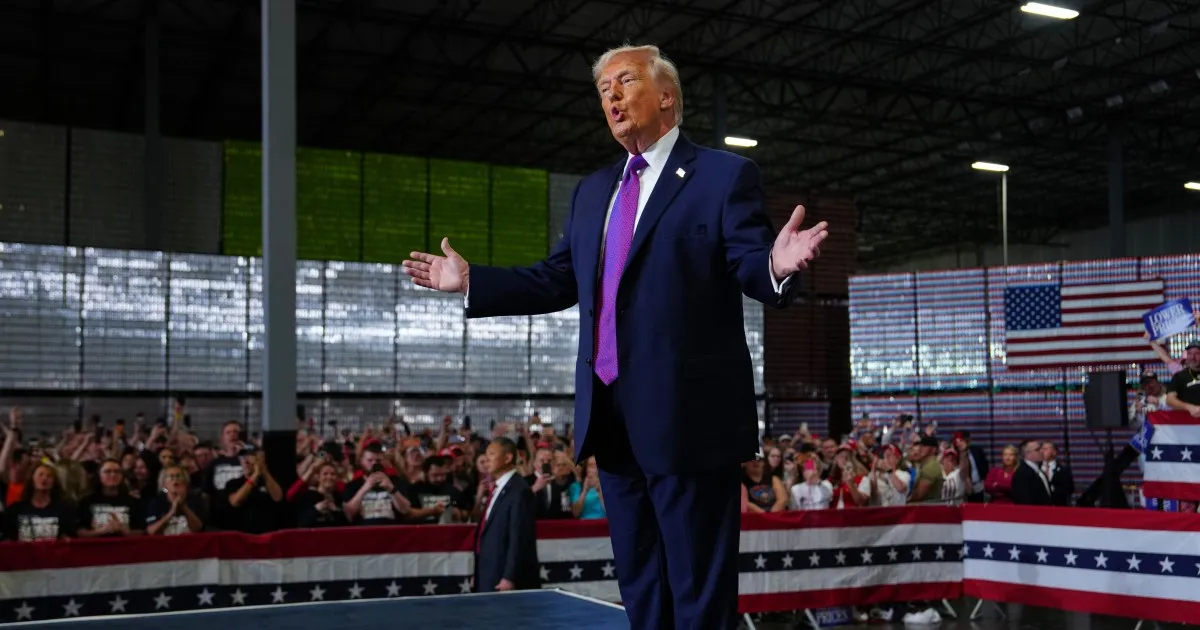
President Trump will deliver his annual State of the Union address Tuesday night at a moment of unusual upheaval, confronting a cascade of crises that have left Washington unsettled and his own political standing diminished early in his second term.

When lawmakers gather to hear the president’s agenda for the year ahead, the scene is expected to reflect an undeterred president under increasing political strain.

The president is facing a partial government shutdown triggered by his administration’s aggressive deportation campaign, rising tensions over the United States’ involvement in foreign conflicts and growing domestic dissent that is fracturing the president’s political alliances and aggravating his rivals.

Adding to the turbulent atmosphere is the economic unease in an election year. The president, who a year ago promised to bring down prices for consumers, insisted Monday that America has “the greatest economy we’ve ever had” even though public polling shows economic pressures are worrying a majority of Americans.

Trump said he plans to talk about the country’s economic successes in his speech, saying “it is going to be a long speech because we have so much to talk about.”

Republicans have recently pushed Trump to focus on the push to lower costs, a message they see as crucial to help them keep control of Congress. What remains to be seen is how much of Trump’s economic message will be colored by a Supreme Court decision last week that struck down his use of tariffs, a key portion of his economic agenda. In recent days, the president has remained defiant on the issue, lashing out at the justices for delivering a legal setback on his tariffs, and looking to impose new global tariffs in a different way.

Trump said Monday he does not need to seek congressional approval to impose new levies, even though the nation’s highest court ruled his tariffs cannot stand without the approval of Congress.

“As president, I do not have to go back to Congress to get approval of Tariffs,” Trump wrote on Truth Social. “It has already been gotten, in many forms, a long time ago!”

Trump’s rebuke underscores the president’s increasingly combative posture toward both the judiciary and Congress, at a time when he is heavily relying on his executive authority to advance sweeping policies on immigration, trade and national security.

His willingness to wield executive authority has been seen in the last year as the president led U.S. forces to capture former Venezuelan President Nicolás Maduro, threatened to seize Greenland, considered an attack on Iran and eyed an armed conflict with drug cartels in Mexico.

At home, Trump has said he thinks the federal government should assert control over state elections as he continues to push false claims of a stolen 2020 election.

Whether that will happen remains to be seen as Republican leaders, and other conservative lawmakers, voice opposition to some of the president’s legislative pitches.

In recent months, Congress has tried to reassert its authority over the executive branch — in some cases led by small Republican defections by lawmakers who have grown concerned about the president’s involvement in foreign wars and his economic policies.

One of the most notable rebukes to Trump’s authority occurred late last year, when a bipartisan group of lawmakers secured legislation that forced the Trump administration to release investigative files related to convicted sex offender Jeffrey Epstein.

While Trump maintains the release of those files cleared him of wrongdoing, the findings have so far ensnared key figures in Trump’s political orbit and reinforced a sense of scandal that continues to loom over his administration. Anger over the administration’s handling of the Epstein case has led to bipartisan backlash, even prompting some conservatives to call for U.S. Atty. Gen. Pam Bondi to resign.

Another sign of the polarized moment Trump will face Tuesday night will be led by Democrats.

About a dozen Democrats in the Senate and House of Representatives plan to boycott the president’s speech and participate in what they have dubbed the “People’s State of the Union.”

“I will not be attending the State of the Union,” U.S. Sen. Adam Schiff (D-Calif.) said in a social media video over the weekend. “We cannot treat this as normal. This is not business as usual. I will not give him the audience he craves for the lies that he tells.”

In recent years, lawmakers who wished to disavow the president’s address would typically stand and shout in protest, disrupt the remarks or coordinate outfits to signal their opposition.

In 2020, for example, former House Speaker Nancy Pelosi (D-San Francisco) stood behind Trump at the podium as he delivered his remarks and then shredded a copy of his script. She later called it a “manifesto of mistruths.”

This year, even the president’s allies appear to be on notice.

While it is a long-standing custom for the Supreme Court justices to attend the president’s annual address, Trump told reporters on Friday that the six justices who voted against his tariffs policy were “barely” invited to the event.

“Three of them are invited,” he said.

Trump’s State of the Union remarks will be dissected to see how he intends to advance his agenda and to deal with a divided Congress that remains at a standstill over how to fund the Department of Homeland Security.

The partial government shutdown was triggered by partisan tensions over Trump’s aggressive immigration crackdown in Minneapolis, where two U.S. citizens were shot and killed by federal agents.

At a White House event Monday, Trump lamented that public polling shows waning support for federal immigration agents.

“It just amazes me that there is not more support out there,” Trump said. “We actually have a silent support, I think it is silent.”

Source link

Supreme Court ruling offers little relief for Republicans divided on Trump’s tariffs

For a few hours on Friday, congressional Republicans seemed to get some relief from one of the largest points of friction they have had with the Trump administration. It didn’t last.

The Supreme Court struck down a significant portion of President Trump’s global tariff regime, ruling that the power to impose taxes lies with Congress. Many Republicans greeted the Friday morning decision with measured statements, some even praising it, and GOP leaders said they would work with Trump on tariffs going forward.

But by the afternoon, the president made clear he had no intention of working with Congress and would continue to go it alone by imposing a new global import tax. He set the new tax at 10% in an executive order, announcing Saturday he planned to hike it to 15%.

Trump is enacting the new tariff under a law that restricts the import taxes to 150 days and has never been invoked this way before. Though that decision is likely to have major implications for the global economy, it might also ensure that Republicans will have to keep answering for Trump’s tariffs for months to come, especially as the midterm elections near. Opinion polls have shown most Americans oppose Trump’s tariff policy.

“I have the right to do tariffs, and I’ve always had the right to do tariffs,” Trump said at a news conference Friday, contending that he doesn’t need Congress’ approval.

Tariffs have been one of the only areas where the Republican-controlled Congress has broken with Trump. Both the House and Senate at various points had passed resolutions intended to rein in the tariffs imposed on key trade partners such as Canada. It’s also one of the few issues about which Republican lawmakers, who came of age in a party that largely championed free trade, have voiced criticism of Trump’s economic policies.

“The empty merits of sweeping trade wars with America’s friends were evident long before today’s decision,” Sen. Mitch McConnell (R-Ky.), the former longtime Senate Republican leader, said in a statement Friday, noting that tariffs raise the prices of homes and disrupt other industries important to his home state.

Democrats’ approach

Democrats, looking to win back control of Congress, intend to make McConnell’s point their own. At a news conference Friday, Senate Democratic leader Chuck Schumer said Trump’s new tariffs “will still raise people’s costs and they will hurt the American people as much as his old tariffs did.”

Schumer challenged Republicans to stop Trump from imposing the new global tariff. Democrats on Friday also called for refunds to be sent to U.S. consumers for the tariffs struck down by the Supreme Court.

“The American people paid for these tariffs and the American people should get their money back,” Sen. Elizabeth Warren (D-Mass.) said on social media.

The remarks underscored one of the Democrats’ central messages for the midterm campaign: that Trump has failed to make the cost of living more affordable and has inflamed prices with tariffs.

Small and midsize U.S. businesses have had to absorb the import taxes by passing them along to customers in the form of higher prices, employing fewer workers or accepting lower profits, according to an analysis by the JPMorganChase Institute.

Will Congress act?

The Supreme Court decision Friday made it clear that a majority of justices believe that Congress alone is granted authority under the Constitution to levy tariffs. Yet Trump quickly signed an executive order citing the Trade Act of 1974, which grants the president the power to impose temporary import taxes when there are “large and serious United States balance-of-payments deficits” or other international payment problems.

The law limits the tax to 150 days without congressional approval to extend it. The authority has never been used and therefore never tested in court.

Republicans at times have warned Trump about the potential economic fallout of his tariff plans. Yet before his “Liberation Day” of global tariffs last April, GOP congressional leaders declined to directly defy the president.

Some GOP lawmakers cheered on the new tariff policy, highlighting a generational divide among Republicans, with a mostly younger group fiercely backing Trump’s strategy. Rather than heed traditional free trade doctrine, they argue for “America First” protectionism, which they argue will revive U.S. manufacturing.

Republican Sen. Bernie Moreno, an Ohio freshman, slammed the Supreme Court’s ruling on Friday and called for GOP lawmakers to “codify the tariffs that had made our country the hottest country on Earth!”

A few Republican opponents of the tariffs, meanwhile, openly cheered the Supreme Court’s decision. Rep. Don Bacon (R-Neb.), a critic of the administration who is not seeking reelection, said on social media that “Congress must stand on its own two feet, take tough votes and defend its authorities.”

Bacon predicted there would be more Republican resistance coming. He and a few other GOP members were instrumental this month in forcing a House vote on Trump’s tariffs on Canada. As that measure passed, Trump vowed political retribution for any Republican who voted to oppose his tariff plans.

Groves writes for the Associated Press. AP writers Matt Brown, Joey Cappelletti and Lisa Mascaro contributed to this report.

Source link

Coronation Street fans divided as Shona Platt is reunited with long-lost dad

Coronation Street fans were left divided when Shona Platt was reunited with her long-lost dad on Monday night’s episode of the ITV soap and “struggled” to watch the telling scenes

Coronation Street fans were left divided when Shona Platt was reunited with her long-lost dad on Monday night’s episode of the ITV soap. Following the programme’s crossover with Emmerdale earlier this year, Shona crossed paths with her long-lost sister Jodie, whom she had never mentioned before, and has since been trying to get back in touch with their father.

Jodie, who made her first appearance tied up in the back of a van, has clearly been hiding something whilst worming back into her sister’s life and moving in with her and husband David Platt at number eight, but the Roy’s Rolls waitress has just seemed pleased to have her younger sibling back in her life.

On the latest episode of the world’s longest-running TV soap, fans and Shona finally got an answer to where her dad had been all these years. Jodie, of course, already knew where her dad was and had tried to stop Shona from finding out. But a suspicious Shona followed her sister to what turned out to be a psychiatric hospital.

READ MORE: Beverley Callard gives health update following breast cancer diagnosisREAD MORE: Coronation Street’s Charlie Lawson says bosses ‘ruined’ Jim McDonald with ‘weak’ plot

Shona demanded answers from Jodie, and she claimed: “It started when you left. And then he had a complete breakdown when mum walked out on him. This is all part of my old life. I didn’t want to drag you into it. You made a clean break. He has these spells where he gets angry, that’s not him, and I know that now, but, as I say, I wasn’t coping. I hated seeing him being taken awa,y but it was the best thing.”

Turning to Shona from his bed, Doug, told her: “No. You can’t be here! No. You can’t be here. It’s not right!” He then added: “Don’t believe her. She’s a liar. She lies. Keep away from her!”

Later on, Jodie was back at the hospital, where she told her father in no uncertain terms to stay on her good side. She said: “Don’t you dare, Dad. Don’t you dare mess this up for me. Cos you know what happens when we fall out. It doesn’t work out very well for you, does it? This could be my happy ending!”

Despite the revelations coming at long last, fans were not entirely sold on the scenes, with one pointing out that Shona wouldn’t be able to focus on this as she already has a baby in intensive care.

One wrote: “Why wasn’t it enough for #corrie to have all the health upsets for the baby? No mother with a child in NICU would have time for any of this. Shona would still be knee deep in trauma!”

Another said: “Jodie is another character I can’t warm to. It might changed but at the minute I am struggling to enjoy her scenes,” and a third wrote: “Feel sorry for Shona’s dad he’s clearly been abused and manipulated by that little cretin!”

Since Jodie’s debut on the programme, fans have started to wonder if the plot will echo that of fans Single White Female, the 1992 thriller that starred Jennifer Jason Leigh and Bridget Fonda and followed a woman whose roommate decides to steal her identity. One said: “I am getting some single white female vibes, I won’t lie,” and another said: “Shona and Jodie. Remember the movie ‘Single White Female’? Jodie has copied Shona’s hair.”

Another said: “I’m convinced Jodie is gonna try and steal Shona’s life, first her clothes, then her kids, then her fella!” There is definitely some mystery surrounding Jodie, as she was previously seen suffering from a panic attack after being harassed by an intrusive caller.

Fans were already suspicious of the situation when Jodie first arrived, with one writing: “Shona’s sister just came out of nowhere, why now? Must be more to the story!”

Coronation Street airs Monday to Friday at 8:30pm on ITV1 and is available to stream from 7am on ITVX.

Like this story? For more of the latest showbiz news and gossip, follow Mirror Celebs on TikTok, Snapchat, Instagram, Twitter, Facebook, YouTube and Threads.


Source link

Iraq’s Shia bloc divided over tactics after US rejects al-Maliki for PM | Politics News

Najaf, Iraq – Leaders of Iraq’s Coordination Framework – the Shia political coalition that came out on top in November’s parliamentary elections – are adamant that Nouri al-Maliki will be their candidate for the Iraqi premiership, even after threats from United States President Donald Trump.

Trump warned in late January that if al-Maliki, who previously served as Iraq’s prime minister between 2006 and 2014, returned to the role, then the US would cut off aid to Iraq.

Recommended Stories

list of 3 itemsend of list

“If we are not there to help, Iraq has ZERO chance of success, prosperity or freedom,” the US president wrote in a post on his Truth Social website.

Trump, and the US administration, view al-Maliki as part of Iran’s direct network of influence in Iraq, and fear that his return would undermine American efforts to weaken Iran’s power in its western neighbour, including limiting the reach of Iran-backed armed groups.

But, even with pressure ramping up, it appears that a majority of the Coordination Framework’s most influential actors are not willing to give up on al-Maliki, and are determined to find a way to push his candidacy forward.

Coordination Framework divided

The Coordination Framework (CF) is a coalition of Shia political parties established in 2021. It represents the biggest Shia bloc in the Iraqi parliament.

The loose nature of the coalition that makes up the CF means that opinions on al-Maliki’s candidacy are varied, with some opposing it, others willing to bend to Trump’s will and switch their backing, and still others who are adamant that they will push forward.

And it seems as though the majority are in the latter camp.

The CF issued a statement on Saturday reiterating its support for al-Maliki. “Choosing the prime minister is an exclusively Iraqi constitutional matter … free from foreign interference,” the statement added.

The statement reflects the position of various pro-Maliki forces in the CF, including former deputy parliament speaker Mohsen al-Mandalawi; the Badr Organization, led by Hadi al-Amir; and the Islamic Supreme Council, led by cleric Humam Hamoudi.

Current Prime Minister Mohammed Shia al-Sudani, whose party received the most votes in the elections but who did not receive the CF nomination despite his membership within it, is also officially supportive of al-Maliki’s nomination, even if he has not abandoned the possibility of continuing as prime minister himself.

Several of these factions did well in last year’s parliamentary elections, including al-Maliki’s own State of Law Coalition, as well as Badr and al-Sudani’s Reconstruction and Development Coalition.

But, with support from Kurdish and Sunni parties, the Shia al-Maliki sceptics have enough seats, and enough of a voice, to block the nomination if they desire to do so.

These include important Shia figures such as Qais al-Khazali, the leader of the Asaib Ahl al-Haq group; Ammar al-Hakim, the leader of the National State Forces alliance; and former Prime Minister Haider al-Abadi.

Al-Hakim, whose parliamentary bloc has 18 seats, warned that there would be “incoming economic repercussions” if al-Maliki was chosen, and added that “public interest must be prioritised over private interests”.

Meanwhile, the Victory Alliance, led by al-Abadi, issued a statement calling for “[the prioritisation of] the people’s vital interests given the exceptional circumstances Iraq and the region are experiencing”. Al-Abadi’s group has no seats in parliament, but retains an important voice within the CF.

Both statements contain a tacit acknowledgment of Iraq’s inability to withstand US pressure and the need for an alternative candidate suited to the current reality.

Other roadblocks

The CF, therefore, still has an uphill battle to confirm al-Maliki as prime minister. Outside of the Shia political groups, there is also opposition to al-Maliki, a divisive figure remembered negatively by many Iraqis, particularly Sunnis.

And there are also divisions within the non-Shia groups that are also slowing down the nomination process.

Under the Iraqi Constitution, parliament must first elect a president for Iraq, who then mandates the nominee of the largest parliamentary bloc to form the government. According to Iraq’s post-2003 “muhasasa” system of dividing political offices by sect and ethnicity, the prime minister must be a Shia, the president a Kurd, and the parliamentary speaker a Sunni.

To date, the main Kurdish factions – the Kurdistan Democratic Party (KDP) led by Masoud Barzani and the Patriotic Union of Kurdistan (PUK) led by Bafel Talabani – have failed to agree on a consensus candidate for the presidency.

The CF is attempting to broker an agreement between the Kurds. Recent efforts included a delegation led by al-Sudani meeting with both parties, and a personal visit by al-Maliki to Barzani. But these initiatives have not yet succeeded, and without a political agreement on the presidency, the process of designating a prime minister cannot proceed.

And even if the Kurds reach an agreement and don’t stand in the way of al-Maliki, the CF must persuade a long list of the former prime minister’s opponents.

Among them is Mohammed al-Halbousi, former speaker of parliament and leader of the Takadum Party, who issued a statement prior to the US veto implicitly rejecting al-Maliki’s candidacy.

Collectively, the anti-al-Maliki groups could gather roughly a third of the seats in parliament, enough to prevent a presidential election session due to a lack of quorum.

To avoid that scenario, the CF would have to either reset internal negotiations regarding the next prime minister, or nominate al-Sudani for a second term.

Al-Sudani’s party issued a statement on January 28 calling for “positive relationships with the United States” – a move interpreted as an indirect pitch for his renewal, leveraging his proven track record of managing relations with Washington during his tenure.

US leverage

The US may no longer be the occupying power in Iraq, but it still has enormous economic leverage over the country.

The revenue from Iraq’s main export – oil – is routed through the US Federal Reserve Bank in New York.

Trump may decide not to renew a presidential executive order, issued originally by President George W Bush in the wake of the Iraq War, that grants legal protection for the oil revenue funds and prevents them from being frozen by Iraq’s creditors. The order had been expected to be renewed as a formality upon its expiration in May.

If the US president decides against renewal, creditors will seek to claim their funds, and New York courts may issue rulings to freeze the Iraqi assets. This would disrupt the transfer of funds necessary to pay public salaries and sustain the economy for months or even years. In practical terms, the Iraqi economy would grind to a halt.

That therefore explains why the pro-al-Maliki bloc in the CF is attempting to persuade the US to change its position, rather than simply ignore Trump.

A high-ranking source in the CF’s State of Law coalition, who wished to remain anonymous in order to speak freely on the topic, told Al Jazeera there are “ongoing attempts to convince the US administration to lift the veto on al-Maliki”.

Aqeel al-Fatlawi, the State of Law spokesperson, also said he was hopeful that the US “will change its stance in the coming period”.

While blaming regional states, including Turkiye and Syria, for the US position towards him, al-Maliki himself has sought to soften his positions.

Syria has been one of the main points of difference between al-Maliki and the US, which has backed Syria’s President Ahmed al-Sharaa, even as the former Iraqi prime minister has denounced him for his past membership of al-Qaeda.

In a televised interview on Tuesday, al-Maliki used al-Sharaa’s full name, rather than the Syrian leader’s nom de guerre of “al-Jolani”, an attempt to emphasise that he was willing to move on from the past. Al-Maliki also attempted to soften his stance towards the Syrian government, directing his criticism towards the former regime of ousted President Bashar al-Assad and its role in supporting “terrorism” in Iraq.

Whether these attempts will go far enough to placate the US remains to be seen.

Reports indicate that US Special Envoy to Iraq Mark Savaya may have been removed from his position, although there is no official confirmation. His replacement would likely be Tom Barrack, currently the US ambassador to Turkiye and special envoy to Syria.

The CF favours Savaya, who has proven to be more supportive of using a more gradual approach in reducing the power of Iraq’s Shia militias, versus Barrack, who is viewed by the CF more negatively for his role in weakening Hezbollah in Lebanon and his support for Syria’s al-Sharaa.

An official announcement of a change could indicate where Trump’s thoughts are in the critical next few weeks – and whether the president will choose to not renew the US guarantee to protect Iraq’s oil revenue in May.

Source link