Divestment

Why are Ireland vs Israel football matches so controversial? | Football News

When European football’s governing body announced the schedule for its upcoming Nations League competition in February, one fixture became an instant point of contention.

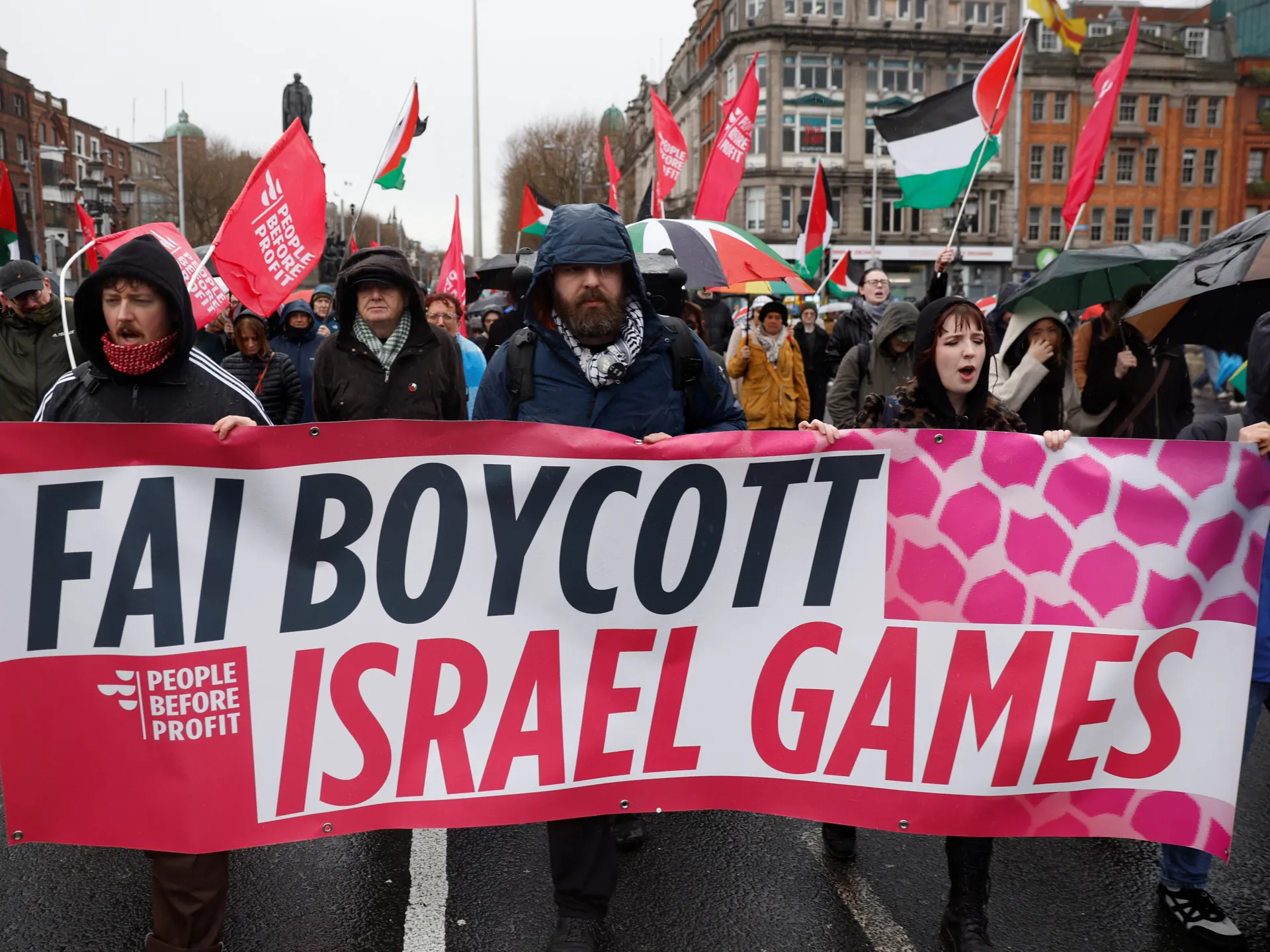
The Republic of Ireland and Israel were allocated the same group in League B of the UEFA Nations League 2026-27, provoking strong opposition from Irish fans, footballers and celebrities due to Israel’s genocidal war in Gaza. It also led to calls for a boycott of the fixture regardless of the consequences.

Recommended Stories

list of 3 itemsend of list

Seven months on, the Ireland vs Israel game is expected to be played as scheduled but amid vociferous criticism, louder calls for Irish football officials not to send a team to the game and bitter Israeli responses to the backlash.

What’s happening between Ireland and Israel?

They will play two matches in the space of eight days amid tense political relations  and in the face of increasing opposition from the Irish public.

The fixtures will be played on a home-and-away basis, with Ireland “hosting” its home leg in Debrecen, Hungary, on Sunday, September 27. Israel’s “home” match will be played in Serbia on October 4.

Why does Ireland have to play against Israel?

Ireland and Israel are members of UEFA, European football’s governing body. As UEFA members, and in order to progress to the top tier of European football competitions and improve their rankings in international football, both nations participate in UEFA-run tournaments.

The UEFA Nations League pits closely ranked nations against each other in groups, where all teams face each other twice in round-robin-style matches.

Ireland and Israel were drawn together in Group B3 along with Austria and Kosovo.

Who is leading the calls to boycott the Ireland vs Israel match?

Ever since the fixture was first confirmed on February 12, the Football Association of Ireland has been under pressure to boycott the matches due to Israel’s genocide in Gaza and Ireland’s status as a Palestine ally.

In May, leading Irish footballers joined celebrities in a campaign by Irish Sport for Palestine, urging Ireland to boycott the match against Israel. A United Nations inquiry confirmed in June 2025 that Israel was committing a genocide in Gaza.

The campaign group says Israel has breached UEFA and FIFA statutes by allowing teams to play on occupied Palestinian land and should be stripped of its membership at both football bodies.

Last November, 93 percent of FAI members voted for its leadership to pressure UEFA to suspend Israel under those statutes, a mandate campaigners say the Irish governing body should “respect and represent”.

The letter, entitled “Stop the Game”, was signed by League of Ireland players, former men’s coach Brian Kerr and twice women’s player of the year Louise Quinn.

The letter includes a statement from Shamrock Rovers captain and Professional Footballers’ Association of Ireland (PFA) chair, Roberto Lopes.

International rights organisations have also called on UEFA and FIFA to exclude Israel from its competitions.

“It’s unconscionable that Israel will participate despite clear evidence that Israel’s football association continues to support illegal settlements,” Amnesty International said in a statement.

“When rules are broken, when occupation, apartheid and genocide are ongoing, we cannot look the other way,” it added.

What have Ireland’s officials said about the match?

Ireland’s Prime Minister Micheal Martin gave a green light to the matches, citing the challenges of mixing sport and politics.

“We have been critics and have opposed very strongly Israeli government policy within Gaza in particular. We condemned the Hamas attack on Israel, which was absolutely horrific,” ‌‌the Taoiseach told The Irish Times.

“I think sport is an area that can be challenging when it crosses into the realm of politics.”

In February, FAI Chief Executive David Courell said the national team had no choice but ‌‌to ‌‌fulfil its obligations or risk harming the long-term sporting interests of Irish football, including potential disqualification from future competitions.

Last week, Ireland manager Heimir Hallgrimsson responded to the boycott calls, saying his team were not “playing with genocide”.

“We’re playing against genocide,” Hallgrimsson said.

What is the public sentiment in Ireland?

The rights groups calling for a boycott of the match have cited several public polls, run by local newspapers, footballers’ bodies and individuals online, which indicate that a vast majority are in favour of opting out of the Nations League fixtures.

A poll by the PFA in February showed that 63 percent of those surveyed did not want Ireland to play the fixtures. A similar poll by the Irish Mirror newspaper indicated that 71 percent of the public would support the FAI if they refused to play the game.

Bohemian FC, an Irish football club with a strong pro-Palestine stance, have thrown their weight behind the calls for a boycott and have urged the FAI to call off their participation.

Bohemian’s Director of Football Pat Fenlon believes it is up to the FAI to “take a stand for what’s happening in Gaza”.

“What an opportunity it would be to be the first country to stand up and say this is totally wrong,” Fenlon told Irish Sport for Palestine.

“The game shouldn’t be played,” he said.

According to officials at the club, the Irish public is aware of the potential consequences but believe that boycotting is “the right thing to do”.

“It is not acceptable to put a price on standing up for what is right and in solidarity with the Palestinian people,” the club’s communications director Luke O’Rodrian told Al Jazeera.

He accused the FAI of showing “sheer cowardice”.

O’Rodrian said the boycott calls have been supported by trade unions representing workers, particularly those employed by the FAI, the PFA and the Irish Football Supporters Partnership, who represent Ireland’s football supporters.

In the country’s political sphere, Mary Lou McDonald, leader of Ireland’s main opposition party Sinn Fein, has also called for the FAI to “do the right thing by its players” by telling them not to take the field.

How did Israel respond?

The Israeli FA responded to Hallgrimsson’s statement on Monday by saying: “We are not playing with ignorance, hypocrisy and stupidity; we’re playing against the coach who embodies them”.

Martin defended Hallgrimsson, describing Israel’s remarks as “unacceptable”, adding that “Israel can’t keep denying what the world knows”.

Why are the matches being played in Hungary and Serbia?

The first leg of the fixture will be held at the Nagyerdei Stadion in Debrecen, Hungary, and the second, which is Ireland’s “home” game, will be played at the TSC Arena in Backa Topola, Serbia.

Israel has not played an international fixture at home since September 2023 as it has been barred by UEFA from hosting teams due to security concerns.

While the October 4 fixture was scheduled to be held in Dublin, the FAI moved it following the protests and boycott calls. That game will be played behind closed doors.

Irish state broadcaster RTE, which ‌‌has ‌‌contractual obligations to show the games, will provide stripped-back coverage.

There will be no studio presentation or punditry and commentary will be taken from the international feed. RTE has not taken advertising or sponsorship around either game.

What would happen if Ireland boycotted the match?

UEFA does not have a fixed fine for refusing to play a Nations League match, and forfeiting teams could face a mix of fines, point penalties and forfeitures.

Officials at Bohemian FC pointed towards a recent report in the Irish Examiner newspaper, which highlighted that the punishment given to Lithuania, Latvia and Estonia when they refused to fulfil recent UEFA fixtures against Belarus was a 3-0 walkover and, in one case, a fine of 5,000 euros ($5,684).

O’Rodrian said there was “real anger” among grassroots towards the FAI.

“The FAI exaggerated the potential consequences to force their delegates to vote in favour of proceeding with fulfilling these fixtures,” he said.

Meanwhile, Bohemians’ Director of Football Fenlon believed such a stance would always come at a cost.

“[They are] talking about losing money, about losing points and punishment, but we’re talking about more than 20,000 children killed [in Gaza],” he said.

“There will be a cost. Stand on the right side. We shouldn’t be playing Israel in anything.”
Source link

Why a Christian group is suing the Dutch government for West Bank trade ban | Occupied West Bank News

Dutch group Christians for Israel is taking the government to court in the Netherlands over its plans to introduce a ban on importing goods from illegal Israeli settlements in the occupied West Bank and Golan Heights.

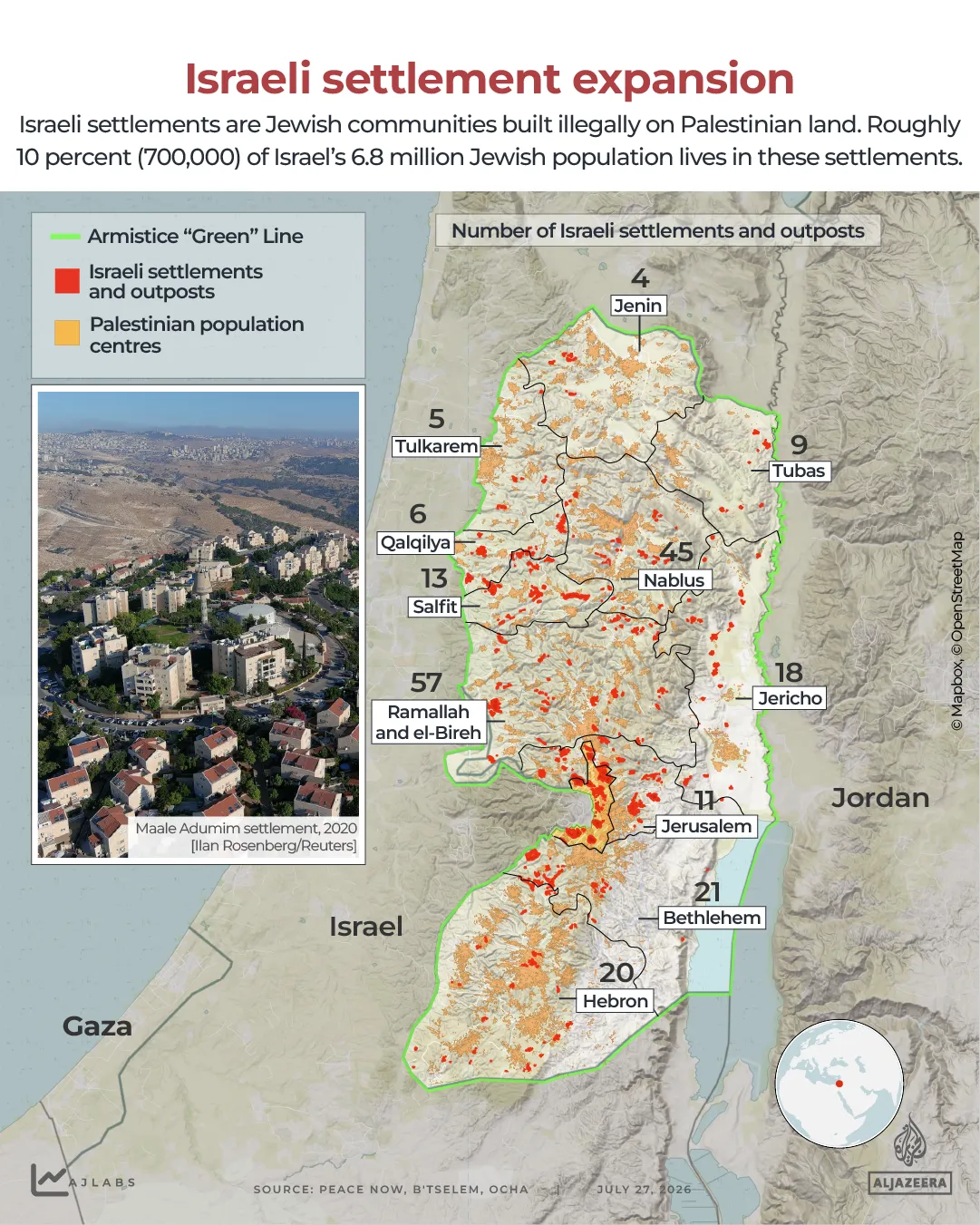
The ban, which was announced in July, is due to take effect on September 22 and will run for three years. It bars importing, buying and selling goods produced in Israeli settlements, as well as intermediary services and any attempt to circumvent the rules.

Recommended Stories

list of 3 itemsend of list

But the Israel Product Centre (IPC), part of Christians for Israel (CvI), a Dutch evangelical organisation which a recent study found has donated about $300,000 to illegal settlements in the occupied West Bank, has responded by filing summary proceedings against the state, with the hearing due today.

Here’s what we know about this case.

What is the case about?

The IPC has issued summary proceedings against the Dutch state, seeking to block the July decree.

The IPC argues the measure is “one-sided” and that the window it now has to clear its existing stock – some 20,000 bottles of wine – is too short.

It is also arguing that a national ban conflicts with the European Union’s principle of free movement of goods.

A verdict is not expected for about two weeks.

How has this case come about?

EU rules have long required goods from illegal settlements in the occupied West Bank to be labelled by their origin – Palestine – rather than as “product of Israel”, but the bloc has not placed an outright ban on trading with Israeli settlements. That remains up to individual countries.

In February 2020, the Dutch advocacy group DocP urged consumers to file complaints with the Dutch food safety authority, NVWA, if they found wine and Dead Sea cosmetics had been mislabelled.

Following complaints, the IPC changed its labelling to “product uit een Israelisch dorp in Judea & Samaria [product from an Israeli village in Judea and Samaria],” which it argued accurately reflected the exact geographical and administrative reality of the origins of the products without deceiving the buyer. Judea and Samaria is the biblical name used by the Israeli government to refer to the West Bank. DocP argued this fell short of the requirement to label products correctly, and continued its campaign.

In 2021, the NVWA agreed and fined the IPC 2,100 euros (about $2,500) for mislabelling goods.

Then, in July 2024, the International Court of Justice (ICJ) issued an advisory opinion that Israel’s presence in the occupied Palestinian territory is unlawful and must end “as rapidly as possible”.

This shifted the legal argument beyond mere consumer labelling, with the court saying countries should take steps to prevent trade or investment relations which help to maintain the unlawful presence of Israeli settlers in the Palestinian territories.

The lower house of the Dutch parliament acted on that in September 2025, proposing an import ban.

The national decree against importing goods from Israeli settlements was made in July this year.

Does Christians for Israel describe the West Bank as ‘Israel’?

CvI describes the West Bank as a “disputed territory” rather than accepting the international legal description of it as “occupied Palestinian territory”.

It says it believes that Israel has strong claims to sovereignty there and that Jews have a right to live there.

The vocabulary matters in a legal sense, as “disputed territory” is not the same as “annexed territory”, therefore, the legal apparatus which would make settlement trade unlawful doesn’t straightforwardly apply.

The group’s stated reasons for funding projects there, it says on its website, are rooted in the Bible; it cites Ezekiel 47:21-23: “Peace for the Jewish people and resident foreigners inheriting alongside the tribes of Israel.”

However, the ICJ’s July 2024 advisory opinion is clear that the Fourth Geneva Convention’s Article 49(6) and successive Security Council resolutions treat the territories as occupied and the settlements as unlawful.

INTERACTIVE - Occupied West Bank - Settlement expansion JULY 27, 2026
(Al Jazeera)

How have other Christian organisations in the West responded to trade with settlements?

Western churches are split on the issue, with CvI sitting at one end of the spectrum.

Mainline Protestants, including the Presbyterian Church in the United States, have divested shareholdings in Caterpillar, HP and Motorola Solutions as early as 2014, and from Israeli bonds in 2024. The United Methodist Church has opposed Israeli settlements since 1996 and sold its Israeli bond holdings last August.

The World Council of Churches called for sanctions against illegal Israeli settlements in 2025, divestment and an arms embargo.

The Vatican calls settlements an obstacle to peace but has avoided divestment so far.

Christian Zionist bodies, however, including Christians United for Israel (CUFI) and the International Christian Embassy Jerusalem, send funding for settlements and fight against boycotts.

How significant is this ban?

It is significant considering that the Netherlands is one of only four EU countries currently imposing a ban on trade with illegal Israeli settlements.

Trade from illegal settlements to the EU is estimated to be worth up to $400m per year.

The Netherlands is also a big market for the illegal settlements; a recent investigation by legal advocacy group Global Echo, which analysed thousands of shipments from Israeli settlements between 2017 and 2026, shows that within the EU, the Dutch market is the largest importer of goods from illegal settlements, with about 30 percent destined for or passing through the country.

Which European countries have banned products from West Bank settlements?

Spain has banned all imports of products from illegal Israeli settlements in the occupied Palestinian territory, including the West Bank, East Jerusalem and the Golan Heights, since September 2025. The decree also enforces an embargo on defence exports and dual-use technology to Israel, bans ships carrying military fuel for Israel from Spanish ports, and restricts advertising for services or goods linked to Israeli settlements.

Ireland’s parliament approved the text of its Israeli Settlements (Prohibition of Importation of Goods) Bill in May and the bill was signed into law in July. It covers all goods produced in Israeli settlements, but excludes services.

Belgium’s federal government approved a draft royal decree in July introducing a specific regime for goods from Israeli settlements in the West Bank and East Jerusalem. The precise details of the new law will be determined by the government in due course.

Slovenia imposed restrictions on imports from Israeli settlements under its previous government, but the new conservative government reversed them in June 2026.

The EU as a bloc remains deadlocked over whether a ban counts as foreign policy requiring unanimity or trade policy needing only a qualified majority, with ministers not meeting again in a decision-making format until October.

Israeli Foreign Minister Gideon Saar last year described the push by some European governments to implement the ICJ advisory opinion as “shameful”.

Which European countries still allow trade with West Bank settlements?

Nearly all of them.

Outside the three European Union states which still have bans in place, settlement goods can be sold legally everywhere, including in most of the EU.

At a July 2026 meeting of EU foreign ministers in Brussels, which addressed trade from Israeli settlements in Palestinian territories, Germany, Austria, Czechia and Hungary were opposed to an EU-wide ban.

Beyond the EU, the United Kingdom does not forbid trade with illegal Israeli settlements, although new Prime Minister Andy Burnham is reportedly considering a ban. In a recent parliamentary briefing, Amnesty International called on the UK government to implement a ban.

It said: “The argument for a UK ban on trade with settlements is clear. The UK government itself accepts it should take stronger action in response to settlement expansion and annexation. The International Court of Justice has directed states not to trade with Israel in relation to the Occupied Palestinian Territory; and there is precedent in UK law and policy to not trade with illegally occupied lands, ie Crimea and other illegally occupied parts of Ukraine.”

Source link