disputes

Romanian jet fighter shoots down suspected Russian drone | Border Disputes News

The incident adds to concern that Moscow’s war on Ukraine risks spilling over to entangle neighbouring NATO states.

A Romanian fighter jet has shot down a drone, suspected to be Russian, that breached the country’s airspace.

The incident on Friday marked the first time the Eastern European country has intercepted an intruding aircraft since Russia’s full-scale invasion of Ukraine began, President Nicusor Dan noted.

Recommended Stories

list of 3 itemsend of list

However, concern that Moscow’s war on Ukraine risks entangling neighbouring NATO states is on the rise. Romania is one of several alliance members to confront repeated stray drones recently, as Russia and Ukraine launch hundreds of drones daily.

Dan reported that a Romanian F-16 jet shot down the drone after it entered the country’s airspace, adding that the fighter had shot over an uninhabited area.

A Romanian military source told the Reuters news agency that Russia was the suspected point of origin, given the pattern of previous incursions in the region.

A marine drone self-detonated in Romania’s Black Sea port of Constanta near an oil terminal in June
A marine drone self-detonated in Romania’s Black Sea port of Constanta near an oil terminal in June [File: Reuters]

Romania’s Ministry of National Defence said a radar first detected the drone about 20km (12 miles) east of the Black Sea port of Sulina, before it crossed into national airspace on a path through Braila, Fetesti and Buzau county.

Two Italian Eurofighter Typhoon jets, deployed to Romania under NATO’s air policing mission, were joined by two Romanian F-16s. One F-16 engaged the target with an air-to-air missile, downing it over unpopulated ground near the village of Padina. No casualties or injuries were reported.

Romania, an EU and NATO member sharing a border with Ukraine, has recorded dozens of drone incursions since the war began. This incident marked the first successful interception.

In late May, a drone struck an apartment building in the city of Galati, injuring two people – the first time such a strike hit a populated area in a NATO country.

NATO and European Union officials condemned the incident. The European Commission said it showed Russia’s war had “crossed yet another line”.

A month later, a Ukrainian sea drone exploded at the port of Constanta. Kyiv said that it had launched the vessel, which had been knocked off course by Russian jamming.

The Baltic states have also reported repeated airspace violations in recent months, incursions that contributed to the collapse of Latvia’s government in May.

NATO chief Mark Rutte has said Moscow’s “reckless behaviour is a danger to us all”. United States ambassador to NATO, Matthew Whitaker, has pledged the alliance will “defend every inch” of its territory.

Source link

Gibraltar border controls lifted: Is it part of Schengen, the UK – or both? | Border Disputes News

Thousands of people who travel every day between the southern tip of Spain and the British territory of Gibraltar will no longer have to cross a physical border from Wednesday.

This came after the European Union and United Kingdom on Tuesday signed a treaty that delivers “economic and trade certainty for the people and businesses of Gibraltar, safeguards British sovereignty and protects the autonomous operation of UK military facilities”.

Recommended Stories

list of 4 itemsend of list

The treaty was signed in Brussels by the European Trade Commissioner Maros Sefcovic, British Minister of State for Europe Stephen Doughty, Spanish Foreign Minister Jose Manuel Albares and Gibraltar Chief Minister Fabian Picardo.

“Gibraltar was left out of the UK-EU Trade and Cooperation Agreement following Brexit, creating the prospect of a devastating ‘hard border’ for the 15,000 people – more than half of Gibraltar’s workforce – who cross the land border between Spain and Gibraltar every day,” the treaty said.

Here’s what we know about the treaty:

What does the treaty include?

Britain secured Gibraltar, a strategically important enclave at the southern tip of Spain, in the 1713 Treaty of Utrecht, which ended the War of Spanish Succession.

The contested British overseas territory of 38,000 people is perched at a strategic location, only 8 nautical miles (15km) from Morocco where the Atlantic Ocean meets the Mediterranean Sea.

The new agreement allows residents of Gibraltar to cross into Spain using residence cards without needing to have their passports stamped. In return, Spanish citizens will be allowed to enter Gibraltar using a government ID card.

The treaty in effect brings Gibraltar into the EU’s Schengen free-travel area, which allows people from 29 countries to move among them freely without needing visas.

At Gibraltar’s airport and port, entry and exit checks will be conducted by both British and Spanish border officials. The arrangement is similar to what’s in place at Eurostar train stations in London and Paris, where both British and French officials check passports.

Travellers to Gibraltar from countries outside the Schengen area, including the UK, will have to contend with the EU Entry/Exit System, which was rolled out in Europe in April and replaced passport stamps with biometric data collected through photographs and digital fingerprints.

Under the older system, every person had to face two border checks, one by Gibraltarian border agents and the other by Spanish officials when entering or exiting the Schengen area. The checks caused long queues, heavily impacting the workers who made the crossing daily.

The British government said the agreement brings “fluidity for people and goods crossing the Gibraltar-Spain border to support economic growth and jobs in the region”.

What was the motivation behind the treaty, and how does Brexit feature in it?

In a 2016 referendum in which UK voters approved leaving the EU, 96 percent of voters on “the Rock”, as Gibraltar is popularly known in English, supported remaining in the bloc.

When Britain eventually left the EU in 2020, the relationship between Gibraltar and the bloc was left unresolved. Previous talks on a deal to ensure people and goods could keep flowing across the border had made halting progress.

While the Trade and Cooperation Agreement, which came into force in 2021, broadly covered relations between the bloc and Britain, it was decided that Gibraltar would be addressed in separate negotiations because of its unique situation because it’s not in the EU customs union or the Schengen area.

In 2025, the EU and UK announced an agreement on those issues after more than three and a half years of negotiations.

Does the treaty place Gibraltar in a special position, and do any other British overseas territories have the same privileges?

Yes, Gibraltar is in a unique position because it has now gained EU privileges without being an actual EU member.

Still, it is under British sovereignty, and the treaty solely seeks to resolve post-Brexit cooperation with the EU and border management due to its open land border with the EU.

None of Britain’s other overseas territories, which include 14 territories scattered across the Caribbean and the Antarctic, has a deal similar to Gibraltar’s due to the shared land border.

Some of the territories have international arrangements, including Bermuda, which has its own immigration and tax systems, and the Falkland Islands, which govern themselves.

Source link

Two roadside bombs kill at least seven in northwestern Pakistan | Border Disputes News

No group has yet claimed responsibility for the attacks.

Two roadside bomb blasts in northwestern Pakistan have killed at least seven people.

The first explosion on Saturday hit a vehicle, and the second was detonated as rescuers responded, police said.

Recommended Stories

list of 3 itemsend of list

“A private pick-up truck carrying passengers was targeted with a remote-controlled IED,” said Yasir Afridi, a police officer in Bannu district in Khyber Pakhtunkhwa province bordering Afghanistan, using a common acronym for a homemade bomb.

“The injured were being transported to hospital in a car for emergency treatment when a second IED exploded,” he said, adding that three people were wounded.

Prime Minister Muhammad Shehbaz Sharif condemned the attack and said the government would bring those responsible to justice.

There has been no claim of responsibility for the blast, but the Pakistan Taliban, known by the acronym TTP, and other armed groups operate in the area.

Pakistan has blamed Afghanistan for a surge in attacks near the border, although the Taliban government in Kabul has repeatedly denied Pakistani accusations that Afghan territory is used as a sanctuary for armed groups.

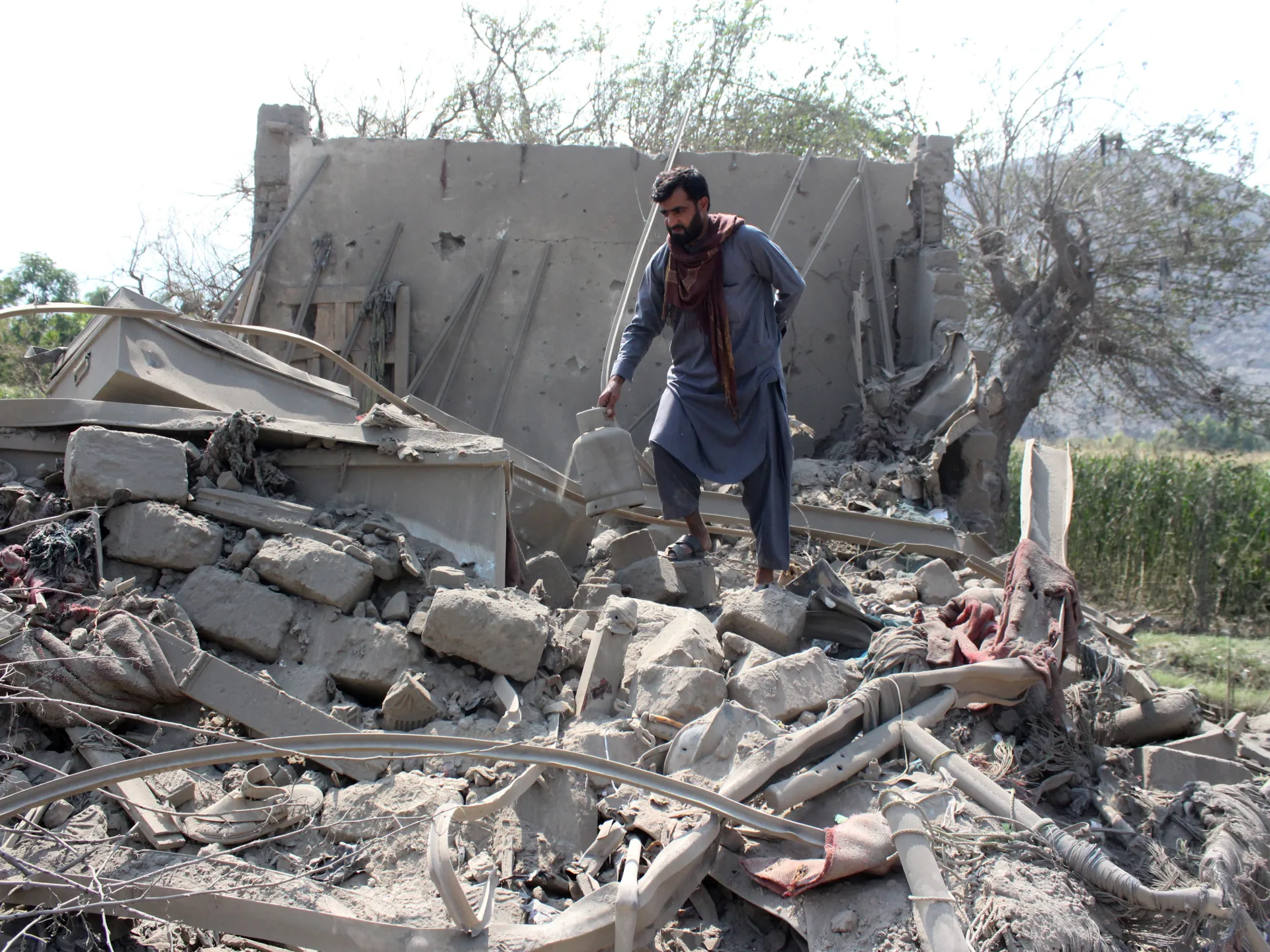
Frosty relations have escalated into clashes in recent months, including Pakistani air strikes on Afghan cities.

Pakistani air strikes near the border this month killed at least 26 Taliban fighters, the Pakistani government said, while the Afghan government said 12 civilians were killed.

The border has remained largely closed since violence escalated in October, freezing bilateral trade and disrupting the movement of people and goods.

Source link