Directors

Claims Swirl Around CIA Director’s Reason For Secret Moscow Visit, Nearly All Of Them Are Terrifying

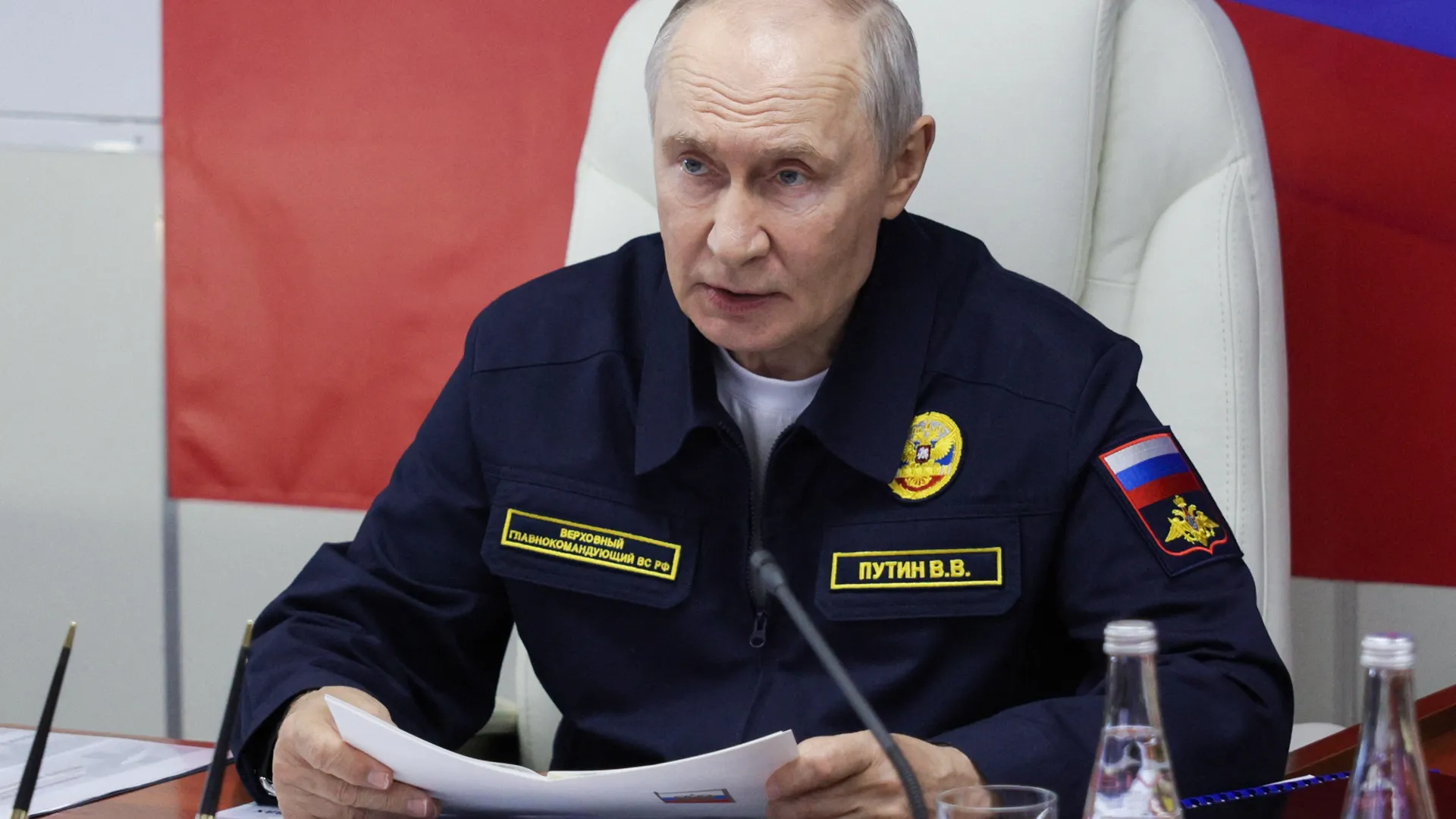
Troubling new reports are emerging about CIA Director John Ratcliffe’s surprise visit to Moscow on Tuesday. All of the reports point to delivering a warning to Putin’s regime, while exactly the nature of that warning differ.

There have been growing concerns in Europe over expanding Russian aggression and specifically the possibility it could attack a NATO country to test the alliance’s resolve. There are also reports that Putin will drastically increase offensive operations in Ukraine due to the massive damage his country is now taking from long-range drone and cruise missile strikes, as well as failed peace talks. Reports even state that he is mulling the use of tactical nuclear weapon in order to stop these attacks and change the tide of the years-long conflict, a possibility which we will discuss more later in this piece. Iran, of course, is also a major issue, but it seems, at least based on reporting, it had taken a backseat to whatever the director was trying to accomplish in Moscow.

Wednesday evening, The Wall Street Journal reported that Ratcliffe was in Moscow to deliver a message to Putin not to attack NATO countries. His visit “followed new U.S. intelligence assessments, reported earlier by The Wall Street Journal, that Russian President Vladimir Putin could try to test the resolve of the North Atlantic Treaty Organization with a limited assault on an allied country in the next few years,” the newspaper noted. We have been reporting on major concerns over exactly this for weeks now.

U.S. officials “are concerned that Putin, squeezed in Ukraine and under pressure at home, could launch an assault ranging from a cyberattack to a small-scale land incursion, likely on a Baltic nation, the Journal added. 

“Kremlin spokesman Dmitry Peskov told reporters in Moscow on Wednesday that Ratcliffe held talks with Russian intelligence officials during his time in the Russian capital, but he didn’t meet with Putin. Putin was briefed on the talks, Peskov said,” according to the publication.

Earlier on Wednesday, ABC News reported that an explosive drone found near an An-124-100 Ruslan (NATO reporting name Condor) cargo jet at Leipzig airport in Germany earlier this month “bore the hallmarks of devices typically employed by Russia’s Military Intelligence Directorate, the GRU.” The network cited a U.S. intelligence source.

“The U.S. official, who was briefed on the investigation into the alleged sabotage plot, said the explosives fitted to the drone as well as the structure of the lethal device were ‘typical’ of those used by Russia’s GRU,” ABC added. “This U.S. assessment was made in conjunction with German security and intelligence agencies, the source added.

Numerous Russian drone incursions and other actions have some European officials convinced that Putin is already waging so-called hybrid war against NATO, and has been doing so for some time.

Meanwhile, President Donald Trump downplayed the Ratcliffe trip, which has sparked a wide range of speculation about its purpose.

The president called it “semi-routine.”

That statement is hard to square considering how rare having a CIA director rush to Moscow is. The last time this happened was just prior to the war in Ukraine breaking out into the destructive reality we see today.

As we noted earlier in this story, Putin is reportedly considering escalating attacks on Ukraine, including the possible use of tactical nuclear weapons, Bloomberg reported, citing “three people close to the Kremlin.”

“For now, Russia is weighing an intensification of powerful conventional ballistic missile attacks on Kyiv, including the center of the capital, and infrastructure targets in other Ukrainian cities.”

At issue, Bloomberg suggested, is that negotiation “frameworks have all effectively collapsed, leaving the two warring sides back at square one.”

This comes as Ukraine is already reeling from constant attacks, especially ballistic missile strikes it can’t defend against because of the lack of Patriot interceptors.

Moreover, the Kremlin “has also abandoned reliance on what it believed was an understanding reached between Putin and Trump at their summit in Alaska last August,” Bloomberg noted.

You can see video from that encounter below.

Such a deal would have required the Trump administration to force Ukraine into giving up the eastern Donetsk region, a demand Kyiv has rejected as it continues to hold out against a Russian onslaught that has gained little ground.

The White House this evening pushed back on the notion that negotiations between Ukraine and Russia have reached an insurmountable impasse. A peace deal has been a major objective for President Donald Trump, who famously promised that he would end the conflict on his first day in office.

“The president wants this war settled so that the senseless killing ends,” a White House official told TWZ. “The president and his team remain committed to continuing to play a constructive role in ending the war between Russia and Ukraine, and he remains optimistic that we’ll ultimately get a peace deal done.” 

The United States “continues to play a constructive role in speaking to both sides in working towards bringing the war to an end,” the official added. “We are the only country in the world that can play that role.”

The level of current U.S. involvement in negotiations is unclear. Trump envoys Steve Witkoff and his son-in-law Jared Kushner were expected to travel to Moscow after an eight-month break and to visit Kyiv for the first time, but no date has emerged for either trip, Bloomberg noted. Last week, Radio Free Europe reporter Alex Raufaglu stated on X that the pair’s trip to Ukraine was delayed, but not canceled, by ongoing Russian attacks on Kyiv.

Putin is not about to cave under economic pressure, Bloomberg suggested, citing its sources. Nor will he end hostilities as Ukraine continues to pound Russian refineries and logistics networks. These attacks are having a devastating effect on the Russian economy and creating increasing frustration among the populace.

As we noted yesterday, Ukraine’s long-range strikes have spurred Putin to allow the government to temporarily seize what it deems commercial critical infrastructure that is not sufficiently protected against such strikes. This follows Russia’s move earlier this year to allow private companies to purchase their own air defense systems to protect their own facilities.

On Wednesday, those attacks continued anew. Ukraine struck another e-commerce hub, causing widespread damage, Russian officials said.

“As a result of the Ukrainian drone strikes, a fire broke out at a Wildberries logistics center,” Tambov Governor Yevgeny Pervyshov stated on Telegram. “The area of the fire is over 100,000 square meters.”

Whether Putin actually does escalate attacks remains to be seen. With increased production of ballistic missiles and new ones from North Korea, he may have new means of sustaining conventional attacks. As for a nuclear one, he has constantly rattled that saber for years. As Bloomberg noted, in the past, there have been reports that China and India have frequently urged him to refrain from that steep climb up the escalation ladder.

We raised the question of Putin using tactical nuclear weapons on Ukraine several months after he launched his full-on invasion, asking the world’s top nuclear proliferation experts of the likelihood it would happen. You can read this feature here, but our expert’s sentiments were made long before Ukraine was picking apart Russia infrastructure on a daily basis, with a standoff weapons armada growing by the day.

So, while it isn’t exactly clear what was discussed in this meeting or its primary objective, none of the reported reasons are encouraging. Quite the opposite, they point to the possibility of a darker new phase in the Russia-NATO standoff.

Contact the author: howard@twz.com
Howard is a Senior Staff Writer for TWZ. He writes frequently about conflict, focusing heavily on the Middle East and Ukraine, and interviews with military and intelligence officials and industry leaders from around the globe. He lives near Tampa, Florida, home of U.S. Central Command, U.S. Special Operations Command.


Tyler’s passion is the study of military technology, strategy, as well as foreign policy, and he has fostered a dominant voice on those topics in the defense and national security space. Tyler was the creator of the hugely popular defense site Foxtrot Alpha before developing TWZ, which he continues to lead as the Editor-In-Chief to this day.


Source link

Meet the ‘I Am Frankelda’ directors mentored by Guillermo del Toro

A VHS tape of 1993’s “The Nightmare Before Christmas” introduced brothers Roy and Arturo Ambriz to the tactile whimsy of stop-motion, an animation technique where physical objects are manipulated and photographed frame by frame to achieve the illusion of life.

Realizing that the characters on screen were figures in real sets shocked the Mexican filmmakers’ young minds and set them on an arduous path to craft their own worlds.

“If there’s something we’ve loved our whole lives it’s toys: collecting them, modifying them, playing with them, creating dioramas for them,” said Roy, 36, from under his dark shades during a recent interview at Netflix Animation Studios in Burbank.

“And for us, the most sublime moments in life are when we’re doing something artistic, whether that’s painting, drawing or sculpting. And stop-motion animation combines all of that.”

The culmination of years of tireless work and financial stress for the Ambriz siblings is the breathtaking period fantasy “I Am Frankelda,” Mexico’s first-ever stop-motion feature, which is now streaming on Netflix.

“Thankfully, no one put it into our heads that it was impossible to do this,” said Arturo, 38. “That’s why we don’t like going around saying that this is extremely difficult, because maybe if young people hear that, they might not want to do stop-motion. Don’t tell them!”

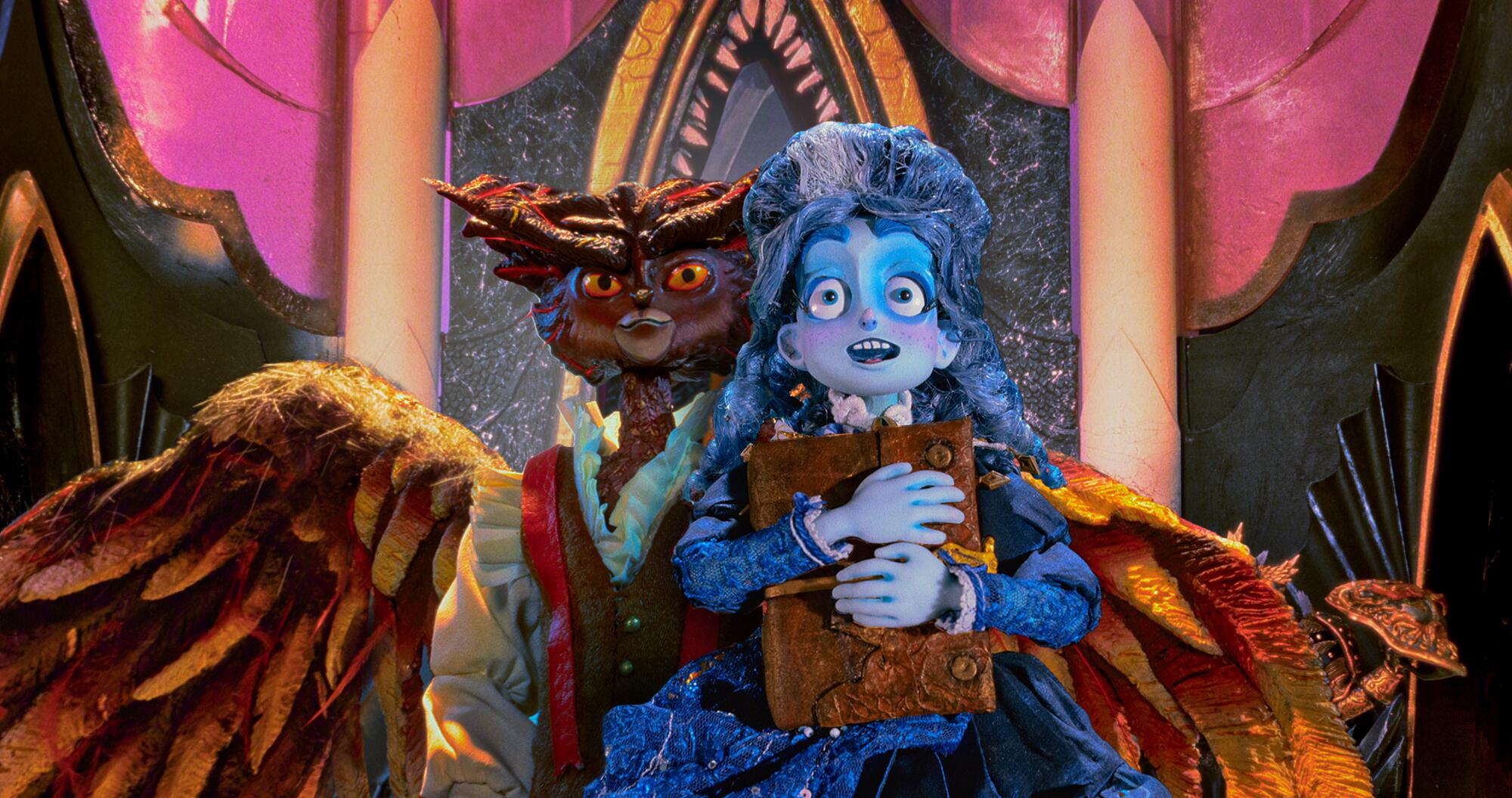
A lavish musical, “I Am Frankelda” follows Francisca Imelda (voiced by Mireya Mendoza), a young aspiring writer living in 19th century Mexico and struggling to publish her stories. Meanwhile, in the Realm of Spooks, an alternative reality that’s home to all of the fictional characters Francisca has written, Herneval (Juan Pablo Monterrubio), a winged prince, must save his parents and his kingdom. The creatures in this world live off of human fear, so they create our nightmares.

Herneval crosses into the human world to bring Francisca with him to the Realm of Spooks, so that she can write new nightmares that actually scare people. Humans have become difficult to terrify. By this point, a frustrated Francisca has decided to change her name to Frankelda (a reference to “Frankenstein” author Mary Shelley, who inspired the character). Frankelda and Herneval sing of the relationship between fiction and reality. One can’t exist without the other.

Two puppets in the stop-motion film “I Am Frankelda”

Frankelda was first introduced as part of the 2021 series “Frankelda’s Book of Spooks,” which HBO Max commissioned. In the show, the heroine shares nightmarish tales alongside Herneval, who appears not as a prince but a sentient book. The film “I Am Frankelda” is a prequel that explains the relationship between these characters.

Last month, “I Am Frankelda” screened at the Los Angeles Latino International Film Festival, where Guillermo del Toro moderated the post-screening Q&A. A longtime mentor of the Ambriz brothers, Del Toro first supported them by donating to a Kickstarter campaign to finance their ambitious 2016 short film inspired by cubist art, “Revoltoso,” about a one-eyed boar living during the Mexican Revolution.

“In that moment, it was incredibly validating to realize that if Guillermo liked what we were doing, then it made sense to keep on doing it,” Roy said.

Two years apart in age, Roy and Arturo both studied filmmaking at the Centro, a university in Mexico City. Yet directing together wasn’t always the plan.

“I said, ‘We have to co-direct,’ because the situation naturally lent itself for me, being the older one, to take on the role of director while Roy would serve as production designer. But at a certain point, I realized that the hierarchy was wrong, and that if we wanted something sustainable for the rest of our lives, it had to be a 50/50 split between us. And I mean, 50/50, Roy!” said Arturo, playfully chastising his younger brother.

“It’s more like 60/40, with me having 60% of the power,” Roy added laughing.

In 2011, not long after graduating, Arturo found himself ridden with anxiety. Over the course of his education, he’d focused on artistic excellence but hadn’t much thought about how to actually make a living out of his and his brother’s shared passion. That’s when he decided they should create their own studio, Cinema Fantasma, so as to have control of the projects they took on. Their productions for hire include the Adult Swim show “Women Wearing Shoulder Pads,” which was produced entirely at their company in Mexico City.

“It’s been very difficult because we are filmmakers by vocation, but we are businesspeople by necessity,” said Arturo. “Developing that side of things has been the hardest part, but both are indispensable.”

To wrap up the “Frankelda” series, HBO Max requested a 30-minute special. Instead of accepting that offer, Roy suggested they use the proposed budget allocated to partially fund a full-length feature film. HBO Max agreed with the caveat that the brothers would have to come up with the rest of the money needed on their own.

To finance “I Am Frankelda,” Roy and Arturo mortgaged two homes. They are losing one of them to pay off their debts, so it helps that their dream of animation is a family affair. Their parents are executive producers on “Frankelda”; Roy’s wife, Ana Coronilla, worked as production designer; and Arturo’s spouse, Irene Melis, as a director of photography.

That “I Am Frankelda” is a musical is due in great part to Roy’s love of musical theater.

“At first, Arturo wasn’t sure, but using my 60% share of the power, I convinced him that it should be a musical,” Roy said. Yet it’s Arturo who wrote the lyrics to musical numbers. Each track starts as a poem that composer Kevin Smithers transformed into songs.

A fantastical stop-motion musical period piece, “I Am Frankelda” is far from an easy sell, and that’s what makes its existence all the more astonishing. The Ambriz brothers’ creative pursuit of the unpopular and the unfeasible has bonded them with Del Toro.

Mexican filmmaker Guillermo del Toro does a Q&A with directors Roy and Arturo Ambriz.

Mexican filmmaker Guillermo del Toro, pictured, interviewed “I Am Frankelda” directors Roy and Arturo Ambriz on May 30 during the film’s screening at the TCL Chinese Theatre as part of the Los Angeles Latino International Film Festival.

(Jill Connelly / For De Los)

“He is our most important mentor and the person we admire most in the world, and we also share many of the same interests,” Arturo explained. “That’s why when we saw ‘Pan’s Labyrinth,’ it was like when the glass slipper fits Cinderella. It was exactly what we loved: monsters, war, the cruelty of the human spirit, fairies and period settings.”

“Did you just call yourself Cinderella?” Roy interjected with the mischievous smirk typical of a younger brother trying to ruffle some feathers.

“Yes!” Arturo said quietly but without hesitation.

Every time they hear Del Toro speak about his interests, the Ambriz brothers discover a new well of references and “cultural protein,” from authors to painters.

“Guillermo is someone who actively champions the work of others, which I believe is the right way for an artist to be,” Arturo said.

When they finished “I Am Frankelda,” the brothers sent it to Del Toro, eager to hear his thoughts. As soon as he watched it, Del Toro called them.

“We spoke with him for hours, and he told us everything he saw, obviously with great tact, sharing both the good and the not-so-good,” Roy recalled. “But most importantly, he kept telling us that we had created something unprecedented. He insisted that we would pull through, even though we had ended up with a lot of debt.”

The version of “I Am Frankelda” that premiered at film festivals in 2025 is not the same one that will be available on Netflix. Based on Del Toro’s thorough feedback, the filmmakers recut the film and even animated new scenes. They playfully refer to this new cut that audiences will see globally as “The Grandfather Cut,” to honor Del Toro’s influence.

That “I Am Frankelda” was picked for distribution by Netflix is also Del Toro’s doing, the brothers said. It was the veteran director who suggested the film to the streaming company.

“I Am Frankelda” debuted in Mexico last October to an incredible reception, in part thanks to the fandom the characters had amassed via the episodic series.

“We receive fan art and fan fiction every day. People send us photos cosplaying the characters or of their ‘Frankelda’-themed quinceañeras. We’ve even bought bootleg merch at Mexican markets and on Temu or AliExpress too,” Roy said.

“We’ve bought ‘Frankelda’ socks from there that are of terrible quality, but all the more beautiful because of their bad quality,” he added.

“Of course, there are haters, too, but a large segment of the audience really identified with Frankelda as someone who perseveres, as someone who refuses to let her detractors hold her back. It’s been really beautiful watching that fandom grow,” Arturo said.

Another conviction where they align with Del Toro is their disinterest in engaging with artificial intelligence.

“AI is the antithesis of stop-motion. We’re not even remotely interested in it, because we do stop-motion to enjoy the artistic processes,” Roy said. “We created the studio for painting, drawing, sculpting and writing. Whatever happens with AI doesn’t really matter to us.”

Their second feature, “The Ballad of the Phoenix,” a medieval fantasy, is already in the works.

Source link

Director’s Guild reaches tentative deal with studios

The Director’s Guild of America has struck a tentative deal with the Alliance of Motion Picture and Television Producers, completing the negotiation cycle for Hollywood’s major unions.

SAG-AFTRA ratified its contract last week, the Writers Guild approved its deal back in April, and the DGA has similarly landed on a new contract, after nearly a month of negotiations. The latest deal with major film and TV studios was announced on Tuesday, but its terms have not yet been disclosed.

The Directors Guild, led by its president Christopher Nolan, reportedly entered negotiations in hopes of improving conditions to create new jobs, bulk up its health fund, and increase protections against generative AI.

“The tentative agreement will be presented to the DGA National Board for approval,” the DGA said in a statement. “Consistent with the Guild’s longstanding practice, terms of the agreement will not be released publicly until the National Board has completed its review.”

Negotiations started on May 11, and the current contract is set to expire on June 30. Once the DGA National Board approves the new contract, it will be sent to its members for a ratification vote. The union represents nearly 20,000 helmers, assistant directors, associate directors, unit production managers and stage managers.

The studios said they were pleased to have reached this latest tentative agreement with DGA.

“We appreciate the hard work and commitment of our guild partners in achieving a fair deal that helps advance a stable and successful entertainment industry,” AMPTP said in a statement.

The DGA’s tentative contract marks the last few steps of the current Hollywood union negotiation cycle. The previous one in 2023 was marked by the industry-stopping strikes from SAG-AFTRA and WGA, and the industry is still feeling the impact from them. But this year’s bargaining season was much quieter and uncontroversial. SAG-AFTRA and WGA will reconvene with the studios for bargaining in 2030, as they all signed four-year contracts.

Source link

‘Backrooms’ review: Get lost in a 20-year-old director’s vision

Hollywood has been waiting for Kane Parsons since the year he was born. The 20-year-old director is the same age as YouTube’s first videos and grew up with no barriers between his creativity and an audience. “Backrooms,” his debut feature, marks the start of a new new wave of filmmakers raised by internet feedback who are ready to reinvigorate the industry.

Young Steven Spielberg screened his 8mm reels for his neighborhood. Parsons uploaded his early shorts online where he could analyze the mass response. When one, an unsettling nine-minute experiment about a warren of dingy carpets, taffy-yellow walls and gridded drop ceilings clicked with 78 million viewers, he made sequels. A24 offered Parsons a deal before he finished high school. He’s graduating into multiplexes having spent his adolescence writing, directing, editing, composing and market-testing what people want to watch. I’d toast to that, but Parsons isn’t old enough for Champagne.

Given that backdrop, “Backrooms” would be one of the year’s most significant releases even if the movie itself was merely fine. But it’s better than fine — it’s a work of honest-to-goodness art. Working with screenwriter Will Soodik, Parsons has gone back into that banal maze to find an uncannily mature story about loss and stagnation, about how our self-serving narratives barricade us from emotional growth.

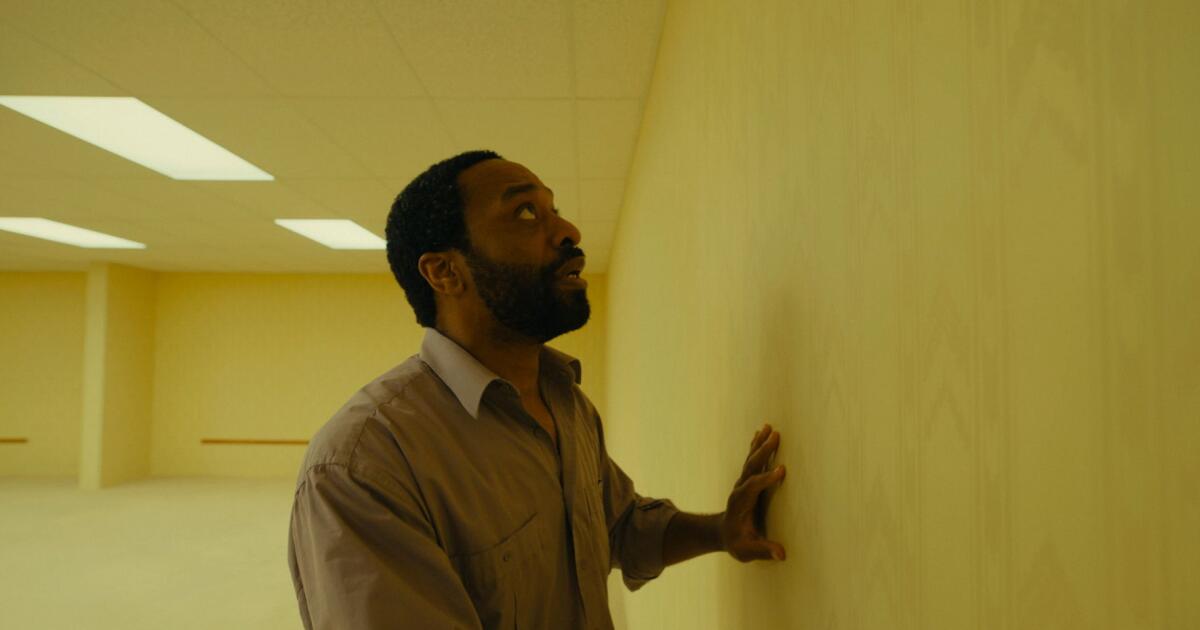
Set in 1990, “Backrooms” has the fritz of an old VHS tape. (Like so many other Gen Z kids, Parsons is nostalgic for a pre-smartphone era he never knew.) A failed architect-turned-furniture salesman named Clark (Chiwetel Ejiofor, superbly expressive) tumbles through a portal in his store’s basement to the backrooms of the title — less Alice in Wonderland, more Alice in Wonderbland.

“It’s like it was made by a bunch of construction workers on acid,” he muses. The hallways lead to more hallways, the overhead fluorescents whine like hornets. Someone — or something — has piled lamps and stools into the center of one room, scattered chairs in another and embedded shoes into the floor as though the ground were made of sand. The disorder looks like the wreckage of an unknown chaos. Aboveground, Clark is trapped in his own resentments, throwing temper tantrums like a toddler. Down here, frustration feels natural.

Should he be afraid? And if so, then what of?

Distant thuds warn that Clark isn’t alone. Soon after, three other characters follow Clark into this liminal space: his loud employees Bobby and Kat (Finn Bennett and Lukita Maxwell) and his exasperated therapist, Dr. Mary Kline (Renate Reinsve), who is haunted by flashbacks of her agoraphobic mother. There’s also a mysterious man in a lab coat (Mark Duplass) who works for a company that factors into the backrooms’ preexisting internet lore, but doesn’t have much purpose in this script. It’s fine just to see Duplass as a gesture toward corporate apathy. More beings will appear too and cinematographer Jeremy Cox’s deliberately low-fi look forces you to do triple and quadruple takes to comprehend what you’re even seeing.

How does a 20-year-old fathom adult-sized discontent? Lord knows, but Parsons does. One theory is that today’s 20-year-olds were just launching into teenhood when the pandemic teleported them from their classrooms to isolated computer screens. Meanwhile, they overheard their parents fret that society might be forever hollowed out. When a young person looks toward the future, what do they see? Probably not an office building bustling with entry-level jobs.

Think about how the act of buying a couch no longer involves interacting with a salesman like Clark, but peering at a pixelated living room that doesn’t actually exist with a couch that changes colors at a tap. Think about how lately the internet at large feels human-less. Then layer that emptiness over the images here.

Sparse yet gripping, “Backrooms” and its minimalist story accommodate the audience’s own free-ranging imagination. The infinite size of these drab catacombs triggers sense-memories of feeling small and confused in an ordinary place that feels all wrong. It’s a time travel trip back to childhood — mass entertainment made intimate — with Parsons tossing us scraps of Clark and Mary’s personal histories like a breadcrumb trail. I remembered what it felt like to get lost in a motel on a road trip with my grandparents. More recently, I tidied the home of a friend who was in the hospital, the pill bottles and crumpled blankets left in situ as evidence of someone else’s pain. “Backrooms” felt like that, too.

There’s an incredible special effects shot where the camera sinks through the floor of Mary’s living room to find a mutation of the same room — and then another and another — each replica deteriorating further from reality until it becomes a new room altogether that would fit right into the backrooms. This, we wordlessly understand, represents how memories of the past can be at once factually inaccurate and emotionally true. We’ve all been bewildered kids, Parsons more recently than most. Some of the most powerful people on Earth still behave like they’re stuck in that headspace.

Describing “Backrooms” as a horror film doesn’t feel exactly right. It’s a surrealist painting in motion, the equivalent of staring at Salvador Dali’s wasteland of melting clocks until it makes gut-sense. Dali made that famous masterpiece, “The Persistence of Memory,” in 1931, a breath-holding moment between wars when daily life looked normal enough but vibrated with the dread that no, things were definitely not OK. Kids don’t know that, but they vibe with Dali anyway because he keys into their suspicion that the world doesn’t really obey the rules.

That anxiety hums through “Backrooms.” It’s why millions of people watched and shared the original short. Yet as fraught as it sounds — and as abruptly as it ends — I left elated. A major new moviemaking talent has arrived and he’s the beginning of a movement. Other internet-honed young filmmakers will follow with their own fresh insights into genres like action, comedy and romance. Kane Parsons is just the first one through Hollywood’s labyrinth.

‘Backrooms’

Rated: R, for language and some violent content/bloody images

Running time: 1 hour, 45 minutes

Playing: Opening Friday, May 29 in wide release

Source link