director

Meet the ‘I Am Frankelda’ directors mentored by Guillermo del Toro

A VHS tape of 1993’s “The Nightmare Before Christmas” introduced brothers Roy and Arturo Ambriz to the tactile whimsy of stop-motion, an animation technique where physical objects are manipulated and photographed frame by frame to achieve the illusion of life.

Realizing that the characters on screen were figures in real sets shocked the Mexican filmmakers’ young minds and set them on an arduous path to craft their own worlds.

“If there’s something we’ve loved our whole lives it’s toys: collecting them, modifying them, playing with them, creating dioramas for them,” said Roy, 36, from under his dark shades during a recent interview at Netflix Animation Studios in Burbank.

“And for us, the most sublime moments in life are when we’re doing something artistic, whether that’s painting, drawing or sculpting. And stop-motion animation combines all of that.”

The culmination of years of tireless work and financial stress for the Ambriz siblings is the breathtaking period fantasy “I Am Frankelda,” Mexico’s first-ever stop-motion feature, which is now streaming on Netflix.

“Thankfully, no one put it into our heads that it was impossible to do this,” said Arturo, 38. “That’s why we don’t like going around saying that this is extremely difficult, because maybe if young people hear that, they might not want to do stop-motion. Don’t tell them!”

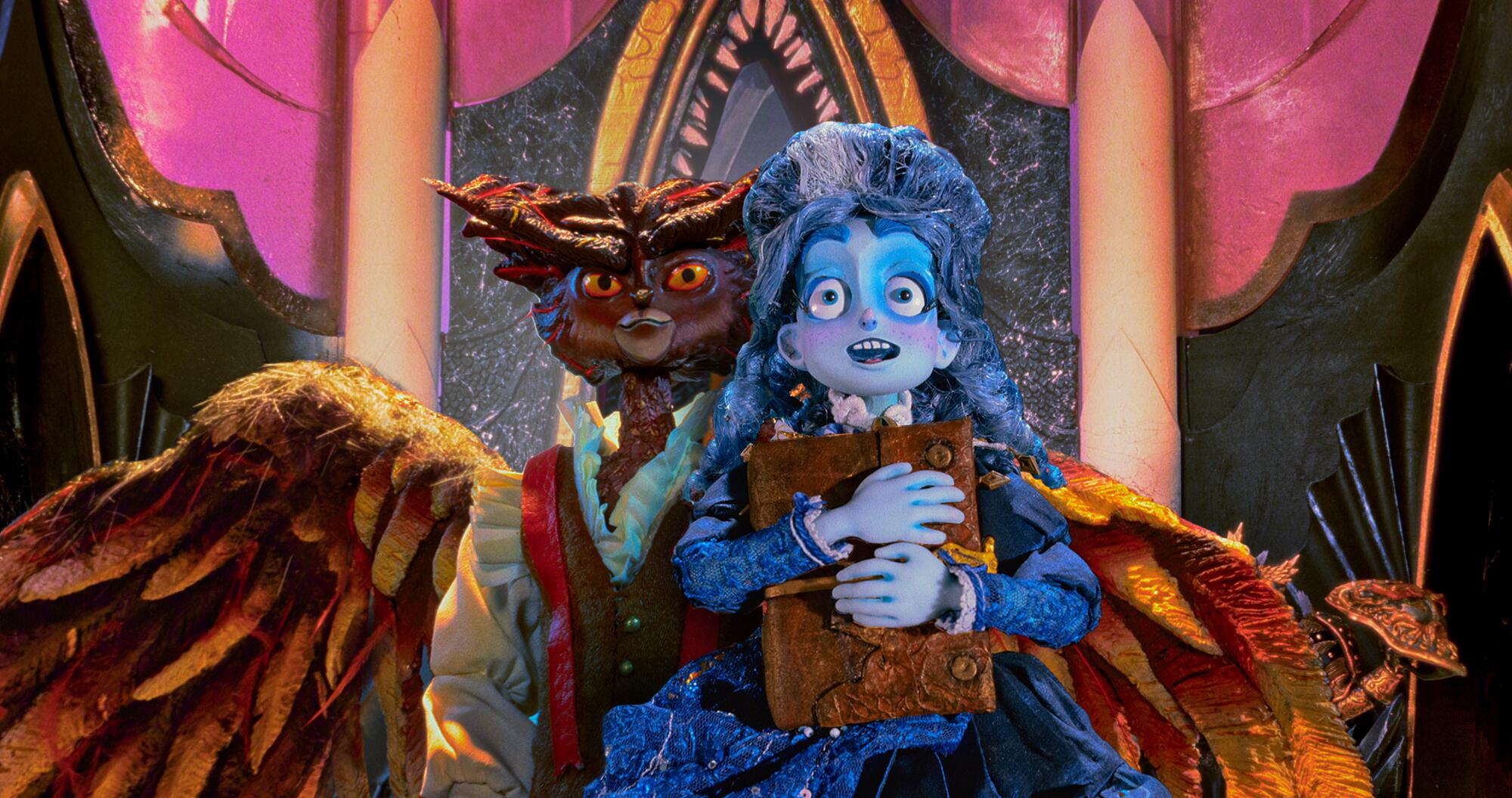
A lavish musical, “I Am Frankelda” follows Francisca Imelda (voiced by Mireya Mendoza), a young aspiring writer living in 19th century Mexico and struggling to publish her stories. Meanwhile, in the Realm of Spooks, an alternative reality that’s home to all of the fictional characters Francisca has written, Herneval (Juan Pablo Monterrubio), a winged prince, must save his parents and his kingdom. The creatures in this world live off of human fear, so they create our nightmares.

Herneval crosses into the human world to bring Francisca with him to the Realm of Spooks, so that she can write new nightmares that actually scare people. Humans have become difficult to terrify. By this point, a frustrated Francisca has decided to change her name to Frankelda (a reference to “Frankenstein” author Mary Shelley, who inspired the character). Frankelda and Herneval sing of the relationship between fiction and reality. One can’t exist without the other.

Two puppets in the stop-motion film “I Am Frankelda”

Frankelda was first introduced as part of the 2021 series “Frankelda’s Book of Spooks,” which HBO Max commissioned. In the show, the heroine shares nightmarish tales alongside Herneval, who appears not as a prince but a sentient book. The film “I Am Frankelda” is a prequel that explains the relationship between these characters.

Last month, “I Am Frankelda” screened at the Los Angeles Latino International Film Festival, where Guillermo del Toro moderated the post-screening Q&A. A longtime mentor of the Ambriz brothers, Del Toro first supported them by donating to a Kickstarter campaign to finance their ambitious 2016 short film inspired by cubist art, “Revoltoso,” about a one-eyed boar living during the Mexican Revolution.

“In that moment, it was incredibly validating to realize that if Guillermo liked what we were doing, then it made sense to keep on doing it,” Roy said.

Two years apart in age, Roy and Arturo both studied filmmaking at the Centro, a university in Mexico City. Yet directing together wasn’t always the plan.

“I said, ‘We have to co-direct,’ because the situation naturally lent itself for me, being the older one, to take on the role of director while Roy would serve as production designer. But at a certain point, I realized that the hierarchy was wrong, and that if we wanted something sustainable for the rest of our lives, it had to be a 50/50 split between us. And I mean, 50/50, Roy!” said Arturo, playfully chastising his younger brother.

“It’s more like 60/40, with me having 60% of the power,” Roy added laughing.

In 2011, not long after graduating, Arturo found himself ridden with anxiety. Over the course of his education, he’d focused on artistic excellence but hadn’t much thought about how to actually make a living out of his and his brother’s shared passion. That’s when he decided they should create their own studio, Cinema Fantasma, so as to have control of the projects they took on. Their productions for hire include the Adult Swim show “Women Wearing Shoulder Pads,” which was produced entirely at their company in Mexico City.

“It’s been very difficult because we are filmmakers by vocation, but we are businesspeople by necessity,” said Arturo. “Developing that side of things has been the hardest part, but both are indispensable.”

To wrap up the “Frankelda” series, HBO Max requested a 30-minute special. Instead of accepting that offer, Roy suggested they use the proposed budget allocated to partially fund a full-length feature film. HBO Max agreed with the caveat that the brothers would have to come up with the rest of the money needed on their own.

To finance “I Am Frankelda,” Roy and Arturo mortgaged two homes. They are losing one of them to pay off their debts, so it helps that their dream of animation is a family affair. Their parents are executive producers on “Frankelda”; Roy’s wife, Ana Coronilla, worked as production designer; and Arturo’s spouse, Irene Melis, as a director of photography.

That “I Am Frankelda” is a musical is due in great part to Roy’s love of musical theater.

“At first, Arturo wasn’t sure, but using my 60% share of the power, I convinced him that it should be a musical,” Roy said. Yet it’s Arturo who wrote the lyrics to musical numbers. Each track starts as a poem that composer Kevin Smithers transformed into songs.

A fantastical stop-motion musical period piece, “I Am Frankelda” is far from an easy sell, and that’s what makes its existence all the more astonishing. The Ambriz brothers’ creative pursuit of the unpopular and the unfeasible has bonded them with Del Toro.

Mexican filmmaker Guillermo del Toro does a Q&A with directors Roy and Arturo Ambriz.

Mexican filmmaker Guillermo del Toro, pictured, interviewed “I Am Frankelda” directors Roy and Arturo Ambriz on May 30 during the film’s screening at the TCL Chinese Theatre as part of the Los Angeles Latino International Film Festival.

(Jill Connelly / For De Los)

“He is our most important mentor and the person we admire most in the world, and we also share many of the same interests,” Arturo explained. “That’s why when we saw ‘Pan’s Labyrinth,’ it was like when the glass slipper fits Cinderella. It was exactly what we loved: monsters, war, the cruelty of the human spirit, fairies and period settings.”

“Did you just call yourself Cinderella?” Roy interjected with the mischievous smirk typical of a younger brother trying to ruffle some feathers.

“Yes!” Arturo said quietly but without hesitation.

Every time they hear Del Toro speak about his interests, the Ambriz brothers discover a new well of references and “cultural protein,” from authors to painters.

“Guillermo is someone who actively champions the work of others, which I believe is the right way for an artist to be,” Arturo said.

When they finished “I Am Frankelda,” the brothers sent it to Del Toro, eager to hear his thoughts. As soon as he watched it, Del Toro called them.

“We spoke with him for hours, and he told us everything he saw, obviously with great tact, sharing both the good and the not-so-good,” Roy recalled. “But most importantly, he kept telling us that we had created something unprecedented. He insisted that we would pull through, even though we had ended up with a lot of debt.”

The version of “I Am Frankelda” that premiered at film festivals in 2025 is not the same one that will be available on Netflix. Based on Del Toro’s thorough feedback, the filmmakers recut the film and even animated new scenes. They playfully refer to this new cut that audiences will see globally as “The Grandfather Cut,” to honor Del Toro’s influence.

That “I Am Frankelda” was picked for distribution by Netflix is also Del Toro’s doing, the brothers said. It was the veteran director who suggested the film to the streaming company.

“I Am Frankelda” debuted in Mexico last October to an incredible reception, in part thanks to the fandom the characters had amassed via the episodic series.

“We receive fan art and fan fiction every day. People send us photos cosplaying the characters or of their ‘Frankelda’-themed quinceañeras. We’ve even bought bootleg merch at Mexican markets and on Temu or AliExpress too,” Roy said.

“We’ve bought ‘Frankelda’ socks from there that are of terrible quality, but all the more beautiful because of their bad quality,” he added.

“Of course, there are haters, too, but a large segment of the audience really identified with Frankelda as someone who perseveres, as someone who refuses to let her detractors hold her back. It’s been really beautiful watching that fandom grow,” Arturo said.

Another conviction where they align with Del Toro is their disinterest in engaging with artificial intelligence.

“AI is the antithesis of stop-motion. We’re not even remotely interested in it, because we do stop-motion to enjoy the artistic processes,” Roy said. “We created the studio for painting, drawing, sculpting and writing. Whatever happens with AI doesn’t really matter to us.”

Their second feature, “The Ballad of the Phoenix,” a medieval fantasy, is already in the works.

Source link

Health sleuths are watching for disease threats during the World Cup

While millions of soccer fans cheer or groan over World Cup matches spanning North America, health officials are on high alert for germs.

A heat wave may be the most obvious health threat. But infectious diseases can spread in a crowd, and experts are scrutinizing wastewater, hospital visits, even social media for any signs that an outbreak might be brewing.

Measles, one of the most contagious diseases, is among the top concerns, sparking a warning this week from the Pan American Health Organization, PAHO. With a nearly six-week stretch of packed stadiums, bars and tourist sites in 16 cities, officials are on the lookout for a long list of infections, from the stomach bug norovirus to mosquito-borne dengue fever.

“This is truly a marathon,” said Palak Raval-Nelson, Philadelphia’s health commissioner.

The mass gatherings come at a tense moment for budget-strapped health agencies in the U.S. The Centers for Disease Control and Prevention, hit hard by Trump administration staffing cuts, already was grappling with a growing Ebola outbreak in central Africa and a cruise ship hantavirus outbreak. While CDC officials have advised state and local health departments behind the scenes, it’s expected World Cup disease surveillance dashboard still was “in final development” days before games began, according to the Department of Health and Human Services.

“Our public health professionals are pretty stretched,” said global health specialist Rebecca Katz of Georgetown University, who is leading an unusual new hub to help.

At the Health Security Operations Center, a joint effort between Georgetown and MedStar Health, workers are analyzing data from around the country so they can alert health authorities, even emergency rooms, to any early signs of trouble. The center is issuing daily “situation reports” about disease trends around World Cup host cities and team base camps to several hundred local and federal public health groups, emergency management and hospital officials and others who’ve signed up.

“It’s important that we don’t become alarmist,” said MedStar emergency medicine specialist Dr. Shane Kappler. “We’re trying to be the insurance policy.”

Measles is a top concern for potential World Cup spread

Already more than 2,000 people in the U.S. have come down with measles this year, nearly as many as during all of last year, according to the CDC. Patients can spread measles before the rash appears and they realize they’re sick. Not too long ago, the U.S. seldom saw measles except from international travel by unvaccinated people.

Now with frequent U.S. outbreaks, “actually a lot of our international partners are worried about measles being exported to them after the games,” said Georgetown’s Katz.

Measles is spreading in Canada, too, and has exceeded 11,000 cases in Mexico, according to PAHO. It’s urging soccer fans to be sure they’re vaccinated, with a health campaign saying a single measles patient can spread the virus to up to 18 unprotected people.

Is Ebola a concern at the World Cup?

Brown University’s Dr. Craig Spencer, who survived Ebola while working in the West Africa outbreak over a decade ago, said he’s repeatedly asked about the risk of Ebola during the World Cup — but “for me, Ebola is not the No. 1 or No. 2 or even No. 3 threat.”

“I am concerned about importation of measles, I am much more concerned about the importation of other infectious threats that may not seem as scary to us as Ebola,” Spencer said.

Many health experts agree that the risk of Ebola spreading in the U.S. is very low. That’s partly because of government travel screenings and restrictions on people recently in outbreak-affected areas. Moreover, Ebola spreads by contact with bodily fluids from someone showing symptoms, not through the air like measles or respiratory viruses.

“One fortunate thing about this virus is you’re most contagious when you’re really quite ill. It’s not like COVID, where you could be sitting next to someone who doesn’t even know they’re infected and perhaps contract the virus,” said Jennifer Nuzzo, director of Brown’s Pandemic Center.

How to spot brewing diseases

There’s precedent for germs invading major sporting events. Canadian scientists linked a community measles outbreak to the 2010 Olympics in Vancouver, and clusters of norovirus had to be contained during the Olympics this year in Milan and in 2018 in South Korea.

One way to detect signs of trouble: People with certain viral or bacterial infections shed genetic material that sophisticated testing of wastewater can spot. For example, measles can appear in wastewater days before an emergency room sees its first patients.

A recent surveillance reports from Katz’s center note that wastewater testing recently found diarrhea-causing rotavirus, hepatitis A and norovirus in some parts of the U.S., something to watch as soccer crowds arrive.

In Dallas, officials ramped up wastewater screening including at the international airport, casting a wide net rather than looking for specific illnesses, said Dr. Phil Huang, director of Dallas County Health and Human Services.

His team also is enhancing the usual mosquito testing, checking not just for West Nile virus that regularly spreads in the U.S. but for viruses more common in other countries like dengue and chikungunya.

Public health officials have been preparing for months, said Philadelphia’s Raval-Nelson, including with mock emergency drills and communications with counterparts around the country.

“I don’t want to send a message that there’s one key thing,” she said. “We have the frameworks in place to carry out what we need to.”

Neergaard writes for the Associated Press.

Source link

DGA’s board throws support behind tentative contract with major studios

The Directors Guild of America’s national board on Friday unanimously recommended its membership vote in favor of a four-year contract with the major studios that would increase wages, boost contributions to its health plan and establish guardrails surrounding AI technology.

“We entered this negotiation with three main priorities: secure our Health Plan, protect jobs, and ensure that our members remain secure as AI continues to impact our industry,” DGA President Christopher Nolan said in a statement. “We succeeded in these areas and gained in many others.”

Under the proposed contract, major studios would increase their contributions to the DGA’s health plan by 24.4% over four years, the largest since the plan was founded. In return, the DGA would recommend changes to its plan’s trustees including “modest” increases to the eligibility threshold and annual premiums, the DGA said on Friday.

The contract also increases minimum salaries for most jobs by 2.5% in the first year and up 3% for each of the following years in the agreement. Directors of network non-prime time strip dramatic programs will see their minimum salaries increase 2.5% for each year under the agreement.

The union, which represents more than 19,500 directors and members of directorial teams in areas such as film, commercials and news, said the agreement helps the union’s push for a federal production incentive. Hollywood creatives believe such a benefit could prevent U.S. entertainment jobs from moving overseas where production costs can be significantly lower. The proposed agreement secures a commitment that most senior management at the major studios represented by the Alliance of Motion Picture and Television Producers “would engage in meaningful advocacy for a federal production incentive above and beyond the ongoing lobbying efforts of the Motion Picture Association,” according to the DGA.

The contract also adds more guardrails to AI technology, including treating footage created by artificial intelligence as the same as footage shot by a camera, meaning it will still be under the director’s control, according to the DGA. Major studios will also be required to notify the DGA if an employer decides to license a director’s work to train a generative AI system to create new work, the union said. The agreement also establishes an employer-funded program to enhance directors’ AI skills.

“With these gains, a four-year Agreement was both appropriate and necessary to provide stability and potential for growth at a moment when the industry has been experiencing contraction,” Nolan said in a note to members on Friday.

DGA and AMPTP reached the tentative contract earlier this week. At that time, AMPTP said “we appreciate the hard work and commitment of our guild partners in achieving a fair deal that helps advance a stable and successful entertainment industry.”

DGA members will have until June 25 at 5 p.m. to vote on the plan. If approved, the contract would go into effect July 1 and run through June 30, 2030.

Source link

House Democrats ask new ICE director to roll back policy on visits

Dozens of House Democrats are asking the new director of Immigration and Customs Enforcement to roll back a policy that they say hinders their ability to speak with detainees during oversight visits.

The new policy requires that lawmakers identify detainees by name at least two business days before a visit and provide a signed consent form from each detainee. It’s the latest point of conflict in an ongoing battle over when and how lawmakers can inspect immigration facilities.

In a letter Thursday to acting ICE Director David Venturella, Rep. Mike Levin (D-San Juan Capistrano) and 77 other members of Congress, including two dozen from California, argued that they need to conduct constant oversight of immigration facilities because of historic levels of reports regarding the mistreatment of detainees, deaths in custody and substandard facility conditions.

“This Administration has enabled a revolving door of arbitrary policies, directives, and guidance on member access to facilities or on communication with detainees designed to hinder any productive oversight,” they wrote.

The letter was written in response to the new policy, which was outlined in a memo last month.

In the letter, Levin and the other members wrote that detainees have a hard time accessing the visitation form because it is at times unavailable at a detention center’s law library. They said it limits their ability to speak broadly with detainees, particularly those from vulnerable populations, such as the elderly.

Detainees previously used a sign-up sheet to meet with members of Congress or just started talking to detainees they encountered during facility tours.

In the memo outlining ICE’s new policy, then-acting director Todd Lyons said the increased visits by members of Congress have become a burden and a time suck. Homeland Security didn’t immediately reply to a request for comment, but previously said that the policy doesn’t prevent lawmakers from speaking with detainees.

Levin said the increase in visits was necessary because the agency slashed staffing of its oversight offices. The letter notes that for next fiscal year, the president requested additional cuts to the Homeland Security Office of Inspector General.

“These actions, coupled with the constant changes to policies surrounding member access to facilities, reveal a clear attack on the levers that ensure government transparency at every level,” the members wrote.

Democratic House members sued the Trump administration last July after they were repeatedly denied access to immigrant detention facilities in California and across the country.

Homeland Security officials previously implemented a policy requiring lawmakers to give seven days’ notice before a visit, but that policy was temporarily blocked in federal court.

This week, lawyers said a Belizean man who helped organize hunger strikes at the Adelanto ICE Processing Center was moved to facilities out of state and scheduled to be deported after he spoke to three members of Congress about conditions at the detention center in San Bernardino County.

Source link

Trump plans to nominate U.S. Atty. Jay Clayton to be national intelligence director

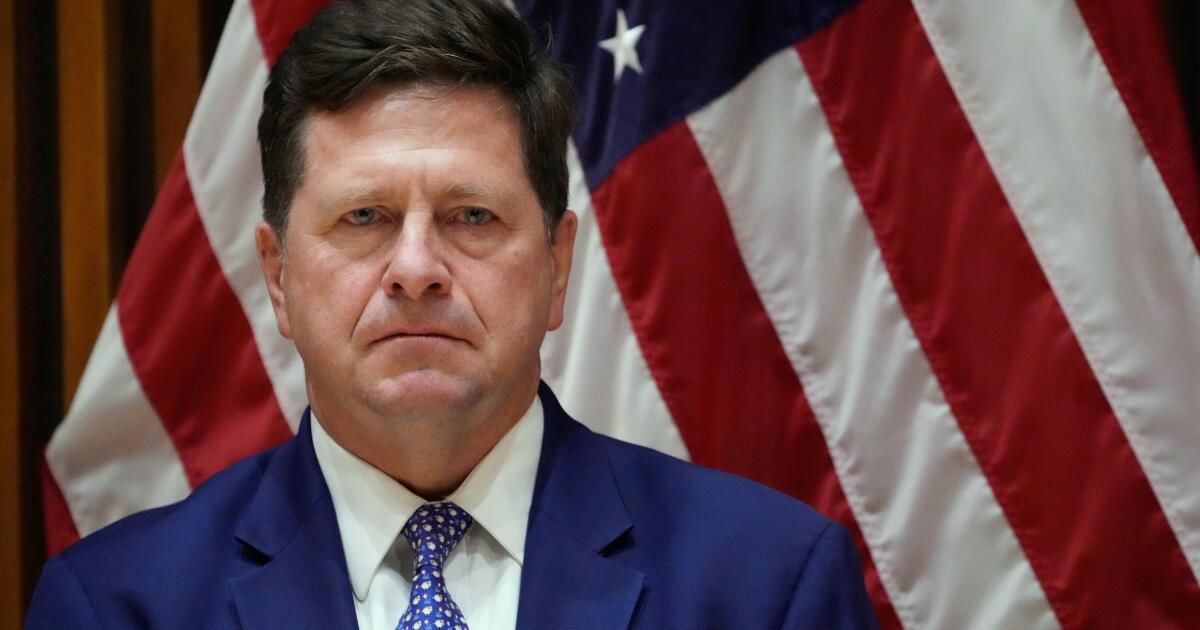
President Trump said Thursday that he plans to nominate Jay Clayton, the U.S. attorney for the Southern District of New York and a former Securities and Exchange Commission chairman, as director of national intelligence.

Trump announced the nomination on social media amid pressure from Congress to name a permanent replacement for Tulsi Gabbard, who resigned last month. Trump faced intense pushback over his decision to name Bill Pulte, head of the Federal Housing Finance Agency, as acting director.

The situation has led to a standoff in Congress as Democrats said they would refuse to renew foreign intelligence powers unless Trump pulled Pulte’s nomination and named a permanent nominee.

“Few people anywhere in the Legal Community are respected at the level of Jay,” Trump wrote. “I encourage the United States Senate to confirm Jay as soon as possible.”

Source link

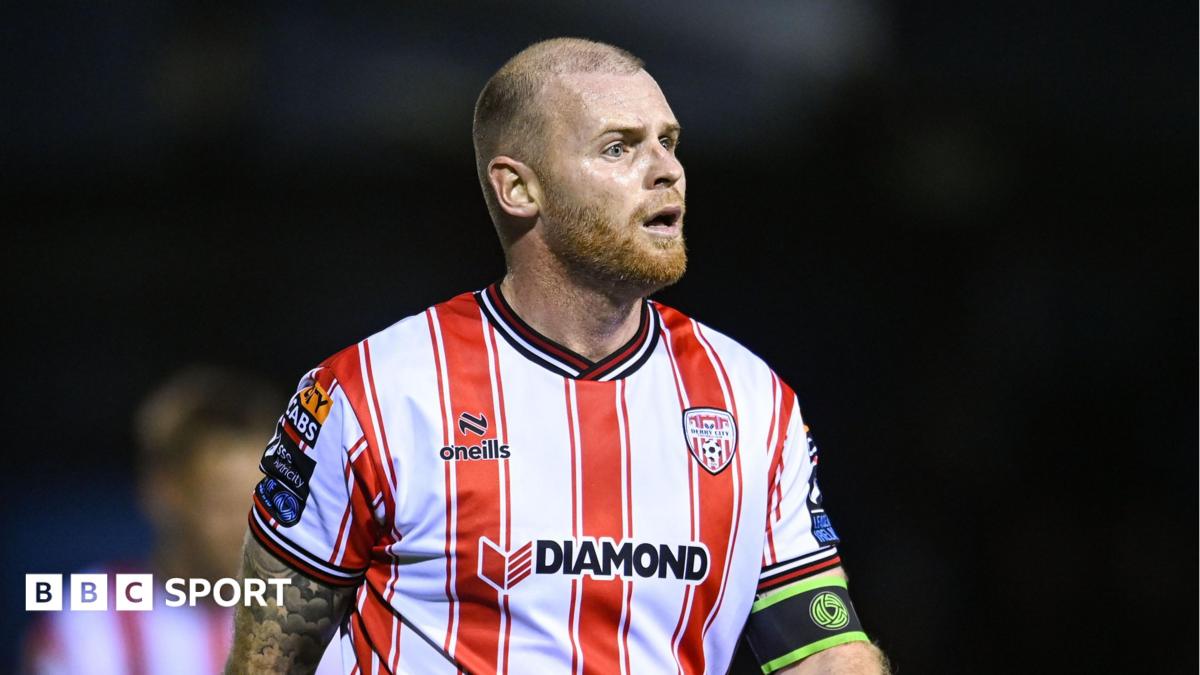
Derry City: Mark Connolly appointed director of football after calling time on career

Mark Connolly has been appointed Derry City director of football after his decision to call time on his playing career.

Connolly left Derry to link up with former Candystripes boss Ruaidhri Higgins at Coleraine in January.

The Clones-born defender, 34, started his professional career at Bolton before spells at Crawley Town, Kilmarnock and Dundee United, where he won the Scottish Championship title in 2020.

He joined Derry in 2022 following a loan stint at Dundalk and helped the Brandywell club win the 2022 FAI Cup.

“I am delighted to rejoin the club in a new role and I can’t wait to get started,” said Connolly.

“I look forward to working with Tiernan [Lynch, manager] and everyone at the club to help create an environment where players, staff and the academy can thrive.”

Coleraine boss Higgins said Connolly “had a great influence on the group” during his time at the Showgrounds as the Bannsiders won the Irish Cup for the first time since 2018.

“He probably didn’t play as much as he would’ve liked towards the end, but his high level of professionalism remained the same,” said Higgins.

“Mark has been exemplary with me and my staff throughout our years working together at Derry City and Coleraine.

“Naturally at 34-years-old, you think about what’s next in your career and this new role at Derry City is a brilliant opportunity for him.

“I’m not surprised he’s been offered that role as he has all the characteristics to be a success. We wish him the very best of luck in the next stage of his career.”

Derry City sit sixth in the League of Ireland Premier Division standings and host Bohemians on Friday (19:45 BST), a game that can be watched on the BBC iPlayer, BBC Sport website and app.

Source link

Director’s Guild reaches tentative deal with studios

The Director’s Guild of America has struck a tentative deal with the Alliance of Motion Picture and Television Producers, completing the negotiation cycle for Hollywood’s major unions.

SAG-AFTRA ratified its contract last week, the Writers Guild approved its deal back in April, and the DGA has similarly landed on a new contract, after nearly a month of negotiations. The latest deal with major film and TV studios was announced on Tuesday, but its terms have not yet been disclosed.

The Directors Guild, led by its president Christopher Nolan, reportedly entered negotiations in hopes of improving conditions to create new jobs, bulk up its health fund, and increase protections against generative AI.

“The tentative agreement will be presented to the DGA National Board for approval,” the DGA said in a statement. “Consistent with the Guild’s longstanding practice, terms of the agreement will not be released publicly until the National Board has completed its review.”

Negotiations started on May 11, and the current contract is set to expire on June 30. Once the DGA National Board approves the new contract, it will be sent to its members for a ratification vote. The union represents nearly 20,000 helmers, assistant directors, associate directors, unit production managers and stage managers.

The studios said they were pleased to have reached this latest tentative agreement with DGA.

“We appreciate the hard work and commitment of our guild partners in achieving a fair deal that helps advance a stable and successful entertainment industry,” AMPTP said in a statement.

The DGA’s tentative contract marks the last few steps of the current Hollywood union negotiation cycle. The previous one in 2023 was marked by the industry-stopping strikes from SAG-AFTRA and WGA, and the industry is still feeling the impact from them. But this year’s bargaining season was much quieter and uncontroversial. SAG-AFTRA and WGA will reconvene with the studios for bargaining in 2030, as they all signed four-year contracts.

Source link

Steve Martin, Ann Philbin to co-curate a Martin Mull exhibit at SBMA

Martin Mull was best known to audiences for playing comedic characters like Col. Mustard in “Clue” and Gene Parmesan in “Arrested Development,” but a new exhibit opening next year at the Santa Barbara Museum of Art seeks to elevate the role Mull was most proud to inhabit: a respected painter.

“Martin Mull: The Joys of Indoor/Outdoor Living,” co-curated by comedian Steve Martin and Hammer Museum Director Emerita Ann Philbin, comes to SBMA next June and runs through October. It will be the first major museum exhibition of Mull’s artwork in 20 years.

The paintings featured include scenes of unassuming houses visited by otherworldly guests, dead-eyed office workers, gravity-defying displays and lambs being led to the slaughter. They play with perspective, color, space and time to illuminate postwar American tensions, be they racial, political or existential.

“Martin Mull’s work as an artist will certainly be his primary legacy,” Martin said in a statement. “After a full-time career in painting, in the last 20 years of his life with his technical gifts fully developed, Martin’s art coalesced into tight, narrative paintings of a peculiar nature. Combining surreal elements with family idioms, he formed his own worried portrayal of American life.”

Martin Mull, "Band on the Run," 2014. Oil on panel, 30 x 40 in.

Martin Mull’s “Band on the Run,” 2014. Oil on panel.

(Estate of Martin Mull)

The exhibit, which will take over the museum’s 6,000 square feet of main galleries, will feature more than 50 paintings and drawings by Mull, most of which come from the artist’s estate and the private collections of Mull’s entertainment industry colleagues, including Steve Martin, Jennifer Tilly, and Ted and Nicole Sarandos .

The exhibit is the second curatorial collaboration between Martin and Philbin since 2015, when they partnered on “The Idea of North: The Paintings of Lawren Harris” at the Hammer Museum.

Steve Martin and Annie Philbin during 3rd Annual Hammer Museum Gala

Steve Martin and Ann Philbin — at the Hammer Museum gala in 2005 — have been friends and collaborators for years.

(John Shearer / WireImage )

Philbin, who retired from her longtime role as the Hammer’s director in 2024, told The Times via email that the idea behind the Mull show came after she saw one of his paintings in Martin’s dining room.

“Steve talked about how Mull’s painting practice was his deepest passion, despite the fact that his fame was as an actor and comedian. It prompted me to do a little research, and I became very intrigued by his body of work. I wrote to Steve, ‘Martin Mull. There’s something there.’ That’s how the project began,” she said.

Along with Martin and Philbin, the upcoming exhibition is led by SBMA Chief Curator James Glisson and Amada Cruz, the museum’s director and CEO. In a news release, a museum spokesperson said Mull’s work “upsets any storybook picture of perfection” and resists nostalgia while acknowledging its allure.

Martin Mull, "Envy," 2008, from the series "Seven Deadly Sins." Oil on linen, 30 x 40 in.

Martin Mull’s “Envy,” 2008, from the series “Seven Deadly Sins.” Oil on linen.

(Estate of Martin Mull)

“It’s so deeply strange — dark and funny, hopeful and menacing all at once,” Philbin said. “The paintings are about the smoldering tensions that underlie the American dream, so I think it’s a particularly apt moment to bring them back into the public eye.”

Mull, who died in 2024, received his master of fine arts degree in painting from the Rhode Island School of Design in 1967. Though he went on to craft a career in the public eye as a musician, comedian and actor, painting remained his “true vocation.”

Martin, a longtime friend of the multidisciplinary artist, echoed this sentiment in an email to The Times.

“If a comedian says he is also a painter, run. Except this once.”

Source link

Trump says he wants his new acting director of national intelligence to cut the office

President Trump said Friday that he wants Bill Pulte, his new acting director of national intelligence, to cut the office, which has already been significantly scaled back during his second term.

Trump noted that the size of the office has been “way too high for way too long” and that “if he cut, I wouldn’t mind.”

“Bill Pulte is very good, he’s very talented,” Trump told reporters on Air Force One as he traveled to Wisconsin. The Republican president said in an earlier interview with the Wall Street Journal that he has asked Pulte to start the process of firing employees.

In the interview with the Journal, the president says he has already conveyed his view to Pulte, the incoming acting director of national intelligence, who has served as head of the Federal Housing Finance Agency but apparently has no national security expertise.

“I’d like to see it smaller. I think there are a lot of people in there that shouldn’t be there,” Trump said, which the Journal said was in reference to intelligence community officials who had served in the Democratic administrations of Presidents Biden and Obama.

Trump told the Journal that he wants Pulte to “start the process” of firing personnel and that the eventual permanent director of national intelligence should continue it. The president has indicated that he would not formally nominate Pulte for the position.

“Frankly, it might be good for him to shake it up before people come,” Trump said. “Because, if he [Pulte] reduced the size, in conjunction with me … and in conjunction with possibly the person coming in … he can do a lot of the hard work and we wouldn’t have to saddle somebody that goes in.”

Pulte was tapped by the president earlier this week in a surprising move that has been met with bipartisan resistance in the Senate, which confirms presidential nominations. The temporary appointment has now snarled the renewal of a critical national security surveillance program on Capitol Hill, with Democrats key to the vote pointing out that they did not trust Pulte — whose office oversees 18 intelligence agencies — to help administer the surveillance program.

Under Pulte’s successor, Tulsi Gabbard, the director of national intelligence’s office had already taken steps to scale back its size. In August, the Trump administration said that the office’s budget would be cut by more than $700 million per year, while slashing the size of its workforce.

At the time, Gabbard said the office had become “bloated and inefficient” while she announced the roughly 40% workforce reduction.

Gabbard resigned last month after revealing her husband’s cancer diagnosis.

Price and Kim write for the Associated Press. Kim reported from Washington.

Source link

Trump: Pulte won’t be ‘permanent’ director of national intelligence

June 4 (UPI) — Acting Director of National Intelligence Bill Pulte, whose new assignment has drawn bipartisan criticism, won’t be the “permanent” choice for the job, President Donald Trump said Thursday.

Trump, speaking to reporters Thursday the White House, said Pulte’s role as acting director of DNI to replace Tulsi Gabbard, which began Tuesday, would not be “permanent.”

Rather, the president said Pulte will be “very good” as he takes the job on for a “little while,” while also asserting he will be able to “figure it out quickly.”

Gabbard announced her resignation in May, saying she will step down June 30, and Trump’s pick of Pulte to replace her two days ago ignited a backlash among lawmakers of both parties.

A former housing developer and currently director of the Federal Housing Finance Agency, Pulte — a staunch Trump loyalist — has no experience in foreign intelligence work, a fact that has sparked criticism from both sides of the political aisle.

Sen. Thom Tillis., R-N.C., on Wednesday blasted Pulte as an “incendiary attack dog” for Trump who likely wouldn’t pass Senate muster for confirmation.

“I don’t think he has a prayer” of becoming the permanent DNI, Tillis told CNBC, adding that Pulte’s presence could hurt the GOP congressional majority’s efforts to reauthorize the part of the Foreign Intelligence Surveillance Act governing warrantless surveillance.

Similarly, Sen. Ron Wyden, D-Ore., a long-serving member of the Senate Intelligence Committee, decried the choice of Pulte for DNI director, saying Trump is “appointing his top political henchman to one of the most important positions for protecting the safety of Americans and preventing terrorist attacks like September 11th.”

Pulte, he said, “appears to be unscathed by intelligence or any semblance of ethics,” noting he has already used his post at a housing agency “to persecute Trump’s political opponents, including Senator Adam Schiff, New York Attorney General Leticia James and Federal Reserve Board member Lisa Cook.”

Pulte has alleged fraud against several of Trump’s foes in their mortgage applications, including Cook for claiming two different homes as her primary residence. She has appealed her firing by Trump to the U.S. Supreme Court.

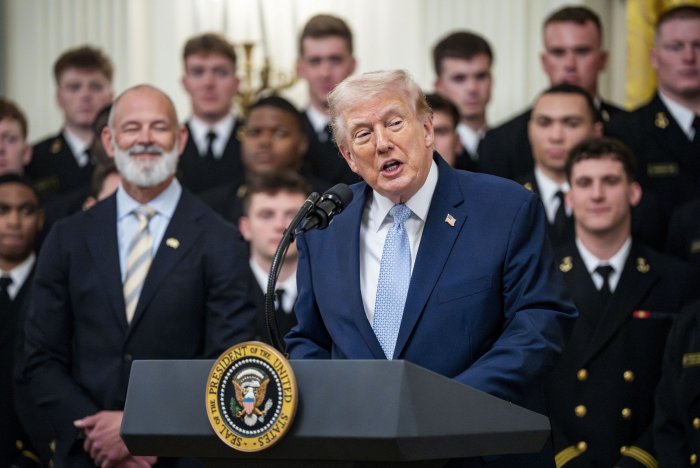
President Donald Trump presents the Commander in Chief’s Trophy to the Navy Midshipmen football team during a ceremony in the East Room of the White House on Friday. The award is presented annually to the winner of the football competition between the Navy, Air Force and Army. Navy has won the trophy back to back years and 13 times over the last 23 years. Photo by Bonnie Cash/UPI | License Photo

Source link

Trump says Pulte won’t be his nominee for director of national intelligence

President Trump said Thursday that federal housing finance regulator Bill Pulte, his pick for acting director of national intelligence, would not be his “permanent” choice for the critical security post.

The Republican president’s disclosure that he was ruling out installing Pulte in the position full time came after bipartisan pushback on Capitol Hill in recent days over Pulte’s lack of national security experience. The position requires Senate confirmation, something that lawmakers indicated was unlikely if Pulte were the nominee.

“He’s not going to be permanent because, you know, I don’t think he’d want to be permanent,” Trump said while taking questions in the Oval Office after an event on coal. He called Pulte a “very smart guy” and said he may look at past elections that Trump claims, without credible evidence, were “rigged” against him.

Trump said other candidates were under consideration for nomination to the post. “We’re interviewing people right now,” he said.

Pulte, a grandson of the founder of PulteGroup, has been a source of controversy within the administration for his work as director of the Federal Housing Finance Agency and his oversight of the mortgage companies Fannie Mae and Freddie Mac.

Pulte has used his position to pursue Trump’s perceived political rivals for alleged mortgage fraud and has verbally attacked Jerome H. Powell, whose term as the Federal Reserve chairman recently ended after months of Trump and Pulte attacking him for not slashing the central bank’s benchmark rates. The federal housing finance regulator has also pitched a 50-year mortgage, an idea that backfired as it meant that the process of building wealth through homeownership would be slowed.

Both Republican and Democratic senators expressed concerns about Pulte and his lack of national security credentials in occupying a role coordinating 18 federal agencies involved in domestic and foreign security issues. Trump’s initial director of national intelligence, Tulsi Gabbard, resigned last month, citing her husband’s recent cancer diagnosis.

Senate Majority Leader John Thune, a Republican from South Dakota, said the national intelligence director job shouldn’t be “weaponized” and should be led by “professionals.”

Republican Sens. Thom Tillis of North Carolina, Bill Cassidy of Louisiana and John Cornyn of Texas, who are each leaving the chamber after this year’s elections, also expressed concerns about Pulte.

Democratic senators view Pulte as a risk even if he is serving only temporarily as the director of national intelligence while keeping his position at the FHFA.

Sen. Elizabeth Warren (D-Mass.) sent Trump a letter on Thursday calling on him to rescind Pulte’s national security appointment.

“Americans cannot trust him to protect our nation and refrain from misusing the sensitive information he will have access to,” Warren wrote, saying that giving Pulte the job on an acting basis was a risk because Trump’s own words suggested the federal agency could be used “to promote election denial theories.”

At a hearing on Wednesday, Treasury Secretary Scott Bessent confirmed reports that he had threatened to fight Pulte in September, a sign of the friction that the federal housing finance director had generated inside the administration.

But as a frequent traveler on Air Force One, Pulte has a close relationship with Trump.

“He’s a person who’s got high integrity,” Trump said Thursday about Pulte.

Boak writes for the Associated Press.

Source link

Martin Scorsese is betting on AI to transform storyboarding process

Oscar-winning director Martin Scorsese is joining the ranks of entertainment industry power players embracing generative AI.

Black Forest Labs, the German AI startup behind the text-to-image model Flux, announced Tuesday that Scorsese is joining the company as an advisor.

The company unveiled the collaboration on its website with a video of the auteur using Flux to storyboard scenes, which involves mocking up shots before filming.

“This conveys a cinematic intelligence,” he said in the video, discussing the program’s uses with Black Forest Labs co-founder and Chief Executive Robin Rombach and Creative Artists Agency co-founder Michael Ovitz. According to the New York Times, Ovitz, an investor in Black Forest Labs, helped bring Scorsese aboard, along with Rick Yorn, Scorsese’s talent manager, whose investment firm BroadLight Capital is also an investor.

In a statement, Scorsese emphasized the potential for AI to transform the storyboarding process.

“For 70 years, I’ve been creating my own storyboards. There’s always been this problem of how do you communicate what you see in your head to your cast and crew. There are some things you have to see and feel,” he said. “I’m interested in the intersection of technology and storytelling, and seeing how that can push the bounds of creativity to create deeper and richer experiences for audiences.”

Traditionally, storyboarding is done by hand or digital illustration through a collaboration between directors and storyboard artists.

Scorsese’s public espousal of this technology marks the latest shift in attitude about AI from powerful Hollywood creatives. Since generative AI became widely accessible in 2022, Hollywood has struggled to navigate its power to rapidly upend industry norms.

Scorsese is not the first decorated filmmaker to embrace AI. James Cameron, the Oscar-winning “Avatar” director, is on the board of directors for Stability AI, where Rombach worked before launching Black Forest Labs. In his keynote address at the AI on the Lot conference last week, director and screenwriter Paul Schrader expressed a mixture of admiration and caution toward the technology.

“AI does not create — it combines,” Shrader said. “If AI wants an idea, it has to go to where that idea already exists. Of course, you can make the argument that that’s all artists do anyway, and to a degree that’s a valid argument. But you still have to come up with something.”

Not everybody is on board with generative AI’s potential transformations. Guillermo del Toro and Seth Rogen spoke out against the technology at Cannes last month, and below-the-line wokers, screenwriters and actors have continued to express apprehension and even horror at the prospect of being replaced by generative AI.

Scorsese’s entry into the AI field might especially shock fans given his traditionalist approach to filmmaking. In 2019, he famously criticized Marvel movies, calling them “theme parks” and “not cinema.”

“It isn’t the cinema of human beings trying to convey emotional, psychological experiences to another human being,” he said in a 2019 interview with Empire Magazine.

Even if his filmmaking centers humanity, Scorsese’s partnership with Black Forest Labs demonstrates his willingness to incorporate non-human assistance.

“Remember, cinema is a young medium, only around 125 years old, so we have to be open to how it can evolve,” he said in the statement on Black Forest Labs’ website.

Source link

Trump taps housing finance director Pulte as acting director of national intelligence

President Trump has tapped Bill Pulte, head of the Federal Housing Finance Agency, to be the acting director of national intelligence — putting a real estate scion and fierce Trump loyalist in a key national security post as the U.S. remains at war with Iran.

Trump made the surprise announcement Tuesday on social media that Pulte would be replacing Tulsi Gabbard, the former Hawaii congresswoman who served as the director of national intelligence.

The Republican president cited Pulte’s work at the FHFA and his role as chair of the mortgage giants Fannie Mae and Freddie Mac, saying that the 38 year-old “has deep experience managing the most sensitive matters in America, the safety and soundness of the Markets, and over 10 Trillion Dollars at Fannie Mae/Freddie Mac, a substantial increase from where it was just 12 months ago.”

Pulte’s sudden elevation to a role coordinating sensitive national security matters is a sign of how Trump is putting a priority on loyalty over a traditional resume full of previous military and intelligence assignments. It’s unclear what national security expertise Pulte has, but he has been a frequent guest on Air Force One as Trump has traveled to Mar-a-Lago, his home and club in Palm Beach, Florida.

As the grandson of the founder of PulteGroup, one of the country’s largest homebuilders, Pulte has cut a combative streak on social media and used his post at the FHFA to attack perceived opponents of the Trump administration.

His time overseeing mortgage finance has been linked with criminal referrals for mortgage fraud by public officials Trump sought to punish, including New York Attorney General Letitia James, a Democrat; Sen. Adam Schiff, D-Calif.; and Lisa Cook, a member of the Federal Reserve, who was nominated by a Democratic president, Joe Biden.

Pulte has famously gone after then-Federal Reserve Chair Jerome Powell for not cutting the central bank’s benchmark interest rates as aggressively as the president wanted. He has also been linked to ideas such as the 50-year mortgage and efforts to lower mortgage rates through the purchase of home loan debt that have not paid off as promised.

Trump said Pulte will keep his other positions even as he fills in for Gabbard, who resigned last month after revealing her husband’s cancer diagnosis.

If formally nominated, Pulte would need to be confirmed by the Senate to hold the position full time.

Boak writes for the Associated Press.

Source link

Prep talk: Loyola freshman pitcher Sheriff Hall can be a slayer in Division 2 final

Week by week, freshman left-handed pitcher Sheriff Hall of Loyola High has gotten better and better. It sets up for an intriguing Southern Section Division 2 baseball final on Saturday when Hall goes against Ganesha at 5:30 p.m. at the Rancho Cucamonga Quakes’ diamond.

He’s expected to face unbeaten left-handed pitcher Logan Schmidt after the Pomona Unified School District indicated that issues about top Ganesha players participating in an out-of-state camp have been resolved.

Whatever happens, Hall is ready. Coach Keith Ramsey has been preparing him for this moment. Hall is 7-3 with a 2.53 ERA while pitching mostly in the tough Mission League.

If Hall ever needs someone to put together a highlight tape, he knows whom to ask. His father, Jason, is a screenwriter and director who also played a recurring character in “Buffy the Vampire Slayer.”

Let’s see if Hall can be his own slayer on Saturday.

This is a daily look at the positive happenings in high school sports. To submit any news, please email eric.sondheimer@latimes.com.

Source link

Race cars and cage fights — on National Park land?

President Trump plans to celebrate the nation’s 250th anniversary — and his own 80th birthday — next month by watching bare-chested and bloody UFC fighters kick, punch and choke each other on the storied South Lawn of the White House.

Later, during the administration’s summer-long festival to commemorate the signing of the Declaration of Independence, IndyCars will race in a fossil fuel-burning extravaganza around and around the National Mall — home to the U.S. Capitol and the Washington and Lincoln monuments.

Both venues are National Park Service land and are administered by the agency.

The planned spectacles — UFC Freedom 250 and the Freedom 250 Grand Prix — stray so far from the park service’s traditional mission and ethos that advocates and career employees are crying foul.

“These events are inappropriate and disrespectful to the history and importance of the White House and the National Mall,” said Jonathan Jarvis, who began his career as a park ranger on the Mall in 1976 and was named director of the National Park Service by President Obama in 2009.

White House officials insist that IndyCar and the UFC are extremely popular with everyday Americans: the race and the fights will be exuberant celebrations of patriotism and pride, they say.

The UFC event, in particular, “will be one of the greatest and most historic sports events in history, and President Trump hosting it at the White House is a testament to his vision to celebrate America’s monumental 250th anniversary,” said White House spokesperson Davis Ingle.

An aerial view of UFC construction outside the White House.

President Trump is hosting a UFC match on the White House grounds in honor of the 250th anniversary of the United States.

(Alex Wong / Getty Images)

To organize this summer’s events, the Trump administration asked the National Park Foundation — a congressionally chartered nonprofit that works closely with the park service and collects private donations to help maintain hiking trails and fund programs to get kids outdoors — to lend a hand.

Because of the scale of the planned celebrations, the foundation created a limited liability company, “Freedom 250,” to “execute events, activities, and celebrations in or around national parks,” according to the Freedom 250 website.

Freedom 250 has its own employees, but the foundation provides funds and the park service approves the events and reviews their budgets, according to the website.

Which is why advocates are appalled.

“Essentially, this is a hijacking of one of America’s oldest and most well-respected conservation organizations,” said Aaron Weiss, director of the Center for Western Priorities, an environmental nonprofit based in Denver. “There are so many very good people at the foundation, with so many years doing real work on behalf of America’s national parks, it’s heartbreaking to watch.”

When Jarvis was director of the park service — and therefore an ex-officio board member of the foundation — the two organizations worked hand in hand to ensure that the foundation’s work complemented that of the park service. They organized the annual Easter Egg Roll on the White House South Lawn and lit the Christmas tree on the Ellipse, Jarvis said.

Workers paint the bottom of the Lincoln Memorial Reflecting Pool.

Workers continue to paint the bottom of the Lincoln Memorial Reflecting Pool on the National Mall.

(Alex Wong / Getty Images)

Occasionally, the president made special requests, which were reviewed carefully to ensure they were consistent with park service principles. Michelle Obama’s famous “Kitchen Garden” passed the test, Jarvis said with a chuckle, providing fruits and vegetables for family meals — and the occasional state dinner — for years.

It’s hard to imagine any career parks employee, or the foundation board members he served with, coming up with the current agenda, Jarvis said.

In addition to the IndyCar race and cage fights, the National Park Foundation is sponsoring “Freedom Trucks” — six red, white and blue tractor trailers traveling the country as rolling museums — and Rededicate 250, a large Christian revival meeting held on the Mall earlier this month that raised objections about the mixing of church and state.

“I think the foundation is being told what to do,” Jarvis said. “And I think it’s hard to say no to the White House these days.”

Josh deBerge, a spokesperson for the National Park Foundation, insisted that no money from Freedom 250 is being spent on the IndyCar race or the UFC fights.

But the IndyCar race is listed as a “signature” event on the Freedom 250 website, and both IndyCar and the UFC are listed as Freedom 250 sponsors.

Danielle Alvarez, a former Trump campaign senior advisor, is a spokesperson for Freedom 250. She acknowledged that the race and the cage fights are happening on national park land and under the banner of Freedom 250, but said neither is receiving funds or logistical support from her organization.

“Many groups have adopted ‘Freedom 250’ branding as part of their festivities, even though it does not mean it is backed by Freedom 250 funding,” Alvarez said in a text message. “The shared terminology is a natural expression of collective pride in 250 years of American independence.”

Neither IndyCar nor the UFC responded to requests for comment.

All of this comes as the Trump administration has taken an ax to the National Park Service, cutting its staff by 25% through buyouts and layoffs since 2025, and proposing another 25% staff reduction this year.

An employee does restoration work on a statue of a general on a horse

A worker applies hot wax during the restoration process of the Gen. Nathanael Greene statue in Stanton Park on Capitol Hill.

(Tom Williams / CQ-Roll Call / Getty Images)

Trump has also proposed slashing nearly $800 million from the park system’s roughly $3-billion operating budget — potentially diminishing the ability to keep facilities clean and control crowds. Already this year, Yosemite National Park has ditched a reservation system, leading to enormous crowds in the valley and on nearby trails.

Parks advocates fear it’s part of a broader and deliberate strategy to marginalize an agency that has long been a sanctuary for environmentalists and progressives — most of whom presumably did not vote for Trump.

In addition to the staff and budget cuts, Trump last year instructed the National Park Service to scrub any language he would deem negative, unpatriotic or smacking of “improper partisan ideology” from signs and presentations visitors encounter at parks and historic sites.

Instead, he ordered the agency to ensure that its signs remind Americans of our “extraordinary heritage, consistent progress toward becoming a more perfect Union, and unmatched record of advancing liberty, prosperity and human flourishing.”

Those marching orders left opponents and free speech advocates in disbelief, wondering how park employees were supposed to put a sunny spin on monuments acknowledging slavery, Jim Crow laws and the incarceration of Japanese Americans during World War II.

Trump opponents also question the political wisdom of picking on an agency that’s routinely ranked among the most admired branches of the large and sprawling federal government. Even Americans who pay little attention to politics will probably never forget standing in Yosemite Valley and admiring a towering waterfall.

There were more than 323 million visits to America’s national parks in 2025, dwarfing attendance — 135 million — at professional football, baseball, basketball and hockey games combined.

That has not stopped the assault by the current administration.

A black granite walkway at the White House.

Black granite was installed last month as the new walkway for the West Wing Colonnade at the White House.

(Andrew Harnik / Getty Images)

“The ideologues in power now take a very dim view of the federal government in general, and the last thing they want is a highly popular and successful federal agency,” Jarvis said. “So if they can kill it, or diminish it through neglect, they win. They don’t really care about the public’s opinion.”

Chuck Sams, the last director of the National Park Service, stepped down the day Trump was inaugurated. Since then, the agency has not had a Senate-confirmed director.

Sams agreed that the Trump administration seems to have it in for the Park Service and worried that the guardrails that used to prevent the executive branch from doing whatever it wants with park land are disappearing.

Destroying the East Wing of the White House for Trump’s proposed ballroom and paving over portions of the White House Rose Garden lawn are prime examples, Sams said.

During his tenure, any proposed change to the White House or its grounds was approached in a “very concerted and deliberate manner with a lot of educated professionals weighing in,” Sams said. “Was it slow? Absolutely, but that was because everyone understood these places belong to the people.”

Asked what he thought of the IndyCar race and the cage fights, Sams said, “We are in uncharted territory, on uncharted ground.”

Source link

10 Cannes movies worth looking out for in a year of disappointments

After 10 days of crazed moviegoing at the Cannes Film Festival, Times film critic Amy Nicholson and Times film editor Joshua Rothkopf are all but spent. They leave with 10 recommendations (listed below in alphabetical order), including several titles you’ll be hearing about during awards season, but also, admittedly, more reservations than usual.

Amy Nicholson: There are worse ways to spend your life than watching four movies a day in the south of France. For a week and half, we ran in and out of the dark theaters, blinking at the shock of the sun and bickering about what we just saw with the highest concentration of film lovers anywhere — most of us jacked up on espresso or rosé. Yet, we’re flying home miffed that the movies themselves were mediocre. Cannes is meant to launch ambitious, prickly works by grandmasters and next-generation talents. This year, the programming looked like a party with an impressive invite list — Nicolas Winding Refn, Asghar Farhadi, Hirokazu Kore-eda — but upon arrival, all the guests felt like old acquaintances tapped out of anything interesting to say.

I’m being harsh. Cannes had good movies, too. But I needed this year’s Cannes to be great. Audiences trickling back into theaters deserve to see something fantastic. Instead, too many filmmakers took the crowd’s attention span for granted; even the strongest films in competition could delete a half-hour of dead air. Fittingly, the majority of my favorites came from Cannes’ kookier programming sections, Directors’ Fortnight and Un Certain Regard — and I suspect many of yours did, too, oui?

Joshua Rothkopf: I did find a handful of films from the main competition that impressed me, but point taken: Nobody is served if we can’t admit that this year’s edition was weaker than others. We could blame screenwriting or pacing (though paradoxically I was impressed by both the longest and the shortest movies in competition). Maybe it’s an overall lack of boldness. When a restored version of Ken Russell’s salacious 55-year-old “The Devils” eclipses virtually everything else shown at the festival, a certain timidity is hard to deny. There were too many “nice” films: perfectly respectable but not what I want Cannes to be.

Fortunately, we saw enough to sharpen up a list of favorites. Here’s what stirred us.

‘All of a Sudden’

"All of a Sudden"

I’m not convinced that the utopian vision of end-of-life care presented in Ryusuke Hamaguchi’s drama has a fighting chance in America, but we deserve the opportunity to grapple with its compassionate turns and have that discussion. The director of “Drive My Car” continues his process-centric exploration of workplace relationships in this quietly revelatory movie, one with a centerpiece conversation that merits comparison to the long walks of Richard Linklater’s “Before” movies. Virginie Efira and Tao Okamoto let a day’s stroll linger into profundity, the twilight dimming and human connection brewing in all its possibilities. Is it too late for them? It doesn’t need to be. — Joshua Rothkopf

‘The Beloved’

"The Beloved"

Esteban (Javier Bardem), a renowned bad boy Spanish filmmaker, returns to his homeland from New York to shoot a period picture in the desert. Off-screen, he’s gifted one of the four leading roles to his estranged daughter (Victoria Luengo), an aspiring actor who hasn’t seen her father in 13 years. Esteban failed as Emilia’s dad. Can he succeed as her director, especially when her big break packs this much pressure? Not likely, especially as Emilia has inherited his disastrous boozing habits. “The Beloved’s” actual director, Rodrigo Sorogoyen, unleashes his leads to become a tag team of destruction, each blaming the other for what’s going wrong on set. They’re both mired in clashing narratives of their relationship. Sorogoyen shows us the truth, as well as the visible frustrations of the film-within-a-film’s cast and crew that risk shutting down this too-passionate passion project. — Amy Nicholson

‘Bitter Christmas’

Barbara Lennie, left, and Victoria Luengo in a scene from "Bitter Christman," directed by Pedro Almodovar.

(Iglesias Mas / Sony Pictures Classics)

Pedro Almodóvar’s self-flagellating film about his artistic process has a Charlie Kaufman-lite structure that I’d rather let audiences discover on their own. In brief: Almodovar’s avatar, a filmmaker named Raúl (Leonardo Sbaraglia), gets dragged over the artistic coals by the dramatic female characters he’s been writing for decades, one of whom dares him to simply coast on his legacy. Too many veteran filmmakers in his year’s Cannes competition seem to have accepted that bargain, so when Raúl got to the end of a new script and decided it wasn’t up to his standards, I nearly shouted “Bravo!” Navel-gazing cinema about the creative process isn’t usually my bag, but Almodóvar doesn’t take his own misery that seriously, even inserting a manic pixie dream hunk, a male stripper-slash-firefighter played by Patrick Criado, for a little bump and grind. — Amy Nicholson

‘Clarissa’

"Clarissa"

It’s been 101 years since Virginia Woolf first published “Mrs Dalloway,” a novel about persnickety party hostess Clarissa Dalloway colliding with her former lovers, one male and one female. The plot seems simple, but every glare and sigh tells a whole story about modernization, capitulation, cynicism and violence. Twin brothers Arie and Chuko Esiri have transplanted the tale to present-day Nigeria and stacked the cast with Sophie Okonedo, Ayo Edebiri, Nikki Amuka-Bird, David Oyelowo and the staggeringly talented India Amarteifio as the diva in her captivating youth before she married a tedious oilman and started bullying the help. “Clarissa” makes several smart adjustments, swapping in a traumatized Boko Haram soldier for a shell-shocked veteran of the Great War, and cocking an eyebrow at the shiny new yoga studios and coffee shops littering Lagos’ once-lush waterfront. Better still, it’s sexy as heck — the flashbacks are one swimsuit party after another. — Amy Nicholson

‘Club Kid’

"Club Kid"

The one-sentence pitch of Jordan Firstman’s debut dramedy — a gay nightclub promoter sobers up when he discovers he has a 10-year-old boy — sounded as fun as snorting a line of aspartame. I stand corrected. “Club Kid” is a blast: a spicy, surprising and irreverent comedy that rarely peddles the audience anything artificially sweet. Firstman stars as Peter, a debauched millennial aging out of a New York scene that never cared about him as a person in the first place. His business partner Sophie (Cara Delevingne) is a horror; his selfish squatter-roommate Nicky (Eldar Isgandarov) is even worse and so hilarious I’d watch a spin-off sequel just about him. Peter’s shock son Arlo (Reggie Absolom) has a casual charm that pickpockets your heart, but it’s the script’s sour quips that will have you urging people to get past the treacly set-up and go see “Club Kid” themselves. — Amy Nicholson

‘The Diary of a Chambermaid’

"The Diary of a Chambermaid"

Art punk Radu Jude’s latest satire is about a Romanian immigrant with a burlesque double life. By day, Gianina (Ana Dumitrașcu, fantastic) is the live-in housemaid of a daft Parisian family; by night, she’s an actress in a turn-of-the-20th century slapstick farce about a housemaid whose master suckles her patent leather boots. In neither world can she openly say what she thinks (although in her native tongue, she curses her employers and their young son plenty). Fast, crisp and snide, “The Diary of a Chambermaid” gives equal weight to the monotony and the absurdity of Gianina’s grind. And Jude isn’t above including a mocking slow-motion shot of a spoiled French boy totally whiffing a soccer kick. — Amy Nicholson

‘Fatherland’

"Fatherland"

The tension at the heart of Paweł Pawlikowski’s period piece, set in a ravaged, fallen Germany after the end of World War II, is one that goes unresolved. All that’s left are defensive denials, evasions of Nazi collaboration and the faint hope that something higher has survived. I could watch this kind of guilt-ridden post-apocalyptic movie for hours; instead, this lasts a scant 82 minutes. The conclusion, a wordless moment between father and daughter set to the strains of Bach played on a broken pipe organ, was the most devastating passage of the entire festival. “Fatherland” shows off Pawlikowski’s exquisite way with black-and-white evocations of European tragedy, but he’s never summed them up as poetically. — Joshua Rothkopf

‘Fjord’

A scene from director Cristian Mungiu's film, "Fjord."

People at the festival called this one complex; I found myself disagreeing. It’s actually a fairly straightforward story about a religious but mostly level-headed family flung into conflict with an overly sensitive branch of child protection services — and maybe with the whole of agnostic Norwegian progressivism. As reactionary as that sounds, I was totally rapt. Partly that’s due to a beautifully plotted courtroom scenario and the immersive performances of Sebastian Stan and Renate Reinsve, reuniting after “A Different Man,” as parents increasingly out of their depths. But mainly, I credit Romanian director Cristian Mungiu, who knows a good story when he sees one, crystallizing its potency with every camera choice. — Joshua Rothkopf

‘Minotaur’

"Minotaur"

The ice-chilled return of Russian filmmaker Andrey Zvyagintsev (after a multiyear battle with long COVID) is worth the wait: a condensation of everything he does well into something so purely distilled, it should come with a proof warning. The movie kicks off as a casual portrait of the vacant nouveau riche lifestyles of the mini-oligarchs: fancy dinners, divorces, bathroom gossip. Then it becomes an erotic thriller (it’s based on Claude Chabrol’s 1969 “The Unfaithful Wife,” as was Diane Lane’s “Unfaithful”). But the best comes last, as the situation gets fixed in broad daylight with breathtaking brutality. The war in Ukraine? Someone else’s problem. “Minotaur” takes on the whole of Putin’s dissociative society and puts its winners above the blackened clouds, looking down at the rest of us. — Joshua Rothkopf

‘Teenage Sex and Death at Camp Miasma’

A scene from "Teenage Sex and Death at Camp Miasma." (MUBI)

I am growing to love Jane Schoenbrun’s exfoliation of ’80s horror obsessions, especially for the movie’s nonjudgmental embrace: Let these movies be free in all their “problematic” badness and let them work on you. The fact that “Teenage Sex” sometimes plays like a bottle episode of “Hacks” doesn’t hurt. Hannah Einbinder brings vulnerability to a project that needs her brand of self-excoriating fearlessness. Points, too, for not turning this into yet another celebration of some forgotten male director reclaimed as a genius. Rather, the opposite: It’s about an abused scream queen (Gillian Anderson, gamely campy), a liminal, wintry campground and the exhilaration of running in the woods in your pajamas. — Joshua Rothkopf

Source link

Tulsi Gabbard resigns as director of national intelligence, citing her husband’s health

Tulsi Gabbard resigned as President Trump’s director of national intelligence on Friday, saying she needed to step away as her husband battles cancer. She is the fourth Cabinet official to depart during Trump’s second term.

“Unfortunately, I must submit my resignation, effective June 30, 2026,” Gabbard wrote in her resignation letter, which she posted on X. “My husband, Abraham, has recently been diagnosed with an extremely rare form of bone cancer.”

There had been rumblings that Gabbard would split with Trump after the president’s decision to strike Iran, which caused some division within his administration. Joe Kent, the director of the National Counterterrorism Center, announced his resignation in March, saying he “cannot in good conscience” back the war.

Gabbard, a veteran and former Democratic congresswoman from Hawaii, built her political name on her opposition to foreign wars. This put her in an awkward position when the U.S. joined Israel in launching attacks on Iran on Feb. 28.

During a congressional hearing in March, her measured comments were notable for their careful non-endorsement of Trump’s decision to strike Iran. She repeatedly dodged questions about whether the White House had been warned of potential fallout from the conflict, including Iran’s effective closure of the Strait of Hormuz.

Gabbard said in written remarks to the Senate Intelligence Committee that there had been no effort by Iran to rebuild its nuclear capability after U.S. attacks last year “obliterated” its nuclear program. That statement contradicted Trump, who has repeatedly asserted that the war was necessary to head off an imminent threat from the Islamic Republic.

This created several awkward exchanges with lawmakers who asked Gabbard for her opinion on the threat posed by Iran as the nation’s top intelligence official. She repeatedly said it was Trump’s decision to strike, not hers.

“It is not the intelligence community’s responsibility to determine what is and is not an imminent threat,” she said.

Gabbard’s departure follows Trump having ousted Homeland Security Secretary Kristi Noem in late March, in the midst of mounting criticism over her leadership of the department — including the handling of the administration’s immigration crackdown and disaster response.

The second Cabinet member to leave was Attorney General Pam Bondi, in response to growing frustration over the Justice Department’s handling of files related to Jeffrey Epstein. And Labor Secretary Lori Chavez-DeRemer resigned in April, after being the target of various misconduct investigations.

A surprising choice for the job

A veteran but without any intelligence experience, Gabbard was a surprising choice to head the Office of the Director of National Intelligence, which oversees the nation’s 18 intelligence agencies. She ran for president in 2020 on a progressive platform and her opposition to U.S. involvement in foreign military conflicts.

Citing her military experience, she argued that U.S. wars in the Middle East had destabilized the region, made the U.S. less safe and cost thousands of American lives. Gabbard later dropped out of the race and endorsed the ultimate winner, President Joe Biden.

Two years later she left the Democratic Party to become an independent, saying her old party was dominated by an “elitist cabal of warmongers” and “woke” ideologues. She subsequently campaigned for several high-profile Republicans and became a contributor to Fox News.

She later endorsed Trump, who also was a strong critic of past U.S. wars in the Middle East and campaigned on a pledge to avoid unnecessary wars and nation-building overseas.

Iran caused early tensions

But friction with the president started soon after he began his second term and tapped Gabbard to lead ODNI, which was set up after the Sept. 11, 2001, attacks to improve coordination between the nation’s intelligence agencies.

Shortly after taking on the job, Gabbard testified before lawmakers that there was no intelligence suggesting Iran was seeking to develop nuclear weapons. After Trump launched attacks on Iranian nuclear sites in June he said Gabbard was wrong and that he didn’t care what she said.

She appeared to be back in Trump’s good graces when she took a lead role in Trump’s effort to relitigate his 2020 election loss to Biden, whom Gabbard had endorsed. She appeared at an FBI search of election offices in Fulton County, Georgia, even though her office was created to focus on foreign espionage, not state elections.

Earlier this week, however, she testified to lawmakers during an annual threats hearing that last year’s strikes on Iran’s nuclear sites had “obliterated” their nuclear program and that there had been no subsequent effort to rebuild.

The statement seemed to complicate Trump’s repeated assertions that Iran posed an imminent threat and created several awkward exchanges with lawmakers who asked Gabbard for her opinion on Iran’s threat as the nation’s top intelligence official. She repeatedly said that it was Trump’s decision to strike, not hers.

“It is not the intelligence community’s responsibility to determine what is and is not an imminent threat,” she said at one of this week’s hearings.

Gabbard wrought big changes in one year

Gabbard vowed to eliminate what she said was the politicization of intelligence by government insiders. But she quickly used her office to support some of Trump’s most partisan of arguments — that he won the 2020 election.

She also worked to undermine the results of earlier investigations into Trump’s ties to Russia.

In her year on the job, Gabbard oversaw a sharp reduction in the intelligence workforce, as well as the creation of a new task force that she charged with considering big changes to the intelligence service.

Earlier this year an intelligence sector whistleblower filed a complaint that Gabbard was withholding intelligence for political reasons, a complaint that prompted calls from Democrats for Gabbard’s resignation.

Gabbard, 44, was born in the U.S. territory of American Samoa, raised in Hawaii and spent a year of her childhood in the Philippines. She was first elected as a 21-year-old to Hawaii’s House of Representatives but had to leave after one term when her National Guard unit deployed to Iraq.

As the first Hindu member of the House, Gabbard was sworn into office with her hand on the Bhagavad Gita, the Hindu devotional work. She was also the first American Samoan elected to Congress.

During her four House terms she became known for speaking out against her party’s leadership. Her early support for Sen. Bernie Sanders ’ 2016 Democratic presidential primary run made her a popular figure in progressive politics nationally.

Kinnard, Weissert and Klepper write for the Associated Press.

Source link

Emails show FBI Director Kash Patel’s Hawaii trip included ‘VIP snorkel’ at a Pearl Harbor memorial

When Kash Patel visited Hawaii last summer, the FBI took pains to note the director was not on vacation, highlighting his walking tour of the bureau’s Honolulu field office and meetings with local law enforcement.

Left out of the FBI’s news releases was an exclusive excursion that Patel took days later when he participated in what government officials described as a “VIP snorkel” around the USS Arizona in an outing coordinated by the military. The sunken battleship entombs more than 900 sailors and Marines at Pearl Harbor.

The swim, revealed in government emails obtained by The Associated Press, comes to light amid criticism of Patel’s use of the FBI plane and his global travel, which have blurred professional responsibilities with leisure activities. The FBI did not disclose the snorkeling session or that Patel had returned to Hawaii for two days after his initial stopover on the island.

“It fits a pattern of Director Patel getting tangled up in unseemly distractions — this time at a site commemorating the second deadliest attack in U.S. history — instead of staying laser-focused on keeping Americans safe,” said Stacey Young, who founded Justice Connection, a network of former federal prosecutors and agents who advocate for the Department of Justice’s independence.

With few exceptions, snorkeling and diving are off-limits around the USS Arizona. The battleship, now a military cemetery reachable only by boat, has stood as one of the nation’s most hallowed sites since Japan bombed and sank it in 1941. Marine archaeologists and crews from the National Park Service make occasional dives at the memorial to survey the condition of the wreck. Other dives have been conducted to inter the remains of Arizona survivors who wanted to rest eternally with their former shipmates.

Still, since at least the Obama administration, the Navy and the park service have quietly allowed a handful of dignitaries, including military and government officials responsible for management of the memorial, to swim at the site. The Navy and park service declined to provide details of those permitted to take such excursions.

Former FBI directors have visited Pearl Harbor on official business, but none going back to at least 1993 has gone snorkeling at the memorial, according to those familiar with their activities and a former government diver who spoke to AP on condition of anonymity for fear of retribution. The diver said it was unusual for a director or anyone not connected to the memorial to be granted such access because the swims come with physical risks and present security, safety and logistical challenges.

Patel has faced scrutiny over his leadership for the past year, with his use of government resources emerging as a recurring storyline of his tenure. The issue flared in February when video surfaced of Patel partying in the locker room  with members of the U.S. men’s hockey team after their gold medal win at the Winter Olympics in Milan.  Patel defended the trip as recently as this week as “purposely planned” in connection with a cybercrime investigation involving the Italian authorities.

Unanswered questions about exclusive outing

Patel’s excursion was in August as he spent two days in Hawaii on his return to the United States from official visits to Australia and New Zealand. On his way to those countries, he stopped in Hawaii to visit the Honolulu field office. An FBI spokesman did not answer questions about the snorkeling session.

The FBI said in a statement that top regional commanders hosted Patel at Joint Base Pearl Harbor-Hickam “as they commonly do with US government officials on official travel.” The Pearl Harbor visit, the spokesman said, “was part of the Director’s public national security engagements last August with counterparts in New Zealand, Australia, our Honolulu Field Office, and the Department of War.”

It was not clear how Patel’s snorkeling session was arranged. A Navy spokesperson, Capt. Jodie Cornell, confirmed the outing but said the service was not able to track down who initiated it.

Participants in Patel’s swim were told “not to touch/come into contact with” the sunken ship in any way, Cornell said. She added that the snorkelers were also briefed about “the historic significance of the Memorial as the final resting place/tomb for hundreds of service members.”

A ‘VIP Snorkel’

Government emails obtained by the AP through a public records request show military officials coordinated logistics and personnel for the “VIP Snorkel.”

The National Park Service, which administers the site in coordination with the Navy, told AP it was not involved in Patel’s swim and declined to comment on the excursion. It also declined to answer questions about any other such outings.

Among those afforded invitations to snorkel have been Navy admirals, secretaries of defense and interior, according to the former government diver. The diver added that the swims were intended to provide officials with insights into the memorial and its operations.

The Navy declined to provide examples or numbers showing how frequently it organizes such excursions. It described Patel’s outing as “not an anomaly.”

Hack Albertson, a Marine veteran, is part of a select group from the Paralyzed Veterans of America trained to dive on the Arizona annually to check on the condition of the wreck. He said it was inappropriate for Patel and other political figures to snorkel or dive at the memorial.

“It’s like having a bachelor party at a church. It’s hallowed ground,” he said. “It needs to be treated with the solemnity it deserves.”

Some family members don’t object to snorkeling

Some family members of Pearl Harbor survivors said they were not bothered by such official excursions, though some expressed a desire to also be permitted to snorkel at the site. They said they have not been permitted to do so.

“I have not heard of anyone who would object to these visits as they are very rare and there aren’t any survivors of the Arizona left alive,” Deidre Kelley, national president of the Sons and Daughters of Pearl Harbor Survivors, wrote in an email. “Their children might have some objections but I haven’t heard any.”

Patel visited Pearl Harbor several years ago during a trip he made to Hawaii while serving as chief of staff to Christopher Miller, then the acting secretary of defense, according to the former government diver.

Miller said he snorkeled over the Arizona during an official visit to the base, but Patel was not present for that excursion. Miller said he was invited to snorkel by regional military officials and was told such a tour was for “special occasions and for special visitors, of which you’re one.” He called it a “meaningful” experience.

“It was a very somber and meaningful event,” Miller said in an interview. “It was a historical tour. It wasn’t a recreational thing.”

FBI will not discuss Patel’s return to Hawaii

Beyond the snorkeling excursion, it is not clear what else Patel did during his second stop in Hawaii.

Flight tracking data for the Gulfstream G550 typically used by the FBI director show the jet remained on the island two nights during that stay before flying on to Las Vegas, Patel’s adopted hometown. The jet has a published range of about 7,700 miles, meaning the plane would have needed to refuel somewhere between New Zealand and Washington.

The snorkeling session happened one day after Patel stopped in Wellington to open the FBI’s first  standalone office  in New Zealand. The visit sparked controversy after the AP revealed that Patel had gifted that country’s police and spy bosses inoperable 3D-printed replica pistols that were  illegal to possess  under local gun laws.

Mustian, Tucker and Biesecker write for the Associated Press. Mustian reported from New York. AP writers Audrey McAvoy in Honolulu, and Konstantin Toropin contributed to this report.

Source link

FBI Director Kash Patel fires back at drinking allegations | Donald Trump

NewsFeed

FBI Director Kash Patel and Senator Chris Van Hollen had a heated exchange during a Senate budget hearing after Van Hollen questioned Patel about drinking allegations first reported by The Atlantic magazine. Patel called the claims “unequivocally, categorically false.”

Source link

FBI Director Kash Patel denies drinking allegations in heated Senate exchange

FBI Director Kash Patel angrily lashed out at a Democratic lawmaker at a budget hearing Tuesday, calling allegations that he drinks excessively on the job and has been unreachable at times to his staff “unequivocally, categorically false.”

“I will not be tarnished by baseless allegations,” Patel told Sen. Chris Van Hollen when the Maryland Democrat confronted him about a recent article in the Atlantic magazine that painted an unflattering portrait of his leadership of the nation’s premier federal law enforcement agency. Patel has sued over the story. The Atlantic has said it stands by its reporting and will vigorously defend against the “meritless lawsuit.”

Patel shouted over Van Hollen and sought to turn the tables by accusing him of “slinging margaritas” in El Salvador, a reference to a visit the Democrat paid last year to Kilmar Abrego Garcia while he was jailed there following his arrest in Maryland.

The testy exchange occurred at an annual Senate committee budget hearing featuring Patel and other senior law enforcement leaders.

Tucker writes for the Associated Press.

Source link