Barry Manilow has told the story behind his first big hit so many times that I had no intention of bringing up the half-century-old “Mandy” when I sat down with the singer on a recent afternoon at his home in Palm Springs. Among the questions I did ask was how he ended up recording the song that opens his new album, and the answer — as it’s so often been throughout Manilow’s career, beginning with that 1975 chart-topper — was Clive Davis.
“It was all Clive,” Manilow said of “Once Before I Go,” the Peter Allen/Dean Pitchford number that leads off his just-released “What a Time” LP. Davis, the star-making record executive with the so-called golden ears, had been urging him to record the song for years, Manilow told me, which inevitably brought him back to the well-rehearsed tale of “Mandy” — to Davis’ decision that Manilow’s debut for his Arista label lacked a breakout smash and to his suggestion that the singer cut a version of a modest hit called “Brandy” by Scott English.
“So I went in the studio and did it trying to sound like that guy,” Manilow recalled, stomping his foot to approximate a lumbering rock beat. “Clive came in and said, ‘That’s terrible.’ I said, ‘I know it’s terrible.’ But in order to learn the song, I’d slowed it down and changed the key — I found the love song hiding in ‘Brandy,’” Manilow continued. (He also changed the title to avoid any confusion with Looking Glass’ “Brandy,” which had recently reached No. 1.) Manilow played the tune in his more romantic style for the exec. “I’ll never forget it — Clive said, ‘Just do that.’ And that was the record.” He laughed.
“He’s a kind of a genius.”
Davis, who died Monday at age 94, didn’t sing or play an instrument. “I knew nothing about music,” he once said, looking back at his entry into the record business. Yet his instincts made him one of the surest spotters and nurturers of talent in pop history, with a long — and varied — line of success stories that included Manilow, Janis Joplin, Neil Diamond, Lou Reed, Patti Smith, Whitney Houston, Aretha Franklin, Dionne Warwick, Alicia Keys, Jennifer Hudson and Maroon 5, among many others. He even helped the Grateful Dead score a Top 10 single with “Touch of Grey” in 1987.
Davis, who got his start in Columbia Records’ legal department, could identify original voices and seemed to intuit which songs were likely to become hits. Sometimes the hits came from the voices themselves, as in the case of Bruce Springsteen, whom Davis cajoled into writing “Blinded by the Light” for his Columbia debut; sometimes the exec match-made performers and composers, as in the case of “Mandy” or “Freeway of Love,” a zippy Narada Michael Walden jam that launched Franklin’s comeback in the mid-1980s.
A natty dresser with a cosmopolitan air, Davis founded Arista in 1974 after he was fired from Columbia (where he’d ascended to the presidency) amid an embezzlement scandal of which he was later cleared. In 2000, he was ousted from Arista in a corporate shakeup — just months after the label won eight Grammy Awards with Carlos Santana’s 15-times-platinum “Supernatural” LP — then launched a new label, J Records, which scored an immediate blockbuster with Keys’ “Songs in A Minor.”
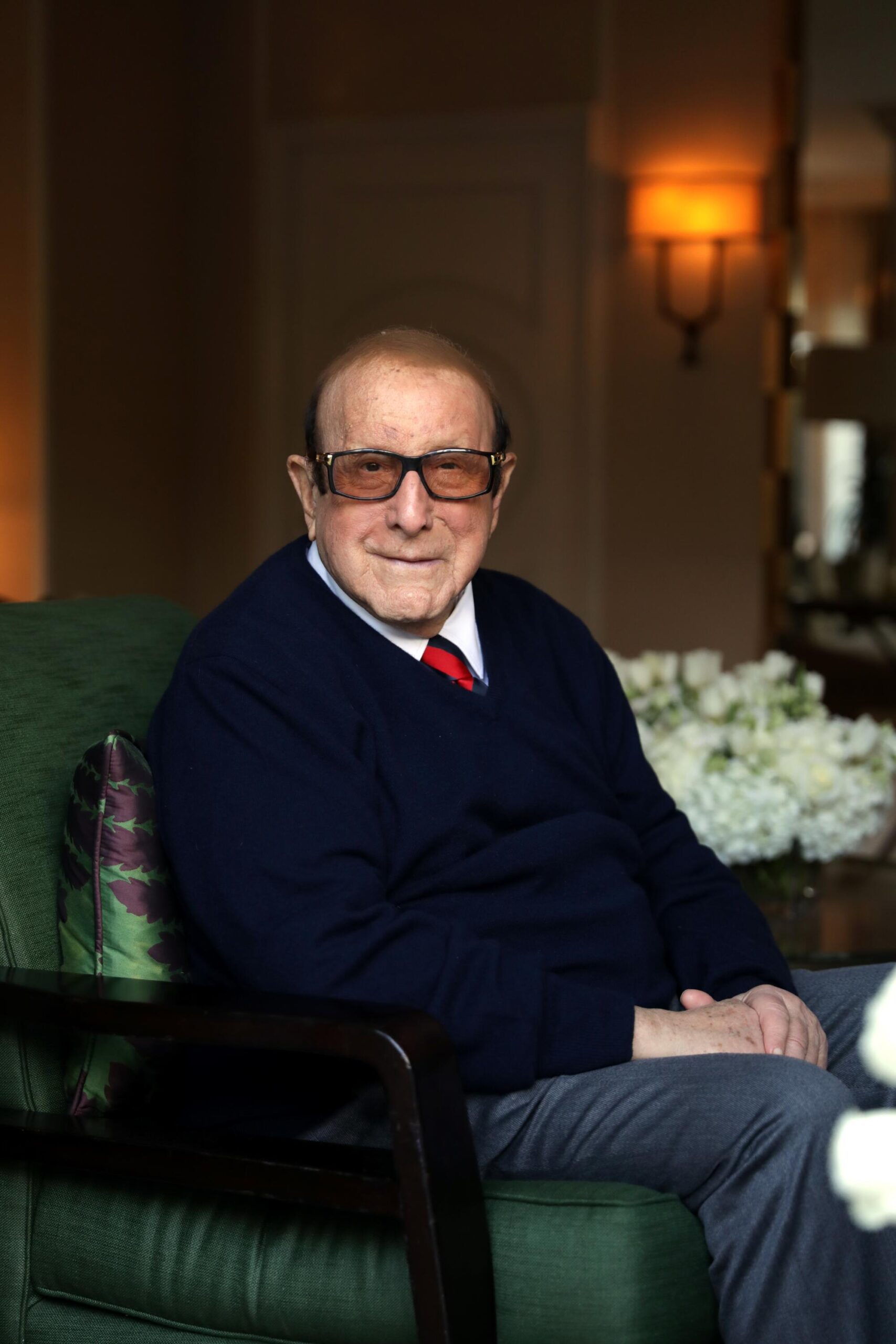
Clive Davis at the Beverly Hills Hotel in 2020.
(Christina House / Los Angeles Times)
Wherever he worked, Davis’ goal was shepherding hits that spanned formats and generations; he delighted in projects like “Smooth,” the inescapable Santana single pairing the rock guitarist and Rob Thomas of Matchbox Twenty, and a series of Great American Songbook albums by the once-scruffy Rod Stewart. He might also have been the music industry’s biggest believer in ballads, at least among suits: Between 1985 and 1992, Houston alone released almost a dozen of music’s all-timers, including “Saving All My Love for You,” “Didn’t We Almost Have It All” and — perhaps the greatest pop ballad ever recorded — her take on Dolly Parton’s “I Will Always Love You.” (It wasn’t a huge hit, but listen to Houston and Jermaine Jackson’s pedal-steel-drenched “Nobody Loves Me Like You Do,” from Houston’s debut, for an early instance of that crossover ambition.)
One of relatively few nonperformers inducted into the Rock & Roll Hall of Fame, Davis brought his flair for variety to the party he threw at the Beverly Hilton every year on the night before the Grammys — a famously hot ticket that drew A-list celebs from the worlds of music and Hollywood as well as business and politics. You could always count on the exec to have persuaded some number of the year’s splashiest new acts to perform; this year’s bash, in January, had Sombr, Olivia Dean and the women of “KPop Demon Hunters.” But my favorite part of the show was always seeing which veteran Davis had tapped to mix it up with the youngsters — Diamond or Manilow, for instance, or Johnny Mathis, who absolutely killed in 2015.
Davis horrified many in 2012 when he opted to proceed with his party just hours after Houston was found dead in a hotel room at the Beverly Hilton. In the years after the singer’s death, Davis drew criticism for taking too much credit for Houston’s artistic achievements; to some, he became a symbol of the music industry’s efforts to tone down Houston’s Blackness in order to reach white audiences. Five years ago, I asked Warwick, who was Houston’s cousin, whether she’d taken on any kind of consulting role on “I Wanna Dance With Somebody,” the 2022 Whitney biopic that Davis produced.
Bobby Brown, from left, Whitney Houston and Clive Davis in New York in 1998.
(Stuart Ramson / AP)
“Not one thing,” she told me. “I want them to let Whitney rest in peace. Leave her alone. Ten years [since she died] — it’s time to let her sleep.” (In a statement Monday, Warwick called Davis her “dear friend” and said she “can think of no other record man that seemed to have that magical ability to know a hit when he heard a song.”)
I spoke with Davis many times over the years and was always struck by his enthusiasm about music and about his recall of events from decades ago. In 2017, I interviewed the exec alongside Mathis and Kenneth “Babyface” Edmonds about a record the three made together that had Mathis singing newish pop songs like Adele’s “Hello” and Pharrell Williams’ “Happy” — a concept Manilow told me in March he and Davis had been talking about replicating. After my story ran, Davis emailed me and said he’d enjoyed the piece, which had a couple of lines about Davis’ tendency to go overboard hyping his projects.
“Yes, a few of your bites required a personal Band-Aid,” he wrote, “but I did appreciate your perspective of the Mathis album’s quality.”
He knew the music was good; Clive Davis always knew when the music was good.
PALM SPRINGS — Barry Manilow steers a golf cart to the end of a long driveway, pulls to a stop and flings a plush toy goose across a manicured lawn to the delight of his two Labrador retrievers.
“OK, where we doing this?” the 82-year-old singer asks about our interview. Dressed in a khaki shirt and slim-fitting rust-colored trousers, he’s got the look of a man prepared to undertake some très chic brush clearance; in reality, he’s motored down here merely to answer questions about his fabulous life and career.
Manilow and his husband and longtime manager, Garry Kief, moved to this sprawling desert estate from Los Angeles in the late 1990s. “We kept coming out, and it’s so beautiful that eventually we said, ‘Screw it — let’s just stay,’” he says. By then, Manilow had long since established himself as one of music’s premier showmen, with a Grammy Award, 11 Top 10 hits and a storied 15-night run at L.A.’s Greek Theatre under his belt.
So you might’ve taken Palm Springs as a sign that he was ready to slow down. Instead, he launched a residency at the Las Vegas Hilton in 2005 that eventually surpassed the length of Elvis Presley’s show there; in 2006, he released “The Greatest Songs of the Fifties,” which went platinum and spawned a series of successful follow-up albums.
Last month, Sabrina Carpenter interpolated a bit of Manilow’s iconic “Copacabana (At the Copa)” into her headlining set at Coachella just days before he was honored by the American Advertising Federation for his work writing commercial jingles. The range of those achievements said something about his blend of music-nerd craft and pop-star razzle-dazzle.
“Barry loves music as much as anyone I’ve ever known,” says Bette Midler, who hired Manilow as her pianist for the name-making gig she played at New York’s Continental Baths in the early 1970s. Performing, Midler adds, “isn’t a job with him — it’s a vocation, a calling.”
Yet now that calling faces a threat. In December, Manilow announced that he’d been diagnosed with lung cancer and that surgery would require him to postpone a number of concert dates; five months later, he has yet to return to the stage — the longest break, COVID-19 aside, he can remember taking in decades.
Fortunately for Manilow, he has a new album, “What a Time,” with which to occupy himself. Due June 5, it consists mostly of original material — his first such LP in nearly 15 years — though it opens with a sumptuous rendition of Peter Allen and Dean Pitchford’s “Once Before I Go.” Manilow notes proudly that the song, which was produced by Kenneth “Babyface” Edmonds, recently made Billboard’s adult contemporary chart, extending his run on that tally beyond the half-century mark.
Barry Manilow performs in Beverly Hills in 2025.
(Gina Ferazzi / Los Angeles Times)
Still, performing is clearly on his mind as he leads me into a tile-roofed gym equipped with weights, a treadmill and a massage table. Manilow has been working out here every morning, he says, to regain the strength needed for his show; he’s got Vegas dates on the books for July but admits he’s unsure whether they’ll happen or not. We settle into two leather club chairs, his dogs Jake and Abby at his feet.
“Please be brilliant,” he tells me. “Don’t be boring.”
What are you doing on a day you’re not working? Working.
I see. Since the surgery, I can’t go on the road. Ninety minutes of screaming in tune, which is what I do for a living — I’m not up for that yet. I will be, but it’s taking a long time to get my voice back. They warned me that I’d have to learn to breathe again. So these days, I get up, I go to my piano and I try to be creative. Before I know it, the afternoon’s over.
Was the diagnosis a shock? Imagine your doctor saying, “You’ve got lung cancer.”
Fair enough. I’ll tell you the story. I have terrible hips — bursitis and everything — and they hurt so bad that I thought maybe I broke a bone or something. So I asked my wonderful family doctor, I said, “Can you just do one of those MRIs and see?” Now, before that, I’d had two bad bouts of bronchitis, one after the next. Have you ever had bronchitis?
I have. It stinks. So I asked him if he could check my hip, and he told the guys that were doing it, “Why don’t you check his lungs?” And I think he might have saved my life because they found a big black thing in my chest. One doctor said it was probably remnants of the bronchitis, the other doctor said it could be cancer. I voted for the bronchitis. But they went back in to see and it was a cancerous tumor.
How’d you react? When they told me, I was on the road, and I just went back to sound check. What else could I do? I never thought cancer would get me — it wasn’t in the cards. They wanted to get rid of it as soon as possible, so we made a deal: I’d finish the couple of weeks of shows that I had, then I’d go to the hospital and they’d remove it. It was supposed to be a no-brainer — it hadn’t spread yet, thank goodness. But then my AFib kicked in and acid reflux kicked in and pneumonia kicked in. They rushed me to the ICU for seven days.
Barry Manilow with Dionne Warwick in Los Angeles in 1985.
(Paul Harris / Getty Images)
Sorry to be morbid, but were you close to death? They said at one point — I didn’t hear them say this but I heard that they did say it — “We don’t want to lose him.” It’s all a total blur now. When they finally brought me back to my lovely room at the Eisenhower [medical center], I weighed 128 pounds.
How long you figure it had been since you weighed 128 pounds? I don’t remember ever being 128.
You said you never thought cancer would get you. Why? I’m too busy. Pretty stupid. What I realized is that I’ve always been the leader — leader of the band, leader of an audience — but I wasn’t the leader of this one. That was a big lesson for me. I had to rely on everybody else. Nurses, doctors, friends — you should see some of the notes people have sent.
What’s it been like to be offstage for so long? Agony. Make an album, go on the road, come back, make an album, go on the road — that’s what my life’s been for years. And I like it. Now I just have to get better and do what the doctors are telling me. It’s the only way out.
Well, there’s one other way. I’m not ready to croak. But I wasn’t ready to stop performing either, and it just went like that [snaps fingers]. The day before surgery, people are screaming, standing ovation, band sounds great. Next day I’m packing to go to the hospital.
Are you working with a vocal coach? Yep. But I get winded just walking down the hallway. I turn on my old records and sing along, and three songs in I’m like [pants].
Could you do a show where you skip the uptempos? No “It’s a Miracle” or “Copacabana”? I’m trying ballads too — my ballads end big.
Are you allowed to smoke or drink? I stopped smoking many, many years ago. I vape but hardly — I just like holding it. I was a great smoker. Brooklyn in the ’50s? Please. I started smoking when I was 9. I got up to three packs of Pall Mall non-filters a day, and it never bothered me — never had any problem breathing. I was just a skinny piano player who smoked. That’s who I am. That’s who I was.
Before he was a skinny piano player, he was a skinny accordion player.
Manilow grew up poor in Brooklyn, the only son of a Jewish mother and an Irish father who split up right after he was born. As a kid he entertained his mom and his maternal grandparents by squeezing out the Jewish folk song “Hava Nagila”; later, his stepfather brought home records by Gerry Mulligan and Judy Garland that opened his mind to jazz and pop.
He says today that he never saw himself as a performer — he wanted to write, arrange, produce. His first success came with jingles for brands like State Farm — “Like a Good Neighbor” is his handiwork — and Band-Aid.
“My ideas were good for pop music because of the commercials,” he says. “The rules are pretty much the same — you need to grab the listener as soon as possible. For a commercial, you’ve got about five seconds. For a pop song, you’ve got 10.”
In 1971, Manilow got the job with Midler and ended up working on her million-selling debut, “The Divine Miss M,” which led to a deal of Manilow’s own with Clive Davis’ Arista Records. Despite Manilow’s insistence that he was a behind-the-scenes guy, he scored a No. 1 hit out of the box with the plaintive “Mandy,” then quickly followed that with another chart-topper, “I Write the Songs” — a pop-philosophical epic, as nobody’s tired of pointing out ever since, that Manilow didn’t actually write.
Barry Manilow at home in Palm Springs.
(Christina House / Los Angeles Times)
Bruce Johnston, who wrote “I Write the Songs” — and won a Grammy for song of the year thanks to Manilow’s recording — says the key to Manilow’s performance is that “he’s never too cool for school.” A Beach Boy for six decades until he retired from the band this year, Johnston adds that Manilow’s rendition of the song, which was also cut by Captain & Tennille and David Cassidy, “is the only one I care about, honestly. He really grabbed it — he’s just as real as he could be.”
After several more Manilow hits — “Tryin’ to Get the Feeling Again,” “Weekend in New England,” “Looks Like We Made It” — Davis asked the singer to produce a would-be comeback album by his latest Arista signing, Dionne Warwick. Warwick’s initial reaction to that idea: “Really?” she says with a laugh. “Did Barry Manilow really know anything about Dionne Warwick? As it turned out, he knew quite a bit,” adds Warwick, who recalls turning up for their first session to discover that Manilow had laid every one of her albums on his piano. “He was letting me know: I know you,” she says.
“Dionne,” the album they made together, went on to win a pair of Grammys and spun off silky hit singles including “Deja Vu” and “I’ll Never Love This Way Again” that reinvigorated Warwick’s career and helped solidify Manilow’s standing as a kind of soft-rock auteur.
Which isn’t to say that rock’s intelligentsia ever viewed him kindly. Though his best music finds an emotional truth in over-the-top theatrics, critics routinely dismissed Manilow as a lightweight or a schlockmeister; even now, he seems an unlikely candidate for the Rock & Roll Hall of Fame, where he’s been eligible for induction for decades.
Manilow, who entered the Songwriters Hall of Fame in 2002, insists the slights don’t bother him. “I’ve never been one of the guys,” he says. We’ve been talking for a while, and because of the bursitis, perhaps, he’s hoisted one of his legs over the arm of his chair. “I don’t think about awards and parties and stuff like that. I’m very lucky — I live in the most gorgeous place I’ve ever seen and I have the most wonderful partner that you can imagine. I’m grateful he’s chosen to share his life with me. We’ve been together for over 46 years, and we still laugh and we still love each other. That’s the greatest award I’ll ever get.”
Manilow and Kief married in 2014; the singer came out as gay three years later. (Manilow was briefly married to his high school girlfriend, Susan Deixler, in the mid-1960s.) Has he found that the world looks at him differently since he came out?
“It was a non-event. Nobody gave a s—,” he says. “They all knew. I never really hid it, but in the ’70s and ’80s, that would have killed the career, and I didn’t want to do that. So I just never talked about it.” He smiles.
“Garry and I are just two guys that live in a house on a hill with two dogs that we love.”
Like many of Manilow’s hits, “Once Before I Go” was Davis’ idea.
Allen, the late Australian entertainer portrayed by Hugh Jackman in Broadway’s Tony-winning “The Boy From Oz,” had played the tune for Manilow in the early ’80s. “And I loved it,” Manilow says now. “But I was too young to sing a song like that — that song needs age to be able to pull it off honestly.”
Davis first suggested that Manilow perform it in his set at the post-pandemic We Love NYC concert that Davis put on in Central Park in 2021. After the show, which was called off due to weather as Manilow sang “Can’t Smile Without You,” Davis repeatedly advised the singer to record it.
Clive Davis, left, with Barry Manilow at an Arista Records party in Los Angeles in 1989.
(Lester Cohen / Getty Images)
“I don’t know, he had a bug up his ass,” Manilow says. “He loved it, and he loved it for me. And I’m not even on his record label anymore — he’s just a friend at this point. But he was right once again.”
Given the cancer diagnosis, did Manilow worry that fans might interpret the song — a teary goodbye from a well-wishing lover — as a more permanent farewell?
“Not one time has anybody said, ‘Is he talking about dying?’”
You wouldn’t necessarily call “What a Time” a concept album, though many of the songs ponder the ways memory and history can shape a romance. Manilow knows he’s regarded as a singles act but says that putting together LPs is what he’s always enjoyed best. His favorite is 1984’s jazzy “2:00 AM Paradise Cafe,” on which he collaborated with Mulligan, Sarah Vaughan and Mel Tormé.
“That was one where the critics who’d been killing me, they didn’t know I was capable of doing something like that,” he says. “But frankly, I’d been surprised that I was capable of doing the pop stuff.”
You made records of hits from the ’50s, ’60s, ’70s and ’80s. Why’d you stop before “The Greatest Songs of the Nineties”? Were there songs in the ’90s?
Barry. Didn’t it start to go downhill?
I can think of a handful of classics by Whitney Houston alone. You can’t touch those. I’m a good arranger, but you can’t top those records. Maybe four of those albums was enough. I was ready to go back to writing.
You’ve said the problem with modern pop is that there’s no melody anymore. That’s what I miss. Clive’s been pushing me to do “The Great New American Songbook.”
Like he did with Johnny Mathis a few years ago. So I’ve been studying the Top 20. The one I like is Lady Gaga and Bruno Mars.
“Die With a Smile.” Love that. But the way they’re writing songs these days is not the way I know how to write songs. They don’t do a verse, a chorus, a bridge, a chorus, a big ending. To me, when I listen, the songs feel like run-on sentences.
Barry Manilow with his dog Abby.
(Christina House / Los Angeles Times)
I was trying to think of artists older than you who are still performing. Name me one.
You’re invoking the widely held assumption that he lip syncs. I loved Frankie Valli and the Four Seasons. Who didn’t?
Would you ever lip sync? I’m terrible at it. I try now and again.
Do you find it morally objectionable? Depends on the artist. I like being in the moment, not knowing what’s gonna happen in the next bar or at the ending. It’s exciting to me to see if I can make those high notes.
Would not being able to make them mean it’s time to hang it up? Well, what’s happening right now, I’m on the verge. But I’m getting stronger, so maybe I don’t have to hang it up yet. I look fantastic, but I’m a hundred years old, right? I don’t know how that happened, by the way — I don’t get Botox or anything.
You’ve had no work done? No! I must say: There was one time when we lived in L.A. that I did do a facelift. But after that it’s just been a little here, a little there.
Wait, I asked you — “Work” is like a facelift, and I only had one of those. The rest of it — I see something falling down, sure, I’ll do that. I’m as vain as anybody else. One of my old friends, his mother said, “I always knew he was talented, but when did he get so handsome?”