Shohei Ohtani’s knee troubles creating a major Dodgers dilemma
NEW YORK — What if the Dodgers never get a full season of pitching from Shohei Ohtani?
In his first season with the Dodgers, he did not pitch at all. In his second, he did not pitch until June. And, halfway through this third season, Dodgers manager Dave Roberts admitted Sunday he could not say when Ohtani might pitch again.
“Don’t know yet,” Roberts said.
October might be your immediate concern, and it should concern the Dodgers too. Of the four starting pitchers they would plan to use in the postseason — Yoshinobu Yamamoto, Blake Snell, Tyler Glasnow and Ohtani — Yamamoto is the only one pitching major league innings right now. It’s not Tarik Skubal or bust, but the Dodgers should trade for someone they would start in a playoff game.
Yet, for a player with seven years left on his $700-million contract beyond this one, there might be a lot fewer opportunities to celebrate Ohtani as a two-way player than the Dodgers and their fans envision.
Ohtani did not pitch in his first year and a half with the Dodgers as he recovered from elbow surgery. When his rehabilitation was complete, he was good to go.
This is different. Ohtani is battling irritation in his left knee. Roberts used three concerning words to describe it: “wear and tear.”
There is no easy fix. The lubricant injection Ohtani received a week ago relieves symptoms for a short period of time, usually a few months. It is repeatable, but its benefits are not always felt right away.
The Dodgers had announced Ohtani would start Wednesday. Roberts said Ohtani experienced discomfort while playing catch, and that was enough for the Dodgers to push back his next start to…
“I would say that it’s going to be some time,” Roberts said. “It’s not going to be a day-to-day thing.”

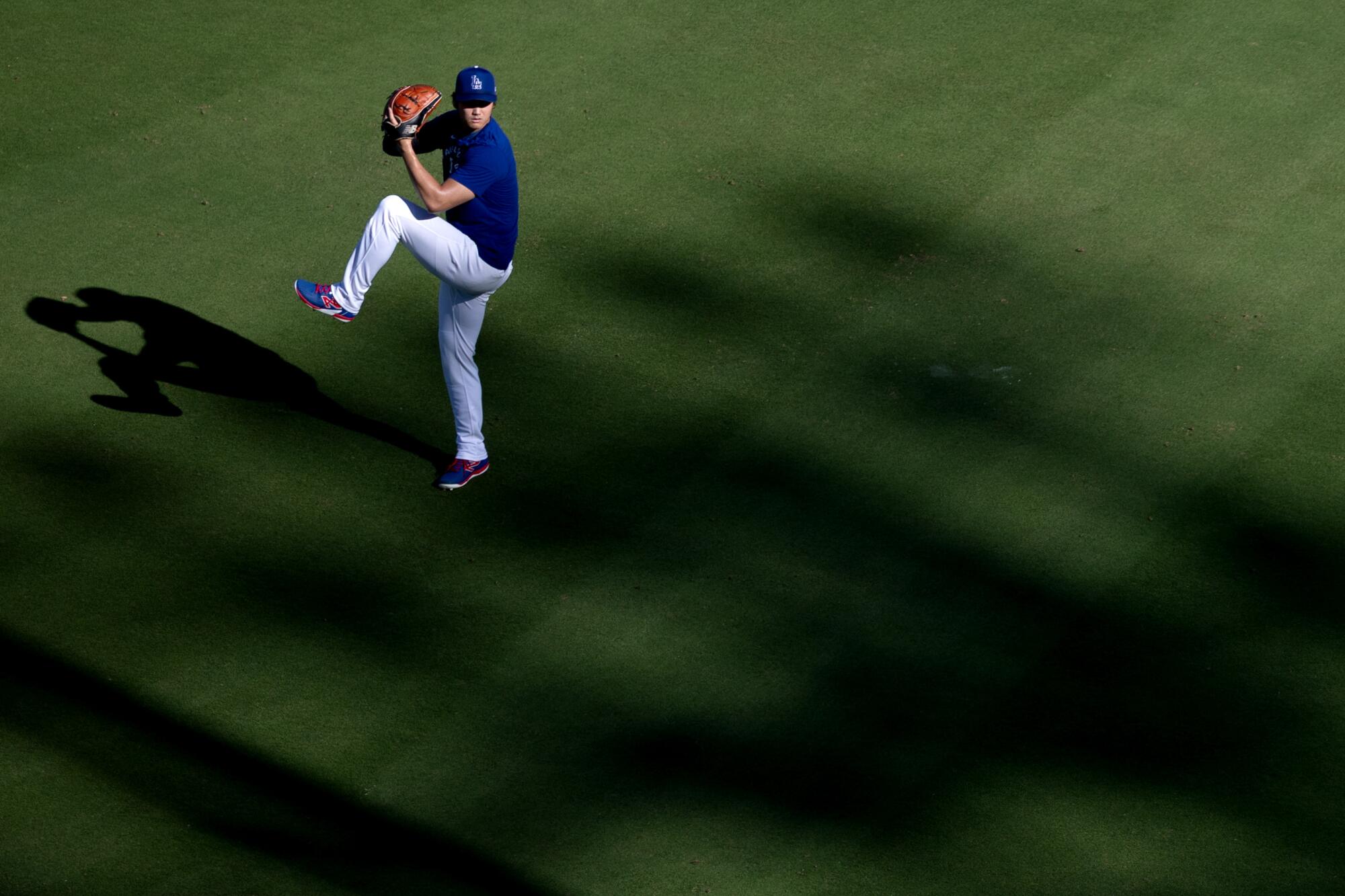
Shohei Ohtani warms up before facing the Tampa Bay Rays at Dodger Stadium on June 15.
(Eric Thayer / Los Angeles Times)
If it is a wear-and-tear thing, there might be no solution besides management over the remainder of his career.
“I think it’s a little bit, it’s just like all of us, all athletes, that kind of have wear and tear,” Roberts said. “That’s just part of it, and now it’s just kind of showing itself a little bit, and then you got to manage it. I think that it’s the years of sliding, pitching, hitting and all that stuff.”
Ohtani is aware of this. He is 32. This is his 14th professional season. He reported to spring training with the goal of winning the National League Cy Young award, in part because who knows how long you can do everything at an elite level on a baseball field?
“Inside, I’m assuming this is my last chance as a pitcher,” Ohtani told the Japanese sports magazine Number in an interview published last month.
In his first 10 starts this season, he posted a 0.74 earned-run average, never giving up more than two runs in a start. In the four starts since the knee irritation surfaced June 10, his ERA is 4.38, and he has given up at least three runs in each start.
Can he pitch effectively if he can tolerate the discomfort? Would he want to? Would the Dodgers want him to, given their investment in him as one of the most dynamic hitters in baseball history?
To this point, Roberts said, Ohtani has experienced the irritation only on the mound, not at bat. As a result, Roberts said, the Dodgers do not believe shutting down Ohtani as a hitter for a few days would help ease the discomfort.
Maybe this works, with the injection calming the knee long enough to get Ohtani through the season, or with the irritation waning. Even then, it’s going to take some time.
“The first step is getting him into a spot where he feels like, and we feel like, he can pitch and not regress,” Roberts said.
Ohtani has not pitched in 16 days, and let’s say he does not pitch for another 16. Then the Dodgers would be looking at building back Ohtani’s endurance as they ramp up for the playoffs. So, even if Ohtani can return, could he pitch deep into a postseason game?

Shohei Ohtani hits a home run against the Tampa Bay Rays at Dodger Stadium on June 16.
(Eric Thayer / Los Angeles Times)
The Ohtani Effect is real, and grand. It is measured in T-shirts and ticket sales, tourists and movie promotions, bobblehead dolls and international corporate sponsorships.
But all of that should not obscure Ohtani’s greatness as a player.
If Aaron Judge cannot hit, he cannot help the Yankees, and they entered play Sunday 18-20 since he suffered a rib injury.
If Ohtani cannot pitch … well, he has hit 11 home runs since then, for the team with the best record in the major leagues.
The Dodgers do not believe Ohtani’s viability as a pitcher is in jeopardy, but we can already hear the cynics: In a worst-case scenario, if he could not pitch well again, would the contract be worth it?
It already is: Two full seasons, two World Series championships.