Diego

F-16s Arrive To Protect Diego Garcia, F-22s Forward Deploy To Israel

Secretary of State Marco Rubio updated U.S. legislators on Iran just hours before President Donald Trump issued warnings over Tehran’s nuclear ambitions in his State of the Union address. In the past days, U.S. military forces in the region have grown to the highest levels seen since the lead-up to the invasion of Iraq in 2003. New assets that have arrived include U.S. Air Force F-22 Raptors, reportedly in Israel, while F-16s have been deployed to Diego Garcia to protect the Indian Ocean outpost against potential Iranian attacks.

Rubio provided a rare intelligence briefing for congressional leaders — the so-called “gang of eight” — which includes the senior lawmakers from both parties in the House and Senate, as well as the chairs and ranking members of the House and Senate intelligence committees. The contents of the briefing are classified, but it underscores the wider preparations for potential significant military action against Iran.

WASHINGTON, DC - FEBRUARY 24: Secretary of State Marco Rubio arrives in the chambers of the U.S. House of Representatives ahead of President Trumpâs State of the Union address in Washington, DC on February 24, 2026. (Photo by Nathan Posner/Anadolu via Getty Images)
Secretary of State Marco Rubio arrives in the chambers of the U.S. House of Representatives ahead of the State of the Union address in Washington, DC on February 24, 2026. Photo by Nathan Posner/Anadolu via Getty Images Anadolu

The “gang of eight” receives classified intelligence from the White House in the form of briefings, and their content can include preparations for military operations. It is notable that the last time Rubio publicly briefed the group was on January 5, one day after the U.S. military launched its successful operation to capture Venezuela’s Nicolás Maduro.

Iran’s leaders know the consequences for pursuing nuclear weapons.

They should not repeat past mistakes.

— Senate Republicans (@SenateGOP) February 24, 2026

As he left yesterday’s briefing, Senate minority leader Chuck Schumer said: “This is serious, and the administration has to make its case to the American people.”

Following today’s classified briefing on Iran by Secretary of State Marco Rubio to members of the Gang of Eight, Senate Minority Leader Chuck Schumer, (D-NY), stated to reporters, “This is serious, and the administration has to make its case to the American people.” pic.twitter.com/VWv76XdO9N

— OSINTdefender (@sentdefender) February 24, 2026

“I’m very concerned,” added Jim Himes, the ranking democrat on the House intelligence committee. “Wars in the Middle East don’t go well for presidents, for the country, and we have not heard articulated a single good reason for why now is the moment to launch yet another war in the Middle East.”

Jim Himes, ranking D on House Intel, after Rubio/Ratcliffe Gang of 8 briefing: “I’m very concerned. Wars in the Middle East don’t go well for presidents, for the country, and we have not heard articulated a single good reason for why now is the moment to launch yet another war in…

— Laura Rozen (@lrozen) February 24, 2026

Rubio’s intel update preceded Trump’s State of the Union address last night, during which the U.S. president reaffirmed that Iran would never be permitted to acquire nuclear weapons.

In his address, Trump stated that he would rather handle rising tensions with Iran through diplomatic means. However, he also claimed that Tehran was developing ballistic missile technology that could potentially reach the United States, without providing further details.

“They’ve already developed missiles that can threaten Europe and our bases overseas,” Trump said. “And they’re working to build missiles that will soon reach the United States of America.”

This might be a reference to Iran’s burgeoning space-launch capability. Under this effort, Iran’s Islamic Revolutionary Guard Corps (IRGC) is developing advanced space-launch vehicles able to put satellites into orbit. While the program is officially non-offensive, there have been concerns that the same technologies could be used to help the IRGC develop long-range ballistic missiles.

Trump has repeatedly called upon Iran to give up its nuclear program, abandon its production of ballistic missiles, and terminate its support for overseas proxies such as Hezbollah in Lebanon and the Houthis in Yemen.

“We are in negotiations with them,” Trump continued. “They want to make a deal. But we haven’t heard those secret words: we will never have a nuclear weapon.”

PRESIDENT TRUMP on IRAN: My preference is to solve this problem through diplomacy, but one thing is certain: I will NEVER allow the world’s number one sponsor of terror to have a nuclear weapon.

We have to be strong. It’s called peace through strength. pic.twitter.com/0CPKHtvQDt

— Department of State (@StateDept) February 25, 2026

The developments came as U.S. military assets continued to flow into the region, providing more options for an operation against Iran, should Trump order it. Over the weekend, U.S. Air Force tankers and transports continued to arrive in the wider region after transatlantic flights.

As well as a second aircraft carrier, the USS Gerald R. Ford, which arrived in the eastern Mediterranean earlier this week, F-22s have also arrived in-theater, according to multiple reports.

Intersting choice.

USAF F-22 fighter jets redeployed from the UK will be stationed at the Ovda Air Base in southern Israel, per reports.

H/t to @EISNspotter as I believe that he broke the news first.

At this moment, we know about the redeployment of 11 F-22s (one from the… https://t.co/v1MKiiDXHr pic.twitter.com/4KOFvJl6yd

— Status-6 (War & Military News) (@Archer83Able) February 24, 2026

The stealth jets took off from RAF Lakenheath in England yesterday, confirmed by open-source flight tracking data and aircraft spotters, and are now at an Israeli Air Force base in the south of Israel, according to The Times of Israel. The base in question is reportedly Ovda, home to an Israeli Air Force F-16C unit.

A total of 12 F-22s were seen taking off from Lakenheath, although one apparently returned to the airbase due to a technical issue. The Raptors had arrived at the base last week.

The presence of F-22s — as well as KC-135 Stratotankers — in Israel reflects the fact that Israel will almost certainly be fully integrated into any potential U.S. operation against Iran. Furthermore, the United States has limited basing options in the region, including countries that have said they would not allow U.S. operations to have access to their airspace. Meanwhile, the threat of Iranian short-range missiles and drone strikes also limits where these U.S. assets can go.

As we have mentioned, very limited basing options for this due to threats and (supposed) airspace restrictions. US fighters basing in Israel was a given. https://t.co/taW12VlhqH

— Tyler Rogoway (@Aviation_Intel) February 24, 2026

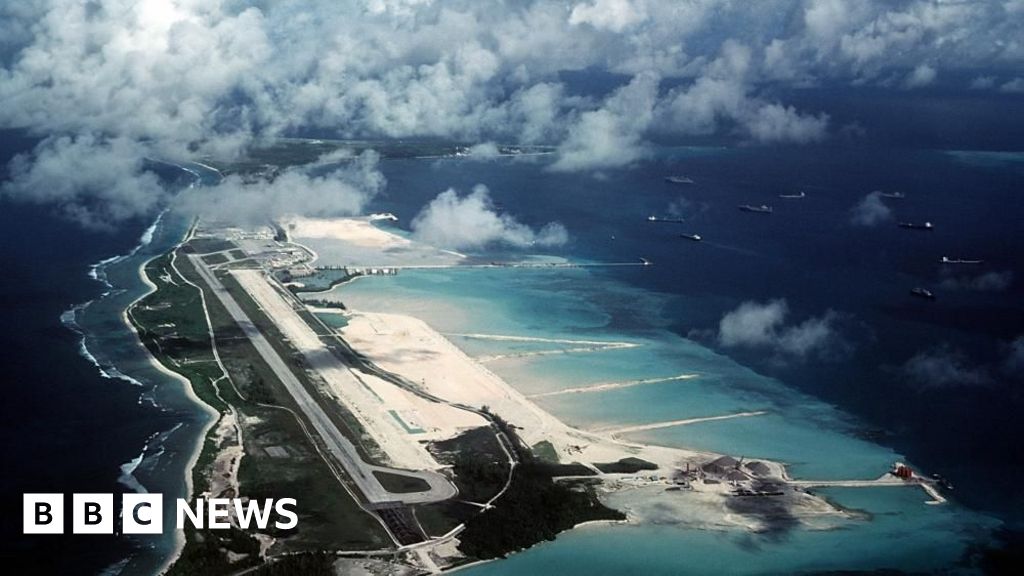
Meanwhile, recent satellite imagery from Diego Garcia in the Indian Ocean reveals the build-up of aircraft at the base, which could be important to any U.S. plans for a sustained campaign of airstrikes against Iran. While long-range bombers periodically operate out of Diego Garcia, the facility is now hosting cargo and refueling support aircraft, as well as F-16CM fighters from the 35th Fighter Wing that recently deployed there from Misawa Air Base in Japan. These would be key assets in defending the island from a possible Iranian attack. As we reported last week, the United Kingdom has apparently said it would not allow the use of the island for strikes on Iran, although this position may well change. Regardless, the importance of the force-protection mission at Diego Garcia — increasingly threatened by Iranian long-range attack drones and missiles — is something we have discussed in the past.

New satellite image from MizarVision (ignore their poor AI overlay) of Diego Garcia shows multiple U.S. assets on the apron, including KC-135 tankers, a C-5, a C-17, a P-8, and F-16s. pic.twitter.com/2rnZd2sH2N

— Faytuks Network (@FaytuksNetwork) February 25, 2026

The Israeli media further reports that the country’s officials now believe that a U.S. attack on Iran is “unavoidable.”

One Israeli official quoted by the country’s Channel 12 news yesterday reportedly said that a diplomatic resolution to the conflict would be the “surprise of the year.”

However, such accounts should be treated with great caution, considering that such claims have been repeated relentlessly by Israeli media.

Israel media thinks the attack has been coming on many nights for weeks. The chances continue to rise, but don’t take this as a hard indicator in any way. Totally unreliable. https://t.co/b2uJsblvqi

— Tyler Rogoway (@Aviation_Intel) February 24, 2026

The next round of U.S.-Iran talks is scheduled to take place in Geneva tomorrow.

Iranian Deputy Foreign Minister Majid Takht-Ravanchi said that his country was “ready to reach an agreement as soon as possible,” in an interview with NPR.

Iran’s Deputy Foreign Minister Majid Takht-Ravanchi:

How can anybody expect Iran to be silent? We have to respond to US assets in the region.

Does sending an armada mean they want to intimidate Iran? That is not going to happen. Iranians have proved to be resilient.

There is… pic.twitter.com/pCxnrlE2D2

— Clash Report (@clashreport) February 24, 2026

“We want to do whatever’s necessary to make it happen,” he continued. However, Takht-Ravanchi added that the talks would relate only to Iran’s nuclear program, which may well not be enough to satisfy U.S. officials.

The U.S. delegation in Geneva will be led by Trump’s Middle East envoy Steve Witkoff. As well as Rubio, they will also include Trump’s advisor Jared Kushner, Vice-President JD Vance, CIA Director John Ratcliffe, Secretary of Defense Pete Hegseth, White House Chief of Staff Susie Wiles, and Director of National Intelligence Tulsi Gabbard.

Speaking last week, Trump said that if Tehran didn’t agree to a deal, the United States would have to “take it a step further.” The U.S. president gave a time limit of 10 days before “really bad things” would happen to Iran.

There have been other recent signs that the United States may be gearing up for an imminent operation.

Earlier this week, the U.S. Embassy in Beirut evacuated “dozens” of non-essential personnel as “a precautionary measure due to anticipated regional developments.”

Travel Advisory: Updated to reflect ordered departure of non-emergency U.S. government personnel and family members of government personnel on February 23.

On February 23 the Department of State ordered the departure of non-emergency U.S. government personnel and family members… pic.twitter.com/vfxdlAnXOf

— U.S. Embassy Beirut (@usembassybeirut) February 23, 2026

In other news out of Lebanon, Hezbollah has reportedly said that it will not hit back against the United States and its allies should the U.S. military launch “limited” strikes against Iran.

Elsewhere in the Middle East, Reuters reports that Saudi Arabia is ramping up its oil production and exports as part of a contingency plan in case a potential U.S. strike on Iran disrupts supplies from the region.

#SaudiArabia is increasing its oil production and exports as part of a contingency plan in case any U.S. strike on #Iran disrupts supplies from the Middle East, two sources familiar with the plan said on Wednesday.https://t.co/yg0zhkWksG

— Jason Brodsky (@JasonMBrodsky) February 25, 2026

Meanwhile, Rubio reportedly delayed a Saturday meeting with Israeli Prime Minister Benjamin Netanyahu to Monday, according to Israeli officials.

There have been concerns, at the highest levels, that, should the United States become involved in a conflict with Iran, the U.S. military could rapidly burn through its stockpiles of certain key weapons.

Reportedly, Gen. Dan Caine, the chairman of the Joint Chiefs of Staff, has warned Trump that such a campaign could have a severe impact on the U.S. stockpile of anti-missile interceptors, including the Patriot, Terminal High-Altitude Area Defense (THAAD), and ship-launched missiles such as the Standard series.

If this Iran thing really pops off, our stocks of critical interceptors, which take years and huge sums of money to build, will be really depleted. The stockpile is already an emergency. If Iran goes full send, SM-3, THAAD interceptors, PAC-3s etc will ran through. Once again,…

— Tyler Rogoway (@Aviation_Intel) February 23, 2026

Trump pushed back against those warnings, claiming that Caine was “against us going to war with Iran.”

“General Caine, like all of us, would like not to see War but, if a decision is made on going against Iran at a Military level, it is his opinion that it will be something easily won,” Trump wrote on his Truth Social platform. Caine “has not spoken of not doing Iran, or even the fake limited strikes that I have been reading about, he only knows one thing, how to WIN and, if he is told to do so, he will be leading the pack.”

JUST IN – Trump says reports that the Pentagon is warning him against attacking Iran are “100% incorrect,” and if the U.S. military goes to war with Iran “it will be something easily won.” pic.twitter.com/46xs950Q0F

— Disclose.tv (@disclosetv) February 23, 2026

‘The Pentagon seems to have discovered that if the US went in for a big campaign against the Iranian regime, they would be out of munitions.’

Professor Michael Clarke shares his analysis of the Iran-US tensions, following Donald Trump’s State of the Union address… pic.twitter.com/pqvGuuRXF9

— Sky News (@SkyNews) February 25, 2026

As to when a possible U.S. operation could be launched, Charles Wald, a retired Air Force general and former deputy commander of U.S. European Command, told The Guardian, “We could go now.”

Ward suggested that Trump’s ultimatums, combined with the scale of the military buildup, could force him into taking action.

Should that happen, the U.S. president’s options would include limited strikes intended to force Tehran to comply with Washington’s demands in the negotiations. Potentially, the U.S. military could also launch a more concerted offensive intended to decapitate or destabilize the Iranian government.

Much will likely hinge on the progress of the talks in Geneva tomorrow.

Contact the author: thomas@thewarzone.com

Thomas is a defense writer and editor with over 20 years of experience covering military aerospace topics and conflicts. He’s written a number of books, edited many more, and has contributed to many of the world’s leading aviation publications. Before joining The War Zone in 2020, he was the editor of AirForces Monthly.


Source link

When the Strong Decide: Diego Garcia, Raw Power, and the Illusion of Conditional Access

On 18 February 2026, reports emerged that Britain was withholding American permission to use Diego Garcia in any hypothetical strike against Iran. The following day, Trump posted “DO NOT GIVE AWAY DIEGO GARCIA” on Truth Social, linking the base directly to potential operations against Tehran in terms that left no room for diplomatic interpretation. The sequence lasted forty-eight hours and revealed what months of careful legal construction had obscured: that the architecture of conditional access Britain had built around a strategically significant military installation was worth precisely what the decisive power chose to make it worth. Whether the intervention also carried tactical signalling toward Tehran is a legitimate question, and intra-alliance friction of this kind sometimes functions as maximalist positioning before settlement. What matters analytically, however, is not the post itself but what the post revealed when operational pressure arrived. It was also, for anyone who had read Washington’s December 2025 National Security Strategy carefully, entirely predictable.

Power Does Not Ask

There are two ways to understand how military power operates in the international system, and the Chagos episode forces a choice between them. The first holds that great powers are meaningfully constrained by the frameworks they inhabit, alliance structures, legal agreements, and diplomatic settlements, and that these frameworks produce stable, predictable behavior even when the underlying interests they were designed to manage come under pressure. The second holds that frameworks are expressions of power relationships at a given moment rather than independent constraints upon them, so that when power shifts or decides to assert itself, the frameworks adjust to reflect the new reality rather than containing it. The first is the language of liberal internationalism. The second is the language of realism, and what February produced was an unambiguous realist moment.

The December 2025 National Security Strategy had already committed this diagnosis to paper. The document did not describe Europe as weak through circumstance. It described Europe as having chosen weakness, identifying a “loss of national identities and self-confidence” as the continent’s defining condition and stating openly that it is “far from obvious whether certain European countries will have economies and militaries strong enough to remain reliable allies.” The strategy framed European concerns about Russia as evidence of that same condition, noting that this lack of self-confidence was most evident in Europe’s relationship with Russia, despite the fact that European allies enjoy a significant hard power advantage over Russia by almost every measure save nuclear weapons. Washington’s reading of its European partners, formalized two months before the Diego Garcia friction became public, was of states that had systematically preferred institutional solutions over sovereign ones, legal arrangements over unconditional control, and managed conditionality over the exercise of will. Britain’s handling of Chagos was, in that context, not an anomaly. It was a confirmation.

What is analytically significant about Trump’s intervention is not simply that he rejected the deal but that he did not engage it at all, did not address the ICJ ruling that gave it legal foundation, did not contest the lease terms that were its operational expression, and did not enter the diplomatic logic that had produced it over months of negotiation. A decision of this kind does not derive its authority from the framework it overrides, because it precedes that framework, and the framework itself only ever existed on the sufferance of the power now choosing to move against it. When Trump asserted that leases are “no good when it comes to countries,” he was not making a legal argument that could be answered within the same register. He was stating a principle about the nature of sovereign will: that when it moves, it moves prior to and above whatever conditional arrangements were constructed in the period of its dormancy.

This is realism in its purest operational form, in which states pursue interests, great powers pursue interests with the capacity to enforce them, and legal architecture functions as an instrument of power when it serves those interests and an obstacle to be displaced when it does not. The Chagos deal did not alter the underlying power relationship between Washington and London, but it did create a layer of conditionality over an asset Washington considers operationally essential, and when operational pressure arrived, that conditionality became intolerable, not because Mauritius is hostile, not because Britain is an adversary, but because no great power conducting military projection at a global scale can accept that a weak state sits structurally inside the chain of its operational decisions, regardless of how that state arrived there or how benign its intentions are understood to be.

Beneath the realist logic sits a transactional one, and the two reinforce each other in ways that matter for how Britain should read what happened. Trump does not evaluate alliance relationships by their historical depth or their institutional architecture. He evaluates them by what they yield in the current moment, and every asset is a leverage point to be maximized. Diego Garcia represents unconditional American operational value. The Chagos deal reduced that value by inserting a condition. From a transactional perspective, that insertion was not a diplomatic nuance to be managed but a concession to be reversed, because Trump’s governing principle across every alliance relationship is maximum American gain, and conditionality is by definition a reduction of gain. The decisionism explains how he responded. The transactionalism explains why.

The Geography of Decision

Diego Garcia is not incidental to American power projection in the region, though its significance is that of an enabler rather than a prerequisite. The base sits at the center of the Indian Ocean, within operational reach of the Persian Gulf, the Strait of Malacca, and the East African littoral, and it has supported American military operations across that entire arc for half a century through bomber rotations, logistics chains, and a sustained forward presence that no other installation in the basin fully replicates at the same scale and permanence. It does not make American power projection possible in any absolute sense, but it makes it faster, cheaper, and more sustained, which in the context of time-sensitive operational planning against a target like Iran is not a marginal difference but a meaningful one.

The Iran dimension exposes the conditionality problem with particular clarity because the operational context in which Diego Garcia’s value is most acute is precisely the context in which conditional access is most dangerous. American military assets have accumulated across the Middle East, talks are active, and a base capable of projecting strategic airpower directly into the Persian Gulf theater is not a background consideration but a variable whose availability, or unavailability, shapes what options exist and on what timeline. Britain’s reported reluctance to grant operational clearance, under a deal still unratified and still contested in domestic courts, still legally dependent on Mauritius’s continued cooperation, revealed that the conditionality embedded in the arrangement had already entered the operational calculus before any of the stabilizing assumptions behind the deal had time to establish themselves. Strategic friction did not arrive at the end of a long maturation period. It arrived in weeks, because operational pressure does not wait for diplomatic frameworks to consolidate.

That compression of the timeline is itself the most realistic lesson. Power does not defer to the developmental logic of legal arrangements, and when the operational moment arrives, whatever sits between a great power’s will and its objective is reclassified from a framework to be respected into a problem to be solved.

The Structural Position of the Weak

The analytical core of the Chagos case is not about Mauritius’s intentions, which by all available evidence are not hostile, but about the structural position that the deal assigned to it within the architecture of American operational planning, because in the logic of great power competition, it is position rather than intention that determines strategic relevance. By inserting itself, or being inserted, into the chain of conditions governing a great power’s operational freedom, a weak state acquires a form of leverage it could never achieve through military means, and the Chagos deal gave Mauritius exactly that position, not through hostility but through legal standing, not through power but through presence within a conditional architecture that a great power now had reason to find constraining.

For Washington operating within a decisionist strategic logic, that presence is categorically unacceptable regardless of Mauritius’s intentions. The relevant question is not whether Mauritius would obstruct American operations but whether, under the terms of the arrangement, it structurally could, and the answer is yes in a way that no amount of diplomatic goodwill can fully neutralize. Sovereignty transferred to Mauritius is not sovereignty parked with a neutral party but sovereignty that now sits within reach of Chinese economic leverage, meaning the lease does not merely introduce conditionality but introduces conditionality whose future content Washington cannot determine or guarantee. A great power conducting global military projection cannot organize its operational planning around the sustained goodwill of a small state whose strategic orientation it cannot guarantee. That such goodwill is required at all is the problem the deal created.

Weak states do not constrain great powers through legal arrangements in any durable sense, because the constraint only holds when the great power chooses to honor it, and great powers choose to honor constraints only when the cost of non-compliance exceeds the cost of compliance, a calculation that shifts decisively once operational necessity enters the equation and the framework reveals itself to be dependent on tolerance rather than grounded in power.

Conclusion

Britain converted unconditional sovereign control over a strategically significant military installation into a conditional leasehold arrangement whose operationalization depended on a small state’s legal cooperation and presented that conversion as a resolution of vulnerability rather than the creation of a new one. Britain was not being naive. It was an attempt to preserve the base’s long-term legal viability against mounting international pressure, a calculation that the alliance relationship would absorb any friction that followed. What Britain did not account for was that its ally evaluates arrangements not by their legal durability but by whether they constrain American will, and a solution sophisticated enough to satisfy international law was simultaneously insufficiently decisive to satisfy Washington.

From the perspective of the December 2025 National Security Strategy, that conversion was not a surprise. It was the predictable output of a European strategic culture that Washington had already formally diagnosed: one that reaches instinctively for institutional solutions when strong states would resolve through will, that mistakes legal legitimacy for strategic security, and that has internalized the habits of the post-Cold War order to the point where it can no longer easily distinguish between a framework and the power that makes frameworks real.

Trump’s response was the most realistic verdict on that presentation, not an argument against the deal’s legal coherence, which was never in question, but a decision that the framework was insufficient for the operational reality it was meant to serve, delivered in terms that made the underlying logic unmistakable. The framework did not collapse under the pressure. It was revealed, under pressure, to have rested entirely on the assumption that the decisive power would continue to choose not to decide otherwise, an assumption that realism has always identified as the central fragility of arrangements built on consent rather than grounded in power.

The strong do not negotiate with the architecture of constraint, and for Europe, February was less a shock than a reminder that the rules it has built its strategic identity around have always depended on the continued willingness of a decisive power to operate within them.

Source link

A first look at Elephant Valley inside San Diego Zoo Safari Park

Before we see elephants at Elephant Valley in the San Diego Zoo Safari Park, we come face to face with destruction, only the wreckage is beautiful. A long, winding path takes guests around and under felled trees. Aged gray tree hunks form arches, for instance, over bridges that tower over clay-colored paths with hoof prints.

The design is meant to reorient us, to take us on a trail walked not by humans but traversed and carved by elephants, a creature still misunderstood, vilified and hunted for its cataclysmic-like ability to reshape land, and sometimes communities.

  • Share via

“It starts,” says Kristi Burtis, vice president of wildlife care for the Safari Park, “by telling the story that elephants are ecosystem engineers.”

Elephant Valley will open March 5 as the newest experience at the Escondido park, its aim to bring guests closer than ever to the zoo’s eight elephants, which range in age from 7 to 36, while more heavily focusing on conservation. The centerpiece of the 13-acre-plus parkland is a curved bridge overlooking a savanna, allowing elephants to walk under guests. But there are also nooks such as a cave that, while not previewed at a recent media event, will allow visitors to view elephants on their level.

In a shift from, say, the Safari Park’s popular tram tour, there are no fences and visible enclosures. Captive elephants remain a sometimes controversial topic, and the zoo’s herd is a mix of rescues and births, but the goal was to create a space where humans are at once removed and don’t impede on the relative free-roaming ability of the animals by keeping guests largely elevated. As an example of just how close people can get to the herd, there was a moment of levity at the event when one of the elephants began flinging what was believed to be a mixture of dirt and feces up onto the bridge.

An aerial view of Elephant Valley at the San Diego Zoo Safari Park, home to eight elephants.

An aerial view of Elephant Valley at the San Diego Zoo Safari Park, home to eight elephants.

(Allen J. Schaben / Los Angeles Times)

An elephant, viewed closely from the side.

“Our guests are going to be able to see the hairs on an elephant,” says Kristi Burtis, vice president of wildlife care for the Safari Park.

(Allen J. Schaben / Los Angeles Times)

“Our guests are going to be able to see the hairs on an elephant,” Burtis says. “They can see their eyes. They can see the eyelashes. They can see how muscular their trunks are. It’s really going to be a different experience.”

Elephant Valley, complete with a multistory lodge with open-air restaurants and bars, boasts a natural design that isn’t influenced by the elephant’s African home so much as it is in conversation with it. The goal isn’t to displace us, but to import communal artistry — Kenyan wood and beadwork can be found in the pathways, resting spaces and more — as a show of admiration rather than imitation.

“We’re not going to pretend that we’re taking people to Africa,” says Fri Forjindam, now a creative executive with Universal’s theme parks but previously a lead designer on Elephant Valley via her role as a chief development officer at Mycotoo, a Pasadena-based experiential design firm.

“That is a slippery slope of theming that can go wrong really fast,” she adds. “How do we recognize where we are right now, which is near San Diego? How do we populate this plane with plants that are indigenous to the region? The story of coexistence is important. We’re not extracting from Africa, we’re learning. We’re not extracting from elephants, we’re sharing information.”

But designing a space that is elephant-first yet also built for humans presented multiple challenges, especially when the collaborating teams were aiming to construct multiple narratives around the animals. Since meetings about Elephant Valley began around 2019, the staff worked to touch on themes related to migration and conservation. And there was also a desire to personalize the elephants.

“Where can we also highlight each of the elephants by name, so they aren’t just this huge herd of random gray creatures?” Forjindam says. “You see that in the lodge.”

Two of eight elephants eat during an Elephant Valley preview.

Two of eight elephants eat during an Elephant Valley preview.

(Allen J. Schaben / Los Angeles Times)

That lodge, the Mkutano House — a phrase that means “gathering” in Swahili — should provide opportunities for guests to linger, although zoo representatives say reservations are recommended for those who wish to dine in the space (there will also be a walk-up, to-go window). Menus have yet to be released, but the ground floor of the structure, boasting hut-like roofing designed to blend into the environment, features close views of the elephant grazing pool as well as an indoor space with a centerpiece tree beneath constellation-like lighting to mimic sunrises and sunsets.

Throughout there are animal wood carvings and beadwork, the latter often hung from sculptures made of tree branches. The ceiling, outfitted with colorful, cloth tapestries designed to move with the wind, aims to create less friction between indoor and outdoor environments.

There are, of course, research and educational goals of the space as well. The Safari Park works, for instance, with the Northern Rangelands Trust and Loisaba Conservancy in Kenya, with an emphasis on studying human-elephant conflict and finding no-kill resolutions. Nonprofits and conservation groups estimate that there are today around 415,000 elephants in Africa, and the African savanna elephant is listed as endangered by the International Union for Conservation of Nature.

Two of eight elephants are reflected in a pond while roaming around the grounds during an Elephant Valley preview

Water areas in Elephant Valley have been redesigned with ramps and steps to make it easier for the elephants to navigate. The hope is to inspire play.

(Allen J. Schaben / Los Angeles Times)

Studies of the zoo’s young elephants is shared with the Reteti Elephant Sanctuary in the hopes of delivering care to elephant youth to prevent orphanage. Additionally, the Safari Park has done extensive examination into the endotheliotropic herpes virus. “The data that we collect from elephants here, you can’t simply get from elephants in the wild,” Burtis says.

One of the two entrances to Elephant Valley is outfitted with bee boxes; bees are known to be a natural elephant deterrent and can help in preventing the animals from disrupting crops or communities. To encourage more natural behavior, the plane is outfitted with timed feeders in an attempt to encourage movement throughout the acreage and establish a level of real-life unpredictability in hunting for resources. Water areas have been redesigned with ramps and steps to make it easier for the elephants to navigate.

Visitors are silhouetted while dining at the Mkutano House

The view from Elephant Valley’s Mkutano House, a two-story dining destination in the new space at the San Diego Zoo Safari Park.

(Allen J. Schaben / Los Angeles Times)

With Elephant Valley, Forjindam says the goal was to allow visitors to “observe safely in luxury — whatever that is — but not from a position of power, more as a cohabitor of the Earth, with as much natural elements as possible. It’s not to impose dominance. Ultimately, it needed to feel natural. It couldn’t feel like a man-made structure, which is an antiquated approach to any sort of safari experience where animals are the product, a prize. In this experience, this is the elephant’s home.”

And the resulting feel of Elephant Valley is that we, the paying customers, are simply their house guests.

Source link