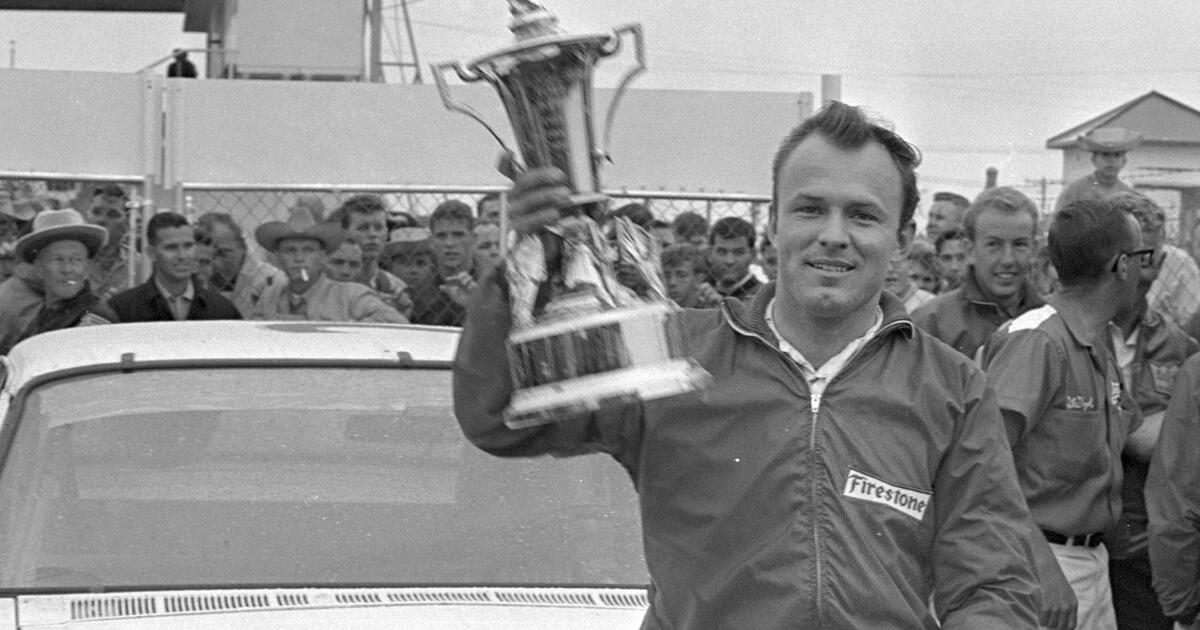
NASCAR legend Fred Lorenzen becomes first driver diagnosed with CTE
Two months ago, legendary NASCAR driver and longtime Fox Sports broadcaster Darrell Waltrip stepped away from public life at age 79 because of a progressive brain disease. His family said in a statement that his frontotemporal degeneration (FTD) diagnosis was complicated by possible chronic traumatic encephalopathy (CTE) — “likely from injuries incurred during his racing career.”
Now Fred Lorenzen — another Hall of Fame NASCAR driver — has been diagnosed posthumously with CTE, according to a statement Tuesday from his children, Chris Lorenzen and Amanda Lorenzen Gardstrom.
His is the first known case of CTE in a NASCAR driver, according to the Concussion & CTE Foundation. CTE can only be diagnosed after death through a microscopic examination of brain tissue during an autopsy.
Lorenzen, who went by the nicknames “The Golden Boy” and “Fast Freddie” when he dominated NASCAR in the 1960s, died Dec. 18, 2024, at age 89. He lived with dementia for 20 years, yet had the foresight in 2016 to pledge to donate his brain for research. Lorenzen had been inducted into the NASCAR Hall of Fame a year earlier — one of the first 25 drivers to be enshrined — but was already living in a nursing home, unable to walk. His son, Chris, delivered his Hall of Fame speech for him.
Researchers at the Boston University CTE Center — a renowned research facility that conducts high-impact research on repetitive brain trauma in athletes, military personnel, and first responders — diagnosed Lorenzen with Stage 3 CTE, the second-most severe of four stages.
Although safety precautions for drivers have vastly improved since the heyday of Lorenzen and Waltrip, concussions and the prospect of CTE remain a constant fear within the sport.
Former NASCAR Cup Series champion Kurt Busch was forced to end his full-time racing career after sustaining a severe concussion during a qualifying crash at Pocono Raceway in 2022. Dale Earnhardt Jr. estimates that he suffered as many as 50 concussions over his 20-year racing career and 10 years ago tweeted that he intends to have his brain donated for concussion research after his death.
CTE is most closely associated with football players. A study published in the British Medical Journal in August reported that 315 of the 338 brains studied from players who died between 2008 and 2021 were diagnosed with CTE. It is becoming clear that NASCAR drivers may also sustain the kind of brain trauma that can cause the condition.
Lorenzen’s children made a $1 million donation to the Concussion and CTE Foundation, creating the Fred Lorenzen Memorial HelpLine to help drivers and their families find care when necessary.
Outgoing and friendly during his career, Lorenzen was the first driver in series history to earn $100,000 in prize money in a single season. He was voted NASCAR’s most popular driver in 1963 and 1965.
He won 26 races from 1961 to 1967, more than “The King” Richard Petty, and won the Daytona 500 in 1965 and the World 600 (now the Coca-Cola 600) in 1963 and 1965. He also won six times at Martinsville Speedway, famously launching the tradition of giving the winner a Ridgeway grandfather clock.