DHS

As Trump pushes deportations, immigration data becomes harder to find

The Trump administration likes to promote its immigration enforcement agenda through numbers, with ambitious goals to deport 1 million people, report zero releases at the U.S.-Mexico border and arrest thousands of alleged gang members.

For all the boasting, the administration has been releasing less reliable, carefully vetted data than its predecessors on a signature policy that has become one of the most contentious of Trump’s second term.

The gap in information and a loss of figures from an office that has tracked immigration data back to the 1800s have left researchers, advocates, lawyers and journalists without important statistics to hold the Republican administration to account.

“They aren’t publishing the data,” said Mike Howell, who heads the conservative Oversight Project, an advocacy group pushing for more deportations. Instead, Howell said, the Department of Homeland Security has put out numbers in news releases “that purport to be statistics with no statistical backup and the numbers have jumped all over the place.”

With mass deportations a priority, new restrictions and increased enforcement have led to a surge in immigration arrests, detentions and deportations.

But finding the metrics that once measured those changes can be hard. It is an extension of earlier administration moves to limit the flow of government information by scrubbing or removing federal datasets or by the firing last year of the top official overseeing jobs data.

Important data is no longer publicly available

The Office of Homeland Security Statistics is responsible for publishing figures from Homeland Security agencies, including removals and the nationalities of those deported, to provide a comprehensive picture of immigration trends at the border and inside the United States.

Originally known as the Office of Immigration Statistics, it tracked such data since 1872. In its current form, created under the Biden administration, it also started publishing monthly reports that allowed researchers to track developments almost in real time.

But key enforcement metrics on its website have not been updated since early last year. A note on the page where the monthly reports were says it “is delayed while it is under review.”

“It’s the most timely data. It’s the most reliable data,” Austin Kocher, research professor at Syracuse University who closely follows immigration data trends, said about the monthly reports. “It has the most omniscient view of immigration enforcement across the entire agency.”

An interactive dashboard launched by U.S. Immigration and Customs Enforcement in December 2023 once let users examine whom the agency was arresting, their nationalities, criminal histories and removal numbers. ICE called it a “new era in transparency.”

Though intended for quarterly updates, the latest data is from January 2025. The agency’s annual report, typically released in December, had not been published as of mid-March.

Other agencies also publish data that touches on immigration, and parts of it do continue to roll out, such as U.S. Customs and Border Protection statistics detailing border encounters or data from the Department of Justice’s immigration courts.

But experts say other data has slowed.

The State Department’s most recent visa issuance data is from August. Key statistics from U.S. Citizenship and Immigration Services have not been updated since October.

The now-missing data had helped researchers study the effects of different policies. Lawyers could cite the figures to support their litigation. Journalists saw in them a powerful tool to hold the government to account on public claims or to report on important trends.

“We’re all a little bit in the dark about exactly how immigration enforcement is operating at a time when it’s taking new and unprecedented forms,” said Julia Gelatt, associate director of the U.S. Immigration Policy Program at the Migration Policy Institute.

DHS did not respond to detailed questions about why it was no longer releasing specific data.

“This is the most transparent Administration in history, we release new data multiple times a week and upon reporter request,” the department said in a statement.

Researchers contend with a patchwork of numbers

Figures the administration has released are inconsistent and unverifiable.

In a Jan. 20 news release, DHS said it had deported more than 675,000 people since Trump returned to the White House. A day later, in a second release, the department put the figure at 622,000. In congressional testimony March 4, Homeland Security Secretary Kristi Noem said the figure was 700,000.

But ICE, an agency within DHS, also releases figures on how many people it has removed from the country, part of a large data release mandated by Congress. An Associated Press analysis of the figures put that number at roughly 400,000 over Trump’s first year.

DHS has said 2.2 million people who were in the U.S. illegally have gone home on their own, but the department has given no explanation for the count. Experts have questioned the source of that figure, saying this was not something that DHS historically has tracked.

The department did not respond to questions about where that data came from.

With key sources of data halted, researchers, advocates and others have had to rely on information the administration is obliged to report or that has come to light through legal action.

The publication of ICE detention figures — how many people are detained, for how long and whether they have committed a crime — is required by Congress and is generally released every two weeks. But the figures’ release has faced some delays and its data gets overwritten with every new publication, complicating the work of people who need access to it.

The University of California, Berkeley’s Deportation Data Project, a research initiative, successfully sued through the Freedom of Information Act to access data about ICE arrests including nationalities, conviction status and whether arrests occurred at jails or in the community.

Graeme Blair, co-director of the project, said every administration has struggled with transparency in immigration enforcement, and given the Trump administration’s ambitious enforcement goals, the team wanted to secure and verify information that the government might not publicly release.

“Given the scale of what they were talking about doing, it seemed really important to be able to understand, to be able to double check those numbers,” he said.

But there are limitations, he said. The data obtained through the lawsuit only runs through Oct. 15. It does not cover recent operations such as the Minneapolis enforcement surge, when federal immigration officers fatally shot two protesters, leading to widespread demonstrations and scrutiny of enforcement tactics.

The absence of data is one of the few issues that has drawn bipartisan criticism.

“We deserve to know the numbers, just like we deserve to know who’s in our country and who needs to leave,” Howell said.

Santana writes for the Associated Press.

Source link

Kristi Noem was a font of inspiration for comedy and memes. What now?

A moment of silence for all the comedians, late-night-show writers, political satirists, memers, animators and random influencers who just lost a wealth of inspiration.

Kristi Noem, Homeland Security secretary, was fired Thursday by President Trump, ending the 13-month tenure of a political figure whose bravado, cruelty, incompetence and commando cosplay inspired more wickedly funny material than Dick Cheney, Sarah Palin and Sean Spicer combined.

Social media’s so-called ICE Barbie, the first Cabinet secretary to leave the Trump administration during the president’s second term, was a font of material for “South Park,” “SNL,” late night and thousands more sketch artists, impersonators, musicians and everyday trash posters. She never disappointed, unless you were looking to her for feasible, humane immigration policy enforcement.

Former Homeland Security Secretary Kristi Noem.

Former Homeland Security Secretary Kristi Noem.

(Julia Demaree Nikhinson / Associated Press)

Drama and spectacle marked her brief career, from posing in front of a packed holding cell at El Salvador’s maximum security prison CECOT, where the DHS had shipped and detained deportees, to casting herself as an agent of action in multiple ICE raid videos. Donning a big gun and long, flowing locks of hair, she insinuated herself into operations, vamping for the camera in a bulletproof vest while masked agents rounded up fellow humans like cattle.

Grim, to be sure, but at least she contributed a shred of comic relief (unintended, of course) to our new, sad reality of federal agents invading American cities and abducting people off the streets, out of their cars and from their homes.

“South Park” skewered Noem in unprintable ways. “SNL” brought back Tina Fey to play Noem. Dressed in a lavender pantsuit, too much makeup and brandishing a massive firearm, she introduced herself as “the rarest type of person in Washington, D.C.: a brunette that Donald Trump listens to.”

The endless stream of memes across social media date back to 2024, when in her memoir Noem recalled shooting and killing her 14‑month‑old dog, a wirehaired pointer named Cricket, after deciding the dog was “untrainable.” Gov. Gavin Newsom later trolled the DHS and Noem with a meme captioned “Kristi Noem’s Dog Obedience School: She’ll Treat Them As Good As She Treats Brown People.” The mock ad featured a smiling woman holding a gun and kneeling beside a dog.

If it seems cruel, consider that the DHS posted holiday-themed deportation memes around Christmas, proclaiming that federal agents were stepping up removals “for the holidays,” with a “holiday deal” offering a free flight and $1,000 to those who self-deport. One X post featured an AI-generated image of federal agents in Santa hats with the caption, “YOU’RE GOING HO HO HOME.”

Noem’s dismissal comes on the heels of two congressional hearings this week where she was questioned about her response to the ICE killings of U.S. citizens Renee Good and Alex Pretti in Minneapolis (she incorrectly called Good a domestic terrorist and claimed Pretti was involved in an act of domestic terrorism). She was grilled about the department spending $172 million for the purchase of two jets, the nature of her relationship with top DHS adviser Corey Lewandowski, and her $220-million DHS ad campaign starring none other than Kristi Noem. She testified in the hearings that Trump approved the ads. He said he knew nothing about them.

Her firing triggered an immediate rush of snarky content across social media, and a sharp a comment or two from prominent politicians. “Shouldn’t let the door hit her on the way out,” said Illinois Democratic Gov. JB Pritzker.

But all is not lost for those needing a laugh at Noem’s expense, or at the expense of the DHS, for that matter. The president said Thursday that Noem would take on a new, freshly invented role: Envoy for The Shield of the Americas. He described the position as one that will lead “our new Security Initiative in the Western Hemisphere.” The job title and description already sound like the basis for a villainous political satire, without even trying.

And for the new guy taking the post? He’s Sen. Markwayne Mullin (R-Okla.), a former MMA fighter. Let the memes begin …


Source link

Trump replaces DHS chief Kristi Noem with Okla. Sen. Markwayne Mullin

March 5 (UPI) — President Donald Trump has removed Secretary of the Department of Homeland Security Kristi Noem and appointed Sen. Markwayne Mullin, R-Okla., Thursday after she was aggressively grilled by a Senate committee the day before.

Trump announced the change on Truth Social, along with a new job for Noem, naming her “Special Envoy for The Shield of the Americas, our new Security Initiative in the Western Hemisphere we are announcing on Saturday in Doral, Florida. I thank Kristi for her service at ‘Homeland.'”

He praised Noem for her “numerous and spectacular results” in the announcement.

“I am pleased to announce that the Highly Respected United States Senator from the Great State of Oklahoma, Markwayne Mullin, will become the United States Secretary of Homeland Security (DHS), effective March 31, 2026,” he said.

Mullin has been a Senator since 2023 and served in the House from 2013-2023. He is a member of the Cherokee Nation.

Noem faced a combative Senate Judiciary Committee on Wednesday, as they pressed her for answers on several issues the department has been plagued with in the past year.

Sen. Thom Tillis, R-N.C., called her leadership a “disaster” and told her she should resign.

“What we’ve seen is innocent people getting detained that turn out are American citizens,” Tillis said in a heated exchange.

“The fact that you can’t admit to a mistake, which looks like, under investigation, is gonna prove that Ms. [Renee] Good and Mr. [Alex] Pretti probably should not have been shot in the face and in the back. Law enforcement needs to learn from that. You don’t protect them by not looking after the facts.”

Sen. John Kennedy, R-La., pressed Noem about DHS ads that she starred in, spending $200 million.

The ads were made by a Republican consulting firm that was allegedly created just before submitting bids for the work.

The company is reportedly connected to the husband of Noem’s former spokesperson, though she denied any part in choosing the firm and called the ads “extremely effective.”

“Well they were effective in your name recognition,” Kennedy said. “It troubles me. A fifth to a quarter of a billion dollars of taxpayer money when we’re scratching over every penny and we’re fighting over rescission packages. I just can’t agree.”

Noem told the Senate panel that Trump had authorized the ads.

Kennedy told reporters Thursday that he got a call from the president about her testimony, The New York Times reported.

“Put it this way: His recollection and her recollection are different.”

Mullin told The Times that he has not had time to call Noem, whom he said is a friend.

“She was tasked with a very difficult job,” he said. “I think she has done the best that she could do under the circumstances.”

But he said he believed that there are opportunities to “build off things that didn’t quite go as planned.”

Sen. Chris Coons, D-Del., said he would wait and see if Mullin will be an improvement at DHS but told The Times, “It will be hard to be a downgrade.”

The Department of Homeland Security is in its third week of a shutdown, with Congress expected to vote later Thursday on a funding package.

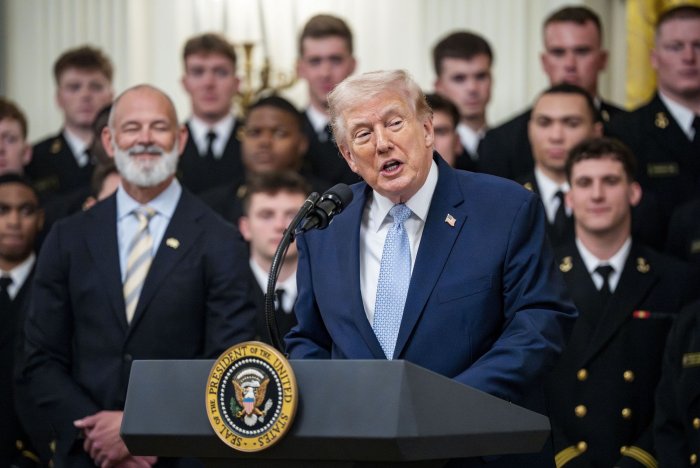
President Donald Trump speaks during a roundtable on the Ratepayer Protection Pledge inside the Indian Treaty Room of the Eisenhower Executive Office Building near the White House on Wednesday. Technology firms that sign the pledge will commit to ensuring artificial intelligence infrastructure does not raise utility bills for households and small businesses. Photo by Bonnie Cash/UPI | License Photo

Source link