FireAnt Mini Uncrewed Ground Vehicles Deploy Drone Detection Sensors In U.S. Army Test
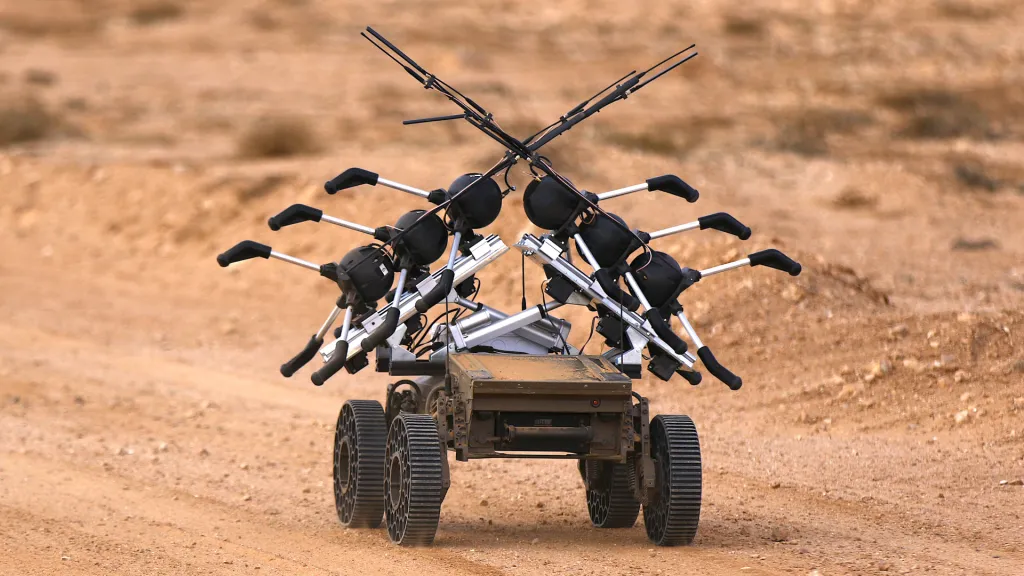
A FireAnt uncrewed ground vehicle (UGV) was used to deploy small sensors capable of detecting hostile drones on the ground during a recent U.S. Army test exercise. Using UGVs to quickly establish even localized sensor networks could give Army units a valuable, if not increasingly critical, boost in situational awareness of potential threats in the air and on the ground.
The sensor-toting FireAnt was among the capabilities demonstrated during the U.S. Army-led Needs-Driven Acquisition for Near-Term Operations Accelerated Capability II (NANO ACE II) event in October. The service only recently shared details about NANO ACE II, which took place at the Multidomain Training Area (MDTA) in Tan-Tan, Morocco, in cooperation with that country’s armed forces. The larger NANO ACE effort falls under the broader umbrella of the Army’s Operation Jailbreak, which has been focused primarily on devising new networking capabilities to link disparate systems.

“NANO ACE tested prototype systems that combine autonomous platforms with different payloads, mission management software and robust communications,” according to an Army release. “This test aimed to evaluate semi-autonomous capability sets that extend C-UAS [counter-uncrewed aerial systems] coverage and addressed an emergent U.S. joint force requirement to field integrated, autonomous sensing and effector capabilities on an accelerated acquisition timeline.”
“To meet these objectives, industry developers evaluated their systems against strict operational criteria, testing whether the platforms could operate independently on unimproved terrain while surviving a contested electronic warfare environment,” the release added. “Hosting this evaluation at the Moroccan owned MDTA underscores a deep appreciation for the Kingdom of Morocco’s ongoing partnership. AMTEC [the U.S. Army’s Africa Multi-Domain Training and Experimentation Center] is intended to leverage the region’s open electromagnetic spectrum, uncongested airspace and contested terrain to help combined forces test emerging technologies and maintain a decisive advantage in a complex strategic environment.”
In addition to AMTEC, representatives from the Army’s Global Tactical Edge Acquisition Directorate, the Army Test and Evaluation Command (ATEC), U.S. Army Central (ARCENT), U.S. Africa Command (AFRICOM), the Army’s Southern European Task Force-Africa (SETAF-AF), and an unnamed “tactical U.S. Army division” participated in the event in Morocco.
Produced by Swarmbotics AI, FireAnt is a small 4×4 UGV designed to be readily reconfigurable for a wide variety of missions, including electronic warfare, surveillance and reconnaissance, and even being used as a one-way-attack munition. FireAnts are also capable of being employed in semi-autonomous swarms.

Pictures accompanying the Army’s release about NANO ACE II show the FireAnt configured to carry six small ground sensors, three each on two sets of rails angled to either side. The sensors slide off the rails and come to rest on a trio of small legs.
How the sensors in question function is not immediately clear, but they have a spherical central body and a slender antenna mast that extends upward. Sensors of this size and configuration could detect drones in various ways, including passively picking up signals they emit or by registering their acoustic signature.

As an aside, another FireAnt was spotted at a separate Army test exercise recently conducted at Fort Hood in Texas with what looks to be another type of deployable sensor system called Maple Seeds. These are “low-power, lightweight, disposable RF [radiofrequency]” sensors that “can locate, differentiate, and track targets in deep fires areas in contested A2/AD [anti-access/area denial] environments,” according to manufacturer MaXentric Technologies.
A separate version of FireAnt with a fixed acoustic sensor array has also been developed for NANO ACE, but it is not clear if it has been demonstrated at one of the Army’s test exercises yet.

Depending on how they are networked together, ground sensors deployed via UGV, as well as UGVs with their own sensor packages, could provide multiple streams of data for operators to fuse together. This, in turn, would help build a higher-fidelity picture of potential drone threats. That data could then be used to cue other more capable sensors to further track and categorize those objects of interest, as well as effectors to engage them. Ukrainian forces have notably been employing broadly similar kinds of distributed, multi-layered sensor architectures to spot incoming drone attacks and manage resources to respond to them for years now.
Using UGVs in this role also opens new options for deploying ground sensors in forward areas while also reducing risks to human operators. A swarm of sensor-toting robotic vehicles would be able to seed that coverage across a broader area faster. Army testing earlier this year involving a Bradley Fighting Vehicle acting as a carrier for FireAnts demonstrated how UGVs could be brought to forward areas before pushing ahead of friendly forces, regardless of what their assigned tasks might be.
There’s a cost component to this equation, too. Whether seeded via UGV or other means, unattended ground sensors offer a lower-cost option for expanding coverage, especially in areas where it would be too risky to deploy more conventional radars and other assets. If they operate passively, the sensors themselves could be challenging for enemy forces to find and neutralize them once they’re in place.
While the recent NANO ACE event in Morocco was focused on counter-drone capabilities, sensors deployed in this way could be used to detect potential threats on the ground, as well. It’s understandable, though, that the Army is most interested currently in providing units new ways to spot incoming uncrewed attackers, a threat ecosystem that is only continuing to expand in scale and scope. Soldiers can expect drone attacks to come at the tactical edge, in rear areas, and everywhere in between in future conflicts.
Recent experiences from the war with Iran, as well as other conflicts in the Middle East and ongoing fighting in Ukraine, have shown that various tiers of uncrewed attackers can easily be layered in with other weapons and approach targets from multiple vectors simultaneously. In Ukraine, a tactic has also emerged where human operators fly small first-person-view kamikaze drones to forward areas where they then lie in wait on the ground like remotely-operated land mines. All of this only increases challenges for defenders when it comes to just spotting threats, let alone prioritizing and engaging them.
It should also be stressed here that unattended ground sensors are in no way new to the U.S. military. Historically, fixed-wing aircraft, helicopters, and small teams on the ground have been used to emplace them. The best-known example of this is Operation Igloo White, the then-state-of-the-art Vietnam War effort to remotely monitor movement along the Ho Chi Minh Trail. Igloo White also proved to be controversial due to its cost, complexity, and mixed results.
The Army and other branches of the U.S. military have also previously experimented with using uncrewed aerial systems to deploy sensors on the ground in forward areas, as well as act as readily relocatable sensor nodes themselves. The service has raised the possibility of using high-altitude balloons for this purpose, as well.

There are still potential hurdles for the Army to clear before it can employ UGV-deployed ground sensors on a broader scale. As noted, NANO ACE is an offshoot of Operation Jailbreak, and networking all of these nodes together could present challenges. Army officials have also talked in the past about how expanding distributed sensor coverage can produce data overload.
“One of the big problems we identified in this particular scenario is going to be we have too much data, and we haven’t been able to correlate it in the way that we want to provide it to the warfighter,” now-retired Lt. Gen. Scott McKean, then Project Convergence experiment director and deputy commander of Army Futures Command, said following a test exercise back in 2022. “A few years ago, we wouldn’t have had that problem because we weren’t even talking to each other, and our machines certainly wouldn’t be talking to each other. And so that’s a huge step forward, the fact that we are all sharing data. … We have the capability right now to take multiple communication pathways. Some of those are very military-specific. Some of those are actually quite commercial. And we can use those in multiple ways, so if one is denied, we switch to another one.”
“We still need to keep working on how we standardize the data so that we’re all able to access it and we’re all able to share it across services and platforms,” then-Secretary of the Army Christine Wormuth also said at the time. “I think we’re making progress on that, but there’s still work that has to be done. … We’re now able to tap into a huge volume of data. A lot of the challenge is going to be figuring out how we process that as quickly as we can, and I think we did see some real improvements in terms of how quickly we were able to take information and change it into what I would call more actionable knowledge. The other thing I think we have to do is commanders are going to have to figure out what are the critical information requirements that they need.”
These are areas where developments in artificial intelligence and machine learning could help human operators sift through the data.

The Army has also struggled with attempts to field larger uncrewed platforms in recent years. This stands in the face of global trends, especially in Ukraine, where smaller UGVs have steadily become a fixture in the ongoing conflict.
FireAnt increasingly looks to be at the forefront of Army efforts to integrate UGVs of various types into its broader force structure. The recent NANO ACE II event has highlighted another potentially important role for these uncrewed platforms as a way to help commanders get a better sense of the battlespace around them in the air and on the ground.
Contact the author: joe@twz.com