detainees

US says over 5,700 suspected ISIL detainees relocated from Syria to Iraq | News

Iraqi authorities confirm the transfer, saying detainees of 61 nationalities have arrived in the country.

The United States has announced the completion of the transfer of more than 5,700 suspected ISIL (ISIS) detainees from Syria to Iraq.

“The 23-day transfer mission began on Jan 21 and resulted in US forces successfully transporting more than 5,700 adult male ISIS fighters from detention facilities in Syria to Iraqi custody,” the US Central Command (CENTCOM) said in a statement on X on Saturday.

Recommended Stories

list of 4 itemsend of list

The operation was completed after a night flight from northeastern Syria to Iraq took place on February 12, “to help ensure ISIS detainees remain secure in detention facilities”, CENTCOM added.

The US had previously announced it would transfer about 7,000 detainees.

The detainees from some 60 countries had for years been held in Syrian prisons run by Kurdish-led Syrian Democratic Forces (SDF) before the recapture of surrounding territory by the Syrian government prompted the US to step in.

ISIL swept across Syria and Iraq in 2014, committing massacres and forcing women and girls into sexual slavery.

Backed by US-led forces, Iraq proclaimed a victory over ISIL in the country in 2017, and the SDF ultimately defeated the armed group in Syria two years later.

The SDF went on to jail thousands of suspected fighters and detain tens of thousands of their relatives in camps.

Iraq’s National Centre for International Judicial Cooperation (NCIJC) said 5,704 ISIL detainees of 61 nationalities had arrived in Iraq. They include 3,543 Syrians, 467 Iraqis, and another 710 detainees from other Arab countries.

There are also more than 980 foreigners, including those from Europe, Asia, Australia and the US.

“We appreciate Iraq’s leadership and recognition that transferring the detainees is essential to regional security,” said CENTCOM head, Admiral Brad Cooper. “Job well done to the entire Joint Force team who executed this exceptionally challenging mission on the ground and in the air.”

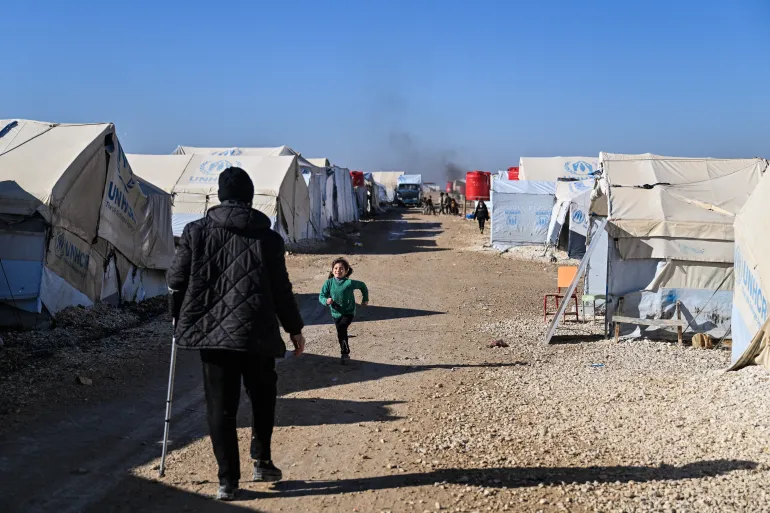
AL HASAKAH, SYRIA - JANUARY 26: Detainees are seen between tents at the al-Hol camp on January 26, 2026 in Al Hasakah, Syria. The al-Hol camp (also spelled Al-Hawl) in Syria's northeastern Hasakah province has come under control by Syrian government forces, following the withdrawal of the Kurdish-led Syrian Democratic Forces (SDF) in recent days. The camp houses around 24,000 people, many of whom are women and children, with alleged links to the jihadist group Islamic State (IS), also referred to as ISIS in the region. Clashes between the SDF and government forces this month over the former's integration with state institutions has seen large swaths of Kurdish-controlled territory ceded. Under a ceasefire agreement, camps and prisons housing ISIS detainees previously held by the US-backed Kurdish forces are to be transferred to the government. The United Nations (UN) has said it will take over management of al-Hol, resuming the delivery of humanitarian supplies to the camp, amid dire conditions. (Photo by Abdulmonam Eassa/Getty Images)
Detainees at the al-Hol camp in Syria’s northeastern Hasakah province [File: Abdulmonam Eassa/Getty Images]

The NCIJC said Iraq’s judiciary will interrogate the detainees before taking legal action against them.

Last month, Syrian troops drove the SDF from swaths of northern Syria, prompting questions over the fate of the ISIL prisoners. Lingering doubts about security pushed the US to announce it would transfer them to Iraq to prevent “a breakout” that could threaten the region.

Iraq has issued calls for countries to repatriate their nationals among the ISIL detainees, though this appears unlikely.

For years, the SDF also called on foreign governments to take back their citizens, but this was done on a small scale and remained limited to women and children held in detention camps.

Most foreign families have left northeast Syria’s al-Hol camp, which is the largest camp holding relatives of ISIL fighters, since the departure of the SDF, which previously guarded it, humanitarian sources told the AFP news agency on Thursday.

Al Jazeera’s Assad Beig said the al-Hol camp, established in 2019 after ISIL was defeated in Syria, developed a “notorious reputation” over the years.

“Aid workers documented the killings and underground ISIL enforcement groups, while security officials warned it was a breeding ground for future armed groups,” he said.

Source link

More than 5,000 ISIL detainees transferred from Syria, says Iraqi ministry | ISIL/ISIS News

Iraq says more than 3,000 Syrians are among the ISIL-linked detainees transferred to one of its prisons by US military.

More than 5,000 ISIL-linked (ISIS) detainees have been transferred from Syrian jails to a prison in neighbouring Iraq so far, according to Iraq’s Ministry of Justice.

In comments to the Iraqi News Agency on Friday, ministry spokesperson Ahmed Laibi said the transfers and ongoing detention of the prisoners had been carried out at the request of an international coalition led by the United States to combat ISIL, of which Iraq is a key member.

Recommended Stories

list of 4 itemsend of list

In separate comments on the sidelines of the Munich Security Conference, Iraqi Foreign Minister Fuad Hussein gave a lower figure, telling Reuters that about 3,000 ISIL-linked detainees had been transferred.

He told the news agency that the process was ongoing and that Baghdad was in discussions with various countries about repatriating their nationals who had been transferred.

Iraq would need more ⁠financial assistance to ⁠deal with the intake, he said, adding that there had been a recent ⁠uptick in ISIL activity in Syria.

The US military has been transporting thousands of ISIL-linked prisoners from jails and detention centres previously run by the Kurdish-led Syrian Democratic Forces (SDF) in northeast Syria.

The transfers have come as control of the prisons has been handed over to the Syrian government, amid a push by Damascus to assert its authority over the full extent of a country still fragmented in the wake of a brutal war.

Deadly clashes with SDF forces broke out amid the Syrian army’s advance in recent weeks, including in and around key prison sites, resulting in some ISIL detainees escaping and raising fears the armed group could exploit any security vacuum to regroup.

A ceasefire has since been struck between the government and the SDF.

Detainees mostly Syrian nationals

Laibi, the Iraqi Justice Ministry spokesperson, said that of the 5,064 ISIL detainees transferred so far, more than 3,000 were Syrian, while at least 270 were Iraqi.

He said the detainees were being held in a single prison, in a section separated from other prisoners.

The detainees would all be investigated and prosecuted under Iraqi law, he said, while the responsibility for feeding the thousands of detainees was being handled by the international coalition, rather than Iraq.

Last month, lawyers for a group of French ISIL suspects who had been transported by the US military from Syria to Iraqi prisons in an earlier series of transfers claimed the inmates had been subjected to “torture and inhumane treatment” there.

Damascus becomes US’s main anti-ISIL partner

The US military has previously said up to 7,000 people with alleged ISIL links could be transferred to Iraqi-controlled facilities.

US Admiral Brad Cooper, the head of US forces in the Middle East, said last month that facilitating the secure transfer of detainees was critical to preventing mass breakouts that could pose a direct threat to the US and regional security.

The statement came shortly after the US special envoy to Syria said that Washington’s main partner against ISIL in Syria would be the Syrian government, rather than the SDF, which had held that position for years.

The shift followed Syria – under new President Ahmed al-Sharaa, the former leader of the armed group Hayat Tahrir al-Sham, who was once deemed a “Specially Designated Global Terrorist” by the US – joining the anti-ISIL coalition in November.

US departs Syrian base

The ongoing transfers of the detainees from Syria have come as the US military reduces its presence in the country, where it has conducted operations against ISIL for years.

On Thursday, Syrian ⁠forces ⁠announced they had taken control of the al-Tanf military base, a strategic garrison near the border with Iraq and Jordan, following the withdrawal of US forces.

Cooper, the commander of US forces in the Middle East, said the departure was “part of a deliberate and conditions-based transition”, and that US forces remained “poised to respond to any [ISIL] threats that arise in the region as we support partner-led efforts” to prevent the group’s resurgence.

While ISIL was largely defeated in 2017 in Iraq and in Syria two years later, sleeper cells still carry out attacks in both countries.

Source link

US transfers ISIL detainees to Iraq as northeast Syria base draws down | Conflict News

Iraq launches investigations into ISIL detainees from Syria, with 7,000 expected to arrive in total.

United States forces have transported a third group of ISIL (ISIS) detainees from Ghwayran prison in Syria’s Hasakah province to Iraq by land, as activity around a US military base in the region points to possible operational changes, an Al Jazeera correspondent reports.

The transfer on Saturday forms part of a trilateral arrangement, which has emerged as part of a painstaking ceasefire after deadly clashes involving the Syrian government and the Syrian Democratic Forces (SDF), under which detainees held in northeastern Syria are being relocated to Iraqi custody. US forces are the third party to that agreement.

Recommended Stories

list of 3 itemsend of list

Earlier, US Central Command (CENTCOM) confirmed the start of a broader operation to move detainees from facilities across the region, with officials outlining a plan to transfer about 7,000 prisoners.

Iraq has launched investigations into ISIL detainees from Syria over atrocities committed against its citizens.

Security developments in northeastern Syria have accelerated in recent weeks in the wake of government forces sweeping across the north and SDF retreats.

On Saturday, SDF governor-designate Nour Eddien Ahmad met a Damascus delegation at the Hasakah government building before a Syrian national flag-raising ceremony.

The meeting carries political significance as the agreement between Damascus and the SDF allows the group to nominate the governor of Hasakah, with Ahmad expected to be formally appointed by the Syrian government.

The visiting delegation includes senior government security officials, underscoring Damascus’s expanding administrative control in the province. The raising of the Syrian national flag over the government building signals the reassertion of central government authority in Hasakah.

Syrian government forces entered the city of Qamishli earlier this week, one of the remaining urban strongholds of the Kurdish-led SDF, following a ceasefire agreement reached on Friday last week.

The accord ended weeks of confrontations and paved the way for the gradual integration of SDF fighters into Syrian state institutions, a step Washington described as an important move towards national reconciliation.

The agreement followed territorial losses suffered by the SDF earlier this year as government troops advanced across parts of eastern and northern Syria, reshaping control lines and prompting negotiations over future security arrangements.

Separately, an Al Jazeera correspondent on the ground reported that US personnel vacated most watchtowers surrounding a military installation in the al-Shaddadi area of Hasakah province, leaving only the western tower staffed.

Soldiers were also seen lowering the US flag from one tower, while equipment used to manage aircraft take-offs and landings at the base’s airstrip was no longer visible.

No combat aircraft were present at the facility, although a large cargo aircraft landed at the base, remained for several hours, and later departed.

The US established its formal military presence in Syria in October 2015, initially deploying about 50 special forces personnel in advisory roles as part of the international coalition fighting ISIL. Since then, troop levels have fluctuated.

Reports in mid-2025 indicated that roughly 500 US troops withdrew from the country, leaving an estimated 1,400 personnel, though precise figures remain unclear due to the classified nature of many deployments.

US forces continue to focus on countering ISIL remnants, supporting the Syrian government now, providing intelligence and logistical assistance, and securing oil and gas infrastructure in Hasakah and Deir Az Zor provinces.

The US carried out another round of “large-scale” attacks against ISIL in Syria in January, following an ambush that killed two US soldiers and a civilian interpreter in the city of Palmyra in December.

Source link

Judge orders ICE chief to appear in court to explain why detainees have been denied due process

The chief federal judge in Minnesota says the Trump administration has failed to comply with orders to hold hearings for detained immigrants and ordered the head of Immigration and Customs Enforcement to appear before him Friday to explain why he should not be held in contempt.

In an order dated Monday, Chief Judge Patrick J. Schiltz said Todd Lyons, the acting director of ICE, must appear personally in court. Schiltz took the administration to task over its handling of bond hearings for immigrants it has detained.

“This Court has been extremely patient with respondents, even though respondents decided to send thousands of agents to Minnesota to detain aliens without making any provision for dealing with the hundreds of habeas petitions and other lawsuits that were sure to result,” the judge wrote.

The order comes a day after President Trump ordered border advisor Tom Homan to take over his administration’s immigration crackdown in Minnesota following the second death this month of a person at the hands of an immigration law enforcement officer.

Trump said in an interview broadcast Tuesday that he had “great calls” with Minnesota Gov. Tim Walz and Minneapolis Mayor Jacob Frey on Monday, mirroring comments he made immediately after the calls.

The White House had tried to blame Democratic leaders for the protests of federal officers conducting immigration raids. But after the killing of Alex Pretti on Saturday and videos suggesting he was not an active threat, the administration tapped Homan to take charge of the Minnesota operation from Border Patrol commander Gregory Bovino.

Schiltz’s order also follows a federal court hearing Monday on a request by the state and the mayors of Minneapolis and St. Paul for a judge to order a halt to the immigration law enforcement surge. The judge said she would prioritize the ruling but did not give a timeline for a decision.

Schiltz wrote that he recognizes ordering the head of a federal agency to appear personally is extraordinary. “But the extent of ICE’s violation of court orders is likewise extraordinary, and lesser measures have been tried and failed,” he said.

“Respondents have continually assured the Court that they recognize their obligation to comply with Court orders, and that they have taken steps to ensure that those orders will be honored going forward,” he wrote. “Unfortunately, though, the violations continue.”

The Associated Press left messages Tuesday with ICE and a DHS Department of Homeland Security spokesperson seeking a response.

The order lists the petitioner by first name and last initials: Juan T.R. It says the court granted a petition on Jan. 14 to provide him with a bond hearing within seven days. On Jan. 23, his lawyers told the court the petitioner was still detained. Court documents show the petitioner is a citizen of Ecuador who came to the United States around 1999.

The order says Schiltz will cancel Lyons’ appearance if the petitioner is released from custody.

Catalini and Karnowski write for the Associated Press. Catalini reported from Trenton, N.J.

Source link