SACRAMENTO — He made millions playing an indestructible action hero in the movies, but Gov. Arnold Schwarzenegger sounded altogether mortal as he talked for the first time Wednesday about the pain and frustration he has felt since his holiday skiing accident.
At a news conference where he released his new budget, Schwarzenegger told reporters that since his surgery two weeks ago he has been in continuous pain.
“The operation was a very complicated operation,” he said, “and I don’t think I can ever remember having had pain — ongoing pain, 24 hours a day — like after this operation.”
In a statement put out last month after the Dec. 23 accident, the governor’s doctor described the surgery planned for Schwarzenegger as routine.
Schwarzenegger had previously said nothing publicly about his accident, and his staff had refused to confirm reports that the governor tripped and fell while standing on a mountain slope in Sun Valley, Idaho.
Adi Erber, a ski instructor who was with the governor at the time, said Schwarzenegger’s pole got caught in one of his skis, causing the fall. Schwarzenegger was then carried down the slope on a toboggan and taken to a hospital.
Asked for his own account of how the accident happened, Schwarzenegger offered a few details about his complicated medical history, which has included steroid use, a heart valve replacement, a torn rotator cuff and broken ribs. He said that he has also had an artificial hip put in — a procedure that, he maintained, helped cause the leg break.
Schwarzenegger said that because he was moving “at a very slow speed,” his ski stayed on.
Had he been moving fast, he said, the ski would have popped off, probably sparing him any real injury.
“I had an artificial hip that was replaced around five years ago,” he said. “Because it was vulnerable, the ski torqued the leg, and it broke the femur because of that. If I were to have that accident at 50 mph — and many times I’ve crashed at that speed — nothing happens.
“So this is what the unfortunate thing was.”
Soon after the injury, speculation bubbled up that the governor’s steroid use might have left his bones weakened, making him more susceptible to a break. Schwarzenegger has admitted using steroids when he was a champion bodybuilder.
The governor’s office released a statement from his orthopedic surgeon, Dr. Kevin Ehrhart, addressing the steroid question.
“Any suggestion that Gov. Schwarzenegger’s injury was sustained as a result of anabolic steroid use is wrong and has no basis in fact,” Ehrhart said. “His bone was completely healthy and rock solid.”
Normally upbeat in his public appearances, Schwarzenegger said the accident has left him shaken. He has looked thinner and somewhat drawn since the surgery.
At his inauguration last week, First Lady Maria Shriver clutched the governor’s arm as he took the oath of office — as if holding him up — and handed him bottled water afterward. Shriver also attended the governor’s budget address.
Schwarzenegger suggested Shriver has been at the receiving end of his darkened mood.
“So it’s really annoying to me, and believe me, there’s nothing I hate more than having an obstacle like this. So this is very frustrating to me. It’s very tough on my wife.
“When I get frustrated and have those obstacles, I’m very angry a lot of times,” he said, “and so I’m working through all of this and trying to get rid of this problem as soon as I can.”
Airbus U.S. Space and Defense has been actively developing and iterating the technology for its Lakota Connector, an uncrewed, autonomous variant of the multi-mission UH-72B Lakota helicopter. This includes testing under Team Lakota Connector, that has brought together Shield AI, L3Harris Technologies, and Parry Labs in a prototyping phase for the U.S. Marine Corps.
TWZ’s Jamie Hunter spoke with Carl Forsling from Airbus U.S., at the AUSA 2026 trade event in Washington D.C. A former U.S. Marine Corps CH-46 Sea Knight and MV-22 Osprey pilot, Forsling explained the requirement for uncrewed logistics in contested theaters, and what’s next for Team Lakota Connector.
Airbus Talks Progress With Lakota Connector Cargo Drone
Burnham was mayor of Manchester from 2017 until earlier this year and his tenure took place during a sustained period of success for City.
As mayor, he championed investment from the Gulf as a way of growing Manchester’s economy, a strategy which was initially pursued by the city’s leaders before Burnham became the inaugural elected mayor of the Greater Manchester Combined Authority.
“I don’t think I misspoke,” said Burnham of his past comments on Man City’s owners.
“What I would say is my mind hadn’t been on all of the issues. My mind had been on Labour Party conference and I was doing interviews in relation to it.
“And also, I didn’t link those two things. You know, the questions linked those two things. What I would say is they’re very separate.
“The football issues are different from the investment issues. People will try and conflate those two things, but they shouldn’t, in my view.
“The football issues, the findings of the independent commission are serious, as I said in the interview.”
The entire process involving the charges against Manchester City is independent of the Premier League.
An independent commission held a 42-day hearing in 2024 which led to the verdict announced last month, with City also guilty of all charges except one relating to non-cooperation with the Premier League investigation.
The commission’s report said that “a number of important club witnesses gave false evidence in key respects and that some knowingly gave untrue and dishonest evidence”.
A separate independent appeal board will hear City’s appeal. The club continues to deny any wrongdoing.
People can expect to see the change roll out at dozens of major UK airports
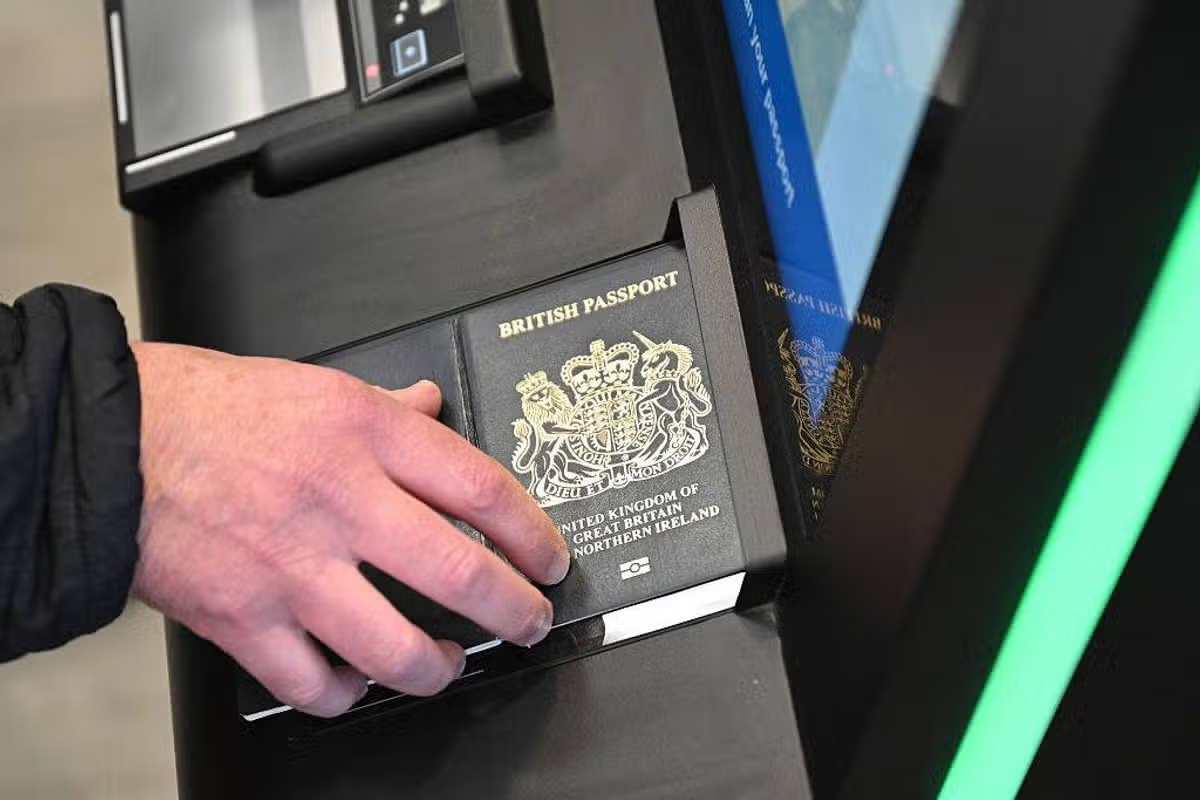
A major change to part of the airport security process is being made at some UK airports ‘by early 2027’(Image: Getty)
One part of airport security is about to get quicker for travellers at certain UK airports. The Government is set to roll out a “state-of-the-art” scheme regarding passports. People heading off on autumn and winter breaks might see this new system in place as airports gradually upgrade.
BBC Morning Live recently discussed a Home Office announcement claiming that a new “contactless system” for checking passports on arrival in the UK could be up and running by early next year at many major British airports. Consumer affairs expert Harry Kind claims that, although passengers won’t be able to leave their passports at home, this process change should make part of the return process “smoother and faster”.
The discussion stems from a BBC headline claiming the “passport-free” system was coming into effect. In an official update from the UK Government, it claims that passengers arriving in the UK will soon pass through airport checkpoints securely without showing their passports. The system uses facial recognition technology to allow arriving passengers to clear immigration without physically scanning their passports.
This is not a “passport-less” journey. Border Force explicitly states that passengers must keep their physical passports with them at all times. If the facial recognition scan hits a snag or requires additional vetting, you will be prompted to scan your physical passport or be directed to a Border Force officer.
Content cannot be displayed without consent
The technology, described as a “cutting-edge contactless system”, will begin rolling out this month and gradually replace every airport eGate “by early 2027”. Here’s how it works:
Passengers approach an eGate and have their photo taken
The system checks this live image against verified immigration, travel and passport information
The eGate opens automatically once these checks are complete
A statement reads: “The system uses state-of-the-art facial comparison technology to verify a passenger’s identity before the UK’s robust border security checks are carried out in full. Legitimate travellers can then simply walk through, without needing to place their passport on the eGate reader.
“If further checks are needed, passengers will need to place their passport on the reader or may be directed to a Border Force officer, as happens today. Border Force officers will continue to monitor all eGates offering assistance, and passengers should keep their passports with them at all times.”
The phased rollout starts at East Midlands Airport, initially for British citizens. The aim, by early 2027, is to expand this to more airports and other nationalities already eligible for eGates over the coming months.
The national rollout began on October 6, 2026. The government plans to have all UK airport eGates switched over to this contactless tech by early 2027. East Midlands Airport is the first UK airport to officially switch on the live contactless technology.
Standard eGates are currently functioning across 13 major UK airports (including Heathrow, Gatwick, Manchester, Edinburgh, and Stansted), all of which will transition gradually during this phased rollout. Phil Douglas, Director General of Border Force, claims that this is “a win for travellers coming to our brilliant country”.
He said: “By using state-of-the-art technology, we are making journeys smoother and faster, all while fully maintaining the UK’s robust border security. Our digital transformation also builds on our work this summer to extend eGates to children aged eight and above, making life a little easier for families.”
Steve Griffiths, managing director of East Midlands Airport, said: “As an airport committed to providing an effortless travel experience, we welcome any technological innovation that can help to safely make our customers’ journeys smoother, swifter and simpler. This complements changes that we carried out to our immigration hall recently to help improve the flow of arriving passengers through the area.”
For My Sister Nicole: Love Shouldn’t Hurt — What to Know About Domestic Violence
By Denise Brown Blackstone Publishing: 240 pages, $30
If you buy books linked on our site, The Times may earn a commission from Bookshop.org, whose fees support independent bookstores.
Nicole Brown Simpson wore a long-sleeved cover-up by the beach, despite the warm weather. “We kept telling her, ‘C’mon, get in the water.’ She wouldn’t,” Denise Brown recalls of a Hawaiian vacation with her sister, Nicole, and the rest of her family, including her brother-in-law, O.J. Simpson. “We didn’t know it then, but he’d beaten the [hell] out of her the night before in the hotel room. We found out later, after she was killed, when we were reading her diaries.”
The incident is one of many chronicled in Brown’s new memoir, “For My Sister Nicole: Love Shouldn’t Hurt.” The book chronicles who Nicole was — from her happy SoCal childhood to meeting beloved celebrity and football star Simpson at the age of 18 (he was 30) to the physical and mental abuse she suffered over seven years of marriage. Brown also reveals the troubling incidents she witnessed behind the scenes, and pairs them with the knowledge she has now of what could have been done to help her sister.
(Blackstone Publishing, Inc.)
Nicole and her friend Ronald L. Goldman were murdered outside her Los Angeles home in Brentwood in June 1994. The brutal homicides set off a media frenzy, and overnight, Brown became the voice for her slain sister.
Images of an angry and sobbing Brown became the media’s hallmark of grief during the criminal trial, particularly when Simpson was acquitted in 1995. He was found guilty in a subsequent civil trial, yet still awarded custody of the divorced couple’s two children.
Now, 69, with sleek silver hair and a voice raspy from the many speaking engagements tied to her advocacy work, Brown has devoted her life to raising awareness about domestic violence. “It’s too late for Nicole,” says the former model who moved from her native Southern California to Florida decades ago. “I want this book to help others avoid what happened to her.”
This interview has been edited for length and clarity.
We’re meeting today in downtown L.A., very close to the courtroom where the trial happened, and to the former LAPD headquarters Parker Center where Simpson was booked after Nicole’s death. Is it difficult being here? Should we have done this somewhere else?
No. This is where it all happened, so it’s OK for me to be here to talk about [the book]. It should start here. And I’m glad it’s with the L.A. Times because Nicole was here in Los Angeles, as was all the chaos. Everything started here.
Denise Brown.
(Ronaldo Bolaños / Los Angeles Times)
It’s been 32 years since your sister’s murder, yet this is the first book you’ve written about what happened.
I had a [previous] book deal, but I wasn’t ready.
It was really hard going back because you think about all the things that should have been, that could have been, that she missed out on, especially with her kids. And everything was so public. It was so out in the open, with everybody looking at you. If you were too happy and laughing, it was, “Oh God, she doesn’t even know how to grieve.” If you’re crying, it’s, “My God, can’t she just get over it?”
I understand why people make these kinds of comments now, because if you’ve never been through something so horrific, you don’t know how to act. You don’t know how you’d respond.
Aside from raising awareness about domestic abuse issues, you haven’t spoken much about your sister’s life or murder until the 2024 Lifetime docuseries, “The Life & Murder of Nicole Brown Simpson.” It was the first production that included interviews and involvement from you and your sisters, which is stunning because there have been so many docs and dramas about the case.
I know. And without asking Nicole’s family, can you really make a good documentary?
A girlfriend of mine who is a producer wanted to [make a documentary] at the 10-year mark, and I just wasn’t ready. Then she asked me at the 20-year mark. I said, “No, this doesn’t feel right yet.” Then on the 30th, I asked my sisters [Tanya, Dominique and Wendy], “Do you guys want to do this?” And it was “Yes, let’s humanize Nicole. Let’s bring her back because she was lost in all of this.” Ron and Nicole were both lost. The trial has been done and saturated. Let’s humanize her, get videos of when we were kids. Stuff like that. So that’s what we did.
In the book you write that the docuseries provided new revelations about Simpson.
What I found out all these decades later shocked me. I learned after Simpson moved down to Florida with the kids, there were 17 calls to 911. There was an FBI raid. I don’t know what it was for, but the police came to the house 17 times?! I was friggin’ livid when I heard that. Where were the advocates? Where were the people protecting those children out there? They would have been protected by my mother and father, by all of us. Coming off that, I thought that it’s time to write a book.
We know so much more about recognizing the signs of domestic violence now than we did in the 1990s. The progress is of course welcome, but it also has to be hard applying that knowledge in hindsight to your sister’s case.
Back then I saw. I was privy to. I was there. I was involved. But I didn’t know it was domestic violence, and that’s what I want people to understand. Don’t read this book like it’s something that I knew about all along because I didn’t. I thought [the fights] were isolated incidents because they didn’t happen every single time I saw Nicole. They were years apart. I learned about domestic violence patterns after the murder.
Can you talk about what was in the diary you found in her home after she was gone?
A couple of months after her murder, my dad was reading her diaries, and I saw him lying on the bed, just broken. He said take a look at these, and it was Nicole’s writing and about the things that were happening. And I sat there like, “Oh my God. We were there.” We were there when this happened, like on a vacation in Hawaii. But we were not in the room with them.
Nicole wrote in her journal of that trip that once they were in their hotel room alone, he beat her and threatened to hang her off the balcony. But the diarywasn’t admissible in court. And maybe it wouldn’t have even made a difference given the lack of awareness about domestic abuse patterns.
Domestic violence, the jurors didn’t really understand it. They thought if you’re not dead after he’s finished strangling you, it’s not domestic violence. Jurors even said, “This is not a domestic violence trial. This is a murder trial.” Well, lo and behold, the ultimate form of domestic violence is murder.
Your passionate statement to a reporter during pretrial hearings marked the first time a member of your family publicly expressed doubt regarding Simpson’s innocence. From then on the press made a point of painting you as the furious, avenging sister.
Why wouldn’t I be angry? My sister was slaughtered, for God’s sake. I became the spokesperson for our family after I went upstairs to the press room [during the hearing] and said to a reporter: “If O.J. so innocent, why is he trying to suppress all the evidence?!” I couldn’t sit there and watch the so-called Dream Team [Simpson’s defense] constantly berating Nicole and belittling her and turning her into something that she wasn’t.
Before testifying in criminal court, you testified before Congress in 1994, urging lawmakers to fully fund programs and shelters supported by the Violence Against Women Act.
It was a bipartisan act from Orrin Hatch and Joe Biden, who were both senators at the time. Bill Clinton signed it into law after Nicole’s murder. I went to Washington and spoke before Congress because the funding was all [tied up ] in state appropriations. I was the first one to speak. I thought I was going to die. But it all worked out [laughs].
How did you deal with such an immense loss in private?
I ran every day for like an hour and a half until I collapsed because there was so much anger in me. My mom said, “Denise, I’m really worried about you because you’re just so angry,” and I said, “Why wouldn’t I be?!” She said, “I know, but you need to be able to deal with it.” So she invited our pastor over to the house who was a friend of the family. He said to me, “Denise, this is not God’s doing. This is the evil of man.” And as soon as he said that, there was something that just came off my shoulders. I could breathe again. You’re right. This is the evil of man. So I was the one who kept saying from the very beginning that I knew who did it: Simpson.
Nicole emerges as a whole person in this book, which after all these years feels long overdue.
Nicole was a wonderful person. Even when he gave her a Ferrari for her birthday, she didn’t give a s— if there was French fries in the gear shelf. Her kids, her friends, her people meant everything to her, and that was taken away from her by a f—ing monster. She was the best wife. All she wanted was her two kids, a white picket fence. The American family. So for her to put up with everything that she went through, it just breaks my heart because she was such a good person. Stubborn as all hell, but that’s OK. You don’t get murdered because you’re stubborn.
And people ask, “Why didn’t you just grab her by the hair and take her out [of that marriage]?” Well, because she was an 18-year-old girl who knew what she wanted, and she wanted him. She was totally in love with him, and she was not going to listen to her sister.
Your sister did eventually leave. She had been divorced for two years before she was killed. During that time, she wrote in her diaries that Simpson stalked her at the gas station, the supermarket, when she ate out, and your family witnessed it.
She did get away — for two years, and he couldn’t handle it. His ego could not handle it. His narcissistic behavior couldn’t handle it.
He was there for every move she made. She’s with a boyfriend having dinner, and he’s there, plopping his ass down at the table and having dinner with them. And at the supermarket?! C’mon, he doesn’t shop.
People [like him], they’re just so obsessed with control. And they’re narcissists. I don’t believe she could have ever gotten out of her situation because [of all the support he had]. He was so loved.
Why do you think she kept the abuse from you?
I asked [a family friend] why they think she hid the abuse. They said she was trying to protect her family and her friends, and to me that made all the sense in the world because that’s exactly what a victim does. The abuser will threaten the family. That’s their MO. I’m going to kill you. Your family. The dog. Our kids. Something you love will get hurt, and you’re the only one that knows about it. You’re the only one who knows how bad and how mean he can actually be.
I don’t have to look over my shoulder. Actually, the funny thing is, I was never afraid. There was never a fear of running into him. But is there a relief that he’s gone? I didn’t even know he was sick, and I hope he suffered the way Nicole did. I wish it would have been longer. You can quote me on that.
Is there ever any closure for you?
You try to move on. You never forget. It’s always there. So to go back, it just ripped my heart out. In 32 years I’ve not told my sister I love her, like we did every single phone call, every single time we left each other. It was always, “I love you. I’ll see you later.” But it was never goodbye. We never said goodbye to each other because that’s so final. It was always, “I’ll see you later.”
What impact do you hope this book has on readers?
I just really want your readers to know, if it can happen to Nicole, it can happen to you. It can happen to anybody: rich, poor, Black, white, gay, Democrat or Republican.
At the end of the book, I say that I think Nicole was put on this earth to be the person that shines the light on domestic violence. The 24-hour national domestic violence hotline didn’t exist before Nicole. The Violence Against Women Act didn’t exist before Nicole. There weren’t a lot of shelters. There wasn’t a lot of education. There weren’t PSAs. She changed that.
Sean “Diddy” Combs’ release date has been moved up once again, just as reports of his alleged pampered federal prison lifestyle have emerged.
The 56-year-old is scheduled to be released on Jan. 21, 2028, from FCI Fort Dix, a low-security federal prison in New Jersey, according to the Federal Bureau of Prisons inmate database.
The disgraced music mogul was sentenced to 50 months in prison last October after he was convicted of transporting prostitutes across state lines for drug-fueled sex performances known as “freak-offs.”
The initial release date for Combs was projected for June 2028.
Time in the jailhouse for the “Mo Money Mo Problems” rapper has been shortened several times this year. The last update to his sentence occurred this summer, moving his release to late February 2028.
News of his shortened prison stint comes as reports of Combs’ special lifestyle have emerged in a report by NBC News published Tuesday.
According to four inmates — who were granted anonymity by the outlet to speak freely about life inside the prison — Combs has allegedly been paying men to clean and cook special meals for him, including curry chicken, pizza and empanadas, and that the hip-hop artist receives Chinese-style massages.
One man told NBC, “This is not some normal s— you see in jail. This is some rich s—. It looks crazy, but again, it’s Diddy.”
The news outlet also reviewed footage obtained from inside the correctional facility, where Combs appeared to be using a contraband phone, which multiple inmates claim the artist-producer is using to scroll Instagram and view explicit nude content shared by an old girlfriend.
There are also claims that the “I’ll Be Missing You” singer is purchasing an antidepressant drug known as Remeron, or “rem-roms,” from other inmates and that he keeps a secret stash of liquor that was smuggled into the prison by guards.
“Hell yeah, I drank with him,” one of the men told NBC. He recounted drinking Hennessy with Combs.
Sources also allege that individuals outside the prison are depositing thousands of dollars into the commissary accounts of those performing services for the “Bad Boy for Life” rapper.
A spokesperson for Combs responded to the Los Angeles Times’ request for comment.
“The continued scrutiny of every mundane detail of Sean Combs’s life in prison has reached the point where the media characterizes ordinary prison life as news,” the spokesperson said via email. “The only real news is that Sean continues to serve his sentence within the rules and he patiently awaits the court’s decision on his appeal.”
In an emailed statement to The Times, a FCI Fort Dix spokesperson said they cannot comment on the “conditions of confinement for any incarcerated individual,” nor can they “confirm or deny the existence of a corresponding investigation.”
“Like all correctional agencies, contraband, particularly cell phones, narcotics, and weapons, remains a constant challenge, and we continue to tackle the problem of contraband being introduced into our facilities,” the spokesperson said. “Inmates are not permitted to have access to cell phones, and all incarcerated individuals in the Federal Bureau of Prisons (BOP) who are found to violate the ‘Inmate Discipline Program’ policy are subject to sanctions.”
Combs’ legal troubles hit a peak last year after he was involved in a lengthy and public trial involving allegations of sexual assault and other violence. Among the accusers were his former girlfriend Casandra “Cassie” Ventura and producer Rodney “Lil Rod” Jones, who lodged civil complaints against the music tycoon.
In July 2025, Combs was found guilty on two counts of a prostitution-related charge, but the business titan was cleared of racketeering conspiracy and sex trafficking, which carried heavier penalties, including a maximum sentence of life in prison.
Times staff writer Alexandra Del Rosario contributed to this report.
U.S. Space Force’s top officer has shared new details about his service’s use of electronic warfare capabilities during Operation Epic Fury against Iran earlier this year. This underscores how space is steadily becoming an arena where conflict actually occurs, and the implications this has for forces operating inside and outside of the Earth’s atmosphere.
Chief of Space Operations Gen. Douglas Schiess highlighted the actions of a member of the 42nd Electromagnetic Warfare Combat Detachment (EWCD) in support of Epic Fury during a keynote speech earlier this morning. Schiess’ remarks came at the Air & Space Forces Association’s (AFA) 2026 Air, Space & Cyber Conference, at which TWZ is in attendance. This is his first major engagement since taking over as head of Space Force less than two weeks ago.
A previously released picture showing a member of the 42nd Electromagnetic Warfare Combat Detachment forward-deployed somewhere in the Middle East in 2024. USAF/Senior Airman Zeeshan Naeem
“During Operation Epic Fury, our components, notably at U.S. Central Command and Space Command, with support from our components at European Command and Pacific Command, demonstrated that Guardians [the official term for uniformed Space Force personnel] are not supporting from the sidelines as a nice-to-have [sic], but we are delivering space power directly into the fight as a need-to-have,” Schiess said. “One of those impressive Guardians is Specialist Gray, who hails from Tampa, Florida. She joined the Space Force just two years ago, but listen to the impact she [has] made in her short term already.”
“She deployed to the CENTCOM AOR [Central Command area of responsibility] as a part of the 42nd Electronic Warfare Detachment [sic], and within hours of OEF kicking off, she received a top priority target package with one critical objective: reconfigure her weapon system and execute critical non-kinetic fires,” he continued. “She locked onto the target, optimized her weapon system, and waged electromagnetic warfare against a determined adversary. Even as ‘Alarm Red’ sirens were blaring, and incoming missiles targeted her site, she courageously held the line, protecting forces, denying adversary capability, and delivering space effects, until her commander had to literally pull her from the console to safety.”
“Specialist Gray is just one of the outstanding members of the entire enterprise of dedicated guardians, including the acquisition professionals that developed and fielded the weapon system that she operated, the intel Guardians that developed the targeting package that she used, and the cyber guardians who ensured communication, connectivity, and network defense for the command and control, the guardian instructors who trained her for combat, and the list goes on and on,” the Chief of Space Operations added.
Schiess did not name the system in question or elaborate further on how it was employed. However, previously released pictures of elements of the 42nd EWCD in the Middle East have shown personnel working with trailer-mounted multi-band antennas that have been associated in the past with variants of the Counter Communications System (CCS). CCS is a family of ground-based electronic warfare jammers primarily designed to disrupt enemy space-based communications capabilities. Prior to yesterday, CCS was the U.S. military’s only publicly acknowledged anti-satellite weapon. Space Force has now confirmed it also has weapons in orbit, which we will come back to later on.
Members of the 42nd EWCD pose in front of a trailer-mounted antenna at an undisclosed location in the Middle East in 2024. USAF/Senior Airman Zeeshan NaeemA picture released in 2020 showing members of the 4th Space Control Squadron standing in front of what is explicitly said to be an element of the Block 10.2 version of the Counter Communications System. USAF
The 42nd Electromagnetic Warfare Combat Detachment has been operating in the Middle East since at least 2024 under the umbrella of Space Force’s main headquarters in the region, U.S. Space Forces – Central (SPACECENT). President Donald Trump briefly called attention to the detachment’s “cutting-edge defense activities” during a Christmas Eve conference call with deployed service members last year.
“Sometimes we have to be within the footprint of the satellite, and so that’s why Guardians go into harm’s way,” Gen. Schiess did tell TWZ and other outlets at a roundtable after his speech this morning when asked for more details about the 42nd EWCD’s role in Operation Epic Fury, and what lessons Space Force has been learning from the conflict more broadly.
“Electromagnetic warfare was a big part of that, but also satellite communications,” he added. “The ability to keep communications, obviously GPS and PNT [positioning, navigation, and timing], were important there.”
“And then, really, missile warning and missile tracking was [sic] incredibly important. Both [Air Force Chief of Staff] Gen. Wilsbach and I talked about ‘Red Alarm’ situations,” the Chief of Space Operations continued. “Being able to tell our forces to be able to take cover was extremely important. And as we’ve seen from Ukraine to Iran, the amount of missiles and the amount of things, the folks that are doing that each and every day are incredible, and they are saving lives.”
Chief of Space Operations Gen. Douglas Schiess. USAF
Gen. Schiess’ anecdote about Specialist Gray and the 42nd EWCD did highlight how Iran, especially in the opening phases of the conflict earlier this year, was able to deal real blows to U.S. and allied facilities and forces across the Middle East. Iranian missiles, drones, and other capabilities were able to damage and/or destroy a variety of high-value assets, including aircraft and radars, and cause hundreds of casualties, as TWZ has drawn attention to on several occasions in the past. This has already been a sobering wake-up call with serious implications for potential future conflicts against larger and even more capability opponents, especially China.
“I think the whole joint force is learning a lot from Operation Epic Fury, the previous operation there, on exactly what needs to be in underground facilities, [and] what maybe can we do from remote locations,” the head of Space Force said at the roundtable today. “You could also look at what can we do from space to do some of those things? And so we’re looking at all those [lessons learned].”
Gen. Schiess mentioning subterranean facilities and remote operations is particularly notable. Even before Operation Epic Fury began, the U.S. Air Force had been working to expand options for directing operations in the Middle East from a command center in the United States. The service had also been looking to push certain command and control functions at Al Udeid Air Base in Qatar underground. Al Udeid was among the many bases Iran subsequently targeted.
For Space Force, operations against Iran have provided a broader opportunity for the service to demonstrate its active role in forward-deployed operations. That, in turn, has generated its own lessons learned beyond just steps needed to help better protect units in the field.
Then-Lt. Gen. Douglas Schiess meets with forward-deployed members of the 42nd Electromagnetic Warfare Combat Detachment in 2025. Schiess was head of US Space Forces – Space (S4S) and the Combined Joint Force Space Component Commander at SPACECOM at the time. Space Force
This extends to “reconstitution [of forces] in a combat environment, the logistics and the importance of that relationship with TRANSCOM [U.S. Transportation Command] and to be able to get supplies and replenishment into the theater,” Chief Master Sergeant of the Space Force John Bentivegna also said today, speaking alongside Gen. Schiess at the roundtable. That is “something we haven’t really worked on before. So definitely, it was a great lesson learned.”
Space-based capabilities including early warning, general intelligence gathering, weapons guidance, near-real-time communications, and more, are already absolutely central to U.S. military operations. America’s long-standing dominance in space is also steadily being eroded, with China, in particular, surging ahead in the deployment of new satellites to support a host of mission requirements, including intelligence-gathering and long-range targeting. The ability to leverage space is also proliferating to smaller adversaries, including Iran.
In addition, as mentioned, the space domain is no longer limited to just supporting operations within the atmosphere, but is a place where real engagements happen. The U.S. military is now capable of generating so-called counter-space effects using forces and assets within the atmosphere as well as in orbit, as was just disclosed yesterday.
Overall, Gen. Douglas Schiess’ comments today about the role played by Specialist Gray and the 42nd EWCD during Operation Epic Fury are indicative of not just what is to come in future operations, but how the Space Force is already engaged in combat missions now.
The top U.S. Air Force officer in Europe, who also serves as the NATO Allied Air Command leader, said he has been tasked with enacting new alliance plans to defend against cruise missiles and drones. He was responding to questions about a drone that NATO had to shoot down after it entered Lithuanian airspace overnight. European Commission President Ursula von der Leyen said Tuesday morning that the incident was “part of a broader pattern of Russian aggression and provocation against Europe, testing our readiness and our resolve.”
We now know that Russia is responsible for the attempted explosive attack at Leipzig airport. Russia’s repeated hybrid attacks on Germany and Europe are unacceptable. (1/4) pic.twitter.com/o3vBjgpeb1
“I don’t know what’s in the mind of Putin or his fielded forces about those one-way attack drones or even cruise missiles, like we’ve seen enter Polish airspace just a few months ago. In July, we had an AS-23 cruise missile enter Poland,” Lt. Gen. Jason T. Hinds, Commander, U.S. Air Forces in Europe/U.S. Air Forces Africa (USAFE), and Commander of the Allied Air Command, said in response to a question about the drone shootdown over Lithuania. He was speaking during a media roundtable at the Air & Space Forces Air, Space and Cyber Conference that TWZ is attending.
This video grab taken from footage from TVN Poland on July 30, 2026, shows the Polish army securing a large crater from a Russian missile that crashed in Poland. (Photo by various sources / AFP) –
Hinds added that while he doesn’t “know the why behind” the drone incursion into Lithuania, he has been tasked by U.S. Air Force Gen. Alexus G. Grynkewich, who serves as NATO Supreme Allied Commander Europe (SACEUR), “to fully implement EVA [Enhanced Vigilance Activity] Eastern Sentry and now its Standing Defense Plan 12000, which gives the nations the capabilities that they need to defend their airspace against either one-way attack drones like the one that you described last night, or a cruise missile.”
EVA Eastern Sentry is a mission NATO stood up in September 2025 after “an unprecedented number of Russian drones and planes violated the airspace of several NATO Allies,” according to the alliance. “Allies are contributing additional capabilities and assets to NATO’s deterrence and defense – for instance, more fighter jets, helicopters, transport aircraft, air defense systems, surveillance aircraft and frigates – and improving the coordination of these assets through NATO.”
Is the Kremlin testing Europe’s defenses with drone incursions? | DW News
Standing Defense Plan 12000 is a new plan for integrated air and missile defense across the alliance. Grynkewich introduced the concept during testimony to Congress in March.
Hinds acknowledged that Russia could be testing the alliance.
“It’s not about the small UASs; that’s typically a national responsibility, and it could be probing,” the Air Force general noted. “Regardless of the intent behind it, what we want to be prepared for is the second that a one-way attack drone or a cruise missile is first and foremost detected – hopefully well before it enters NATO territory – we want to know it. We want to know where it’s coming from. We want to have the capability to sense it. We want to be able to have the C2 [command and control] systems to be able to decide what to do about it, and then have the right kit to be able to act.”
Despite an integrated air and missile defense system that includes Patriot surface-to-air missile batteries, NATO currently is primarily “using air power” against drones and cruise missiles “and that’s not putting us on the right side of the cost curve,” Hinds stated. “But we want to get there.”
Using NATO jets to take down drones “is very effective, just like what you saw last night, and many other times,” but not necessarily efficient, Hinds explained.
Video shows debris after NATO jets shoot down a drone over Lithuania
“I think there’s been at least five other cases of allied nations providing air power to shoot down one-way attack drones,” he proffered. “I want to get to the point where we’re doing it efficiently, using lower-cost interceptors, hopefully ground-based, and in some cases air-based that are cheaper to use, so we’ll see what the intent may be. Intelligence organizations are going to provide us with that intelligence later on, but I just don’t know yet.”
You can see one of those NATO jet engagements with drones in the following video.
The Defence Procurement Agency has successfully completed integration testing of 68 mm laser-guided rockets on the Rafale fighter jet. The time between the contract being awarded for this new capability and initial operational capability being achieved was less than 8 months. pic.twitter.com/rR2Nij9EzY
— French Aid to Europe 🇨🇵 🇪🇺 (@aidefranceukr) July 13, 2026
As the threats have evolved, NATO has “transitioned away from air policing, and we’ve transitioned to air defense for some specific reasons,” the general pointed out. “One is readiness. Air policing is a readiness decrementing mission that the alliance has done for years. There’s also an assurance mission that we did for 32 nations. That’s transitioned to air defense now. Air defense means we have the right kit, multi-domain, to be able to be put in the right place based on indications, warnings, or real threats, like you saw last night, inside of the Baltic nations, to be able to respond decisively and quickly.”
“There’s also a deterrence value there,” Hinds added. “So if Russia does fly a one-way attack drone or a cruise missile, they know that we’re going to be in the right spot to be able to detect it and then defend against it.”
“These are limited incursions, right? Small numbers. Here’s what I see: hybrid activities may, in fact, only be one of the few levers that Putin has available to him, because he sees that he does not have an advantage in geography, domain, or readiness,” Hinds suggested.
“Think about that,” he urged. “So what are we seeing? We’re not seeing a massing of forces across the opposite side of Finland, a new NATO nation. We’re not seeing a massing of forces whatsoever in any domain opposite of Poland, Latvia, Lithuania, or Estonia. You’re seeing a significant number of one-way attack drones in the Black Sea targeting Ukraine. Some of them are entering Romania. What you’re not seeing is a direct confrontation in geography. We’re not seeing direct competition in domains. And I think Putin knows that we are ready. I know he knows that we’re a defensive alliance. I know he knows that we have an advantage in every domain against them, and I think that’s likely why you’re seeing things like what you’re seeing with hybrid activity.”
Russian President Vladimir Putin. (Photo by Contributor/Getty Images) Contributor#8523328
Though below the level of armed conflict, these Russian activities raise the potential for something worse, Hinds posited.
“The risk about hybrid activity, from my perspective, is it could lead to escalation, and that’s where I hope that we get back towards deterrence again, and that the nations they’re going to decide to do what they want to do when it comes to these hybrid activities,” the general said. “Some of them are law enforcement. Some of them are military responses, and that’s up to the nations to decide how they’re going to deal with that. Not me.”
“But what I owe General Grynkewich is to ensure that we are demonstrating our deterrence each and every day, and we’re doing that effectively across all domains,” Hinds added. “And to ensure that Putin knows that if he tries something against the alliance, that we will be there, and we’re ready to win decisively if challenged.”