New Army 6.8mm Carbine Recycles XM8 Designation From Failed “Starship Troopers” Rifle Program
A slightly shorter and lighter-weight carbine version of the U.S. Army’s new 6.8x51mm M7 service rifle has now gotten its own designation: XM8. This choice of moniker is somewhat interesting, given that the service previously applied this designation to an abortive modular family of firearms designed to ape the looks of the guns in the 1997 movie Starship Troopers. The M7 had faced some significant criticisms of its own previously over its weight, ergonomics, and other aspects of the design, which the Army and manufacturer Sig pushed back strenuously against. At the same time, the design has continued to evolve and has been fielded more widely, as evidenced by the carbine version.
The Soldier Systems blog was the first to report on the new XM8 designation for the carbine variant of the M7 earlier this month. The Army subsequently confirmed this to Task & Purpose.
The Army chose what is now designated the M7 as its standard service rifle back in 2022. That year, the service chose Sig as the winner of its Next Generation Squad Weapons (NGSW) competition. The NGSW also includes a new 6.8x51mm light machine gun from Sig, designated the M250, as well as a suite of accompanying ammunition types for both guns. The NGSW ‘system’ also includes computerized XM157 optics, which the Army is procuring separately from Vortex Optics.

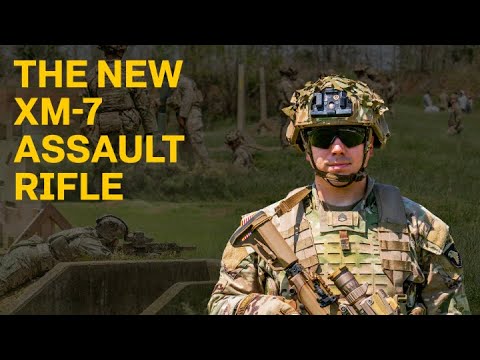
What Is the New Army XM-7 Rifle Like? | GOARMY
“The XM8 is just over 32 inches long overall, compared to 37 inches for the M7, with a barrel length dropped from 13 to 11 inches and its suppressor from 7 to 6 inches,” according to Task & Purpose, citing Sig Sauer’s product manager for rifles and suppressors Joshua Shoemaker. “Without the suppressor, the XM8 weighs 7.33 pounds while the M7 weighs 8.36 pounds. The carbine’s suppressor shaves down to 1.31 pounds from the M7’s 1.46 pounds.”
“The carbine also comes with a fixed stock after soldiers said they preferred it to the M7’s folding stock,” Task & Purpose‘s piece adds. “The carbine also has a softer butt pad and a more rigid handguard for optics and other mounted equipment.”
The XM8 builds on what the Army had originally referred to as the product-improved or PIE version of the M7. This is one of two lighter-weight versions of the rifle that Sig had on display at the Association of the U.S. Army’s (AUSA) main annual symposium last September, both of which are seen in the picture at the top of this story.
“There’s basically two combined efforts going on within the M7,” Jason St. John, senior director of strategic products for the Defense Strategies Group at Sig Sauer, told TWZ at that time. “We have a carbine version, and then we have a lightened, improved version of the M7. And so when you look at the standard M7 that’s been issued to the troops, the overall weight of the firearm was 8.3 pounds. Now, the improved M7 is 7.6 pounds, and the carbine version weighs 7.3 pounds. So we’re getting closer and closer to [a] rifle weight system similar to the M4.”
The carbine variation Sig had previously presented then had a 10-inch barrel. Past reports have said that the PIE M7 had a 10.5-inch barrel. The baseline M7 has a 13.5-inch barrel. The 5.56x45mm M4A1 has a 14.5-inch barrel and weighs 8.63 pounds (including a sling and loaded magazine), according to the Army. It should be noted that optics and other accessories add appreciable weight to any firearm. The XM157 is heavier, as well as physically larger, than the types the Army has historically issued with M4A1s.

In terms of how the PIE M7 was lightened, “there’s the upper receiver, we’ve redesigned and taken some weight out of it. We’ve lessened the barrel profile slightly to get some weight out of it,” Sig’s St. John had also told us. “We’ve done some lightening efforts within the operating system, as well as remove the folding stock hinge. By removing that hinge, we save some weight.”
The XM8’s configuration could well evolve further as early testing by operational Army units gets underway, which Task & Purpose says could happen as soon as October.
Regardless, as noted, this is not the first XM8 ‘carbine’ the Army has tried to adopt. For a time in the early 2000s, the service looked set to replace all of its existing M16 rifles and M4 carbines with a new family of 5.56x45mm rifles and carbines known collectively as the XM8, developed by famed German gunmaker Heckler & Koch.

The previous XM8 had evolved from an earlier and more ambitious Army small arms program that envisioned future soldiers carrying a single weapon that combined a compact 5.56mm gun with a highly computerized 20mm grenade launcher firing programmable ammunition. That gun, called the XM29 Objective Infantry Combat Weapon, was beset by technical and other issues. In 2004, the Army decided to pursue the rifle and grenade launcher components as separate programs. The grenade launcher evolved into a 25mm design designated the XM25 and eventually nicknamed “the Punisher.”

XM29 OICW (Objective Individual Combat Weapon) Prototype
The standalone XM8 family was based on Heckler & Koch’s G36, which the German armed forces had adopted as its standard infantry rifle in the late 1990s. However, U.S. Army officials specifically asked if the gun could be made to look “more Starship Troopers,” in reference to the 1997 film, which is a very loose adaptation of the 1959 Robert Heinlein science fiction novel of the same name, according to firearms researcher Ian McCollum, who runs the website ForgottenWeapons.com. As a result, the XM8 evolved to have a much sleeker and futuristic-looking appearance externally.

STARSHIP TROOPERS [1997]– Official Trailer (HD) | Get the 25th Anniversary 4K Ultra HD SteelBook Now
Testing of the XM8 proceeded relatively well by all accounts. Versions of guns also gained a foothold in popular culture, appearing in several video games in the 2000s. Replicas were also featured in the movies Children of Men and District 13: Ultimatum.
In the end, though, a future Army with soldiers carrying “Starship Troopers” rifles was not to be. The program was cancelled in 2005. Continually evolving requirements and domestic U.S. political factors, together with broad questions about whether the cost, not to mention the time and effort, of adopting a new standard infantry weapon was justified by the reliability and improvements the XM8 was expected to offer over the existing M16/M4 family, were key factors.

Work on the XM25 grenade launcher continued for more than another decade before that program was axed, as well. The Army is now pursuing a new futuristic grenade launcher through a program called the Precision Grenadier System (PGS).
In the late 2000s, elements of the Malaysian Armed Forces (MAF) and the Royal Malaysia Police (RMP) evaluated the XM8. The Royal Malaysian Navy’s Pasukan Khas Laut naval special warfare unit, or PAKSAL, subsequently adopted multiple variants of the gun, but on a very limited level. The extent to which those guns remain in sevice today is unclear. There are no other known users anywhere else globally. You can read more about the full story of Heckler & Koch’s XM8 here.

Rare Unicorn Gun – H&K XM8 Compact PDW
The Army’s selection and fielding of the M7 have not been entirely smooth, either. As mentioned, the rifle has been the subject of criticism in the past. Army Capt. Braden Trent drew particular attention with a presentation that slammed the rifle at the annual Modern Day Marine conference last year. That assessment was based on the findings of a report written while he was a student at the Expeditionary Warfare School, which is part of the Marine Corps University in Quantico, Virginia. Both the Army and Sig had vehemently disputed his claims, as you can read more about here.

It still remains to be seen how widespread the adoption of any variation on the M7, including the XM8 carbine, might be across the rest of the U.S. military. In February, the U.S. Marine Corps notably told Task & Purpose that the service had no intention currently of adopting a version of the Army’s new 6.8mm rifle, and would instead stick with its 5.56x45mm M27 Infantry Automatic Rifle (IAR).
“We will continue to monitor development of the M7 [Next Generation Squad Weapon rifle] to inform future requirements,” a Marine Corps spokesperson told that outlet.
In the meantime, at least some Army soldiers now look to be in line to finally carry XM8 carbines, but not the “Starship Trooper” rifles they were once promised.
Contact the author: joe@twz.com