deputy

Tiger Woods said he ‘talking to the president’ just after crash

After crashing his SUV last week in Florida, Tiger Woods took out his phone and told a deputy, “I was just talking to the president,” according to body camera footage released Thursday showing Woods’ arrest on a DUI charge.

The phone conversation was not captured on video, but Woods could be heard saying, “Thank you so much,” as he hung up and the deputy approached. It wasn’t clear if Woods was referring to President Trump, whose former daughter-in-law, Vanessa Trump, is dating Woods.

Shortly after the golfer’s March 27 arrest, Trump was asked about Woods and told reporters: “I feel so badly. He’s got some difficulty. Very close friend of mine. He’s an amazing person. Amazing man. But, some difficulty.”

The White House did not immediately respond to a request for comment on whether Trump spoke to Woods after the crash.

The footage also shows how Woods appeared to be astonished as he was handcuffed after failing a sobriety test and a video from the back of the patrol car shows the handcuffed golfer hiccupping, yawning and repeatedly appearing to nod off during the 15-minute ride.

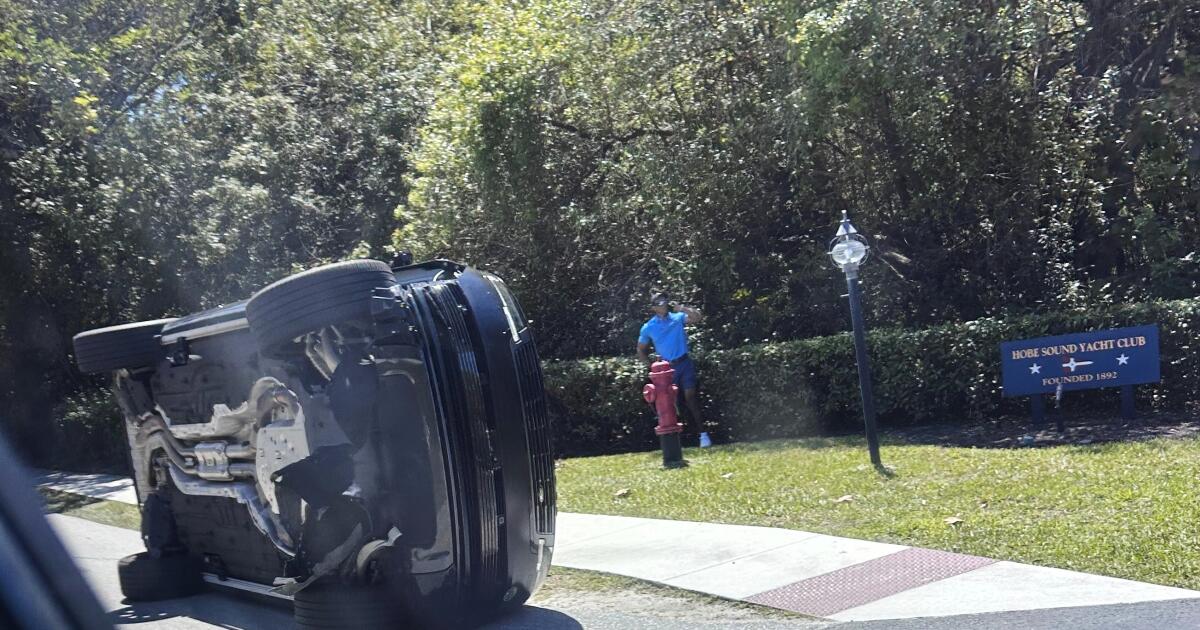
Woods told authorities he was looking at his phone and changing the radio station when his speeding Land Rover clipped the back of a truck and rolled onto its side on a residential road on Jupiter Island. No one was injured.

“I looked down at my phone, and all of a sudden — boom,” Woods told an officer as he knelt on a lawn, prior to his arrest.

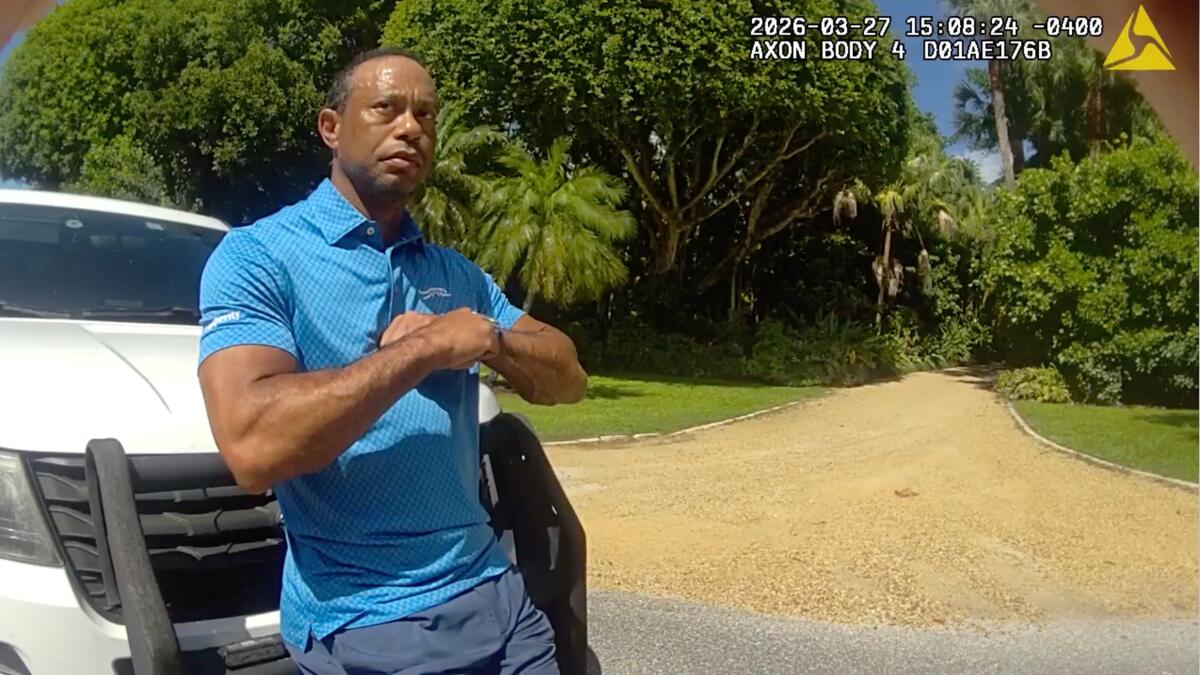
Tiger Woods performs a field sobriety test following a car crash in Jupiter Island, Fla., on March 27.

In this image from police body camera video released by the Martin County Sheriff’s Office, golfer Tiger Woods performs a field sobriety test following a car crash in Jupiter Island, Fla., on Friday.

(Associated Press)

Body camera footage shows Martin County Sheriff’s Deputy Tatiana Levenar then conducting a roadside sobriety test and telling Woods: “I do believe your normal faculties are impaired, and you’re under an unknown substance, so at this time you’re under arrest for DUI.”

“I’m being arrested?” Woods responded.

“Yes, sir,” Levenar said.

After handcuffing Woods, authorities searched his pockets and found two white pills.

“That’s a Norco,” Woods said after an officer pulled out the pills, referring to a painkiller that contains acetaminophen and the opioid hydrocodone. Authorities would later confirm that Woods was in possession of hydrocodone.

In the body camera footage, Woods told Levenar that he had not drunk any alcohol and that he had taken “a few” medications earlier in the day, though Woods’ words are muted in the released video as he describes some of the drugs.

At the sheriff’s office complex, after Woods was escorted into the “DUI room” where drivers are tested for being under the influence, Woods said, “I’m not drunk. I’m on a prescription medication,” according to a supplemental sheriff’s office report released Thursday.

Woods, 50, pleaded not guilty on Tuesday to suspicion of driving under the influence. He posted a statement Tuesday night saying that he was stepping away indefinitely “to seek treatment and focus on my health.”

Woods agreed to a Breathalyzer test that showed no signs of alcohol, but he refused a urine test, authorities said. Under a change to Florida law last year, refusing an officer’s request to take a breath, blood or urine test became a misdemeanor, even for a first offense.

During the field sobriety test, deputies noticed Woods limping and that he had a compression sock over his right knee. Woods explained he had undergone seven back surgeries and over 20 surgeries on his right leg, and that his ankle seizes up while walking.

Tiger Woods is strapped into a police vehicle after his arrest in Florida.

Tiger Woods is strapped into a police vehicle following a car crash in Jupiter Island, Fla., on Friday in image from video provided by the Martin County Sheriff’s Office.

(Associated Press)

Woods, who was hiccupping during questioning, continuously moved his head during one of the sobriety tests and deputies had to tell him several times to keep his head straight, according to an arrest report.

“Based on my observations of Woods, how he performed the exercises and based on my training, knowledge, and experience, I believed that Woods normal faculties were impaired, and he was unable to safely operate the motor vehicle,” Levenar wrote.

Woods is the most influential figure in golf and has become as recognizable as any athlete in the world. The first person of Black heritage to win the Masters in 1997, he has captivated golf fans with records likely never to be broken.

His injuries have kept him from accomplishing more, including from a 2021 Los Angeles car crash that damaged his right leg so badly he said doctors considered amputation. He has not played an official event since the 2024 British Open. He was recovering from a seventh back surgery in October and was trying to return at the Masters, where he is a five-time champion.

Rico writes for the Associated Press.

Source link

State court ruling gives cop watchdogs more teeth in records subpoenas

A recent California appellate court ruling will give civilian oversight groups the authority to subpoena the law enforcement agencies they are tasked with monitoring, a decision hailed by local advocates as a step toward greater transparency by the Los Angeles County Sheriff’s Department.

In a unanimous opinion issued Thursday, justices from the state’s first appellate district found that an oversight body in Sonoma County is legally authorized to subpoena the county sheriff’s office while probing whistleblower inquiries. The justices also directed the law enforcement agency to comply with the watchdog’s requests for records.

The Independent Office of Law Enforcement Review and Outreach sued the Sonoma County Sheriff’s Office in 2024 over refusals to comply with a whistleblower complaint subpoena. A lower court initially ruled in favor of the Sheriff’s Office, but the appellate judges reversed that decision.

Hans Johnson, chair of the Los Angeles County Civilian Oversight Commission, called the ruling a “big win” for law enforcement transparency.

“This is one of the most significant court rulings in recent CA history about oversight,” he said in a message to The Times. “It strengthens the powers of Civilian Oversight boards and Inspectors General and upholds our subpoena authority while also showcasing the strong public interest in robust, effective oversight of sheriffs, their departments, and their operations.”

The L.A. County Sheriff’s Department said in a statement that it is “discussing with County Counsel to determine the appropriate path for implementing any lawful authority granted to the Civilian Oversight Commission.”

Angelenos who have long sought records related to alleged misconduct by sheriff’s deputies also cheered the court’s decision.

Vanessa Perez’s son Joseph was badly beaten by deputies in the San Gabriel Valley six years ago. She has been fighting ever since for more clarity about what happened.

Perez said she hopes Thursday’s ruling will result in “some type of justice, some type of fairness” for her son and others who have been stymied by the Sheriff’s Department in efforts to obtain information.

“Hopefully we’ll have effective oversight at the end of this, someone other than LASD looking at Joseph’s case,” Perez said in a phone interview Monday. “Not one deputy, not one sheriff, nobody has ever brought to light what they did to Joseph.”

She has been vocal in her criticism of the agency and the fact that it has only released redacted versions of its “use of force” report from the July 2020 incident involving her son.

Perez’s case is one of several in which the Civilian Oversight Commission has tried unsuccessfully to pry records out of the Sheriff’s Department. Two other cases involved Emmett Brock, a trans man beaten by a deputy in a convenience store parking lot in 2023, and Andres Guardado, an 18-year-old fatally shot in 2020.

The commission subpoenaed unredacted files in the cases in Feburary 2025, but the county counsel’s office has argued they should remain confidential.

“L.A. County voters overwhelmingly approved Measure R in March 2020 to grant the Commission subpoena powers,” the Civilian Oversight Commission wrote in a statement. “However, six years later, it is not yet fully in effect.”

The county counsel’s office said in a statement that it “does not question the Civilian Oversight Commission’s power to issue subpoenas.”

But, it said, court decisions, the county’s Employee Relations Commission and the law “require that the County … meet and confer with labor partners about the impacts before documents are shared. Those discussions are underway.”

Hilda Eke, executive director of the L.A.-based advocacy organization Dignity and Power Now, said in a statement that the ruling is a positive development in the ongoing battle for more transparency.

“It affirms what our communities have always known: You cannot investigate injustice without the power to uncover the truth,” Eke said.

Source link

Tiger Woods failed a sobriety test, possessed opioid pills after crash

Tiger Woods failed field sobriety tests after crashing into another vehicle last week, and had bloodshot eyes and two hydrocodone pills in his pants pocket, according to a probable cause arrest affidavit released Tuesday.

Woods, 50, told investigators he did not notice the vehicle in front of him had slowed because he was looking at his cell phone and changing the radio station, the affidavit said. His Land Rover rolled onto its side after hitting a Ford-F150 pickup truck pulling a small trailer.

The prescription opioid pills were found during a search after his arrest on suspicion of driving under the influence, causing property damage and refusal to submit to a lawful test. Woods told deputies he had taken prescription medications earlier that day.

The accident and arrest occurred Friday afternoon near Woods’ home on Jupiter Island, Fla. Although Woods appeared impaired, he told deputies he had not consumed alcohol, which Martin County Sheriff John M. Budensiek said was confirmed by a breathalyzer test.

“Our DUI investigators came to the scene here, and Mr. Woods did exemplify the signs of impairment,” Budensiek said.

A Martin County Sheriff deputy noted that Woods had bloodshot and glassy eyes and extremely dilated pupils, according to the affidavit. Woods also was “sweating profusely” while performing field sobriety tests.

Asked if he had any medical conditions, the 82-time PGA Tour champion replied that he has had seven back surgeries and at least 20 leg operations. He was wearing a compression sleeve over his right knee.

“Woods’ movement was lethargic and slow,” sheriff’s deputy Tatiana Levenar wrote in the report. “While walking, I observed Woods limping and stumbling to the right.

“I asked Woods if he was able to perform tasks such as walking and lifting his leg. Woods advised he has a limp and his ankle seizes while walking.”

The affidavit also noted that “Woods had hiccups during the entire investigation.”

The crash is the fourth major incident involving Woods behind the wheel since 2009. When he was arrested on suspicion of driving under the influence in May 2017, Woods was found to have five drugs in his system, including hydrocodone and Dilaudid. Woods checked into a rehab clinic shortly thereafter and completed treatment.

Around Thanksgiving 2009, a report that Woods had been in a car accident near his home erupted into a major scandal involving allegations of affairs. It resulted in Woods’ divorce from Elin Nordegren, the mother of his children.

In 2021, Woods was seriously injured in a rollover crash near Rancho Palos Verdes the morning after the Genesis Invitational, which he hosted at Riviera Country Club. He had to be extricated from the wreckage of the Genesis GV80 SUV he was driving

Woods underwent “a long surgical procedure” on his lower right leg and ankle, according to a statement he released. Doctors inserted a rod into his leg and placed screws into his foot and ankle.

Source link

Afroman cites free speech in trial over videos mocking deputies

Afroman testified Tuesday in a civil lawsuit brought by seven members of an Ohio sheriff’s office who allege he used their likenesses without permission in music videos and on merchandise and spread lies about them after they raided his home in August 2022.

The fault, the “Because I Got High” rapper maintained, was not his. On Wednesday, the jury was deliberating the case.

The 51-year-old, whose real name is Joseph Edgar Foreman, said on the stand Tuesday that he was in the right, according to local station WCPO Channel 9 in Cincinnati.

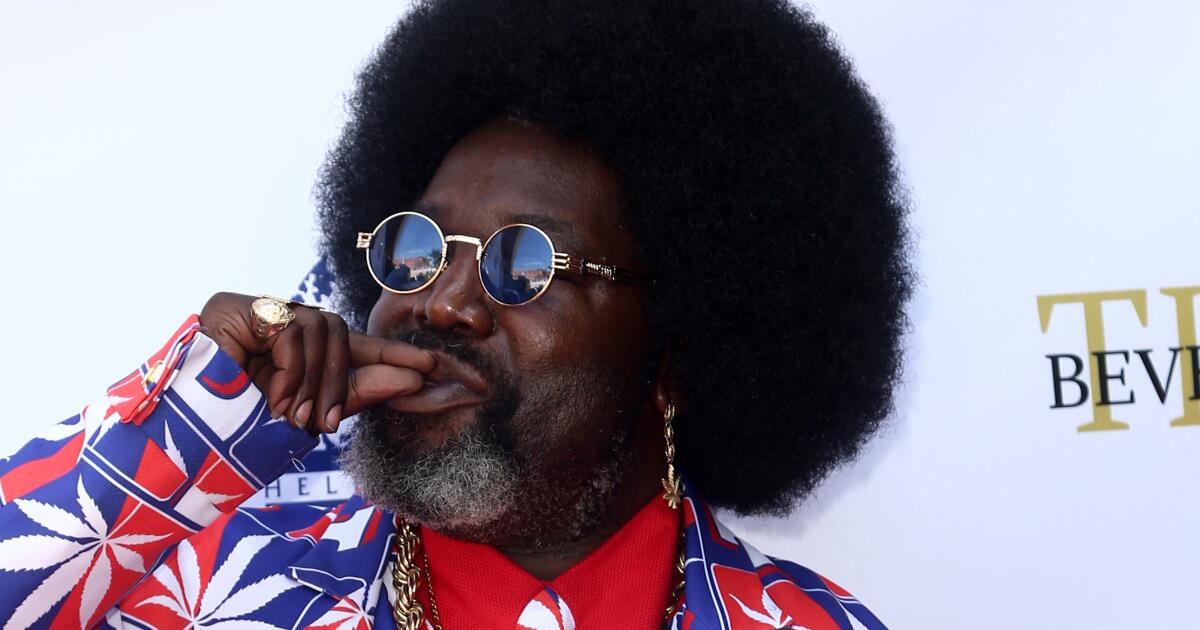
“The whole raid was a mistake. All of this is their fault,” Foreman testified, taking the stand wearing sunglasses with American flag lenses and a red, white and blue suit and matching tie made of fabric recalling the American flag. “If they hadn’t wrongly raided my house, there would be no lawsuit, I would not know their names, they wouldn’t be on my home surveillance system, and there would be no songs, nothing.”

Officers were acting in 2022 on a warrant showing probable cause that drugs and drug paraphernalia would be found on the property. The warrant also alleged that trafficking and kidnapping had happened there. No evidence of a crime was found, and no charges were filed. Foreman wasn’t home during the raid but was able to see at least part of it via a video recorded by his ex-wife and footage captured on his home security system before law enforcement turned off those cameras.

It was that footage that was used in the various videos the rapper subsequently posted, including a music video for the song “Lemon Pound Cake,” which he wrote about the raid.

Officers tore down his door, he said, and damaged his house, taking money, vape pens and a small amount of marijuana. There was a discrepancy about the amount of money taken and returned to the rapper, which seemed to be a point of contention linked to whether he was misrepresenting what the deputies did during the raid.

“After they left, I had the right to kick the can and to do what I had to do to repair the damage they brought to my house. Yes, I did,” Foreman said. “I have freedom of speech. I’m a rapper. I entertain.”

His testimony came on the second day of the trial, after the deputies took the stand the first day and testified that though the raid wasn’t perfect, Foreman had been spreading lies about them for years since it occurred. Deputy Lisa Phillips, whose gender identity had been called into question in Foreman’s videos and social media posts, cried on the stand as some of those videos were played for the court.

Footage with a song called “Licc’em Low Lisa” showed Foreman saying he thought he would “crack some musical jokes” in the wake of the raid, then going to comfort a crying actor who resembled Phillips. “I didn’t know they hurt you that bad. … I was just having fun with a bad situation.” The same video showed the actor engaging in sexual activity with another woman.

In their lawsuit, WCPO said, the deputies said the posts and videos caused them “humiliation, ridicule, mental distress, embarrassment and loss of reputation” and made it difficult to do their law enforcement work.

In an amicus brief, however, the ACLU argued that the deputies’ lawsuit was a “classic entry into the SLAPP suit genre,” referring to a type of lawsuit that seeks to discourage criticism of public officials.

Source link