MIAMI — More than 100,000 people from Ukraine and Sudan can stay in the United States without immediate risk of deportation, the Department of Homeland Security said, in what amounts to a temporary reprieve after their right to stay in the country was set to expire Monday.
Temporary Protected Status was set to end Oct. 19 for about 101,000 Ukrainians and 1,800 Sudanese. But DHS said an announcement “will be made at the appropriate time.” Until then, the department said in a written statement, Ukrainians and Sudanese in the U.S. covered by those temporary measures “retain protection.” The Department did not indicate how long they could stay or when a final announcement would be made on their status.
DHS did not respond to a question about whether they can keep their work permits, but TPS generally allows people to work while their protections remain in effect.
The decision Monday marks another incident where the Trump administration, which has previously sought to end these temporary protections from deportation and send people back to their home countries, has allowed people covered by the temporary status to stay in the country but without giving any guidance as to how long.
The context of the decisions to keep the protections
The Trump administration has already terminated TPS for more than 1 million people from 13 countries, including Venezuela, Haiti, Honduras, Nicaragua, Afghanistan and Syria.
But in a change in practice roughly a month ago, the administration kept protections in place for nearly 200,000 Salvadorans whose TPS was set to expire Sept. 9. In that case they also said that they were going to make a decision at the appropriate time and that in the meantime, people from El Salvador could continue to work and live in the U.S.
Activists and a bipartisan group of lawmakers have been raising the alarm over the upcoming deadline for TPS to expire for Ukrainians, arguing that conditions remain unsafe for them to return home amid the war with Russia.
Ukraine was first designated for TPS in April 2022, following Russia’s full-scale invasion two months earlier. The Biden administration subsequently extended the designation, most recently in January 2025, when DHS authorized an additional 18 months of protection through October 2026.
The TPS program for Sudan was established in 1997, and since then, successive U.S. administrations have extended it due to the armed conflict and political instability that have plagued the African nation.
The decision Monday comes two weeks before the Nov. 3 midterm elections, when Trump’s hard line immigration policies will face a test at the ballot box.
The TPS program has offered protections for decades but is controversial
The U.S. Congress created TPS in 1990 to prevent deportations to countries suffering from natural disasters or civil strife.
It allows people already in the country to remain and work, for renewable periods if the homeland security secretary determines conditions are unsafe for their return. But it doesn’t give them a pathway to permanent residency.
Supporters say that using this tool protects people from being returned to dangerous situations and that uprooting people covered by TPS after years of living in the U.S. is cruel. Critics, especially in the Trump administration, say successive administrations have extended these protections for years regardless of what has happened in the home countries.
Federal rules say TPS is automatically extended for six months if the secretary doesn’t make a determination at least 60 days before the designation expires.
Advocates are grateful for DHS decision, warn about the war
“We’re grateful for an extension, however temporary, for TPS holders from Ukraine and Sudan,” said Myal Greene, president and CEO of World Relief, an organization that has provided humanitarian assistance in both countries. “We encourage the administration and Congress to consider longer term relief for women, men and children trying to carve out stability while their countries of origin remain in upheaval.”
Krish O’Mara Vignarajah, president and CEO of Global Refuge, noted Ukraine and Sudan are not safe and meet the legal conditions for TPS to be extended.
“Russia’s war on Ukraine is nearing its fifth year, and Ukrainians are bracing for another winter under drone and missile strikes, driving civilian casualties and devastating critical infrastructure. Sudan remains locked in a brutal civil war marked by famine, widespread human rights abuses and the hallmarks of genocide,” Vignarajah said. “It is not safe for these families to go home.”
Salomon writes for the Associated Press. AP reporter Rebecca Santana contributed to this report from Washington.
Kuala Lumpur, Malaysia – The phone hasn’t stopped ringing in recent days. Raf*, a leader of refugees from Myanmar who are living in Malaysia, receives more than 100 calls a day, and they follow a common pattern.
“They are crying, asking me to do something,” Raf told Al Jazeera.
The Malaysian government on Tuesday deported nearly 1,500 refugees, part of its stated plan to send back at least 5,000 refugees as part of a deal with the military government of Myanmar. That move, from a country that had long taken in the refugees, has sparked fear among the tens of thousands of other refugees from Myanmar in the country, who have one question at the top of their minds: Who might be next?
The deportation was carried out during escalating raids on refugee communities by immigration officials, which have led to the detention of more than 50,000 refugees this year alone. Those working with refugees in Malaysia said the frequency of the raids has increased since June when Prime Minister Anwar Ibrahim announced the repatriation agreement with Myanmar.
“[We’ve seen] a sharp increase. Raids are happening every single day. There’s up to 50 raids or more happening every day,” said Heidy Quah, founder and executive director of the Malaysian nonprofit Refuge for the Refugees.
Minister of Home Affairs Saifuddin Nasution told local media that the government has conducted more than 9,700 such operations from the beginning of this year until September 17. That’s an average of 37 operations a day.
There are now more than 10,000 Myanmar nationals in Malaysia’s immigration depots, according to the Ministry of Home Affairs.
In all, Malaysia is home to more than 215,000 refugees, according to the Office of the United Nations High Commissioner for Refugees (UNHCR). Nearly 194,000 are from Myanmar. There are more than 126,000 Rohingya refugees in Malaysia, where they have been the target of widespread hate speech on social media in recent months. Apart from the Rohingya, the Myanmar refugees in Malaysia include nearly 16,000 from the Chin community and 33,000 from other Myanmar communities. The non-Myanmar refugees in Malaysia include small numbers of Pakistanis, Yemenis, Somalis, Afghans, Syrians, Sri Lankans, Palestinians and Iraqis.
The Myanmar refugee community in Malaysia has yet to identify any Rohingya among the first nearly 1,500 people deported on Tuesday, community leaders told Al Jazeera. Instead, many are from Myanmar’s other ethnic minorities, who are more likely to have valid national identification documents, community leaders said.
“The Rohingyas are a problem for deportation because Myanmar denies their citizenship,” Raf said. “So I don’t think that Myanmar will agree and accept all those Rohingyas.”
Myanmar officially treats the Rohingya as Bangladeshi immigrants despite the community’s long roots in Myanmar and their distinct ethnic identity. The Myanmar army has repeatedly cracked down on the Rohingya minority, including a wave of violence in 2017 that many rights groups have described as genocide. It set off a major refugee crisis when hundreds of thousands of Rohingya fled to Bangladesh, Malaysia, India and other neighbouring nations.
Myanmar community leaders also said the raids this year appear to have targeted locations highlighted in anti-refugee videos on social media in which content creators filmed refugee-populated areas, portraying them as hubs of chaos. These videos have been shared thousands of times on platforms such as Threads, TikTok and Facebook.
Al Jazeera contacted the Immigration Department to verify the link between the videos and raids but had not received a response at the time of publication. Accounts that had posted and shared antirefugee sentiment also did not respond to requests for comment.
Decline in resources
The increase in hostilities towards refugees in Malaysia coincides with a sharp decline in the capacity of local and international aid groups to support them, especially since the closure of the United States Agency for International Development in July 2025.
In Malaysia, this severely shrank resources for organisations helping refugees with basic needs, such as healthcare, Quah told Al Jazeera.
“Then slowly, United Nations organisations were being defunded, and even within the UN High Commissioner for Refugees in Malaysia, they lost a lot of staff,” Quah said. The job cuts reflected global retrenchments by UNHCR last year.
The agency continues to struggle with a funding crisis, saying on Tuesday that it faces a $5.79bn funding gap and, as of July, has received 32 percent of the funds it needs this year.
In Malaysia, this has led to even less protection for refugees and higher rates of exploitation, Quah said.
“Even UNHCR cardholders are arrested and remanded for about 14 days [while the] cards are verified,” she said.
For instance, an asylum-seeking woman who had scheduled an appointment to meet UNHCR representatives this month was recently detained, and immigration authorities demanded a letter from the organisation to prove that she was an asylum seeker, Quah said.
Although UNHCR confirmed the woman was seeking asylum, she remains in detention, Quah said.
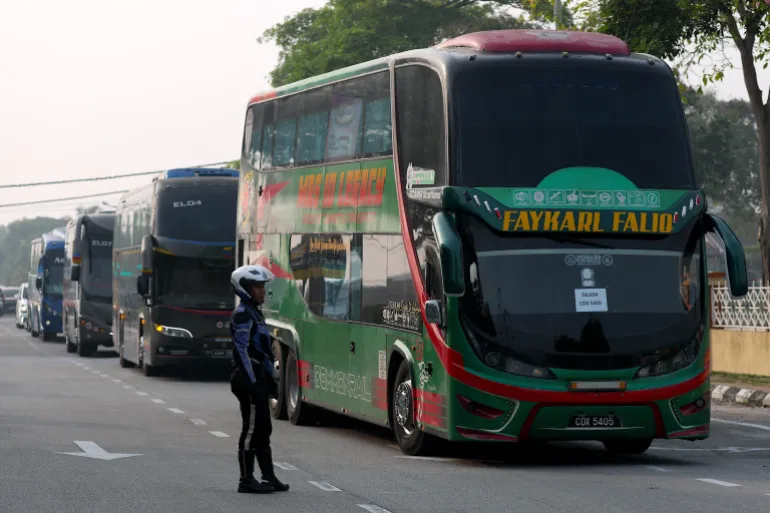
An initial group of 1,476 people from Myanmar are deported from Malaysia on September 29, 2026, first my bus and then by Myanmar navy ships [Fazry Ismail/EPA]
Ongoing violence in Myanmar
UNHCR and rights groups in Malaysia have urged the Malaysian government to stop the deportations as violence continues in Myanmar.
A day before Malaysia’s deportation of the refugees on Tuesday, an air strike by Myanmar’s military was reported to have killed at least 33 people in Rakhine state, the historical home of the Rohingya. The Arakan Army group said the victims included vendors, shoppers and pedestrians. In June, the UN said Myanmar’s military was responsible for more than 700 civilian deaths over a six-month election period that started in August last year.
The Human Rights Commission of Malaysia (SUHAKAM) said that while Malaysia is not a party to the Refugee Convention of 1951, the principle of nonrefoulement has become part of customary international law and Malaysia, therefore, is bound to abide by it. The principle protects people from being returned to a place where they face a real risk of persecution, torture or other serious harm.
Particular attention should also be given to children, SUHAKAM said, highlighting that Tuesday’s deportation included 27 children, some reportedly as young as eight years old.
“No child should be returned to danger. Their safety, dignity and best interests must come first,” it said.
Myanmar community leaders in Malaysia told Al Jazeera the ships that departed on Tuesday will arrive in Yangon on Sunday.
“After that, we will [learn] whether they are allowed to leave the port safely [or are detained],” said one community leader who requested anonymity due to the increase in violence towards refugees in Malaysia.
Still, even those who are allowed to leave the port may need to spend months or years in Yangon because it is unsafe to travel across the country, the community leader said.
Rohingya refugees face evictions from their homes in Malaysia amid rising local tensions and online misinformation [File: Hasnoor Hussain/Reuters]
Call for independent access
Rights groups further criticised the Malaysian government’s framing of the deportations as “voluntary”, saying individuals should have sufficient information about conditions in their home countries before making such a decision.
“While authorities say the returns are voluntary, those returned had been held in immigration detention. This raises serious questions about whether decisions to return were genuinely free and informed,” UNHCR Assistant High Commissioner for Protection Edem Wosornu said.
The Malaysian government said people were selected for deportation based on a list of names shared by the Myanmar government in an official diplomatic note.
“Such [a] ‘voluntary’ decision must be determined by an independent authority, such as the UNHCR, and not by the Immigration Department,” SUHAKAM said .
UNHCR told Al Jazeera that it was not involved in the latest return process and did not have access to the individuals concerned. “[We were,] therefore, not in a position to independently ascertain the voluntariness of their decisions to return,” it said.
“We continue to encourage the government to ensure that return processes include individual assessments, access to protection procedures and safeguards to ensure that any decision to return is free, informed and genuinely voluntary,” it said.
Malaysian Prime Minister Anwar Ibrahim has long positioned himself as a champion of human rights but now faces criticism for the expulsion of Myanmar refugees [File: Rafiq Maqbool/AP]
Malaysia registering refugees
The deportations come at a time when Malaysia is simultaneously positioning itself as welcoming to refugees and their needs.
In 2015, the Malaysian government launched a Refugee Registration Document (DPP) programme. On paper, it is supposed to help register refugees, giving them official documentation.
Raf welcomed the DPP as long as the registration and documentation of refugees in Malaysia leads to access to work, education and healthcare.
“If these three things are provided, I think that’s a good solution for temporary refugees staying here.”
But the Malaysian branches of Amnesty International and Asylum Access said the latest deportations raise profound concerns about the purpose of the DPP. The programme should not be used to fast-track unlawful deportations, the groups said in a joint statement.
*Name changed to protect the individual’s identity
U.S. Immigration and Customs Enforcement has stopped publicly revealing where it is holding thousands of detainees who are subject to final deportation orders, an unannounced move that has made it far more difficult for lawyers and relatives to find them, according to current and former officials familiar with the practice.
ICE removed those detainees from its online detainee locator system on Sept. 15, according to three current and former ICE officials who spoke on condition of anonymity because they were not authorized to discuss the change. Several lawyers contacted by The Associated Press confirmed their clients vanished from the system this week, and the American Immigration Lawyers Association warned its members about the situation Friday.
The move represents a stark departure from previous practice and highlights the hardline nature of President Trump’s immigration crackdown, leaving thousands of detainees exceedingly hard to trace and potentially unable to exercise all of their legal options.
The practice, which applies to detainees who have received final orders of removal from an immigration court, could speed deportations by making last-minute legal challenges harder to pursue, immigration lawyers said. Nearly 16,000 people who were arrested and booked into ICE detention in July were subject to final removal orders, more than a third of the overall bookings, according to ICE data obtained by the Deportation Data Project based at U.C. Berkeley and UCLA.
The practice does not apply to detainees held at a detention facility in Adelanto, California or at temporary holding facilities in Minneapolis, New York City or suburban Chicago, the sources said. Judges have ordered ICE to list detainees in those facilities in the online locator promptly upon their arrival, as part of litigation over their detention practices.
Lawyers and relatives distressed by lack of information on detainees
The effort to hide their locations adds to the ways in which the Trump administration has made life harder for detainees and their families as it has increased pressure on them to waive appeals and agree to deportation.
ICE did not publicize the move and in a statement issued to the AP, the agency did not confirm or deny it. The statement said detainees with final removal orders were being prioritized for deportation, even as ICE faces a “historic number of injunctions” from courts stopping individual removals.
As a result of the change, lawyers and relatives lost track of their clients and loved ones without explanation, which is especially concerning because detainees are frequently moved to new facilities before deportation, said Greg Chen, senior director of government relations at the American Immigration Lawyers Association.
“Families are freaking out because they think the person has been deported and they don’t know where the person might be,” he said. “On the attorney side, this has serious implications for the ability to contact their client. It certainly has implications about how it will interfere with the attorney-client relationship.”
The Department of Homeland Security, ICE’s parent agency, has argued that people who are subject to final removal orders have received due process. That usually means an immigration judge has ordered their removal after a hearing, including cases when immigrants fail to show up, and the decision was affirmed on appeal or not appealed.
Detainees with final removal orders still have options to appeal
Still, those detainees have options to challenge their detention and removal, including seeking to reopen the case or by bringing what’s known as a habeas petition asking a judge to release them on constitutional grounds. Federal judges have granted thousands of rulings ordering that detainees be released or granted bond hearings.
ICE detention facilities held more than 65,000 people as of early July, the most recent available data. Around 30% of them likely have final removal orders, said Michelle Mendez, legal director at the National Immigration Project.
More people have been issued final removal orders after failing to show up for hearings in recent months because the administration’s immigration courts have taken steps to make it harder to participate and to reopen such cases, she said.
“To me, it’s just another iteration of disappearing people,” she said. “Why would we do that in the United States of America? It’s something we’d hear about in another country and be concerned about individual rights and due process.”
Some with final removal orders also have legal protections against deportation to their countries of origin based on the likelihood they would be tortured or persecuted. Many of them are facing removal to third-party countries where they have no ties and their disappearance in ICE’s system will make legal challenges harder, lawyers said.
Lawyers say clients have vanished from ICE locator system
ICE initiated the online detainee locator system in 2010 to allow relatives, lawyers and the public to search for people in custody. Previously they had to call ICE regional offices or individual facilities to try to track them down.
Many advocates and lawmakers have complained that the system updates too slowly and contains too much inaccurate or missing information, allowing ICE to shield the locations of detainees for days or weeks. Minors, people who have been held by U.S. Customs and Border Protection for less than 48 hours, and detainees who are being transported are not in the system, among others.
But the exclusion of detainees with final removal orders has no apparent parallel, several immigration lawyers said. Atenas Burrola Estrada, a deputy program director with the Amica Center for Immigrant Rights, said that “every single one of our clients who has a final order has disappeared from the locator,” including 17 in all as of Monday.
Among those disappeared from the locator system are eight Somali men being detained at the U.S. military base in Guantanamo Bay, Cuba, according to one of their attorneys, My Khanh Ngo, of the American Civil Liberties Union. She said the change could make it “nearly impossible” for people to challenge their removals in some cases.
“If you can’t find your client, don’t know what’s happening to your client, you can’t get that information to the court to stop their removal,” she said.

![Rohingya refugees facing evicted from their homes amid rising local tensions and online misinformation, Kuala Lumpur, Malaysia, July 27, 2026 [Hasnoor Hussain/Reuters]](https://i0.wp.com/occasionaldigest.com/wp-content/uploads/2026/10/2026-07-27T123715Z_206813602_RC2BMMA6AR5R_RTRMADP_3_MALAYSIA-REFUGEE-1787872480.jpg?w=640&ssl=1)